Registering a Bahrain Company from France
French founders should plan the Bahrain setup together with French tax residence, document translation, bank compliance, and where the company will actually be managed. Bahrain can be attractive for GCC access and foreign ownership, but French tax advice is important before relying on a Bahrain structure.
For the full Bahrain process, see company formation in Bahrain. For banking, see business bank account in Bahrain.
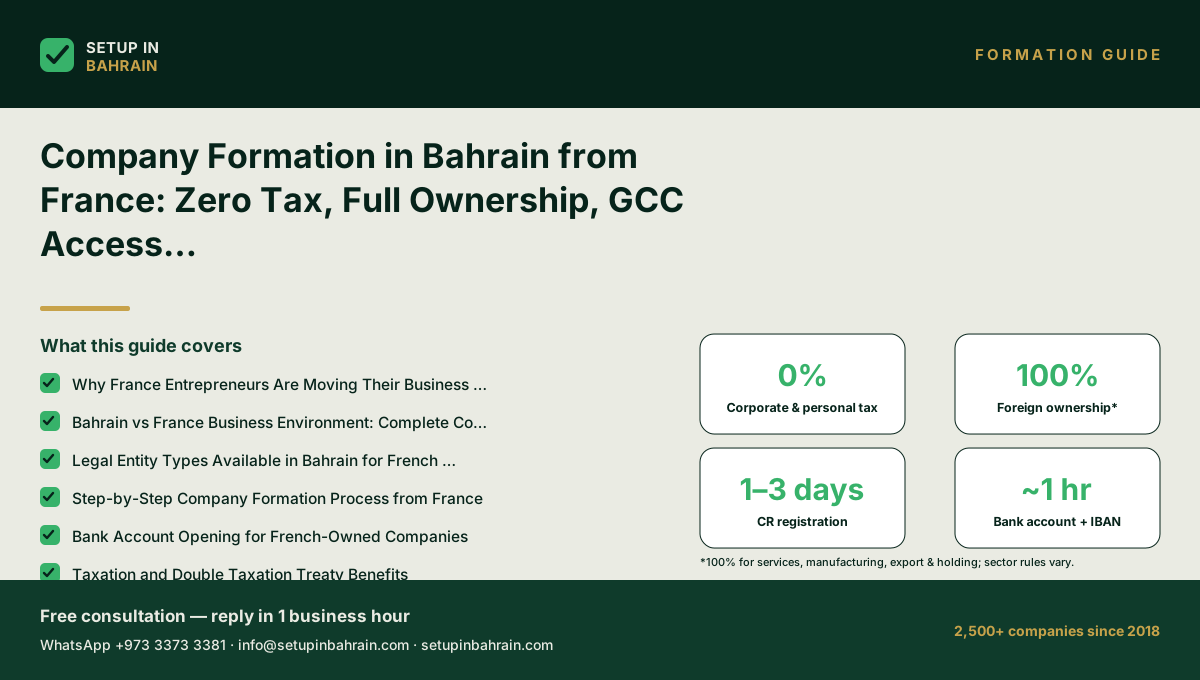
Form your Bahrain company from France with generally no corporate income tax for most sectors. Fast registration, full foreign ownership & easy process for French entrepreneurs.
Key Takeaways
- Why France Entrepreneurs Are Moving Their Business to Bahrain
- Bahrain vs France Business Environment: Complete Comparison
- Legal Entity Types Available in Bahrain for French Citizens
- Step-by-Step Company Formation Process from France
- Bank Account Opening for French-Owned Companies
→ Complete guide: Company Formation in Bahrain — the full 2026 guide
View details
Ownership & capital
A Bahrain WLL can be owned by a single person — 100% foreign ownership applies to most activities, with no local partner required for services, manufacturing, export trading and holding companies. The minimum share capital is BHD 1 ; we recommend BHD 1,000 . This Makes bank account opening and investor visa approval smoother.
Pierre runs a SaaS company from Lyon. Last year, his business generated €420,000 in profit. After paying impôt sur les sociétés at 25%, then dividend tax at 30% flat rate plus social contributions, he took home roughly €210,000. Half gone—evaporated into the French fiscal machine before he could reinvest a single euro into product development or market expansion.
This year, Pierre restructured through Bahrain. Same revenue. Same clients. Same work. His effective tax bill dropped to near zero on retained earnings. His repatriated dividends face only the French flat tax—with no double taxation thanks to the France-Bahrain treaty signed in 1993. He's now reinvesting €150,000 more annually into hiring developers and expanding into Saudi Arabia.
Pierre isn't unique. French entrepreneurs—especially in tech, consulting, e-commerce, and trading—are discovering what the Gulf has offered for decades: a legitimate, OECD-compliant jurisdiction with zero corporate income tax, full foreign ownership since 2001, and a 25-kilometer bridge to the world's most ambitious economy.
This guide walks you through every step of forming a Bahrain company as a French citizen, from understanding precisely why you're paying too much in France to opening your bank account in Manama and hiring your first employee.
Why France Entrepreneurs Are Moving Their Business to Bahrain
The exodus isn't sudden. It's calculated, rational, and accelerating.
French entrepreneurs have spent decades accepting that high taxation is simply the price of operating in a developed economy. The implicit bargain was clear: you pay more, but you get infrastructure, educated workers, and market access. Except that bargain has cracked under its own weight.
Between 2020 and 2025, French SME owners faced consecutive shocks—COVID-era cotisations sociales that kept climbing even as revenues collapsed, energy costs that tripled overnight, and a regulatory environment that added compliance burden after compliance burden without removing old ones. The DSN (Déclaration Sociale Nominative) alone requires monthly payroll reporting so granular that hiring a single freelancer triggers a cascade of paperwork lasting weeks.
Let me paint you a picture that might feel uncomfortably familiar.
Philippe ran a mid-sized IT consulting firm in Paris for 12 years. Revenue: €2.8 million annually. Profits looked decent on paper. But when he finally calculated his effective tax burden at the end of 2024—including the 25% corporate income tax, the CVAE (contribution on business value added), the CET (territorial economic contribution), plus the cascading effect of TVA administrative costs and his expert-comptable fees—he realized he was sending nearly 48% of his net profit to various government agencies. Not in headlines, but in silent, compounding friction that bled his business dry.
Then there was his expansion attempt into Saudi Arabia. A distributor offered a €900,000 licensing deal if Philippe could provide Arabic-speaking technical support. Hiring two qualified support staff in France would have added €180,000 in annual labor costs—but the cotisations sociales pushed the true cost to €315,000. The math simply didn't work from Paris.
The Numbers That Force the Decision
Take a typical founder in Lyon running a B2B SaaS company with €1.8 million in annual revenue. Here's what the French fiscal environment actually extracts:
Corporate Income Tax (IS): 25% on profits above €42,500 (the reduced 15% rate applies only to the first €42,500 for qualifying PMEs). On €500,000 in profit, that's roughly €120,000 directly to the state.
Cotisations Sociales: This is where France becomes genuinely punishing. For a technical employee earning €55,000 gross salary, employer contributions add between 40% and 80% depending on the sector and specific regime. That €55,000 developer actually costs €77,000 to €99,000 when you include the charges patronales. Scale that across a seven-person team. You're burning €300,000 or more annually just on social charges—money that could fund product development, marketing, or expansion.
TVA Administration: France requires monthly TVA declarations for businesses above €254,000 in annual revenue for services. Each declaration requires reconciliation, verification, and submission. The administrative burden alone consumes 8-12 hours monthly for most SMEs, plus expert-comptable fees averaging €300-600 per monthly filing when you factor in their time.
URSSAF Complexity: Registering with URSSAF isn't a one-time event. It's an ongoing relationship requiring quarterly declarations, annual reconciliations. Instant reporting of any change in employment status. Missing a deadline triggers automatic penalties starting at €750 per infraction.
DSN Reporting: The Déclaration Sociale Nominative requires employers to report every payroll event monthly—hires, terminations, sick leave, salary changes, bonuses, everything. A single error cascades into corrections that can take months to resolve with multiple agencies at once.
For the Lyon founder we mentioned, the combined burden means roughly 11 hours every month spent on URSSAF correspondence alone. Not building. Not selling. Corresponding.
What French Entrepreneurs Actually Want
When I speak with French founders considering Bahrain, their motivations cluster around four consistent themes:
Tax efficiency, obviously. But it's not greed—it's survival math. When your competitor in Singapore or Dubai operates at a 15-20 percentage point tax advantage, you're not competing on equal terms. You're handicapped before you begin.
Administrative simplicity. French entrepreneurs don't want to spend their cognitive energy on compliance. They want to build products, serve customers, and grow. The mental load of French bureaucracy is genuinely exhausting in ways that don't show up on financial statements.
Regional market access. The Gulf Cooperation Council represents 60 million consumers with the highest per-capita GDP concentration on Earth. Saudi Arabia alone is implementing a $3.2 trillion economic transformation. Being physically present in the region—with a real company, real bank accounts. Real commercial relationships—opens doors that remote selling simply cannot.
Respect for entrepreneurship. This sounds soft, but it matters. In Bahrain, business formation is designed to be easy because the government genuinely wants entrepreneurs to succeed. The Economic Development Board (EDB) assigns dedicated relationship managers to foreign investors. Officials respond to emails within 24 hours. The contrast with French administrative culture—where entrepreneurs are often treated as tax-extraction opportunities rather than economic drivers—is stark and immediately noticeable.
Bahrain vs France Business Environment: Complete Comparison
Understanding the magnitude of difference requires side-by-side analysis. This isn't marginal optimization—it's a fundamentally different operating environment.
Corporate Taxation
France: 25% corporate income tax rate on profits exceeding €42,500. Small businesses qualifying for the PME regime pay 15% on the first €42,500. Most scaling companies quickly exceed this threshold. Also, the CVAE (Cotisation sur la Valeur Ajoutée des Entreprises) applies to businesses with revenue above €500,000, adding another 0.75% to 1.5% depending on turnover.
Bahrain: 0% corporate income tax for most businesses. The only exception is a 46% tax specifically on oil and gas exploration companies—which represents perhaps 0.1% of new business formations. For technology companies, consultancies, trading firms, e-commerce businesses. Virtually every sector French entrepreneurs actually operate in, the rate is zero. Not reduced. Zero.
This isn't a temporary incentive or a special economic zone trick. It's the standard rate, applicable to all qualifying companies, with no sunset clause and no clawback provisions.
Labor Costs and Social Charges
France: Employer social contributions (cotisations patronales) add 40-80% to gross salary depending on sector, employee status. Specific benefit requirements. A software developer earning €60,000 gross costs the employer €84,000 to €108,000 annually when all charges are included. This doesn't count mandatory profit-sharing (participation) for companies above 50 employees, supplementary pension contributions, or training levies (contribution à la formation professionnelle).
Bahrain: Social insurance contributions exist but are dramatically lower. Employers pay 12% of basic salary to the Social Insurance Organization (SIO) for Bahraini employees, capped at BD 4,000 monthly salary. For expatriate workers—which most French-owned companies initially hire—the contribution is just 3% for employer and 1% for employee, covering occupational hazards only.
A developer earning BD 2,000 monthly (about €4,900) costs the employer BD 2,060 including all social contributions for expatriates—roughly 3% overhead versus 40-80% in France.
Value-Added Tax
France: TVA at 20% standard rate, with reduced rates of 10%, 5.5%, and 2.1% for specific categories. Monthly declarations required above €254,000 turnover for services. Quarterly option available for smaller businesses but with strict conditions. Récupération (input VAT recovery) requires meticulous documents and often triggers audits.
Bahrain: 10% VAT rate, introduced in 2019, with mandatory registration only above BD 37,500 (about €92,000) annual turnover. Optional registration below BD 18,750 threshold. Quarterly filing standard, with straightforward online submission through the National Bureau for Revenue (NBR) portal. The system was designed recently with modern compliance in mind—no legacy complexity, no arcane exceptions, no Byzantine interpretation disputes.
For businesses below the registration threshold, no VAT compliance exists whatsoever.
Business Formation Process
France: Forming a SAS (Société par Actions Simplifiée) or SARL (Société à Responsabilité Limitée) requires notarized statutes, bank deposit certification, publication in a Journal d'Annonces Légales, registration with the Centre de Formalités des Entreprises, INSEE registration for SIRET/SIREN numbers, URSSAF registration, and depending on activity, various sector-specific licenses. Timeline: 2-6 weeks under optimal conditions, with costs between €1,500 and €4,000 including professional fees.
Bahrain: Company formation through the Sijilat online portal takes 48-72 hours for standard WLL (With Limited Liability) structures. Documents requirements are minimal—passport copies, business plan summary, proposed activities, and proof of address. No notarization required. No mandatory local partner since 2001. No publication requirements. Total government fees for a typical commercial registration: BD 150-300 (€370-740) depending on activities selected.
Ownership Restrictions
France: No foreign ownership restrictions per se, but practical barriers exist. Bank account opening for non-resident directors can take months. Registered office requirements demand a genuine French address. Director liability rules under French commercial code create personal exposure that many foreign entrepreneurs find uncomfortable.
Bahrain: 100% foreign ownership permitted in most sectors since the Commercial Companies Law amendment of 2001. Foreign investors have identical rights to Bahraini nationals for company formation, property ownership within designated areas. Profit repatriation. The only restricted sectors requiring majority Bahraini ownership are specific activities like local newspapers, Islamic pilgrimage services. Certain agricultural activities—none of which affect typical French entrepreneurs.
Comparative Table: France vs Bahrain
| Factor | France | Bahrain |
| Corporate Tax Rate | 25% (15% on first €42,500 for PMEs) | 0% |
| Employer Social Contributions | 40-80% of gross salary | 3% for expats, 12% for locals |
| VAT Rate | 20% standard | 10% |
| VAT Filing Frequency | Monthly above €254K | Quarterly |
| Company Formation Time | 2-6 weeks | 48-72 hours |
| Formation Cost | €1,500-4,000 | €370-740 |
| Foreign Ownership | 100% (with practical barriers) | 100% (no barriers) |
| Minimum Capital | €1 (SAS), none specified (SARL) | BD 50 (≈€125) for WLL |
| Annual Reporting | Extensive (liasse fiscale, annexes) | Simplified CR renewal |
| Double Tax Treaty with France | N/A | Yes (1993) |
Legal Entity Types Available in Bahrain for French Citizens
Bahrain offers several corporate structures, each suited to different business models, scales, and operational requirements. Understanding the distinctions prevents costly restructuring later.
WLL (With Limited Liability Company)
The WLL is Bahrain's equivalent of the French SARL—a limited liability company suitable for most small to medium operations. It's the default choice for French entrepreneurs entering Bahrain.
Key characteristics:
- a single shareholder (one person can own 100%) (individuals or corporate entities)
- Minimum capital: BD 50 (about €125) for general commercial activities
- Limited liability protection identical to French SARL
- 100% foreign ownership permitted
- No residency requirement for shareholders or directors
- Suitable for trading, consulting, technology, professional services
Practical consideration: Many French entrepreneurs initially balk at the two-shareholder requirement, having operated as single-member SAS or EURL in France. The solution is straightforward: your second shareholder can be a spouse, family member, or a holding company you control. The shareholding split can be 99%/1%, maintaining effective single control while satisfying the legal requirement.
single-shareholder WLL
Introduced to accommodate entrepreneurs preferring sole ownership structures, the WLL allows a single natural person or corporate entity to form a limited liability company.
Key characteristics:
- Single shareholder permitted
- Minimum capital: BD 50
- Same limited liability protection as WLL
- Slightly higher annual fees than WLL
- Cannot have subsidiaries (if shareholder is a natural person)
Practical consideration: The WLL is ideal for consultants, freelancers, and solo entrepreneurs who want straightforward ownership. But, if you anticipate taking on investors or partners later, starting with a WLL provides more flexibility for share transfers.
Closed Joint Stock Company (BSC Closed)
For larger operations or those planning significant capital raises, the BSC (Bahraini Shareholding Company) Closed offers a structure analogous to a non-public limited company.
Key characteristics:
- Minimum capital: BD 250,000 (about €615,000)
- a single shareholder (one person can own 100%), maximum 50
- Board of directors required (minimum three members)
- Annual audited financial statements mandatory
- Suitable for larger operations, real estate holding, financial services
Practical consideration: Most French SMEs don't need this structure. It's designed for substantial operations—regional headquarters, investment holding companies, or businesses preparing for eventual public offering. The compliance requirements and capital requirements make it excessive for typical €1-5 million revenue businesses.
Branch Office
French companies can establish a branch in Bahrain without forming a separate legal entity. The branch operates as an extension of the parent company.
Key characteristics:
- No separate legal personality—parent company bears full liability
- No capital requirements
- Must appoint a local representative
- Suitable for project-based work, market testing, or government contracts requiring local presence
- Profits attributed to branch are taxed at 0% in Bahrain
Practical consideration: Branches work well for French companies wanting to test the Bahrain market before committing to a full subsidiary. They're also useful for construction projects, consulting engagements, or any time-limited activity where forming a complete WLL seems excessive.
Representative Office
The most limited structure, suitable only for market research, liaison, and promotional activities.
Key characteristics:
- Cannot conduct commercial activities or generate revenue
- Cannot sign contracts in Bahrain
- Useful only for market exploration and relationship building
- Minimal setup requirements
Practical consideration: Representative offices are rarely appropriate for entrepreneurs. If you're actually going to do business—invoice clients, sign contracts, employ staff—you need a WLL or branch.
Recommended Structure for Most French Entrepreneurs
For the typical French entrepreneur—running a technology company, consulting practice, e-commerce operation, or trading business—the WLL with 100% foreign ownership is almost always the correct choice.
It offers:
- Full limited liability protection
- Minimal capital requirements
- Complete foreign ownership
- Flexibility for future restructuring
- Acceptance by Bahraini banks for account opening
- Credibility with regional clients and partners
The WLL is a viable alternative for solo consultants who genuinely prefer single ownership. The WLL's flexibility advantages typically outweigh the minor administrative inconvenience of nominal second shareholder.
Step-by-Step Company Formation Process from France
Forming a Bahrain company as a French resident follows a logical sequence. The entire process can be completed remotely, though many entrepreneurs find value in visiting Bahrain at least once during setup.
Phase 1: Preparation and Planning (Week 1)
Define your business activities. Bahrain's commercial registration system categorizes businesses by specific activity codes. You'll select from a list during registration, and your chosen activities determine licensing requirements and permitted operations. Be comprehensive—adding activities later requires amendment fees and processing time.
For a typical French technology company, relevant activities might include:
- Computer software development
- Information technology consulting
- Electronic commerce services
- Data processing and hosting
- Management consulting
Determine your structure. Based on the analysis above, select WLL for most situations. Confirm your second shareholder if needed—this can be a family member with a 1% stake or a holding company.
Gather personal documents:
- Valid passport (minimum 6 months validity)
- Proof of current address (French utility bill or bank statement, translated if necessary)
- CV or professional biography
- Bank reference letter from your French bank
- Passport-size photos (white background)
Prepare corporate documents (if parent company involved):
- Certificate of incorporation
- Memorandum and articles of association
- Board resolution authorizing Bahrain subsidiary formation
- Certificate of good standing
- All documents must be notarized, apostilled, and translated into Arabic/English by certified translator
Phase 2: Reserve Company Name and Initial Application (Week 1-2)
Name reservation. Through the MOIC (Ministry of Industry and Commerce) Sijilat portal, reserve your proposed company name. The name must:
- Not duplicate existing registered names
- Include legal structure designation (WLL, WLL, etc.)
- Not contain restricted words (bank, insurance, royal, etc.) without special approval
- Arabic translation required for official registration
Name reservation costs BD 10 and remains valid for 60 days.
Initial application submission. Via the Sijilat portal, submit:
- Completed application form
- Shareholders' passport copies
- Proposed memorandum of association
- Activity descriptions
- Registered office address (can be virtual office initially)
The portal is genuinely user-friendly—designed in the last decade rather than retrofitted from paper systems. English interface available throughout.
Phase 3: Documents and Approval (Week 2-3)
Memorandum and Articles drafting. While templates are available, consider engaging a Bahraini legal advisor to customize your constitutional documents. Key provisions to address:
- Share capital structure and classes
- Director appointment and removal procedures
- Dividend distribution policies
- Share transfer restrictions (if any)
- Deadlock resolution mechanisms
MOIC review. The Ministry reviews your application for completeness and compliance. Standard processing takes 2-3 business days. Complex applications or unusual activities may require additional clarification.
Activity-specific licensing. Certain activities require supplementary approvals:
- Financial services: Central Bank of Bahrain (CBB) license
- Healthcare: National Health Regulatory Authority (NHRA)
- Education: Ministry of Education
- Food services: Ministry of Health
- Construction: Ministry of Works
For most technology, consulting, and trading activities, no additional licensing is required beyond the standard commercial registration.
Phase 4: Registration and Certificate Issuance (Week 3)
Capital deposit. Unlike France, Bahrain doesn't require pre-formation capital deposit in a blocked account. You can form the company first, then capitalize it. This eliminates the frustrating circularity French entrepreneurs know well—needing a bank account to deposit capital. Needing capital deposit proof to form the company.
Commercial Registration (CR) issuance. Upon approval, MOIC issues your Commercial Registration certificate—the foundational document proving your company's legal existence. This certificate includes:
- Company name in Arabic and English
- CR number (your company's unique identifier)
- Registered address
- Authorized activities
- Shareholder information
Municipal license. Depending on your registered address location, you'll get a municipal operating license from the relevant municipality. This is typically processed at once with the CR.
Phase 5: Post-Formation Compliance (Week 3-4)
Social Insurance Organization (SIO) registration. If you plan to employ staff, register with SIO for social insurance contributions. This process takes 1-2 days and requires:
- CR certificate copy
- Company memorandum
- Specimen signature of authorized signatories
VAT registration (if applicable). Companies exceeding BD 37,500 annual turnover must register for VAT with the National Bureau for Revenue. Registration is online through the NBR portal and completes within 5 business days.
Labour Market Regulatory Authority (LMRA) registration. For hiring expatriate workers, register with LMRA to get work permit authorization. This enables future visa applications for employees.
Phase 6: Bank Account Opening (Week 4-6)
This step deserves special attention as it's often the most time-consuming element for foreign entrepreneurs.
Bank Account Opening for French-Owned Companies
Banking is where theory meets friction. Every jurisdiction claims easy company formation. Bank account opening separates the genuinely business-friendly from the merely tax-friendly.
Bahrain sits in a favorable position. As a well-regulated financial center—the Central Bank of Bahrain (CBB) maintains international standards and FATF compliance—banks are receptive to legitimate businesses while conducting appropriate due diligence.
Bank Options for French Entrepreneurs
International banks with Bahrain presence:
- HSBC Bahrain: Familiar processes for entrepreneurs with existing HSBC relationships elsewhere. Strong for international transfers and multi-currency accounts.
- Standard Chartered: Good for businesses with Asian trade connections. Straightforward onboarding for established companies.
- Citibank: Corporate banking focus, typically suited for larger operations.
Regional banks:
- National Bank of Bahrain (NBB): The largest local bank, excellent domestic network and government relationships. Competitive for businesses primarily operating in Bahrain/GCC.
- Bank of Bahrain and Kuwait (BBK): Strong SME banking services, local expertise.
- Ahli United Bank: Regional presence across GCC, good for companies planning multi-country operations.
Islamic banks:
- Bahrain Islamic Bank: For entrepreneurs preferring Sharia-compliant banking structures.
- Al Baraka Banking Group: Regional Islamic banking with Bahrain headquarters.
Account Opening Requirements
Banks require comprehensive documents reflecting post-2008 compliance standards. Prepare:
Company documents:
- Commercial Registration certificate
- Memorandum and Articles of Association
- Board resolution authorizing account opening and specifying authorized signatories
- Certificate of good standing (for established companies)
- Ownership structure chart (if holding company involved)
Personal documents for shareholders and directors:
- Passport copies (certified)
- Proof of residential address (utility bill, bank statement dated within 3 months)
- CV or professional biography
- Bank reference letter from existing bank
- Source of funds documents (tax returns, company accounts, investment statements)
Business documents:
- Business plan or description of intended activities
- Projected turnover and transaction volumes
- Key customer and supplier information
- Sample contracts or invoices (if existing business)
The In-Person Question
Most Bahraini banks prefer at least one face-to-face meeting with beneficial owners. While some accounts can be opened entirely remotely—especially for entrepreneurs with established HSBC or Standard Chartered relationships elsewhere—expect that physical presence in Bahrain for 1-2 days greatly accelerates the process.
This isn't Bahrain being difficult. It's standard international banking practice following decades of anti-money laundering evolution. The good news: Manama is a direct 6-hour flight from Paris, with Air France and Gulf Air offering daily service.
Timeline Expectations
For a French entrepreneur with complete documents and clean background:
- Application to preliminary approval: 1-2 weeks
- Due diligence completion: 1-2 weeks additional
- Account activation: 3-5 business days after approval
Total timeline: 3-6 weeks from initial application to functional account.
This compares favorably to opening accounts as a non-resident director of a French company. This Can take 2-4 months and frequently requires appointments at specific branches with limited availability.
Multi-Currency Considerations
Bahraini banks routinely offer multi-currency accounts including EUR, USD, GBP, and BHD. The Bahraini Dinar is pegged to the US Dollar at BD 1 = USD 2.659, providing currency stability that French entrepreneurs—accustomed to Euro fluctuations—appreciate.
For businesses invoicing European clients in EUR and regional clients in USD, a multi-currency structure eliminates conversion fees on incoming payments and simplifies financial management.
Taxation and Double Taxation Treaty Benefits
The France-Bahrain tax treaty, signed in 1993 and ratified in 1995, provides the legal framework enabling French entrepreneurs to benefit from Bahrain's zero-tax environment without creating double taxation nightmares.
How the Treaty Works for French Entrepreneurs
Bahrain taxation: Your Bahrain WLL pays 0% corporate income tax on its profits. This isn't a special incentive—it's the standard rate applying to all non-oil companies.
Dividend repatriation: When your Bahrain company distributes dividends to you as a French tax resident, France taxes those dividends under domestic law. The standard treatment is the 30% Prélèvement Forfaitaire Unique (PFU), also called "flat tax," covering income tax and social contributions on investment income.
Treaty benefit: Article 10 of the France-Bahrain treaty limits dividend withholding at source. Since Bahrain doesn't impose withholding tax on dividends anyway, French recipients don't face double taxation—they pay only French tax on received dividends, at the 30% flat rate.
Practical outcome: Instead of your profits being taxed at 25% in France at the corporate level, then again at individual level when distributed, you pay 0% in Bahrain and 30% in France only on amounts actually distributed as dividends.
Structuring for Tax Efficiency
The key optimization lies in retained earnings versus distribution timing:
Reinvestment: Profits retained in your Bahrain company for business reinvestment face no immediate French taxation. You can compound growth at 0% indefinitely, distributing only when personally needed.
Salary structuring: If you work greatly in your Bahrain business, you can draw a reasonable salary from the Bahrain entity. This salary, if earned for work performed in Bahrain during physical presence there, may be taxable only in Bahrain (at 0%) under treaty Article 15, rather than in France.
Important caveat: This requires genuine substance. French tax authorities actively challenge structures that lack economic reality. If you're drawing a salary from a Bahrain company but never actually work in Bahrain, spending all your time in Lyon, expect problems.
French Exit Tax Considerations
French tax residents planning relocation must address the exit tax (Article 167 bis CGI) if they hold participations exceeding €800,000 or representing 50%+ of a company's capital.
The exit tax applies to unrealized capital gains at the moment of departure. But, if relocating to a country with adequate administrative assistance arrangements with France (Bahrain qualifies), taxpayers can defer payment until actual sale of the participations.
Planning exit tax implications before any move is essential. Consult with a French tax advisor specializing in international mobility before committing to any restructuring involving residence change.
Transfer Pricing and Substance Requirements
Post-BEPS (Base Erosion and Profit Shifting) reforms, French authorities scrutinize transactions between related French and foreign entities. Your Bahrain company must show genuine economic substance to justify profits allocated there.
Substance indicators:
- Physical office space in Bahrain (not just a virtual address for compliance)
- Employees in Bahrain performing core functions
- Management decisions made in Bahrain
- Real customer relationships originating from Bahrain activities
- Board meetings held in Bahrain
A Bahrain company that merely invoices clients while all actual work occurs in France invites French tax authority recharacterization. The profits would be deemed French-source, taxable at 25%, plus penalties and interest.
The most robust structures involve genuine operational presence—even if modest. One employee, a small office, regular management presence. Real GCC client relationships create defensible substance that hollow invoicing arrangements cannot.
Visa and Residency Options for French Entrepreneurs
Bahrain offers multiple visa pathways for French entrepreneurs, from short-term business visits to permanent residency.
Business Visitor Visa
For initial exploration, French passport holders can get visa-on-arrival at Bahrain International Airport. Duration: 14 days, extendable to 30 days. Cost: BD 5 (about €12).
This visa permits business meetings, site visits, and company formation activities but not employment or residence.
Investor Residence Visa
Entrepreneurs establishing companies in Bahrain qualify for residence visas linked to their business. The standard investor visa requires:
- Active commercial registration
- Minimum investment demonstrable through company capitalization
- Clean criminal record
- Medical examination
- Residence address in Bahrain
Duration: 1-2 years, renewable indefinitely while business remains active.
The residence visa permits living in Bahrain but doesn't automatically create tax residency. Bahrain doesn't have income tax, so "tax residence" there is a non-issue from the Bahraini perspective. From France's perspective, you remain French tax resident unless you genuinely relocate—spending 183+ days outside France and establishing primary home elsewhere.
Golden Visa Program
Launched in 2022, Bahrain's Golden Visa offers longer-term residence for qualified investors and professionals.
Categories:
- Real estate investors (minimum BD 200,000 property investment)
- Business owners (significant contribution to Bahraini economy)
- Exceptional talents (professionals with distinguished achievements)
- Retirees (meeting income requirements)
Benefits:
- 10-year residence visa
- Family inclusion (spouse and children)
- No sponsor requirement
- Right to own property in designated areas
For French entrepreneurs planning substantive relocation—not just corporate structuring—the Golden Visa provides security and status that annual renewals cannot match.
Work Visa for Employees
If hiring expatriate staff for your Bahrain company, you'll get work permits through the Labour Market Regulatory Authority (LMRA). The process requires:
- Job approval from LMRA
- Work permit application with employment contract
- Employee visa issuance
- Residence permit upon arrival
Processing time: 2-4 weeks for standard cases. Bahrain maintains relatively open labor policies compared to neighboring GCC states, though "Bahrainisation" policies encourage hiring Bahraini nationals for certain positions.
Employing Staff in Bahrain vs France
The contrast between hiring in France versus Bahrain reveals one of the most compelling advantages of Gulf-based operations.
True Cost of Employment Comparison
Consider hiring a software developer:
France (€55,000 gross salary):
- Gross salary: €55,000
- Employer social contributions (about 45%): €24,750
- Mandatory training contribution: €550
- Transport contribution: €200
- Total employer cost: €80,500
- Employee net salary (after personal contributions and income tax): about €35,000
Bahrain (BD 1,800 monthly gross, about €53,000 annually):
- Gross salary: BD 21,600 (€53,000)
- Employer social contributions (3% for expatriate): BD 648 (€1,590)
- LMRA fees and work permit: BD 300 annually (€740)
- Total employer cost: BD 22,548 (€55,330)
- Employee net salary (0% income tax): BD 21,384 (€52,500)
Outcome: The Bahraini employee costs 31% less than the French equivalent while taking home 50% more in net pay. Both employer and employee benefit dramatically.
Administrative Burden
France: Each hire triggers URSSAF registration, DSN declaration, DPAE (Déclaration Préalable à l'Embauche) submission, employment contract registration, mandatory medical visit scheduling. Ongoing monthly reporting. Termination requires months of procedures, notice periods, and potential Prud'hommes exposure.
Bahrain: Employment registration with LMRA takes days, not weeks. Contracts follow standard templates. Termination requires notice per contract terms and end-of-service benefit payment (one-half month salary per year of service for first three years, one month per year thereafter)—but not endless legal proceedings.
Employment Law Framework
Bahrain's Labour Law (Law No. 36 of 2012) provides worker protections while maintaining employer flexibility:
- Maximum working hours: 48 per week (8 hours daily, 6 days weekly)
- Annual leave: 30 days minimum after one year
- Sick leave: 55 days annually (15 days full pay, 20 days half pay, 20 days unpaid)
- Maternity leave: 75 days (paid)
- End-of-service benefit: Mandatory gratuity upon termination
- Dispute resolution: Labour court system with typically rapid resolution
Frequently Asked Questions
Can I form a Bahrain company entirely from France without visiting?
Yes, technically. The Sijilat portal permits online application, and documents can
Bahrain Business Guides for France Citizens
→ Company formation in Bahrain — full guide
→ Company formation in Bahrain by country
→ Business bank account in Bahrain
Frequently Asked Questions
How long does it take to set up?
It takes 15 to 20 days. We file all forms for you. You do not need to wait long.
What does it cost?
Company formation: Standard BHD 1,340 with 3 months of office address; Gold BHD 1,700 with 6 months; Premium BHD 2,150 with 12 months and a cabin, officer table and chair, and two guest chairs. No formation package includes visas, including Premium. Investor/work visas are priced separately: BHD 755 for one year or BHD 953 for two years, in addition to the formation package. Ask for a written, itemized quotation confirming government fees and all inclusions before payment.
Do I need to visit Bahrain?
No. You can set up your firm from home. We do all the work online. Some banks may ask for one visit.
What tax will I pay?
You pay zero tax on your profits. Bahrain has no corporate income tax. This is a key benefit of the setup.
Can I own 100% of my firm?
Yes. Foreign owners can hold all shares. No local partner is needed. Full ownership is allowed.
What do I need to start?
You need a valid passport. You also need a trade name and a business address. We help you with all of these.
How do I open a bank account?
We guide you step by step. Most banks take 3 to 6 weeks. You will need your CR and firm papers.
Who issues the Commercial Registration (CR)?
The CR is issued by the MOICT. It is your legal right to trade in Bahrain. We file the CR for you.
Can I renew my CR each year?
Company renewal packages: BHD 530 with 3 months of office address; BHD 980 with 6 months; BHD 1,520 with 12 months. These are separate renewal packages, not visa fees.
How do I get started?
Fill in our form on this page. Our team will call you back. We map your best setup plan at no cost.
Steps to Form Your Company
- Pick your trade name. We check if it is free.
- Choose your business type. WLL is the most common.
- Sign the MOA. We draft and file all legal docs.
- Pay the state fees. About BHD 432 in total.
- Get your CR. Takes 15 to 20 days.
- Open your bank account. We guide each step.
- Start trading. You are ready to do business.
Key Facts
- Tax rate: 0%
- Foreign ownership: 100%
- Setup time: 15 to 20 days
- Company formation: Standard BHD 1,340 with 3 months of office address; Gold BHD 1,700 with 6 months; Premium BHD 2,150 with 12 months and a cabin, officer table and chair, and two guest chairs. No formation package includes visas, including Premium. Investor/work visas are priced separately: BHD 755 for one year or BHD 953 for two years, in addition to the formation package. Ask for a written, itemized quotation confirming government fees and all inclusions before payment.
- Company renewal packages: BHD 530 with 3 months of office address; BHD 980 with 6 months; BHD 1,520 with 12 months. These are separate renewal packages, not visa fees.
- Client rating: 4.8 stars
- Clients served: 2,500 and more
Quick Facts
- Tax rate: 0%
- Own all of your firm: Yes, 100%
- Time to set up: 15 to 20 days
- Company formation: Standard BHD 1,340 with 3 months of office address; Gold BHD 1,700 with 6 months; Premium BHD 2,150 with 12 months and a cabin, officer table and chair, and two guest chairs. No formation package includes visas, including Premium. Investor/work visas are priced separately: BHD 755 for one year or BHD 953 for two years, in addition to the formation package. Ask for a written, itemized quotation confirming government fees and all inclusions before payment.
- Company renewal packages: BHD 530 with 3 months of office address; BHD 980 with 6 months; BHD 1,520 with 12 months. These are separate renewal packages, not visa fees.
- Rating: 4.8 stars
- Clients: 2,500 and more
Why Bahrain?
Bahrain has no tax. You keep all your profits. This is rare in the Gulf.
You can own all of your firm. No local partner is needed. The law allows full foreign ownership.
Setup takes 15 to 20 days. We file all forms for you. You can do it all from home.
Bahrain has a free trade deal with the US. Your goods face low or no tariffs. This gives you access to big markets.
We have served 2,800+ clients from 44+ countries and maintain records to substantiate that total where needed. We have 113 Google reviews; reviews represent only some clients and are not the same as the total clients served.
Our Steps
- Tell us your plan. We advise you for free.
- We pick the right firm type for you.
- We file all your forms with MOICT.
- You get your CR in 15 to 20 days.
- We help you open a bank account.
- You are ready to trade. We stay with you.
Next Steps for France Citizens
You can set up a firm in Bahrain from France. You do not need to fly there first. We do all the work online.
Tell us your plan. We call you back the same day. We map the best route for you at no cost.
We file all your forms. We deal with MOICT and the state. You get your CR in 15 to 20 days.
After your CR, we help you get a bank account. We also help with your Investor Visa. One firm guides you at each step.
Why Our Clients from France Choose Us
- We speak your language. We know your needs.
- We have helped clients from France before.
- Our fee is clear. No surprise costs.
- We have a 4.8 star rating on Google.
- We have helped more than 2,500 clients set up in Bahrain.
Fill in the form on this page. We will be in touch soon. Let us help you start your Bahrain firm today.
Ready to set up in Bahrain from France?
Tell us your business idea. We map the right entity, ownership and timeline — then handle the filing while you focus on what matters.