

Register, Start or Incorporate a Company in Bahrain
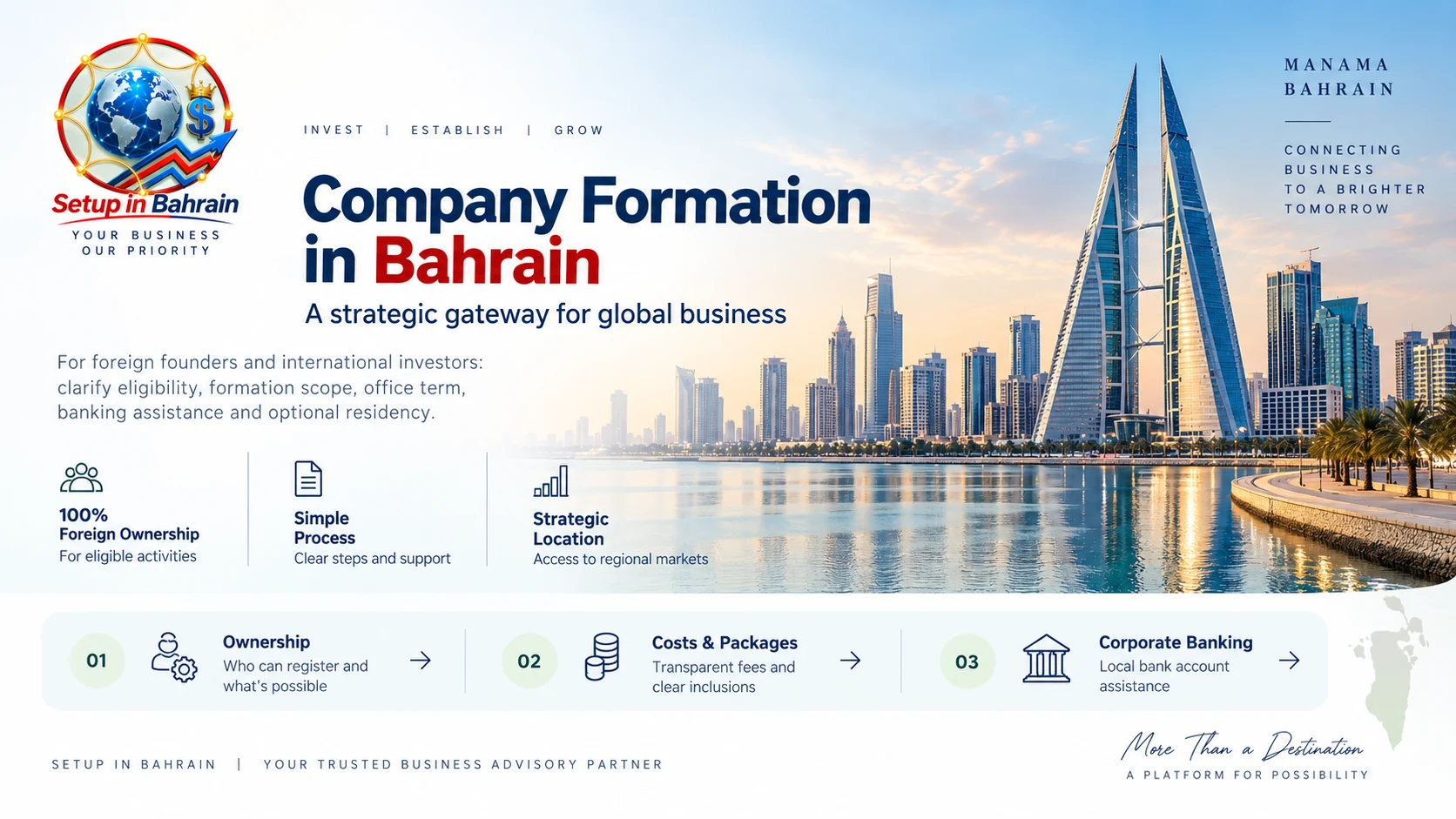
People use different words for the same goal: company formation, company registration, company incorporation, opening a company, or starting a company in Bahrain. In practice, the process has one legal outcome: your Bahrain Commercial Registration (CR), supported by the right company structure, approved business activities, address, bank-ready documents, and post-formation compliance.
If you want to register a company in Bahrain, the usual route is:
- Confirm activity eligibility, ownership and company type.
- Prepare shareholder documents and complete required clearance.
- Reserve the company name and register the address.
- Sign the approved incorporation documents.
- Receive the Commercial Registration and complete licensing requirements.
- Proceed with banking assistance if included in the written scope.
- Apply for investor residency only if purchased separately.
Most foreign-owned service and consultancy businesses can be structured with 100% foreign ownership. Some regulated or restricted activities need extra approval or a Bahraini partner.
For full cost details, see company formation cost in Bahrain. For CR mechanics, see Commercial Registration in Bahrain. For banking, see business bank account in Bahrain. For country-specific guides, see company formation in Bahrain by country.
Register your company in Bahrain in 15–20 days. generally no corporate income tax for most sectors. 100% foreign ownership. No local sponsor required. Trusted by 2,500+ entrepreneurs from 40+ countries since 2018.
View details
| Government authority | MOICT / Sijilat portal |
| Scope (incl. virtual office, Year 1) | Package scope varies: office address is included for 3, 6 or 12 months; banking assistance and other inclusions follow the written quotation. |
| Timeline | Confirmed for the selected activity and shareholder structure in the written case plan. |
| Corporate tax | ✓ 0% SMEs: 0%. MNEs €750M+: 15% (OECD, in force). BHD 1M+ domestic tax from 2027. (0% personal income tax, 0% capital gains tax) |
| Foreign ownership | ✓ 100% across 350+ activity codes — no local sponsor needed |
| Physical visit required | Confirmed for your case before payment: formation signing, bank attendance and residency attendance are assessed separately. |
| Most popular entity type | WLL (Limited Liability Company) — 1 to 50 shareholders |
| Annual renewal | Managed fully online via Sijilat |
Many foreign investors can own up to 100% of an eligible Bahrain company. Formation timing depends on the activity, shareholder documents and external approvals. Banking and investor residency are separate stages, and the required attendance plan is confirmed for the specific case before payment.
We have served 2,500+ clients and maintain records to substantiate that total where needed. Clients served are not the same as Google reviews; not every client has left a review.
What company formation provides - and what is separate
Company formation provides the legal company and Commercial Registration. Banking assistance can be included in the agreed service scope, but the bank decides whether to open the account. Investor residency is optional and separately priced; no formation package includes a visa.
→ Business bank account opening in Bahrain
The CR is the document everything else hangs on. A valid CR unlocks:
- Corporate bank account — no bank opens a business account without a current CR
- Investor visa — the LMRA issues residency to the company owner against a valid CR; you can sponsor your family on it
- Work permits — hire employees once the company is registered with the LMRA
- Commercial lease — landlords require a CR for business tenancy
- VAT registration — the NBR registers your company for VAT against the CR
- International invoicing — UK, US, and EU clients accept a Bahrain CR as proof of a legal entity
Your liability stops at your share capital. Article 18 bis of the Commercial Companies Law separates company debts from your personal assets — if the business fails, your savings and property are not on the line.
That is the destination. The rest of this guide is the route: who qualifies, the five steps, the documents, what your life looks like afterwards, and the full price.
Who Can Register a Company? Foreign Investors, Bahrainis, and GCC Citizens
Anyone can register a company in Bahrain — Bahraini nationals, GCC nationals, and foreign individuals or companies. What decides your setup is your nationality, your business activity, and your company type. Most service, manufacturing, and export activities allow full foreign ownership with no local partner.
100% Foreign Ownership — No Local Sponsor Needed
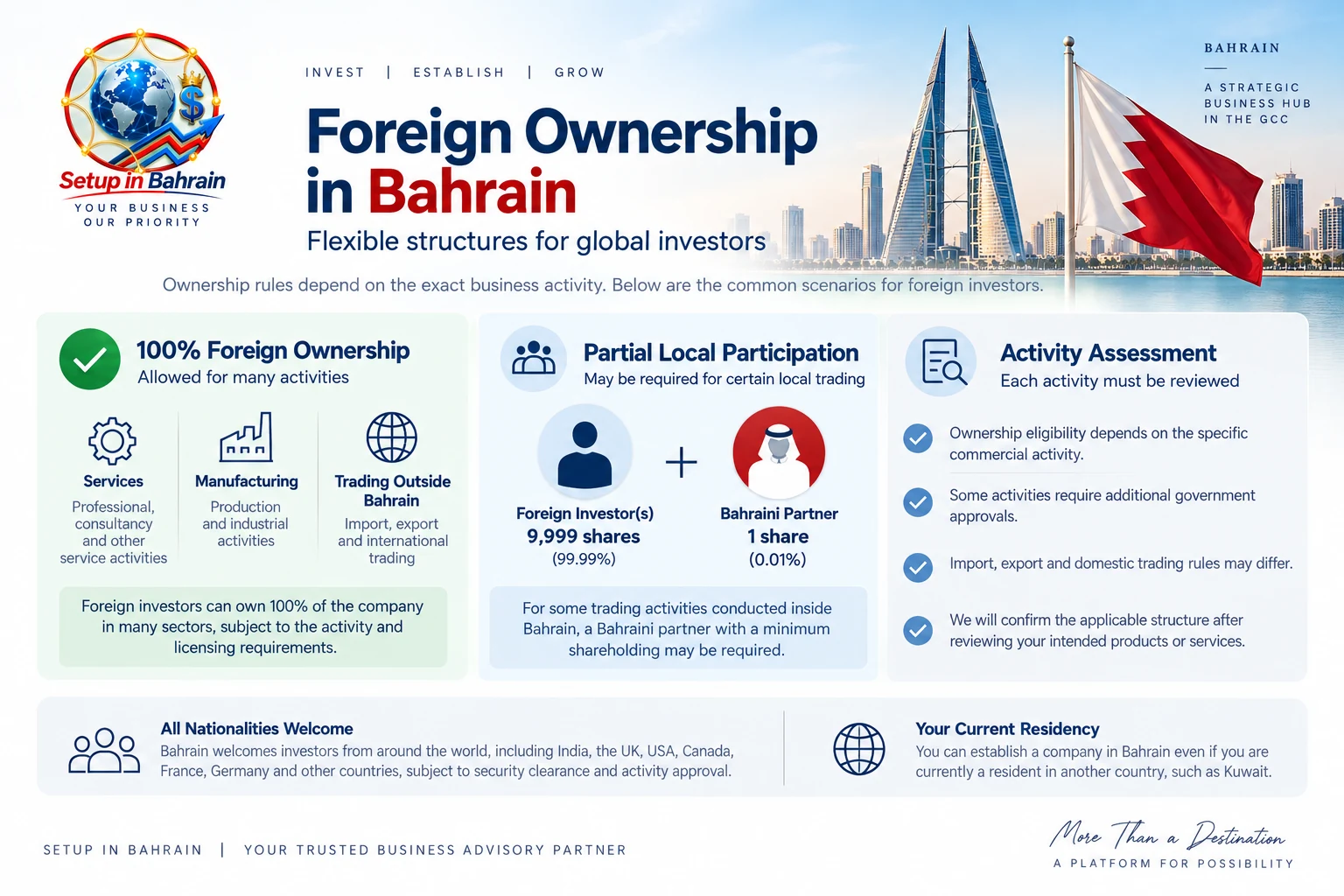
Over 350 activity codes let foreign investors hold 100% equity. No sponsor, no profit-sharing, no local partner for most sectors. Profits, dividends, and capital leave Bahrain with zero restrictions and zero withholding tax.
Which Activities Allow Full Foreign Ownership?
Consulting, tech services, manufacturing, trading (export), logistics, education, and professional services all qualify. Export-based service providers qualify regardless of activity code. The government's activity list changes from time to time — check your exact activity before applying. Check your activity code →
Restricted Sectors: When You Need a Local Partner
Construction needs 51% Bahraini ownership. Trading inside Bahrain uses a 9999+1 share structure with one Bahraini share. Financial services need Central Bank of Bahrain approval, healthcare needs NHRA licensing, and education needs Ministry of Education approval. A few activities — document clearance, pilgrimage services, small traditional shops — are reserved for Bahraini nationals.
What Fails Security Clearance
Every shareholder passes an NPRA background check before anything else happens. The screening looks for financial crimes, deportations, and security flags. Separately, your bank statements are checked for source of funds: large unexplained cash deposits, complex ownership chains, heavy crypto or gold trading, and previously closed companies all trigger review. If any of this applies to you, raise it before you apply — surprises here stop the whole process.
How Different Nationalities Register: UK, US, Canada, France, Germany, and India
British citizens get full ownership across most sectors; many UK consultants in the UAE form a Bahrain entity to bill European clients from a 0% base instead of the UAE's 9%. American citizens get extra market access and IP protections through the US–Bahrain Free Trade Agreement — Bahrain is the only GCC state that has one. Canadians trade a 26.5% combined corporate rate for 0%. French and German owners work two hours ahead of Paris and Berlin. Indian nationals — especially those already in the GCC — use the Bahrain–India DTAA and 0% personal income tax on dividends, with Saudi Arabia a causeway drive away.
Liability Protection Under Article 18 bis
Creditors can pursue the company, not you. If the company fails, you lose what you invested — not your house. This is one of the stronger liability shields in the GCC and a common reason founders pick Bahrain over jurisdictions where personal guarantees creep into everything.
What Is the Company Formation Process in Bahrain?
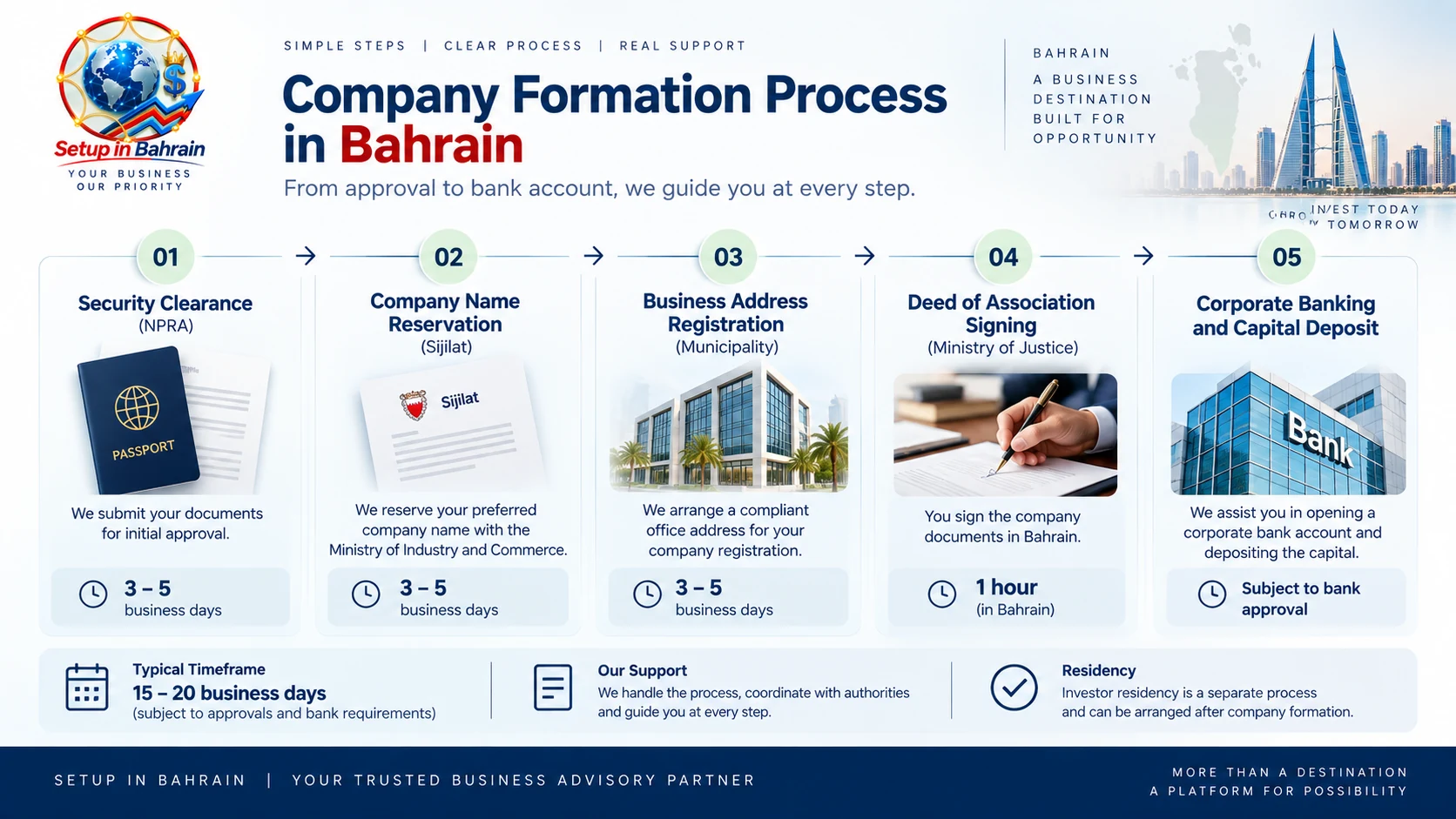
The formation journey is activity and ownership review, security clearance, name reservation, address registration, incorporation-document signing and Commercial Registration. Banking follows as a separate bank-controlled stage, and residency follows only if purchased.
Step 1 — Security Clearance (NPRA, 3–5 business days)
Passport copies of all shareholders and directors go to the NPRA for a background check. You supply documents; we file and track. What goes wrong here: a missing passport page or an expired passport (under 6 months validity) adds 3–5 days per fix, and a failed clearance stops everything — see the red-flags list above before you start.
Step 2 — Company Name Reservation (Sijilat, 3–5 business days)
Three proposed names, ranked by preference, checked against the MOICT registry in English and Arabic. Reserved names hold for sixty days. What goes wrong here: name conflicts. Submit three genuinely different names, not three spellings of one idea.
Step 3 — Business Address Registration (3–5 business days)
Every company needs a municipality-approved address — a physical office, a co-working desk, or a licensed virtual office. Virtual offices work for consulting, tech, and holding companies. What goes wrong here: nothing at setup, but later — an expired lease suspends your CR immediately, which freezes your bank account and visa. Keep the lease current, always.
Step 4 — Deed of Association Signing (1 hour)
The Articles and Memorandum of Association — shareholder rights, capital, activities — are notarised before the Ministry of Justice. Standard deeds sign online through Sijilat. What goes wrong here: nothing, if you can attend or grant a power of attorney for remote signing.
Step 5 - Corporate banking and capital deposit
We prepare the bank-ready company documents and coordinate the selected bank application. The authorised signatory completes any required KYC or signing, deposits the agreed share capital where required, and the bank makes the final decision.
The authorities involved, in one line each: MOICT licenses and registers (via Sijilat), NPRA clears people, the municipality verifies addresses, the Ministry of Justice notarises, the LMRA handles work permits after registration, and the NBR handles VAT.
How Long Does Company Registration Take?
The timeline depends on the activity, shareholder documents, clearance and any external approvals. Your written case plan should identify the expected formation stages and any banking or residency attendance separately.
→ Commercial Registration (CR) in Bahrain — step-by-step guide
| Step | Duration |
|---|---|
| NPRA security clearance | 3–5 business days |
| Company name reservation (Sijilat) | 3–5 business days |
| Address registration | 3–5 business days |
| Deed of Association signing | 1 hour |
| Bank account & capital deposit | Banking: approximately 1 hour in 99% of our reported cases; subsidiaries or CIS shareholders: 3 days to 2 weeks. Subject to bank review. |
| Total (complete documents) | 15–20 business days |
What Documents Do You Need for Company Formation?
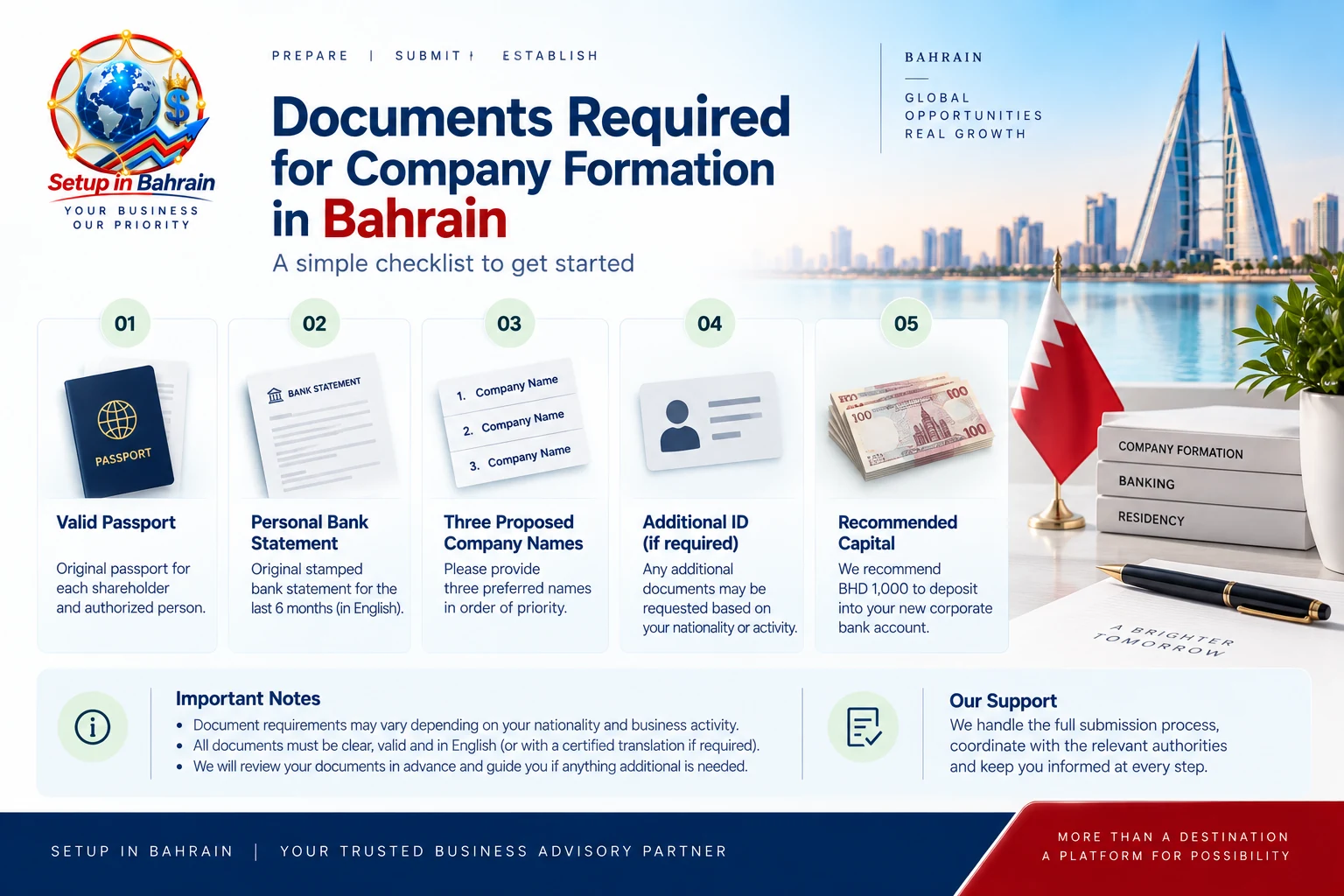
You need five things: passport copies, three proposed company names, stamped bank statements, extra ID if requested, and a capital deposit. Everything submits online through Sijilat.
- Passport copies for all partners, minimum 6 months validity. GCC residents add CPR/Emirates ID/Iqama. US citizens add Social Security information for FATCA. Corporate shareholders add a certificate of incorporation and board resolution.
- Three company names ranked by preference, unique in English and Arabic.
- Six-month bank statements, stamped by your bank — any major licensed bank in your country. Statements must show consistent, explainable income; odd deposits cause delays.
- Additional ID if the bank or government asks: driving licence, national ID, or proof of address.
- Capital deposit at Step 5 — the bank certificate activates your CR the same day.
A business plan is not required for registration, but banks want one for account opening and the LMRA reads it for investor visa approval. Have a short one ready.
Company Formation vs Company Registration in Bahrain — What Is the Difference?
Company formation is the end-to-end process: structure, documents, approvals, deed, CR, then bank account and visa. Company registration in Bahrain means the specific step of recording your company with MOICT and receiving your CR number through Sijilat. Company incorporation in Bahrain is the same thing under its international name. Whichever term you searched, you almost certainly mean the whole journey — and this page covers all of it.
Business Registration vs Business License
Registration creates the company's legal existence. A license permits specific activities inside it. One registration can hold multiple licenses. Picking the wrong activity code triggers ownership limits or rejection — get it right the first time, or ask us to check it.
Which Business Activities Need Special Approval?
Three groups: activities needing Bahraini majority ownership (construction, government contracts), activities needing a local partner share (domestic retail), and activities needing special licences (finance, healthcare, education). Everything else — the large majority — registers without special approval.
Types of Companies in Bahrain: W.L.L, Branch Office, and More
The main structures are the WLL (the default for foreign founders), the branch office, and a set of special-purpose forms. Your choice sets ownership, liability, and compliance load.
WLL Company (Limited Liability Company)
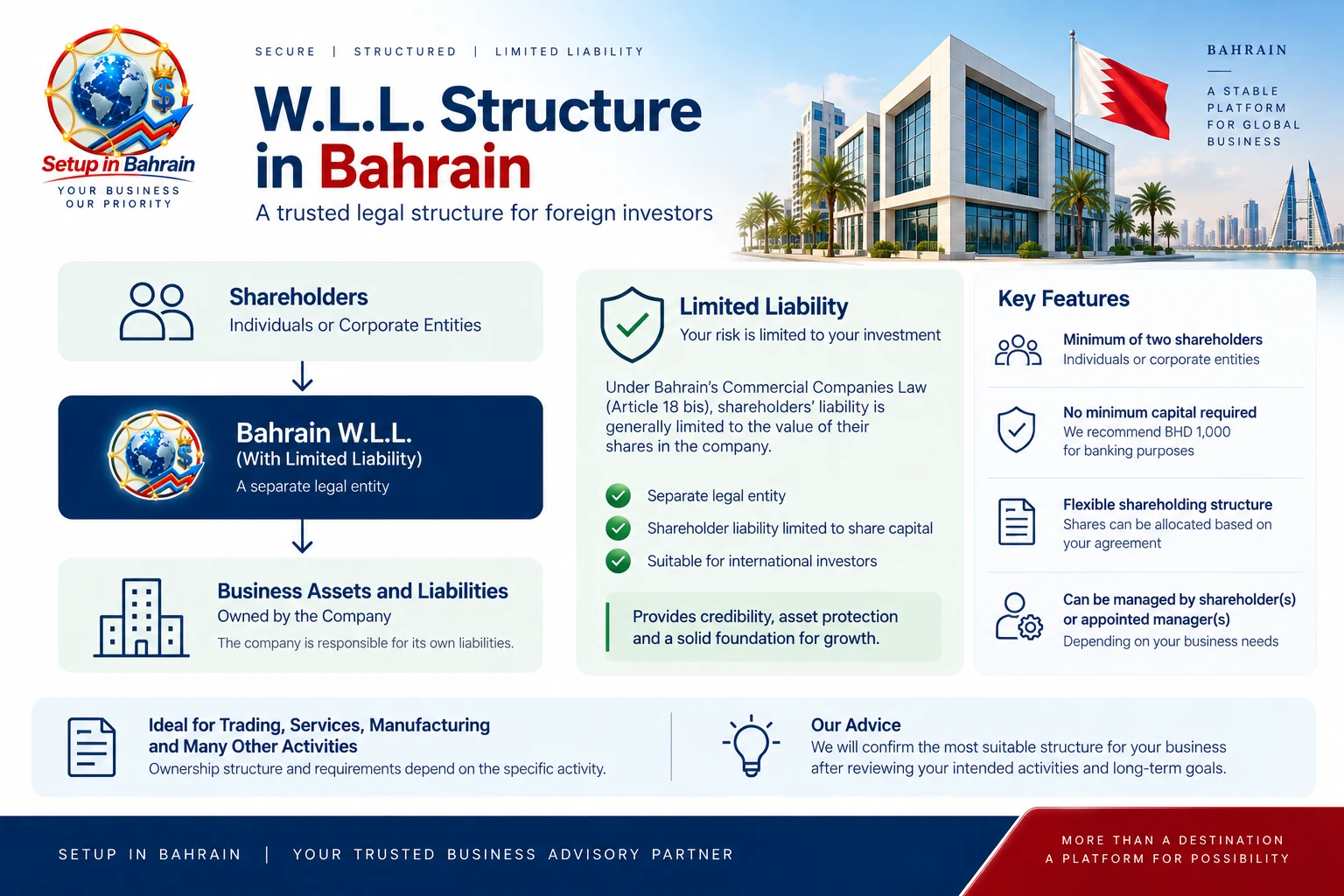
The WLL suits almost everyone: 1 to 50 shareholders, flexible capital, up to 100% foreign ownership, liability limited to your investment, multiple activities under one CR.
| Feature | Detail |
|---|---|
| Shareholders | 1–50, individuals or corporate |
| Minimum share capital | BHD 1 legally; BHD 1,000 recommended (AML review flags minimal capital) |
| Foreign ownership | Up to 100% |
| Liability | Limited to capital |
The old Single Person Company (SPC) merged into the WLL under Legislative Decree No. 38 of 2025 — a single shareholder now owns 100% of a WLL with full Article 18 bis protection. If you searched “LLC company formation in Bahrain,” the WLL is Bahrain’s LLC.
Branch Office of a Foreign Company
A branch extends your existing company into Bahrain without creating a new entity. The parent stays fully liable. You need parent-company approval, financial statements, a board resolution, and a local manager. No minimum capital. Good for testing Bahrain before committing.
Partnership, Joint Stock, Free Zone and Representative Office
Partnerships share management and unlimited personal liability — rare for foreign founders. Closed joint stock companies (BHD 250,000 capital) suit private equity and family groups; public shareholding companies (BHD 1,000,000, seven founders) list on the Bahrain Bourse. Free zone companies add tax and customs advantages in designated zones. A representative office researches the market without trading.
Can I Set Up a Holding Company in Bahrain?
Yes. A Bahrain WLL can hold shares in other GCC companies, receive dividends tax-free, and manage IP or brand licences. Zero withholding on dividends in or out, zero capital gains on selling subsidiary shares, the Bahrain–India DTAA for Indian shareholders, and the Bahrain–UK double tax treaty for British owners. Same 5-step process, same single visit, virtual office sufficient if there’s no active local trade.
Tax, Corporate Tax, and VAT Registration in Bahrain
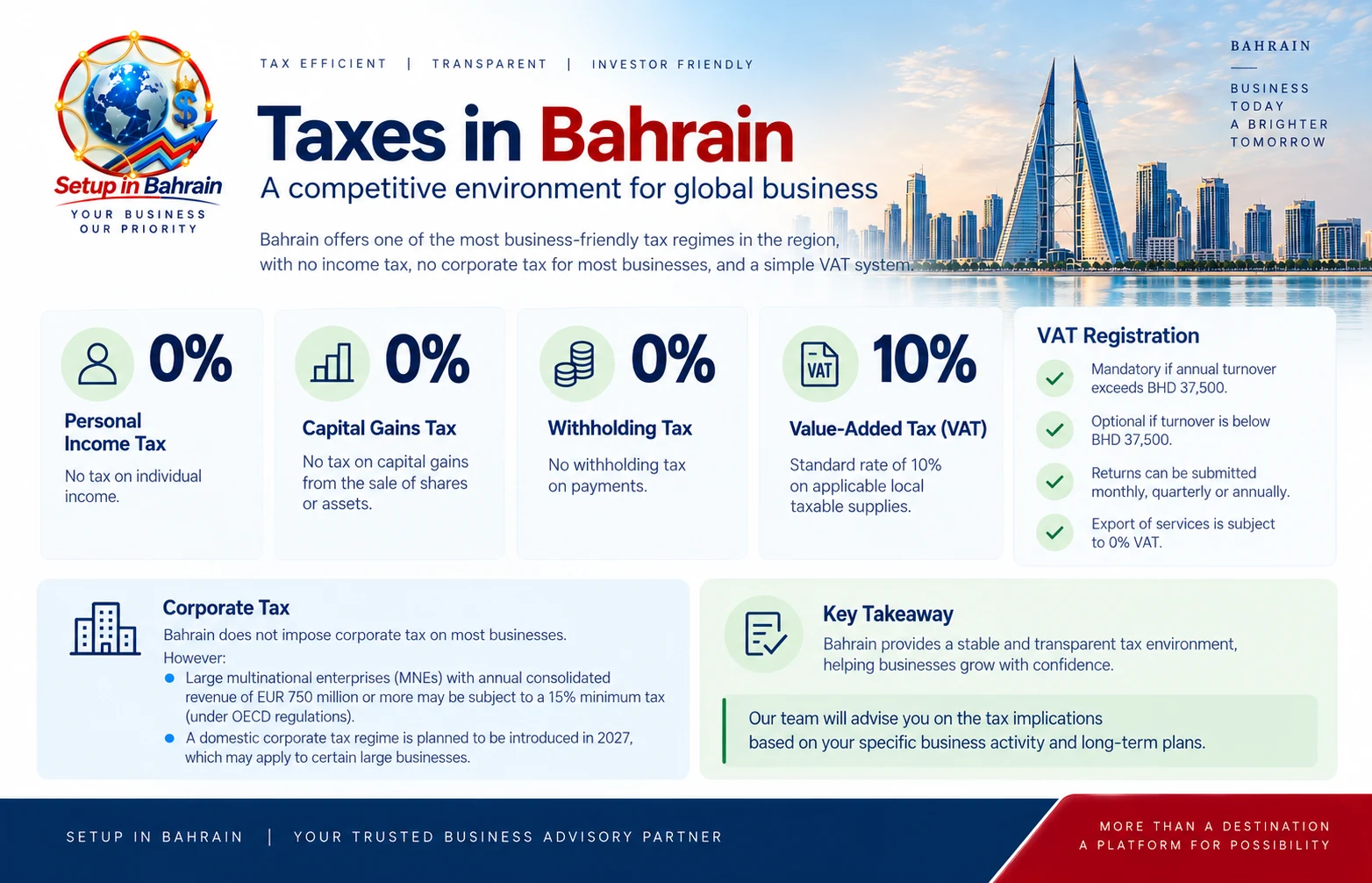
Bahrain charges 0% corporate income tax, 0% personal income tax, 0% capital gains tax, and 0% withholding tax for SMEs and typical foreign-owned companies. VAT is 10% on local sales and 0% on service exports.
| Tax type | Rate |
|---|---|
| Corporate income tax | 0%* |
| Personal income tax | 0% |
| Capital gains tax | 0% |
| Withholding tax | 0% |
| VAT — local sales | 10% |
| VAT — service exports | 0% |
*0% for SMEs and typical foreign-owned companies. Large multinationals (€750M+ global revenue) pay the OECD 15% minimum tax, already in force. A domestic corporate tax for enterprises above BHD 1M revenue arrives in 2027. Oil and gas companies pay 46%.
The 0% rate on service exports is the quiet winner: a consultant or SaaS company billing clients outside Bahrain charges no VAT and keeps the margin. VAT registration with the NBR becomes mandatory once local turnover crosses the threshold. Bahrain holds double taxation agreements with the UK, France, India, and others — the Bahrain–India DTAA matters most for Indian founders, preventing the same income being taxed twice.
New Corporate Tax in 2027 — Who It Affects
Enterprises earning over BHD 1 million a year will pay a domestic corporate tax from 2027. Small and medium businesses are unaffected — for most founders reading this page, Bahrain stays at 0%. Full analysis: Bahrain corporate tax guide →
Can I Register a Company in Bahrain Remotely from the UK, USA, or Canada?
Most preparation and filing can begin remotely. Any physical attendance depends on the signing route, the selected bank and whether residency is purchased. We confirm the required visit plan for the specific shareholder structure before payment.
Sijilat is the Ministry of Industry and Commerce’s digital registration portal: you (or we) submit documents, track each approval in real time, and receive the CR electronically. After formation, the portal handles CR renewals, VAT filings, and ministry correspondence — remote company formation in Bahrain is not a workaround, it’s the designed path. You need a resident manager and a valid address; the owner does not need to live in Bahrain.
Your Life After Company Formation in Bahrain
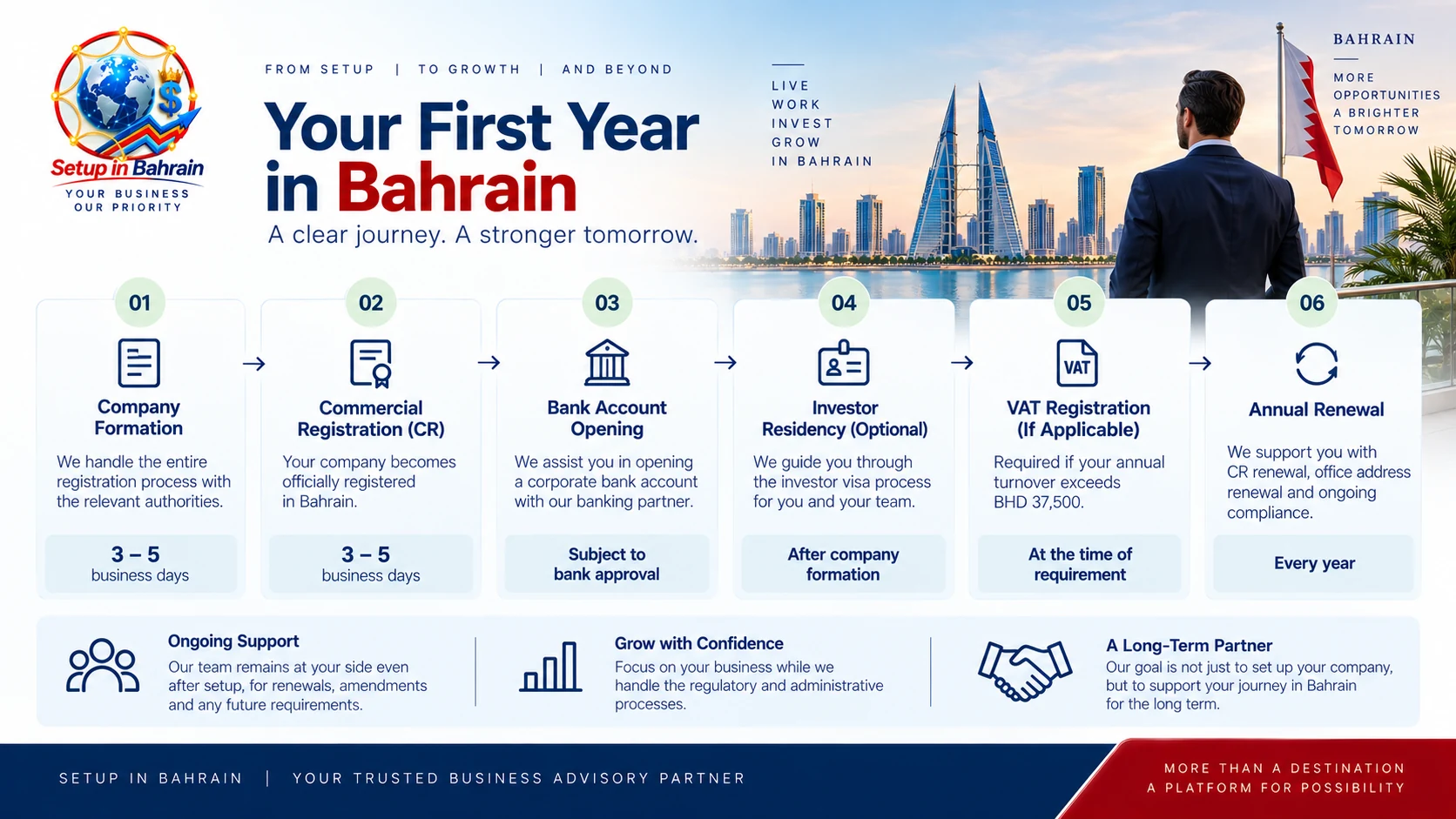
Formation is three weeks. Owning the company is the years after. Here is what actually changes — the part most guides skip.
Residency and Family: What the Investor Visa Gives You
Investor residency is a separate service after company formation. It is not included in Standard, Gold or Premium. The current service price is BHD 755 for one year or BHD 953 for two years; medical, biometric and attendance requirements are confirmed for the applicant before filing.
The Annual Calendar: What Your Company Asks of You Every Year
Renewal and office continuity are ongoing costs. Current renewal packages are BHD 530 with three months of office address, BHD 800 with six months, or BHD 1,520 with twelve months. Visa renewal and other optional services are separate.
What Your Home Country’s Tax Office Will Say
Bahrain will not tax you. Your home country might. UK, US, Canadian, and Indian residents can still owe home-country tax on worldwide income depending on their residency status — the US taxes citizens regardless of where they live. Double taxation agreements soften this, and many founders restructure their residency as part of the move, but this page cannot answer your personal case. Take advice from a tax professional in your home country before you form. We say this because clients who plan it properly keep the 0%; clients who don’t get surprised.
If Things Go Wrong: Bank Rejection, CR Suspension, and Exit
Banks reject applications, usually for explainable reasons: gaps in source-of-funds evidence, minimal share capital, or a business plan that doesn’t match the account activity. This is why our formations are prepared bank-ready — the documents are built to pass AML review the first time. CR suspension follows an expired lease or missed renewal and reverses once fixed. And if the business ends, liquidation is a defined legal process, not a trap — we handle exits as well as entries. Knowing the way out is part of deciding to come in.
Talk through your situation — free consultation →
How Much Does Company Formation in Bahrain Cost? (BHD, GBP, USD, CAD)
Formation packages are BHD 1,340, BHD 1,700 and BHD 2,150. Each includes a different office-address period; visas are separate. Your formal quotation confirms government fees, share capital, optional services and the cost of maintaining the address after the included period.
→ Full cost breakdown: company formation in Bahrain
Bahrain vs Dubai/UAE comparison: See the full comparison at Bahrain vs Dubai company formation.
When Bahrain May Not Be the Right Fit
Bahrain is not perfect for every business. Large projects needing public fundraising may find deeper capital markets elsewhere. Pharmaceutical manufacturing and advanced financial products have more mature setups in other countries. And if you only plan to sell inside Bahrain with no regional expansion, the GCC gateway benefits matter less. If that’s you, we’ll tell you in the first call — it costs us less than a bad-fit client costs both of us.
Frequently Asked Questions — Company Formation & Registration in Bahrain
Can one person own a WLL company in Bahrain?
Can an expat own 100% of a company without a local sponsor?
Does Bahrain charge any income tax?
Can I get Bahrain residency through company formation?
Why do banks reject corporate bank account applications in Bahrain?
What usually causes delays in company formation approval in Bahrain?
What is Sijilat and how do I use it to register a company in Bahrain?
How does share capital work?
Do I need a business plan?
What triggers CR suspension?
Is Bahrain good for e-commerce and small businesses?
How does a Bahrain WLL compare to UAE and Saudi structures?
How much does it cost to register a company in Bahrain from the UK?
Why Bahrain over other GCC countries?
Compare the package price, included office period and the separate costs below. Your quotation confirms government fees and any case-specific requirements before payment.
Choose your Bahrain company-formation package
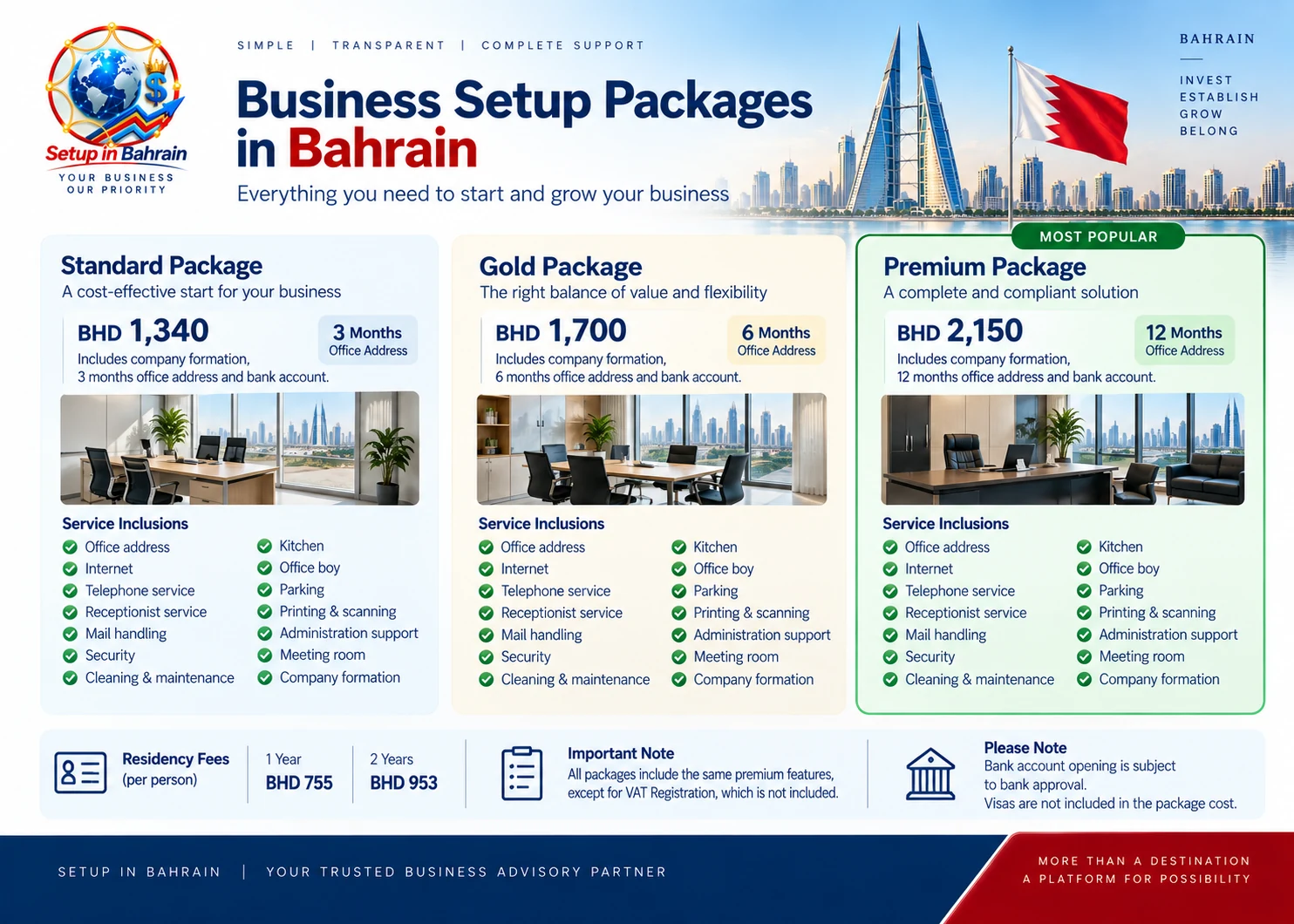
Compare the initial package price and included office period. Visas, share capital and any government fees identified in the formal quotation are separate.
Standard
BHD 1,340
Office address: 3 months
Included office-address component: BHD 440 (not an extra charge)
- Best for
- Founders needing a three-month registered address
- Formation service
- Included to the written scope
- Banking support
- Document preparation and coordination; bank approval is separate
- Residency
- Not included
- Government fees
- Confirmed in the formal quotation
- Share capital
- Not included as a service fee
- What happens next
- Renew or replace the registered address before the included term expires
Company formation
No formation package includes visas, including Premium. Investor/work visas are priced separately: BHD 755 for one year or BHD 953 for two years, in addition to the formation package.
Request an itemized quoteGold
BHD 1,700
Office address: 6 months
Included office-address component: BHD 800 (not an extra charge)
- Best for
- Founders wanting six months of address continuity
- Formation service
- Included to the written scope
- Banking support
- Document preparation and coordination; bank approval is separate
- Residency
- Not included
- Government fees
- Confirmed in the formal quotation
- Share capital
- Not included as a service fee
- What happens next
- Renew or replace the registered address before the included term expires
Company formation
No formation package includes visas, including Premium. Investor/work visas are priced separately: BHD 755 for one year or BHD 953 for two years, in addition to the formation package.
Request an itemized quotePremium
BHD 2,150
Office address: 12 months
Included office-address component: BHD 1,250 (not an extra charge)
- Best for
- Founders wanting a full-year address and the stated cabin furniture
- Formation service
- Included to the written scope
- Banking support
- Document preparation and coordination; bank approval is separate
- Residency
- Not included
- Government fees
- Confirmed in the formal quotation
- Share capital
- Not included as a service fee
- What happens next
- Renew or replace the registered address before the included term expires
Company formation
Premium BHD 2,150 with 12 months and a cabin, officer table and chair, and two guest chairs.
No formation package includes visas, including Premium. Investor/work visas are priced separately: BHD 755 for one year or BHD 953 for two years, in addition to the formation package.
Request an itemized quoteIncluded, separate and bank-controlled
| Item | Status |
|---|---|
| Company formation service | Included according to the selected package scope |
| Office address | Included for 3, 6 or 12 months by package |
| Investor/work visa | Separate: BHD 755 for one year or BHD 953 for two years |
| Government fees | Confirmed in the formal, itemised quotation |
| Share capital | Not a service fee; amount and deposit requirement are confirmed for the case |
| Bank account | Setup assists; the bank controls approval and KYC |
| After the office period | Renew or replace the registered address before it expires |
Optional add-ons
Payment terms: 50% on signing · 40% at MOA · 10% on completion. Standard processing 15–20 business days.
Ready to set up in Bahrain?
Tell us your business idea. We'll map the right entity, ownership and timeline — then handle the filing while you build.
Official Bahrain government references
- Sijilat — MOICT commercial registration portalsijilat.bh
- Ministry of Industry, Commerce & Tourismmoic.gov.bh
- Ministry of Justice (notary)moj.gov.bh
- National Bureau for Revenue (VAT)nbr.gov.bh
- Labour Market Regulatory Authoritylmra.gov.bh
- US State Dept: 2025 Bahrain Investment Climate Statementstate.gov