Register your Bahrain company from Iceland with generally no corporate income tax for most sectors. Fast setup, full foreign ownership, and easy process for Icelandic entrepreneurs.
Key Takeaways
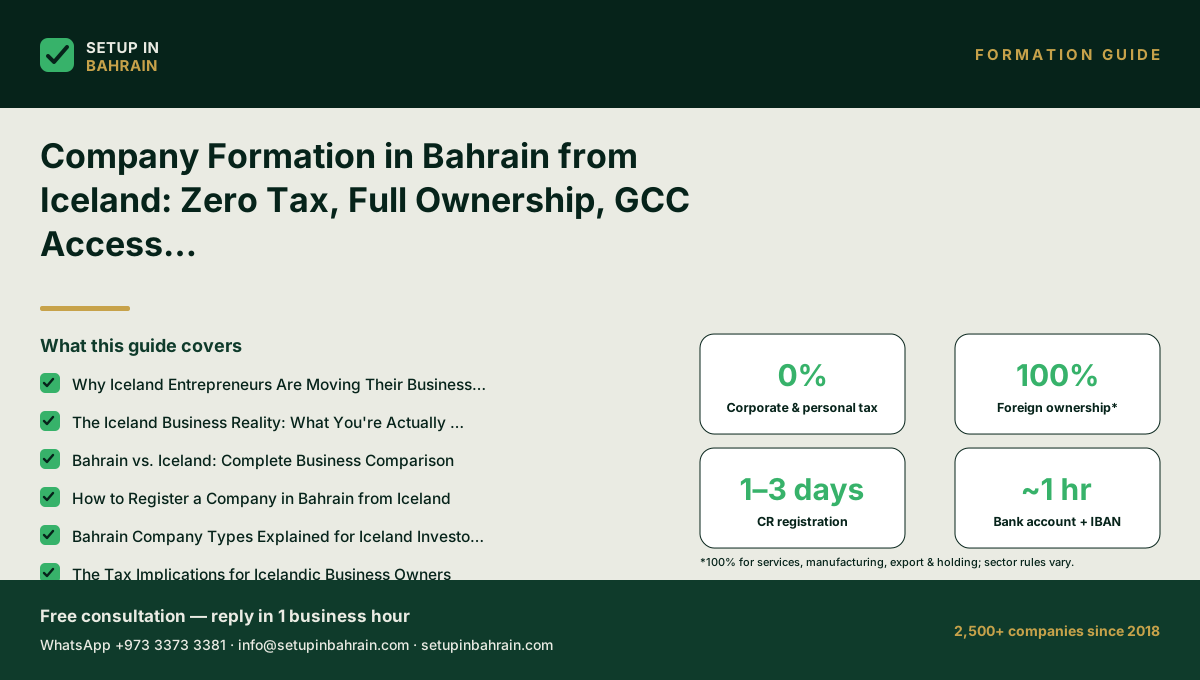
- Why Iceland Entrepreneurs Are Moving Their Business to Bahrain
- The Iceland Business Reality: What You're Actually Paying
- Bahrain vs. Iceland: Complete Business Comparison
- How to Register a Company in Bahrain from Iceland
- Bahrain Company Types Explained for Iceland Investors
→ Complete guide: Company Formation in Bahrain — the full 2026 guide
View details
Ownership & capital
A Bahrain WLL can be owned by a single person — 100% foreign ownership applies to most activities, with no local partner required for services, manufacturing, export trading and holding companies. The minimum share capital is BHD 1 ; we recommend BHD 1,000 . This Makes bank account opening and investor visa approval smoother.
Why Iceland Entrepreneurs Are Moving Their Business to Bahrain
Let me paint a picture you'll recognize.
Björn, a Reykjavík-based software entrepreneur with a team of 12 developers, filed his 2025 corporate tax return last April. His company hit ISK 180 million in revenue—respectable growth for an Icelandic tech firm. But after Skatturinn took their 20% corporate slice, after the mandatory Chamber of Commerce fees, after the 11.5% social security contributions on his payroll, after the bi-monthly VAT filings. After paying his accountant ISK 1.8 million just to navigate the RSK compliance labyrinth, he found himself staring at a number that made his stomach turn.
Nearly ISK 48 million had evaporated before he could reinvest a single króna into product development.
"What exactly am I getting for this?" he asked himself. His answer: access to a domestic market of 370,000 people. Geographic isolation that makes client meetings in London or Dubai require full-day travel commitments. A currency prone to wild swings—the ISK lost 35% of its value against the euro during the 2008 financial crisis. As recently as 2023, dropped another 11% against the USD in a single quarter. Limited banking infrastructure that makes international wire transfers slow, expensive. Occasionally blocked entirely for certain Middle Eastern destinations.
Meanwhile, Björn's competitors incorporated in Dubai and Singapore were reinvesting every dollar of profit. They were outspending him on marketing, hiring faster, and winning contracts he should have won—not because their products were better. Because their cost structures allowed them to price more aggressively while maintaining healthy margins.
This isn't a unique story. Across Iceland, entrepreneurs in technology consulting, fisheries technology, renewable energy services, aluminum industry support, and e-commerce are asking the same fundamental question: Does it make sense to run a globally-oriented business exclusively from a country with high taxation, extreme currency volatility, and geographic isolation from major growth markets?
The answer, more and more, is that it doesn't—at least not exclusively.
And that's why a growing number of Icelandic business owners are establishing operations in Bahrain, a 780-square-kilometer island nation in the Persian Gulf that offers what Iceland structurally cannot: Generally no corporate income tax for most sectors, complete foreign ownership rights, rock-solid currency stability pegged to the USD, and a physical doorway to the $2.5 trillion GCC market.
This isn't about abandoning Iceland. Many Icelandic founders maintain their primary residence in Reykjavík, keep development teams in Iceland. Continue serving Nordic clients from their original entity. What changes is where the holding company sits, where the intellectual property resides, where the international contracts flow through. Ultimately, how much of their hard-earned revenue they actually keep.
The Iceland Business Reality: What You're Actually Paying
Let's get brutally specific about the numbers. This is because Understanding precisely what you're paying in Iceland is essential to evaluating whether Bahrain makes strategic sense.
Corporate Taxation and Effective Rates
Iceland's headline corporate tax rate sits at 20%—competitive by European standards, certainly lower than Germany's 30% effective rate or France's 25%. But the headline number obscures the complete picture.
Consider an Icelandic ehf (private limited company) generating ISK 100 million in annual profit. Here's what actually happens:
Direct Corporate Tax: ISK 20 million (20% of profit)
Social Security Contributions: If your company employs staff, you're paying 11.5% employer social security on all wages. For a company with ISK 60 million in annual payroll, that's ISK 6.9 million.
Mandatory Pension Contributions: Employers must contribute a minimum of 11.5% to employee pension funds (though employees contribute also). On that same ISK 60 million payroll, another ISK 6.9 million.
Chamber of Commerce Fees: Mandatory membership for most businesses ranges from ISK 250,000 to ISK 800,000 annually, depending on revenue brackets.
Accounting and Compliance Costs: Navigating Skatturinn's requirements, preparing audited financial statements (mandatory for companies above certain thresholds). Managing bi-monthly VAT returns typically costs ISK 1.5-3 million annually for a company of this size.
Total Effective Outflow: Before any dividend distribution or owner compensation, you're looking at ISK 36-38 million in combined taxation and mandatory compliance costs on ISK 100 million in profit. That's a 36-38% effective rate when you account for everything—nearly double the headline corporate tax figure.
The ISK Volatility Problem
But taxation is only half the story. The Icelandic króna presents a structural challenge that no amount of tax planning can fully address.
Consider the historical data. During the 2008 financial crisis, the ISK collapsed by about 35% against major currencies in a matter of weeks. Businesses with USD or EUR-denominated liabilities were devastated. Companies that had appeared profitable in ISK terms found their international purchasing power evaporated almost overnight.
More recently, between January and September 2023, the ISK depreciated roughly 11% against the USD. For an Icelandic company billing international clients in foreign currencies and converting to ISK for local expenses and tax obligations, this volatility creates unpredictable margin compression.
Let's quantify this with a real scenario. An Icelandic consulting firm invoices a Saudi Arabian client USD 500,000 for a project. At the time of contract signing, the exchange rate is ISK 137 per USD, meaning expected revenue of ISK 68.5 million. By the time payment arrives three months later, the ISK has strengthened to ISK 132 per USD. Actual received revenue: ISK 66 million. The company just lost ISK 2.5 million—roughly 3.6% of the contract value—purely on currency timing.
Now flip the scenario. The ISK weakens instead. Revenue increases in ISK terms, but so does your apparent profit, which means higher corporate tax obligations on gains that are purely nominal—paper profits you can't actually spend in the international marketplace because your purchasing power remains unchanged.
This currency whipsaw creates constant planning uncertainty. Iceland's Central Bank maintains a floating exchange rate with periodic interventions, but the fundamental reality is that the ISK is a small, thinly-traded currency subject to significant volatility based on tourism flows, fishing exports, aluminum prices, and global risk sentiment.
Market Size and Geographic Isolation
Iceland's domestic market of about 370,000 people is both a strength and a profound limitation. The small, tight-knit business community means strong networks and high trust. It also means that any business with ambitions beyond serving local needs must go international—and going international from Iceland is expensive.
Reykjavík to London: 3 hours flying, but total door-to-door with connections often exceeds 6 hours. Reykjavík to Dubai: minimum 10 hours with at least one connection, often two. Reykjavík to Riyadh: 12+ hours with multiple connections.
For service businesses requiring regular client face time, this geographic isolation translates directly into higher travel costs, more time away from productive work, and the intangible disadvantage of being perceived as "far away" from major markets.
The MENA region—comprising the GCC states (Saudi Arabia, UAE, Qatar, Kuwait, Oman, Bahrain) plus Egypt, Jordan. North Africa—represents a combined GDP exceeding $3.5 trillion and a population of over 400 million. These markets are experiencing massive infrastructure investment, digital transformation initiatives. Diversification programs like Saudi Vision 2030 and Bahrain's Economic Vision 2030.
For Icelandic companies with relevant expertise—especially in renewable energy, geothermal technology, fisheries management, financial services technology. Sustainable development—the MENA region represents perhaps the highest-growth opportunity globally. Yet accessing these markets from Iceland means operating at a structural disadvantage compared to competitors physically present in the region.
Bahrain vs. Iceland: Complete Business Comparison
Understanding the comparative landscape requires examining both jurisdictions across multiple dimensions. The following analysis draws on data from the World Bank, the Bahrain Economic Development Board (EDB). Iceland's Directorate of Internal Revenue (Skatturinn RSK).
Corporate Taxation
Iceland: 20% corporate income tax on worldwide profits for resident companies. Dividends distributed to individual shareholders face an additional 22% tax, creating potential double taxation.
Bahrain: 0% corporate income tax for most business activities. The only exception is a 46% tax on hydrocarbon extraction companies—which doesn't affect foreign investors establishing service, trading, or holding companies. No withholding tax on dividends, interest, or royalties. No capital gains tax.
For an Icelandic company generating ISK 100 million (about USD 730,000) in annual profit, the direct tax savings from operating through a Bahrain entity would be ISK 20 million—every single year, compounding into substantial capital for reinvestment.
Foreign Ownership Rights
Iceland: While Iceland permits foreign ownership of companies, non-EEA investors face restrictions in certain sectors including fishing, energy production. Aviation. Foreign ownership of Icelandic ehf companies requires no specific approval for most sectors. Investment in "strategic" industries may require government review.
Bahrain: 100% foreign ownership permitted in virtually all sectors since the 2017 Commercial Companies Law amendments. No local partner or sponsor required for most business activities. Foreign investors can establish, own, and operate companies with complete autonomy. The Bahrain Investors Protection Agreement (BIPA) provides additional legal guarantees against expropriation and ensures fair treatment under international law.
Currency Stability
Iceland: The Icelandic króna (ISK) operates as a freely floating currency with periodic Central Bank interventions. Historical volatility is significant—the ISK's trade-weighted index has fluctuated by more than 30% in single-year periods. The currency is not freely convertible in international markets, meaning large transactions may face liquidity constraints.
Bahrain: The Bahraini dinar (BHD) has been pegged to the US dollar at a fixed rate of BHD 1 = USD 2.65957 (or about BHD 0.376 per USD) since 1980. This peg has survived multiple regional crises, including the 1991 Gulf War, the 2008 global financial crisis, the 2011 Arab Spring, the 2014-2016 oil price collapse, and the 2020 pandemic. The Central Bank of Bahrain (CBB) maintains substantial foreign exchange reserves—about USD 4.8 billion as of late 2024—to defend the peg.
For Icelandic businesses, this currency stability is transformative. Billing clients in USD, receiving payment in USD. Holding reserves in a USD-pegged currency eliminates the forex volatility that constantly erodes margins in ISK-based operations.
Banking Infrastructure
Iceland: Iceland's banking sector, rebuilt after the 2008 collapse, comprises three major commercial banks: Arion Bank, Íslandsbanki. Landsbankinn. International wire transfer capabilities exist but can be expensive (fees of ISK 3,000-8,000 per outbound transfer) and slow (2-5 business days for non-SEPA transfers). Banking relationships with MENA-region counterparties may face additional scrutiny or restrictions.
Bahrain: Bahrain hosts over 400 financial institutions, including 19 full retail banks, numerous wholesale banks. The regional offices of most major global banks. The Central Bank of Bahrain (CBB) has established Bahrain as the GCC's financial services hub, with sophisticated correspondent banking relationships worldwide. International transfers typically settle within 1-2 business days, with fees greatly lower than Iceland. Multiple banks offer USD, EUR, GBP, and multi-currency accounts, facilitating seamless international trade.
For an Icelandic entrepreneur regularly invoicing clients in Saudi Arabia, UAE, or other GCC states, having a Bahrain bank account means faster collections, lower fees, and simpler relationship management with regional clients accustomed to dealing with Bahrain-based entities.
Regulatory Environment and Compliance
Iceland: Skatturinn RSK requires bi-monthly VAT returns (for VAT-registered entities), annual corporate tax returns due by May 31, audited financial statements for larger companies, and various supplementary filings depending on business activity. The compliance burden is manageable but resource-intensive, especially for growing companies.
Bahrain: The Ministry of Industry and Commerce (MOIC) oversees company registration and compliance. Annual requirements include renewing the Commercial Registration (CR), filing beneficial ownership information. Submitting annual financial statements (audited for certain company types). Bahrain introduced a 10% Domestic Minimum Top-up Tax (DMTT) effective January 2025, aligned with OECD Pillar Two global minimum tax rules—but this only applies to multinational enterprises with consolidated global revenues exceeding EUR 750 million. For the vast majority of Icelandic SMEs and mid-market companies, the generally no corporate income tax for most sectors remains fully applicable.
Market Access Comparison
| Factor | Iceland | Bahrain |
| Domestic Market Size | 370,000 | 1.5 million (plus 60+ million GCC) |
| Regional Trade Area | EEA (450 million) | GCC (60 million, $2.5T GDP) |
| Free Trade Agreements | EEA, EFTA | GCC, US-Bahrain FTA, Arab League |
| Flight Time to Dubai | 10+ hours | 45 minutes |
| Flight Time to Riyadh | 12+ hours | 1 hour |
| Flight Time to London | 3 hours | 7 hours |
| Flight Time to Mumbai | 14+ hours | 3 hours |
How to Register a Company in Bahrain from Iceland
The practical process of establishing a Bahrain company from Iceland is more straightforward than many entrepreneurs expect. The Bahrain Economic Development Board (EDB) has invested greatly in streamlining business registration. The entire process can be completed remotely with proper documents.
Step 1: Determine Your Company Structure
Bahrain offers several entity types suitable for foreign investors:
WLL (With Limited Liability Company): The most common structure for foreign investors operating actively in Bahrain. Requires minimum capital of BHD 50 (about USD 133) for most activities, though certain licensed activities may require higher capital. Can be 100% foreign-owned for most sectors.
single-shareholder WLL: Ideal for solo entrepreneurs or holding structures. One shareholder, limited liability, minimum capital of BHD 50 for standard activities. Simpler governance requirements than WLL.
Branch Office: An extension of your existing Icelandic company, useful for specific projects or contracts. Retains the legal personality of the parent company—meaning the parent bears full liability. May be appropriate for government contracts requiring a local presence.
Representative Office: Strictly limited to marketing and liaison activities; cannot conduct commercial transactions. Rarely the optimal choice for active business operations.
For most Icelandic entrepreneurs, either a WLL (for operating businesses) or a single-shareholder WLL (for holding companies or solo consultants) represents the optimal structure.
Step 2: Prepare Your Documents
Required documents for foreign investors include:
From Iceland:
- Passport copies of all shareholders and directors (clear, colored scans)
- Proof of address (utility bills or bank statements dated within 3 months)
- Bank reference letter from your Icelandic bank
- Source of funds documents (especially for banking applications)
- If using an existing Icelandic company as shareholder: Certificate of Good Standing, Articles of Association, and Board Resolution authorizing the Bahrain investment
For the Bahrain Company:
- Proposed company name (3-5 alternatives recommended)
- Detailed business activity description aligned with MOIC activity codes
- Proposed share capital structure
- Director and shareholder appointments
All Icelandic documents must be attested. The process involves:
- Notarization by an Icelandic notary
- Legalization by the Ministry of Foreign Affairs of Iceland
- Attestation by the Embassy of Bahrain (either the embassy with jurisdiction or through a Bahrain-based agent)
Processing time for attestation: typically 2-3 weeks, though expedited services are available.
Step 3: Reserve Your Company Name
Company name reservation through MOIC's online portal (Sijilat) is the first formal step. Names must be:
- Unique and not confusingly similar to existing registered companies
- Not offensive or contrary to public policy
- Indicative of the company's legal form (ending in "WLL," "WLL," etc.)
Reservation fee: BHD 10 (about USD 27) Reservation validity: 30 days
Step 4: Draft and Execute Foundational Documents
For a WLL, you'll need: Memorandum of Association (MOA) specifying shareholders, capital. Governance Articles of Association (AOA) covering operational procedures
These documents must be drafted in Arabic for official registration, though English translations are maintained for investor reference. Your formation agent will prepare bilingual versions.
For companies with capital exceeding BHD 20,000, or where partners desire additional flexibility, the MOA may need notarization before a Bahrain notary. This can typically be accomplished through a properly authorized agent using power of attorney, without requiring the Icelandic founder's physical presence.
Step 5: Get Commercial Registration
Submission to MOIC through the Sijilat portal includes:
- Completed application form
- Attested shareholder documents
- MOA and AOA
- Office lease agreement (can be a flexi-desk or virtual office for many activities)
- Director and shareholder appointments
MOIC processing time: 3-5 business days for standard applications
Commercial Registration (CR) fees vary by activity type but typically range from BHD 100-500 for most services and trading activities.
Step 6: Post-Registration Requirements
Municipality License: Required for companies with physical premises, obtained from the relevant municipality (Manama, Muharraq, etc.). Fees: BHD 30-150 depending on office size and location.
Chamber of Commerce Registration: Mandatory for all commercial entities. Annual fees: BHD 50-200 depending on company type and capital.
General Organization for Social Insurance (GOSI): If employing staff in Bahrain, registration required within 30 days of first employment. Employer contributions: 12% of Bahraini employee salaries, 3% for expatriate employees.
Tax Registration: If applicable for DMTT (companies meeting the EUR 750M threshold), registration with the National Bureau for Revenue (NBR). For most SMEs, no tax registration is required.
Total Timeline and Costs
| Stage | Duration | Cost (BHD) |
| Document Preparation and Attestation | 2-3 weeks | 200-400 |
| Name Reservation | 1-2 days | 10 |
| CR Application and Approval | 3-5 business days | 100-500 |
| Municipal License | 1-2 weeks | 30-150 |
| Chamber of Commerce | 1-2 days | 50-200 |
| Bank Account Opening | 2-4 weeks | 0-100 |
| Total | 6-10 weeks | BHD 390-1,360 |
Compared to the annual tax savings of ISK 20+ million for a profitable Icelandic company, the setup costs are recovered within the first few weeks of operation.
Bahrain Company Types Explained for Iceland Investors
Choosing the correct entity structure greatly impacts your liability protection, operational flexibility, and compliance burden. Here's a detailed analysis tailored to common Icelandic business scenarios.
WLL (With Limited Liability Company)
Best for: Active trading businesses, consulting firms with multiple employees, technology companies, import/export operations.
Structure: a single shareholder (one person can own 100%) (maximum 50). A single person can achieve effective sole ownership by holding 99% and having a corporate vehicle or nominee hold 1%.
Capital Requirements: Minimum BHD 50 for standard activities. Certain activities (real estate development, specific financial services) require higher minimums ranging from BHD 20,000 to BHD 500,000.
Governance: Must appoint at least one manager (can be foreign). Annual shareholders' meeting required. Financial statements must be maintained, audited for larger companies.
Taxation: generally no corporate income tax for most sectors (standard activities), 46% (hydrocarbon extraction only).
Icelandic Use Case Example: Sigurður's geothermal consulting firm employs 8 engineers serving clients across the GCC. A Bahrain WLL provides limited liability protection, allows multi-currency invoicing through a Bahrain bank account. Positions the company as a regional player for GCC government tenders that preference locally-registered entities.
single-shareholder WLL
Best for: Solo consultants, intellectual property holding structures, investment holding companies, real estate holding, family offices.
Structure: Single shareholder permitted. Simpler governance than WLL.
Capital Requirements: Minimum BHD 50 for most activities.
Governance: Sole shareholder has complete control. Simpler annual compliance—no shareholder meetings required.
Taxation: generally no corporate income tax for most sectors.
Icelandic Use Case Example: Katrín developed proprietary fisheries management software. She establishes a Bahrain WLL to hold the intellectual property, licensing it to operating companies (including her Icelandic entity) for royalties. The Bahrain WLL collects royalty income tax-free, which can be reinvested, distributed, or held as USD reserves.
Branch Office
Best for: Executing specific contracts requiring local presence, government projects with local incorporation mandates, testing market viability before full subsidiary setup.
Structure: Legal extension of parent company (the Icelandic ehf). No separate legal personality—parent company assumes all liabilities.
Capital Requirements: None (draws on parent company capital).
Governance: Must appoint a local representative. Subject to parent company's governance plus Bahrain branch registration requirements.
Taxation: Profits attributed to Bahrain branch activities theoretically subject to Bahrain tax rules (0% for standard activities). But, integration with parent company creates complexity—consult tax advisor about Iceland's treatment of branch profits.
Icelandic Use Case Example: An Icelandic renewable energy engineering firm wins a contract to advise on a Bahrain solar installation. The branch allows local invoicing and presence for the project duration without permanent subsidiary commitment. Upon project completion, branch can be maintained for future opportunities or deregistered.
Holding Company Structure
Best for: Icelandic entrepreneurs with multiple business interests, families seeking wealth structuring, investors building regional portfolios.
Structure: Typically WLL holding shares in operating subsidiaries.
Benefits:
- Dividend income received from subsidiaries: 0% tax
- Capital gains on subsidiary sales: 0% tax
- No withholding tax on dividends distributed from Bahrain holding company
- Asset protection through subsidiary liability isolation
Icelandic Use Case Example: Jón operates three businesses—an IT services firm, a tourism tech platform. A consulting practice. Rather than having his Icelandic personal ownership directly, he establishes a Bahrain WLL holding company. The holding company owns the operating entities (which could be Bahrain entities, or could own shares in his Icelandic company as an investment). Profits accumulate in the tax-free holding company, from which Jón takes drawings as needed, timing distributions for personal tax efficiency.
The Tax Implications for Icelandic Business Owners
Tax planning for Icelandic entrepreneurs establishing Bahrain operations requires careful navigation of Iceland's tax rules, Bahrain's straightforward regime. International frameworks including the OECD's Base Erosion and Profit Shifting (BEPS) initiatives.
Iceland's Controlled Foreign Corporation (CFC) Rules
Iceland maintains CFC provisions designed to prevent Icelandic tax residents from deferring taxation by holding profits in low-tax foreign entities. Under these rules, if an Icelandic resident (individual or company) controls a foreign entity in a low-tax jurisdiction, the foreign entity's passive income may be imputed to the Icelandic owner and taxed currently in Iceland—regardless of whether profits are actually distributed.
Key Elements of Iceland's CFC Rules:
Control Threshold: CFC rules apply when Icelandic residents own (directly or indirectly) more than 50% of a foreign entity.
Low-Tax Definition: The rules target entities in jurisdictions where taxation is "greatly lower" than Iceland's—generally interpreted as below 10% effective rate. Bahrain's 0% rate clearly meets this threshold.
Passive Income Focus: CFC imputation primarily targets passive income—dividends, interest, royalties, capital gains, and rental income. Active business income from genuine economic activities may be exempt.
Substance Exception: If the foreign entity maintains genuine economic substance—real employees, real decisions, real activities in the foreign jurisdiction—CFC imputation may not apply, even for passive income.
How Icelandic Entrepreneurs Can Legally Optimize
Scenario 1: Active Business with Substance
If your Bahrain company conducts genuine business activities—serving clients, employing staff, making decisions in Bahrain—the CFC rules may not apply, even if you (as an Icelandic resident) are the controlling shareholder.
Example: Björn establishes a Bahrain WLL providing engineering consulting to GCC clients. The company employs 4 engineers in Bahrain, maintains a physical office. Björn travels to Bahrain quarterly for board meetings and client engagement. The profits earned from active consulting services to genuine third-party clients represent active business income generated through real economic activity. Iceland's CFC rules would not impute this income to Björn personally, as long as proper substance exists.
Scenario 2: Holding Company Structure with Careful Planning
Holding company structures require more careful navigation. Passive holding of investments and collecting dividends from subsidiaries may trigger CFC issues if the only purpose is tax deferral.
Mitigation Strategies:
- Ensure the Bahrain holding company has genuine decision-making authority (board meetings in Bahrain, local directors with real authority)
- Maintain proper corporate governance and documents
- Consider having the holding company provide genuine services (treasury management, administrative support) to subsidiaries
- Take regular distributions to Iceland and pay applicable personal taxes, demonstrating the structure isn't pure deferral
Scenario 3: Personal Relocation
The cleanest solution for significant wealth creation: relocate tax residence to Bahrain. If you cease to be an Icelandic tax resident, Iceland's CFC rules no longer apply. Bahrain has no personal income tax, no capital gains tax, and no inheritance tax.
Iceland's tax residency rules consider multiple factors including physical presence (spending more than 183 days per year outside Iceland supports non-residency), permanent home location, center of vital interests, and habitual abode. Simply establishing a company in Bahrain without personal relocation maintains full Icelandic tax exposure on worldwide income.
Transfer Pricing Considerations
If your Bahrain entity transacts with a related Icelandic entity (intercompany services, royalties, sales), transfer pricing rules require that transactions occur at arm's length prices—the price unrelated parties would agree to for equivalent transactions.
Documents Requirements:
- Maintain contemporaneous transfer pricing documents
- Benchmark intercompany pricing against comparable market transactions
- Ensure proper contracts exist between related entities
- Be prepared to defend pricing in an Icelandic tax audit
Example: Your Icelandic ehf licenses software from your Bahrain WLL (which holds the IP). The royalty rate must be justifiable—typically supported by benchmarking studies showing comparable royalty rates for similar IP in arms-length transactions. Skatturinn RSK can challenge royalties deemed excessive and recharacterize them as non-deductible dividends.
The Domestic Minimum Top-up Tax (DMTT) Reality
Effective January 2025, Bahrain implemented a 15% Domestic Minimum Top-up Tax aligned with OECD Pillar Two global minimum tax rules. This has caused some concern among prospective investors—but understanding the scope clarifies that most Icelandic SMEs remain unaffected.
DMTT Only Applies If:
- Your multinational enterprise group has consolidated annual revenues exceeding EUR 750 million
For context, EUR 750 million equals about ISK 103 billion. The largest Icelandic companies (Marel, Össur, Icelandair Group) approach or exceed this threshold. The vast majority of Icelandic entrepreneurs exploring Bahrain operate far below it.
If your global revenues are under EUR 750 million: Bahrain's generally no corporate income tax for most sectors remains fully applicable. The DMTT is irrelevant to your situation.
If your global revenues exceed EUR 750 million: You're likely already working with Big Four advisors on Pillar Two compliance globally, and Bahrain's DMTT ensures the minimum tax is captured in Bahrain rather than allowing other jurisdictions to collect "top-up" taxes on your Bahrain profits.
Banking in Bahrain for Iceland Entrepreneurs
Establishing banking relationships represents the most critical post-incorporation step—and historically the most challenging for foreign investors. But, Bahrain's banking infrastructure, supervised by the Central Bank of Bahrain (CBB), offers significant advantages once you understand the process.
The Bahrain Banking Landscape
Bahrain hosts over 400 financial institutions, including:
Major Retail Banks: NBB (National Bank of Bahrain), Ahli United Bank, BBK, Bank of Bahrain and Kuwait Islamic Banks: Bahrain Islamic Bank, Al Salam Bank, Ithmaar Bank, Kuwait Finance House Bahrain International Banks with Bahrain Presence: HSBC, Standard Chartered, Citibank, BNP Paribas
For corporate accounts, most Icelandic entrepreneurs find success with NBB, Ahli United Bank, or HSBC—institutions with robust international transfer capabilities and experience serving foreign-owned companies.
Account Opening Requirements
Documents Typically Required:
- Company Commercial Registration certificate
- Memorandum and Articles of Association
- Board resolution authorizing account opening and designating signatories
- Passport copies and proof of address for all directors and signatories
- Passport copies and proof of address for all beneficial owners (25%+ shareholders)
- Bank reference letter from existing bank (your Icelandic bank)
- Business plan or company profile describing activities
- Expected transaction volumes and patterns
- Source of funds documents
Source of Funds Scrutiny:
Bahrain banks conduct thorough due diligence on the source of funds and business purpose. For an Icelandic entrepreneur, this typically means providing:
- Historical financial statements from your Icelandic company
- Tax returns demonstrating income history
- Employment or business ownership history
- Explanation of how the Bahrain company will generate revenue
This scrutiny isn't arbitrary—it's part of Bahrain's commitment to international anti-money laundering standards. The Financial Action Task Force (FATF) rates Bahrain favorably. Maintaining this reputation requires banks to know their customers thoroughly.
Practical Timeline and Process
Week 1-2: Compile and submit documents to chosen bank(s)
Week 2-3: Bank conducts initial compliance review, may request additional documents
Week 3-4: Compliance approval, account opening, issuance of account details
Total Timeline: 2-4 weeks for most straightforward cases; complex structures or unusual business models may require longer.
Tips for Faster Approval:
- Apply to 2-3 banks at once—approval rates vary
- Provide comprehensive documents upfront rather than waiting for requests
- Include a clear business plan explaining your Bahrain operations
- Maintain realistic expected transaction volumes—don't overstate
- If possible, arrange an in-person meeting with the relationship manager
Multi-Currency Account Capabilities
Most Bahrain corporate banks offer multi-currency accounts supporting: BHD (Bahraini Dinar) USD (US Dollar) EUR (Euro) GBP (British Pound) SAR (Saudi Riyal) AED (UAE Dirham) For an Icelandic company billing international clients, the ability to hold USD and EUR eliminates the forced conversion to ISK that creates currency volatility in Iceland-based operations. You can receive payment in client currencies, hold reserves in stable currencies. Convert to ISK only when specifically needed for Icelandic expenses—timing conversions advantageously rather than being forced by banking constraints.
Wire Transfer Costs and Speed
| Transfer Type | Typical Cost | Typical Timeline |
| Outbound International (USD) | BHD 10-25 (~$27-67) | 1-2 business days |
| Inbound International (USD) | Often free | 1-2 business days |
| Intra-GCC Transfers | BHD 5-15 | Same day to 1 day |
| SWIFT to Iceland | BHD 15-30 | 2-3 business days |
Visa and Residency Options
While establishing a company can be done entirely remotely, many Icelandic entrepreneurs eventually want the ability to spend extended time in Bahrain—for client
Bahrain Business Guides for Iceland Citizens
Frequently Asked Questions
How long does it take to set up?
It takes 15 to 20 days. We file all forms for you. You do not need to wait long.
What does it cost?
Company formation: Standard BHD 1,340 with 3 months of office address; Gold BHD 1,700 with 6 months; Premium BHD 2,150 with 12 months and a cabin, officer table and chair, and two guest chairs. No formation package includes visas, including Premium. Investor/work visas are priced separately: BHD 755 for one year or BHD 953 for two years, in addition to the formation package. Ask for a written, itemized quotation confirming government fees and all inclusions before payment.
Do I need to visit Bahrain?
No. You can set up your firm from home. We do all the work online. Some banks may ask for one visit.
What tax will I pay?
You pay zero tax on your profits. Bahrain has no corporate income tax. This is a key benefit of the setup.
Can I own 100% of my firm?
Yes. Foreign owners can hold all shares. No local partner is needed. Full ownership is allowed.
What do I need to start?
You need a valid passport. You also need a trade name and a business address. We help you with all of these.
How do I open a bank account?
We guide you step by step. Most banks take 3 to 6 weeks. You will need your CR and firm papers.
Who issues the Commercial Registration (CR)?
The CR is issued by the MOICT. It is your legal right to trade in Bahrain. We file the CR for you.
Can I renew my CR each year?
Company renewal packages: BHD 530 with 3 months of office address; BHD 980 with 6 months; BHD 1,520 with 12 months. These are separate renewal packages, not visa fees.
How do I get started?
Fill in our form on this page. Our team will call you back. We map your best setup plan at no cost.
Steps to Form Your Company
- Pick your trade name. We check if it is free.
- Choose your business type. WLL is the most common.
- Sign the MOA. We draft and file all legal docs.
- Pay the state fees. About BHD 432 in total.
- Get your CR. Takes 15 to 20 days.
- Open your bank account. We guide each step.
- Start trading. You are ready to do business.
Key Facts
- Tax rate: 0%
- Foreign ownership: 100%
- Setup time: 15 to 20 days
- Company formation: Standard BHD 1,340 with 3 months of office address; Gold BHD 1,700 with 6 months; Premium BHD 2,150 with 12 months and a cabin, officer table and chair, and two guest chairs. No formation package includes visas, including Premium. Investor/work visas are priced separately: BHD 755 for one year or BHD 953 for two years, in addition to the formation package. Ask for a written, itemized quotation confirming government fees and all inclusions before payment.
- Company renewal packages: BHD 530 with 3 months of office address; BHD 980 with 6 months; BHD 1,520 with 12 months. These are separate renewal packages, not visa fees.
- Client rating: 4.8 stars
- Clients served: 2,500 and more
Quick Facts
- Tax rate: 0%
- Own all of your firm: Yes, 100%
- Time to set up: 15 to 20 days
- Company formation: Standard BHD 1,340 with 3 months of office address; Gold BHD 1,700 with 6 months; Premium BHD 2,150 with 12 months and a cabin, officer table and chair, and two guest chairs. No formation package includes visas, including Premium. Investor/work visas are priced separately: BHD 755 for one year or BHD 953 for two years, in addition to the formation package. Ask for a written, itemized quotation confirming government fees and all inclusions before payment.
- Company renewal packages: BHD 530 with 3 months of office address; BHD 980 with 6 months; BHD 1,520 with 12 months. These are separate renewal packages, not visa fees.
- Rating: 4.8 stars
- Clients: 2,500 and more
Why Bahrain?
Bahrain has no tax. You keep all your profits. This is rare in the Gulf.
You can own all of your firm. No local partner is needed. The law allows full foreign ownership.
Setup takes 15 to 20 days. We file all forms for you. You can do it all from home.
Bahrain has a free trade deal with the US. Your goods face low or no tariffs. This gives you access to big markets.
We have served 2,800+ clients from 44+ countries and maintain records to substantiate that total where needed. We have 113 Google reviews; reviews represent only some clients and are not the same as the total clients served.
Our Steps
- Tell us your plan. We advise you for free.
- We pick the right firm type for you.
- We file all your forms with MOICT.
- You get your CR in 15 to 20 days.
- We help you open a bank account.
- You are ready to trade. We stay with you.
Next Steps for Iceland Citizens
You can set up a firm in Bahrain from Iceland. You do not need to fly there first. We do all the work online.
Tell us your plan. We call you back the same day. We map the best route for you at no cost.
We file all your forms. We deal with MOICT and the state. You get your CR in 15 to 20 days.
After your CR, we help you get a bank account. We also help with your Investor Visa. One firm guides you at each step.
Why Our Clients from Iceland Choose Us
- We speak your language. We know your needs.
- We have helped clients from Iceland before.
- Our fee is clear. No surprise costs.
- We have a 4.8 star rating on Google.
- We have helped more than 2,500 clients set up in Bahrain.
Fill in the form on this page. We will be in touch soon. Let us help you start your Bahrain firm today.
Ready to set up in Bahrain from Iceland?
Tell us your business idea. We map the right entity, ownership and timeline — then handle the filing while you focus on what matters.