Form your Bahrain company from Portugal and enjoy generally no corporate income tax for most sectors. Expert guidance for Portuguese entrepreneurs seeking tax-efficient business setup in Bahrain.
Key Takeaways
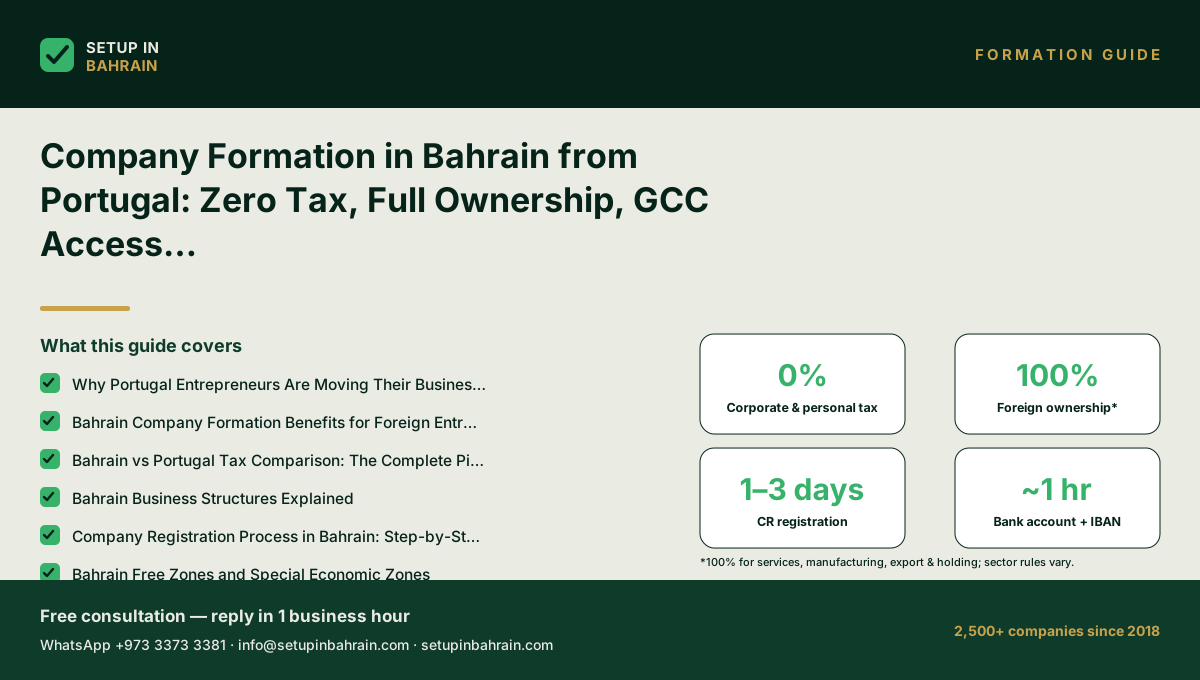
- Why Portugal Entrepreneurs Are Moving Their Business to Bahrain
- Bahrain Company Formation Benefits for Foreign Entrepreneurs
- Bahrain vs Portugal Tax Comparison: The Complete Picture
- Bahrain Business Structures Explained
- Company Registration Process in Bahrain: Step-by-Step
→ Complete guide: Company Formation in Bahrain — the full 2026 guide
View details
Ownership & capital
A Bahrain WLL can be owned by a single person — 100% foreign ownership applies to most activities, with no local partner required for services, manufacturing, export trading and holding companies. The minimum share capital is BHD 1 ; we recommend BHD 1,000 . This Makes bank account opening and investor visa approval smoother.
Miguel had been running his digital marketing agency in Lisbon for seven years when he finally did the math that changed everything. Between his 21% IRC corporate tax, the municipal derrama pushing his effective rate to 24.5%, mandatory social security contributions of 23.75% as an employer, and the constant headaches of quarterly IVA filings through Portal das Finanças, he was surrendering nearly €180,000 annually to the Portuguese state on €500,000 in revenue. His take-home after paying himself? Barely enough to justify the stress of employing twelve people under Portugal's rigid labor code.
"I spent more time dealing with compliance than actually growing my business," Miguel told me over coffee in Manama six months after relocating his company to Bahrain. "Now I pay Generally no corporate income tax for most sectors, my clients in the Gulf pay me in dollars that actually stay dollars. I opened my company in four days instead of four months."
Miguel isn't an outlier. He represents a growing wave of Portuguese entrepreneurs who've discovered what savvy international investors have known for years: Bahrain offers something Portugal simply cannot match—a genuine zero-tax environment with full foreign ownership, positioned at the doorstep of the world's fastest-growing consumer market.
This guide isn't theoretical. It's built from dozens of conversations with Portuguese business owners who've made the move, plus direct experience navigating the MOIC registration system, Bahrain EDB fast-track programs, and CBB-regulated banking infrastructure. If you're a Portugal-based entrepreneur tired of feeding a tax system that gives you little in return, this is your roadmap.
BHD 1 ≈ EUR 2.45 (based on BHD/USD peg of 2.65 and EUR/USD of about 1.08)
Why Portugal Entrepreneurs Are Moving Their Business to Bahrain
Let's be direct about something most "international business" articles dance around: the Portuguese tax system is designed to extract maximum value from entrepreneurs while providing more and more limited returns. The numbers don't lie, and Portuguese business owners are finally doing the calculations that matter.
Take the case of Sofia, a software developer from Porto who built a successful SaaS company serving clients across Europe. Her revenue grew steadily, her team expanded, and her innovation was recognized. Yet every quarter, she found herself wrestling with the Portal das Finanças, calculating her 21% IRC corporate tax, often compounded by municipal surtaxes that pushed her effective rate to 24.5%. This wasn't just a number on a balance sheet—it was money that could have funded two additional developers, expanded her marketing reach, or simply provided a cushion for future investment.
Sofia's story resonates with thousands of Portuguese entrepreneurs who face the same reality: a tax burden that actively discourages growth, a compliance infrastructure that consumes productive hours, and a labor framework so rigid that hiring decisions become existential risks.
The Real Cost of Operating in Portugal
When international benchmarking is applied honestly, Portugal's fiscal competitiveness looks more and more problematic for growth-oriented businesses:
Corporate Taxation : The headline 21% IRC rate is misleading. Add the municipal derrama (up to 1.5% depending on municipality). The derrama estadual (state surtax) that kicks in progressively from 3% to 9% on profits exceeding €1.5 million, and your effective rate can reach 31.5% at higher profit levels. For a company earning €2 million in taxable profit, we're talking about €630,000 disappearing annually.
Social Security Burden: Portuguese employers contribute 23.75% of gross wages to social security, while employees pay 11%. Combined, that's 34.75% on every euro of payroll—money that neither grows the business nor enriches the worker meaningfully. A €50,000 annual salary actually costs the company €61,875.
IVA Complexity : The 23% standard VAT rate isn't just high—it's administratively punishing. Quarterly declaração periódica de IVA filings through Portal das Finanças require meticulous record-keeping. Errors trigger penalties that can reach 100% of the understated amount. For businesses operating internationally, the reverse-charge mechanisms and intra-community supply rules add layers of complexity that require specialized accountants.
Mandatory Auditor Requirements : Once your company crosses the medium-company threshold (€4 million in total assets, €8 million in net sales, or 50 employees—meeting two of three criteria), you're legally required to engage a Revisor Oficial de Contas (ROC). Annual ROC fees typically range from €8,000 to €25,000, depending on company complexity. Represent a compliance cost that provides no operational benefit.
Labor Code Rigidity : Portugal's Código do Trabalho makes employee termination extraordinarily difficult and expensive. Dismissing an underperforming employee requires documented cause, lengthy procedures. Severance payments that can exceed 12 months of salary for long-tenured workers. This rigidity transforms hiring decisions into long-term financial commitments that many entrepreneurs simply cannot afford to make.
What's Driving the Migration
Three converging factors explain why Portuguese entrepreneurs are more and more looking toward Bahrain:
Post-Golden Visa Constraints : The 2023 changes to Portugal's Golden Visa program eliminated real estate as a pathway for most investors. The broader tightening of residency-by-investment schemes across Europe has made outbound relocation more attractive than inbound immigration facilitation.
Gulf Economic Growth: The GCC region, anchored by Saudi Arabia's Vision 2030 transformation, represents a €1.5 trillion economy growing at rates European markets haven't seen in decades. Saudi Arabia alone is investing €500 billion in NEOM and related megaprojects. Portuguese companies with Gulf-based entities can access this spending directly.
Digital Business Reality : For software companies, consultancies. Service businesses, physical location more and more matters less than regulatory environment. A Portuguese developer can serve clients globally from anywhere—the question becomes where that "anywhere" should be incorporated for optimal tax treatment and operational flexibility.
Bahrain Company Formation Benefits for Foreign Entrepreneurs
Bahrain's value proposition for Portuguese entrepreneurs centers on four pillars that directly address the pain points of operating in Portugal: Generally no corporate income tax for most sectorsation, 100% foreign ownership, streamlined regulatory processes, and strategic GCC market access.
Generally no corporate income tax for most sectors: Understanding What It Really Means
Unlike jurisdictions that offer "low" tax rates or complex incentive schemes, Bahrain's approach is refreshingly straightforward: there is no corporate income tax for most business activities. Period.
According to the Ministry of Industry and Commerce (MOIC), companies engaged in commercial, service, or industrial activities pay generally no corporate income tax for most sectors on their profits. The only exception involves oil and gas extraction. This Faces a 46% tax rate—irrelevant to the vast majority of foreign entrepreneurs.
For a Portuguese company generating €500,000 in annual profit, the difference is stark:
| Tax Element | Portugal | Bahrain |
| Corporate Tax | €122,500 (24.5% effective) | €0 |
| Municipal Surtax | Included above | €0 |
| State Surtax | Applicable above €1.5M | N/A |
| Tax on Dividends | 28% PIT on distribution | 0% |
| Annual Tax Savings | — | €122,500+ |
The World Bank's 2024 Doing Business metrics rank Bahrain highly for tax administration simplicity. There are no quarterly provisional tax payments, no complex deduction calculations. No risk of reassessment based on transfer pricing disputes. Your profit is your profit.
100% Foreign Ownership: No Local Partner Required
Until recently, many GCC countries required foreign businesses to partner with local sponsors who held majority ownership. This created dependency relationships that often disadvantaged foreign entrepreneurs and complicated exit strategies.
Bahrain eliminated these requirements fully. Under the Commercial Companies Law and subsequent amendments, foreign nationals and entities can own 100% of most business types without any Bahraini partnership requirement.
The Economic Development Board (EDB) confirms that this applies to:
- Single-person companies (WLLs)
- Limited liability companies (WLLs)
- Branch offices of foreign companies
- Holding companies
- Free zone entities
For Portuguese entrepreneurs accustomed to full ownership of their domestic companies, this means no structural compromise is necessary when expanding to Bahrain.
Strategic GCC Access: The 57 Million Consumer Market
Bahrain's geographic position provides access advantages that no European jurisdiction can match. The King Fahd Causeway connects Bahrain directly to Saudi Arabia—the GCC's largest economy with 36 million consumers and €650 billion in annual imports.
The GCC Unified Economic Agreement allows Bahraini-registered companies to operate across member states (Saudi Arabia, UAE, Kuwait, Qatar, Oman) with preferential treatment. For Portuguese businesses targeting regional expansion, this means:
- Saudi Market Access: Direct service contracts with Saudi government entities and private companies, more and more requiring in-region invoicing
- UAE Connectivity: Dubai's re-export hub accessible via short flights and established logistics networks
- Qatar Opportunities: Post-World Cup infrastructure spending continuing through 2030
Portuguese tech companies especially benefit from this positioning. Gulf governments are investing heavily in digital transformation—Saudi Arabia's digital economy is projected to reach €150 billion by 2030—and they more and more prefer vendors with regional presence over purely European suppliers.
The EDB Fast-Track Advantage
The Bahrain Economic Development Board operates investor facilitation programs that compress timelines dramatically compared to Portuguese bureaucratic processes.
For qualifying businesses, the EDB provides:
- Pre-arrival Processing: License applications reviewed before you land in Bahrain
- Dedicated Case Managers: Single points of contact who coordinate across MOIC, LMRA, and banking institutions
- 48-Hour Commitments: Priority processing for investor visa applications
- Soft Landing Support: Introductions to service providers, banking contacts, and business community networks
According to EDB statistics, the average company formation timeline for EDB-supported investors is 5-7 business days from initial application to operating license. Compare this to Portugal, where forming a sociedade por quotas (Lda.) through Empresa na Hora takes 2-3 weeks minimum, with more complex structures requiring 2-4 months.
Bahrain vs Portugal Tax Comparison: The Complete Picture
Understanding the full fiscal comparison requires looking beyond headline rates to examine total cost of business operation.
Corporate Taxation: Detailed Breakdown
Portugal's Layered System : Base IRC Rate: 21% Derrama Municipal: 0% to 1.5% (varies by municipality. Lisbon charges 1.5%) Derrama Estadual: 3% on profits €1.5M-€7.5M; 5% on profits €7.5M-€35M; 9% above €35M Effective Rate Range: 21% to 31.5%
Bahrain's Straightforward Approach:
- Corporate Income Tax: 0%
- Municipal Taxes: None
- Sectoral Surcharges: None (except hydrocarbons)
- Effective Rate: 0%
For a Portuguese company with €3 million in taxable profit, the tax burden breaks down as:
| Component | Portugal Calculation | Amount |
| IRC (21%) | €3,000,000 × 21% | €630,000 |
| Derrama Municipal (1.5%) | €3,000,000 × 1.5% | €45,000 |
| Derrama Estadual (3% on €1.5M) | €1,500,000 × 3% | €45,000 |
| Total Tax | €720,000 |
Employment Cost Comparison
Portugal's social security burden transforms labor costs greatly:
| Employee Gross Salary | Portugal Total Cost | Bahrain Total Cost |
| €40,000 | €49,500 (+23.75% TSU) | €40,000 (no social contributions) |
| €60,000 | €74,250 | €60,000 |
| €100,000 | €123,750 | €100,000 |
For a Portuguese company with €500,000 in annual payroll, moving to Bahrain saves about €118,750 in social contributions alone.
Dividend and Capital Gains Treatment
Portugal taxes dividend distributions at 28% for individual shareholders (or 35% for corporate shareholders outside the participation exemption regime). Capital gains on share disposals face similar treatment.
Bahrain imposes no withholding tax on dividends, no capital gains tax, and no taxation on profit repatriation. Your after-tax profit in Bahrain can be distributed to shareholders or reinvested without any additional fiscal layer.
VAT Considerations
Bahrain implemented a 10% VAT in 2019, lower than Portugal's 23% standard rate. More importantly, Bahrain's VAT administration is simpler:
- Quarterly filing only (no monthly obligations for most businesses)
- Higher registration threshold (BHD 37,500, about €91,875)
- Zero-rating for financial services and exports
Portuguese businesses selling services to GCC clients can structure operations to minimize VAT exposure entirely, as exported services are typically zero-rated.
Bahrain Business Structures Explained
Choosing the right entity structure affects everything from initial capital requirements to operational flexibility and future exit options. Bahrain offers several options suited to different business models.
Limited Liability Company (WLL)
The With Limited Liability company structure is the most common choice for foreign entrepreneurs establishing operational businesses in Bahrain.
Key Characteristics:
- Minimum capital: BHD 50 (about €122) for most activities
- Shareholders: 2-50 (can be individuals or corporate entities)
- 100% foreign ownership: Permitted
- Manager requirements: At least one manager, can be non-Bahraini
- Ideal for: Operating companies, service businesses, trading entities
The WLL structure provides limited liability protection while allowing flexibility in profit distribution and management arrangements. Portuguese entrepreneurs typically use this structure for subsidiaries or relocating existing operations.
Formation Requirements:
- Memorandum of Association (Arabic, with English translation)
- Articles of Association
- Proof of registered office address
- Shareholder identification documents
- Initial capital deposit confirmation
- Commercial registration application
single-shareholder WLL
For individual entrepreneurs or solo consultants, the WLL offers simplified governance without requiring multiple shareholders.
Key Characteristics:
- Minimum capital: BHD 50 for most activities
- Shareholder: Single individual or corporate entity
- Limited liability: Yes, personal assets protected
- Manager: Owner can self-manage
- Ideal for: Consultants, freelancers, holding structures
The WLL is especially attractive for Portuguese digital nomads or consultants who want a proper corporate structure without the complexity of multi-shareholder governance.
Branch Office
Foreign companies can establish Bahrain branches without creating separate legal entities.
Key Characteristics:
- No separate capital requirement
- Parent company liable for branch obligations
- Activities limited to parent company scope
- Ideal for: Testing the market, specific project execution
Branch offices work well for Portuguese companies wanting regional presence without full commitment to a new entity. But, they don't provide liability separation—parent company assets remain exposed to branch obligations.
Holding Company
For Portuguese entrepreneurs with multiple business interests or investment portfolios, Bahrain's holding company structure offers efficient asset consolidation.
Key Characteristics:
- Can hold shares in Bahraini and foreign entities
- No minimum capital specified (practical minimum BHD 1,000)
- Management flexibility
- Zero tax on dividend income and capital gains
The holding structure is especially valuable for Portuguese families looking to consolidate business interests in a tax-efficient jurisdiction while maintaining control.
Free Zone Options
Bahrain's free zones offer additional advantages for specific activities:
Bahrain Logistics Zone (BLZ):
- Duty-free import/export
- No minimum capital requirements
- 100% foreign ownership guaranteed by law
- Ideal for: Distribution, warehousing, light manufacturing
Bahrain International Investment Park (BIIP):
- Industrial and manufacturing focus
- Streamlined licensing
- Ready-built facilities available
- Ideal for: Manufacturing, assembly operations
Bahrain FinTech Bay:
- Financial technology focus
- Regulatory sandbox access
- CBB fast-track licensing support
- Ideal for: Payment processors, digital banking, insurtech
For most Portuguese service companies, the mainland WLL structure offers the best balance of flexibility and simplicity. Free zones add value primarily for logistics, manufacturing, or regulated financial services.
Company Registration Process in Bahrain: Step-by-Step
The registration process in Bahrain is designed for efficiency, a stark contrast to Portuguese bureaucratic timelines. Here's exactly what to expect.
Step 1: Business Activity Selection and Name Reservation (Day 1-2)
Activity Classification: MOIC maintains a comprehensive list of permitted business activities. Each activity carries specific licensing requirements and, in some cases, minimum capital thresholds. Common choices for Portuguese entrepreneurs include:
- Management consultancy services
- Information technology services
- Marketing and advertising services
- Import and export trading
- Professional services (engineering, architecture, etc.)
Name Reservation: Submit three name choices to MOIC via the Sijilat online platform. Names must be unique, cannot imply government affiliation, and must include the entity type (WLL, WLL, etc.). Arabic names are primary; English translations are permitted.
Timeline: Online approval typically within 24-48 hours.
Step 2: Document Preparation (Day 2-4)
Required Documents:
- Memorandum of Association: Outlines company purpose, capital, and shareholder rights
- Articles of Association: Governance procedures and management structure
- Shareholder Documents: Passport copies, address proof, and bank reference letters for individuals; certificate of incorporation and board resolution for corporate shareholders
- Manager Appointment: Documents for designated managers including passport and qualifications
- Registered Office Proof: Lease agreement or ownership documents for business premises
Portuguese-Specific Considerations: Documents issued in Portugal require:
- Certified translation to Arabic by a licensed translator
- Apostille from the Portuguese Ministry of Justice (for Hague Convention recognition)
- Authentication timeline: 5-10 business days
Pro Tip: Complete Portuguese document apostille before traveling to Bahrain. The Loja do Cidadão provides apostille services, but processing takes longer than many entrepreneurs expect.
Step 3: Capital Deposit and Bank Account Opening (Day 3-5)
Capital Requirements: Deposit the minimum share capital (as low as BHD 50 for most activities) into a temporary bank account opened specifically for company formation.
Banking Options: Major banks accepting initial corporate deposits include:
- Bank of Bahrain and Kuwait (BBK)
- Ahli United Bank
- National Bank of Bahrain (NBB)
- BNP Paribas Bahrain (for larger operations)
Documents for Banking:
- Passport copies of all shareholders
- Proof of address (Portuguese documents acceptable with translation)
- Business plan summary
- Source of funds declaration
- Expected transaction volumes
CBB Compliance Note: The Central Bank of Bahrain (CBB) mandates thorough due diligence under anti-money laundering regulations. Portuguese entrepreneurs should prepare clear documents of funds sources—business profits, investment returns, property sales—with supporting bank statements.
Step 4: Commercial Registration Submission (Day 4-6)
Submit the complete application package through MOIC's Sijilat portal or directly at MOIC offices in Manama.
Application Components:
- Completed CR application form
- Notarized Memorandum and Articles of Association
- Capital deposit confirmation
- Registered office documents
- Shareholder and manager identification
- Proposed business activities list
Fees: Registration fees vary by activity but typically range from BHD 100-500 (€245-€1,225) for standard commercial activities. Specialized licenses (financial services, healthcare) carry higher fees.
Step 5: License Issuance (Day 5-7)
Upon approval, MOIC issues:
- Commercial Registration Certificate: Primary business license
- CR Number: Unique identifier for all official transactions
- Activity Permit: Confirming approved business activities
Digital Delivery: Licenses are issued digitally through the Sijilat system, with physical certificates available upon request.
Step 6: Post-Registration Requirements (Week 2)
Permanent Bank Account: Convert temporary formation account to permanent operating account or open accounts at additional banks.
GOSI Registration: Register with the General Organization for Social Insurance (mandatory for any Bahraini employees; optional for foreign staff work injury coverage).
Municipality Registration: Get municipal license for physical premises.
Chamber of Commerce Membership: Join the Bahrain Chamber of Commerce and Industry (BCCI) for networking access and trade facilitation.
Total Timeline Comparison
| Milestone | Bahrain | Portugal (Lda.) |
| Name reservation | 1-2 days | 1-2 days |
| Document preparation | 2-3 days | 5-10 days |
| Notarization/apostille | Not required if done abroad | 3-5 days |
| Submission to registration | Same day | Same day |
| Registration approval | 2-4 days | 5-10 days |
| Bank account opening | 3-5 days | Banking: approximately 1 hour in 99% of our reported cases; our last 100 applications handled in 2026 were approved; subsidiaries or CIS shareholders: 3 days to 2 weeks. Subject to the bank’s final review. |
| Total to operational | 7-12 days | 25-45 days |
Bahrain Free Zones and Special Economic Zones
While mainland incorporation suits most service businesses, Bahrain's free zones offer specific advantages worth considering.
Bahrain Logistics Zone (BLZ)
Located adjacent to Khalifa Bin Salman Port, the BLZ caters to distribution and logistics operations.
Key Benefits:
- 100% foreign ownership guaranteed by legislation
- Zero customs duties on imports for re-export
- No minimum capital requirements
- Streamlined customs procedures
- Ready-built warehouse facilities available
Best For: Portuguese companies involved in trading physical goods, especially those targeting Saudi Arabian market entry via Bahrain's causeway connectivity.
Practical Example : A Porto-based wine distributor established BLZ presence to warehouse inventory for Gulf-wide distribution. Goods arrive duty-free, are stored in climate-controlled facilities. Ship to Saudi, UAE, and Kuwait without incurring Bahrain import duties.
Bahrain International Investment Park (BIIP)
The BIIP focuses on light manufacturing, assembly, and industrial operations.
Key Benefits:
- Competitive land lease rates (BHD 1-3 per square meter annually)
- Built-to-suit facility options
- Shared infrastructure (power, water, waste management)
- Proximity to port and airport facilities
Best For: Portuguese manufacturers considering regional production to serve GCC markets with "Made in Bahrain" origin for preferential trade treatment.
Investment Gateway Bahrain
This isn't a physical free zone but rather a one-stop facilitation service for foreign investors operated by the EDB.
Services Include:
- License application processing
- Visa and work permit coordination
- Banking introductions
- Office space sourcing
- Business matching with local partners
Portuguese Entrepreneurs: The EDB actively courts European investors and maintains Portuguese-language capability through translation services. Designated relationship managers guide investors through each step.
Comparing Free Zone vs. Mainland Incorporation
| Factor | Free Zone | Mainland |
| Foreign ownership | 100% guaranteed | 100% for most activities |
| Tax rate | 0% | 0% |
| Customs duties | Exempt for re-export | Standard rates apply |
| Office flexibility | Must locate in zone | Any location |
| Banking access | Full access | Full access |
| Activity restrictions | Zone-specific | Broader activity range |
| Setup complexity | Similar | Similar |
Opening a Corporate Bank Account in Bahrain
Banking infrastructure is often the make-or-break factor for international entrepreneurs. Bahrain's CBB-regulated banking sector offers robust options but requires preparation.
The Banking Landscape
Bahrain hosts over 400 financial institutions, regulated by one of the region's most respected central banks. The Central Bank of Bahrain (CBB) maintains standards aligned with Basel III requirements and FATF recommendations.
Major Commercial Banks:
- Ahli United Bank: Largest regional bank, strong SME services
- Bank of Bahrain and Kuwait (BBK): Established local institution, competitive fees
- National Bank of Bahrain (NBB): Government-linked, extensive branch network
- Arab Banking Corporation (ABC): International focus, multi-currency capabilities
International Banks with Bahrain Presence:
- BNP Paribas
- HSBC
- Standard Chartered
- Citibank
Account Opening Requirements
Banks require comprehensive documents reflecting CBB's anti-money laundering framework:
Corporate Documents:
- Commercial Registration Certificate
- Memorandum and Articles of Association (Arabic originals plus English translations)
- Board resolution authorizing account opening and designating signatories
- Shareholder register
Beneficial Owner Documents:
- Passport copies for all shareholders holding 10%+ ownership
- Proof of residential address (utility bills, bank statements)
- Professional or business references
- Source of funds documents
Business Information:
- Business plan or company profile
- Expected monthly transaction volumes
- Primary trading currencies
- Key clients and suppliers (names, countries)
Source of Funds: Critical for Portuguese Entrepreneurs
Bahrain's banks take source of funds verification seriously. Portuguese entrepreneurs should prepare:
- Business Profits: Tax returns (IRC declarations) showing historical profits, bank statements demonstrating receipt of business income
- Property Sales: Sale contracts, notary documents, proof of funds transfer
- Investment Returns: Brokerage statements, dividend receipts
- Family Wealth: Inheritance documents, gift declarations
Common Issue: Portuguese entrepreneurs sometimes assume their word is sufficient. It isn't. Banks require documentary proof, and accounts have been delayed or rejected due to inadequate source verification.
Multi-Currency Capabilities
Bahrain's banking system excels at multi-currency management:
- Account Currencies: BHD, USD, EUR, GBP readily available
- Currency Conversion: Competitive rates, especially BHD-USD (pegged currency)
- International Transfers: SWIFT connectivity to all major banking centers
- Regional Payments: GCC payment systems integration
For Portuguese businesses invoicing European clients in euros while paying Gulf suppliers in dollars, Bahrain banks handle currency management efficiently.
Timeline and Costs
Account Opening Timeline: 10-20 business days after document submission (faster than Portuguese banks for corporate accounts)
Typical Fees:
- Account opening: BHD 50-200 (€122-€490)
- Monthly maintenance: BHD 20-50 (€49-€122)
- International transfers: BHD 15-40 per transaction
- Currency conversion: 0.5%-1.5% spread
Digital Banking Options
Bahrain's fintech ecosystem includes digital-first banks with streamlined onboarding:
- ila Bank: Fully digital, rapid account opening
- Meem: Islamic digital banking option
- Rain: Cryptocurrency-friendly (for relevant businesses)
These options can serve as secondary accounts while traditional bank relationships develop.
Residency and Work Visas for Portuguese Nationals
Portuguese entrepreneurs have multiple pathways to establish residency in Bahrain, each suited to different operational models.
Investor Visa
The investor visa is the primary pathway for business owners establishing companies in Bahrain.
Requirements:
- Valid Commercial Registration
- Minimum investment threshold (varies by activity, typically BHD 50,000 / €122,500 for full privileges)
- Clean criminal record
- Health insurance coverage
- Medical examination
Benefits:
- Residency permit renewable annually
- Ability to sponsor employee visas
- Access to Bahrain banking and services
- GCC travel facilitation
Processing Time: 2-4 weeks through LMRA (Labour Market Regulatory Authority)
Portugal-Specific Documents: Portuguese criminal record certificates (Certificado do Registo Criminal) must be apostilled before submission.
Golden Residency Visa
Bahrain introduced an enhanced residency program for high-value investors and retirees.
Qualification Criteria:
- Real estate investment of BHD 200,000+ (€490,000), or
- Proven income/pension of BHD 4,000+ monthly (€9,800), or
- Significant business investment
Benefits:
- Long-term residency (5-10 year validity)
- Family sponsorship included
- No employment requirement
- Property ownership rights
This program especially appeals to Portuguese entrepreneurs who've sold businesses or accumulated investment portfolios and seek long-term Gulf residence.
Flexi Permit
For entrepreneurs not requiring full residency or those testing the market:
Characteristics:
- One-year self-sponsored work permit
- No employer sponsorship required
- Can freelance or work for multiple clients
- BHD 500 annual fee (€1,225)
Limitations: Cannot sponsor other employees or access all residency benefits.
Visa-Free Entry for Initial Visit
Portuguese passport holders enjoy visa-free entry to Bahrain for tourism purposes (14 days, extendable). This allows entrepreneurs to:
- Visit Bahrain to explore the market
- Meet with service providers and potential clients
- Complete initial company formation steps
- Return to Portugal while processing completes
- Re-enter on investor visa once approved
This flexibility means Portuguese entrepreneurs don't need to commit to residency before verifying Bahrain suits their needs.
Family Considerations
Investor visas allow family sponsorship:
- Spouse: Immediately eligible for dependent visa
- Children: Covered until age 18 (25 if in full-time education)
- Parents: Possible with additional documents
International schools in Bahrain offer British, American. IB curricula, with annual fees ranging from BHD 3,000-10,000 (€7,350-€24,500) depending on school and grade level.
Hiring and Managing Employees from Portugal
Portuguese entrepreneurs often want to bring key team members or hire locally. Understanding Bahrain's labor market is essential for either approach.
Bringing Portuguese Employees to Bahrain
Work Permit Process:
- Job offer from Bahrain-registered company
- LMRA work permit application
- Medical examination (conducted in Bahrain)
- Visa issuance
- Residency permit (iqama) collection
Timeline: 3-6 weeks after application submission
Costs:
- Work permit fee: BHD 500-800 per employee annually
- Medical examination: BHD 30
- Residency processing: BHD 100
- Health insurance: BHD 200-500 annually (mandatory)
Practical Reality : Bringing Portuguese employees involves visa costs, relocation expenses. Often salary premiums to compensate for living abroad. Most Portuguese entrepreneurs start with one or two key people and hire locally for other roles.
Hiring in Bahrain
Bahrain's labor market includes:
Bahraini Nationals: Government encourages Bahraini employment through the Bahrainisation program, which sets sector-specific quotas. Service companies typically have lower requirements than manufacturing or retail.
Expatriate Workers : The majority of private-sector employment, sourced from across Asia, Middle East. More and more Africa and Europe.
Compensation Benchmarks (Monthly):
- Junior administrative: BHD 400-600 (€980-€1,470)
- Mid-level professional: BHD 800-1,500 (€1,960-€3,675)
- Senior manager: BHD 2,000-5,000 (€4,900-€12,250)
- Executive: BHD 5,000+ (€12,250+)
Labor Law Comparison: Bahrain vs. Portugal
| Factor | Portugal | Bahrain |
| Minimum wage | €820/month (2024) | BHD 300 for Bahrainis only |
| Working hours | 40 hours/week maximum | 48 hours/week standard |
| Annual leave | 22 working days minimum | 30 calendar days after 1 year |
| Termination notice | 15-75 days depending on tenure | 30-90 days depending on contract |
| Severance | 12-20 days per year of service | 15 days-2 weeks per year of service |
| Probation period | Maximum 180 days | Maximum 3 months |
| Termination flexibility | Extremely rigid | Moderate |
Remote Work Considerations
Many Portuguese entrepreneurs maintain hybrid models:
- Core operations team in Bahrain (2-3
Bahrain Business Guides for Portugal Citizens
Frequently Asked Questions
How long does it take to set up?
It takes 15 to 20 days. We file all forms for you. You do not need to wait long.
What does it cost?
Company formation: Standard BHD 1,340 with 3 months of office address; Gold BHD 1,700 with 6 months; Premium BHD 2,150 with 12 months and a cabin, officer table and chair, and two guest chairs. No formation package includes visas, including Premium. Investor/work visas are priced separately: BHD 755 for one year or BHD 953 for two years, in addition to the formation package. Ask for a written, itemized quotation confirming government fees and all inclusions before payment.
Do I need to visit Bahrain?
No. You can set up your firm from home. We do all the work online. Some banks may ask for one visit.
What tax will I pay?
You pay zero tax on your profits. Bahrain has no corporate income tax. This is a key benefit of the setup.
Can I own 100% of my firm?
Yes. Foreign owners can hold all shares. No local partner is needed. Full ownership is allowed.
What do I need to start?
You need a valid passport. You also need a trade name and a business address. We help you with all of these.
How do I open a bank account?
We guide you step by step. Most banks take 3 to 6 weeks. You will need your CR and firm papers.
Who issues the Commercial Registration (CR)?
The CR is issued by the MOICT. It is your legal right to trade in Bahrain. We file the CR for you.
Can I renew my CR each year?
Company renewal packages: BHD 530 with 3 months of office address; BHD 980 with 6 months; BHD 1,520 with 12 months. These are separate renewal packages, not visa fees.
How do I get started?
Fill in our form on this page. Our team will call you back. We map your best setup plan at no cost.
Steps to Form Your Company
- Pick your trade name. We check if it is free.
- Choose your business type. WLL is the most common.
- Sign the MOA. We draft and file all legal docs.
- Pay the state fees. About BHD 432 in total.
- Get your CR. Takes 15 to 20 days.
- Open your bank account. We guide each step.
- Start trading. You are ready to do business.
Key Facts
- Tax rate: 0%
- Foreign ownership: 100%
- Setup time: 15 to 20 days
- Company formation: Standard BHD 1,340 with 3 months of office address; Gold BHD 1,700 with 6 months; Premium BHD 2,150 with 12 months and a cabin, officer table and chair, and two guest chairs. No formation package includes visas, including Premium. Investor/work visas are priced separately: BHD 755 for one year or BHD 953 for two years, in addition to the formation package. Ask for a written, itemized quotation confirming government fees and all inclusions before payment.
- Company renewal packages: BHD 530 with 3 months of office address; BHD 980 with 6 months; BHD 1,520 with 12 months. These are separate renewal packages, not visa fees.
- Client rating: 4.8 stars
- Clients served: 2,500 and more
Quick Facts
- Tax rate: 0%
- Own all of your firm: Yes, 100%
- Time to set up: 15 to 20 days
- Company formation: Standard BHD 1,340 with 3 months of office address; Gold BHD 1,700 with 6 months; Premium BHD 2,150 with 12 months and a cabin, officer table and chair, and two guest chairs. No formation package includes visas, including Premium. Investor/work visas are priced separately: BHD 755 for one year or BHD 953 for two years, in addition to the formation package. Ask for a written, itemized quotation confirming government fees and all inclusions before payment.
- Company renewal packages: BHD 530 with 3 months of office address; BHD 980 with 6 months; BHD 1,520 with 12 months. These are separate renewal packages, not visa fees.
- Rating: 4.8 stars
- Clients: 2,500 and more
Why Bahrain?
Bahrain has no tax. You keep all your profits. This is rare in the Gulf.
You can own all of your firm. No local partner is needed. The law allows full foreign ownership.
Setup takes 15 to 20 days. We file all forms for you. You can do it all from home.
Bahrain has a free trade deal with the US. Your goods face low or no tariffs. This gives you access to big markets.
We have served 2,800+ clients from 44+ countries and maintain records to substantiate that total where needed. We have 113 Google reviews; reviews represent only some clients and are not the same as the total clients served.
Our Steps
- Tell us your plan. We advise you for free.
- We pick the right firm type for you.
- We file all your forms with MOICT.
- You get your CR in 15 to 20 days.
- We help you open a bank account.
- You are ready to trade. We stay with you.
Why Set Up in Bahrain?
Bahrain is a great place to run a firm. It has no tax. You keep all your profits. This is rare in the Gulf.
You can own your firm 100%. No local partner is needed. The law is clear and fair.
It is fast to set up. You can have a CR in 15 to 20 days. We file all forms for you.
Bahrain has a free trade deal with the US. Your goods face low or no tariffs. This gives you access to big markets.
The banks are good. The roads are good. The schools are good. It is a well-run state.
We have served 2,800+ clients from 44+ countries and maintain records to substantiate that total where needed. We have 113 Google reviews; reviews represent only some clients and are not the same as the total clients served.
Our Services
- Company formation: Standard BHD 1,340 with 3 months of office address; Gold BHD 1,700 with 6 months; Premium BHD 2,150 with 12 months and a cabin, officer table and chair, and two guest chairs. No formation package includes visas, including Premium. Investor/work visas are priced separately: BHD 755 for one year or BHD 953 for two years, in addition to the formation package. Ask for a written, itemized quotation confirming government fees and all inclusions before payment.
- Company renewal packages: BHD 530 with 3 months of office address; BHD 980 with 6 months; BHD 1,520 with 12 months. These are separate renewal packages, not visa fees.
- Investor Visa — from BHD 755
- Work Visa — LMRA managed
- Virtual office — from BHD 600 per year
- Bank account opening — 3 to 6 weeks
- Family visa — for spouse and kids
- UBO filing — as required by law
Bahrain at a Glance
- Tax rate: 0%
- Foreign ownership: 100%
- Setup time: 15 to 20 days
- Free trade deal: Yes, with the US
- Language: Arabic and English
- Currency: Bahraini Dinar (BHD)
- Time zone: UTC+3
- GDP growth: Steady and strong
How to Start
- Fill in the form on this page. It takes 3 minutes.
- We call you back the same day.
- We map the best plan for your firm type and goals.
- We file all forms. We deal with MOICT for you.
- You get your CR in 15 to 20 days.
- We help you open a bank account and get your visa.
- You are ready to trade. We stay with you.
Common Questions
Do I need to visit Bahrain to set up?
No. You can do it all from home. We file online. You may need one visit to open a bank account.
Is Bahrain safe for business?
Yes. Bahrain is a stable state. It has a clear legal system. Your firm and funds are safe here.
Can I hire staff from any country?
Yes. You can hire from any country. Each hire needs a work permit from LMRA. We manage this for you.
What type of firm should I set up?
Most clients choose a WLL. This is a limited liability firm. It is flexible and well-known in Bahrain. We advise you on the best type for your case.
How do I get in touch?
Fill in our form. We call you back the same day. You can also email us or use the chat on this page.
Ready to set up in Bahrain from Portugal?
Tell us your business idea. We map the right entity, ownership and timeline — then handle the filing while you focus on what matters.