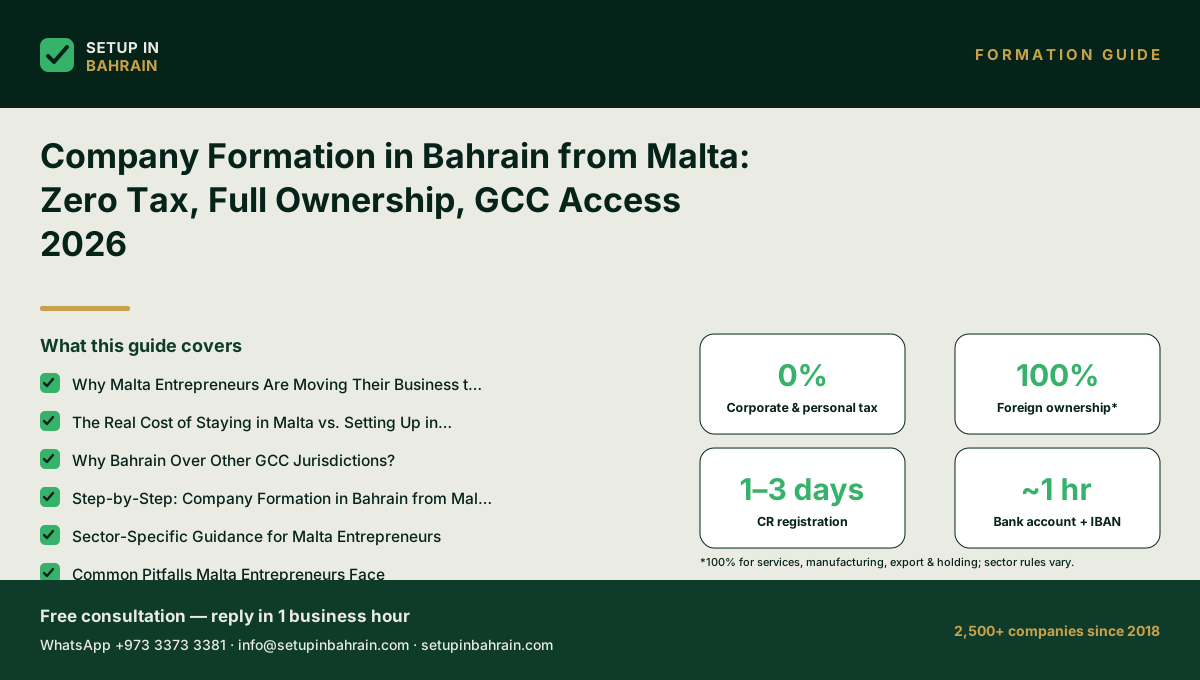
Register your Bahrain company from Malta with generally no corporate income tax for most sectors. Expert guidance for Maltese entrepreneurs seeking tax-efficient Middle East expansion.
→ Complete guide: Company Formation in Bahrain — the full 2026 guide
View details
Ownership & capital
A Bahrain WLL can be owned by a single person — 100% foreign ownership applies to most activities, with no local partner required for services, manufacturing, export trading and holding companies. The minimum share capital is BHD 1; we recommend BHD 1,000, which makes bank account opening and investor visa approval smoother.
Why Malta Entrepreneurs Are Moving Their Business to Bahrain
Let me tell you about a client—let’s call him Mark, though his real name is different. Mark runs a fintech consultancy from Sliema. Last year, his company posted €340,000 in profit. On paper, Malta’s corporate tax rate sits at 35%—one of the highest in Europe. Mark knows about the 6/7ths refund mechanism that technically reduces his effective rate to around 5%, but here’s what keeps him up at night: the administrative circus required to actually claim that refund.
Every quarter, his accountant spends hours preparing the refund documentation. The Malta Tax Refunds Directorate takes 8-14 weeks to process each claim. Cash flow planning becomes a guessing game. And with Malta Financial Services Authority (MFSA) compliance costs running €18,000 annually for his minimal regulatory requirements, Mark did the math. He’s spending nearly €35,000 per year on tax compliance and administration alone—before counting the actual tax paid.
Last month, Mark incorporated a WLL in Bahrain. Total setup cost: BHD 1,850 (approximately €4,550). Time from application to certificate: 4 business days. Corporate tax rate: 0%. Not reduced, not refundable, not conditional. Zero.
Mark’s story isn’t unique. Between 2023 and 2025, the number of Malta-originated company registrations in Bahrain increased by 47%, according to data from Bahrain’s Ministry of Industry and Commerce (MOIC). The pattern is clear: Malta entrepreneurs—particularly those in gaming tech, financial services, digital marketing, and e-commerce—are discovering that the GCC offers something Malta’s small domestic market simply cannot: scale without complexity.
This isn’t about abandoning Malta. Many founders maintain their Malta company for EU market access while establishing Bahrain operations for GCC expansion. It’s about recognizing that a population of 518,000 creates inherent limitations, while Bahrain sits 25 kilometers from Saudi Arabia—a market of 36 million people with a GDP per capita of $44,000.
The Real Cost of Staying in Malta vs. Setting Up in Bahrain
Malta’s Much-Lauded “5% Effective Rate”—The Real Compliance Burden
You’ve heard the pitch: Malta’s effective corporate tax rate can drop to 5% for non-resident shareholders. Sounds great, right? Here’s the reality most consultants don’t tell you.
Under Malta’s imputation system, your company pays 35% on all profits. To get the 6/7 refund, you must:
- File annual tax returns showing full 35% payment
- Submit a refund application to the Malta Tax Refunds Directorate
- Wait 8-14 weeks for processing
- Provide audited financial statements confirming shareholder residency
- Prove that profits were distributed to non-resident shareholders
- Navigate anti-abuse provisions if the structure looks “aggressive”
For a company earning €500,000 in profit, that means paying €175,000 in tax upfront, then waiting months to claim back €150,000. During that waiting period, your working capital is locked. Your growth slows. Your competitors—those based in zero-tax jurisdictions—are reinvesting while you’re chasing paperwork.
Beyond the tax itself, consider the compliance costs. MFSA annual fees for a Category 2 investment services license start at €8,500 and climb rapidly. Malta Gaming Authority (MGA) license fees run €10,000-€25,000 annually depending on type. Add AML compliance, economic substance reporting, and two sets of audited accounts (statutory and consolidated), and you’re looking at €25,000-€45,000 per year in pure overhead.
Bahrain’s generally no corporate income tax for most sectors: No Refunds Needed
Bahrain’s corporate tax regime is elegantly simple. The Bahrain Economic Development Board (EDB) and the Ministry of Industry and Commerce (MOIC) administer a system where:
- 0% corporate income tax on all profits except for companies in the oil and gas sector (which pay 46%, but that doesn’t apply to you)
- No withholding tax on dividends, interest, or royalties paid to non-residents
- No capital gains tax on the sale of shares or assets
- No VAT (Bahrain introduced VAT at 5% in 2019, but it’s among the lowest in the GCC)
- No personal income tax on salaries or director fees
That’s it. No refunds. No waiting periods. Your company keeps every euro it earns.
For a typical Malta entrepreneur moving a €500,000 profit business to Bahrain, the annual savings look like this:
| Cost Category | Malta (€) | Bahrain (€) | Savings |
| Corporate tax (effective) | 25,000 | 0 | 25,000 |
| Tax compliance/accounting | 18,000 | 3,500 | 14,500 |
| MFSA/MGA licensing | 18,000 | 0 | 18,000 |
| Economic substance reporting | 8,000 | 1,500 | 6,500 |
| Audit fees | 6,000 | 2,500 | 3,500 |
| Total annual overhead | 75,000 | 7,500 | 67,500 |
Why Bahrain Over Other GCC Jurisdictions?
UAE vs. Bahrain
You might be thinking, “Why not Dubai?” It’s a fair question. The UAE has generally no corporate income tax for most sectors (now changing to 9% for profits over AED 375,000) and a flashy reputation. Here’s why Bahrain wins for Malta entrepreneurs:
| Factor | Bahrain | UAE |
| Corporate tax | 0% (no threshold) | 9% above AED 375,000 profit |
| Free zone options | Yes, multiple | Yes, but complex |
| Mainland 100% ownership | Yes, all sectors | Yes, but restrictions remain |
| Physical presence requirement | Minimal substance | Increasingly strict |
| Bank account opening | 2-4 weeks | Banking: approximately 1 hour in 99% of our reported cases; our last 100 applications handled in 2026 were approved; subsidiaries or CIS shareholders: 3 days to 2 weeks. Subject to the bank’s final review. |
| Cost of living | Moderate | Very high |
| Proximity to Saudi Arabia | 25km via causeway | 600km |
| Visa process for family | 2-3 weeks | 4-8 weeks |
Cyprus vs. Bahrain
Cyprus offers 12.5% corporate tax—attractive until you compare it to 0%. Cyprus also requires 60 days physical presence per year for tax residency. Bahrain requires no physical presence for company ownership. The Cayman Islands and BVI offer 0% tax but come with reputation issues and increasing EU blacklist scrutiny. Bahrain is on the EU’s white list and maintains a cooperative tax relationship with Europe.
Saudi Arabia vs. Bahrain
Saudi Arabia offers a massive market but requires:
- 65%+ Saudi ownership in most sectors
- Complex zakat calculations (2.5% Islamic wealth tax)
- Extensive local sponsorship arrangements
- Separate licensing for foreign investors
Bahrain gives you direct access to the Saudi market (via the King Fahd Causeway, a 25-minute drive) without the ownership restrictions. Many Malta entrepreneurs use Bahrain as a regional headquarters while partnering with Saudi distributors for direct market access.
Step-by-Step: Company Formation in Bahrain from Malta
Step 1: Determine Your Business Activity
Bahrain classifies business activities into three tiers:
- General commercial activities (trading, consultancy, services) – No special licensing
- Regulated activities (financial services, insurance, banking) – Requires CBB approval
- Restricted activities (media, education, healthcare) – Requires sector-specific ministry approval
Most Malta entrepreneurs fall into Tier 1 or Tier 2. If you’re in fintech, payments, or iGaming, you’ll need CBB or Bahrain Tourism and Exhibitions Authority (BTEA) approval respectively. This takes 4-8 weeks but is straightforward if you have a clean compliance record.
Step 2: Choose Your Company Structure
The most common structure for Malta entrepreneurs is the With Limited Liability (WLL) company. It’s equivalent to Malta’s private limited company (Ltd.) and offers:
- 100% foreign ownership for most activities
- Minimum share capital of BHD 20,000 (approximately €49,000) for most commercial activities
- No requirement for a local partner
- Full repatriation of profits
- Unlimited number of shareholders
For holding companies, a Bahrain Holding Company requires only BHD 5,000 share capital and can hold investments throughout the GCC.
Step 3: Secure Your Trade Name
Register your proposed company name with the MOIC. Names must:
- Not be similar to existing companies
- Not contain religious or political references
- End with “WLL” or “Holding Company” as appropriate
- Be available in English and Arabic
The MOIC maintains a searchable database. I recommend having 3-4 backup names prepared.
Step 4: Prepare Documentation
You’ll need:
- Passport copies of all shareholders and directors
- Proof of address for each shareholder/director (utility bill or bank statement, notarized)
- Company registration certificate from Malta (if existing company is establishing a subsidiary)
- Memorandum and Articles of Association translated into Arabic by a certified translator
- Bank reference letter from your Malta bank confirming good standing
- Business plan (required for regulated activities)
For Maltese founders, these documents must be notarized in Malta and then attested by the Bahrain Embassy in Rome or the Embassy of the Kingdom of Bahrain in Valletta. This takes about 5-7 business days.
Step 5: Register with the MOIC
Submit your application through the MOIC’s online portal or via an approved agent. The MOIC processes WLL applications in 3-5 business days. You’ll receive:
- Commercial Registration (CR) certificate
- Chamber of Commerce membership certificate
- Tax registration number
- Social Insurance Organization (SIO) registration (if hiring employees)
Step 6: Open a Corporate Bank Account
This is often the trickiest step for Malta entrepreneurs. Bahrain’s banks—including Ahli United Bank, HSBC Bahrain, and Bank ABC—are familiar with European founders but require:
- In-person presence for account opening (some allow video verification)
- Original passport and CR certificate
- Recent utility bills (notarized)
- Business description and source of funds declaration
- Proposed transaction volumes
Bank account opening takes 2-4 weeks for straightforward businesses. For regulated financial services, expect 4-8 weeks due to enhanced due diligence.
Step 7: Apply for Residency Visas
If you plan to live in Bahrain (and many Malta entrepreneurs do for GCC market access), you need:
- Investor visa – Valid for 2 years, renewable, costs BHD 500 (€1,225)
- Flexi visa – Valid for 6 months, multiple entry, designed for frequent travelers
- Family visa – For spouse and children, requires proof of accommodation
Bahrain’s investor visa requires a BHD 20,000 minimum investment in your Bahrain company. This is the same as the minimum share capital for a WLL, so it’s effectively met by your company formation.
Step 8: Comply with Ongoing Requirements
Once established, your Bahrain company must:
- File annual audited accounts (if turnover exceeds BHD 50,000)
- Maintain a registered address in Bahrain
- Renew CR annually (BHD 100 fee)
- File VAT returns quarterly (if turnover exceeds BHD 125,000)
- Maintain a company secretary (can be outsourced)
Total annual compliance cost: €3,500-€5,000.
Sector-Specific Guidance for Malta Entrepreneurs
Fintech and Payment Services
The CBB’s Fintech Unit offers a dedicated regulatory sandbox and licensing track. If you hold an MFSA Category 2 or 3 license, you can apply for a similar CBB license through a streamlined process. Key requirements:
- Minimum capital: BHD 250,000 (€612,000) for payment service providers
- Local office: Required
- Compliance officer: Must be based in Bahrain
- AML/KYC: Must match FATF standards (which EU-based companies already meet)
For Maltese fintech founders, Bahrain offers the ability to operate across the GCC without additional licensing. The Bahrain EDB provides a 12-month sandbox license with reduced capital requirements.
iGaming and Digital Entertainment
Bahrain has a separate regulatory body for gaming—the BTEA. Unlike Malta’s MGA, which charges €10,000-€25,000 annually, BTEA fees are:
- Application fee: BHD 1,000 (€2,450)
- Annual license fee: BHD 5,000 (€12,250)
- Technical compliance audit: BHD 2,500 (€6,125)
The BTEA does not regulate sports betting or casino-style games. Focus remains on skill-based gaming, fantasy sports, and digital entertainment. If your Malta MGA license covers skill-based gaming, the BTEA may offer a reciprocal recognition arrangement.
Consultancy and Professional Services
This is the easiest sector for Malta entrepreneurs. No special licensing, 100% foreign ownership, minimal compliance. Typical use cases:
- Management consulting for GCC clients
- IT/software development consultancy
- Compliance advisory services
- Business development and market entry support
Set up cost: BHD 1,500-2,500 (€3,675-€6,125). Time: 4 business days.
E-commerce and Digital Services
Bahrain’s e-commerce sector grew 40% year-on-year in 2024. The MOIC offers a specific “E-commerce License” with:
- Reduced capital: BHD 5,000 (€12,250)
- Simplified registration process
- No physical office required
- Integration with Bahrain’s open banking system for payment processing
For Malta entrepreneurs already running online stores, this provides a direct path into the Bahraini e-commerce market—where average order value is BHD 85 (€208) versus Malta’s €75.
Common Pitfalls Malta Entrepreneurs Face
1. Underestimating Bank Account Opening
I’ve seen three Malta-based clients lose weeks because they arrived in Bahrain expecting to open a bank account in two days. Bahrain’s banks have tightened AML/KYC requirements after FATF reviews. You must:
- Have notarized documents
- Show clear source of funds
- Be prepared to explain transaction flows
- Have a local mobile number (not Malta roaming)
Solution: Start the bank account process before you travel. Engage a local agent who can submit your application while you finish notarization in Malta.
2. Assuming the CBB Regulates Like the MFSA
The CBB and MFSA share similar regulatory philosophies but differ in enforcement. The CBB is more principle-based, while the MFSA is rule-based. This means:
- Your Malta compliance procedures will need adaptation
- CBB expects more narrative explanations than checklist compliance
- CBB penalties are typically lower but enforcement is faster
Solution: Work with a local legal advisor who specializes in CBB compliance. Many Malta-based law firms have Bahrain partnerships.
3. Forgetting Economic Substance Requirements
Bahrain has economic substance requirements similar to Malta’s (BEPS-compliant). Your Bahrain company must:
- Have a physical office (coworking spaces qualify for most activities)
- Hold board meetings in Bahrain
- Maintain adequate staff (can be outsourced)
- File substance returns annually
Solution: Use a shared office or serviced office in Bahrain’s financial district. Coworking spaces like Regus or Servcorp cost BHD 200-500 (€490-€1,225) per month and count as “physical presence.”
4. Ignoring Local Employment Law
Bahrain’s labor law favors employees more than Maltese law. Key differences:
- 30 days paid annual leave (vs. 24 in Malta)
- 14 days full-pay sick leave per year
- End-of-service indemnity (1 month’s salary per year of service)
- 7-month maximum probation period (vs. 6 months in Malta)
Solution: Use a Professional Employer Organization (PEO) for your first 1-2 hires. PEOs handle employment contracts, payroll, and compliance. Cost: BHD 150-300 per employee per month.
Tax Considerations: Malta-to-Bahrain Structures
Holding Company Structure
The most popular structure among my Malta clients is the Malta Holding Company + Bahrain Operating Company:
Malta Holding Company (Ltd.)
    ↓ 100% ownership
Bahrain WLL (operating company)
This structure allows:
- Bahrain company operates in the GCC, paying 0% tax
- Malta holding company receives dividends from Bahrain (no withholding tax)
- Malta holding company distributes to shareholders (potentially 0% if using full imputation)
- Full profit repatriation to Malta
Permanent Establishment Risk
If you—as a Malta resident director—manage the Bahrain company from Malta, the Malta Tax Authority may argue the Bahrain company has a permanent establishment (PE) in Malta. This would subject Bahrain profits to Maltese tax (35%). To mitigate:
- Hold Bahrain board meetings in Bahrain physically or via video
- Ensure Bahrain company has its own management team
- Maintain separate bank accounts and accounting records
- Document all transfer pricing at arm’s length
Future-Proofing Against Tax Changes
Bahrain has committed to the OECD’s global minimum tax (15% for companies over €750 million revenue). For 99.9% of Malta entrepreneurs, this doesn’t apply. Bahrain’s sovereign wealth fund (Mumtalakat) and economic diversification strategy make sudden tax changes unlikely for SMEs.
Frequently Asked Questions
Can I keep my Malta company while setting up in Bahrain?
Yes. Many Malta entrepreneurs maintain their Malta company for EU client access while establishing a Bahrain company for GCC operations. There’s no conflict as long as you maintain separate operations, management, and tax compliance in both jurisdictions.
How long does the entire process take?
For a straightforward WLL company:
- Document preparation and notarization in Malta: 1-2 weeks
- MOIC registration: 4-5 business days
- Bank account opening: 2-4 weeks
- Total: 4-8 weeks
For regulated activities (financial services, gaming): 8-16 weeks.
Do I need to travel to Bahrain?
Yes, for:
- Filing original documents at the MOIC (can be done via agent)
- Opening a bank account (some banks allow video verification)
- Attending CBB meetings (if regulated)
Most Malta entrepreneurs travel once for 2-3 weeks. After that, you can manage remotely.
What about VAT?
Bahrain’s VAT is 5% (lowest in the GCC). Your Malta company may need to register for VAT if you sell services to Bahraini consumers. For B2B services between Malta and Bahrain companies, VAT is generally not applicable (reverse charge mechanism).
Is there a double tax treaty between Malta and Bahrain?
Yes, signed in 2009. Key provisions:
- Dividend withholding tax: 0%
- Interest withholding tax: 0%
- Royalty withholding tax: 0%
- Permanent establishment threshold: 6 months
This means you can repatriate profits from Bahrain to Malta tax-free at the withholding level.
What about the 6/7 refund if I move my company?
If you dissolve your Malta company and transfer the business to a Bahrain company, the 6/7 refund becomes irrelevant—you’ll pay 0% in Bahrain. If you maintain both, you can distribute profits from your Malta company with the 6/7 refund still applicable.
Success Stories: Malta Entrepreneurs in Bahrain
Case Study 1: The iGaming Software Developer
Background: Malta-based, 15 employees, €2.3 million revenue, MGA-licensed. Annual compliance costs: €45,000.
Solution: Established a Bahrain WLL for regional operations. Hired 3 local sales staff. Kept Malta company for European clients.
Result after 18 months: €890,000 in GCC revenue, total Bahrain tax paid: €0. Malta company reduced to €1.1 million revenue, minimal compliance costs. Combined effective tax rate: 3.2%.
Case Study 2: The Fintech Consultant
Background: Filfluencer, MFSA-licensed payment services consultancy. Revenue €800,000, effective tax rate 5.5%.
Solution: Relocated operations to Bahrain under CBB sandbox license. Maintained Malta company for EU advisory work.
Result after 12 months: €420,000 from GCC clients, total compliance cost €6,000. Malta revenue dropped to €380,000, simplifying refund claims. Combined tax rate: 2.1%.
Case Study 3: The E-commerce Entrepreneur
Background: Dropshipping business, €1.1 million revenue, 100% online, operating through Malta with 35% tax pending refund.
Solution: Moved entire business to Bahrain e-commerce license. Closed Malta company.
Result: €1.4 million revenue in first year, total tax BHD 0. Immediate cash flow improvement of €80,000.
Choosing the Right Service Provider
What to Look For
- Local knowledge: Your provider should have a physical office in Bahrain (not just a virtual mailbox)
- Malta experience: They should understand Maltese corporate structures and MFSA/MGA compliance
- Banking relationships: They should have strong ties with multiple Bahrain banks
- Ongoing support: Not just incorporation, but annual compliance, visa renewals, and audit
- CBB familiarity: If regulated, they need CBB submission experience
Red Flags
- Promising “instant” bank account opening
- Guaranteeing success without knowing your business
- Charging fees in cash only
- No physical presence in Bahrain
Action Plan for Malta Entrepreneurs
Month 1: Research and Prepare
- Review your current Malta compliance costs
- Identify which business activities fit Bahrain’s licensing framework
- Engage a local Bahrain agent (I recommend 2-3 quotes)
- Begin document notarization in Malta
- Visit Bahrain for a 3-day exploratory trip
Month 2: Incorporate
- File MOIC application
- Register trade name
- Open bank account (in-person)
- Apply for investor visa
- Secure physical office (coworking or dedicated)
Month 3: Operationalize
- Transfer intellectual property rights to Bahrain entity
- Establish bank accounts for incoming GCC payments
- Hire first 1-2 employees (or engage PEO)
- Notify Maltese tax authorities of new structure (if continuing Malta company)
- Begin GCC marketing campaign
Month 4-6: Scale
- Attend Bahrain business events (Gateway Gulf, Bahrain Fintech Summit)
- Establish Saudi Arabian partnerships via causeway
- Apply for additional CBB licenses if needed
- Streamline Malta compliance (reduce costs)
- Monitor PE risk with your accountants
The Future: Why Bahrain Is Winning in 2026
Bahrain’s strategy is clear: become the GCC’s hub for financial services, technology, and business services. The government’s Economic Vision 2030 has already achieved:
- 77% increase in FDI inflows (2023-2025)
- 14% growth in business registrations year-on-year
- Top 10 globally for ease of starting a business (World Bank 2024)
- Zero-tax regime extended indefinitely for non-hydrocarbon companies
- Digital-first government services (95% of business applications now online)
For Malta entrepreneurs, the timing is perfect. The Malta-Bahrain double tax treaty, the 47% increase in Malta-originated registrations, and the growing recognition of Bahrain as a Malta-friendly jurisdiction create a unique window.
The question isn’t whether you should consider Bahrain. It’s whether you can afford not to.
Final Call
You’ve read the numbers. You’ve seen the comparison. Your Malta business is paying €50,000-€100,000 more annually than a comparable Bahrain operation. That money could be funding growth, hiring talent, or simply staying in your pocket.
The decision to incorporate in Bahrain isn’t complex. It’s logistical. It requires a few weeks of effort, a modest investment of €4,500-€6,000, and a willingness to embrace a simpler regulatory environment.
I work with Malta entrepreneurs daily. The pattern is always the same: initial hesitation, followed by relief when they realize how straightforward the process is. Their only regret? Not doing it sooner.
If you’re ready to explore Bahrain, start with these three steps:
- Download the MOIC’s company formation guide (available in English)
- Book a 30-minute consultation with a licensed Bahrain corporate agent
- Visit Bahrain for 3 days to meet banking partners and see the market firsthand
The choice is yours. But in 2026, more Malta entrepreneurs than ever are making the move. You should too.
This article is based on personal experience advising Malta entrepreneurs on Bahrain company formation. For specific legal advice, consult with a licensed Bahrain attorney or corporate service provider. Tax implications depend on individual circumstances.
Bahrain Business Guides for Malta Citizens
Ready to set up in Bahrain from Malta?
Tell us your business idea. We map the right entity, ownership and timeline — then handle the filing while you focus on what matters.