Danish entrepreneurs can establish a company in Bahrain with generally no corporate income tax for most sectors. Enjoy strategic Gulf location, easy setup process, and full foreign ownership benefits.
Key Takeaways
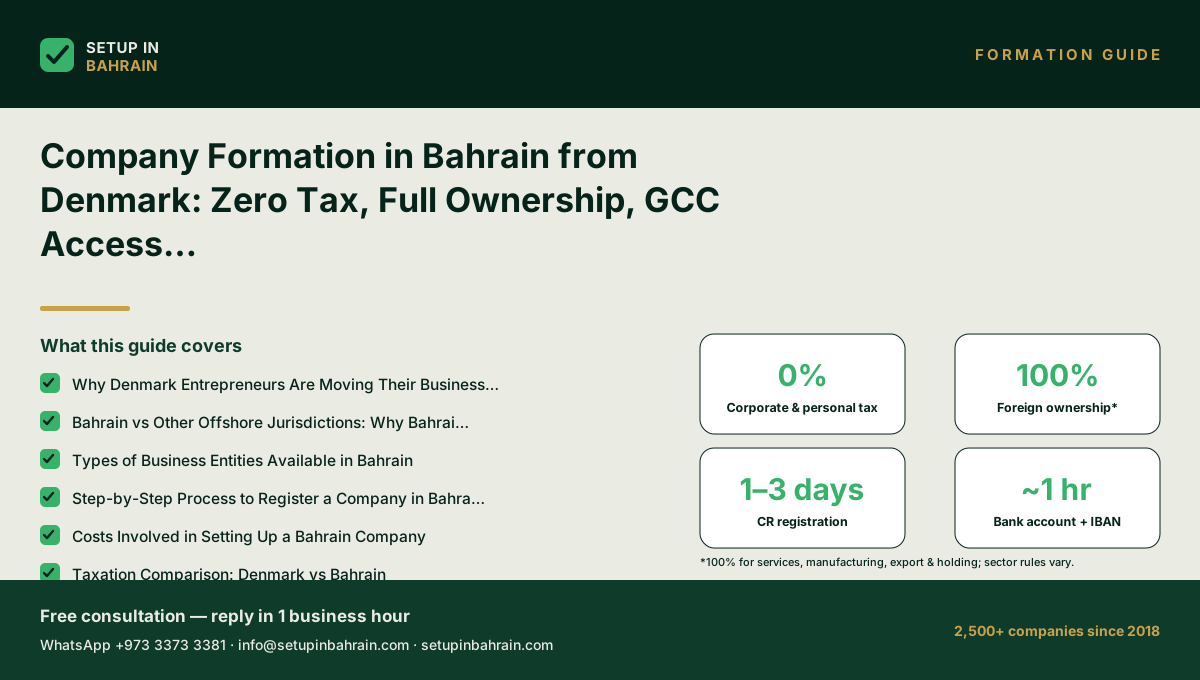
- Why Denmark Entrepreneurs Are Moving Their Business to Bahrain
- Bahrain vs Other Offshore Jurisdictions: Why Bahrain Wins
- Types of Business Entities Available in Bahrain
- Step-by-Step Process to Register a Company in Bahrain
- Costs Involved in Setting Up a Bahrain Company
→ Complete guide: Company Formation in Bahrain — the full 2026 guide
View details
Ownership & capital
A Bahrain WLL can be owned by a single person — 100% foreign ownership applies to most activities, with no local partner required for services, manufacturing, export trading and holding companies. The minimum share capital is BHD 1 ; we recommend BHD 1,000 . This Makes bank account opening and investor visa approval smoother.
Lars ran the numbers three times because he couldn't believe what he was seeing.
His Copenhagen-based software consultancy had just finished a record year — DKK 4.2 million in profit. After corporate tax, social contributions. The various fees the Danish Business Authority demanded, he'd keep roughly DKK 2.9 million. The 22% corporate tax was just the beginning. When he calculated what he'd actually take home as a founder salary, factoring in Denmark's progressive personal income tax that climbs toward 56% at higher brackets, the picture grew considerably darker.
"I'm working harder every year, hiring Danish talent at DKK 45,000+ monthly salaries, dealing with transfer pricing documents that costs me DKK 85,000 annually in accounting fees — and somehow, my actual take-home keeps shrinking," Lars told me over coffee in Nørrebro last autumn.
Six months later, Lars runs his consultancy from a modern office in Bahrain's Seef District. Same clients. Same remote team structure. Generally no corporate income tax for most sectors. Full ownership. Banking in a currency that hasn't moved against the dollar in decades.
This isn't a story about tax evasion — it's about tax efficiency. About recognizing that Denmark's business environment, while excellent for certain company types, has become prohibitively expensive for internationally-mobile entrepreneurs who don't need to physically operate from Copenhagen or Aarhus.
If you're a Danish entrepreneur running a location-independent business, this guide will walk you through exactly how to establish a legitimate company in Bahrain — step by step, cost by cost, with the specific implications for your Danish tax situation explained clearly.
Why Denmark Entrepreneurs Are Moving Their Business to Bahrain
The migration of Danish entrepreneurs to Bahrain isn't happening in isolation. According to Statistics Denmark, 1,847 Danish-owned companies maintained foreign subsidiaries in low-tax jurisdictions as of 2023, representing a 23% increase from 2019. While traditional destinations like Cyprus and Malta dominated earlier years, Gulf states — especially Bahrain and the UAE — now capture an increasing share of new formations.
Why the shift? The answer lies in understanding what Danish entrepreneurs actually face at home.
The Real Cost of Running a Business in Denmark
Any seasoned Danish founder knows: the headline 22% corporate tax rate tells barely half the story. Consider a profitable ApS (Anpartsselskab) generating DKK 5,000,000 in annual net profit:
Corporate Level:
- Corporate tax: DKK 1,100,000 (22%)
- Danish Business Authority (Erhvervsstyrelsen) annual report filing: DKK 3,000-8,000
- Mandatory auditor fees for medium companies: DKK 35,000-85,000
- Transfer pricing documents (if any cross-border transactions): DKK 40,000-120,000 annually
Personal Level (Founder Salary of DKK 800,000):
- AM-bidrag (labour market contribution): 8%
- Municipal tax: ~24.9% average
- State tax (bundskat): 12.09%
- Top tax (topskat) on income above DKK 588,900: 15%
- Church tax (if applicable): ~0.7%
The effective marginal tax rate on high-earning founders regularly exceeds 55.8% when all contributions combine. A Danish entrepreneur earning DKK 1,200,000 personally might retain only DKK 520,000-540,000 after all deductions.
Then there's the administrative burden. Quarterly VAT filings. XBRL-format annual statements. The new digital bookkeeping requirements (bogføringsloven) taking full effect in 2026. Transfer pricing documents if you have a Swedish client or a German supplier. Currency conversion headaches because the DKK sits outside the Eurozone, meaning every USD or EUR transaction creates accounting friction.
What Bahrain Offers Instead
The Kingdom of Bahrain presents a fundamentally different proposition:
| Factor | Denmark | Bahrain |
| Corporate tax rate | 22% | 0% |
| Personal income tax | Up to 55.8% | 0% |
| Capital gains tax | 42% (on shares held <3 years) | 0% |
| VAT rate | 25% | 10% (many services exempt) |
| Foreign ownership permitted | 100% | 100% |
| Minimum local shareholders | None | None |
| Currency stability | DKK (managed float) | BHD (pegged to USD since 1980) |
| Annual reporting complexity | High (XBRL, audit requirements) | Moderate (simpler standards) |
| Company formation timeline | 1-3 weeks | 3-7 business days |
Bahrain vs Other Offshore Jurisdictions: Why Bahrain Wins
Danish entrepreneurs exploring international structures typically evaluate multiple jurisdictions. Let me explain why Bahrain consistently emerges as the superior choice for most business models.
Bahrain vs UAE (Dubai)
The UAE remains the default choice for many European entrepreneurs, but the comparison reveals important nuances:
Corporate Tax: The UAE introduced a 9% corporate tax in June 2023 on profits exceeding AED 375,000 (about DKK 680,000). Bahrain maintains generally no corporate income tax for most sectors regardless of profit levels. For a company generating DKK 5 million in annual profit, that's a DKK 450,000 annual difference.
Free Zone Restrictions: UAE free zone companies face limitations on mainland business activity. Bahrain's mainland WLL and Single Person Company structures permit unrestricted national market access without these artificial boundaries.
Cost of Living: Dubai's rental market has exploded. A comparable two-bedroom apartment in Business Bay costs 40-60% more than equivalent accommodation in Bahrain's Seef or Juffair districts. For entrepreneurs relocating personally, this materially affects the calculation.
Banking Access: Both jurisdictions offer strong banking. Bahrain houses the region's oldest and most sophisticated financial sector. The Central Bank of Bahrain (CBB) regulates over 400 financial institutions, creating competition that benefits business customers through better service and lower fees.
Bahrain vs Singapore
Singapore attracts Danish tech entrepreneurs with its reputation and infrastructure, but the economics often disappoint:
Tax Reality: Singapore's headline 17% corporate tax sounds attractive until you factor in the complexity. The territorial system creates confusion about what's actually exempt. Bahrain's 0% rate requires no interpretation.
Cost Base: Singapore ranks among the world's most expensive cities. Office space in Singapore's CBD runs SGD 9-12 per square foot monthly. Equivalent space in Bahrain's Diplomatic Area costs BHD 4-7 (about 60% less).
Distance: Copenhagen to Singapore is 10,000+ kilometers and 6-7 hours of time difference. Copenhagen to Bahrain is 4,800 kilometers with only a 2-hour time zone difference, making European client communication far more practical.
Bahrain vs Estonia (e-Residency)
Estonian e-Residency appeals to digital nomads, but it's frequently misunderstood:
Tax Obligation: Estonian companies pay 0% on retained profits but 20% on distributed profits. Danish founders drawing salary or dividends face immediate taxation. The "0% tax" marketing obscures this fundamental limitation.
Substance Requirements: EU tax authorities more and more scrutinize Estonian e-Residency companies for substance. Denmark's Skattestyrelsen has explicitly flagged these structures in recent guidance.
Banking Challenges: Estonian e-Residency companies regularly face banking difficulties. Major institutions remain reluctant to onboard these structures, forcing founders toward fintech alternatives with higher fees and lower limits.
Bahrain vs Cyprus/Malta
Traditional European holding jurisdictions have lost their edge:
EU Pressure: Both Cyprus and Malta face ongoing EU scrutiny over their tax regimes. The OECD's BEPS initiatives and EU's anti-tax avoidance directives have steadily eroded their advantages.
Blacklist Risk: While currently not blacklisted, these jurisdictions appear on various "grey lists" that complicate banking relationships and trigger enhanced due diligence.
Limited Market Access: Neither provides meaningful access to high-growth markets. Bahrain serves as a genuine gateway to GCC economies totaling $2.4 trillion in combined GDP.
Types of Business Entities Available in Bahrain
Understanding Bahrain's corporate structures helps you choose the optimal vehicle for your specific situation. The Ministry of Industry and Commerce (MOIC) registers all commercial entities. The Central Bank of Bahrain (CBB) oversees financial services businesses.
WLL (With Limited Liability Company)
The WLL represents Bahrain's most popular structure for foreign entrepreneurs. Think of it as equivalent to a Danish ApS but with more flexibility:
Key Characteristics:
- a single shareholder (one person can own 100%), maximum 50
- 100% foreign ownership permitted since 2021 reforms
- Minimum capital: BHD 20,000 for most activities (about DKK 353,000)
- No mandatory capital deposit — it's stated capital, not paid-up
- Suitable for most trading, consulting, and services activities
Danish Entrepreneur Application: If you're forming a Bahraini subsidiary of your Danish ApS, or establishing a new venture with a business partner, the WLL structure provides familiar corporate governance while eliminating the tax burden.
single-shareholder WLL
The WLL functions similarly to a Danish enkeltmandvirksomhed but with limited liability protection:
Key Characteristics:
- Single shareholder permitted (individual or corporate)
- 100% foreign ownership
- Minimum capital: BHD 1 (we recommend BHD 1,000)for most activities (about DKK 883,000)
- Simplified governance — no board meetings required
- Ideal for consultants, freelancers, and solo entrepreneurs
Danish Entrepreneur Application: Solo consultants currently operating through a Danish ApS often find the WLL perfectly suited to their needs. The higher minimum capital requirement rarely presents practical obstacles since it's stated rather than deposited capital.
Branch Office
Foreign companies can establish Bahrain branches to operate locally without creating a separate legal entity:
Key Characteristics:
- Not a separate legal entity — parent company retains full liability
- Requires MOIC registration and local agent appointment
- Suitable for project-based work or market testing
- Profits remit directly to parent company
Danish Entrepreneur Application: If your Danish ApS wants to test the Bahraini market before committing to a subsidiary, a branch office provides a lower-commitment entry point. But, the profits still flow to Denmark and face Danish corporate taxation, eliminating most tax advantages.
Holding Company
Bahrain's holding company regime attracts entrepreneurs managing multiple ventures:
Key Characteristics:
- Can hold shares in Bahraini and foreign companies
- 0% tax on dividends received from subsidiaries
- 0% tax on capital gains from share disposals
- Minimum capital: BHD 1 (we recommend BHD 1,000)
- Requires CBB licensing for certain activities
Danish Entrepreneur Application: Entrepreneurs with multiple business lines or investment activities often structure a Bahraini holding company to own operating subsidiaries. This creates clean separation while maintaining tax efficiency across the portfolio.
Free Zone Companies
Bahrain's free zones offer specialized advantages for specific industries:
Bahrain Logistics Zone (BLZ):
- 100% foreign ownership
- 0% customs duties on imports/exports
- Dedicated infrastructure for logistics operations
Bahrain International Investment Park (BIIP):
- Manufacturing and light industrial focus
- Subsidized utilities and land costs
- Direct port and airport access
Danish Entrepreneur Application: E-commerce businesses shipping physical products throughout the GCC often find free zone structures optimal for inventory management and distribution efficiency.
Step-by-Step Process to Register a Company in Bahrain
The practical registration process has become more and more streamlined through Bahrain's Sijilat online portal. Here's exactly what to expect:
Phase 1: Preparation (1-2 Weeks Before Filing)
Document Collection:
- Valid Danish passport (minimum 6 months validity)
- Proof of address in Denmark (CPR registration or utility bill)
- Bank reference letter from your Danish bank
- CV or professional biography
- Business plan summary (1-2 pages sufficient for most activities)
Document Authentication: All documents require attestation through a specific chain:
- Notarization in Denmark (Notar or relevant authority)
- Authentication by the Danish Ministry of Foreign Affairs (Udenrigsministeriet)
- Legalization by the Bahrain Embassy in Copenhagen
Pro Tip: The Bahrain Embassy in Copenhagen processes about 15-20 document legalizations weekly for Danish entrepreneurs. Book your appointment 2-3 weeks ahead during peak periods (September-November and January-March).
Phase 2: Commercial Registration (3-7 Business Days)
Step 1: Reserve Company Name Submit 3-5 potential company names through Sijilat (www.sijilat.bh). Names must:
- Not duplicate existing registered companies
- Not contain restricted terms without relevant licenses
- Include an appropriate suffix (W.L.L., S.P.C., etc.)
Processing time: 24-48 hours. Fee: BHD 15 (about DKK 265).
Step 2: Submit CR Application The Commercial Registration application requires:
- Completed application form (generated through Sijilat)
- Memorandum of Association (drafted by your registered agent)
- Articles of Association
- Shareholders' and directors' passports (authenticated copies)
- Proof of registered office address
- Activity-specific documents (if applicable)
Processing time: 2-4 business days for standard activities. Fee: BHD 50-200 depending on activities (about DKK 880-3,530).
Step 3: Get CR Certificate Upon approval, MOIC issues your Commercial Registration certificate. This document serves as your company's primary identification for banking, contracts, and government interactions.
Phase 3: Post-Registration Requirements (1-2 Weeks)
LMRA Registration: The Labour Market Regulatory Authority requires registration even before hiring employees. This establishes your company in the labor system and enables future visa sponsorship.
Municipal License: Depending on your activity and premises, you may require a municipal operating license from the relevant governorate.
GOSI Registration: The General Organisation for Social Insurance registration becomes mandatory once you hire employees. Employer contributions run about 12% of gross salary.
Phase 4: Bank Account Opening (2-4 Weeks)
Banking deserves special attention — it's often the longest phase:
Required Documents:
- Commercial Registration certificate
- Memorandum and Articles of Association
- Shareholders' passports and CVs
- Board resolution authorizing account opening
- Business plan and projected financials
- Source of funds documents
Bank Selection for Danish Entrepreneurs:
| Bank | Minimum Balance | USD Account | EUR Account | Online Banking | Danish Entrepreneur Experience |
| Ahli United Bank | BHD 5,000 | Yes | Yes | Advanced | Excellent — familiar with Nordic clients |
| National Bank of Bahrain | BHD 2,000 | Yes | Yes | Good | Strong SME focus |
| Bahrain Islamic Bank | BHD 1,000 | Yes | Limited | Basic | Sharia-compliant options |
| Standard Chartered | BHD 10,000 | Yes | Yes | Excellent | Premium service, higher requirements |
Costs Involved in Setting Up a Bahrain Company
Transparency about costs helps you budget accurately. Here's the complete picture for a standard WLL formation:
Formation Costs (One-Time)
| Item | Cost (BHD) | Cost (DKK) | Notes |
| Name reservation | 15 | 265 | Valid 60 days |
| CR registration fee | 100-200 | 1,765-3,530 | Varies by activity |
| Memorandum drafting | 150-300 | 2,645-5,295 | Legal professional fee |
| Document attestation (Denmark) | 500-1,000 | 8,825-17,650 | Notarization + Ministry + Embassy |
| Registered office (initial) | 200-400 | 3,530-7,060 | First quarter typically required upfront |
| PRO/formation agent services | 500-1,500 | 8,825-26,475 | Comprehensive service varies widely |
Annual Operating Costs
| Item | Cost (BHD) | Cost (DKK) | Notes |
| CR renewal | 50-100 | 880-1,765 | Annual requirement |
| Registered office | 1,200-3,600 | 21,180-63,540 | Physical office or virtual address |
| Accounting services | 600-2,400 | 10,590-42,360 | Depends on transaction volume |
| Annual audit (if required) | 800-2,500 | 14,120-44,125 | Required above certain thresholds |
| LMRA fees | 200-600 | 3,530-10,590 | Per work permit sponsored |
| Bank fees | 300-800 | 5,295-14,120 | Monthly maintenance + transactions |
Cost Comparison: Denmark vs Bahrain
For a company generating DKK 4,000,000 in annual profit:
Denmark (ApS):
- Corporate tax (22%): DKK 880,000
- Business Authority fees: DKK 5,000
- Audit/accounting: DKK 85,000
- Transfer pricing documents: DKK 60,000
- Total annual cost: DKK 1,030,000+
Bahrain (WLL):
- Corporate tax (0%): DKK 0
- CR renewal and fees: DKK 5,000
- Accounting/audit: DKK 45,000
- Office and administration: DKK 40,000
- Total annual cost: DKK 90,000
Net Annual Savings: DKK 940,000+ (about BHD 53,300)
Over a 5-year period, a Danish entrepreneur relocating a profitable consultancy saves about DKK 4.7 million — enough to acquire property in Bahrain, fund significant business expansion, or simply enjoy a dramatically improved quality of life.
Taxation Comparison: Denmark vs Bahrain
Understanding the complete tax picture requires examining both corporate and personal implications.
Corporate Taxation
Denmark:
- Standard rate: 22%
- No lower rate for SMEs
- Dividend withholding tax: 27% (reducible via treaties)
- Interest withholding on certain payments: 22%
- CFC rules applying to low-tax subsidiaries
Bahrain:
- Standard rate: 0%
- No withholding taxes on dividends, interest, or royalties
- No CFC regime
- No thin capitalization rules
- No transfer pricing documents requirements
Personal Taxation
Denmark: For a founder earning DKK 1,000,000 annually:
- AM-bidrag (8%): DKK 80,000
- Municipal tax (~24.9%): DKK 229,080
- State tax (12.09%): DKK 111,228
- Top tax on amount above threshold: ~DKK 62,000
- Total tax: about DKK 482,000+
- Net income: about DKK 518,000
Bahrain: For a founder earning equivalent BHD 56,600 (DKK 1,000,000):
- Personal income tax: BHD 0
- Social contributions: BHD 0 (for foreign entrepreneurs)
- Total tax: BHD 0
- Net income: BHD 56,600 (DKK 1,000,000)
Danish Tax Obligations After Relocation
This section is critical: establishing a Bahrain company doesn't automatically eliminate Danish tax obligations. Skattestyrelsen (Danish Tax Authority) assesses based on:
Tax Residency: You remain Danish tax resident if:
- You maintain a permanent home (helårsbolig) available in Denmark
- You spend more than 183 days annually in Denmark
- Your "center of vital interests" remains in Denmark
Practical Implications: To achieve genuine Danish tax exit, most entrepreneurs must:
- Establish residence in Bahrain (or another jurisdiction)
- Dispose of or rent out Danish property
- Demonstrate Bahrain as primary business and personal base
- File a "fraflytning" (departure) declaration with Skattestyrelsen
Exit Tax (Fraflytterskat): Denmark imposes exit taxation on unrealized capital gains when tax residency ends. This includes:
- Shares in Danish companies
- Shares in foreign companies held while Danish resident
- Certain other assets
The exit tax can be deferred in installments but represents a one-time cost of relocating. Careful planning with a qualified Danish tax advisor is essential before any relocation.
Company Attribution Rules
Even after personal relocation, a Bahrain company may be considered Danish for tax purposes if:
- Management and control occurs primarily from Denmark
- Key decisions are made by Danish-resident directors
- The company lacks genuine substance in Bahrain
Solution: Ensure your Bahrain company has genuine local substance — a real office, regular board meetings held in Bahrain. Documented decision-making occurring in the Kingdom.
Legal Requirements for Foreign Investors in Bahrain
Bahrain's regulatory framework for foreign investors ranks among the region's most favorable, as documented by the Bahrain Investor Protection Agreement (BIPA) and World Bank's Doing Business assessments.
Investment Law Framework
The 2021 amendments to Bahrain's Commercial Companies Law eliminated most restrictions on foreign ownership:
100% Foreign Ownership: Available for virtually all commercial activities without requiring Bahraini partners. Exceptions include:
- Certain oil and gas concessions
- Specific government contracting categories
- Islamic endowment (waqf) management
Investment Protection: Bahrain has signed bilateral investment treaties with 49 countries, including Denmark. The Denmark-Bahrain BIT (2004) provides:
- Protection against expropriation without compensation
- Free transfer of profits and capital
- Most-favored-nation treatment
- International arbitration access (ICSID)
Regulatory Bodies
Ministry of Industry and Commerce (MOIC): Primary authority for company registration, commercial licensing, and corporate governance.
Economic Development Board (EDB): Investment promotion agency providing:
- Investor support services
- License facilitation
- Market intelligence
- Networking with potential partners
Central Bank of Bahrain (CBB): Regulates all financial services activities, including:
- Banking and finance companies
- Insurance providers
- Investment businesses
- Fintech operations
Labour Market Regulatory Authority (LMRA): Oversees all employment matters:
- Work permit issuance
- Flexi visa administration
- Labor market monitoring
Compliance Requirements
Annual Obligations:
- CR renewal: Required annually, submittable 30 days before expiration
- Financial statements: Required for companies above certain thresholds
- GOSI contributions: Monthly for companies with employees
- VAT returns: Quarterly for registered businesses
Ongoing Documents:
- Maintain share register
- Document board resolutions
- Retain financial records for 5 years
- Update CR for any material changes (address, activities, shareholders)
How to Open a Business Bank Account in Bahrain
Banking represents perhaps the most frequently underestimated aspect of Bahrain company formation. Danish entrepreneurs accustomed to straightforward Danish bank account opening often encounter unexpected complexity.
Banking Landscape
Bahrain hosts the GCC's most sophisticated financial sector, regulated by the Central Bank of Bahrain (CBB). Over 400 licensed financial institutions create healthy competition:
Retail Banks (Recommended for SMEs):
- National Bank of Bahrain
- Ahli United Bank
- Bank of Bahrain and Kuwait
- Bahrain Islamic Bank
International Banks:
- Standard Chartered
- HSBC
- Citibank
- BNP Paribas
Digital Banks:
- Ila Bank (Bahrain's first digital bank)
- Rain (crypto-friendly)
Account Opening Process
Step 1: Bank Selection Consider:
- Minimum balance requirements
- Monthly fee structures
- Online banking capabilities
- Multi-currency account options
- Trade finance services (if needed)
Step 2: Documents Submission Standard requirements include:
- Commercial Registration certificate
- Memorandum and Articles of Association
- Board resolution authorizing account opening
- Shareholders' and directors' passports
- Proof of address for all shareholders
- CVs for key personnel
- Business plan or description
- Source of funds documents
- Bank reference letters
Step 3: Due Diligence Interview Most banks conduct face-to-face meetings with:
- The ultimate beneficial owner
- Primary account signatories
- Company directors
For Danish entrepreneurs not yet relocated, many banks arrange video calls, though this may extend processing times.
Step 4: Account Activation Upon approval:
- Initial deposit (minimum balance)
- Signatory card completion
- Online banking setup
- Card issuance (if applicable)
Multi-Currency Considerations
Danish entrepreneurs typically require accounts in:
USD: Primary currency for GCC business and international clients BHD: Local expenses and government payments EUR: European client invoicing DKK: Rarely needed but sometimes requested for Danish contract obligations
Most Bahraini banks offer multi-currency accounts, enabling you to hold, receive. Send in multiple currencies without constant conversion.
Banking Challenges and Solutions
Challenge: Enhanced due diligence delays for European beneficial owners Solution: Prepare comprehensive documents upfront; engage your registered agent to help introductions
Challenge: Minimum balance requirements straining initial cash flow Solution: Negotiate based on projected deposit levels; smaller banks often offer more flexibility
Challenge: Physical presence requirements for account opening Solution: Many banks accept a single visit with video follow-ups; coordinate with visa acquisition timeline
Residency Visa Options and Requirements
For Danish entrepreneurs seeking to relocate personally — which is often necessary for tax optimization — Bahrain offers several pathways:
Investor Visa (Golden Residency)
Bahrain's investor residence program provides long-term stability:
Eligibility:
- Investment of BHD 100,000+ in Bahrain real estate, OR
- Investment of BHD 50,000+ in an approved commercial venture, OR
- Sponsorship through your own Bahrain company
Benefits:
- 10-year renewable residency
- Family inclusion (spouse, children)
- Multiple entry privileges
- Right to work (through your company)
- Access to Bahrain healthcare and education
Process:
- Complete investment or company formation
- Apply through LMRA or NPRA (National Portal for Residency Affairs)
- Medical examination in Bahrain
- Biometric registration
- Visa issuance
Timeline: 2-4 weeks from complete application Cost: BHD 200-500 (DKK 3,530-8,825) plus medical fees
Work Visa (Through Your Company)
If your Bahrain company sponsors your employment:
Requirements:
- Valid Commercial Registration
- LMRA registration
- Labor market test (simplified for company owners)
- Employment contract
- Medical examination
Timeline: 1-3 weeks Cost: BHD 300-500 per person (DKK 5,295-8,825)
Bahrain Flexi Visa
For entrepreneurs testing the market before full commitment:
Characteristics:
- 1-year or 2-year validity
- Self-sponsored (no company sponsor required)
- Can work freelance or for multiple entities
- Renewable
Cost: BHD 500 (1-year) or BHD 900 (2-year)
Limitation: Does not alone establish tax residency for Danish tax exit purposes; genuine substance remains essential.
Family Considerations
Spouse Visa:
- Dependent on your primary visa
- Work permit obtainable separately
- Healthcare access included
Children:
- Education: International schools follow British, American, or IB curricula
- Annual fees: BHD 3,000-8,000 (DKK 52,950-141,200) depending on school
- Public healthcare access with private insurance recommended
Benefits of Company Formation in Bahrain for Denmark-Based Entrepreneurs
Beyond tax savings, Bahrain offers strategic advantages especially relevant to Danish businesses:
GCC Market Access
Bahrain's location provides unparalleled access to Gulf markets:
Saudi Arabia: 25 kilometers via King Fahd Causeway — the world's 12th largest economy UAE: 1-hour flight to Dubai Qatar: 45-minute flight Kuwait: 1-hour flight Oman: 1.5-hour flight
Combined GCC market: 60+ million consumers, $2.4 trillion GDP, some of the world's highest per-capita incomes.
Practical Implications: Danish technology, consulting, and design services command premium pricing throughout the Gulf. A Bahrain base positions you to serve regional clients while maintaining European quality standards and GMT+3 time zone compatibility with Nordic working hours.
Currency Stability
The Bahraini Dinar has been pegged to the US Dollar at BHD 1 = USD 2.659 since 1980. This 44+ year stability eliminates:
- Currency speculation risk
- Hedging costs
- Translation adjustments in financial statements
- Pricing uncertainty for USD-denominated contracts
For Danish entrepreneurs accustomed to DKK/EUR/USD volatility affecting margins, this stability proves remarkably valuable.
Quality of Life
Bahrain consistently ranks highly for expatriate quality of life:
Cost of Living: 30-40% below Copenhagen for comparable lifestyle Housing: Modern apartments from BHD 400/month (DKK 7,060); villas from BHD 800/month Climate: Hot summers, pleasant winters; widespread air conditioning Safety: Among the region's safest countries; low crime rates Healthcare: Modern facilities; international-standard private hospitals Culture: Cosmopolitan; large expatriate community; relatively liberal social environment by regional standards
Infrastructure
Telecommunications: High-speed fiber widely available; 5G coverage Transportation: Modern road network; Bahrain International Airport with European connections Coworking: Growing ecosystem including WeWork, CH9, and local operators Banking: Sophisticated financial services sector as detailed above
Frequently Asked Questions
Can I form a Bahrain company while remaining in Denmark?
Yes, the formation process can be completed remotely. But, bank account opening typically requires at least one visit. More importantly, achieving genuine tax efficiency usually requires establishing Bahraini residence and demonstrating that management and control occurs in Bahrain, not Denmark. A remote Bahrain company with Danish-resident directors may still face Danish taxation.
How long does the entire company formation process take?
Typical timelines:
- Document preparation and attestation: 2-3 weeks
- Name reservation and CR registration: 1 week
- Post-registration procedures: 1 week
- Bank account opening: 2-4 weeks
Total realistic timeline: 6-10 weeks from decision to fully operational company with banking.
What are the minimum capital requirements?
For a WLL (most common structure): BHD 20,000 (about DKK 353,000) stated capital for most activities. This is not paid-up capital — you don't need to deposit this amount. It's a stated figure in your formation documents. For a single-shareholder WLL: BHD 1 (we recommend BHD 1,000)stated capital.
Can my Danish ApS own the Bahrain company?
Yes, corporate shareholders are permitted. But, this structure may trigger Danish CFC (Controlled Foreign Company) rules, potentially attributing Bahraini company profits to your Danish company for taxation. Consult a Danish tax advisor before implementing this structure.
What happens to my Danish company when I relocate?
Options include:
- Liquidation: Wind down the Danish ApS and transfer activities to Bahrain
- Sale: Sell the Danish company to a third party
- Retention: Keep the Danish company for Danish-source activities while operating internationally through Bahrain
- Conversion: Convert to a holding structure with Bahrain as the primary operating entity
Is there VAT in Bahrain?
Bahrain implemented VAT at 5% in 2019, increased to 10% in 2022. But, many services remain zero-rated or exempt, including:
Bahrain Business Guides for Denmark Citizens
Frequently Asked Questions
How long does it take to set up?
It takes 15 to 20 days. We file all forms for you. You do not need to wait long.
What does it cost?
Company formation: Standard BHD 1,340 with 3 months of office address; Gold BHD 1,700 with 6 months; Premium BHD 2,150 with 12 months and a cabin, officer table and chair, and two guest chairs. No formation package includes visas, including Premium. Investor/work visas are priced separately: BHD 755 for one year or BHD 953 for two years, in addition to the formation package. Ask for a written, itemized quotation confirming government fees and all inclusions before payment.
Do I need to visit Bahrain?
No. You can set up your firm from home. We do all the work online. Some banks may ask for one visit.
What tax will I pay?
You pay zero tax on your profits. Bahrain has no corporate income tax. This is a key benefit of the setup.
Can I own 100% of my firm?
Yes. Foreign owners can hold all shares. No local partner is needed. Full ownership is allowed.
What do I need to start?
You need a valid passport. You also need a trade name and a business address. We help you with all of these.
How do I open a bank account?
We guide you step by step. Most banks take 3 to 6 weeks. You will need your CR and firm papers.
Who issues the Commercial Registration (CR)?
The CR is issued by the MOICT. It is your legal right to trade in Bahrain. We file the CR for you.
Can I renew my CR each year?
Company renewal packages: BHD 530 with 3 months of office address; BHD 980 with 6 months; BHD 1,520 with 12 months. These are separate renewal packages, not visa fees.
How do I get started?
Fill in our form on this page. Our team will call you back. We map your best setup plan at no cost.
Steps to Form Your Company
- Pick your trade name. We check if it is free.
- Choose your business type. WLL is the most common.
- Sign the MOA. We draft and file all legal docs.
- Pay the state fees. About BHD 432 in total.
- Get your CR. Takes 15 to 20 days.
- Open your bank account. We guide each step.
- Start trading. You are ready to do business.
Key Facts
- Tax rate: 0%
- Foreign ownership: 100%
- Setup time: 15 to 20 days
- Company formation: Standard BHD 1,340 with 3 months of office address; Gold BHD 1,700 with 6 months; Premium BHD 2,150 with 12 months and a cabin, officer table and chair, and two guest chairs. No formation package includes visas, including Premium. Investor/work visas are priced separately: BHD 755 for one year or BHD 953 for two years, in addition to the formation package. Ask for a written, itemized quotation confirming government fees and all inclusions before payment.
- Company renewal packages: BHD 530 with 3 months of office address; BHD 980 with 6 months; BHD 1,520 with 12 months. These are separate renewal packages, not visa fees.
- Client rating: 4.8 stars
- Clients served: 2,500 and more
Quick Facts
- Tax rate: 0%
- Own all of your firm: Yes, 100%
- Time to set up: 15 to 20 days
- Company formation: Standard BHD 1,340 with 3 months of office address; Gold BHD 1,700 with 6 months; Premium BHD 2,150 with 12 months and a cabin, officer table and chair, and two guest chairs. No formation package includes visas, including Premium. Investor/work visas are priced separately: BHD 755 for one year or BHD 953 for two years, in addition to the formation package. Ask for a written, itemized quotation confirming government fees and all inclusions before payment.
- Company renewal packages: BHD 530 with 3 months of office address; BHD 980 with 6 months; BHD 1,520 with 12 months. These are separate renewal packages, not visa fees.
- Rating: 4.8 stars
- Clients: 2,500 and more
Why Bahrain?
Bahrain has no tax. You keep all your profits. This is rare in the Gulf.
You can own all of your firm. No local partner is needed. The law allows full foreign ownership.
Setup takes 15 to 20 days. We file all forms for you. You can do it all from home.
Bahrain has a free trade deal with the US. Your goods face low or no tariffs. This gives you access to big markets.
We have served 2,800+ clients from 44+ countries and maintain records to substantiate that total where needed. We have 113 Google reviews; reviews represent only some clients and are not the same as the total clients served.
Our Steps
- Tell us your plan. We advise you for free.
- We pick the right firm type for you.
- We file all your forms with MOICT.
- You get your CR in 15 to 20 days.
- We help you open a bank account.
- You are ready to trade. We stay with you.
Why Set Up in Bahrain?
Bahrain is a great place to run a firm. It has no tax. You keep all your profits. This is rare in the Gulf.
You can own your firm 100%. No local partner is needed. The law is clear and fair.
It is fast to set up. You can have a CR in 15 to 20 days. We file all forms for you.
Bahrain has a free trade deal with the US. Your goods face low or no tariffs. This gives you access to big markets.
The banks are good. The roads are good. The schools are good. It is a well-run state.
We have served 2,800+ clients from 44+ countries and maintain records to substantiate that total where needed. We have 113 Google reviews; reviews represent only some clients and are not the same as the total clients served.
Our Services
- Company formation: Standard BHD 1,340 with 3 months of office address; Gold BHD 1,700 with 6 months; Premium BHD 2,150 with 12 months and a cabin, officer table and chair, and two guest chairs. No formation package includes visas, including Premium. Investor/work visas are priced separately: BHD 755 for one year or BHD 953 for two years, in addition to the formation package. Ask for a written, itemized quotation confirming government fees and all inclusions before payment.
- Company renewal packages: BHD 530 with 3 months of office address; BHD 980 with 6 months; BHD 1,520 with 12 months. These are separate renewal packages, not visa fees.
- Investor Visa — from BHD 755
- Work Visa — LMRA managed
- Virtual office — from BHD 600 per year
- Bank account opening — 3 to 6 weeks
- Family visa — for spouse and kids
- UBO filing — as required by law
Bahrain at a Glance
- Tax rate: 0%
- Foreign ownership: 100%
- Setup time: 15 to 20 days
- Free trade deal: Yes, with the US
- Language: Arabic and English
- Currency: Bahraini Dinar (BHD)
- Time zone: UTC+3
- GDP growth: Steady and strong
How to Start
- Fill in the form on this page. It takes 3 minutes.
- We call you back the same day.
- We map the best plan for your firm type and goals.
- We file all forms. We deal with MOICT for you.
- You get your CR in 15 to 20 days.
- We help you open a bank account and get your visa.
- You are ready to trade. We stay with you.
Common Questions
Do I need to visit Bahrain to set up?
No. You can do it all from home. We file online. You may need one visit to open a bank account.
Is Bahrain safe for business?
Yes. Bahrain is a stable state. It has a clear legal system. Your firm and funds are safe here.
Can I hire staff from any country?
Yes. You can hire from any country. Each hire needs a work permit from LMRA. We manage this for you.
What type of firm should I set up?
Most clients choose a WLL. This is a limited liability firm. It is flexible and well-known in Bahrain. We advise you on the best type for your case.
How do I get in touch?
Fill in our form. We call you back the same day. You can also email us or use the chat on this page.
Ready to set up in Bahrain from Denmark?
Tell us your business idea. We map the right entity, ownership and timeline — then handle the filing while you focus on what matters.