Start your Bahrain company from Belgium with generally no corporate income tax for most sectors. Fast registration, full foreign ownership & easy setup for Belgian entrepreneurs.
Key Takeaways
- Why Belgium Entrepreneurs Are Moving Their Business to Bahrain
- Belgium vs Bahrain Business Setup: Side-by-Side Comparison
- Bahrain Business Structures: Choosing the Right Entity for Belgian Entrepreneurs
- Step-by-Step Company Formation Process in Bahrain for Belgian Entrepreneurs
- Visa and Residency Options for Belgian Entrepreneurs in Bahrain
→ Complete guide: Company Formation in Bahrain — the full 2026 guide
View details
Ownership & capital
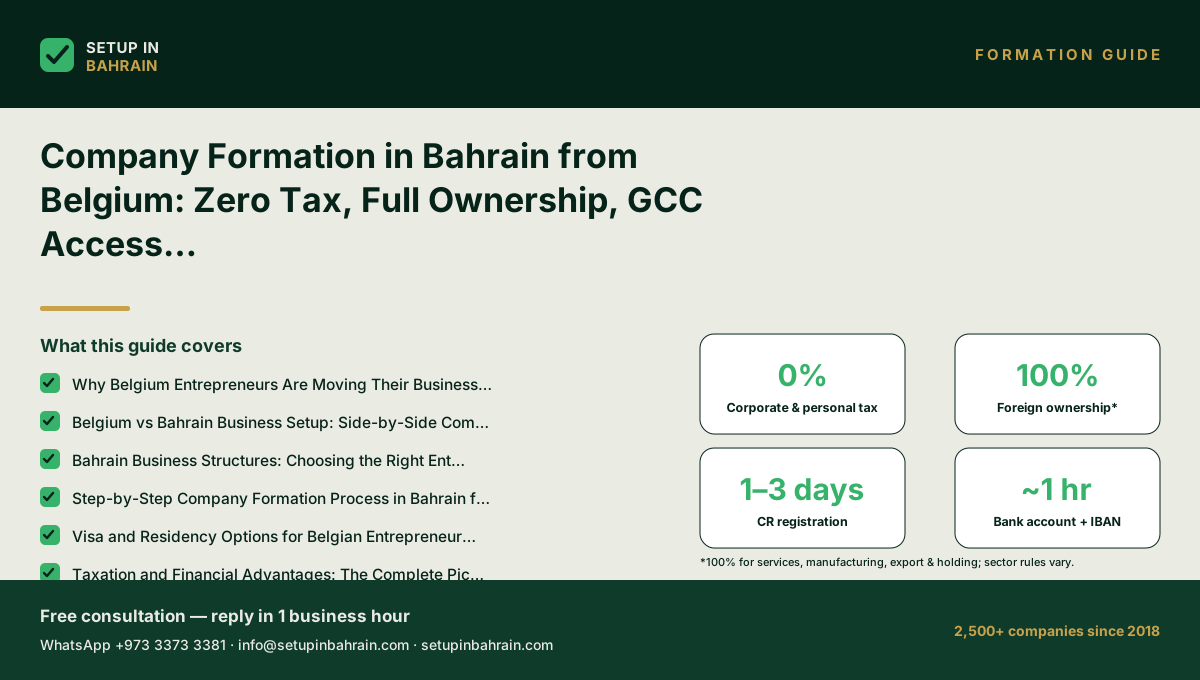
A Bahrain WLL can be owned by a single person — 100% foreign ownership applies to most activities, with no local partner required for services, manufacturing, export trading and holding companies. The minimum share capital is BHD 1 ; we recommend BHD 1,000 . This Makes bank account opening and investor visa approval smoother.
Let me paint you a picture that might feel uncomfortably familiar.
You're a Belgian entrepreneur running a digital agency from Antwerp. Last year, your company turned a €420,000 profit. You'd expect to celebrate, perhaps expand the team, invest in new technology, or finally take that dividend you've been promising yourself. Instead, you're sitting across from your accountant in a cramped Borgerhout office, watching him tap numbers into a spreadsheet that makes your stomach tighten with each keystroke.
After Belgium's 25% corporate tax, €315,000 remains. But your accountant reminds you about the additional compliance costs—the Vlabel rulings you need to navigate, the cross-regional complications because two of your developers work remotely from Wallonia, the mandatory sector contributions. His own €9,200 annual fee barely scratches the surface. By the time you've paid employer social security contributions on your modest €65,000 salary (another €16,250, because Belgium charges roughly 25% on top of gross salary), distributed dividends through the liquidation reserve system (facing 5-15% additional taxation depending on timing), and covered the quarterly VAT return translations required for your EU-wide client base, you're wondering why you bothered growing the business at all.
This isn't a hypothetical scenario constructed to make a point. This is the lived reality of thousands of Belgian entrepreneurs in 2025 and 2026—talented founders in Ghent, Brussels, Liège, and Charleroi who've built profitable companies only to watch their wealth systematically extracted by one of Europe's most complex and burdensome tax systems.
Meanwhile, 5,200 kilometers southeast, a small island kingdom in the Arabian Gulf has structured its entire economy around a radically different proposition: Generally no corporate income tax for most sectors, 100% foreign ownership, no withholding on dividends, and direct access to a 2.3 billion consumer market through preferential trade agreements with the Gulf Cooperation Council, the broader Middle East, and growing partnerships across Asia.
That country is Bahrain. And the Belgium-to-Bahrain corporate migration has accelerated from a curious anomaly to a legitimate business strategy since 2023.
This guide exists because the information available online about this specific corridor—Belgian entrepreneurs establishing operations in Bahrain—ranges from superficial to outright misleading. You deserve better. You deserve the specific numbers, the concrete comparisons, the regulatory details. The practical steps that will let you make an informed decision about whether Bahrain makes sense for your particular business circumstances.
Why Belgium Entrepreneurs Are Moving Their Business to Bahrain
The Belgian Tax Reality: It's Not Just the Headline Rate
When international tax comparisons cite Belgium's 25% corporate tax rate, they're telling you less than half the story. The headline rate obscures a compliance ecosystem of staggering complexity—one that extracts far more than 25% from the typical Belgian entrepreneur.
Consider the real arithmetic for a profitable Belgian BVBA (now BV under the 2019 Companies Code) generating €400,000 in annual profit:
Direct Corporate Taxation:
- Corporate tax at 25%: €100,000
- Reduced rate of 20% on first €100,000 (if eligible for SME status): saves €5,000
- Effective corporate tax after SME benefit: about €95,000
Employment Costs on Owner's Salary: Most Belgian entrepreneurs must pay themselves a minimum salary of around €45,000 annually to qualify for the reduced SME corporate tax rate. On that salary:
- Employer social security contributions (RSZ/ONSS): about €11,250 (25% on top of gross)
- Sector-specific contributions (depending on industry): €500-€2,000 annually
- Work accident insurance: about €500
Dividend Distribution: After paying corporate tax, you want to access your profits personally. Belgium offers the liquidation reserve system (VVPR-bis), but:
- You must wait 5 years to benefit from the reduced 5% withholding rate
- Distributed earlier: 15-30% additional taxation
- Standard dividend withholding without VVPR-bis: 30%
Compliance and Professional Costs:
- Annual accounting fees for a company your size: €6,000-€12,000
- Vlabel rulings (Flemish tax authority) for any non-standard transactions: €1,500-€5,000
- Cross-regional complications (employees in different regions): additional €2,000-€4,000
- Mandatory deposit guarantee scheme participation for certain sectors: varies
- VAT return preparation and filing (quarterly, potentially in multiple languages): €2,400-€4,800
The Hidden Time Tax: What the numbers don't capture is the 15-25 hours monthly most Belgian entrepreneurs spend on administrative compliance—hours that could be invested in product development, client acquisition, or simply living a life outside your business.
Regional Tax Fragmentation: The Vlabel Problem
Belgium's constitutional structure creates a compliance nightmare unique in Western Europe. Tax policy sits partially at federal level, partially at regional level (Flanders, Wallonia, Brussels-Capital). The three regions interpret rules differently.
If you're a Flemish company with a Walloon employee working remotely, you face overlapping compliance obligations. Vlabel (Flemish tax administration) has become more and more aggressive since 2020, issuing rulings that sometimes contradict federal tax authority positions. Wallonia maintains separate registration taxes and interpretations. Brussels operates its own frameworks.
For a Belgian entrepreneur selling digital services across the EU, this regional fragmentation compounds with VAT complexity. You may find yourself filing returns that must satisfy three regional authorities plus federal oversight, each with slightly different documents requirements and interpretation standards.
What Bahrain Offers: The Counter-Reality
Against this backdrop, Bahrain's proposition becomes almost surreal in its simplicity:
- Corporate tax rate: 0% (with limited exception for oil and gas companies)
- Personal income tax: 0%
- Dividend withholding tax: 0%
- Capital gains tax: 0%
- Foreign ownership permitted: 100% (since 2017 reforms, across most sectors)
- Minimum share capital for LLC: BHD 50 (about €120)
- Company formation timeline: 3-5 business days (through Sijilat online portal)
- Annual compliance: simplified financial statements, no mandatory audit for most SMEs
The Economic Development Board (EDB) of Bahrain and the Ministry of Industry and Commerce (MOIC) have explicitly designed the regulatory framework to attract foreign entrepreneurs. The Central Bank of Bahrain (CBB) provides clear, English-language guidance. The Bahrain Investors Center (BIC) offers one-stop-shop services that consolidate 14 government agencies into a single application process.
For a Belgian entrepreneur, this isn't just about paying less tax. It's about reclaiming 20+ hours monthly, eliminating the cognitive burden of regional compliance fragmentation. Operating in a jurisdiction that actually wants your business to succeed.
Belgium vs Bahrain Business Setup: Side-by-Side Comparison
Understanding the concrete differences between Belgian and Bahraini company formation helps quantify what's actually at stake. The following comparison assumes a professional services company (consultancy, software development, or digital services) with annual revenues of €500,000 and profits of €200,000.
Tax and Cost Comparison Table
| Category | Belgium (BV/BVBA) | Bahrain (WLL or Single-Person Company) |
| Corporate Tax Rate | 25% (20% on first €100,000 for SMEs) | 0% |
| Annual Corporate Tax on €200,000 Profit | €45,000-€50,000 | €0 |
| Dividend Withholding Tax | 5-30% (depending on structure and timing) | 0% |
| Personal Income Tax on Founder | 25-50% progressive (on salary) | 0% |
| Employer Social Security | ~25% on top of gross salary | 0% (for foreign employees) |
| Minimum Capital Requirement | €1 (but €18,550 historical standard) | BHD 50 (~€120) for LLC |
| Formation Timeline | 2-6 weeks (including notary, bank, registration) | 3-5 business days |
| Formation Cost (Professional Fees) | €2,500-€5,000 | €1,800-€3,500 |
| Annual Compliance Cost | €6,000-€15,000 | €1,500-€3,000 |
| Mandatory Audit | Required above certain thresholds | Not required for most SMEs |
| VAT Rate | 21% | 10% |
| Language of Business/Legal Documents | Dutch/French/German (region-dependent) | English and Arabic |
Real-World Savings Illustration
Let's make this concrete with a specific example based on a Belgian entrepreneur currently running a profitable consultancy.
Current Belgian Situation:
- Annual profit: €200,000
- Corporate tax (SME rate): €40,000
- Owner salary: €60,000 (to qualify for SME rate)
- Employer social security on salary: €15,000
- Annual accounting/compliance: €8,000
- Remaining after corporate expenses but before personal tax: €137,000
- Dividend distribution (€97,000 after salary costs, taxed at 15% VVPR-bis after 5 years): €82,450 net
Bahraini Alternative:
- Annual profit: €200,000
- Corporate tax: €0
- No mandatory owner salary requirement
- No employer social security (foreign employee)
- Annual compliance (local registered agent, license renewal): €2,500
- Remaining after corporate expenses: €197,500
- Dividend distribution: €197,500 net (no withholding)
Annual Difference: €115,050 in additional retained earnings.
Over a 10-year business lifecycle, that difference compounds to over €1.15 million—money that could be reinvested in growth, allocated to pension planning, or simply enjoyed as the reward for business risk.
Bahrain Business Structures: Choosing the Right Entity for Belgian Entrepreneurs
Bahrain offers several corporate structures, each suited to different business models and objectives. For Belgian entrepreneurs, three options cover 95% of use cases.
Single-Person Company (WLL)
The WLL is Bahrain's equivalent of Belgium's eenpersoons-BV (single-member limited company). It allows one individual or corporate shareholder to establish a limited liability company with 100% foreign ownership.
Key Characteristics:
- Minimum capital: BHD 50 (about €120)
- Single shareholder permitted (individual or corporate)
- Limited liability protection
- Suitable for: consultants, freelancers, digital service providers, holding structures
Advantages for Belgian Entrepreneurs:
- Simplest structure for solo founders
- No local partner requirement
- Straightforward formation process (typically 3-4 business days)
- Can be wholly owned by your Belgian company or you personally
Considerations:
- Cannot have multiple shareholders (would require conversion to WLL)
- Some activities require higher minimum capital
With Limited Liability Company (WLL)
The WLL functions similarly to Belgium's BV with multiple shareholders. It's the most common structure for operational businesses in Bahrain.
Key Characteristics:
- a single shareholder (one person can own 100%), maximum 50
- Minimum capital: BHD 50 for most activities (higher for certain regulated sectors)
- 100% foreign ownership permitted since 2017
- Limited liability for all shareholders
Advantages for Belgian Entrepreneurs:
- Flexibility for partnership structures or investor involvement
- Widely recognized structure for commercial contracts
- Suitable for: trading companies, agencies, professional services with multiple partners
Considerations:
- Requires at least one manager (can be a shareholder)
- Slightly more complex governance tha single-shareholder WLL
Branch Office
For Belgian companies wanting to test the Bahraini market without establishing a separate legal entity, a branch office provides a middle ground.
Key Characteristics:
- Extension of the parent Belgian company (not a separate legal entity)
- Parent company retains full liability
- Requires Ministry of Industry and Commerce approval
- Must have a local manager
Advantages for Belgian Entrepreneurs:
- No separate capitalization required
- Profits can be repatriated directly to Belgian parent
- Useful for: project-based work, market testing, government contracts requiring local presence
Considerations:
- Parent company remains liable for branch obligations
- May not offer same tax efficiency as standalone Bahraini entity
- Profits may be taxable in Belgium depending on structure (consult tax advisor)
Strategic Recommendation for Most Belgian Entrepreneurs
For the typical Belgian entrepreneur seeking to optimize tax efficiency while maintaining operational simplicity, the Single-Person Company (WLL) provides the ideal balance. It offers:
- Complete ownership control
- Limited liability protection
- Minimal capital requirement
- Fast formation (3-5 business days)
- Straightforward annual compliance
- Ability to add shareholders later by converting to WLL if needed
The WLL structure also works well for Belgian entrepreneurs who want to maintain their Belgian residency while operating a Bahrain-based company—a topic we'll address in detail in the residency and visa section.
Step-by-Step Company Formation Process in Bahrain for Belgian Entrepreneurs
The Bahrain company formation process has been streamlined greatly through the Sijilat online platform and the Bahrain Investors Center (BIC). Here's exactly what to expect.
Phase 1: Pre-Formation Planning (1-2 Weeks Before Application)
Decide on Structure and Activities:
- Choose between WLL, WLL, or Branch based on your business model
- Identify your commercial activities using Bahrain's economic activity classification system
- Certain activities require additional licenses (financial services, healthcare, education)
Prepare Required Documents: For Belgian entrepreneurs, you'll need:
- Passport copies (valid for at least 6 months)
- Proof of address in Belgium (utility bill or bank statement, less than 3 months old)
- Belgian criminal record extract (uittreksel uit het strafregister/extrait de casier judiciaire)
- For corporate shareholders: Belgian company registration documents (apostilled)
- Proposed company name (three alternatives recommended)
- Brief business plan or activity description
Apostille Belgian Documents: Belgium is party to the Hague Apostille Convention. Documents must be apostilled by:
- Federal Public Service Foreign Affairs (for federal documents)
- Relevant regional authority (for regional documents)
Cost: about €20-€50 per document Timeline: 3-7 business days
Phase 2: Name Reservation and Commercial Registration (Days 1-2)
Reserve Company Name: Submit name reservation request through Sijilat portal or via registered agent. The Ministry of Industry and Commerce checks against existing registrations.
Requirements:
- Name must not conflict with existing companies
- Cannot include restricted terms without approval
- Arabic translation required (your agent will handle this)
Fee: BHD 10 (about €24) Timeline: Same day to 24 hours
Commercial Registration Application: Submit application including:
- Completed application form (available in English)
- Memorandum of Association (standard template available)
- Articles of Association
- Shareholder details and passport copies
- Registered office address (can be provided by your formation agent initially)
- Activity classification codes
Fee: BHD 10 for basic CR + activity fees (varies by activity, typically BHD 50-200) Timeline: 1-2 business days
Phase 3: Capital Deposit and Bank Account (Days 2-4)
Open Corporate Bank Account: Bahrain has a well-developed banking sector with both international and local banks. Popular choices for foreign entrepreneurs include:
- Bank ABC – strong international correspondent relationships
- NBB (National Bank of Bahrain) – largest local bank, good for regional transactions
- BBK – competitive for SMEs
- Ahli United Bank – good digital banking services
Required documents:
- Commercial registration certificate
- Memorandum and Articles of Association
- Passport copies of shareholders and directors
- Proof of address
- Expected transaction volumes and business description
Timeline: 2-5 business days (some banks faster than others) Minimum deposit: Typically BHD 500-1,000 to open, though requirements vary
In our reported experience, 99% of the bank-account cases we handle are completed on the spot in approximately one hour. Our last 100 bank-account applications handled in 2026 were approved. Cases involving subsidiaries or CIS shareholders typically take 3 days to 2 weeks. This is our service experience; the bank completes its own final review. Most banks provide English-speaking relationship managers familiar with foreign entrepreneur requirements.
Phase 4: License Issuance (Days 3-5)
Commercial License: Once commercial registration is complete and capital is deposited, your commercial license is issued.
The license specifies:
- Permitted activities
- Validity period (typically 1 year, renewable)
- Any conditions or restrictions
Fee: Included in registration fees Timeline: 1-2 business days after CR completion
Phase 5: Additional Registrations (Days 5-10, Depending on Activities)
Social Insurance Organization (SIO): If you'll have Bahraini employees, register with SIO for social insurance contributions.
- Employer contribution: 12% of basic salary (Bahraini employees only)
- Employee contribution: 8% (Bahraini employees only)
- Foreign employees: No SIO contributions required
LMRA (Labour Market Regulatory Authority): Register for work permit quotas if hiring foreign employees.
Municipality Registration: Depending on physical location of your office.
Sector-Specific Licenses:
- Financial services: Central Bank of Bahrain (CBB) license
- Healthcare: NHRA (National Health Regulatory Authority)
- Food services: Ministry of Health
- Construction: Ministry of Works
Total Formation Timeline and Costs
Standard Timeline: 5-10 business days from document submission to operational company
Typical Costs for WLL Formation:
| Item | Cost (BHD) | Cost (EUR) |
| Name Reservation | 10 | 24 |
| Commercial Registration | 10 | 24 |
| Activity Fees (typical) | 100 | 240 |
| Memorandum Attestation | 25 | 60 |
| Registered Agent/Formation Service | 600-1,200 | 1,440-2,880 |
| Bank Account Opening | 0-100 | 0-240 |
| Total Formation | 745-1,445 | 1,788-3,468 |
| Item | Cost (BHD) | Cost (EUR) |
| License Renewal | 100-200 | 240-480 |
| Registered Agent (annual) | 400-800 | 960-1,920 |
| Accounting/Bookkeeping | 300-600 | 720-1,440 |
| Total Annual | 800-1,600 | 1,920-3,840 |
Visa and Residency Options for Belgian Entrepreneurs in Bahrain
One of the most common questions from Belgian entrepreneurs exploring Bahrain involves personal residency. The good news: Bahrain offers multiple pathways for entrepreneurs to establish legal residency. The process integrates smoothly with company formation.
Golden Residency Visa
Introduced in 2022 and expanded since, Bahrain's Golden Residency Visa provides long-term residency for qualified investors and entrepreneurs.
Eligibility Criteria:
- Real estate investment of BHD 200,000+ (about €480,000), OR
- Business investment demonstrating significant economic contribution, OR
- Retired individuals with proven pension/income of BHD 4,000+ monthly
Benefits:
- 10-year residency permit (renewable)
- Self-sponsorship (not tied to employer)
- Ability to sponsor family members
- Path to permanent residency
Process: Application through LMRA and Interior Ministry Timeline: 2-4 weeks for approval Cost: BHD 500 (about €1,200) initial fee
Investor Visa
For Belgian entrepreneurs establishing a company in Bahrain, the Investor Visa provides the most direct path to residency.
Requirements:
- Active Bahrain company with valid commercial registration
- Investment of at least BHD 50,000 (about €120,000) in the company, OR
- Employment of Bahraini nationals meeting certain quotas
Benefits:
- 2-year residency permit (renewable)
- Self-sponsored (no need for local sponsor)
- Can sponsor spouse and children
- Ability to open personal bank accounts, rent property, get driver's license
Process:
- Submit application through LMRA after company formation
- Provide proof of investment or business activity
- Medical examination at approved clinic
- Biometrics registration
Timeline: 2-3 weeks after company formation Cost: BHD 300-500 (about €720-1,200) including medical and processing fees
Flexi Permit
For Belgian entrepreneurs who don't need full residency but want legal basis to stay in Bahrain for extended periods, the Flexi Permit offers an innovative solution.
Features:
- 2-year self-sponsored work permit
- Freedom to work for multiple employers or self-employ
- No sponsor required
- Entry and exit freedom
Cost: BHD 549 for 2 years (about €1,320)
Ideal for: Belgian entrepreneurs who want to maintain Belgian tax residency while spending extended periods in Bahrain developing their business.
Maintaining Belgian Residency vs. Relocating
Belgian entrepreneurs face a critical strategic decision: maintain Belgian tax residency while operating a Bahrain company, or relocate and become Bahraini tax resident.
Option A: Maintain Belgian Tax Residency
- Continue living primarily in Belgium (183+ days annually)
- Bahrain company profits may be taxable in Belgium under CFC (Controlled Foreign Company) rules
- Requires careful structuring to ensure commercial substance in Bahrain
- Suitable for entrepreneurs with family obligations or who prefer Belgian lifestyle
Option B: Relocate to Bahrain
- Establish tax residency in Bahrain (typically requires 183+ days in-country)
- Properly structured departure from Belgian tax residency
- Bahrain company profits and personal income completely tax-free
- Suitable for entrepreneurs ready for international lifestyle change
Important Warning: Belgian tax authorities have become more and more sophisticated in challenging residency changes. Simply forming a Bahrain company while continuing to live in Belgium will NOT eliminate Belgian tax obligations. The company's profits may be attributed to you as a Belgian resident. You could face penalties for aggressive tax structuring.
For legitimate tax optimization, you must either:
- Maintain a Bahrain company with genuine commercial substance (employees, office, actual operations) that provides justifiable business reasons beyond tax, OR
- Genuinely relocate your personal tax residence to Bahrain
We strongly recommend consulting with a qualified Belgian tax advisor (such as firms specializing in international mobility like Tiberghien or Loyens & Loeff) before making any decisions.
Taxation and Financial Advantages: The Complete Picture
Understanding Bahrain's tax framework—and how it interacts with Belgian obligations—is essential for making informed decisions.
Bahrain's Tax Structure
Corporate Taxation: Bahrain imposes generally no corporate income tax for most sectors on most business activities. The only exception is oil and gas companies, which pay 46% on Bahrain-source income. For virtually every other sector, including:
- Professional services
- Consulting
- Technology and software
- E-commerce
- Trading
- Holding companies
- Real estate
...the corporate tax rate is zero.
Value Added Tax (VAT): Bahrain introduced VAT in January 2019 at 5%, increased to 10% in January 2022. This applies to most goods and services with specific exemptions:
- Healthcare: Zero-rated
- Education: Zero-rated
- Basic food items: Zero-rated
- Financial services: Exempt
- Real estate (first sale): Zero-rated
For Belgian entrepreneurs accustomed to 21% Belgian VAT, Bahrain's 10% rate represents a significant reduction in compliance burden and consumer pricing flexibility.
Withholding Taxes: Bahrain imposes no withholding taxes on:
- Dividends (whether to residents or non-residents)
- Interest
- Royalties
- Management fees
This means profits can be extracted from your Bahrain company to you personally (wherever you reside) without any Bahraini tax deduction.
Personal Income Tax: Bahrain has no personal income tax. If you become a Bahraini tax resident, your worldwide income—including income from investments, pensions, or other sources—is not taxed.
Social Insurance:
- Bahraini employees: Employer pays 12%, employee pays 8%
- Foreign employees: No social insurance contributions
Compare this to Belgium's 25% employer social security on top of gross salary. The savings become substantial for companies with international teams.
Belgium-Bahrain Tax Interaction
Belgium and Bahrain have signed a Double Taxation Agreement (DTA), which came into force in 2009. This treaty:
- Prevents double taxation on the same income
- Establishes residency tie-breaker rules
- Provides mechanisms for tax authority cooperation
Critical Considerations for Belgian Entrepreneurs:
CFC (Controlled Foreign Company) Rules: Belgium's CFC rules can attribute income from foreign subsidiaries to Belgian shareholders if:
- The Belgian shareholder holds more than 50% of the foreign company
- The foreign company is subject to tax lower than 50% of Belgian effective rate
- The income is primarily passive (interest, royalties, dividends)
For service companies with genuine operations, CFC rules typically don't apply because the income is active rather than passive. But, holding structures or investment vehicles require careful planning.
Transfer Pricing: If your Belgian activities interact with your Bahrain company, transactions must occur at arm's length (market rates). Belgian tax authorities scrutinize Belgium-low tax jurisdiction transactions closely.
Exit Taxation: If you relocate from Belgium to Bahrain, Belgium may impose exit taxation on unrealized capital gains in certain circumstances. This requires professional planning before departure.
Financial Services and Banking
Bahrain hosts the largest financial services sector in the GCC region, with 375+ financial institutions regulated by the Central Bank of Bahrain (CBB). For Belgian entrepreneurs, this means:
- Multi-currency accounts: Easy access to EUR, USD, GBP, and regional currencies
- International transfers: Sophisticated correspondent banking relationships
- Trade finance: Letters of credit and documentary collections for international trade
- Islamic finance options: Bahrain is a global Islamic finance hub if relevant to your clients
The CBB maintains rigorous regulatory standards aligned with international frameworks (Basel III, FATF recommendations), providing credibility when dealing with European banks and clients.
Banking and Finance Considerations for Belgian Entrepreneurs
Opening a Bahraini Corporate Bank Account
Unlike the 3-6 week ordeal of opening a Belgian business bank account (with extensive documents, compliance questionnaires. Multiple in-person meetings), Bahraini corporate banking is notably efficient.
Typical Requirements:
- Commercial registration and license copies
- Memorandum and Articles of Association
- Passport copies of directors and shareholders
- Proof of address for directors
- Business description and expected transaction volumes
- Initial deposit (typically BHD 500-2,000)
Timeline: 3-7 business days for most banks
Recommended Banks for Belgian Entrepreneurs:
| Bank | Strengths | Considerations |
| Bank ABC | Strong international focus, good SWIFT connectivity | Higher minimum balances |
| NBB | Largest local bank, government relationships | More traditional service model |
| Ahli United Bank | Good digital banking, multi-currency | Thorough compliance process |
| BBK | SME-friendly, competitive fees | More local focus |
| Standard Chartered | International brand, easy Europe integration | Higher fees |
Managing EUR Transactions
As a Belgian entrepreneur, you'll likely receive payments in EUR and need to manage currency exposure. Bahraini banks offer:
- EUR-denominated accounts alongside BHD
- Competitive forex rates (BHD is pegged to USD at fixed rate)
- SEPA access through correspondent banks
- International wire transfers (typically €15-25 per transaction)
Pro Tip: The Bahraini Dinar (BHD) is pegged to the US Dollar at BHD 1 = USD 2.659. This provides stability but means EUR/BHD fluctuates with EUR/USD movements. For EUR-denominated business, consider maintaining EUR accounts and converting only as needed.
Maintaining Belgian Banking Relationships
Many Belgian entrepreneurs maintain a Belgian bank account alongside their Bahrain corporate account for:
- Receiving European client payments with SEPA efficiency
- Paying Belgian suppliers or contractors
- Personal banking (if maintaining Belgian residency)
Belgian banks may ask questions about your Bahrain company. Prepare documents showing:
- Legitimate business purpose
- Commercial substance in Bahrain
- Compliance with Belgian tax obligations
Business Activities and Opportunities in Bahrain
Bahrain's strategic position and business-friendly environment create opportunities across multiple sectors relevant to Belgian entrepreneurs.
Technology and Software
Bahrain has positioned itself as a GCC technology hub, with:
- AWS regional data center (established 2019)
- Google Cloud partnership
- Growing fintech ecosystem (60+ licensed fintechs)
- Bahrain FinTech Bay (largest fintech hub in Middle East)
Opportunities for Belgian Tech Entrepreneurs:
- SaaS delivery to GCC markets
- Fintech development and licensing
- Cloud services and managed IT
- Cybersecurity consulting
- AI and data analytics
Regulatory Note: Certain technology activities may require additional Central Bank of Bahrain licensing, especially those involving payment services or regulated financial technology.
Professional Services
Bahrain's concentration of financial institutions and multinational regional headquarters creates substantial demand for professional services:
- Management consulting
- Legal services (subject to licensing)
- Accounting and advisory
- HR and recruitment
- Marketing and communications
Belgian expertise in European regulatory compliance, sustainability consulting. Multilingual services is especially valuable as GCC companies expand into European markets.
Trading and E-Commerce
Bahrain's membership in the GCC provides tariff-free access to Saudi Arabia, UAE, Kuwait, Oman. Qatar—a combined market of 56 million consumers with high purchasing power.
E-Commerce Advantages:
- Strategic logistics location (overnight delivery to entire GCC)
- Free trade zones with simplified import/export
- Growing digital payment adoption
- No customs duties on GCC-origin goods
Belgian entrepreneurs with consumer products, fashion, food and beverage, or luxury goods experience find Bahrain an effective platform for GCC distribution.
Financial Services
Bahrain is the historical financial center of the Gulf, hosting:
- 375+ licensed financial institutions
- Regional headquarters of global banks
- Insurance and reinsurance hub
- Islamic finance center of excellence
Opportunities:
- Investment advisory (requires CBB licensing)
- Insurance brokerage
- Fintech platforms
- Fund administration
Note: Financial services activities require Central Bank of Bahrain licensing. The CBB maintains a proportionate approach, with lighter regimes for fintech sandboxes and ancillary services. Full licensing for core financial activities.
Legal Framework and Intellectual Property Protection
Belgian entrepreneurs often express concern about legal protections in Middle Eastern jurisdictions. Bahrain's legal framework addresses these concerns effectively.
Legal System
Bahrain operates a civil law system influenced by Egyptian and Islamic law traditions. For commercial matters, key frameworks include:
- Commercial Companies Law (2001, amended 2018): Governs corporate formation and governance
- Bahrain Commercial Code: General commercial transactions
- Labor Law for the Private Sector (2012): Employment relationships
- Bankruptcy Law (2018): Insolvency and restructuring
Contracts are enforced through Bahraini courts, which maintain commercial divisions experienced in business disputes.
Intellectual Property Protection
Bahrain provides comprehensive IP protection under:
- Patents: Protected under GCC Patent Office (unified regional system) plus national registration. Protection term: 20 years
- Trademarks: Protected under Bahraini trademark law. Protection term: 10 years, renewable
- Copyright: Protected under Copyright Law. Automatic protection; registration recommended
- Trade Secrets: Protected under unfair competition provisions
Bahrain is party to:
- Paris Convention for the Protection of Industrial Property
- WIPO Copyright Treaty
- TRIPS Agreement (through WTO membership)
Registration Process: Trademark registration: 6-12 months, cost about BHD 200-400 Patent registration: 12-24 months, cost about BHD 500-1,000 (excluding drafting)
Dispute Resolution
Court System: Bahrain's judiciary includes specialized commercial courts. Proceedings may be in Arabic, requiring certified translation of documents.
Arbitration: The Bahrain Chamber for Dispute Resolution (BCDR) provides international arbitration services using UNCITRAL rules. For disputes involving Belgian parties, BCDR arbitration with neutral arbitrators is often preferable to court proceedings.
Investment Protection: The Bahrain-Belgium Bilateral Investment Treaty (BIT), signed in 2006, provides:
- Fair and equitable treatment
- Protection against expropriation without compensation
- Free transfer of investments and returns
- Access to international arbitration for investment disputes
Bahrain Business Guides for Belgium Citizens
Frequently Asked Questions
How long does it take to set up?
It takes 15 to 20 days. We file all forms for you. You do not need to wait long.
What does it cost?
Company formation: Standard BHD 1,340 with 3 months of office address; Gold BHD 1,700 with 6 months; Premium BHD 2,150 with 12 months and a cabin, officer table and chair, and two guest chairs. No formation package includes visas, including Premium. Investor/work visas are priced separately: BHD 755 for one year or BHD 953 for two years, in addition to the formation package. Ask for a written, itemized quotation confirming government fees and all inclusions before payment.
Do I need to visit Bahrain?
No. You can set up your firm from home. We do all the work online. Some banks may ask for one visit.
What tax will I pay?
You pay zero tax on your profits. Bahrain has no corporate income tax. This is a key benefit of the setup.
Can I own 100% of my firm?
Yes. Foreign owners can hold all shares. No local partner is needed. Full ownership is allowed.
What do I need to start?
You need a valid passport. You also need a trade name and a business address. We help you with all of these.
How do I open a bank account?
We guide you step by step. Most banks take 3 to 6 weeks. You will need your CR and firm papers.
Who issues the Commercial Registration (CR)?
The CR is issued by the MOICT. It is your legal right to trade in Bahrain. We file the CR for you.
Can I renew my CR each year?
Company renewal packages: BHD 530 with 3 months of office address; BHD 980 with 6 months; BHD 1,520 with 12 months. These are separate renewal packages, not visa fees.
How do I get started?
Fill in our form on this page. Our team will call you back. We map your best setup plan at no cost.
Steps to Form Your Company
- Pick your trade name. We check if it is free.
- Choose your business type. WLL is the most common.
- Sign the MOA. We draft and file all legal docs.
- Pay the state fees. About BHD 432 in total.
- Get your CR. Takes 15 to 20 days.
- Open your bank account. We guide each step.
- Start trading. You are ready to do business.
Key Facts
- Tax rate: 0%
- Foreign ownership: 100%
- Setup time: 15 to 20 days
- Company formation: Standard BHD 1,340 with 3 months of office address; Gold BHD 1,700 with 6 months; Premium BHD 2,150 with 12 months and a cabin, officer table and chair, and two guest chairs. No formation package includes visas, including Premium. Investor/work visas are priced separately: BHD 755 for one year or BHD 953 for two years, in addition to the formation package. Ask for a written, itemized quotation confirming government fees and all inclusions before payment.
- Company renewal packages: BHD 530 with 3 months of office address; BHD 980 with 6 months; BHD 1,520 with 12 months. These are separate renewal packages, not visa fees.
- Client rating: 4.8 stars
- Clients served: 2,500 and more
Quick Facts
- Tax rate: 0%
- Own all of your firm: Yes, 100%
- Time to set up: 15 to 20 days
- Company formation: Standard BHD 1,340 with 3 months of office address; Gold BHD 1,700 with 6 months; Premium BHD 2,150 with 12 months and a cabin, officer table and chair, and two guest chairs. No formation package includes visas, including Premium. Investor/work visas are priced separately: BHD 755 for one year or BHD 953 for two years, in addition to the formation package. Ask for a written, itemized quotation confirming government fees and all inclusions before payment.
- Company renewal packages: BHD 530 with 3 months of office address; BHD 980 with 6 months; BHD 1,520 with 12 months. These are separate renewal packages, not visa fees.
- Rating: 4.8 stars
- Clients: 2,500 and more
Why Bahrain?
Bahrain has no tax. You keep all your profits. This is rare in the Gulf.
You can own all of your firm. No local partner is needed. The law allows full foreign ownership.
Setup takes 15 to 20 days. We file all forms for you. You can do it all from home.
Bahrain has a free trade deal with the US. Your goods face low or no tariffs. This gives you access to big markets.
We have served 2,800+ clients from 44+ countries and maintain records to substantiate that total where needed. We have 113 Google reviews; reviews represent only some clients and are not the same as the total clients served.
Our Steps
- Tell us your plan. We advise you for free.
- We pick the right firm type for you.
- We file all your forms with MOICT.
- You get your CR in 15 to 20 days.
- We help you open a bank account.
- You are ready to trade. We stay with you.
Why Set Up in Bahrain?
Bahrain is a great place to run a firm. It has no tax. You keep all your profits. This is rare in the Gulf.
You can own your firm 100%. No local partner is needed. The law is clear and fair.
It is fast to set up. You can have a CR in 15 to 20 days. We file all forms for you.
Bahrain has a free trade deal with the US. Your goods face low or no tariffs. This gives you access to big markets.
The banks are good. The roads are good. The schools are good. It is a well-run state.
We have served 2,800+ clients from 44+ countries and maintain records to substantiate that total where needed. We have 113 Google reviews; reviews represent only some clients and are not the same as the total clients served.
Our Services
- Company formation: Standard BHD 1,340 with 3 months of office address; Gold BHD 1,700 with 6 months; Premium BHD 2,150 with 12 months and a cabin, officer table and chair, and two guest chairs. No formation package includes visas, including Premium. Investor/work visas are priced separately: BHD 755 for one year or BHD 953 for two years, in addition to the formation package. Ask for a written, itemized quotation confirming government fees and all inclusions before payment.
- Company renewal packages: BHD 530 with 3 months of office address; BHD 980 with 6 months; BHD 1,520 with 12 months. These are separate renewal packages, not visa fees.
- Investor Visa — from BHD 755
- Work Visa — LMRA managed
- Virtual office — from BHD 600 per year
- Bank account opening — 3 to 6 weeks
- Family visa — for spouse and kids
- UBO filing — as required by law
Bahrain at a Glance
- Tax rate: 0%
- Foreign ownership: 100%
- Setup time: 15 to 20 days
- Free trade deal: Yes, with the US
- Language: Arabic and English
- Currency: Bahraini Dinar (BHD)
- Time zone: UTC+3
- GDP growth: Steady and strong
How to Start
- Fill in the form on this page. It takes 3 minutes.
- We call you back the same day.
- We map the best plan for your firm type and goals.
- We file all forms. We deal with MOICT for you.
- You get your CR in 15 to 20 days.
- We help you open a bank account and get your visa.
- You are ready to trade. We stay with you.
Common Questions
Do I need to visit Bahrain to set up?
No. You can do it all from home. We file online. You may need one visit to open a bank account.
Is Bahrain safe for business?
Yes. Bahrain is a stable state. It has a clear legal system. Your firm and funds are safe here.
Can I hire staff from any country?
Yes. You can hire from any country. Each hire needs a work permit from LMRA. We manage this for you.
What type of firm should I set up?
Most clients choose a WLL. This is a limited liability firm. It is flexible and well-known in Bahrain. We advise you on the best type for your case.
How do I get in touch?
Fill in our form. We call you back the same day. You can also email us or use the chat on this page.
Ready to set up in Bahrain from Belgium?
Tell us your business idea. We map the right entity, ownership and timeline — then handle the filing while you focus on what matters.