Form your Bahrain company from Switzerland with generally no corporate income tax for most sectors. Enjoy seamless registration, full foreign ownership, and tax-free business benefits.
Key Takeaways
- Why Switzerland Entrepreneurs Are Moving Their Business to Bahrain
- Bahrain Corporate Tax System: What Swiss Business Owners Need to Know
- Complete Company Formation Process in Bahrain: Step-by-Step Guide
- Switzerland vs Bahrain: Complete Business Structure Comparison
- Bahrain Free Zones and Special Economic Areas
→ Complete guide: Company Formation in Bahrain — the full 2026 guide
View details
Ownership & capital
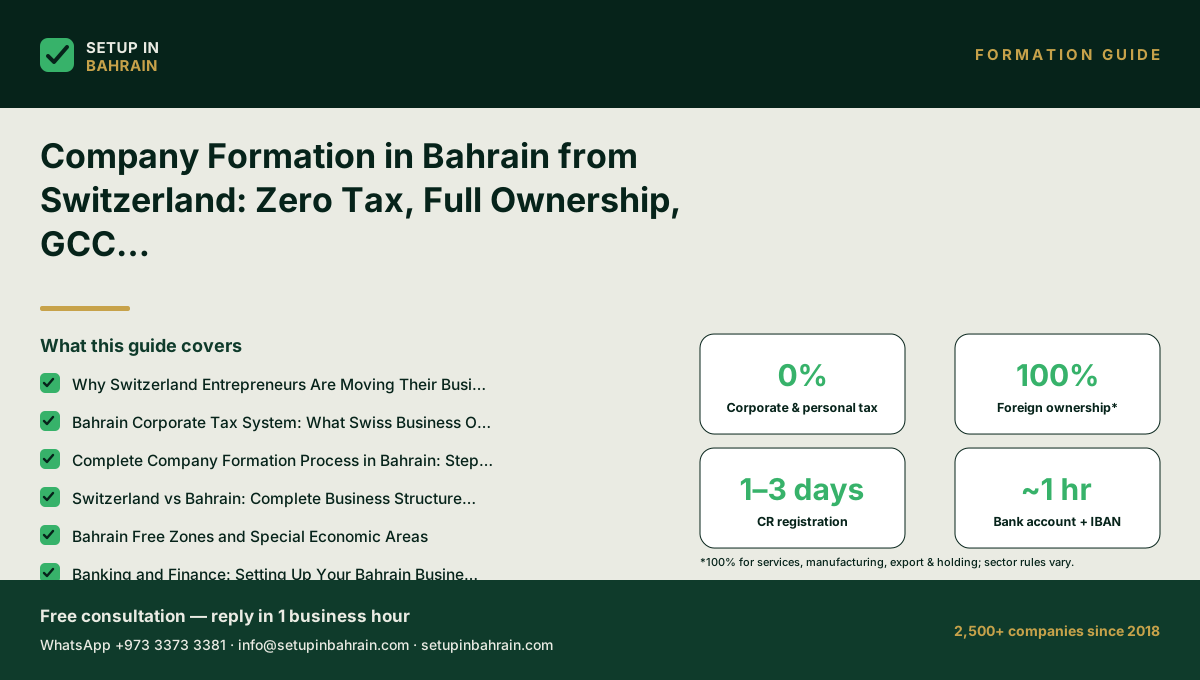
A Bahrain WLL can be owned by a single person — 100% foreign ownership applies to most activities, with no local partner required for services, manufacturing, export trading and holding companies. The minimum share capital is BHD 1 ; we recommend BHD 1,000 . This Makes bank account opening and investor visa approval smoother.
Markus had built his precision engineering consultancy in Winterthur over twelve years. His firm designed components for Swiss watchmakers and medical device manufacturers — the kind of meticulous, high-margin work Switzerland is known for. By 2024, his revenue had grown to CHF 1.2 million annually, with profit margins hovering around 35%.
Then came the tax calculation that changed everything.
Between his canton's combined corporate tax rate of 18.7%, his AHV/IV contributions as both employer and self-employed director, the mandatory commercial register fees, and the CHF 20,000 minimum share capital sitting untouched in his GmbH account, Markus realized he was surrendering nearly CHF 180,000 annually to various Swiss obligations. When he started exploring expansion into the Gulf region — where several medical device manufacturers had relocated production — his Zurich-based bank flagged his wire transfers for additional KYC review. Each international payment took three weeks to clear.
"I didn't leave Switzerland because I stopped loving it," Markus told me over coffee in Bahrain's Diplomatic Area last November. "I left because the system punished me for wanting to grow internationally."
Today, Markus operates his consultancy from a Bahrain-based WLL. His corporate tax rate is zero percent — not reduced, not deferred, zero. His Saudi Arabian clients pay invoices in three days instead of three weeks. His setup costs totaled less than what he paid annually for Swiss commercial register maintenance alone.
This isn't an outlier story. According to the Bahrain Economic Development Board (EDB), inquiries from Swiss-owned SMEs increased by 210% between 2023 and 2025. The Swiss-Bahrain Business Association reports that company formations by Swiss nationals have tripled since 2022.
Something fundamental has shifted. Swiss entrepreneurs — historically conservative about international expansion — are discovering that Bahrain offers something their home country structurally cannot: fiscal freedom combined with legitimate Gulf market access.
Why Switzerland Entrepreneurs Are Moving Their Business to Bahrain
Let's address the frustration driving this migration with complete honesty: Switzerland's corporate tax system makes no rational sense to entrepreneurs trying to scale beyond European borders.
You chose your canton based on quality of life, client proximity, or where your family settled. But that choice accidentally determines whether you pay 12.1% combined corporate tax (Zug), 14.3% (Lucerne), 18.7% (Winterthur), or 21.1% (Geneva). The spread between the lowest and highest cantonal rates exceeds nine percentage points — a gap that means CHF 90,000 in additional tax on every CHF 1 million in profit.
This isn't progressive taxation based on ability to pay. It's geographic lottery dressed as federalism.
Consider the cascading effect. Your GmbH earns CHF 500,000 in profit. In Geneva, you pay roughly CHF 105,500 in corporate tax. In Zug, you'd pay about CHF 60,500. That CHF 45,000 difference — determined entirely by which side of a cantonal border your office sits — could fund a new hire, a market expansion, or twelve months of product development.
But corporate tax is only the beginning.
The AHV/IV Burden Nobody Discusses Openly
Swiss entrepreneurs rarely talk publicly about AHV/IV contributions because complaining about social insurance feels unseemly. But the numbers deserve scrutiny.
As a self-employed director of your own GmbH, you contribute about 10.6% of your salary to AHV/IV/EO. Your company matches this as the employer contribution. On a modest director's salary of CHF 150,000, that's CHF 31,800 annually — before you've paid a single franc in income tax.
For a small team of three employees earning an average of CHF 100,000 each, you're looking at roughly CHF 63,600 in combined employer-employee AHV/IV contributions. Add unemployment insurance, occupational pension fund requirements. Accident insurance, and social contributions easily consume 15-18% of your total payroll costs.
These aren't optional. These aren't negotiable. These are structural costs of doing business in Switzerland.
The CHF 20,000 Capital Trap
Every Swiss GmbH requires minimum share capital of CHF 20,000, fully paid up and deposited before registration. For an AG, the requirement jumps to CHF 100,000 (with CHF 50,000 paid up).
This capital sits in a blocked account during formation, and while you can access it afterward, the psychological and practical effect is real: CHF 20,000 that could fund marketing, inventory, or equipment instead shows to the commercial register that you're "serious."
Bahrain's equivalent structure — the single-shareholder WLL — requires capital of BHD 50, about CHF 120. The WLL structure requires BHD 20,000 (roughly CHF 48,000). This can be deployed immediately into business operations rather than sitting as statutory evidence of legitimacy.
FINMA Compliance and International Banking Friction
Swiss financial regulation through FINMA maintains Switzerland's reputation for stability. But that same regulatory intensity creates friction for businesses operating internationally.
If your clients are based outside the EU — especially in the Middle East, Asia, or Africa — your Swiss bank will subject incoming payments to enhanced due diligence. Wire transfers that should clear in 48 hours instead take two to three weeks. Your relationship manager requests updated KYC documents every quarter. Opening a second corporate account for a new business line requires three months of compliance review.
For entrepreneurs serving GCC markets, this friction isn't merely inconvenient — it's competitively damaging. Your Dubai-based competitor receives payment in 24 hours while you're still waiting for compliance clearance.
The Currency Volatility Problem
The Swiss franc's strength is at once blessing and curse. When invoicing European clients in euros, the CHF's appreciation against the EUR since 2015 has continuously eroded export margins. When the SNB abandoned the EUR/CHF floor in January 2015, Swiss exporters lost 15-20% of their price competitiveness overnight.
For entrepreneurs serving Gulf markets, the calculation becomes more complex. GCC currencies (Saudi riyal, UAE dirham, Bahraini dinar) are pegged to the US dollar. When you invoice from Switzerland in CHF and your client pays in a USD-pegged currency, you're exposed to both CHF/USD volatility and the conversion costs of moving between currency pairs.
Operating a Bahraini entity eliminates this entirely. You invoice in Bahraini dinars (pegged at 0.376 to the dollar since 1980), receive payment in dinars. Maintain dollar-denominated stability throughout your GCC operations.
Bahrain Corporate Tax System: What Swiss Business Owners Need to Know
Here's the number that stops Swiss entrepreneurs mid-conversation: Bahrain's corporate income tax rate is zero percent.
Not reduced. Not incentivized. Not temporary. Zero.
This applies to all business activities except oil and gas extraction (taxed at 46%) and applies equally to foreign-owned companies and Bahraini-owned enterprises. There's no distinction between onshore and offshore entities — a Bahrain WLL serving the domestic market pays the same zero rate as a single-shareholder WLL conducting purely international business.
According to the Ministry of Industry and Commerce (MOIC), this zero-rate policy has been in effect since Bahrain's modern commercial code was established and shows no indication of changing. Unlike special economic zones in other jurisdictions that offer temporary tax holidays, Bahrain's Generally no corporate income tax for most sectors is structural to the entire economy.
No Withholding Tax on Dividends, Interest, or Royalties
When your Bahraini company distributes dividends to you as a Swiss shareholder, Bahrain imposes no withholding tax. Zero percent on dividends. Zero percent on interest payments. Zero percent on royalty distributions.
Compare this to Switzerland, where dividend distributions from your GmbH face partial taxation at the personal level (typically 50-70% of dividends are taxable income, depending on canton), plus potential withholding obligations for non-resident shareholders.
The practical effect is profound. A Bahraini WLL earning BHD 100,000 in profit can distribute BHD 100,000 to its Swiss owner. A Swiss GmbH earning CHF 100,000 might retain CHF 80,000 after corporate tax, then face additional personal taxation when distributing dividends.
No Capital Gains Tax
Bahrain imposes no capital gains tax on the sale of shares, real estate, or business assets. If you build your Bahraini company to BHD 5 million in value and sell it entirely, Bahrain takes nothing from the transaction.
For serial entrepreneurs or those building with eventual exit in mind, this changes the calculus entirely. Swiss capital gains on substantial shareholdings (typically above 10% ownership) face complex taxation depending on whether the sale qualifies as "private wealth management" or "self-employment." The ambiguity itself creates advisory costs and planning uncertainty.
No Personal Income Tax for Residents
Should you choose to relocate personally to Bahrain — not required to form a company. Advantageous for hands-on management — you'll pay zero personal income tax. This applies regardless of income source, whether from your Bahraini business, international investments, or consulting fees from Swiss clients.
The World Bank's 2024 Doing Business indicators rank Bahrain first in the MENA region for tax administration simplicity. There's no personal income tax filing because there's no personal income tax.
VAT at 10% — Recently Implemented
Bahrain implemented Value Added Tax in January 2019 at 5%, increasing to 10% in January 2022. This is the only broad-based consumption tax in the country.
For context, Switzerland's standard VAT rate is 8.1% (effective January 2024), with reduced rates for certain goods and services. The marginal difference of 1.9 percentage points on VATable supplies is vastly outweighed by the elimination of corporate and personal income taxes.
Importantly, Bahrain's VAT system allows full input tax recovery for registered businesses. Exports of services to other GCC countries are generally zero-rated under intra-GCC agreements.
Complete Company Formation Process in Bahrain: Step-by-Step Guide
The formation process in Bahrain reflects the government's strategic commitment to attracting foreign investment. The MOIC has systematically digitized nearly every step, reducing what once took months into a process completable in two to three weeks.
Step 1: Determine Your Optimal Entity Structure
Your first decision is structural. Bahrain offers several entity types for foreign entrepreneurs, each with distinct characteristics:
single-shareholder WLL : Ideal for solo entrepreneurs and consultants. Requires only one shareholder, one director (can be the same person). Minimum capital of BHD 50 (about CHF 120). Allows 100% foreign ownership across most business activities.
With Limited Liability Company (WLL): The most common structure for SMEs, requiring 2-50 shareholders. Minimum capital is BHD 20,000 (about CHF 48,000), though this can be deployed immediately into operations. Allows 100% foreign ownership.
Branch of Foreign Company: Suitable if you want to maintain your Swiss GmbH while establishing a Bahraini presence. No separate capital requirement, but activities must mirror the parent company's scope. Profits are taxable in the home jurisdiction (Switzerland), making this less advantageous from a tax perspective.
Representative Office: For market exploration only — cannot conduct commercial transactions or generate revenue in Bahrain. Useful for preliminary research but not suitable for actual operations.
For most Swiss entrepreneurs, the WLL offers optimal simplicity for individual consultants and service providers. The WLL provides more flexibility for companies expecting multiple shareholders or future investment rounds.
Step 2: Reserve Your Company Name
Name reservation occurs through MOIC's Sijilat online portal. The name must be unique, not misleading about the company's activities. Must include the entity type designation (WLL).
Processing time: 1-2 business days. Cost: BHD 10 (about CHF 24).
Arabic name registration is required alongside the English name, though the Arabic version can be a transliteration rather than a translation.
Step 3: Prepare and Notarize Formation Documents
Required documents for a single-shareholder WLL:
- Memorandum of Association
- Identification documents (passport copy, residence proof)
- Professional qualifications (if applicable to your activity)
Required documents for a WLL:
- Memorandum and Articles of Association
- Shareholder agreements (if multiple parties)
- Director appointments and specimen signatures
- Identification for all shareholders and directors
Documents must be notarized. If you're preparing documents from Switzerland, they require apostille certification before submission to Bahraini authorities. Swiss notarization is recognized under the Hague Apostille Convention, which Bahrain joined in 2013.
Step 4: Get Commercial Registration (CR)
The Commercial Registration is your company's legal birth certificate. Application occurs through Sijilat, with the MOIC processing applications within 3-5 business days for straightforward cases.
You'll select your business activities from MOIC's standardized list. Most consulting, trading, and professional services activities allow 100% foreign ownership. Certain sectors — including some retail activities, real estate agency. Specific professional services — may require a Bahraini partner or additional licensing.
CR cost: BHD 100 (about CHF 240) for initial registration, renewable annually.
Step 5: Get Municipal License
The municipal license authorizes operation from your physical address. Requirements include:
- Tenancy agreement (lease) for your office premises
- Fire safety approval
- Building compliance certificate
For entrepreneurs not requiring substantial physical presence, Bahrain offers licensed virtual office arrangements through approved business centers. This satisfies municipal requirements while avoiding traditional office lease obligations.
Municipal license cost: BHD 50-200 depending on business activity and premises size.
Step 6: Open Corporate Bank Account
Bahrain's banking sector includes both international institutions (HSBC, Standard Chartered, Citibank) and strong regional banks (Ahli United Bank, National Bank of Bahrain, Bank of Bahrain and Kuwait).
Account opening typically requires:
- Commercial Registration certificate
- Memorandum of Association
- Board resolution authorizing account opening
- Personal identification for signatories
- Proof of business activity (contracts, invoices, business plan)
The Central Bank of Bahrain (CBB) maintains robust AML/KYC requirements, so expect thorough due diligence. But, for legitimate businesses with clear documents, account opening typically completes within 2-3 weeks — greatly faster than adding international banking relationships to an existing Swiss entity.
Step 7: Register for VAT (If Applicable)
Businesses with annual revenue exceeding BHD 37,500 (about CHF 90,000) must register for VAT. Registration is optional for businesses below this threshold but mandatory above it.
Registration occurs through the National Bureau for Revenue (NBR) online portal. Returns are filed quarterly. The NBR's digital systems integrate directly with accounting software used by major practices.
Complete Timeline and Cost Summary
| Phase | Duration | Cost (Approximate) |
| Name reservation | 1-2 days | BHD 10 (CHF 24) |
| Document preparation & notarization | 3-5 days | BHD 50-200 (CHF 120-480) |
| Commercial Registration | 3-5 days | BHD 100 (CHF 240) |
| Municipal License | 5-7 days | BHD 50-200 (CHF 120-480) |
| Bank account opening | 10-15 days | Varies by bank |
| VAT registration | 3-5 days | Free |
| Total | 14-21 business days | BHD 300-600 (CHF 720-1,440) |
Switzerland vs Bahrain: Complete Business Structure Comparison
Understanding the structural differences between Swiss and Bahraini business entities helps you plan appropriately. The following comparison covers the most commonly chosen structures by Swiss entrepreneurs.
Legal Entity Comparison
| Factor | Swiss GmbH | Swiss AG | Bahrain WLL | Bahrain WLL |
| Minimum shareholders | 1 | 1 | 1 | 2 |
| Maximum shareholders | Unlimited | Unlimited | 1 | 50 |
| Minimum capital | CHF 20,000 | CHF 100,000 | BHD 50 (CHF 120) | BHD 20,000 (CHF 48,000) |
| Capital paid up | 100% | 50% (CHF 50,000 min) | 100% | 100% |
| Foreign ownership | 100% | 100% | 100% | 100%* |
| Director residency | No requirement | No requirement | No requirement | No requirement |
| Annual audit | Required (with exceptions) | Required | Required (WLL exempt under threshold) | Required |
| Public disclosure | Shareholder register | Share register | Limited | Limited |
Taxation Comparison
| Tax Type | Switzerland | Bahrain |
| Corporate income tax | 12-21% (canton dependent) | 0% |
| Dividend withholding | 35% (reduced by treaty) | 0% |
| Capital gains tax | Complex (may apply) | 0% |
| Personal income tax | Progressive (canton dependent) | 0% |
| VAT | 8.1% standard | 10% |
| Social contributions | ~15-18% of payroll | ~7% of payroll (SIO) |
| Annual registration fees | CHF 400-800 | BHD 100-300 (CHF 240-720) |
Operational Cost Comparison (Annual, for CHF 500,000 Revenue Business)
| Cost Category | Switzerland (Geneva) | Switzerland (Zug) | Bahrain |
| Corporate tax (at 25% profit margin) | CHF 26,375 | CHF 15,125 | CHF 0 |
| Social contributions (3 employees) | CHF 45,000 | CHF 45,000 | CHF 21,000 |
| Office space (50m²) | CHF 30,000 | CHF 24,000 | CHF 7,200 |
| Accounting & compliance | CHF 15,000 | CHF 15,000 | CHF 6,000 |
| Bank charges (international) | CHF 3,600 | CHF 3,600 | CHF 1,200 |
| Total annual overhead | CHF 119,975 | CHF 102,725 | CHF 35,400 |
Bahrain Free Zones and Special Economic Areas
Bahrain offers several designated zones providing additional benefits beyond the mainland's already favorable environment. Understanding these options helps you optimize your structure.
Bahrain Investment Wharf (BIW)
Located in Hidd, BIW offers purpose-built industrial and logistics facilities targeting manufacturing and distribution companies. Key benefits include:
- 100% foreign ownership without exception
- 10-year renewable land lease agreements
- Duty exemption on imported machinery and equipment
- Direct port access for shipping-intensive operations
BIW is especially relevant for Swiss companies in precision manufacturing, specialty chemicals, or pharma logistics seeking regional distribution capabilities.
Bahrain Logistics Zone (BLZ)
Adjacent to Khalifa Bin Salman Port, BLZ provides specialized infrastructure for warehousing and logistics operations:
- 100% foreign ownership
- Exemption from import duties for re-export activities
- Integrated customs procedures with reduced documents
- Cold storage and specialized handling facilities
For Swiss companies managing supply chains into Saudi Arabia (accessible via the King Fahd Causeway in 45 minutes), BLZ offers strategic positioning.
Bahrain International Investment Park (BIIP)
BIIP focuses on light manufacturing and assembly operations, offering:
- Pre-built industrial units from 500m² upward
- 10-year renewable lease terms
- Exemption from corporate tax (matching mainland rate)
- Simplified visa processing for technical staff
When Free Zones Make Sense
Free zones become advantageous when:
- Your business involves significant physical goods movement
- You require specialized industrial infrastructure
- You're establishing manufacturing operations
- Duty exemptions on imported equipment materially affect setup costs
For service-based businesses — consulting, software, professional services — mainland registration typically provides equivalent tax benefits with greater flexibility.
Banking and Finance: Setting Up Your Bahrain Business Accounts
Bahrain's position as a regional financial center, regulated by the Central Bank of Bahrain (CBB), provides infrastructure that matches or exceeds Swiss standards in many respects.
Banking Landscape
The CBB regulates about 375 licensed financial institutions, including:
Retail Banks (suitable for operational accounts):
- National Bank of Bahrain
- Bank of Bahrain and Kuwait
- Ahli United Bank
- HSBC Bahrain
- Standard Chartered Bahrain
Islamic Banks (Sharia-compliant structures):
- Al Baraka Banking Group
- Kuwait Finance House Bahrain
- Bahrain Islamic Bank
Wholesale Banks (for larger operations):
- Citibank
- BNP Paribas
- Credit Agricole
Account Opening Practicalities
Banks will request:
- Commercial Registration certificate
- Memorandum and Articles of Association
- Board resolution authorizing account opening
- Specimen signatures for authorized signatories
- Passport copies and proof of address for directors/signatories
- Business plan or description of intended activities
- Source of funds documents
For Swiss entrepreneurs, the process is familiar — Swiss banks require similar documents. The difference lies in processing speed. Bahraini banks, accustomed to serving international businesses, typically complete onboarding in 2-3 weeks rather than the 6-8 weeks common for adding international banking to Swiss entities.
Multi-Currency Capabilities
Major Bahraini banks offer multi-currency accounts as standard:
- Bahraini Dinar (BHD) — pegged to USD
- US Dollars (USD)
- Euro (EUR)
- British Pounds (GBP)
- Saudi Riyals (SAR)
This capability simplifies invoicing across GCC markets while maintaining currency flexibility for European clients.
Digital Banking and Payment Processing
Bahrain FinTech Bay — the region's largest fintech hub — has attracted payment processors, digital banking platforms. Financial technology companies. Benefit Pay, Bahrain's domestic payment network, integrates with international systems. Card processing through regional and international acquirers provides multiple payment acceptance options.
For e-commerce or SaaS businesses, payment gateway integration is straightforward, with Stripe, PayTabs. Regional processors all operating in Bahrain.
Visa and Residence Permits: Living and Working in Bahrain
While company formation doesn't require physical presence in Bahrain, many Swiss entrepreneurs choose to relocate for hands-on management and personal tax optimization.
Golden Residency Visa
Bahrain's Golden Residency program targets investors and high-net-worth individuals:
Qualification requirements:
- Property ownership of BHD 200,000+ (about CHF 480,000), or
- Retirement income of BHD 4,000/month (about CHF 9,600), or
- Investment in Bahraini business of significant value
Benefits:
- Indefinite residence (renewable every 10 years)
- Family inclusion (spouse and dependent children)
- No sponsor requirement
- Work authorization without separate permit
Investor Visa
For company founders not meeting Golden Residency thresholds:
Requirements:
- Business ownership in Bahrain
- Capital investment meeting MOIC requirements
- Active business operations
Benefits:
- 2-year renewable residence
- Self-sponsoring through your company
- Family residence included
Work Visa (for Employed Directors)
If structured as an employee of your Bahraini company:
Requirements:
- Employment contract
- Company sponsorship
- Medical examination
- Background verification
Process duration: 2-4 weeks
Practical Residency Considerations for Swiss Nationals
Switzerland and Bahrain maintain cordial diplomatic relations, though no bilateral social security agreement exists. This means:
- Swiss AHV/IV contributions cease upon Bahrain residency
- You can voluntarily continue Swiss AVS contributions (covering basic retirement insurance)
- Bahraini Social Insurance Organization (SIO) contributions apply to locally employed individuals
For entrepreneurs maintaining Swiss domicile while operating a Bahraini company (not relocating personally), the company structure provides tax benefits while your personal tax situation remains governed by Swiss rules.
Double Taxation and Legal Framework
Switzerland-Bahrain Tax Treaty Status
As of 2025, no comprehensive double taxation agreement exists between Switzerland and Bahrain. This creates both challenges and opportunities.
Without a DTA:
- Dividends from Bahrain to Swiss shareholders may face Swiss taxation without foreign tax credit (since Bahrain charges no tax)
- Swiss tax authorities apply normal domestic rules without treaty-based rate reductions
- Careful structuring required to optimize overall tax position
Practical implications:
- Your Bahraini company generally pays no corporate income tax in most sectors
- Dividends distributed to you personally are subject to Swiss income tax if you remain Swiss resident
- Capital gains on sale of Bahraini company shares follow Swiss rules for Swiss residents
Substance Requirements
Both Swiss and international tax authorities more and more focus on "economic substance" — whether companies have genuine business operations in their stated jurisdiction.
To establish proper Bahrain substance:
- Maintain physical presence (office, employees, or substantial service agreements)
- Conduct board meetings in Bahrain (or via documented participation from Bahrain)
- Generate revenue through genuine business activities
- Maintain local banking relationships and financial records
Swiss entrepreneurs should ensure their Bahraini entities reflect genuine business operations rather than appearing as artificial structures designed solely for tax avoidance.
Bahrain Investment Protection
Bahrain provides strong investor protections:
BIPA (Bahrain Investors Protection Agreement): Bilateral investment treaties with numerous countries, providing:
- Protection against expropriation without compensation
- Free transfer of investment returns
- Access to international arbitration (ICSID, UNCITRAL)
World Bank Recognition: Bahrain consistently ranks among the top MENA countries in the World Bank's Doing Business rankings for investor protection, contract enforcement, and regulatory quality.
Industry-Specific Formation Considerations
Different business types face varying requirements in Bahrain. Understanding sector-specific nuances prevents delays and ensures proper licensing.
Professional Services (Consulting, Advisory)
Permitted activities: Management consulting, technical consulting, IT services, marketing, human resources advisory
Ownership: 100% foreign ownership permitted
Requirements:
- Professional qualifications documents
- Portfolio of previous work (for some license categories)
- Professional liability insurance (recommended, not mandatory)
Swiss relevance: Swiss consultants in finance, engineering, and technology find straightforward licensing pathways.
Financial Services
Regulated activities: Investment advisory, asset management, insurance, banking, payment services
Licensing authority: Central Bank of Bahrain (CBB)
Requirements:
- CBB license application (separate from commercial registration)
- Capital requirements varying by license category
- Compliance officer appointment
- Detailed business plan and risk frameworks
Processing time: 3-6 months for regulated activities
Swiss relevance: Given FINMA's stringent requirements, Swiss financial professionals often find CBB licensing familiar in rigor but faster in processing.
Technology and Software
Permitted activities: Software development, IT infrastructure, SaaS, fintech
Ownership: 100% foreign ownership
Requirements: Standard commercial registration
Benefits:
- Bahrain Economic Development Board offers tech sector support
- AWS and Microsoft Azure maintain regional infrastructure in Bahrain
- Fintech regulatory sandbox available for innovative services
Trading and Distribution
Permitted activities: Import/export, wholesale distribution, retail (with restrictions)
Ownership: 100% foreign ownership for wholesale; retail may require Bahraini partnership
Requirements:
- Product registration with relevant ministries (food, pharmaceuticals, etc.)
- Import licenses for controlled goods
- Warehouse facilities for physical inventory
Manufacturing
Permitted activities: Light manufacturing, assembly, processing
Ownership: 100% foreign ownership
Location requirements: May require industrial zone location (BIW, BIIP)
Benefits:
- No duties on imported manufacturing equipment
- Favorable electricity rates for industrial users
- Regional export facilitation through GCC agreements
GCC Market Access: Your Gateway to $2.8 Trillion Regional Economy
Bahrain's strategic value extends far beyond its domestic market of 1.5 million people. Your Bahraini company positions you within the Gulf Cooperation Council economic framework.
The GCC Common Market
Since 2008, the GCC Common Market has progressively eliminated trade barriers between member states:
- Saudi Arabia (population 36 million, GDP $833 billion)
- United Arab Emirates (population 9.9 million, GDP $422 billion)
- Qatar (population 2.9 million, GDP $220 billion)
- Kuwait (population 4.3 million, GDP $184 billion)
- Oman (population 5.1 million, GDP $108 billion)
- Bahrain (population 1.5 million, GDP $44 billion)
Combined, the GCC represents $1.8 trillion in GDP and a consumer market of 60 million people, predominantly young, urban. Affluent.
Saudi Arabia: 45 Minutes Away
The King Fahd Causeway connects Bahrain to Saudi Arabia's Eastern Province — home to Saudi Aramco, major industrial cities. A population of 5 million. The drive takes 45 minutes from central Manama.
Swiss companies serving Saudi clients can:
- Meet clients in person without visa complications (Bahrain residents can get Saudi business visas efficiently)
- Ship products across the causeway with minimal customs friction
- Hire Saudi nationals who commute daily to Bahrain offices
This proximity advantage cannot be replicated from Switzerland, where serving Saudi clients involves multiple flights, significant visa processing, and 14-hour travel times.
GCC Single Visa and Business Travel
GCC nationals and residents benefit from streamlined intra-regional travel:
- No visa required for GCC nationals visiting other member states
- Simplified business visa procedures for non-GCC residents with GCC company sponsorship
- Growing acceptance of digital visa applications
For a Swiss entrepreneur based in Bahrain, client meetings in Dubai, Riyadh, Doha, or Kuwait City become day trips rather than international expeditions.
Free Trade Agreements
Bahrain maintains trade agreements extending beyond the GCC:
- US-Bahrain FTA (2006): Duty-free access for most goods, services liberalization
- GCC-Singapore FTA: Preferential access to Southeast Asian markets
- Greater Arab Free Trade Area: Reduced tariffs across 17 Arab nations
Frequently Asked Questions from Swiss Entrepreneurs
Can I form a Bahrain company without visiting Bahrain?
Yes, remote formation is possible through appointed agents and power of attorney arrangements. But, bank account opening typically requires in-person verification or certified video identification. Establishing genuine substance requires some physical presence.
Will my Swiss GmbH still exist if I form a Bahrain company?
Forming a Bahraini entity doesn't affect your Swiss company. Many Swiss entrepreneurs maintain their GmbH for Swiss/European clients while establishing a Bahrain entity for GCC operations. The two can coexist indefinitely.
How do Swiss authorities view Bahrain company structures?
Swiss tax authorities apply normal international tax rules. If you remain Swiss resident, your worldwide income — including Bahrain company profits where applicable — remains subject to Swiss taxation. Proper structuring with genuine substance in Bahrain can provide legitimate tax efficiencies. Structures without business purpose may be challenged.
What about Swiss social security if I relocate?
Upon relocating to Bahrain, mandatory AHV/IV contributions cease. You can voluntarily continue basic AVS coverage. No totalization agreement exists between Switzerland and Bahrain, so Bahrain Social Insurance Organization (SIO) contributions become applicable for locally employed individuals without crediting toward Swiss retirement benefits.
Is Bahrain politically stable?
Bahrain has maintained stable governance under the Al Khalifa monarchy since 1783. While the 2011 Arab Spring saw protests, the political situation has been stable since 2012. Bahrain hosts the US Fifth Fleet, maintains close UK defense ties. Has formal diplomatic relations with Israel since 2020. Economic diversification away from oil dependence continues under the Economic Vision 2030 program.
Can I hire Swiss employees to work from Bahrain?
Yes. Swiss nationals can get Bahrain work visas through company sponsorship. Employment contracts follow Bahrain Labour Law, which provides employee protections while offering more flexibility than Swiss employment regulations.
What happens if my Bahrain business fails?
Bahrain's commercial law provides for orderly business dissolution. Voluntary liquidation requires settling debts, distributing remaining assets to shareholders, and de-registering with MOIC. The process typically takes 3-6 months. Personal liability is limited to share capital in properly constituted WLLs and WLLs.
How do I move money between my Bahrain and Swiss companies?
Intercompany transactions follow normal commercial principles. Your Bahrain company can invoice your Swiss company for
Bahrain Business Guides for Switzerland Citizens
Frequently Asked Questions
How long does it take to set up?
It takes 15 to 20 days. We file all forms for you. You do not need to wait long.
What does it cost?
Company formation: Standard BHD 1,340 with 3 months of office address; Gold BHD 1,700 with 6 months; Premium BHD 2,150 with 12 months and a cabin, officer table and chair, and two guest chairs. No formation package includes visas, including Premium. Investor/work visas are priced separately: BHD 755 for one year or BHD 953 for two years, in addition to the formation package. Ask for a written, itemized quotation confirming government fees and all inclusions before payment.
Do I need to visit Bahrain?
No. You can set up your firm from home. We do all the work online. Some banks may ask for one visit.
What tax will I pay?
You pay zero tax on your profits. Bahrain has no corporate income tax. This is a key benefit of the setup.
Can I own 100% of my firm?
Yes. Foreign owners can hold all shares. No local partner is needed. Full ownership is allowed.
What do I need to start?
You need a valid passport. You also need a trade name and a business address. We help you with all of these.
How do I open a bank account?
We guide you step by step. Most banks take 3 to 6 weeks. You will need your CR and firm papers.
Who issues the Commercial Registration (CR)?
The CR is issued by the MOICT. It is your legal right to trade in Bahrain. We file the CR for you.
Can I renew my CR each year?
Company renewal packages: BHD 530 with 3 months of office address; BHD 980 with 6 months; BHD 1,520 with 12 months. These are separate renewal packages, not visa fees.
How do I get started?
Fill in our form on this page. Our team will call you back. We map your best setup plan at no cost.
Steps to Form Your Company
- Pick your trade name. We check if it is free.
- Choose your business type. WLL is the most common.
- Sign the MOA. We draft and file all legal docs.
- Pay the state fees. About BHD 432 in total.
- Get your CR. Takes 15 to 20 days.
- Open your bank account. We guide each step.
- Start trading. You are ready to do business.
Key Facts
- Tax rate: 0%
- Foreign ownership: 100%
- Setup time: 15 to 20 days
- Company formation: Standard BHD 1,340 with 3 months of office address; Gold BHD 1,700 with 6 months; Premium BHD 2,150 with 12 months and a cabin, officer table and chair, and two guest chairs. No formation package includes visas, including Premium. Investor/work visas are priced separately: BHD 755 for one year or BHD 953 for two years, in addition to the formation package. Ask for a written, itemized quotation confirming government fees and all inclusions before payment.
- Company renewal packages: BHD 530 with 3 months of office address; BHD 980 with 6 months; BHD 1,520 with 12 months. These are separate renewal packages, not visa fees.
- Client rating: 4.8 stars
- Clients served: 2,500 and more
Quick Facts
- Tax rate: 0%
- Own all of your firm: Yes, 100%
- Time to set up: 15 to 20 days
- Company formation: Standard BHD 1,340 with 3 months of office address; Gold BHD 1,700 with 6 months; Premium BHD 2,150 with 12 months and a cabin, officer table and chair, and two guest chairs. No formation package includes visas, including Premium. Investor/work visas are priced separately: BHD 755 for one year or BHD 953 for two years, in addition to the formation package. Ask for a written, itemized quotation confirming government fees and all inclusions before payment.
- Company renewal packages: BHD 530 with 3 months of office address; BHD 980 with 6 months; BHD 1,520 with 12 months. These are separate renewal packages, not visa fees.
- Rating: 4.8 stars
- Clients: 2,500 and more
Why Bahrain?
Bahrain has no tax. You keep all your profits. This is rare in the Gulf.
You can own all of your firm. No local partner is needed. The law allows full foreign ownership.
Setup takes 15 to 20 days. We file all forms for you. You can do it all from home.
Bahrain has a free trade deal with the US. Your goods face low or no tariffs. This gives you access to big markets.
We have served 2,800+ clients from 44+ countries and maintain records to substantiate that total where needed. We have 113 Google reviews; reviews represent only some clients and are not the same as the total clients served.
Our Steps
- Tell us your plan. We advise you for free.
- We pick the right firm type for you.
- We file all your forms with MOICT.
- You get your CR in 15 to 20 days.
- We help you open a bank account.
- You are ready to trade. We stay with you.
Why Set Up in Bahrain?
Bahrain is a great place to run a firm. It has no tax. You keep all your profits. This is rare in the Gulf.
You can own your firm 100%. No local partner is needed. The law is clear and fair.
It is fast to set up. You can have a CR in 15 to 20 days. We file all forms for you.
Bahrain has a free trade deal with the US. Your goods face low or no tariffs. This gives you access to big markets.
The banks are good. The roads are good. The schools are good. It is a well-run state.
We have served 2,800+ clients from 44+ countries and maintain records to substantiate that total where needed. We have 113 Google reviews; reviews represent only some clients and are not the same as the total clients served.
Our Services
- Company formation: Standard BHD 1,340 with 3 months of office address; Gold BHD 1,700 with 6 months; Premium BHD 2,150 with 12 months and a cabin, officer table and chair, and two guest chairs. No formation package includes visas, including Premium. Investor/work visas are priced separately: BHD 755 for one year or BHD 953 for two years, in addition to the formation package. Ask for a written, itemized quotation confirming government fees and all inclusions before payment.
- Company renewal packages: BHD 530 with 3 months of office address; BHD 980 with 6 months; BHD 1,520 with 12 months. These are separate renewal packages, not visa fees.
- Investor Visa — from BHD 755
- Work Visa — LMRA managed
- Virtual office — from BHD 600 per year
- Bank account opening — 3 to 6 weeks
- Family visa — for spouse and kids
- UBO filing — as required by law
Bahrain at a Glance
- Tax rate: 0%
- Foreign ownership: 100%
- Setup time: 15 to 20 days
- Free trade deal: Yes, with the US
- Language: Arabic and English
- Currency: Bahraini Dinar (BHD)
- Time zone: UTC+3
- GDP growth: Steady and strong
How to Start
- Fill in the form on this page. It takes 3 minutes.
- We call you back the same day.
- We map the best plan for your firm type and goals.
- We file all forms. We deal with MOICT for you.
- You get your CR in 15 to 20 days.
- We help you open a bank account and get your visa.
- You are ready to trade. We stay with you.
Common Questions
Do I need to visit Bahrain to set up?
No. You can do it all from home. We file online. You may need one visit to open a bank account.
Is Bahrain safe for business?
Yes. Bahrain is a stable state. It has a clear legal system. Your firm and funds are safe here.
Can I hire staff from any country?
Yes. You can hire from any country. Each hire needs a work permit from LMRA. We manage this for you.
What type of firm should I set up?
Most clients choose a WLL. This is a limited liability firm. It is flexible and well-known in Bahrain. We advise you on the best type for your case.
How do I get in touch?
Fill in our form. We call you back the same day. You can also email us or use the chat on this page.
Ready to set up in Bahrain from Switzerland?
Tell us your business idea. We map the right entity, ownership and timeline — then handle the filing while you focus on what matters.