
Start your business in Bahrain from Saudi Arabia with generally no corporate income tax for most sectors. Easy setup, strategic location, and full foreign ownership for Saudi entrepreneurs.
Key Takeaways
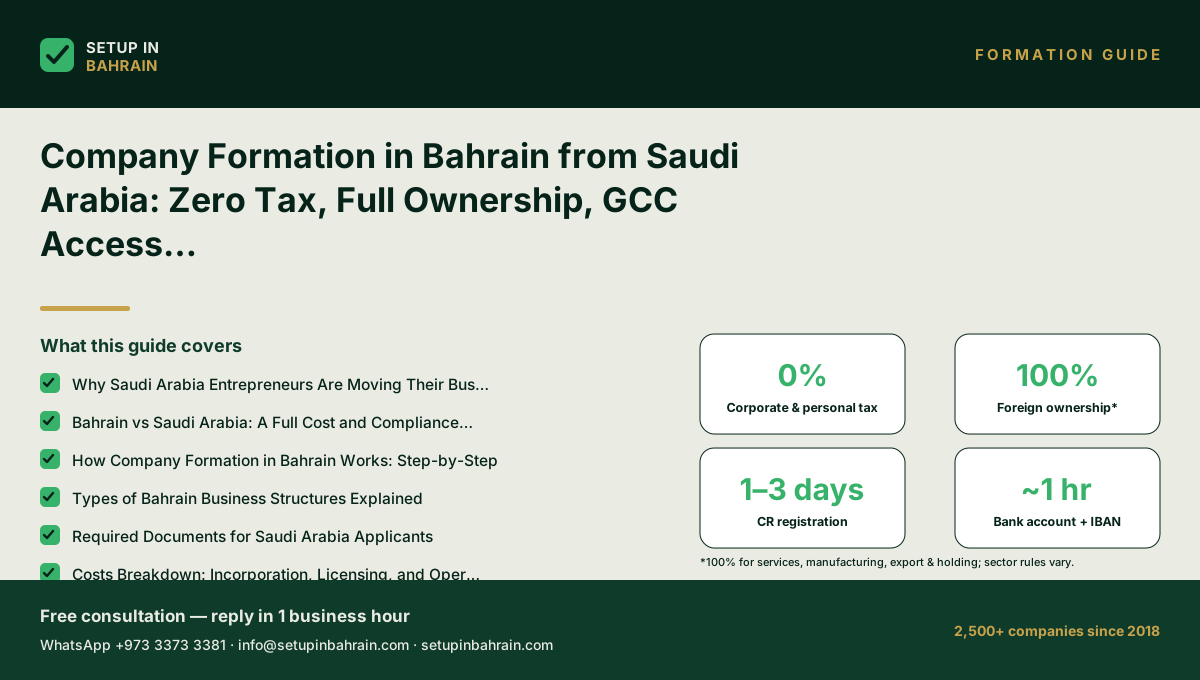
- Why Saudi Arabia Entrepreneurs Are Moving Their Business to Bahrain
- Bahrain vs Saudi Arabia: A Full Cost and Compliance Comparison
- How Company Formation in Bahrain Works: Step-by-Step
- Types of Bahrain Business Structures Explained
- Required Documents for Saudi Arabia Applicants
→ Complete guide: Company Formation in Bahrain — the full 2026 guide
View details
Ownership & capital
A Bahrain WLL can be owned by a single person — 100% foreign ownership applies to most activities, with no local partner required for services, manufacturing, export trading and holding companies. The minimum share capital is BHD 1 ; we recommend BHD 1,000 . This Makes bank account opening and investor visa approval smoother.
Last month, I sat across from Ahmed Al-Harbi at a coffee shop in Jeddah's Al-Rawdah district. He had just finished his annual ZATCA filing. His expression told the entire story before he uttered a single word.
"I paid SAR 1.08 million in taxes last year," he said, sliding his phone across the table to show me the transfer confirmation. "Twenty percent corporate tax on SAR 4.8 million profit, then the 2.5% Zakat on top. My trading company needs 35% Saudi nationals under Nitaqat — that's 14 people on a 40-person team — and I'm paying them 40% more than comparable expat workers for roles I barely need filled. My warehouse-office in the industrial district costs SAR 720,000 annually. And when ZATCA's Phase 2 e-invoicing mandate went live, I spent another SAR 185,000 on integration consultants and audit fees just to stay compliant."
Ahmed isn't alone. Across the Kingdom, from Riyadh's glass towers to Dammam's industrial zones, Saudi entrepreneurs are running identical calculations and arriving at the same conclusion: the numbers simply don't work anymore.
What Ahmed discovered — and what thousands of Saudi business owners are now acting on — is that Bahrain sits just 25 kilometers across the King Fahd Causeway, offers identical GCC market access, and operates on fundamentally different economics. Generally no corporate income tax for most sectors. Zero personal income tax. Zero Saudization requirements. Zero mandatory local sponsors. One hundred percent foreign ownership across virtually every sector.
This guide exists because Saudi entrepreneurs deserve specific, actionable intelligence — not recycled content written for a generic "MENA" audience. Every section addresses your exact situation: Saudi corporate tax obligations, ZATCA compliance headaches, Nitaqat frustrations, iqama renewal anxieties. The real logistics of operating across the causeway.
By the time you finish reading, you'll know precisely whether Bahrain makes sense for your business, exactly how to set it up, and what your Saudi tax obligations look like on the other side.
Why Saudi Arabia Entrepreneurs Are Moving Their Business to Bahrain
The Kingdom of Saudi Arabia has transformed dramatically under Vision 2030. Megaprojects like NEOM, the Red Sea Development, and Qiddiya are reshaping the economic landscape. The entertainment sector has exploded. Foreign investment is pouring in at unprecedented rates.
But for existing Saudi entrepreneurs — the people who built their businesses before the transformation began — the environment has grown progressively more challenging.
The 2generally no corporate income tax for most sectors Reality
Saudi Arabia's corporate income tax rate stands at 20% for non-GCC owned companies and mixed ownership structures. For fully Saudi-owned companies, the 2.5% Zakat on net worth applies instead — but many entrepreneurs operate with foreign partners, investors, or shareholders, triggering the full corporate tax rate plus Zakat obligations on the Saudi-owned portion.
Consider the mathematics on a SAR 5 million annual profit:
| Tax Component | Amount (SAR) | Amount (USD) |
| 20% Corporate Income Tax | 1,000,000 | 266,600 |
| 2.5% Zakat (on Saudi portion) | 125,000 | 33,300 |
| Total Annual Tax Burden | 1,125,000 | 300,000 |
In Bahrain, that identical SAR 5 million profit incurs Generally no corporate income tax for most sectors. The entire amount remains available for business expansion, dividend distribution, or reserve building.
Nitaqat: The Saudization Equation
The Nitaqat system categorizes Saudi businesses into color-coded bands based on the percentage of Saudi nationals employed. Companies in the "Green" band enjoy full government services access. Those falling into "Yellow" or "Red" face more and more severe restrictions — including the inability to renew expat visas, process new work permits, or access government contracts.
For most private-sector categories, maintaining Green status requires between 30% and 40% Saudi national employees. In some sectors — especially retail and hospitality — requirements reach 70% or higher.
The financial impact compounds quickly:
Salary differential: Saudi national employees typically command 30% to 50% higher salaries than equivalent expat workers for the same roles. A software developer position paying an Egyptian or Indian expat SAR 12,000 monthly often requires SAR 16,000 to SAR 18,000 for a Saudi candidate — if you can find one with the required skills.
Training investment: Many Saudi hires require extensive training before reaching productivity levels. Companies report 6 to 12 months of reduced output per new Saudi employee in technical roles.
Turnover costs: Saudi employees in private-sector roles show higher turnover rates, especially when government positions become available. Replacing a departing Saudi worker triggers new recruitment costs, training cycles, and potential Nitaqat compliance gaps.
For Ahmed's 40-person trading company, maintaining 14 Saudi employees at a SAR 4,000 monthly premium over equivalent expat salaries adds SAR 672,000 annually — purely for compliance, not productivity.
ZATCA E-Invoicing: The Compliance Burden
The Zakat, Tax and Customs Authority's (ZATCA) e-invoicing mandate has rolled out in phases since 2021. Phase 1 required electronic invoice generation. Phase 2, implemented progressively throughout 2024 and 2025, demands real-time integration with ZATCA's Fatoora Platform, including cryptographic stamping and immediate validation.
For small and medium enterprises, compliance costs range from SAR 50,000 to SAR 200,000 depending on existing ERP infrastructure, integration complexity, and ongoing maintenance requirements. Many entrepreneurs report spending 15 to 20 hours monthly on e-invoicing administration and error resolution.
A Bahrain-based company serving Saudi clients can issue standard commercial invoices without ZATCA integration requirements. The compliance burden disappears entirely for revenue generated outside the Kingdom.
Commercial Rent: The Riyadh and Jeddah Premium
Grade A commercial space in Riyadh's prime business districts now commands SAR 1,500 to SAR 2,200 per square meter annually. Jeddah's central business areas range from SAR 1,200 to SAR 1,800. Both markets typically require two to three years of advance rent payment for new leases.
For a 500-square-meter office in Riyadh's Olaya district, annual rent easily reaches SAR 1,000,000 — with SAR 2,000,000 to SAR 3,000,000 required upfront for the lease term.
Bahrain's Diplomatic Area and Seef District offer comparable Grade A space at BHD 6 to BHD 10 per square meter monthly (SAR 60 to SAR 100 per square meter monthly) — roughly 40% to 60% less than equivalent Saudi locations. Lease terms typically require only one year advance payment, and flexible co-working arrangements proliferate throughout Manama.
Bahrain vs Saudi Arabia: A Full Cost and Compliance Comparison
Understanding the complete cost differential requires examining every major business expense category. The table below compares identical operations in both jurisdictions:
| Factor | Saudi Arabia | Bahrain | Annual Savings (SAR 5M Revenue Company) |
| Corporate Income Tax | 20% | 0% | SAR 1,000,000 |
| Zakat | 2.5% on net worth | None | SAR 125,000 |
| Minimum Local Ownership | 25% for some sectors | 0% (100% foreign ownership) | Varies |
| Saudization (Nitaqat) | 30-40% Saudi employees | None | SAR 500,000+ |
| Personal Income Tax | 0% | 0% | Neutral |
| VAT Rate | 15% | 10% (limited scope) | Variable |
| E-Invoicing Mandate | ZATCA Fatoora integration | Standard invoicing | SAR 85,000-185,000 |
| Commercial Rent (Grade A) | SAR 1,500-2,200/sqm/year | SAR 720-1,200/sqm/year | SAR 300,000+ |
| Company Formation Time | 2-4 weeks | 3-7 business days | Faster market entry |
| Minimum Capital Requirement | SAR 500,000 (LLC) | BHD 50 (approx SAR 500) | SAR 499,500 |
The Total Cost Equation
For a Saudi entrepreneur operating a services company with SAR 5 million annual revenue, SAR 3 million annual profit, a 40-person team, and 500 square meters of Grade A office space, the comparative annual costs break down as follows:
Saudi Arabia Annual Operating Costs:
- Corporate tax (20% of SAR 3M profit): SAR 600,000
- Zakat (estimated): SAR 75,000
- Saudization premium (14 employees × SAR 4,000 × 12 months): SAR 672,000
- Office rent (Riyadh, 500 sqm): SAR 850,000
- ZATCA compliance and administration: SAR 120,000
- Total regulatory and occupancy burden: SAR 2,317,000
Bahrain Annual Operating Costs:
- Corporate tax: SAR 0
- Zakat: SAR 0
- Workforce premiums: SAR 0 (hire purely based on merit)
- Office rent (Manama, 500 sqm): SAR 420,000
- E-invoicing compliance: SAR 0
- Total regulatory and occupancy burden: SAR 420,000
Annual savings from Bahrain incorporation: SAR 1,897,000
That's nearly SAR 2 million annually returned to your bottom line — capital available for product development, market expansion, talent acquisition, or personal wealth building.
Beyond the Numbers: Operational Freedom
The financial comparison captures only quantifiable costs. The qualitative benefits of Bahrain incorporation include:
Hiring flexibility: Employ the best candidate for every role regardless of nationality. Build specialized teams with global talent. Scale workforce up or down based purely on business needs.
Strategic planning certainty: Bahrain's tax regime has remained stable for decades. The Central Bank of Bahrain (CBB) and Economic Development Board (EDB) actively maintain the competitive framework. Long-term financial projections don't require hedging against potential tax increases.
Administrative simplicity: Company maintenance requires annual license renewal, corporate registry filings, and standard accounting. No Nitaqat audits. No ZATCA platform integrations. No complex compliance calendars consuming management attention.
Investor attractiveness: International investors prefer Bahrain-domiciled holding structures for regional operations. The zero-tax environment improves return calculations and simplifies profit repatriation discussions.
How Company Formation in Bahrain Works: Step-by-Step
The Bahrain incorporation process has been streamlined greatly through the Sijilat system — the national business registration portal operated by the Ministry of Industry and Commerce (MOIC). Saudi entrepreneurs can complete most steps remotely before traveling for final signatures.
Step 1: Determine the Optimal Legal Structure
Bahrain offers several entity types, each suited to different business models:
single-shareholder WLL: Ideal for solo entrepreneurs and consultants. Requires only one shareholder (individual or corporate). Minimum capital BHD 50 (about SAR 500). Perfect for service businesses, consulting practices, and holding structures.
Limited Liability Company (WLL): The most common structure for operating businesses. a single shareholder (one person can own 100%), maximum 50. Minimum capital BHD 50 for general activities, BHD 250,000 for certain regulated activities. Shareholders' liability limited to capital contribution.
Branch Office: Suitable for Saudi companies wanting to extend operations into Bahrain without creating a separate legal entity. The Saudi parent company retains full liability. Requires Saudi company registration documents, board resolution authorizing branch setup, and appointment of a Bahrain-based manager.
Regional Headquarters: For multinational corporations seeking a regional base. Enhanced incentives available through the EDB including extended work permits, priority government services, and potential customs benefits.
For most Saudi entrepreneurs, the single-shareholder WLL or Limited Liability Company (WLL) provides the optimal combination of liability protection, operational flexibility. Administrative simplicity.
Step 2: Reserve Your Company Name
Company name reservation occurs through the Sijilat portal (www.sijilat.bh). The name must:
- Not conflict with existing registered businesses
- Include appropriate legal designation (WLL)
- Avoid restricted terms without proper authorization (Bank, Insurance, Royal, etc.)
Name reservation costs BHD 10 and remains valid for 90 days. The process typically completes within 24 hours for non-conflicting names.
Step 3: Prepare Required Documents
Saudi entrepreneurs need the following documents:
For Individual Shareholders:
- Valid Saudi passport (minimum 6 months validity)
- Saudi national ID (Hawiyah)
- Proof of residential address (utility bill or bank statement)
- Personal bank reference letter
- Professional CV or resume
For Corporate Shareholders:
- Commercial Registration (CR) certificate
- Articles of Association
- Board resolution authorizing Bahrain investment
- Authorized signatory passport copies
- Corporate bank reference letter
All documents require attestation by the Saudi Ministry of Foreign Affairs followed by Bahrain Embassy legalization. Alternatively, Apostille certification under the Hague Convention is accepted for countries where applicable.
Step 4: Draft the Memorandum of Association
The Memorandum of Association (MOA) establishes the company's fundamental framework:
- Company name and registered office address
- Business activities (aligned with MOIC classification codes)
- Capital structure and share allocation
- Shareholder details and percentage ownership
- Director appointments and signing authority
- Profit distribution mechanisms
- Dissolution procedures
Standard MOA templates are available through Sijilat, though customized versions addressing specific operational needs are advisable. The MOA must be executed before a Bahrain notary public, requiring physical presence of shareholders or properly authorized power of attorney holders.
Step 5: Get Initial Approvals
Depending on business activities, additional approvals may be required before registration:
| Activity Type | Approving Authority | Typical Timeline |
| General Trading | MOIC only | 1-2 days |
| Professional Services | MOIC only | 1-2 days |
| Financial Services | Central Bank of Bahrain (CBB) | 30-90 days |
| Investment Business | CBB | 30-90 days |
| Food & Beverage | Ministry of Health | 3-5 days |
| Construction | Ministry of Works | 5-10 days |
| Education | Ministry of Education | 15-30 days |
| Healthcare | NHRA | 30-60 days |
Step 6: Register Through Sijilat
With documents prepared and approvals obtained, submit the registration application through Sijilat:
- Create Sijilat account (if not existing)
- Select "New Company Registration"
- Enter company details matching MOA
- Upload supporting documents
- Pay registration fees (BHD 200-500 depending on structure)
- Schedule notary appointment for MOA execution
The MOIC reviews applications within 1-3 business days. Approval triggers automatic notifications to Labor Market Regulatory Authority (LMRA), Social Insurance Organization (SIO), and other relevant bodies.
Step 7: Post-Registration Requirements
Within 30 days of registration, complete:
Commercial Registration (CR) Collection: Physical CR certificate available from MOIC or downloadable through Sijilat.
Tax Registration: Register with the National Bureau for Revenue (NBR) for VAT purposes if applicable (businesses exceeding BHD 37,500 annual taxable supplies).
Bank Account Opening: Bahrain banks require CR, MOA, shareholder identification, and proof of business address. Account opening typically takes 5-10 business days with physical presence of authorized signatories.
Office Setup: Arrange physical office space or virtual office arrangement. MOIC requires a valid business address for license maintenance.
Timeline Summary
| Phase | Duration | Cumulative |
| Document preparation and attestation | 5-7 days | 5-7 days |
| Name reservation | 1 day | 6-8 days |
| MOA drafting and review | 2-3 days | 8-11 days |
| Notarization and registration | 1-3 days | 9-14 days |
| CR issuance | 1-2 days | 10-16 days |
| Bank account opening | 5-10 days | Banking: approximately 1 hour in 99% of our reported cases; our last 100 applications handled in 2026 were approved; subsidiaries or CIS shareholders: 3 days to 2 weeks. Subject to the bank’s final review. |
Types of Bahrain Business Structures Explained
Selecting the appropriate legal structure impacts taxation, liability, regulatory requirements, and operational flexibility. Here's a deeper examination of each option:
single-shareholder WLL
The WLL allows a single individual or corporate entity to establish a Bahrain company with limited liability protection.
Key characteristics:
- One shareholder (individual or company)
- Minimum capital: BHD 50
- Shareholder liability limited to capital contribution
- Can convert to WLL if additional shareholders join later
- Ideal for consultants, freelancers, small service providers
Advantages for Saudi entrepreneurs:
- Simplest structure to establish and maintain
- Full control without partner negotiations
- Clean liability separation from personal assets
- Easy annual renewal process
Limitations:
- Some activities restricted to multi-shareholder structures
- Cannot issue shares publicly
- May appear less established to certain clients or partners
Limited Liability Company (WLL)
The WLL represents Bahrain's most versatile and commonly used business structure.
Key characteristics:
- a single shareholder (one person can own 100%), maximum 50
- Minimum capital: BHD 50 for most activities
- Shareholders' liability limited to capital contribution
- Profit distribution per shareholding or as agreed in MOA
- Can have multiple classes of shares with different rights
Advantages for Saudi entrepreneurs:
- Accommodates partners, investors, or family members
- Professional credibility with larger clients
- Flexible profit distribution mechanisms
- Easier to attract investment or sell equity
Limitations:
- Requires agreement among multiple shareholders
- Decision-making can be slower without clear governance
- Higher administrative burden tha single-shareholder WLL
Bahrain Shareholding Company (BSC)
For larger enterprises with significant capital requirements:
Key characteristics:
- Minimum 7 shareholders
- Minimum capital: BHD 500,000 (closed) or BHD 1,000,000 (public)
- Suitable for large operations or eventual public listing
- Board of directors required
- Annual audit mandatory
When appropriate:
- Large-scale manufacturing or infrastructure projects
- Businesses planning eventual IPO
- Joint ventures with institutional investors
- Heavily capitalized industries
Branch Office
Saudi companies can establish Bahrain branches without creating a separate legal entity:
Key characteristics:
- Not a separate legal person — parent company retains liability
- Subject to same regulations as local companies
- Profits may be repatriated to Saudi parent
- Requires registered manager resident in Bahrain
Advantages:
- No new legal entity to manage
- Direct extension of existing business
- Simplified accounting (consolidated with parent)
Considerations:
- Saudi parent company fully liable for branch obligations
- May not qualify for certain Bahrain-specific incentives
- Profits still potentially subject to Saudi taxation on repatriation
Holding Company
For entrepreneurs with multiple business interests:
Key characteristics:
- Specifically licensed to hold shares in other companies
- No operational trading activities
- Ideal for managing a portfolio of subsidiaries
- Enhanced confidentiality for underlying investments
Saudi entrepreneur use case:
- Holding shares in multiple operating companies
- Managing family business interests across GCC
- Structuring for eventual succession planning
- Creating separation between different business lines
Required Documents for Saudi Arabia Applicants
Saudi entrepreneurs face specific documents requirements reflecting bilateral agreements and existing bureaucratic frameworks:
Personal Documents
Saudi Passport:
- Valid minimum 6 months beyond intended incorporation date
- Clear, unobscured photograph page
- All pages with stamps or visas may need copying
Saudi National ID (Hawiyah):
- Current, unexpired version
- Both sides clearly legible
- Matches passport name exactly
Proof of Address:
- Utility bill (SCECO, water company) dated within 90 days
- Bank statement showing Saudi address
- Title deed (if property owner)
Personal Bank Reference:
- Letter from your Saudi bank confirming account relationship
- Should reference good standing and account tenure
- Preferably on bank letterhead with verifiable contact
Professional CV:
- Summary of business experience
- Educational qualifications
- Previous company involvements
- Required for director/manager appointments
Corporate Documents (if Saudi company is shareholder)
Commercial Registration (CR):
- Current, valid CR from Ministry of Commerce
- Shows authorized activities
- Lists existing shareholders
Articles of Association (AOA):
- Current version with all amendments
- Certified by Ministry of Commerce
- Arabic version (English translation may be required)
Board Resolution:
- Authorizing Bahrain company formation
- Specifying investment amount
- Appointing representative for signing
Good Standing Certificate:
- From Ministry of Commerce
- Confirms no violations or suspensions
- Dated within 30 days of application
Attestation Process
All documents require authentication before Bahrain authorities accept them:
Step 1: Saudi Ministry of Foreign Affairs
- Submit documents to MOFA regional office
- Attestation typically completed same day
- Fee: SAR 30 per document
Step 2: Bahrain Embassy in Riyadh
- Secondary attestation after MOFA
- Usually 2-3 business days
- Fee: BHD 5-10 per document
Alternative: Apostille
- Saudi Arabia acceded to Hague Apostille Convention in 2023
- Apostilled documents accepted directly
- Simplifies multi-country authentication needs
Document Translation
Bahrain government bodies accept Arabic documents without translation. For English-language documents or international transactions, certified Arabic translation may be required. Translation services in both Riyadh and Manama offer expedited processing at about SAR 100-150 per page.
Costs Breakdown: Incorporation, Licensing, and Operations
Transparency on costs prevents surprises and enables accurate business planning. Here's a comprehensive breakdown:
Incorporation Costs (One-Time)
| Item | Cost (BHD) | Cost (SAR) | Notes |
| Name Reservation | 10 | 100 | Valid 90 days |
| MOIC Registration Fee | 200-300 | 2,000-3,000 | Varies by structure |
| Commercial Registration | 100 | 1,000 | Annual renewal |
| Notary Fees | 50-100 | 500-1,000 | MOA execution |
| Document Attestation | 50-100 | 500-1,000 | Depends on document count |
| Legal/Consultancy Fees | 1,500-3,500 | 15,000-35,000 | Full-service incorporation |
| Total Incorporation | 1,910-4,110 | 19,100-41,100 |
Annual Recurring Costs
| Item | Cost (BHD) | Cost (SAR) | Frequency |
| Commercial Registration Renewal | 100 | 1,000 | Annual |
| Municipal License | 50-200 | 500-2,000 | Annual, varies by location |
| Chamber of Commerce | 50-100 | 500-1,000 | Annual |
| Accounting Services | 1,200-3,600 | 12,000-36,000 | Annual, depending on complexity |
| Audit Fees (if required) | 1,500-5,000 | 15,000-50,000 | Annual, for larger companies |
| Virtual Office (if used) | 1,200-3,000 | 12,000-30,000 | Annual |
| Total Annual Maintenance | 4,100-12,000 | 41,000-120,000 |
Work Visa and Residence Costs
| Item | Cost (BHD) | Cost (SAR) | Notes |
| Work Permit Application | 400-600 | 4,000-6,000 | Per employee |
| LMRA Processing | 200-300 | 2,000-3,000 | Per employee |
| Medical Examination | 30-50 | 300-500 | Per person |
| Residence Permit | 100-200 | 1,000-2,000 | 2-year validity |
| Health Insurance | 300-600 | 3,000-6,000 | Annual, per person |
| Total per Employee | 1,030-1,750 | 10,300-17,500 | First year |
Comparison: Saudi vs Bahrain First-Year Total Cost
For a new company with 10 employees and SAR 3 million projected first-year revenue:
Saudi Arabia:
- Company formation: SAR 25,000
- Saudization compliance (4 Saudi employees at SAR 4,000 premium): SAR 192,000
- Office space (200 sqm × SAR 1,500): SAR 300,000
- ZATCA e-invoicing setup: SAR 85,000
- Annual regulatory compliance: SAR 45,000
- First-year total: SAR 647,000
Bahrain:
- Company formation: SAR 35,000
- Work visas (10 × SAR 14,000): SAR 140,000
- Office space (200 sqm × SAR 900): SAR 180,000
- Annual compliance: SAR 50,000
- First-year total: SAR 405,000
First-year savings: SAR 242,000 — before considering the Generally no corporate income tax for most sectors on any profits generated.
Tax Implications: Saudi Arabia Obligations and Bahrain Benefits
Understanding cross-border tax obligations prevents costly surprises and ensures full compliance with both jurisdictions.
Bahrain's Tax Framework
The Kingdom of Bahrain imposes no corporate income tax on company profits. This applies regardless of:
- Shareholder nationality
- Revenue source geography
- Profit repatriation destination
- Company size or structure
Exceptions:
- Oil and gas companies pay 46% corporate tax
- Banking sector subject to specific regulations
- These exceptions don't apply to standard commercial activities
VAT in Bahrain:
- 10% rate (increased from 5% in January 2022)
- Registration required for businesses exceeding BHD 37,500 annual taxable supplies
- Optional registration available for smaller businesses
- Lower than Saudi Arabia's 15% VAT rate
Saudi Tax Obligations for Bahrain Companies
Critical understanding: Saudi Arabia taxes based on residency and source rules. A Bahrain company does not automatically escape Saudi taxation.
Scenario 1: Pure Bahrain Operations A Bahrain company with no Saudi employees, no Saudi clients. No Saudi permanent setup owes zero Saudi tax. Revenue generated entirely outside the Kingdom falls outside ZATCA jurisdiction.
Scenario 2: Saudi-Sourced Revenue If your Bahrain company contracts with Saudi clients, withholding tax applies:
- 5% withholding on technical service fees
- 5% withholding on consulting fees
- 15% withholding on royalties
- 5% withholding on rental payments
Saudi clients must withhold and remit these amounts to ZATCA. Your Bahrain company receives the net payment. No additional Saudi tax applies on these revenues.
Scenario 3: Permanent Setup If your Bahrain company maintains a permanent setup in Saudi Arabia — fixed office, employees, or dependent agents — that PE triggers Saudi corporate tax liability on PE-attributable profits. Careful structuring avoids unintended PE creation.
Scenario 4: Personal Residency Saudi nationals residing in the Kingdom remain subject to Zakat on their personal wealth regardless of where their company income originates. But, corporate profits retained in a Bahrain company are not automatically attributed to personal Zakat calculations until distributed as dividends.
Tax Optimization Strategies
Invoice from Bahrain, deliver services remotely: Many professional services — software development, consulting, design, marketing — can be delivered without physical Saudi presence. The Bahrain company invoices the Saudi client, withholding tax applies. Remaining revenue stays in the tax-free Bahrain structure.
Separate Saudi operations: Maintain a minimal Saudi entity for activities requiring local presence while routing non-presence activities through Bahrain. Transfer pricing rules require arm's-length transactions between related entities.
Regional hub structure: Serve the entire GCC from Bahrain as headquarters. Only activities specifically requiring Saudi presence occur in-Kingdom. Bahrain's GCC market access allows serving Saudi customers from outside the Kingdom for many service types.
Saudi-Bahrain Tax Treaty
Saudi Arabia and Bahrain have not executed a comprehensive double taxation agreement. But, GCC economic unity arrangements provide certain benefits:
- No customs duties on goods moving between countries
- Mutual recognition of company registrations
- Work permit facilitation for GCC nationals
- Banking and financial services integration
Consult a cross-border tax advisor for structures involving significant Saudi-sourced revenue.
Opening a Bank Account in Bahrain from Saudi Arabia
Bank account setup represents one of the most frequently asked questions — and areas of misinformation — for Saudi entrepreneurs.
Bahrain Banking Landscape
Bahrain hosts over 400 financial institutions, including global banks (HSBC, Citi, Standard Chartered), regional powerhouses (NBB, Ahli United Bank, Bank ABC). Specialized institutions. This concentration creates competitive options and generally entrepreneur-friendly policies.
Recommended banks for Saudi entrepreneurs:
| Bank | Strengths | Typical Opening Time |
| Ahli United Bank | Regional expertise, Arabic interface | Banking: approximately 1 hour in 99% of our reported cases; our last 100 applications handled in 2026 were approved; subsidiaries or CIS shareholders: 3 days to 2 weeks. Subject to the bank’s final review. |
| National Bank of Bahrain | Government backing, extensive branch network | Banking: approximately 1 hour in 99% of our reported cases; our last 100 applications handled in 2026 were approved; subsidiaries or CIS shareholders: 3 days to 2 weeks. Subject to the bank’s final review. |
| Bank ABC | International capabilities, multi-currency | Banking: approximately 1 hour in 99% of our reported cases; our last 100 applications handled in 2026 were approved; subsidiaries or CIS shareholders: 3 days to 2 weeks. Subject to the bank’s final review. |
| HSBC Bahrain | Global network, sophisticated treasury | 14-21 days |
| Khaleeji Commercial Bank | Islamic banking, Sharia-compliant | Banking: approximately 1 hour in 99% of our reported cases; our last 100 applications handled in 2026 were approved; subsidiaries or CIS shareholders: 3 days to 2 weeks. Subject to the bank’s final review. |
Account Opening Requirements
Standard documents for corporate account opening:
Company Documents:
- Commercial Registration certificate
- Memorandum and Articles of Association
- Certificate of Incorporation
- Specimen signatures of authorized signatories
- Board resolution authorizing account opening
- Details of beneficial owners (25%+ shareholders)
Shareholder/Director Documents:
- Passport copies
- Proof of address
- Bank reference letters from existing banks
- Source of funds documents
- Business plan or company profile
Saudi-Specific Requirements: Some banks request additional documents for Saudi-owned companies:
- Saudi Commercial Registration (if corporate shareholder)
- Personal financial statements
- Tax compliance certificates from ZATCA (for larger accounts)
The Physical Presence Reality
Almost all Bahrain banks require at least one physical visit for account opening. Remote account opening without any in-person verification remains rare for new business relationships.
What to expect:
- Initial meeting: 30-60 minutes at branch
- Interview covers business model, expected transaction volumes, key clients
- Passport verification and biometric capture
- Signing of account documents
Planning your trip: Many Saudi entrepreneurs schedule incorporation and bank account opening in a single 2-3 day Manama visit:
- Day 1: Notarization and MOIC registration submission
- Day 2: Bank appointment and office arrangements
- Day 3: CR collection and final administrative tasks
Multi-Currency Capabilities
Bahrain banks routinely offer multi-currency accounts supporting USD, EUR, GBP, and other major currencies alongside BHD. This proves valuable for:
- International client invoicing
- Foreign supplier payments
- Currency hedging strategies
- Global payroll management
Expected Account Opening Timeline
| Phase | Duration |
| Document compilation | 3-5 days |
| Bank application submission | Banking: approximately 1 hour in 99% of our reported cases; our last 100 applications handled in 2026 were approved; subsidiaries or CIS shareholders: 3 days to 2 weeks. Subject to the bank’s final review. |
| Compliance review | 5-10 days |
| Account approval | 1-3 days |
| Internet banking activation | Banking: approximately 1 hour in 99% of our reported cases; our last 100 applications handled in 2026 were approved; subsidiaries or CIS shareholders: 3 days to 2 weeks. Subject to the bank’s final review. |
| Total | 12-22 days |
Visa Options and Residency Pathways for Saudi Nationals
GCC nationals, including Saudi citizens, enjoy significant advantages when establishing Bahrain residency — but specific pathways offer different benefits.
GCC National Privileges
As a Saudi national, you can:
- Enter Bahrain without visa using Saudi ID or passport
- Stay indefinitely without residence permit for tourism/business visits
- Work in Bahrain without standard work permit procedures
- Own property without restrictions
- Open personal bank accounts with minimal documents
Bahrain Business Guides for Saudi Arabia Citizens
Frequently Asked Questions
How long does it take to set up?
It takes 15 to 20 days. We file all forms for you. You do not need to wait long.
What does it cost?
Company formation: Standard BHD 1,340 with 3 months of office address; Gold BHD 1,700 with 6 months; Premium BHD 2,150 with 12 months and a cabin, officer table and chair, and two guest chairs. No formation package includes visas, including Premium. Investor/work visas are priced separately: BHD 755 for one year or BHD 953 for two years, in addition to the formation package. Ask for a written, itemized quotation confirming government fees and all inclusions before payment.
Do I need to visit Bahrain?
No. You can set up your firm from home. We do all the work online. Some banks may ask for one visit.
What tax will I pay?
You pay zero tax on your profits. Bahrain has no corporate income tax. This is a key benefit of the setup.
Can I own 100% of my firm?
Yes. Foreign owners can hold all shares. No local partner is needed. Full ownership is allowed.
What do I need to start?
You need a valid passport. You also need a trade name and a business address. We help you with all of these.
How do I open a bank account?
We guide you step by step. Most banks take 3 to 6 weeks. You will need your CR and firm papers.
Who issues the Commercial Registration (CR)?
The CR is issued by the MOICT. It is your legal right to trade in Bahrain. We file the CR for you.
Can I renew my CR each year?
Company renewal packages: BHD 530 with 3 months of office address; BHD 980 with 6 months; BHD 1,520 with 12 months. These are separate renewal packages, not visa fees.
How do I get started?
Fill in our form on this page. Our team will call you back. We map your best setup plan at no cost.
Steps to Form Your Company
- Pick your trade name. We check if it is free.
- Choose your business type. WLL is the most common.
- Sign the MOA. We draft and file all legal docs.
- Pay the state fees. About BHD 432 in total.
- Get your CR. Takes 15 to 20 days.
- Open your bank account. We guide each step.
- Start trading. You are ready to do business.
Key Facts
- Tax rate: 0%
- Foreign ownership: 100%
- Setup time: 15 to 20 days
- Company formation: Standard BHD 1,340 with 3 months of office address; Gold BHD 1,700 with 6 months; Premium BHD 2,150 with 12 months and a cabin, officer table and chair, and two guest chairs. No formation package includes visas, including Premium. Investor/work visas are priced separately: BHD 755 for one year or BHD 953 for two years, in addition to the formation package. Ask for a written, itemized quotation confirming government fees and all inclusions before payment.
- Company renewal packages: BHD 530 with 3 months of office address; BHD 980 with 6 months; BHD 1,520 with 12 months. These are separate renewal packages, not visa fees.
- Client rating: 4.8 stars
- Clients served: 2,500 and more
Quick Facts
- Tax rate: 0%
- Own all of your firm: Yes, 100%
- Time to set up: 15 to 20 days
- Company formation: Standard BHD 1,340 with 3 months of office address; Gold BHD 1,700 with 6 months; Premium BHD 2,150 with 12 months and a cabin, officer table and chair, and two guest chairs. No formation package includes visas, including Premium. Investor/work visas are priced separately: BHD 755 for one year or BHD 953 for two years, in addition to the formation package. Ask for a written, itemized quotation confirming government fees and all inclusions before payment.
- Company renewal packages: BHD 530 with 3 months of office address; BHD 980 with 6 months; BHD 1,520 with 12 months. These are separate renewal packages, not visa fees.
- Rating: 4.8 stars
- Clients: 2,500 and more
Why Bahrain?
Bahrain has no tax. You keep all your profits. This is rare in the Gulf.
You can own all of your firm. No local partner is needed. The law allows full foreign ownership.
Setup takes 15 to 20 days. We file all forms for you. You can do it all from home.
Bahrain has a free trade deal with the US. Your goods face low or no tariffs. This gives you access to big markets.
We have served 2,800+ clients from 44+ countries and maintain records to substantiate that total where needed. We have 113 Google reviews; reviews represent only some clients and are not the same as the total clients served.
Our Steps
- Tell us your plan. We advise you for free.
- We pick the right firm type for you.
- We file all your forms with MOICT.
- You get your CR in 15 to 20 days.
- We help you open a bank account.
- You are ready to trade. We stay with you.
Why Set Up in Bahrain?
Bahrain is a great place to run a firm. It has no tax. You keep all your profits. This is rare in the Gulf.
You can own your firm 100%. No local partner is needed. The law is clear and fair.
It is fast to set up. You can have a CR in 15 to 20 days. We file all forms for you.
Bahrain has a free trade deal with the US. Your goods face low or no tariffs. This gives you access to big markets.
The banks are good. The roads are good. The schools are good. It is a well-run state.
We have served 2,800+ clients from 44+ countries and maintain records to substantiate that total where needed. We have 113 Google reviews; reviews represent only some clients and are not the same as the total clients served.
Our Services
- Company formation: Standard BHD 1,340 with 3 months of office address; Gold BHD 1,700 with 6 months; Premium BHD 2,150 with 12 months and a cabin, officer table and chair, and two guest chairs. No formation package includes visas, including Premium. Investor/work visas are priced separately: BHD 755 for one year or BHD 953 for two years, in addition to the formation package. Ask for a written, itemized quotation confirming government fees and all inclusions before payment.
- Company renewal packages: BHD 530 with 3 months of office address; BHD 980 with 6 months; BHD 1,520 with 12 months. These are separate renewal packages, not visa fees.
- Investor Visa — from BHD 755
- Work Visa — LMRA managed
- Virtual office — from BHD 600 per year
- Bank account opening — 3 to 6 weeks
- Family visa — for spouse and kids
- UBO filing — as required by law
Bahrain at a Glance
- Tax rate: 0%
- Foreign ownership: 100%
- Setup time: 15 to 20 days
- Free trade deal: Yes, with the US
- Language: Arabic and English
- Currency: Bahraini Dinar (BHD)
- Time zone: UTC+3
- GDP growth: Steady and strong
How to Start
- Fill in the form on this page. It takes 3 minutes.
- We call you back the same day.
- We map the best plan for your firm type and goals.
- We file all forms. We deal with MOICT for you.
- You get your CR in 15 to 20 days.
- We help you open a bank account and get your visa.
- You are ready to trade. We stay with you.
Common Questions
Do I need to visit Bahrain to set up?
No. You can do it all from home. We file online. You may need one visit to open a bank account.
Is Bahrain safe for business?
Yes. Bahrain is a stable state. It has a clear legal system. Your firm and funds are safe here.
Can I hire staff from any country?
Yes. You can hire from any country. Each hire needs a work permit from LMRA. We manage this for you.
What type of firm should I set up?
Most clients choose a WLL. This is a limited liability firm. It is flexible and well-known in Bahrain. We advise you on the best type for your case.
How do I get in touch?
Fill in our form. We call you back the same day. You can also email us or use the chat on this page.
Ready to set up in Bahrain from Saudi Arabia?
Tell us your business idea. We map the right entity, ownership and timeline — then handle the filing while you focus on what matters.