Complete guide for Mozambique entrepreneurs: form a company in Bahrain with generally no corporate income tax for most sectors, 100% foreign ownership. GCC market access. Costs, steps, visas, banking.
Key Takeaways
- Why Mozambique Entrepreneurs Are Moving Their Business to Bahrain
- Understanding Bahrain's Business Landscape: A Strategic Overview
- Choosing the Right Legal Entity: Bahrain's Options for Foreigners
- The Step-by-Step Company Formation Process in Bahrain
→ Complete guide: Company Formation in Bahrain — the full 2026 guide
View details
Ownership & capital
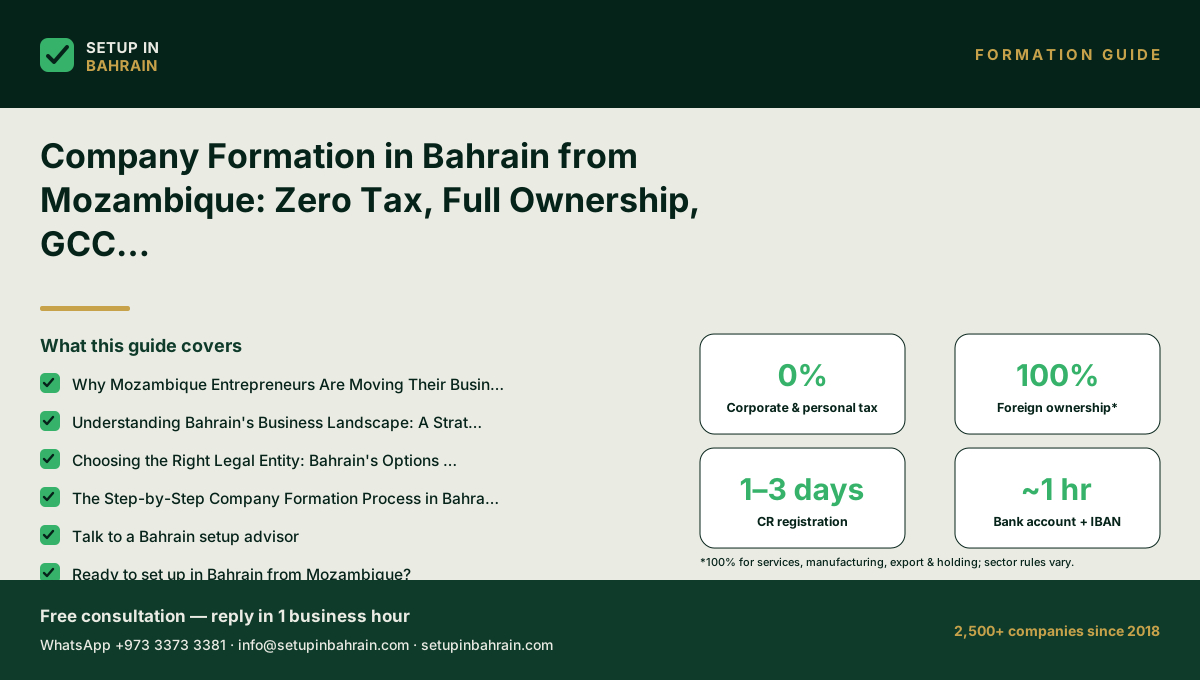
A Bahrain WLL can be owned by a single person — 100% foreign ownership applies to most activities, with no local partner required for services, manufacturing, export trading and holding companies. The minimum share capital is BHD 1 ; we recommend BHD 1,000 . This Makes bank account opening and investor visa approval smoother.
For many entrepreneurs in Mozambique, the dream of scaling a business internationally often bumps up against a wall of frustrating realities back home. Imagine Joaquim, a successful e-commerce entrepreneur from Maputo. His online store, Lar Doce Lar, sells artisanal home goods sourced locally and exports to customers across Southern Africa and beyond. Joaquim is good at what he does, his products are unique, and his market is growing.
Yet, every year, he grapples with the same formidable challenges. His 32% corporate income tax bites deep into his profits, eroding capital that could be reinvested into growth. The constant MZN currency depreciation, often 10% to 15% annually, means that the MZN 1,000,000 profit he made last year is effectively worth only MZN 850,000-900,000 in real purchasing power a year later, especially when buying imported materials or paying international suppliers in USD. When he does need USD for international transactions, he faces the labyrinthine BM central bank's strict forex controls on USD outflows, making timely payments to his global logistics partners a perpetual headache. Then there’s the mandatory AT Portuguese-language filing requirement, a bureaucratic hurdle that adds time and cost, even if his actual business is conducted largely in English. And let's not forget the mandatory INSS social contributions that add another layer of payroll burden.
Joaquim's story isn't unique. Consider a Maputo-based logistics operator who moved three containers of construction materials through Beira port last year. After paying the 32% corporate income tax, mandatory INSS contributions on every payroll. Absorbing another 12% effective loss from MZN depreciation against the USD, the net margin on the transaction fell below 9%. That same operator later watched a similar shipment, routed through a Bahrain-registered entity, clear customs in Dammam and generate a 27% margin with Generally no corporate income tax for most sectors and no currency erosion.
These scenarios reflect the shared struggles of countless Mozambican business owners striving for stability and growth in an environment where. Progress is being made, the path to international expansion remains fraught with local challenges. The aspiration to expand, protect capital, and access broader markets is real. And for many like Joaquim, Bahrain is emerging not just as an option, but as a strategic imperative. It's a gateway that offers stability, transparency. A direct route to global markets, free from many of the constraints that stifle growth in Mozambique.
Why Mozambique Entrepreneurs Are Moving Their Business to Bahrain
The decision to establish an international presence is rarely taken lightly. It involves significant consideration, research, and a clear understanding of the advantages. For Mozambican entrepreneurs, the contrast between their home market and Bahrain is stark, offering compelling reasons to make the leap.
Let’s dissect the specific pain points you, as a Mozambican entrepreneur, might be feeling and how Bahrain provides a robust, often game-changing, solution.
Navigating High Corporate Income Tax vs. Bahrain’s Zero-Tax Environment
Your Challenge in Mozambique: You're grappling with a 32% corporate income tax. This isn't just a number; it's a significant chunk of your hard-earned profit that could otherwise be reinvested into innovation, hiring talent, or expanding your operations. It means that for every MZN 1,000,000 profit your business generates, MZN 320,000 is siphoned off to the tax authority. This greatly limits your growth trajectory and makes accumulating capital for larger projects incredibly difficult.
Bahrain’s Solution: Here’s where Bahrain shines, especially for companies operating outside specific sectors (like oil and gas). Bahrain boasts a zero corporate income tax environment for most business activities. Imagine retaining 100% of your operational profits. This isn't a temporary tax holiday; it's a foundational pillar of Bahrain's economic strategy to attract foreign direct investment and stimulate economic growth. For an entrepreneur like Joaquim, who's constantly looking to expand his product lines and market reach, keeping that 32% would dramatically accelerate his business development, allowing for faster scaling and greater financial resilience.
Battling Currency Depreciation and Forex Controls vs. Stable, Free Capital Movement
Your Challenge in Mozambique: The MZN currency depreciation, often 10% to 15% annually against the USD, is a silent killer of your purchasing power and international competitiveness. If you're importing raw materials, paying international suppliers, or simply trying to hold onto your capital, this depreciation means your money is losing value consistently. A MZN 5,000,000 investment today could be worth MZN 4,250,000-4,500,000 in real terms in a year, solely due to currency erosion.
Compounding this is the BM central bank's strict forex controls on USD outflows. Need to pay a supplier in China? Or a logistics partner in Dubai? The process can be cumbersome, time-consuming, and unpredictable. Delays can lead to missed deadlines, damaged supplier relationships, and increased operational costs. This friction is a major impediment to international trade and efficient global supply chain management.
Bahrain’s Solution: Bahrain’s national currency, the Bahraini Dinar (BHD), is pegged to the US Dollar at a fixed rate of 0.376 BHD to 1 USD. This peg offers unparalleled currency stability, eliminating the risk of depreciation that plagues the MZN. Your capital retains its value, providing a predictable and secure financial foundation for your international operations.
Also, Bahrain operates with zero foreign exchange controls . This means you can freely move capital in and out of the country, convert currencies. Pay international suppliers without bureaucratic hurdles or delays. For a logistics operator needing to make swift, international payments, or an e-commerce business processing cross-border transactions, this financial freedom is invaluable. It greatly reduces operational risk and enhances your ability to participate effectively in the global economy. The Central Bank of Bahrain (CBB) maintains a robust yet liberal regulatory framework that supports this free flow of capital.
Overcoming Portuguese-Language Filing vs. English as the Business Language
Your Challenge in Mozambique: The mandatory AT Portuguese-language filing requirement is a significant administrative burden, even if your business primarily operates in English or deals with international partners. It necessitates translation services, adds complexity to legal and accounting processes, and increases administrative costs. For entrepreneurs who are more comfortable in English, this can be a frustrating and inefficient use of resources.
Bahrain’s Solution: Bahrain is a highly international business hub where English is the predominant language of business and administration. While Arabic is the official language, government ministries, legal entities, and financial institutions readily conduct business in English. This dramatically simplifies compliance, legal documents, and day-to-day operations for foreign entrepreneurs. You won't need to hire dedicated translators for official filings, saving both time and money. This seamless linguistic environment ensures a smoother transition and more efficient management of your Bahraini entity.
Addressing Mandatory INSS Contributions vs. Flexible Employment Costs
Your Challenge in Mozambique: The mandatory INSS social contributions levied on every payroll add a substantial hidden cost to your employee expenses. These contributions. Providing social safety nets, increase your operational overhead and can make hiring more expensive, especially when scaling.
Bahrain’s Solution: While Bahrain does have social insurance contributions (primarily for Bahraini nationals and, in some cases, GCC nationals), foreign-owned companies primarily hiring non-Bahraini foreign talent generally do not face the same mandatory INSS-equivalent burdens that drive up costs in Mozambique. This offers greater flexibility in managing your payroll and employee costs, especially if your business model involves a globally sourced workforce. This allows you to optimize your human capital investments without the added statutory deductions prevalent in Mozambique.
Broader Market Access and Strategic Location
Beyond these direct contrasts, Bahrain offers immense strategic advantages:
Gateway to the GCC: Bahrain serves as a literal and figurative bridge to the trillion-dollar Gulf Cooperation Council (GCC) market, including Saudi Arabia, UAE, Qatar, Kuwait, and Oman. With the King Fahd Causeway directly linking Bahrain to Saudi Arabia – the largest economy in the Middle East – your business gains immediate access to over 50 million high-net-worth consumers and vast supply chains. Regional Hub for Logistics: Its strategically central location in the Arabian Gulf, combined with world-class logistics infrastructure (Bahrain Logistics Zone, Khalifa bin Salman Port, Bahrain International Airport), positions it as an ideal hub for regional and international distribution. Free Trade Agreements: Bahrain has a robust network of Free Trade Agreements (FTAs), notably with the United States. This provides preferential access to one of the world's largest consumer markets, a benefit unavailable to Mozambican companies. World-Class Infrastructure: From advanced telecommunications and digital infrastructure (e.g., nationwide 5G coverage, secure data centers) to modern industrial parks and commercial districts, Bahrain offers a superior operational environment. Ease of Doing Business: While the World Bank's global "Ease of Doing Business" report has been discontinued, Bahrain consistently ranks among the top countries globally in various competitiveness and business environment indices (e.g., IMD World Competitiveness Yearbook, Heritage Foundation Index of Economic Freedom). It offers a transparent, efficient. Investor-friendly regulatory landscape, starkly contrasting with the challenges often faced in Mozambique.
For Joaquim and other Mozambican entrepreneurs, moving their business to Bahrain isn't just about escaping challenges; it's about proactively embracing an ecosystem designed for growth, stability, and unparalleled market access.
Understanding Bahrain's Business Landscape: A Strategic Overview
Before diving into the mechanics of company formation, it's crucial to grasp the overarching ethos and structure of Bahrain's business environment. This understanding will help you appreciate why so many international entrepreneurs, including those from Mozambique, view it as an ideal destination.
A Stable and Diversified Economy
Bahrain was one of the first countries in the GCC to diversify its economy away from oil, starting decades ago. This foresight has resulted in a resilient and robust economic landscape, primarily driven by sectors like:
- Financial Services: Home to a mature banking sector, Islamic finance, and a rapidly growing FinTech ecosystem. The Central Bank of Bahrain (CBB) is a highly respected regulator.
- Manufacturing & Logistics: Strategic location and excellent infrastructure make it a prime hub for regional distribution and light manufacturing.
- Tourism: A growing sector attracting regional and international visitors.
- Information & Communication Technology (ICT): Significant investment in digital infrastructure and innovation.
This diversification means your business isn't reliant on a single industry, offering greater stability and a broader range of opportunities for collaboration and growth.
Pro-Business Regulatory Framework
Bahrain has cultivated a regulatory environment that actively encourages foreign investment and entrepreneurship. Key characteristics include:
- Open Ownership Policies: As you'll see, Bahrain offers 100% foreign ownership in most sectors, a significant draw for entrepreneurs who want full control over their ventures.
- Streamlined Processes: The government, through entities like the Economic Development Board (EDB) and the Ministry of Industry and Commerce (MOIC), is committed to reducing bureaucracy and simplifying company registration processes. The Sijilat portal is a prime example of this digital-first approach.
- Predictable Legal System: Based on a modern civil law framework, Bahrain's legal system provides clarity and protection for investors, ensuring contracts are upheld and disputes are resolved fairly.
Favorable Tax Regime (Beyond Corporate Tax)
While the zero corporate income tax is a headline benefit, Bahrain's broader tax landscape is equally attractive:
- No Personal Income Tax: You keep 100% of your personal earnings.
- No Capital Gains Tax: Profits from the sale of assets (e.g., shares, property) are generally not taxed.
- No Withholding Tax: No tax on dividends, interest, or royalties paid to non-residents.
- Value Added Tax (VAT): Introduced in 2019, VAT is levied at a standard rate of 10% on most goods and services. But, many essential items and certain financial services are exempt or zero-rated. This is a consumption tax, not a direct tax on profits or income.
Key Regulatory Bodies: Your Guides in Bahrain
Understanding the roles of these key institutions is vital:
Economic Development Board (EDB): The EDB is Bahrain's national investment promotion agency. They are your first point of contact for strategic advice, market insights, and connections. They play a pivotal role in attracting and supporting foreign businesses, acting as a facilitator and advocate. Ministry of Industry and Commerce (MOIC): This is the primary authority for company registration and commercial licensing. Their digital Sijilat portal is where you will initiate and manage most of your incorporation process. Central Bank of Bahrain (CBB): The CBB regulates the financial services sector, including banks, insurance companies. Fintech firms. They ensure financial stability and uphold Bahrain's reputation as a secure financial hub. Bahrain Intellectual Property Association (BIPA): While not a regulatory body in the strictest sense, BIPA is a key entity for understanding and protecting your intellectual property rights in Bahrain. The Directorate of Industrial Property at the MOIC handles actual registration.
Bahrain's Economic Vision 2030
Underpinning all these elements is Bahrain's Economic Vision 2030, a comprehensive blueprint for sustainable economic development. This vision emphasizes creating a competitive, fair, and sustainable economy driven by a productive, skilled workforce. It signifies a long-term commitment to fostering a dynamic business environment and attracting global talent and capital. This forward-looking strategy provides confidence to investors that Bahrain is committed to continuous improvement and innovation.
Choosing the Right Legal Entity: Bahrain's Options for Foreigners
One of the most critical decisions you'll make when forming your company in Bahrain is selecting the appropriate legal entity. This choice impacts everything from liability and ownership structure to capital requirements and ongoing compliance. For Mozambican entrepreneurs, understanding the nuances is key.
The Most Common Choice: With Limited Liability Company (WLL)
The With Limited Liability Company (WLL) is, without a doubt, the most popular and recommended option for foreign entrepreneurs establishing a commercial presence in Bahrain, especially for those seeking full ownership and flexibility.
Key Characteristics of a WLL:
100% Foreign Ownership: This is a crucial advantage. Unlike some jurisdictions that require local partners or sponsors, a WLL in Bahrain can be 100% owned by a single foreign individual or corporate entity. This means you retain complete control over your business, free from the complexities and potential conflicts that can arise with local partners. Let's be absolutely clear: you do not need a Bahraini partner or shareholder for a WLL.*
- Limited Liability: As the name suggests, your personal liability as a shareholder is limited to the amount of capital you have invested in the company. This protects your personal assets from the company's debts and obligations, a fundamental principle of modern corporate law.
- Flexibility: A WLL is suitable for a wide range of business activities, from trading and consulting to e-commerce and services.
- Management: It can be managed by a board of directors or by a single manager, offering flexibility based on the scale and complexity of your operations.
Is a WLL truly 100% foreign-owned with no partners? Yes, absolutely. This is one of Bahrain's most attractive features. A WLL can be entirely owned by one individual or one corporate entity, regardless of their nationality.
Other Relevant Legal Entities for Foreigners
While the WLL is often the best fit, it’s worth understanding other options:
Setup (Sole Proprietorship): * Description: Owned by a single individual who has unlimited liability for the business's debts. * Pros: Simplest and cheapest to set up. * Cons: Unlimited liability is a major risk. Less professional image for international dealings. * Recommendation: Generally not suitable for Mozambican entrepreneurs looking for international expansion and asset protection. Branch of a Foreign Company: * Description: An extension of an existing foreign company, legally part of the parent company. * Pros: Allows an existing international business to operate in Bahrain without creating a new legal entity. * Cons: The parent company remains fully liable for the branch's activities. More complex registration, often requiring extensive parent company documents. * Recommendation: Ideal for established Mozambican companies seeking to enter the Bahraini market directly under their existing brand and legal structure. Holding Company: * Description: A company established primarily to own shares in other companies, rather than engaging in direct commercial operations. * Pros: Excellent for asset protection, consolidating international investments, and optimizing tax efficiency within a group structure. * Cons: Typically not for direct operational businesses. * Recommendation: If your primary goal is to hold intellectual property, manage a portfolio of investments, or oversee subsidiaries, a WLL structured as a holding company can be very effective.
Critical Point: There is NO WLL (Single Person Company) in Bahrain
It's vital to clarify a common misconception. In some jurisdictions, a "Single Person Company" (WLL) exists as a distinct legal form. But, there is NO WLL (Single Person Company) as a separate legal entity type in Bahrain. If you encounter this term elsewhere, understand that it does not apply here. A WLL, but, serves the exact purpose of a single-shareholder WLL in other countries, allowing 100% single ownership with limited liability.
Comparison Table: Legal Entities in Bahrain for Foreigners
| Feature | With Limited Liability (WLL) | Setup (Sole Proprietorship) | Branch of a Foreign Company |
| :---------------------- | :------------------------------------------- | :---------------------------------- | :------------------------------------ |
| Ownership | 100% foreign (single owner allowed) | 100% individual owner | 100% owned by foreign parent company |
| Liability | Limited to invested capital | Unlimited | Parent company assumes full liability |
| Minimum Capital | BHD 1 (legal), BHD 1,000 (practical) | No minimum | No specific capital required |
| Local Partner Req. | No | No | No |
| Complexity | Moderate | Low | Moderate to High |
| Business Scope | Wide range, very flexible | Limited, personal services | Aligned with parent company's scope |
| Professional Image | High, well-recognized | Low | High, reputable |
| Visa Eligibility | Excellent for investor visa | Possible, but less straightforward | Possible for branch employees |
| Mozambican Fit | Highly Recommended | Not recommended | Recommended for existing businesses |
The Step-by-Step Company Formation Process in Bahrain
Establishing your company in Bahrain is a systematic process, primarily managed through the Ministry of Industry and Commerce (MOIC)'s digital Sijilat portal. While it’s designed to be efficient, having a clear roadmap is essential.
1. Business Activity and Name Reservation
- Define Your Activities: Before anything else, clearly define the commercial activities your company will undertake. Bahrain’s MOIC categorizes these, and your license will be issued for specific activities. Ensure these align with your business plan.
- Trade Name Reservation: The first official step is to propose and reserve your company name through the Sijilat portal. You'll typically need to submit a few options in order of preference. The name must be unique and not conflict with existing registered entities. This process usually takes 1-2 business days.
2. Document Preparation and Submission
This is where meticulous attention to detail is paramount. The required documents will vary slightly depending on your chosen legal entity (e.g., WLL) and whether the shareholders/directors are individuals or corporate entities.
For Individual Shareholders/Directors (Most common for Mozambican entrepreneurs):
Passport Copies: Clear, valid passport copies for all proposed shareholders and directors. CVs/Resumes: Detailed CVs outlining professional experience and qualifications for all proposed shareholders and directors. Proof of Residence: A recent utility bill (electricity, water, or telephone) not older than three months, showing the residential address of each shareholder/director. This acts as proof of address. MOIC Application Forms: Duly filled and signed. Memorandum and Articles of Association (MAA): This is the foundational legal document outlining your company's purpose, structure, share capital, governance. Shareholder rights. It must be drafted in Arabic (an authorized legal translator can provide an English version), notarized by a public notary in Bahrain. Then submitted to MOIC.
For Corporate Shareholders:
Certificate of Incorporation/Registration: Of the parent company, duly attested. Memorandum and Articles of Association (MAA): Of the parent company, duly attested. Board Resolution: Authorizing the setup of the Bahraini entity and appointing representatives/directors. Power of Attorney: For the appointed representative in Bahrain. Good Standing Certificate: From the parent company's home jurisdiction. Shareholder/Director Documents: Passport copies, CVs. Utility bills of the ultimate beneficial owners (UBOs) and directors of the parent company.
Attestation Requirements: Documents originating from Mozambique (e.g., passports, corporate documents) will likely require attestation. This typically involves:
- Notarization in Mozambique.
- Legalization by the Ministry of Foreign Affairs in Mozambique.
- Attestation by the Bahraini Embassy in Pretoria, South Africa (as Bahrain does not have a resident embassy in Maputo).
- Final attestation by the Ministry of Foreign Affairs in Bahrain.
3. MOIC Approval and Commercial Registration (CR) Issuance
Once all documents are prepared and submitted through the Sijilat portal, the MOIC will review your application. This involves several stages, including:
- Initial Review: Checking for completeness and accuracy.
- External Approvals (if applicable): Certain business activities (e.g., financial services, education, healthcare) require pre-approvals from other government ministries or regulatory bodies (e.g., CBB for financial firms, Ministry of Health for medical clinics). Your consultant can advise on these.
- Final Approval: Upon satisfactory review and completion of all necessary steps, the MOIC will issue your Commercial Registration (CR) certificate. This is your company's official license to operate in Bahrain.
This entire process, from name reservation to CR issuance, can typically take 2 to 4 weeks if all documents are in order and external approvals are not unduly delayed.
4. Crucial Step: Opening a Corporate Bank Account
This is often cited by entrepreneurs as the most challenging and time-consuming part of the setup, so it deserves special attention.
- Pre-Requisites: You will need your company's Commercial Registration (CR) and the MAA to
Bahrain Business Guides for Mozambique Citizens
Frequently Asked Questions
How long does it take to set up?
It takes 15 to 20 days. We file all forms for you. You do not need to wait long.
What does it cost?
Company formation: Standard BHD 1,340 with 3 months of office address; Gold BHD 1,700 with 6 months; Premium BHD 2,150 with 12 months and a cabin, officer table and chair, and two guest chairs. No formation package includes visas, including Premium. Investor/work visas are priced separately: BHD 755 for one year or BHD 953 for two years, in addition to the formation package. Ask for a written, itemized quotation confirming government fees and all inclusions before payment.
Do I need to visit Bahrain?
No. You can set up your firm from home. We do all the work online. Some banks may ask for one visit.
What tax will I pay?
You pay zero tax on your profits. Bahrain has no corporate income tax. This is a key benefit of the setup.
Can I own 100% of my firm?
Yes. Foreign owners can hold all shares. No local partner is needed. Full ownership is allowed.
What do I need to start?
You need a valid passport. You also need a trade name and a business address. We help you with all of these.
How do I open a bank account?
We guide you step by step. Most banks take 3 to 6 weeks. You will need your CR and firm papers.
Who issues the Commercial Registration (CR)?
The CR is issued by the MOICT. It is your legal right to trade in Bahrain. We file the CR for you.
Can I renew my CR each year?
Company renewal packages: BHD 530 with 3 months of office address; BHD 980 with 6 months; BHD 1,520 with 12 months. These are separate renewal packages, not visa fees.
How do I get started?
Fill in our form on this page. Our team will call you back. We map your best setup plan at no cost.
Steps to Form Your Company
- Pick your trade name. We check if it is free.
- Choose your business type. WLL is the most common.
- Sign the MOA. We draft and file all legal docs.
- Pay the state fees. About BHD 432 in total.
- Get your CR. Takes 15 to 20 days.
- Open your bank account. We guide each step.
- Start trading. You are ready to do business.
Key Facts
- Tax rate: 0%
- Foreign ownership: 100%
- Setup time: 15 to 20 days
- Company formation: Standard BHD 1,340 with 3 months of office address; Gold BHD 1,700 with 6 months; Premium BHD 2,150 with 12 months and a cabin, officer table and chair, and two guest chairs. No formation package includes visas, including Premium. Investor/work visas are priced separately: BHD 755 for one year or BHD 953 for two years, in addition to the formation package. Ask for a written, itemized quotation confirming government fees and all inclusions before payment.
- Company renewal packages: BHD 530 with 3 months of office address; BHD 980 with 6 months; BHD 1,520 with 12 months. These are separate renewal packages, not visa fees.
- Client rating: 4.8 stars
- Clients served: 2,500 and more
Quick Facts
- Tax rate: 0%
- Own all of your firm: Yes, 100%
- Time to set up: 15 to 20 days
- Company formation: Standard BHD 1,340 with 3 months of office address; Gold BHD 1,700 with 6 months; Premium BHD 2,150 with 12 months and a cabin, officer table and chair, and two guest chairs. No formation package includes visas, including Premium. Investor/work visas are priced separately: BHD 755 for one year or BHD 953 for two years, in addition to the formation package. Ask for a written, itemized quotation confirming government fees and all inclusions before payment.
- Company renewal packages: BHD 530 with 3 months of office address; BHD 980 with 6 months; BHD 1,520 with 12 months. These are separate renewal packages, not visa fees.
- Rating: 4.8 stars
- Clients: 2,500 and more
Why Bahrain?
Bahrain has no tax. You keep all your profits. This is rare in the Gulf.
You can own all of your firm. No local partner is needed. The law allows full foreign ownership.
Setup takes 15 to 20 days. We file all forms for you. You can do it all from home.
Bahrain has a free trade deal with the US. Your goods face low or no tariffs. This gives you access to big markets.
We have served 2,800+ clients from 44+ countries and maintain records to substantiate that total where needed. We have 113 Google reviews; reviews represent only some clients and are not the same as the total clients served.
Our Steps
- Tell us your plan. We advise you for free.
- We pick the right firm type for you.
- We file all your forms with MOICT.
- You get your CR in 15 to 20 days.
- We help you open a bank account.
- You are ready to trade. We stay with you.
Next Steps for Mozambique Citizens
You can set up a firm in Bahrain from Mozambique. You do not need to fly there first. We do all the work online.
Tell us your plan. We call you back the same day. We map the best route for you at no cost.
We file all your forms. We deal with MOICT and the state. You get your CR in 15 to 20 days.
After your CR, we help you get a bank account. We also help with your Investor Visa. One firm guides you at each step.
Why Our Clients from Mozambique Choose Us
- We speak your language. We know your needs.
- We have helped clients from Mozambique before.
- Our fee is clear. No surprise costs.
- We have a 4.8 star rating on Google.
- We have helped more than 2,500 clients set up in Bahrain.
Fill in the form on this page. We will be in touch soon. Let us help you start your Bahrain firm today.
Ready to set up in Bahrain from Mozambique?
Tell us your business idea. We map the right entity, ownership and timeline — then handle the filing while you focus on what matters.