Register your Bahrain company from Lithuania with generally no corporate income tax for most sectors. Fast setup, full support for Lithuanian entrepreneurs expanding to the Gulf.
Key Takeaways
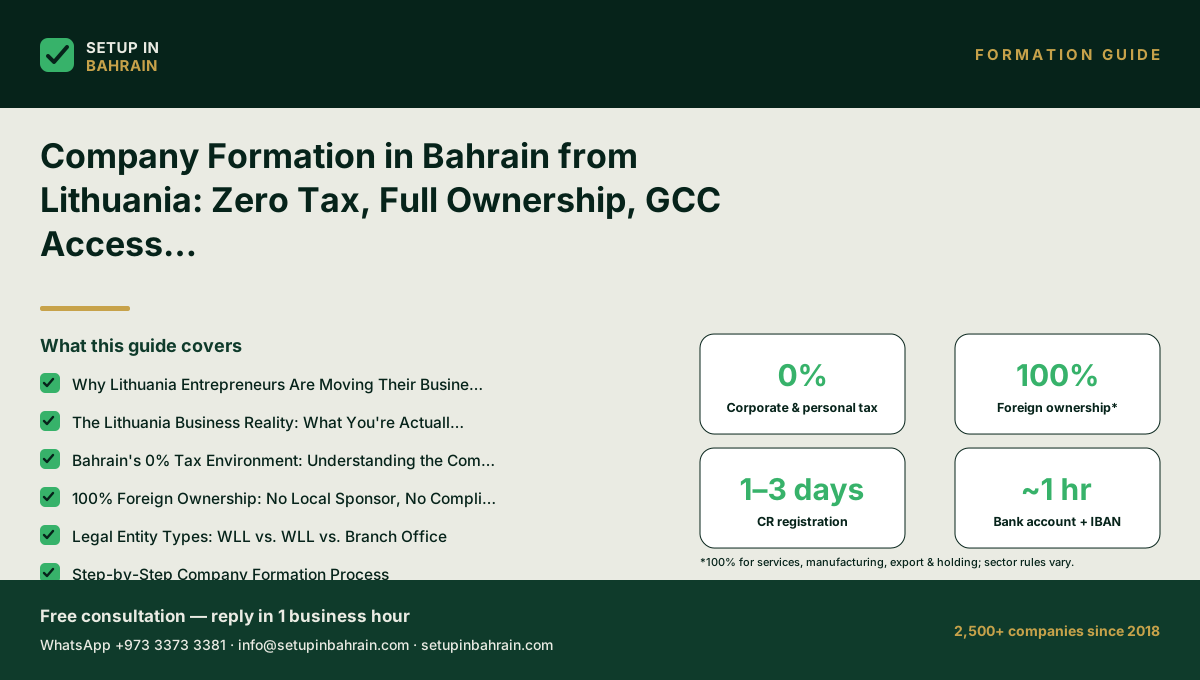
- Why Lithuania Entrepreneurs Are Moving Their Business to Bahrain
- The Lithuania Business Reality: What You're Actually Paying
- Bahrain's 0% Tax Environment: Understanding the Complete Picture
- 100% Foreign Ownership: No Local Sponsor, No Complications
- Legal Entity Types: WLL vs. WLL vs. Branch Office
→ Complete guide: Company Formation in Bahrain — the full 2026 guide
View details
Ownership & capital
A Bahrain WLL can be owned by a single person — 100% foreign ownership applies to most activities, with no local partner required for services, manufacturing, export trading and holding companies. The minimum share capital is BHD 1 ; we recommend BHD 1,000 . This Makes bank account opening and investor visa approval smoother.
Mindaugas built his fintech startup from a cramped co-working space in Vilnius. By late 2024, his payment processing platform was generating €520,000 annually, serving clients across Scandinavia and Germany. On paper, success. In reality, he watched €78,000 vanish to VMI in corporate tax alone. Add mandatory Sodra contributions for his seven-person team, the quarterly nightmare of e-VAT compliance, and €6,400 in annual accounting fees just to navigate Lithuania's documents requirements—and suddenly his "profitable" company was bleeding money to stay compliant.
When a potential Saudi client approached him about expanding into Gulf markets, Mindaugas discovered another brutal truth: Lithuania has virtually no bilateral tax treaties with GCC nations. Every contract would require Lithuanian-language court documents, Arabic translations, and apostille certifications. The legal costs alone would consume his entire first-year profit from the region.
Then his Estonian competitor—running an almost identical business—mentioned something over drinks at a Tallinn conference. He'd moved his holding company to Bahrain eighteen months earlier. Same clients. Same services. Generally no corporate income tax for most sectors. Full foreign ownership. A Central Bank of Bahrain fintech sandbox that took weeks instead of the eight months Bank of Lithuania required. Annual compliance costs under €2,000.
Mindaugas isn't an outlier. Since 2022, I've watched dozens of Lithuanian entrepreneurs—SaaS founders, e-commerce operators, consultants. Manufacturing exporters—quietly restructure their operations through Bahrain. They're not abandoning Lithuania entirely. They're simply choosing to stop feeding a system that extracts 40-50% of gross revenue before they see a euro of personal income.
This isn't aggressive tax planning. This isn't a loophole. This is recognizing that a small island kingdom in the Arabian Gulf genuinely wants your business—and has built an entire economic infrastructure to prove it.
If you're a Lithuanian business owner tired of VMI audits, PSD contribution calculations, and watching your profits subsidize a bureaucracy that offers diminishing returns, this guide will show you exactly how to establish a legitimate, fully compliant Bahrain company. You'll maintain your Lithuanian residence, keep your EU clients. Finally run your business in a jurisdiction designed for growth rather than extraction.
Why Lithuania Entrepreneurs Are Moving Their Business to Bahrain
The exodus isn't dramatic. There's no newspaper coverage or parliamentary debates. But in Vilnius tech circles, Kaunas manufacturing networks. Lithuanian e-commerce communities, the same conversation keeps happening: "Have you looked at Bahrain?"
The reasons aren't complicated. They're mathematical.
Lithuania positioned itself as a Baltic business hub. For EU-focused operations requiring physical presence, it still makes sense. But for internationally-traded services, digital businesses. Companies targeting growth markets outside Europe, the Lithuanian structure has become a liability rather than an asset.
The Tax Mathematics That Changed Everything
Consider what a €400,000 annual profit actually means in Lithuania versus Bahrain:
| Expense Category | Lithuania (UAB) | Bahrain (WLL) |
| Corporate Income Tax | €60,000 (15%) | €0 (0%) |
| Dividend Tax (when distributed) | €51,000 (15% on remainder) | €0 |
| Effective Tax on Distributed Profits | 27.75% combined | 0% |
| Annual Accounting/Compliance | €4,800-€9,600 | €1,200-€2,400 |
| VAT Filing Complexity | Quarterly e-VAT via VMI | No VAT system |
| Social Contributions (owner-director) | €7,200-€14,400 annually | €0 (no Sodra equivalent) |
The gap widens further when you factor in what Lithuanian entrepreneurs actually experience: VMI audits that consume weeks of productive time, Sodra contribution disputes, and the constant anxiety of navigating a tax system that seems designed to catch you making mistakes.
The GCC Market Access Factor
Here's what most Lithuania-focused advisors won't tell you: the Gulf Cooperation Council represents a €1.8 trillion economy that's actively diversifying away from oil dependence. Saudi Arabia's Vision 2030 alone is deploying €850 billion in infrastructure, technology, and services projects. The UAE, Qatar, Kuwait, and Oman are following similar trajectories.
Lithuania has no comprehensive tax treaties with any GCC nation. Zero preferential trade agreements. No existing commercial infrastructure in the region.
Bahrain, by contrast, sits at the geographic and economic center of this market. A company registered in Bahrain can:
- Access Saudi Arabia's market via the 25-kilometer King Fahd Causeway
- Benefit from GCC unified customs territory status
- Leverage Bahrain's bilateral investment treaties across the region
- Operate under Central Bank of Bahrain (CBB) regulatory frameworks recognized throughout the Gulf
For Lithuanian tech companies, consultancies. Service providers targeting Gulf expansion, the choice between operating from Vilnius versus Manama isn't close.
The Regulatory Exhaustion Factor
Ask any Lithuanian business owner about their relationship with VMI (Valstybinė mokesčių inspekcija). You'll hear the same exhausted tone. It's not that VMI is corrupt or malicious—it's that the system demands constant attention, documents. Defensive recordkeeping.
The quarterly e-VAT filing process alone consumes 15-25 hours for most small businesses. Every transaction must be coded correctly, every cross-border service must be classified properly. Every deadline must be met precisely. Miss a filing by three days? Automatic penalties. Miscategorize a service? Potential audit.
Bahrain has no VAT system for most businesses. No quarterly filings. No classification disputes. No VMI equivalent sending automated penalty notices.
The Central Bank of Bahrain (CBB) and Ministry of Industry and Commerce (MOIC) operate on a different philosophy entirely: establish clear rules, provide responsive support, and trust businesses to operate within established frameworks.
The Lithuania Business Reality: What You're Actually Paying
Before examining Bahrain's advantages, let's establish what Lithuanian business ownership actually costs. Most entrepreneurs know the headline 15% corporate tax rate. Few understand the complete picture.
Corporate Income Tax: The Visible Burden
Lithuania's standard corporate income tax stands at 15%—competitive by EU standards, but hardly exceptional. Small companies (annual revenue under €300,000 and fewer than 10 employees) qualify for a reduced 5% rate during their first year only, reverting to 15% thereafter.
For context, Ireland offers 12.5%, Hungary provides 9%, and Bulgaria maintains a flat 10%. Lithuania's rate isn't punitive, but it's not the business-friendly environment the government marketing suggests.
The real issue isn't the rate—it's the inevitability. Every euro of profit, regardless of reinvestment plans or expansion needs, faces immediate 15% extraction. There's no deferral mechanism, no reinvestment incentive, no pathway to reduced rates for growing companies.
The Dividend Tax Double-Hit
When you finally distribute profits to yourself as a shareholder, Lithuania applies an additional 15% tax on dividends. This creates an effective combined rate of 27.75% on every euro that moves from your company to your personal account.
The mathematics are straightforward but painful:
- €100,000 company profit
- €15,000 corporate tax (15%)
- €85,000 remaining
- €12,750 dividend tax (15% of €85,000)
- €72,250 in your pocket
Nearly 28% gone before you've bought groceries or paid your mortgage.
Sodra: The Hidden Employment Tax
Lithuania's social security system (Sodra) extracts 19.5% from employers and 12.52% from employees, creating a combined burden exceeding 32% on every salary euro. Even as a company owner paying yourself a modest director's salary, you're subject to these contributions.
For a €3,000 monthly gross salary:
- Employer Sodra contribution: €585
- Employee Sodra contribution: €376
- Total monthly extraction: €961
That's €11,532 annually in social contributions alone—on top of corporate tax, dividend tax. Income tax on your salary.
Mandatory Health Insurance (PSD) Contributions
Beyond Sodra, Lithuanian self-employed individuals and company owners face mandatory Privalomasis sveikatos draudimas (PSD) contributions. These fund the national health insurance system and cannot be avoided regardless of whether you use Lithuanian healthcare services.
For company owners, PSD contributions typically range from €70-€180 monthly depending on income levels—another €840-€2,160 annually that doesn't appear in headline tax rate discussions.
VMI e-VAT: The Administrative Time Sink
Lithuania's transition to mandatory electronic VAT filing through the VMI portal was meant to streamline compliance. In practice, it created a system that demands constant attention and punishes even minor errors.
Every Lithuanian VAT-registered business must:
- File quarterly VAT returns via the i.SAF system
- Submit monthly SAF-T reports for larger businesses
- Classify every transaction according to VAT codes
- Track and report EU cross-border services separately
- Maintain documents proving zero-rate or exempt status for international services
The average small business owner spends 8-12 hours monthly managing VAT compliance. At opportunity cost of €50-€100/hour for skilled professionals, that's €4,800-€14,400 in annual productivity loss—invisible but very real.
Lithuanian Language Documents Requirements
Here's something that catches many international-facing Lithuanian businesses: all statutory documents, court filings. Official submissions must be in Lithuanian. Commercial contracts with foreign partners require certified translations. Disputes involving non-Lithuanian parties require translated evidence.
For businesses operating primarily in English (most tech companies, consultancies. Service providers), this creates ongoing translation costs and communication barriers. Every shareholder agreement, every board resolution, every amendment to company statutes—all must exist in Lithuanian, even when no party to the transaction speaks the language.
The Complete Picture
Total annual cost of Lithuanian business compliance for a typical €400,000 revenue company with 2-3 employees:
| Category | Annual Cost |
| Corporate Tax (15%) | €45,000-€60,000 |
| Dividend Tax (distributed profits) | €30,000-€45,000 |
| Sodra (employer + employee) | €18,000-€36,000 |
| PSD Contributions | €2,000-€4,000 |
| Accounting/Compliance Services | €4,800-€9,600 |
| VAT Administration Time | €4,800-€14,400 |
| Translation/Documents | €1,200-€3,600 |
| Total Extraction | €105,800-€172,600 |
Bahrain's 0% Tax Environment: Understanding the Complete Picture
Bahrain's Generally no corporate income tax for most sectors rate isn't marketing hyperbole. It's the actual law, consistently applied since the country's independence and reaffirmed through multiple economic development initiatives.
But understanding why this works—and why it's sustainable—matters for Lithuanian entrepreneurs evaluating the legitimacy of Bahrain incorporation.
The Oil Economy Transition Strategy
Bahrain was the first Gulf state to discover oil (1932) and the first to face oil depletion. Unlike neighbors sitting on centuries of proven reserves, Bahrain recognized by the 1980s that its economic future required diversification.
The response was strategic: position Bahrain as the region's financial and commercial hub. Attract international businesses through regulatory clarity, infrastructure investment, and yes—Generally no corporate income tax for most sectorsation. The government revenue comes from:
- Oil and gas (about 70% of government revenue, declining)
- Fees and charges (company registration, licensing, work permits)
- Property and stamp taxes
- Customs duties (5% on most imports, though free zones exempt)
- The 10% VAT introduced in 2019 (affecting retail consumers, not most B2B services)
For Lithuanian business owners, the critical point is this: Bahrain's Generally no corporate income tax for most sectors isn't a temporary incentive or a too-good-to-be-true scheme. It's the structural foundation of a deliberate economic strategy pursued for four decades.
What "Zero Tax" Actually Means
Let's be precise about Bahrain's tax environment:
Corporate Income Tax: 0% for all commercial activities except oil and gas extraction (which faces 46% taxation)
Personal Income Tax: 0% on all personal income, including salaries, dividends, capital gains, and investment returns
Dividend Tax: 0% on distributions from Bahraini companies to shareholders regardless of nationality
Capital Gains Tax: 0% on sale of shares, property, or business assets
Withholding Tax: 0% on payments to non-residents (interest, royalties, dividends, service fees)
VAT: 10% applies to retail sales and specified services, but most B2B services, exports. Financial services are zero-rated or exempt
For a Lithuanian company transferring operations to Bahrain, this means:
- €400,000 profit = €400,000 retained
- Dividends distributed to yourself = no additional tax
- Sale of the business eventually = no capital gains tax
- Payments to Lithuanian contractors or suppliers = no withholding
The contrast with Lithuania's layered taxation couldn't be starker.
International Legitimacy and OECD Compliance
Lithuanian business owners rightly worry about aggressive tax structures that might trigger scrutiny from VMI or create complications with EU clients. Bahrain addresses these concerns directly:
OECD White List Status: Bahrain is fully compliant with OECD transparency standards and is not on any grey or black lists for tax purposes.
Economic Substance Requirements: Since 2019, Bahrain requires companies conducting relevant activities (holding, IP, distribution, service centers, headquarters, shipping, fund management, banking, insurance) to show adequate economic substance. This means physical presence, qualified employees, and actual management activities in Bahrain—not shell company structures.
Bilateral Investment Treaties: Bahrain has 40+ bilateral investment protection agreements (BIPAs), providing legal frameworks for international business operations.
No CFC Targeting: Bahrain's structure doesn't trigger Controlled Foreign Corporation rules in most jurisdictions because it's a genuine operating location, not a passive holding structure.
For Lithuanian entrepreneurs, this means a Bahrain company is a legitimate business entity—not a scheme requiring concealment or aggressive legal interpretations.
100% Foreign Ownership: No Local Sponsor, No Complications
For decades, establishing businesses in Gulf states required local sponsors—nationals who held 51% ownership in exchange for lending their citizenship to your commercial endeavors. These arrangements created dependency relationships, profit-sharing complications, and legal vulnerabilities that made serious investors cautious.
Bahrain eliminated these requirements entirely. The 2018 amendments to the Commercial Companies Law and subsequent Economic Development Board (EDB) initiatives established that foreign entrepreneurs can own 100% of Bahraini companies across virtually all sectors.
What Full Ownership Actually Means
When you register a Bahrain company as a Lithuanian citizen, you are the complete and sole owner. No silent partner taking 51% of your profits. No local sponsor requiring annual payments for signing documents. No complicated share structures designed to obscure actual control.
Your company documents—memorandum of association, articles, shareholder registry—reflect your actual ownership. Banks, clients. Partners deal with you as the genuine proprietor, not as a foreign operator working through a local intermediary.
Comparison with Regional Alternatives
| Jurisdiction | Foreign Ownership | Local Requirement | Practical Reality |
| Bahrain (mainland) | 100% | None | Full control |
| UAE (mainland) | 100% (since 2021) | Complex approval process | Bureaucratic delays common |
| UAE (free zones) | 100% | Free zone restrictions | Limited mainland activity |
| Saudi Arabia | 100% (with MISA license) | Significant capital requirements | €130,000+ minimum for many activities |
| Qatar | 100% (in free zones) | Mainland requires 51% local | Dual structure often needed |
| Kuwait | 100% (limited sectors) | Agency arrangements common | Practical restrictions remain |
Sectors Open to Full Foreign Ownership
Lithuanian entrepreneurs can establish 100% foreign-owned companies in:
- Information technology and software development
- E-commerce and digital services
- Consulting and professional services
- Trading and distribution
- Manufacturing and light industry
- Education and training services
- Healthcare services (with appropriate licensing)
- Financial services (with CBB authorization)
- Tourism and hospitality
- Logistics and supply chain
- Media and communications
Restricted sectors (requiring Bahraini partnership or special authorization) include:
- Oil and gas extraction
- Defense and security services
- Some real estate activities
- Certain professional services (legal practice under Bahraini law)
For the vast majority of Lithuanian businesses—tech companies, consultancies, e-commerce operations, service providers—full foreign ownership is available without restriction.
Legal Entity Types: WLL vs. WLL vs. Branch Office
Choosing the correct legal structure determines your operational flexibility, liability protection, and administrative burden. Bahrain offers several options, each suited to different business objectives.
WLL (With Limited Liability Company) — The Standard Choice
The WLL is Bahrain's equivalent of a Lithuanian UAB—a limited liability company protecting shareholders from business debts beyond their capital contribution.
Key Characteristics:
- Minimum shareholders: 2 (can include individuals or corporate entities)
- Maximum shareholders: 50
- Minimum capital: BHD 50 (about €122) for most activities; BHD 20,000 (€49,000) for general trading
- Liability: Limited to share capital
- Management: Board of directors or single manager
- Profit distribution: According to shareholding percentages
Best For: Lithuanian entrepreneurs with business partners, family businesses, or those planning to bring in investors. The dual-shareholder requirement is easily satisfied by holding shares through a personal capacity and a holding company, or through two family members.
Practical Consideration: Most formation agents can structure a WLL with 99%/1% shareholding, giving you effective sole control while meeting the technical requirement for multiple shareholders.
WLL (Single Person Company) — The Sole Proprietor Option
Introduced to accommodate sole entrepreneurs, the WLL allows a single individual or corporate entity to hold 100% ownership without additional shareholders.
Key Characteristics:
- Shareholders: Exactly 1 (individual or corporate)
- Minimum capital: BHD 50 (about €122) for most activities
- Liability: Limited to share capital
- Management: Owner or appointed director
- Profit distribution: All profits to single shareholder
Best For: Lithuanian entrepreneurs operating independently, without partners or immediate plans for equity investors. The WLL provides clean, simple ownership without artificial shareholding arrangements.
Practical Consideration: Some banking relationships and government contracts prefer WLL structures over WLLs, viewing them as more established. For most commercial purposes, this distinction is minimal.
Branch Office — The Extension Model
A branch office extends an existing foreign company (your Lithuanian UAB, for example) into Bahrain without creating a separate legal entity.
Key Characteristics:
- Ownership: Parent company (your Lithuanian UAB)
- Liability: Parent company responsible for branch obligations
- Taxation: Branch profits taxable in parent jurisdiction (Lithuania)
- Activities: Limited to scope of parent company's activities
- Closure: Relatively simple dissolution
Best For: Lithuanian companies wanting Bahrain presence while maintaining primary operations in Lithuania. Useful for testing the market before full commitment.
Critical Warning: Branch structure means Bahrain profits flow back to Lithuanian parent and face Lithuanian taxation. You don't achieve the tax benefits of separate Bahrain incorporation. For most Lithuanian entrepreneurs seeking tax optimization, branch offices defeat the purpose.
Holding Company Structure
For Lithuanian entrepreneurs with multiple business interests, a Bahrain holding company provides structural flexibility:
Structure: Bahrain WLL owns shares in operating companies (which can be in Bahrain, Lithuania, or elsewhere)
Benefits:
- Centralized ownership
- Dividend income received tax-free in Bahrain
- No capital gains on disposal of subsidiary shares
- Clear succession planning
Practical Application: A Lithuanian tech founder might establish a Bahrain holding company owning both the original Lithuanian UAB (for EU operations) and a new Bahrain operating company (for GCC operations). Profits accumulate in the Bahrain holding company tax-free.
Recommended Structure for Most Lithuanian Entrepreneurs
For a typical Lithuanian entrepreneur starting fresh in Bahrain:
Simple situation (sole owner, service business): WLL with BHD 50 capital
Growth-oriented (planning investors, partners): WLL with 99%/1% structure
Multiple business interests: Bahrain holding company (WLL) owning operating subsidiaries
Avoid branch office structures unless you specifically need Lithuanian tax treatment of Bahrain profits (unusual situation).
Step-by-Step Company Formation Process
The Bahrain incorporation process is genuinely streamlined compared to Lithuanian standards. Where establishing a Lithuanian UAB involves notary appointments, bank account capital deposits. Multiple Registry of Legal Entities submissions, Bahrain has consolidated most steps into a single-window system.
Phase 1: Name Reservation and Initial Planning (Days 1-3)
Step 1: Name Availability Check
Submit proposed company names to MOIC (Ministry of Industry and Commerce) for availability check. Names must:
- Not duplicate existing registered companies
- Not violate trademark protections
- Not imply government affiliation
- Include appropriate suffix (WLL, WLL, etc.)
Processing time: 1-2 business days Cost: Free for initial check; BHD 30 (€73) for reservation
Step 2: Activity Classification
Select Commercial Registration (CR) activity codes matching your business operations. Bahrain uses a standardized classification system—your formation agent will help identify appropriate codes.
Lithuanian tech companies typically fall under:
- Computer programming and consultancy
- Information service activities
- Data processing and hosting
- Web portal operations
Pro Tip: Select activity codes broader than your immediate plans. Adding activities later requires amendments and additional fees. Starting with comprehensive codes provides flexibility.
Phase 2: Documents Preparation (Days 4-10)
Required Documents for WLL Formation:
For Individual Shareholders:
- Passport copy (notarized and apostilled from Lithuania)
- Proof of address (utility bill or bank statement, apostilled)
- CV/professional background
- Passport-size photographs
For Corporate Shareholders:
- Certificate of incorporation (apostilled)
- Memorandum and articles of association (apostilled)
- Board resolution authorizing Bahrain subsidiary formation
- Certificate of good standing
- Passport copies of authorized signatories
Apostille Process from Lithuania:
Lithuanian documents require apostille from the Ministry of Foreign Affairs (Užsienio reikalų ministerija). Processing typically takes 2-5 business days. Some formation agents accept certified copies initially, with originals following.
Memorandum and Articles of Association:
Your formation agent or legal advisor prepares MOA/AOA in Arabic and English. Standard templates exist, but customize for:
- Shareholding percentages
- Director appointment rights
- Dividend distribution policies
- Transfer restrictions (if desired)
Phase 3: Submission and Approval (Days 11-18)
Step 3: Sijilat Portal Submission
All company registration in Bahrain processes through the Sijilat portal—the unified commercial registration system. Your formation agent submits:
- Completed application forms
- Apostilled shareholder documents
- MOA/AOA
- Name reservation confirmation
- Activity code selections
- Office lease agreement (can be virtual office initially)
Step 4: MOIC Review
Ministry of Industry and Commerce reviews the application for completeness and compliance. For straightforward WLL formations without regulated activities, approval typically comes within 5-7 business days.
Regulated activities (financial services, healthcare, education) require additional licensing from sector-specific regulators—extending timelines by 3-8 weeks.
Step 5: Commercial Registration Issuance
Upon approval, MOIC issues your Commercial Registration (CR) certificate. This is the primary document establishing your company's legal existence and authorizing business activities.
Phase 4: Post-Registration Compliance (Days 19-25)
Step 6: LMRA Registration
Register with Labour Market Regulatory Authority (LMRA) to enable employment activities and work permit sponsorship. Even without immediate employees, LMRA registration establishes your company in the national workforce system.
Step 7: Social Insurance Registration
Register with Social Insurance Organization (SIO) for employee social insurance contributions. Rates are greatly lower than Lithuanian Sodra:
- Employer contribution: 12%
- Employee contribution: 7%
- Total: 19% (vs. 32%+ in Lithuania)
Contributions apply only to employed staff, not to company owners who don't draw salaries.
Step 8: Bank Account Opening
With Commercial Registration in hand, approach Bahraini banks for corporate account opening. Required documents typically include:
- Commercial Registration certificate
- MOA/AOA
- Shareholder passport copies
- Board resolution appointing signatories
- Business plan or activity description
- Proof of address (corporate and personal)
Processing time varies by bank: 5-15 business days for straightforward cases.
Complete Timeline Summary
| Phase | Activity | Timeline |
| 1 | Name reservation and planning | Days 1-3 |
| 2 | Document preparation and apostille | Days 4-10 |
| 3 | Submission and approval | Days 11-18 |
| 4 | Post-registration compliance | Days 19-25 |
| Total | Complete formation | 21-30 business days |
Banking and Financial Infrastructure
Lithuanian entrepreneurs often assume that Gulf banking resembles the opaque, relationship-driven systems portrayed in media. Bahrain's reality is quite different—the country hosts one of the world's most sophisticated financial sectors, regulated to international standards and explicitly welcoming foreign business.
Bahrain's Financial Sector Credentials
The Central Bank of Bahrain (CBB) regulates one of the region's largest financial services sectors:
- 400+ financial institutions
- 100+ wholesale and retail banks
- $200+ billion in banking assets
- Regional headquarters for major international banks
Bahrain hosts HSBC's Middle East headquarters, Standard Chartered's regional operations, and Citibank's Gulf hub. These aren't frontier banking arrangements—they're sophisticated financial services meeting Basel III requirements and international compliance standards.
Corporate Banking Options for Lithuanian Entrepreneurs
International Banks with Strong European Connections:
HSBC Bahrain: Familiar to European businesses, offers multi-currency accounts, trade finance. Treasury services Standard Chartered: Strong Asia-Pacific and MENA connectivity Citibank: Corporate banking focused on larger enterprises
Major Bahraini Banks:
- National Bank of Bahrain (NBB): Oldest bank in the country, extensive local relationships
- Bank of Bahrain and Kuwait (BBK): Strong SME banking services
- Ahli United Bank: Regional presence across GCC
Islamic Banking Options:
- Bahrain Islamic Bank: Sharia-compliant business accounts
- Al Salam Bank: Islamic corporate banking services
Account Opening Process
Required Documents:
- Commercial Registration certificate
- Memorandum and Articles of Association
- Board resolution appointing signatories
- Shareholder passport copies (notarized)
- Proof of address (shareholders and company)
- Business plan or activity description
- Source of funds documents
- Reference letters (from existing banks, helpful but not always required)
Expected Due Diligence Questions:
Banks will inquire about:
- Nature of business activities
- Expected transaction volumes and patterns
- Primary clients and suppliers
- Source of initial capital
- Anticipated currencies for operations
Processing Timeline:
Straightforward applications with complete documents: 7-12 business days Complex structures or regulated activities: 3-6 weeks
Pro Tip for Lithuanian Entrepreneurs: Prepare a clear business description explaining your Lithuanian background, existing client base. Reasons for Bahrain expansion. Banks appreciate transparency about your commercial rationale.
Multi-Currency Capabilities
Bahraini corporate accounts routinely handle:
- Bahraini Dinar (BHD) — pegged to USD at fixed rate
- US Dollars (USD) — standard for regional trade
- Euros (EUR) — for European client invoicing
- British Pounds (GBP) — common in regional commerce
- Saudi Riyals (SAR) — for Saudi market transactions
For Lithuanian entrepreneurs maintaining EU clients while developing GCC business, this multi-currency flexibility simplifies treasury management considerably compared to operating everything through Lithuanian banks.
International Payment Infrastructure
Bahrain participates in:
- SWIFT network (full international connectivity)
- Gulf Cooperation Council payment systems
- Bahrain Real-Time Gross Settlement (RTGS)
Transferring funds to/from Lithuania, receiving payments from EU clients. Paying international suppliers works smoothly through established banking infrastructure.
FinTech Banking Alternatives
Beyond traditional banks, Bahrain's fintech ecosystem offers alternatives:
Licensed Payment Service Providers:
- Digital wallet solutions
- Payment gateway services
- Cross-border payment specialists
The CBB Regulatory Sandbox:
For Lithuanian fintech entrepreneurs, the Central Bank of Bahrain operates a regulatory sandbox allowing testing of innovative financial products with temporary licensing. This contrasts sharply with Bank of Lithuania's extended licensing processes—sandbox participants can operate in Bahrain while refining their models for eventual full authorization.
FinTech Licensing Under CBB: Why Lithuanian Tech Founders Choose Bahrain
Lithuanian entrepreneurs in the fintech space face particular frustrations at home. The Bank of Lithuania's licensing requirements, while creating a legitimate regulatory framework, demand:
- Extended application timelines (8-14 months typical)
- Substantial capital requirements (€350,000+ for payment institutions)
- Detailed technical documents in Lithuanian
- Ongoing compliance costs of €50,000-€150,000 annually
- Limited pathway for innovative business models
Bahrain has deliberately positioned itself as a fintech destination, offering regulatory pathways that balance consumer protection with innovation support.
CBB Regulatory Categories for FinTech
Category 1: Full Licensure
Complete banking or financial service license under CBB rulebook. Appropriate for established operations seeking permanent Bahrain presence.
Requirements: Substantial capital, full compliance infrastructure, local management presence Timeline: 6-12 months Best for: Mature companies with proven track records
Category 2: Specialized Licensure
Specific activity licenses (payment services, crowdfunding, robo-advisory) with proportionate requirements.
Requirements: Moderate capital, focused compliance frameworks Timeline: 3-6 months Best for: Companies with specific service offerings
Category 3: Regulatory Sandbox
Temporary authorization to test innovative products in controlled environment with real customers.
Requirements: Viable business concept, basic compliance controls Timeline: 4-8 weeks for sandbox entry Best for: Early-stage companies testing market fit
The Regulatory Sandbox Advantage
For Lithuanian fintech founders, the CBB sandbox offers something Bank of Lithuania cannot: rapid market entry for validation.
Sandbox Benefits:
- Test with real Bahrain customers while refining the model
- Limited regulatory requirements during test phase
- Direct CBB engagement and feedback
- Clear pathway to full licensure upon sandbox completion
- GCC market access from sandbox stage
Sandbox Limitations:
- Transaction volume caps
- Customer number restrictions
- Time-limited operation (12-24 months typical)
- Geographic restrictions to Bahrain
A Lithuanian payment processing startup spent 11 months pursuing Bank of Lithuania licensing—ultimately unsuccessful due to capital requirements. The same company entered CBB sandbox within 6 weeks, processed live transactions within 3 months. Used Bahrain market traction to attract investment for eventual full licensure.
CBB vs. Bank of Lithuania: Direct Comparison
| Factor | Bank of Lithuania | Central Bank of Bahrain |
| Payment Institution License Timeline | 8-14 months | 3-6 months |
| Minimum Capital (Payment Services) | €350,000 | BHD 25,000-100,000 (€61,000-€245,000) |
| Sandbox Availability | Limited pilot programs | Established, active sandbox |
| Innovation Support | Bureaucratic approach | Dedicated fintech unit |
| Regional Market Access | EU (competitive market) | GCC (underserved, growing) |
| Language Requirements | Lithuanian documents | English accepted |
| Ongoing Compliance Cost | €50,000-€150,000 annually | €15,000-€40,000 annually |
GCC Market Access: The Saudi Arabia Gateway
Bahrain's geographic position—connected to Saudi Arabia by the 25-kilometer King Fahd Causeway—provides physical and commercial access to the world's largest emerging market.
Saudi Arabia: The Scale of Opportunity
Saudi Arabia's Vision 2
Bahrain Business Guides for Lithuania Citizens
Frequently Asked Questions
How long does it take to set up?
It takes 15 to 20 days. We file all forms for you. You do not need to wait long.
What does it cost?
Company formation: Standard BHD 1,340 with 3 months of office address; Gold BHD 1,700 with 6 months; Premium BHD 2,150 with 12 months and a cabin, officer table and chair, and two guest chairs. No formation package includes visas, including Premium. Investor/work visas are priced separately: BHD 755 for one year or BHD 953 for two years, in addition to the formation package. Ask for a written, itemized quotation confirming government fees and all inclusions before payment.
Do I need to visit Bahrain?
No. You can set up your firm from home. We do all the work online. Some banks may ask for one visit.
What tax will I pay?
You pay zero tax on your profits. Bahrain has no corporate income tax. This is a key benefit of the setup.
Can I own 100% of my firm?
Yes. Foreign owners can hold all shares. No local partner is needed. Full ownership is allowed.
What do I need to start?
You need a valid passport. You also need a trade name and a business address. We help you with all of these.
How do I open a bank account?
We guide you step by step. Most banks take 3 to 6 weeks. You will need your CR and firm papers.
Who issues the Commercial Registration (CR)?
The CR is issued by the MOICT. It is your legal right to trade in Bahrain. We file the CR for you.
Can I renew my CR each year?
Company renewal packages: BHD 530 with 3 months of office address; BHD 980 with 6 months; BHD 1,520 with 12 months. These are separate renewal packages, not visa fees.
How do I get started?
Fill in our form on this page. Our team will call you back. We map your best setup plan at no cost.
Steps to Form Your Company
- Pick your trade name. We check if it is free.
- Choose your business type. WLL is the most common.
- Sign the MOA. We draft and file all legal docs.
- Pay the state fees. About BHD 432 in total.
- Get your CR. Takes 15 to 20 days.
- Open your bank account. We guide each step.
- Start trading. You are ready to do business.
Key Facts
- Tax rate: 0%
- Foreign ownership: 100%
- Setup time: 15 to 20 days
- Company formation: Standard BHD 1,340 with 3 months of office address; Gold BHD 1,700 with 6 months; Premium BHD 2,150 with 12 months and a cabin, officer table and chair, and two guest chairs. No formation package includes visas, including Premium. Investor/work visas are priced separately: BHD 755 for one year or BHD 953 for two years, in addition to the formation package. Ask for a written, itemized quotation confirming government fees and all inclusions before payment.
- Company renewal packages: BHD 530 with 3 months of office address; BHD 980 with 6 months; BHD 1,520 with 12 months. These are separate renewal packages, not visa fees.
- Client rating: 4.8 stars
- Clients served: 2,500 and more
Quick Facts
- Tax rate: 0%
- Own all of your firm: Yes, 100%
- Time to set up: 15 to 20 days
- Company formation: Standard BHD 1,340 with 3 months of office address; Gold BHD 1,700 with 6 months; Premium BHD 2,150 with 12 months and a cabin, officer table and chair, and two guest chairs. No formation package includes visas, including Premium. Investor/work visas are priced separately: BHD 755 for one year or BHD 953 for two years, in addition to the formation package. Ask for a written, itemized quotation confirming government fees and all inclusions before payment.
- Company renewal packages: BHD 530 with 3 months of office address; BHD 980 with 6 months; BHD 1,520 with 12 months. These are separate renewal packages, not visa fees.
- Rating: 4.8 stars
- Clients: 2,500 and more
Why Bahrain?
Bahrain has no tax. You keep all your profits. This is rare in the Gulf.
You can own all of your firm. No local partner is needed. The law allows full foreign ownership.
Setup takes 15 to 20 days. We file all forms for you. You can do it all from home.
Bahrain has a free trade deal with the US. Your goods face low or no tariffs. This gives you access to big markets.
We have served 2,800+ clients from 44+ countries and maintain records to substantiate that total where needed. We have 113 Google reviews; reviews represent only some clients and are not the same as the total clients served.
Our Steps
- Tell us your plan. We advise you for free.
- We pick the right firm type for you.
- We file all your forms with MOICT.
- You get your CR in 15 to 20 days.
- We help you open a bank account.
- You are ready to trade. We stay with you.
Why Set Up in Bahrain?
Bahrain is a great place to run a firm. It has no tax. You keep all your profits. This is rare in the Gulf.
You can own your firm 100%. No local partner is needed. The law is clear and fair.
It is fast to set up. You can have a CR in 15 to 20 days. We file all forms for you.
Bahrain has a free trade deal with the US. Your goods face low or no tariffs. This gives you access to big markets.
The banks are good. The roads are good. The schools are good. It is a well-run state.
We have served 2,800+ clients from 44+ countries and maintain records to substantiate that total where needed. We have 113 Google reviews; reviews represent only some clients and are not the same as the total clients served.
Our Services
- Company formation: Standard BHD 1,340 with 3 months of office address; Gold BHD 1,700 with 6 months; Premium BHD 2,150 with 12 months and a cabin, officer table and chair, and two guest chairs. No formation package includes visas, including Premium. Investor/work visas are priced separately: BHD 755 for one year or BHD 953 for two years, in addition to the formation package. Ask for a written, itemized quotation confirming government fees and all inclusions before payment.
- Company renewal packages: BHD 530 with 3 months of office address; BHD 980 with 6 months; BHD 1,520 with 12 months. These are separate renewal packages, not visa fees.
- Investor Visa — from BHD 755
- Work Visa — LMRA managed
- Virtual office — from BHD 600 per year
- Bank account opening — 3 to 6 weeks
- Family visa — for spouse and kids
- UBO filing — as required by law
Bahrain at a Glance
- Tax rate: 0%
- Foreign ownership: 100%
- Setup time: 15 to 20 days
- Free trade deal: Yes, with the US
- Language: Arabic and English
- Currency: Bahraini Dinar (BHD)
- Time zone: UTC+3
- GDP growth: Steady and strong
How to Start
- Fill in the form on this page. It takes 3 minutes.
- We call you back the same day.
- We map the best plan for your firm type and goals.
- We file all forms. We deal with MOICT for you.
- You get your CR in 15 to 20 days.
- We help you open a bank account and get your visa.
- You are ready to trade. We stay with you.
Common Questions
Do I need to visit Bahrain to set up?
No. You can do it all from home. We file online. You may need one visit to open a bank account.
Is Bahrain safe for business?
Yes. Bahrain is a stable state. It has a clear legal system. Your firm and funds are safe here.
Can I hire staff from any country?
Yes. You can hire from any country. Each hire needs a work permit from LMRA. We manage this for you.
What type of firm should I set up?
Most clients choose a WLL. This is a limited liability firm. It is flexible and well-known in Bahrain. We advise you on the best type for your case.
How do I get in touch?
Fill in our form. We call you back the same day. You can also email us or use the chat on this page.
Ready to set up in Bahrain from Lithuania?
Tell us your business idea. We map the right entity, ownership and timeline — then handle the filing while you focus on what matters.