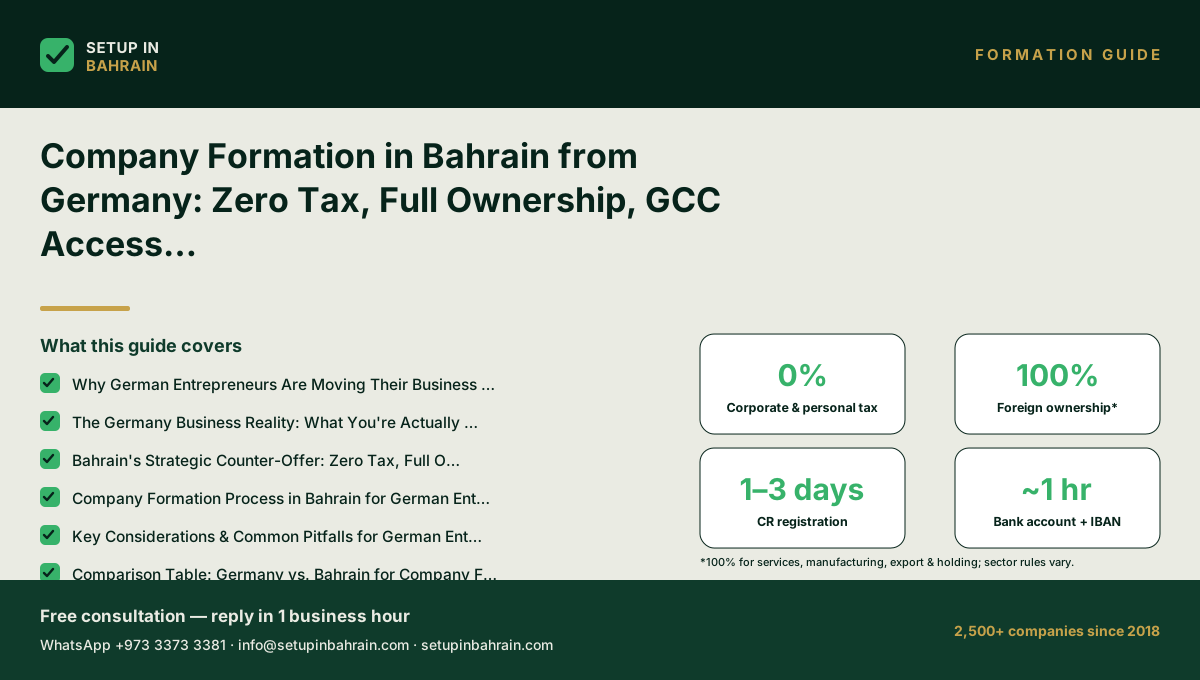
Start your Bahrain company from Germany with generally no corporate income tax for most sectors. Easy setup, full foreign ownership & strategic Gulf access for German entrepreneurs.
→ Complete guide: Company Formation in Bahrain — the full 2026 guide
View details
Ownership & capital
A Bahrain WLL can be owned by a single person — 100% foreign ownership applies to most activities, with no local partner required for services, manufacturing, export trading and holding companies. The minimum share capital is BHD 1; we recommend BHD 1,000, which makes bank account opening and investor visa approval smoother.
Marcus Weber sat in his accountant's office in Frankfurt last November, staring at numbers that made his stomach turn. His software consulting GmbH had generated €340,000 in profit that year—solid growth for his six-person team. But after Körperschaftsteuer, the solidarity surcharge, and Munich's punishing Gewerbesteuer, he watched €108,000 disappear into German government coffers. Another €25,000 went to compliance: the Steuerberater fees, mandatory audits, quarterly Umsatzsteuervoranmeldungen, and the endless Handelsregister updates every time he sneezed.
"There has to be another way," Marcus told me when we first spoke in January. Six weeks later, his Bahrain WLL was operational, banking established, and his first Saudi client signed. His effective tax rate on international revenue? Zero percent.
Marcus isn't an outlier. Every month in Germany, hundreds of managing directors and shareholders face the same silent frustration. Stefan, a Mittelstand entrepreneur from Frankfurt, just finished his annual meeting with his tax advisor, staring at a spreadsheet showing his company’s effective tax rate — 32.8%. A Stuttgart-based supplier of precision automotive components, turning over €2.8 million annually, found their effective rate landed at 31.4% after all the federal and local taxes. And for a digital health founder building AI-driven medical diagnostic tools, Markus, his €870,000 net profit saw €276,000 vanish to the Finanzamt, alongside €1,200 for a simple shareholder resolution notary cost.
The German business environment, across sector after sector, is increasingly high-friction, high-cost, and heavy on regulation. The 29–33% combined corporate burden that Germany extracts from GmbH profits isn't just painful; it's increasingly uncompetitive in a world where legitimate, OECD-compliant jurisdictions offer dramatically better terms.
This guide is specifically crafted for you, the German entrepreneur. We understand the nuances of the German business environment, from the intricate requirements of the Handelsregister to the quarterly demands of the Finanzamt. We know the €25,000 minimum share capital for a GmbH can be a barrier for agile startups, and the cumulative effect of Körperschaftsteuer, solidarity surcharge, and Gewerbesteuer can feel punitive. Here, we will lay out, in precise detail, why Bahrain isn't just an attractive "offshore" option, but a robust, OECD-compliant, and strategically advantageous platform for German businesses to thrive, expand, and, crucially, retain more of their hard-earned profits.
Why German Entrepreneurs Are Moving Their Business to Bahrain
The exodus of German business owners to tax-efficient jurisdictions accelerated sharply after 2020, but Bahrain specifically gained traction among German founders starting in 2022. The reasons compound each other in ways that create genuine momentum. German entrepreneurs carry a particular mindset: they value structure, regulatory clarity, and institutional stability. They're not looking for shady offshore schemes or jurisdictions that might embarrass them at dinner parties. They need something defensible—a real business hub with legitimate banking, proper regulation, and transparent processes. Bahrain delivers on all these fronts, coupled with undeniable economic advantages.
Here's why German entrepreneurs, in particular, are making the shift:
- Escape the Crushing Tax Burden: This is often the primary driver. We'll dive into the specifics shortly, but the difference between a 30%+ effective corporate tax rate in Germany and 0% in Bahrain is staggering and directly impacts reinvestment potential and shareholder returns.
- Unburden from Bureaucracy: The administrative overhead in Germany, from lengthy Handelsregister processes to frequent tax filings and mandatory capital requirements, can stifle agility. Bahrain offers streamlined, digitally-enabled company formation.
- Achieve 100% Foreign Ownership: Unlike many other GCC nations that historically required local partners, Bahrain has long embraced 100% foreign ownership in most sectors. For German entrepreneurs who value full control over their operations and strategic direction, this is a non-negotiable benefit.
- Strategic Gateway to the GCC and Beyond: Bahrain is literally a 25km drive over a causeway from Saudi Arabia, the largest economy in the Middle East with its ambitious $800 billion Vision 2030 projects. It offers unparalleled access to a booming market without the complexities of direct setup in larger, more intricate economies.
- Robust and Stable Business Environment: As an early adopter of economic diversification in the GCC, Bahrain boasts a mature regulatory framework (oversight by the Central Bank of Bahrain – CBB), an independent judiciary, and a clear legal system that resonates deeply with the German appreciation for order and predictability. The Bahrain Economic Development Board (EDB) plays a proactive role in supporting foreign investors.
- Low Operating Costs: Compared to major German cities, Bahrain offers significantly lower costs for office space, utilities, and a highly competitive wage structure for skilled local and expatriate talent, leading to better profit margins.
What if you could keep your EU connections AND gain zero-tax profits, full ownership, and instant market access to the GCC — especially Saudi Arabia’s Vision 2030 bonanza — only a 25km drive away? Welcome to Bahrain: the only GCC country where you can set up a fully foreign-owned company, pay generally no corporate income tax for most sectors forever (no sunset, no cap), skip the notary, register in a week, enjoy banking with a stable, USD-pegged currency, and keep every euro of profit you earn. As a German founder, you’re not just escaping taxes. You’re escaping bureaucracy.
The Germany Business Reality: What You're Actually Paying
Let’s break down the true, often hidden, costs for a midsize German company (say, €500,000 annual profit) headquartered in Munich or Hamburg. You likely navigate a labyrinth of taxes and regulations that collectively erode your profitability and agility.
The German Corporate Tax Burden: A Deeper Look
The combined corporate burden in Germany is a significant hurdle for many entrepreneurs. It’s not just one tax; it’s a stack of them:
- Körperschaftsteuer (Corporate Income Tax): A flat rate of 15% on your company’s taxable profits. Sounds manageable on its own, right?
- Gewerbesteuer (Trade Tax): This is where it gets complex and highly variable. Gewerbesteuer is a municipal tax, and its rate depends entirely on the municipality where your business is registered.
Illustrative Calculation for a €500,000 Profit Company (e.g., in Munich with 17% Gewerbesteuer):
- Taxable Profit: €500,000
- Körperschaftsteuer (15%): €75,000
- Solidarity Surcharge (5.5% on €75,000): €4,125
- Gewerbesteuer (approx. 17% on €500,000): €85,000
- Total Corporate Tax Burden: €75,000 + €4,125 + €85,000 = €164,125
This translates to an effective combined corporate tax rate of 32.8% (€164,125 / €500,000). For many businesses, this figure can reach 29-33%, a substantial chunk of hard-earned profit.
The Bureaucracy and Cost of Compliance
Beyond the direct taxes, German entrepreneurs face a range of administrative and financial burdens:
- GmbH Minimum Share Capital: For a GmbH (Gesellschaft mit beschränkter Haftung), the most common limited liability company structure, a minimum share capital of €25,000 is mandatory. This capital must be deposited and locked up, representing a significant barrier to entry or a drain on working capital for agile startups and smaller businesses.
- Lengthy Handelsregister Delays: The process of formal company incorporation, including notary appointments and entry into the Handelsregister (commercial register), can stretch to eight weeks or more. This delay means lost time, delayed market entry, and prolonged uncertainty.
- Mandatory Audits and Extensive Bookkeeping: German accounting standards (HGB) are rigorous, often requiring mandatory external audits for mid-sized companies and highly detailed bookkeeping. This necessitates employing professional Steuerberaters (tax advisors) and Wirtschaftsprüfers (auditors), with annual fees easily reaching €18,000 or more for a profitable SME.
- Quarterly Umsatzsteuer-Voranmeldung (VAT Pre-filings): The constant demand for quarterly, sometimes even monthly, VAT pre-filings requires ongoing administrative attention and diverts valuable resources from core business activities.
- Notary Costs: Simple corporate actions, from shareholder resolutions to changes in company articles, often require a notary, incurring fees that can be substantial (e.g., €1,200 for a shareholder resolution as mentioned by Markus).
- Social Security and Employment Costs: While not corporate tax, the high social security contributions and other employment-related costs further increase the overall cost of doing business and hiring in Germany.
These accumulated frictions are not merely annoyances; they represent tangible costs, missed opportunities, and a significant drag on innovation and growth. It's why an increasing number of German entrepreneurs are actively seeking more agile, fiscally efficient, and supportive environments.
Bahrain's Strategic Counter-Offer: Zero Tax, Full Ownership, GCC Access
Bahrain presents a compelling alternative, designed precisely to address the pain points experienced by German entrepreneurs while offering robust opportunities for growth and expansion.
generally no corporate income tax for most sectors, Forever: A Game Changer
This is perhaps Bahrain's most significant draw. The Kingdom of Bahrain levies 0% corporate income tax on nearly all business activities. There is no sunset clause, no caps, and no tiered system that kicks in after a certain profit level. Your company's profits, after legitimate business expenses, are entirely yours.
- Direct Comparison: Imagine that €500,000 profit. In Germany, €164,125 goes to taxes. In Bahrain, it's €0. This isn't about "tax evasion"; it's about operating in a jurisdiction with a fundamentally different fiscal model, one that prioritizes attracting investment and fostering economic growth through non-tax revenues.
- No Personal Income Tax: Furthermore, Bahrain also has no personal income tax, no wealth tax, no capital gains tax, and no inheritance tax. This means that as a shareholder or director, your personal distributions from your company are also tax-free in Bahrain, subject to your tax residency status in Germany and any applicable double taxation agreements (more on this later).
- OECD Compliance: It’s crucial to understand that Bahrain is not a "tax haven" in the pejorative sense. It is a signatory to international transparency initiatives and a member of the OECD's Inclusive Framework on BEPS (Base Erosion and Profit Shifting). Its 0% tax regime is legitimate and recognized, predicated on promoting genuine economic activity and substance.
100% Foreign Ownership – No Local Partner Headache
For German entrepreneurs who value uncompromised control and straightforward operations, Bahrain’s stance on foreign ownership is a breath of fresh air. Since 2002, Bahrain has permitted 100% foreign ownership in most sectors, with very few exceptions (e.g., some highly sensitive services like oil exploration).
- Contrast with Other GCC Nations: Historically, many Gulf Cooperation Council (GCC) countries required a local sponsor or majority local shareholding. While some are gradually liberalizing, Bahrain has been a pioneer in this regard.
- Simplicity and Control: This means you, as the German founder, can own 100% of your Bahraini entity, make all strategic decisions, and control all assets without the complexities, potential conflicts, or additional costs associated with a local partner. This directly addresses a significant concern for many international investors entering the region.
Minimal Bureaucracy, Rapid Setup, and Digital-First Approach
Bahrain has invested heavily in creating an efficient, investor-friendly ecosystem. The process of company formation is remarkably streamlined:
- The Sijilat Portal: The Ministry of Industry and Commerce (MOIC) developed "Sijilat," an integrated online portal (sijilat.bh) that allows entrepreneurs to register a company, apply for licenses, and conduct most post-incorporation activities completely online.
- No Notary Required: Unlike Germany, where notary involvement is mandatory for various stages of company formation and changes, Bahrain's digital process often bypasses this requirement, saving both time and money.
- Rapid Incorporation: Typically, a new company can be registered and issued its Commercial Registration (CR) number within 5-7 business days, provided all documents are in order. This stands in stark contrast to the 8+ weeks often experienced in Germany.
- Low/No Minimum Capital: For many company structures, particularly the most common WLL (With Limited Liability), there is no statutory minimum share capital requirement. This removes the €25,000 barrier faced by GmbHs, freeing up capital for immediate business operations. While a nominal capital (e.g., BHD 50 / €120) might be declared, it doesn't need to be locked up.
Strategic Gateway to the GCC Market (Especially Saudi Vision 2030)
Bahrain's geographical location is a significant strategic asset. It serves as an ideal base for German companies looking to tap into the booming Middle East and North Africa (MENA) market, particularly the GCC.
- Saudi Arabia's Proximity: Bahrain is connected to Saudi Arabia via the King Fahad Causeway, a 25km land bridge. This means that Saudi Arabia's massive $800 billion Vision 2030 projects – spanning NEOM, Red Sea Project, Qiddiya, and more – are literally on your doorstep. For German engineering firms, IT companies, consultants, and suppliers, Bahrain offers an unparalleled logistical and administrative hub to service this colossal market without needing to establish a full presence in Saudi Arabia immediately.
- Logistics Hub: With a highly efficient port (Khalifa Bin Salman Port) and Bahrain International Airport, the country serves as an effective logistics and distribution hub for the wider region.
- Free Trade Agreements: Bahrain has Free Trade Agreements (FTAs) with several key economies, including the United States, providing preferential access to these markets.
- EDB Support: The Bahrain Economic Development Board (EDB) actively promotes foreign investment and acts as a central point of contact for businesses looking to set up. They offer invaluable guidance on market entry, sector-specific opportunities, and connecting investors with local resources.
Stable Economy & Sound Financial System
For German entrepreneurs, accustomed to the reliability of the Eurozone, Bahrain offers a reassuringly stable economic and financial environment.
- USD-Pegged Currency: The Bahraini Dinar (BHD) is pegged to the US Dollar, providing exchange rate stability and predictability for international transactions. This reduces currency risk significantly for businesses dealing in major international currencies. (1 BHD = approx. 2.45 EUR currently).
- World-Class Banking Sector: The Central Bank of Bahrain (CBB) is a respected and proactive regulator, fostering a robust and diverse financial services sector. Bahrain is home to numerous international banks, FinTech innovators, and Islamic banking institutions, offering a wide array of corporate banking services. This institutional strength provides comfort to German businesses seeking secure and efficient financial operations.
- Diversified Economy: While historically reliant on oil, Bahrain has successfully diversified its economy, with financial services, manufacturing, tourism, and logistics now contributing significantly to GDP. This diversification contributes to long-term economic resilience, recognized by institutions like the World Bank.
World-Class Infrastructure & Quality of Life
Beyond the fiscal and regulatory advantages, Bahrain offers practical benefits that enhance business operations and attract talent.
- Connectivity: Modern telecommunications, reliable internet, and excellent air connectivity (Bahrain International Airport is a major regional hub) ensure seamless operations.
- Educated Workforce: Bahrain boasts a highly educated and skilled local workforce, augmented by a diverse and talented expatriate community. English is widely spoken in business circles and government.
- Expatriate-Friendly Environment: The quality of life for expatriates is high, with excellent schools, healthcare, and leisure facilities. This makes it easier for German entrepreneurs to relocate key staff or manage operations remotely with regular visits.
- Business-Friendly Laws: The legal system is based on civil law principles, similar to many European systems, offering clarity and predictability. The Bahrain International Arbitration Centre (BIPA) provides dispute resolution services.
Low Operating Costs
Compared to major European business hubs, Bahrain offers significantly lower operating costs across various fronts.
- Office Rent: Commercial office space in prime locations is considerably more affordable than in Berlin, Munich, or Frankfurt.
- Salaries: While attracting top talent requires competitive remuneration, the overall wage structure for many roles is more favorable than in Germany, particularly for mid-level administrative and support functions.
- Utilities: Electricity, water, and internet costs are generally lower, contributing to reduced overheads.
- Ease of Doing Business: The World Bank's Doing Business report consistently ranks Bahrain highly for its ease of starting a business and overall business environment.
Company Formation Process in Bahrain for German Entrepreneurs
Setting up a company in Bahrain is a straightforward process, especially with the digital Sijilat portal. Here’s a step-by-step guide tailored for German entrepreneurs:
1. Initial Planning & Due Diligence
- Define Your Business Activity: Clearly articulate your company's core business activities. This determines the type of licenses required. Be as specific as possible.
- Choose a Legal Structure:
- Company Name Reservation: You'll need to propose several company names (usually 3-5 options) in order of preference. The name must be unique and not conflict with existing registrations. This can be done online via Sijilat.
- Select an Office Address: Even if you plan to initially work remotely, a physical office address is usually required for company registration. Virtual office providers are available and accepted for many activities.
2. Prepare Required Documents
For each shareholder and director (and for the parent company if setting up a branch):
- Individual Shareholders/Directors:
- Corporate Shareholders (e.g., your German GmbH):
- Business Plan: A brief business plan outlining your activities, market strategy, and financial projections is generally required, especially for regulated activities or when applying for visas.
Note on Attestation: Documents originating from Germany (like Handelsregisterauszug, Gesellschaftsvertrag) will need to be officially translated into Arabic or English, and then attested by the German Ministry of Foreign Affairs and the Bahraini Embassy in Berlin. This step is crucial and can take some time. An experienced consultant can guide you through this.
3. Online Application via Sijilat
This is where the digital-first approach shines:
- Log in/Register on Sijilat: Create an account on the MOIC's Sijilat portal (sijilat.bh).
- Initiate New Commercial Registration: Follow the prompts to apply for a new Commercial Registration (CR).
- Upload Documents: Upload all scanned copies of the required documents.
- Pay Fees: Pay the government registration fees online. These are typically very reasonable compared to European counterparts.
- Application Review: The MOIC and relevant ministries (e.g., Ministry of Health for medical, Ministry of Education for training institutes) will review your application. This usually takes 3-5 working days. They might request clarifications or additional documents.
- Commercial Registration Issuance: Once approved, your Commercial Registration (CR) certificate will be issued electronically. This is your company's legal identity.
4. Opening a Corporate Bank Account
This is a critical step and often requires careful planning.
- Choose a Bank: Bahrain has a robust banking sector with international players (e.g., HSBC, Citibank, Standard Chartered) and prominent local banks (e.g., NBB, BBK, Al Baraka). Research which bank best suits your needs for international transfers, online banking, and specific services.
- Required Documents: Typically, the bank will require:
- In-Person Visit: While initial applications can sometimes be started remotely, an in-person visit by the authorized signatory is almost always required to finalize the account opening and verify identity for AML/CFT compliance. This is a standard global banking requirement, not unique to Bahrain.
- Timeline: Bank account opening can take 2-4 weeks, depending on the bank and the complexity of your company structure and shareholder nationalities. Start this process as early as possible.
5. Visa and Residency Formalities
Once your company is registered, you and any key employees can apply for residency visas:
- Investor Visa: As a German entrepreneur establishing a business, you are eligible for an investor visa. Your company will sponsor your visa.
- Employee Visas: If you plan to hire expatriate staff, your company will also sponsor their work permits and residency visas.
- Bahrain Labour Market Regulatory Authority (LMRA): The LMRA is responsible for issuing work permits. The process involves submitting application forms, passport copies, medical tests, and often educational qualifications.
- Family Visas: Once your investor or employee visa is obtained, you can sponsor your spouse and children for family residency visas.
6. Ongoing Compliance
Even with generally no corporate income tax for most sectors, compliance remains essential:
- Annual Renewals: Your Commercial Registration (CR) needs to be renewed annually via Sijilat.
- VAT Registration: If your company's annual turnover exceeds BHD 37,500 (approx. €92,000), you must register for VAT with the National Bureau for Revenue (NBR). Bahrain introduced VAT at 5% in 2019, which increased to 10% in 2022. This is a consumption tax, not a corporate income tax, and is usually passed on to the consumer.
- Accounting Records: You are still required to maintain proper accounting records in line with International Financial Reporting Standards (IFRS), even if you don't pay corporate tax. This ensures transparency and helps with internal management and potential audits.
- Economic Substance Regulations (ESR): While Bahrain's 0% tax applies broadly, entities engaging in certain "relevant activities" (e.g., banking, insurance, fund management, shipping, holding company business, headquarters business) must demonstrate adequate economic substance in Bahrain. This typically means having sufficient physical presence, employees, and expenditure in the Kingdom. This is an OECD-driven initiative to combat shell companies, and Bahrain is fully compliant. Most standard trading or consulting companies will easily meet substance requirements.
Key Considerations & Common Pitfalls for German Entrepreneurs
While Bahrain offers significant advantages, a successful transition requires careful planning and an understanding of key nuances.
1. Double Taxation Agreement (DTA) between Germany and Bahrain
Germany and Bahrain have a Double Taxation Agreement (DTA) in place. This treaty is crucial for German entrepreneurs as it defines how income is taxed when sourced in one country and received by a resident of the other.
- Tax Residency: Your personal tax residency status in Germany is paramount. If you remain a tax resident of Germany (e.g., you still have your primary home, family, and centre of vital interests there), Germany will likely still claim the right to tax your worldwide income, including profits distributed from your Bahraini company.
- Withholding Tax: The DTA usually specifies reduced withholding tax rates on dividends, interest, and royalties paid between the two countries.
2. Substance Requirements
As mentioned, Bahrain adheres to international standards regarding economic substance. While this mostly applies to specific "relevant activities," all companies are expected to have genuine operational substance.
- Avoid "Letterbox" Companies: Merely registering a company without any real presence (no office, no employees, no genuine activity) will eventually run into issues, especially for banking and international compliance.
- Demonstrate Presence: For most businesses, this means having a physical office, hiring at least one employee (even part-time), and conducting your core income-generating activities from Bahrain. This strengthens your claim of genuine commercial operations.
3. Value Added Tax (VAT) in Bahrain
While there's no corporate tax, Bahrain has VAT.
- 10% Standard Rate: The current standard VAT rate in Bahrain is 10%.
- Registration Threshold: Companies with annual supplies exceeding BHD 37,500 (approx. €92,000) are legally required to register for VAT.
- Compliance: You'll need to maintain proper VAT records, issue VAT-compliant invoices, and file regular VAT returns (usually quarterly).
- Impact: VAT is typically a pass-through tax, meaning your customers pay it, and you remit it to the government. It’s important to understand its impact on your pricing and accounting.
4. Language and Culture
While English is widely used in business, particularly in multinational firms and government agencies like the EDB, the official language is Arabic.
- Official Documents: Legal documents, MOIC forms, and some banking communications will be in Arabic (with English translations provided).
- Cultural Nuances: Understanding local customs, business etiquette, and working weeks (typically Sunday-Thursday) is beneficial for smooth operations and building strong local relationships.
5. Finding the Right Local Partner/Advisor
Even with streamlined processes, navigating a new jurisdiction is always easier with expert local guidance.
- Consultancy Firms: Engage a reputable corporate services provider or law firm in Bahrain that specializes in company formation for foreign investors. They can assist with:
- Due Diligence: Just as you would in Germany, conduct thorough due diligence on any service provider you consider. Check their credentials, experience with German clients, and client testimonials.
Comparison Table: Germany vs. Bahrain for Company Formation
To provide a clear overview, here's a direct comparison of key factors for company formation:
| Feature | Germany (GmbH Example) | Bahrain (WLL Example) |
| :-------------------------- | :------------------------------------------------------- |
Bahrain Business Guides for Germany Citizens
Ready to set up in Bahrain from Germany?
Tell us your business idea. We map the right entity, ownership and timeline — then handle the filing while you focus on what matters.