
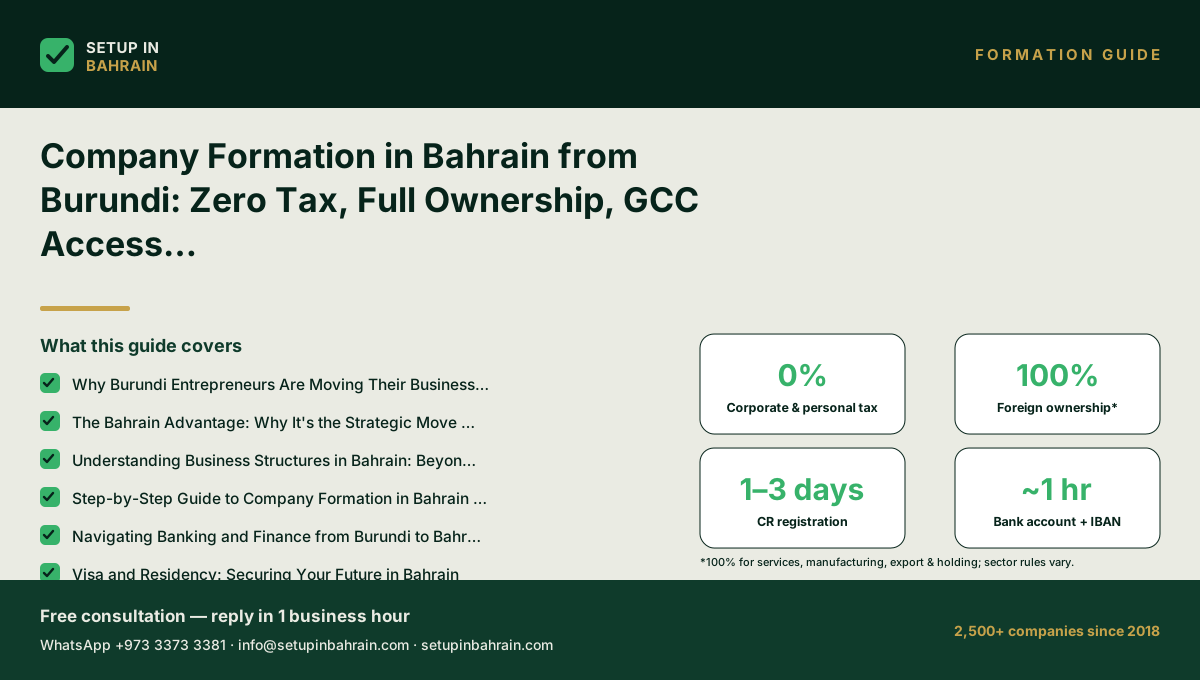
Complete guide for Burundi entrepreneurs: form a company in Bahrain with generally no corporate income tax for most sectors, 100% foreign ownership. GCC market access. Costs, steps, visas, banking.
Key Takeaways
- Why Burundi Entrepreneurs Are Moving Their Business to Bahrain
- The Bahrain Advantage: Why It's the Strategic Move for Burundian Capital
- Understanding Business Structures in Bahrain: Beyond the "Single Person Company" Myth
- Step-by-Step Guide to Company Formation in Bahrain for Burundian Entrepreneurs
- Navigating Banking and Finance from Burundi to Bahrain
→ Complete guide: Company Formation in Bahrain — the full 2026 guide
View details
Ownership & capital
A Bahrain WLL can be owned by a single person — 100% foreign ownership applies to most activities, with no local partner required for services, manufacturing, export trading and holding companies. The minimum share capital is BHD 1 ; we recommend BHD 1,000 . This Makes bank account opening and investor visa approval smoother.
Picture this: Jean-Claude, a seasoned textile exporter from Bujumbura, sits across from his accountant after another year of grappling with a 30% corporate income tax, constant currency drops, and an ever-mounting pile of paperwork for the Office Burundais des Recettes (OBR). The final straw? His meticulously earned Burundian Franc (BIF) profits, cleared for export, shrink by a staggering 18% from currency depreciation before he can even pay his international suppliers in USD. Jean-Claude leans back, a deep sigh escaping him. Wonders: "Am I truly building my legacy, or just running in place, losing ground year after year?"
Entrepreneurship in Burundi is, without question, a testament to incredible resilience. You navigate a landscape where every step, from securing capital to managing daily operations, feels like an uphill climb against a powerful current. You're constantly looking for an edge, a way to protect your hard-earned profits and expand your vision beyond the immediate horizon. If you’ve ever dreamed of a business environment where your innovation isn't penalized by hefty taxes, where your capital isn't relentlessly eroded by currency instability, and where the world’s most dynamic markets are within reach without prohibitive barriers, then this guide is specifically written for you.
We understand the unique, often exasperating, challenges you face as a Burundian entrepreneur. The struggle is profoundly real – the weight of a 30% corporate income tax that cuts deep into your margins, the relentless depreciation of the BIF eroding your cash flow by 15-20% annually, and the bureaucratic maze of the OBR tax authority with its complex, often paper-based systems that consume invaluable time and expose you to prolonged audits. You’ve likely felt the frustration of a central bank like the Banque de la République du Burundi (BRB), offering very limited international banking services, making cross-border transactions a Herculean task. The lingering effects of the post-2015 political crisis, including the suspensions of aid from crucial partners like the European Union and the United States, and the ongoing political tension, continue to limit foreign direct investment into Burundi, making it harder for your business to grow, attract capital, and compete on an international scale.
It’s in this challenging context that we invite you to consider a radical, yet entirely pragmatic, solution: establishing a strategic part of your business, or even its entirety, in the Kingdom of Bahrain. This isn't about abandoning Burundi or your roots; it's about strategically positioning a robust, fortified bridge from your home market to the global stage. It’s about creating an offshore base where the burdens you currently carry are greatly lightened, if not entirely removed, allowing your business to thrive with unprecedented freedom and access.
This guide will break down precisely how and why hundreds of African founders – especially those with the business spirit and challenges familiar to Burundian business owners – are now incorporating in Bahrain, and how you can leverage what they’ve discovered to secure your financial future and expand your global reach.
Why Burundi Entrepreneurs Are Moving Their Business to Bahrain
Let’s not sugarcoat the reality. Operating a business in Burundi in 2026 means fighting daily against a unique confluence of bottom-line killers and operational hurdles that are more and more pushing resilient entrepreneurs to seek more stable and growth-oriented environments.
Take the very real case of a Bujumbura-based coffee exporter who cleared BIF 180 million in revenue last year. After the Office Burundais des Recettes (OBR) applied the standard 30% corporate income tax, plus social security contributions and various municipal levies, the owner was left with roughly BIF 105 million. This already significant reduction is just the first hurdle. Over the following twelve months, the Burundian Franc lost another 18% against the dollar, according to data synthesized from various financial reports for 2026, wiping out most of the remaining margin when it came time to pay for imported roasting equipment and shipping containers in USD. To compound matters, this owner could not secure a reliable letter of credit or access sufficient foreign exchange through any local bank because the Banque de la République du Burundi (BRB) maintains tight foreign exchange controls and severe restrictions on opening foreign bank accounts, limiting access to USD for critical import/export operations.
This illustrates the three primary financial and operational devastators that continually erode profits and stifle growth for Burundian businesses:
A Crippling 30% Corporate Income Tax: This hefty tax eats away nearly a third of your company's hard-earned profit, leaving greatly less capital for reinvestment, expansion, or owner distribution. When combined with other taxes and levies, the effective tax burden can be even higher, making genuine capital accumulation a persistent struggle. Relentless Currency Depreciation: The Burundian Franc (BIF) suffers from chronic instability, depreciating by an alarming average of 15% to 20% every single year . The International Monetary Fund (IMF), in its assessments from 2021-2025, noted that Burundi’s BIF annual depreciation averaged 17.2%. This isn’t a theoretical number; it’s a direct attack on your real purchasing power, your ability to pay international suppliers. The long-term value of your savings. Your BIF-denominated earnings are literally shrinking as you hold them, making long-term financial planning incredibly difficult and risk-laden. Onerous Paper-Based Reporting and Bureaucracy: The OBR tax authority operates largely on a complex, paper-based system that is notoriously inefficient and time-consuming. This translates into excessive administrative overhead, constant exposure to unpredictable audits. A significant diversion of resources that could otherwise be used for productive business activities. It's a system that fosters frustration and uncertainty rather than ease of doing business.
Beyond these direct financial drains, Burundian entrepreneurs also contend with:
Severe Foreign Exchange Controls by the BRB: The Central Bank's tight grip on foreign currency access makes international transactions, crucial for import/export businesses, incredibly difficult. Securing USD for operations often involves protracted delays, complex approvals. An opaque process that hinders timely payments and reliable supply chains. Limited International Banking Services: The BRB’s very restricted international banking services mean Burundian companies struggle to open foreign bank accounts or conduct seamless cross-border financial operations. This isolation severely limits global competitiveness and makes attracting international investment a formidable challenge. Political Instability and its Aftermath: The lingering effects of the post-2015 political crisis continue to cast a long shadow. This instability has led to the suspension of significant aid from crucial partners like the EU and the US, further limiting foreign direct investment (FDI) into Burundi. The lack of consistent external capital inflow makes it incredibly difficult for local businesses to secure funding for growth, innovation. Large-scale projects. Difficulty in Accessing Global Markets: The combination of internal economic pressures, currency instability, and limited international financial connectivity makes it exceptionally hard for Burundian businesses to truly access and compete in global and regional markets like the East African Community, let alone the wider world.
When you add these real-world complications together, it becomes profoundly clear why some of the most astute Burundian business owners are no longer merely considering, but actively relocating their base of international operations. They are seeking environments where their efforts are rewarded, not diminished, and where their capital can grow unhindered.
The Bahrain Advantage: Why It's the Strategic Move for Burundian Capital
Compare the Burundian operational landscape with Bahrain’s compelling promise: a stable, growth-oriented environment designed to attract and nurture international business. For Burundian entrepreneurs, the contrast is stark and the benefits transformative:
In our reported experience, 99% of the bank-account cases we handle are completed on the spot in approximately one hour. Our last 100 bank-account applications handled in 2026 were approved. Cases involving subsidiaries or CIS shareholders typically take 3 days to 2 weeks. This is our service experience; the bank completes its own final review.
For a Burundian entrepreneur, moving a core part of their operations to Bahrain isn't merely a tactical shift; it’s a strategic realignment that can fundamentally transform their business’s trajectory, protecting their wealth and unlocking unprecedented growth potential.
Understanding Business Structures in Bahrain: Beyond the "Single Person Company" Myth
When Burundian entrepreneurs first look at company formation in new jurisdictions, a common question arises: "Can I form a 'Single Person Company'?" It's a reasonable query, often associated with simplified structures for sole proprietors. But, it's absolutely critical to understand that there is NO formal legal entity called a "Single Person Company" (WLL) in Bahrain. This is a common misconception. Relying on outdated or incorrect information can lead to significant delays and frustration.
Instead, Bahrain offers highly flexible and robust legal structures that effectively cater to entrepreneurs who wish to maintain 100% ownership and operate without partners. The most suitable and frequently chosen option for a single individual establishing a business in Bahrain is the With Limited Liability (WLL) company.
Let's clarify the key facts about a WLL that are especially relevant for Burundian entrepreneurs:
100% Single Person Ownership is Permitted: Contrary to what the term "Limited Liability" might imply in some contexts, a Bahraini WLL company can be owned 100% by a single individual*. There is absolutely no requirement for multiple shareholders or local partners to form a WLL. This provides the same level of control and singular ownership that an entrepreneur might seek from a "Single Person Company" in other jurisdictions, but within a recognized and highly functional legal framework in Bahrain. Shareholder Liability is Limited: As the name suggests, the liability of the shareholder (or shareholders) is limited to the amount of their capital contribution to the company. This separates personal assets from business liabilities, offering crucial protection to the entrepreneur. Minimum Share Capital: This is another critical point where clarity is essential. Legally, the minimum share capital for a WLL company in Bahrain is a symbolic BHD 1 (one Bahraini Dinar) . While legally permissible, recommending this absolute minimum for practical purposes would be irresponsible. * Practical Recommendation: BHD 1,000. For an international entrepreneur from Burundi, intending to open a corporate bank account and apply for an investor's visa, we strongly recommend a minimum stated share capital of BHD 1,000 . Why? * Bank Account Approval: While BHD 1 is legal, Bahraini banks, like any financial institution, have their own internal due diligence and risk assessment policies. A nominal capital of BHD 1 can raise red flags about the seriousness and stability of the business, making it incredibly difficult to secure a corporate bank account. BHD 1,000 signals a more substantial and committed venture, greatly increasing your chances of bank account approval. * Investor Visa Feasibility: The investor visa process, designed to attract genuine entrepreneurs, also looks at the economic substance of the proposed business. A BHD 1,000 capital contribution. Still modest, provides a more convincing demonstration of intent and financial capacity than a purely symbolic BHD 1. * Operational Credibility: For suppliers, customers. Potential partners, a company with a slightly more robust initial capital appears more credible and financially sound.
Other Relevant Business Structures in Bahrain:
While the WLL is the most common and recommended choice for single owners, it's worth briefly mentioning other structures:
Setup (Sole Proprietorship): This is for individual tradespersons or professionals. While it offers simplicity, it does not provide limited liability; the owner's personal assets are not separate from the business. For most international entrepreneurs seeking asset protection, this is not the ideal structure. Partnership Company (General Partnership, Limited Partnership): These structures involve two or more partners and are generally suitable for joint ventures where partners desire a higher degree of personal involvement and shared liability (General Partnership) or a mix of active and passive partners (Limited Partnership). Bahrain Shareholding Company (B.S.C. Closed or Public): These are suitable for larger enterprises requiring significant capital from multiple shareholders, with stricter regulatory requirements. A B.S.C. (Closed) is a private company with a single shareholder (one person can own 100%) and BHD 250,000 capital. A B.S.C. (Public) is for publicly traded companies. Foreign Company Branch/Representative Office: This allows an existing foreign company to establish a presence in Bahrain. The branch has the same legal identity as the parent company. A representative office is limited to marketing and promotional activities.
For Burundian entrepreneurs prioritizing control, limited liability. Ease of setup, the WLL company with 100% single ownership is almost invariably the most appropriate and advantageous choice.
Step-by-Step Guide to Company Formation in Bahrain for Burundian Entrepreneurs
Establishing your company in Bahrain is a straightforward process, largely thanks to the Ministry of Industry and Commerce (MOIC)'s digital "Sijilat" portal. Here’s a detailed, step-by-step guide tailored for entrepreneurs from Burundi:
Phase 1: Planning and Pre-Registration
Define Your Business Activity: This is the absolute first step. Clearly identify the specific commercial activities your Bahraini company will undertake (e.g., general trading, consulting, IT services, logistics, real estate, etc.). Bahrain has a comprehensive list of approved activities. Some niche activities may require additional approvals from specific ministries (e.g., financial services from CBB, healthcare from Ministry of Health). Choose Your Company Name: Select a unique and relevant name for your WLL. You will need to check its availability through the Sijilat portal. It’s wise to have a few options ready, as names must not infringe on existing trademarks and generally should not be misleading. Appoint a Local Service Provider (Optional, but Highly Recommended): While you can navigate Sijilat yourself, for non-residents, especially from a different legal and linguistic context like Burundi, engaging a local business formation consultant, legal firm, or PRO (Public Relations Officer) company is invaluable. They understand the nuances, can expedite processes, and ensure compliance. This is an investment that saves time, prevents errors, and eases your path. Gather Required Documents: Prepare the following: * Applicant's Passport Copy: Valid passport of the Burundian entrepreneur. * National ID (if applicable): While not always required for foreign shareholders, having a valid national ID can be useful. * CV/Resume: A professional CV outlining your experience and qualifications. * Bank Reference Letter: A letter from your Burundian bank (or any international bank where you have an account) confirming your good standing. * Proof of Address: Utility bill or bank statement showing your residential address. * Power of Attorney (if using a service provider): To authorize your chosen consultant to act on your behalf. * Proposed Articles of Association (AOA) and Memorandum of Association (MOA): These are standard legal documents outlining the company's rules, objectives. Shareholder structure. Your service provider will draft these.
Phase 2: Online Registration via Sijilat Portal
Sijilat Account Creation: Your service provider (or you) will create an account on the Sijilat portal (www.sijilat.bh). Reserve Company Name: Submit your preferred company name for approval. This usually takes a few hours to a few days. Submit Commercial Registration (CR) Application: * Fill out the electronic application form for a WLL company. * Upload all required documents (passport, CV, bank reference, MOA/AOA, etc.). * Specify your chosen business activities. * Declare the company’s share capital (recommend BHD 1,000 for the reasons discussed earlier, though BHD 1 is legally permissible). * Appoint a director and a manager (who can be the same person if you are the sole owner). Pay Government Fees: Pay the registration fees online through the Sijilat portal. These fees are generally nominal. Initial Approval: MOIC will review your application. If all documents are correct and activities are approved, you will receive an initial approval.
Phase 3: Post-Approval & Commercial Registration Issuance
Finalize Documents: Some final documents, potentially including physical signatures (though many can now be done electronically or via verified digital signatures), may be required. Commercial Registration (CR) Issuance: Once all steps are completed and verified, MOIC will issue your Commercial Registration (CR). This is your official business license. This document is crucial and serves as your company's birth certificate in Bahrain. It typically takes 2-5 working days from initial submission to CR issuance if all documents are in order. Virtual Office/Physical Address: Before obtaining your CR, you will need to provide a registered office address. Many Burundian entrepreneurs start with a virtual office provider in Bahrain, which offers a reputable business address, mail handling. Often meeting room access, all without the overhead of a physical office. This fulfills the legal requirement.
Phase 4: Post-Registration Essentials
Open a Corporate Bank Account: This is a critical step, especially coming from a jurisdiction like Burundi with banking limitations. With your CR in hand, approach a reputable Bahraini bank (e.g., BBK, NBB, Ahli United Bank, HSBC, Standard Chartered). * Crucial Tip: The BHD 1,000 recommended share capital will greatly smoothen this process. Banks require robust KYC (Know Your Customer) and AML (Anti-Money Laundering) checks. Be prepared to provide comprehensive personal and business documents, including your source of funds. * Initial Deposit: You will need to deposit your stated share capital (e.g., BHD 1,000) into this account. Apply for an Investor Visa: As the owner of a Bahraini WLL, you are eligible to apply for an investor visa. This process is managed by the Nationality, Passports, and Residence Affairs (NPRA) Directorate. * Requirements: Typically includes passport copies, company CR, proof of funds/capital deposit, medical examination. Possibly a police clearance certificate. * Benefits: The investor visa allows you to reside in Bahrain, often for two years initially, renewable thereafter. It also opens pathways for family members to join you. Register with the Social Insurance Organization (SIO): If your company will employ staff (including yourself as a working director), you must register with the SIO. Get Specific Licenses (if required): Depending on your business activity, you may need additional sector-specific licenses from relevant ministries or regulatory bodies (e.g., CBB for financial services, Ministry of Health for medical practices).
The entire process, from initial planning to receiving your CR, can be completed remarkably quickly – often within a week to ten days – if all documents are prepared and submitted correctly, especially with the help of an experienced local consultant.
Navigating Banking and Finance from Burundi to Bahrain
For Burundian entrepreneurs, the contrast in banking environments between Burundi and Bahrain is perhaps one of the most liberating aspects of establishing a business in the Gulf. The challenges posed by the Banque de la République du Burundi (BRB) are well-known: tight foreign exchange controls, severe restrictions on opening foreign bank accounts, and limited access to critical foreign currencies like USD for import/export. These hurdles can turn simple international transactions into logistical nightmares, impacting cash flow, supplier relationships. Overall business efficiency.
Bahrain, in stark contrast, offers a sophisticated, globally integrated financial ecosystem overseen by the Central Bank of Bahrain (CBB). The CBB maintains a progressive regulatory framework that fosters transparency, stability, and international connectivity. This translates into tangible benefits for your business:
Seamless Access to International Banking Services: * Global Transactions: Bahraini banks offer robust platforms for international wire transfers, Letters of Credit (LCs). Other trade finance instruments in major currencies like USD, EUR, GBP, and JPY. You can finally make and receive international payments with speed and reliability, freeing you from the BRB’s foreign exchange bottlenecks. * Multi-Currency Accounts: Easily open accounts in multiple currencies to manage your international cash flows efficiently, hedging against currency fluctuations that have plagued your BIF-denominated earnings. * Online Banking & Digital Tools: Most Bahraini banks provide advanced online banking platforms, mobile apps. Digital payment solutions, enabling you to manage your finances remotely and efficiently.
Opening a Corporate Bank Account in Bahrain: * The Importance of Share Capital: As reiterated, while the legal minimum share capital for a WLL is BHD 1, recommending BHD 1,000 for Burundian entrepreneurs is not merely practical; it’s almost essential for a smooth bank account opening process. Banks conduct thorough due diligence and a BHD 1,000 capital signals a serious, well-capitalized entity, enhancing your credibility. Required Documents: Banks will require your company's Commercial Registration (CR), Memorandum and Articles of Association, passport copies of shareholders/directors/managers, proof of address, and a comprehensive business plan. Critically, they will also require Know Your Customer (KYC) and Anti-Money Laundering (AML) documents, including proof of the source of funds* for your initial capital deposit. Be prepared to provide bank statements from your Burundian accounts or other international accounts, tax returns, or business invoices to show the legitimate origin of your wealth. * Process: After submitting documents, the bank will conduct its internal review. This typically takes 1-3 weeks. Once approved, you will make your initial capital deposit into the new corporate account.
- Access to Credit and Financing:
- Financial Stability and Regulatory Oversight:
For Burundian entrepreneurs, the transition to Bahrain's financial landscape is not just about avoiding problems; it’s about unlocking opportunities. It’s about gaining control over your finances, ensuring the value of your earnings. Accessing the capital and banking services necessary to compete and thrive on a global scale.
Visa and Residency: Securing Your Future in Bahrain
Beyond establishing your company, securing your right to live and work in Bahrain is a critical component of your move. As the owner of a Bahraini business, you are eligible to apply for an Investor Visa . This Offers a pathway to long-term residency and significant benefits for you and your family.
Eligibility for the Investor Visa: * As the owner or a significant shareholder (typically at least BHD 100,000 in share capital, though lower amounts can be approved based on the business activity and job creation) of a Bahraini company, you qualify for an investor visa. For WLL companies with a recommended BHD 1,000 capital, the visa is granted based on the economic activity and the entrepreneur's commitment to building a business in Bahrain. * The Bahrain Economic Development Board (EDB) actively supports investor visa applications for entrepreneurs contributing to the economy.
The Application Process: The Investor Visa application is managed by the Nationality, Passports. Residence Affairs (NPRA) Directorate, often facilitated through the Labour Market Regulatory Authority (LMRA) for work permits. * Required Documents: * Valid passport with at least six months validity. * Copy of your company’s Commercial Registration (CR). * Memorandum and Articles of Association. * Proof of capital deposit in your Bahraini corporate bank account. * Personal bank statements (often for the last 3-6 months) demonstrating financial stability. * A detailed business plan. * Medical examination results from an authorized clinic in Bahrain. * A police clearance certificate (or good conduct certificate) from Burundi and any other country of residence in the last five years. This is a standard security check. * Passport-sized photographs. * Application forms. * Sponsorship: Your Bahraini company acts as your sponsor for the visa. * Processing Time: Once all documents are submitted and checks are cleared, the processing time for an investor visa typically ranges from 2 to 4 weeks.
Key Benefits of the Investor Visa: * Long-Term Residency: Investor visas are typically granted for two years initially, renewable thereafter, offering stability and predictability for your stay in Bahrain. * Ability to Live and Work in Bahrain: This visa grants you the legal right to reside in Bahrain and actively manage your business. * Family Sponsorship: As an investor visa holder, you can sponsor your immediate family members (spouse and children) for their residency visas, allowing them to join you in Bahrain. This is a significant consideration for entrepreneurs looking to relocate their families. * Access to Services: With residency, you gain access to essential services in Bahrain, including healthcare, education for your children. Opportunities to get a Bahraini driving license. * Travel Freedom: A Bahraini residency permit facilitates easier travel to other GCC countries for business purposes.
- Pathways to Permanent Residency: While Bahrain does not have a direct "citizenship by investment" program, a long-term, sustained commitment to business and residency can open up possibilities for more permanent residency statuses, further cementing your future in the Kingdom.
Bahrain Business Guides for Burundi Citizens
Frequently Asked Questions
How long does it take to set up?
It takes 15 to 20 days. We file all forms for you. You do not need to wait long.
What does it cost?
Company formation: Standard BHD 1,340 with 3 months of office address; Gold BHD 1,700 with 6 months; Premium BHD 2,150 with 12 months and a cabin, officer table and chair, and two guest chairs. No formation package includes visas, including Premium. Investor/work visas are priced separately: BHD 755 for one year or BHD 953 for two years, in addition to the formation package. Ask for a written, itemized quotation confirming government fees and all inclusions before payment.
Do I need to visit Bahrain?
No. You can set up your firm from home. We do all the work online. Some banks may ask for one visit.
What tax will I pay?
You pay zero tax on your profits. Bahrain has no corporate income tax. This is a key benefit of the setup.
Can I own 100% of my firm?
Yes. Foreign owners can hold all shares. No local partner is needed. Full ownership is allowed.
What do I need to start?
You need a valid passport. You also need a trade name and a business address. We help you with all of these.
How do I open a bank account?
We guide you step by step. Most banks take 3 to 6 weeks. You will need your CR and firm papers.
Who issues the Commercial Registration (CR)?
The CR is issued by the MOICT. It is your legal right to trade in Bahrain. We file the CR for you.
Can I renew my CR each year?
Company renewal packages: BHD 530 with 3 months of office address; BHD 980 with 6 months; BHD 1,520 with 12 months. These are separate renewal packages, not visa fees.
How do I get started?
Fill in our form on this page. Our team will call you back. We map your best setup plan at no cost.
Steps to Form Your Company
- Pick your trade name. We check if it is free.
- Choose your business type. WLL is the most common.
- Sign the MOA. We draft and file all legal docs.
- Pay the state fees. About BHD 432 in total.
- Get your CR. Takes 15 to 20 days.
- Open your bank account. We guide each step.
- Start trading. You are ready to do business.
Key Facts
- Tax rate: 0%
- Foreign ownership: 100%
- Setup time: 15 to 20 days
- Company formation: Standard BHD 1,340 with 3 months of office address; Gold BHD 1,700 with 6 months; Premium BHD 2,150 with 12 months and a cabin, officer table and chair, and two guest chairs. No formation package includes visas, including Premium. Investor/work visas are priced separately: BHD 755 for one year or BHD 953 for two years, in addition to the formation package. Ask for a written, itemized quotation confirming government fees and all inclusions before payment.
- Company renewal packages: BHD 530 with 3 months of office address; BHD 980 with 6 months; BHD 1,520 with 12 months. These are separate renewal packages, not visa fees.
- Client rating: 4.8 stars
- Clients served: 2,500 and more
Quick Facts
- Tax rate: 0%
- Own all of your firm: Yes, 100%
- Time to set up: 15 to 20 days
- Company formation: Standard BHD 1,340 with 3 months of office address; Gold BHD 1,700 with 6 months; Premium BHD 2,150 with 12 months and a cabin, officer table and chair, and two guest chairs. No formation package includes visas, including Premium. Investor/work visas are priced separately: BHD 755 for one year or BHD 953 for two years, in addition to the formation package. Ask for a written, itemized quotation confirming government fees and all inclusions before payment.
- Company renewal packages: BHD 530 with 3 months of office address; BHD 980 with 6 months; BHD 1,520 with 12 months. These are separate renewal packages, not visa fees.
- Rating: 4.8 stars
- Clients: 2,500 and more
Why Bahrain?
Bahrain has no tax. You keep all your profits. This is rare in the Gulf.
You can own all of your firm. No local partner is needed. The law allows full foreign ownership.
Setup takes 15 to 20 days. We file all forms for you. You can do it all from home.
Bahrain has a free trade deal with the US. Your goods face low or no tariffs. This gives you access to big markets.
We have served 2,800+ clients from 44+ countries and maintain records to substantiate that total where needed. We have 113 Google reviews; reviews represent only some clients and are not the same as the total clients served.
Our Steps
- Tell us your plan. We advise you for free.
- We pick the right firm type for you.
- We file all your forms with MOICT.
- You get your CR in 15 to 20 days.
- We help you open a bank account.
- You are ready to trade. We stay with you.
Next Steps for Burundi Citizens
You can set up a firm in Bahrain from Burundi. You do not need to fly there first. We do all the work online.
Tell us your plan. We call you back the same day. We map the best route for you at no cost.
We file all your forms. We deal with MOICT and the state. You get your CR in 15 to 20 days.
After your CR, we help you get a bank account. We also help with your Investor Visa. One firm guides you at each step.
Why Our Clients from Burundi Choose Us
- We speak your language. We know your needs.
- We have helped clients from Burundi before.
- Our fee is clear. No surprise costs.
- We have a 4.8 star rating on Google.
- We have helped more than 2,500 clients set up in Bahrain.
Fill in the form on this page. We will be in touch soon. Let us help you start your Bahrain firm today.
Ready to set up in Bahrain from Burundi?
Tell us your business idea. We map the right entity, ownership and timeline — then handle the filing while you focus on what matters.