
Everything Qatar nationals need to know about work visa in Bahrain. Steps, costs, documents, timeline — complete 2025 guide.
View details
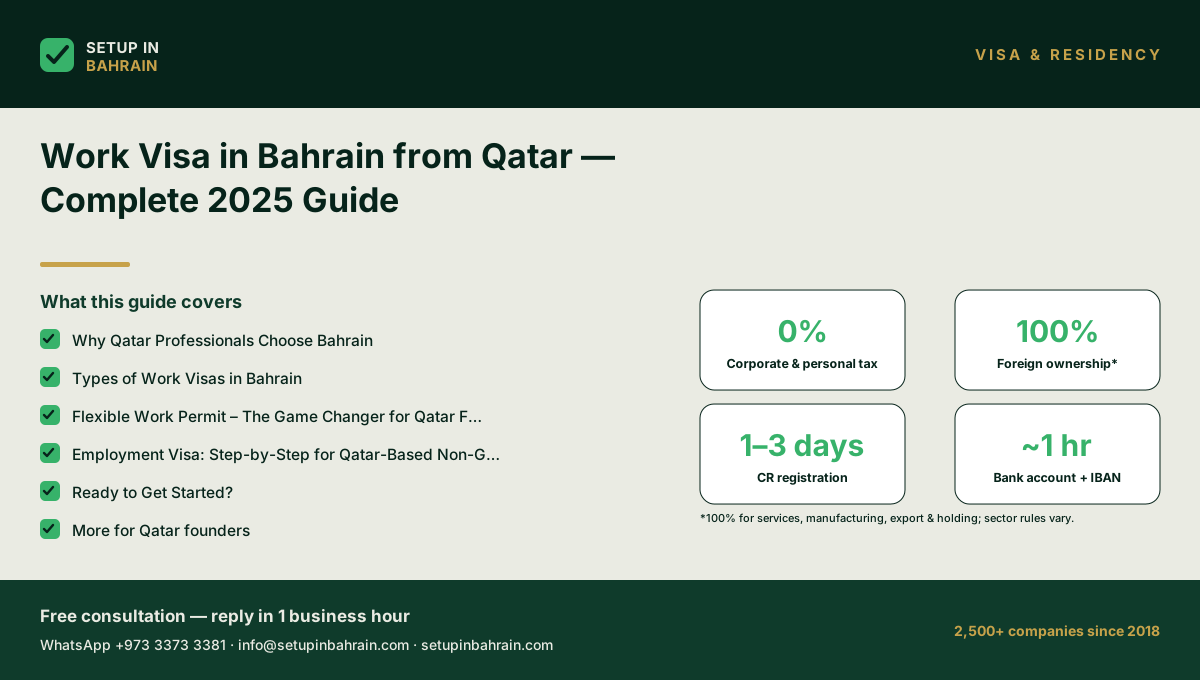
Everything Qatar nationals need to know about work visa in Bahrain. Steps, costs, documents, timeline — complete 2025 guide.
Bahrain Business Guides for Qatar Citizens
As a senior consultant with over 15 years of experience guiding entrepreneurs and professionals across the GCC, I've witnessed Bahrain's remarkable evolution into a dynamic hub. This is particularly appealing to those in Qatar seeking new horizons. Since 2021, hundreds of skilled workers have relocated from Qatar to Bahrain, drawn by a potent combination of lower costs, genuinely simplified visa systems, and proactive labour reforms that have reshaped the Kingdom's economic landscape.
Bahrain has strategically positioned itself as a business-friendly economy with an open and progressive labour market. It offers the most straightforward work visa pathway for Qatar professionals in the entire Gulf region. The reason is simple: Bahrain abolished the traditional kafala sponsorship system in 2009, long before Saudi Arabia or the UAE followed suit.
This means as a worker, you gain unprecedented freedom: you can change jobs without your employer's permission, leave the country without an exit visa, and in some cases, work entirely without an employer sponsor.
This comprehensive guide is specifically designed for Qatar-based professionals, freelancers, and entrepreneurs considering a move or expansion to Bahrain. We will provide practical, actionable insights on securing a work visa, directly from an expert who understands the nuances of both markets. All figures are in Bahraini Dinars (BD); one Bahraini Dinar is approximately 10.12 Qatari Riyals, based on the fixed peg to the US Dollar.
The figures presented are current as of early 2025 and sourced directly from the Labour Market Regulatory Authority (LMRA) and Bahrain's Ministry of Interior.
Why Qatar Professionals Choose Bahrain
The economic landscape in the Gulf is constantly shifting. While Qatar has seen significant growth, particularly around major events, its post-World Cup phase has brought new considerations for businesses and individuals. Many Qatar-based professionals and entrepreneurs are now looking at Bahrain for several compelling reasons:
Lower Cost of Living and Doing Business: Bahrain generally offers a significantly lower cost of living and a more affordable operational environment for businesses compared to Doha. Bahrain is approximately 35-45% cheaper than Qatar for equivalent housing, utilities, and services. For example, a one-bedroom apartment in popular expatriate areas like Juffair or Seef typically costs BD 250-350 per month, compared to QR 6,000-8,000 in Doha.
This translates into better profit margins for companies and a higher quality of life for individuals, allowing your salary to stretch further. Taxation Advantage: For businesses, Qatar imposes a 10% corporate income tax on most commercial activities. Bahrain, on the other hand, has a Generally no corporate income tax for most sectors policy for most sectors (except oil and gas companies), offering a significant financial advantage that can be critical for startups and SMEs.
While personal income is tax-free in both countries, Bahrain also has no VAT on most essential goods and services (VAT is 5% on select items, compared to 5% in Qatar but applied more broadly). Diversified Economy & Opportunity: Bahrain boasts a highly diversified economy beyond oil and gas, with strong sectors in financial services, fintech, manufacturing, logistics, information technology, oil and gas, construction, hospitality, and tourism. This creates a wider array of job opportunities and business niches.
The Kingdom is actively recruiting internationally for talent in these growing areas. Strategic Location and Connectivity: Bahrain's strategic location in the Arabian Gulf, coupled with excellent air and road connectivity (via the King Fahd Causeway to Saudi Arabia), makes it an ideal regional base. It offers direct access to key Gulf financial hubs. Progressive Regulatory Environment: Bahrain is renowned for its forward-thinking regulatory frameworks, particularly in its labour market and business registration processes.
Its reforms to the sponsorship system in 2009 significantly predate similar changes in other GCC countries, offering greater flexibility and freedom to workers. Full Foreign Ownership: Since 2021, foreign nationals can own 100% of a Bahraini With Limited Liability (WLL) company without requiring a local partner. While the legal minimum capital for a WLL is BHD 1, a practical recommendation for smoother bank account opening and investor visa approval is BHD 1,000 or more, demonstrating serious intent.
Quality of Life: Bahrain offers a vibrant expatriate community, excellent international schools, modern healthcare facilities, and a relaxed lifestyle, often at a more accessible cost. For those facing increasing commercial real estate costs and service inflation in Qatar post-major events, Bahrain presents a tangible solution for both personal and professional growth.
Types of Work Visas in Bahrain
All work visas in Bahrain are managed by the Labour Market Regulatory Authority (LMRA), the government body responsible for regulating the labour market and issuing work permits for expatriates. Understanding the different types is crucial for choosing the right path.
GCC Nationals: An Important Distinction for Qataris
It's crucial to highlight a significant advantage for Qatari citizens: As GCC nationals, you have open access to the Bahraini labour market. This means Qatari citizens do not require an LMRA work permit to be employed in Bahrain. You can enter, reside, and work freely, benefiting from the same labour laws and regulations as Bahraini citizens. You simply register with LMRA. This simplifies the process immensely for Qatari passport holders.
This guide primarily focuses on non-GCC nationals residing in Qatar, but this exception for Qatari citizens is vital to note.
Here’s a breakdown of the main work visa categories for non-GCC nationals from Qatar:
1. Employment Visa (Employer-Sponsored)
This is the most common type of work visa, used by most salaried employees. It's designed for individuals who have secured a job offer from a Bahraini employer. The employer takes on the responsibility of sponsoring your work permit.
* Who it's for: Professionals, skilled workers, managers, and anyone hired by a company registered in Bahrain. * Process: The employer initiates the application through the LMRA Expatriates Portal. Once approved, the employee receives an entry visa to enter Bahrain. Upon arrival and completion of medical exams and biometrics, the full work permit (often referred to as a "work permit card" or "residence permit" / CPR card) is issued. * Validity: Valid for 2 years and is renewable.
* Cost: BD 96 per year (BD 192 for the full two years). This cost is typically borne by the employer as per Bahraini labour law. * Key Feature: Direct employment with a single sponsoring entity, though with considerable flexibility to change jobs (discussed later).
2. Flexible Work Permit (FWP) – The Game Changer
Launched in December 2021, the Flexible Work Permit (FWP) is a revolutionary scheme that positions Bahrain at the forefront of modern work arrangements. It's unique in the GCC, offering unparalleled freedom and autonomy to expatriate workers. With the FWP, you sponsor yourself.
* Who it's for: Freelancers, digital nomads, independent consultants, project-based workers, and those who prefer not to be tied to a single employer. It’s an ideal solution for Qatar-based professionals looking to work for multiple clients or establish their independent practice in Bahrain without needing a local sponsor. You cannot be a full-time employee of any one company but can contract with as many as you wish. * Process: This permit is self-sponsored. Eligible individuals apply directly to the LMRA.
* Validity: Valid for 2 years (BD 450 for the full two-year period), with no annual renewal hassle. It is renewable. * Cost: BD 450 for the 2-year permit. You also pay a monthly fee of BD 30 to LMRA. This also requires comprehensive health insurance, which applicants must arrange themselves. * Key Feature: No employer sponsor needed. Allows you to work for multiple clients or employers, switch jobs, or run your own freelance business legally, offering immense flexibility.
It allows unlimited multi-entry to Bahrain.
3. Training Visa
This visa is for individuals who wish to undertake vocational training or internships in Bahrain. It's typically short-term and non-renewable, focused purely on skill development.
* Who it's for: Students, recent graduates, or professionals seeking specific training programmes in Bahraini institutions or companies. * Process: The sponsoring training institution or company applies for the visa. * Validity: Usually for the duration of the training program, typically up to 6 months or 1 year. * Cost: BD 20-40 depending on duration. * Key Feature: Non-employment specific, focused on learning and skill acquisition.
4. Investor-as-Employee Visa
This category applies to individuals who establish a company in Bahrain and also wish to work within that company, drawing a salary. It combines the roles of business owner and employee.
* Who it's for: Entrepreneurs from Qatar who want to set up their own business in Bahrain (e.g., a Bahraini With Limited Liability company – WLL) and act as its managing director or a key employee. * Process: After company registration (e.g., with the Ministry of Industry and Commerce), the company can then sponsor the owner for a work permit. The process is identical to the Employment Visa. * Validity: Typically 2 years, renewable, tied to the company's registration status.
* Key Feature: Grants the business owner a legal work status within their own entity. For a Bahrain WLL, it's worth noting that while the legal minimum share capital is BHD 1, we highly recommend a minimum of BHD 1,000 to facilitate smoother bank account opening and investor visa approval. Furthermore, one person can own 100% of a WLL, making it a very accessible structure for solo entrepreneurs.
Flexible Work Permit – The Game Changer for Qatar Freelancers and Consultants
If you are a consultant, freelancer, remote worker, or independent professional based in Qatar, the Flexible Work Permit (FWP) is truly transformative and should be your primary consideration. It removes the need for any employer sponsor and does not require a job offer. What it does require is proof that you have the skills, income, and professional standing to support yourself while living in Bahrain.
Who Qualifies for FWP?
The LMRA targets seven categories of workers under the FWP scheme:
- Freelancers in media, marketing, and creative industries
- IT consultants and developers
- Engineers and technical specialists
- Healthcare professionals (with valid licensing)
- Academic and education consultants
- Business and management consultants
- Artists, performers, and cultural professionals
FWP Application Process: Step-by-Step
Step 1: Document Preparation Prepare your documents: valid passport copy, professional CV, portfolio or client contracts, proof of professional qualifications (degrees, certifications), and bank statements showing a minimum BD 2,000 balance for the last 3 months. Arrange for a comprehensive health insurance policy covering your stay in Bahrain.
Step 2: Online Application Submission Register on the LMRA Expatriates Portal at lmra.bh. Select the Flexible Work Permit application. Submit the application online.
Step 3: Fee Payment Pay the BD 450 fee for the two-year permit (credit card or bank transfer).
Step 4: Medical Examination (Upon Arrival) Once your application is initially approved and you enter Bahrain, you must complete a mandatory medical examination at an LMRA-approved clinic. This typically includes blood tests, chest X-ray, and a general health check, testing for tuberculosis, hepatitis B and C, HIV, and syphilis.
Step 5: Biometrics and Card Issuance After clear medical results (usually 2-3 working days), you will go to an LMRA service centre for fingerprinting and photo. Within 5-10 working days, you will receive your FWP card and CPR (Central Population Register) card. The CPR card is your official residency document.
Key Benefits for Qatar Freelancers and Consultants
The FWP offers an unprecedented level of independence, significantly de-risking the independent work model:
* No Employer Sponsor: You are self-sponsored, removing the reliance on a single employer. * Work for Multiple Clients: You can work for multiple clients, both within Bahrain and internationally, without needing individual sponsorships. This is ideal for servicing existing clients in Qatar, the UAE, or globally. * Transition Between Projects: Smoothly transition between projects and contracts without a new visa application each time.
* Legal Independent Practice: Operate your independent practice legally, paying social contributions, and having a recognised residency status. * Freedom to Change Jobs: Take on new assignments without requiring permission from a previous sponsor. * Multi-Entry: The FWP allows unlimited multi-entry, enabling you to freely move between Doha and Manama while based in Bahrain.
* Financial Flexibility: You can keep your Qatar bank account and maintain your Qatar residence permit (though consider implications of being outside Qatar for more than 6 consecutive months).
This permit is a clear signal of Bahrain's commitment to fostering a modern, agile economy. If you are a consultant, IT specialist, creative professional, or offer any service that can be delivered independently, the FWP should be your primary consideration.
Employment Visa: Step-by-Step for Qatar-Based Non-GCC Professionals
If you've secured a job offer, here's a realistic breakdown of the Employment Visa process:
Step 1: Job Offer and Contract Receive
Ready to Get Started?
Our team specialises in helping Qatar entrepreneurs navigate Bahrain's process quickly and correctly.
Get Free ConsultationMore for Qatar founders
Ready to start from Qatar?
Tell us your goal — we map the right route, timeline and cost, then handle the filing.
Looking for a different nationality? See our master guide on the Bahrain Work Visa by Nationality.