
Start your Bahrain company from Qatar with generally no corporate income tax for most sectors. Fast registration, full foreign ownership & easy access for Qatari entrepreneurs. Expert support.
Key Takeaways
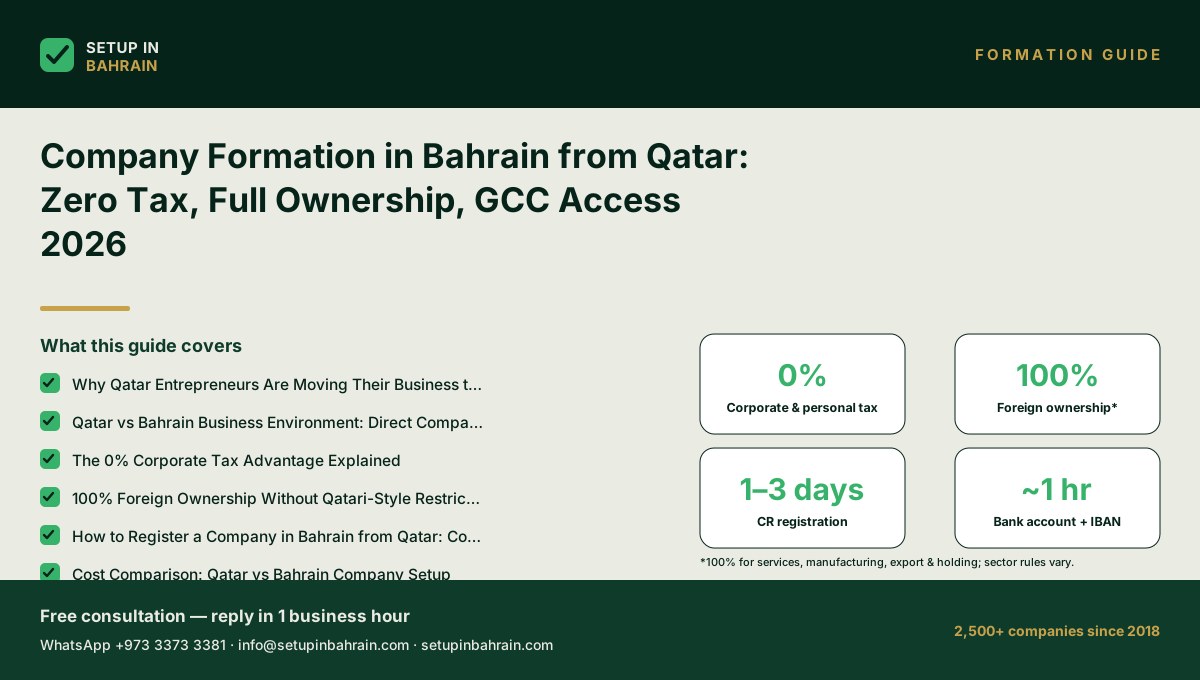
- Why Qatar Entrepreneurs Are Moving Their Business to Bahrain
- Qatar vs Bahrain Business Environment: Direct Comparison
- The generally no corporate income tax for most sectors Advantage Explained
- 100% Foreign Ownership Without Qatari-Style Restrictions
- How to Register a Company in Bahrain from Qatar: Complete Process
→ Complete guide: Company Formation in Bahrain — the full 2026 guide
View details
Ownership & capital
A Bahrain WLL can be owned by a single person — 100% foreign ownership applies to most activities, with no local partner required for services, manufacturing, export trading and holding companies. The minimum share capital is BHD 1 ; we recommend BHD 1,000 . This Makes bank account opening and investor visa approval smoother.
Why Qatar Entrepreneurs Are Moving Their Business to Bahrain
Sitting in his West Bay office last Ramadan, Ahmed Al-Thani did what hundreds of Qatar business owners have done since 2023—he opened Excel and calculated what his company actually kept after tax. The numbers were sobering.
His Doha-based trading firm, seven years of profitable operations spanning commodities and real estate services, was hemorrhaging value to a 10% corporate income tax that felt more and more burdensome with each passing quarter. His annual profit of QAR 4.8 million meant QAR 480,000 flowing directly to the General Tax Authority—money that could have funded his Saudi market expansion, hired four senior staff members, or simply provided the working capital cushion every entrepreneur craves.
But the tax wasn't the full picture. Ahmed's two commercial leases in Lusail had renewed at 22% higher rates post-World Cup. His PRO services contract jumped from QAR 3,200 monthly to QAR 4,100. When he tried to bring in a Syrian logistics specialist through the kafala sponsorship system, the approval process stretched to thirteen weeks, during which his competitor in Manama had already secured the Saudi contract Ahmed was chasing.
"My neighbor in the same commercial tower had already moved his holding company to Bahrain," Ahmed told me during a recent consultation. "The pitch was simple: Generally no corporate income tax for most sectors, permanent, no sunset clause, and the same Gulf time zone. I kept asking myself—what exactly am I paying for?"
Ahmed isn't an outlier. According to data from Bahrain's Economic Development Board (EDB), GCC-origin company registrations increased 38% year-on-year in 2025, with Qatari founders representing the fastest-growing segment. The Ministry of Industry and Commerce (MOIC) processed over 1,200 new commercial registrations from Qatar-based entrepreneurs in the past eighteen months alone.
The mathematics driving this migration are brutally straightforward. Consider a Qatar-based consulting firm generating QAR 5 million in annual profit:
| Scenario | Annual Tax Liability | 5-Year Total Tax | Capital Retained |
| Qatar (10% CIT) | QAR 500,000 | QAR 2,500,000 | QAR 22,500,000 |
| Bahrain (0% CIT) | QAR 0 | QAR 0 | QAR 25,000,000 |
| Difference | QAR 500,000/year | QAR 2,500,000 | +11% capital |
But the migration isn't solely about tax arbitrage. Qatar's business environment has tightened in specific ways that disproportionately impact certain entrepreneur profiles. The Qatar Free Zone Authority (QFZA) has implemented stricter activity classifications, limiting what companies can conduct within free zone boundaries and forcing many service businesses onto the mainland where full corporate tax applies. Multi-activity licenses that once allowed entrepreneurs to pivot between related business lines now require separate approvals and often separate entities.
The kafala work-permit sponsorship system. Reformed compared to a decade ago, still creates friction points that Bahrain has systematically eliminated. A Qatar-based company hiring foreign talent navigates a process averaging 8-12 weeks for standard positions; the same hire through a Bahrain entity completes in 2-3 weeks through the Labour Market Regulatory Authority's (LMRA) streamlined system.
Meanwhile, Bahrain offers a fundamentally different proposition: 0% corporate income tax with no cap, no phaseout. No industry restrictions. The Central Bank of Bahrain (CBB) has licensed over 380 financial institutions, creating genuine competition for business banking services. The Bahrain Investors Center processes company formations in a single location, often completing registration within 48 hours for straightforward structures.
For Qatari entrepreneurs, this isn't about abandoning their home market—it's about optimizing their regional structure. The 25-kilometer King Fahd Causeway means your Bahrain entity is closer to many Saudi clients than driving across Doha during rush hour. Same time zone. Same business culture. Dramatically different cost structure.
Qatar vs Bahrain Business Environment: Direct Comparison
Understanding why Bahrain has become the preferred incorporation destination for Qatari entrepreneurs requires examining the specific friction points in Qatar's current business environment against Bahrain's streamlined alternatives.
Corporate Taxation Structure
Qatar implemented its 10% corporate income tax on commercial entities in 2023, applying to all companies operating on the mainland regardless of ownership structure. This flat rate, while competitive by global standards, represents a significant departure from the region's traditional zero-tax positioning and creates an immediate competitive disadvantage against Bahrain, UAE, and Saudi Arabia's evolving tax incentives.
The tax applies to all taxable profits above a minimal threshold, with limited deductions available for legitimate business expenses. Critically, there is no reduced rate for reinvested profits, no startup exemptions for new businesses. No sector-specific relief for priority industries. A Qatari technology startup generating its first QAR 1 million in profit faces the identical 10% rate as a established conglomerate.
Bahrain, by contrast, maintains a genuine 0% corporate income tax for all commercial activities except hydrocarbon extraction and refining. This isn't a temporary incentive or a free zone benefit—it's the standard rate applying to every WLL, BSC. Branch operation throughout the kingdom. The Bahrain Economic Vision 2030 has explicitly committed to maintaining this rate as a cornerstone of the nation's competitive positioning.
Post-World Cup Cost Inflation in Qatar
The 2022 World Cup transformed Qatar's infrastructure but also permanently elevated the cost base for commercial operations. Commercial real estate in premium locations like West Bay, Lusail. The Pearl has experienced rental increases of 18-26% since 2022, with limited downward correction despite increased supply.
A standard 100-square-meter office in West Bay that leased for QAR 14,000 monthly in 2021 now commands QAR 17,500-19,000. Grade A space in Lusail has reached QAR 180-220 per square meter annually, approaching Abu Dhabi pricing levels despite a smaller tenant pool.
These increases compound across the operational cost structure. Professional services—legal, audit, PRO, and advisory—have adjusted rates upward by 15-22% since 2022. A standard corporate PRO retainer that cost QAR 2,800 monthly in 2021 now averages QAR 3,400-4,200 depending on service scope.
Bahrain's cost structure tells a different story. Grade A office space in the Seef District or Bahrain Bay averages BHD 8-12 per square meter monthly (about QAR 77-116), representing 35-50% savings compared to equivalent Qatar positioning. A fully serviced 50-square-meter executive office in a premium Bahrain tower costs roughly the same as a basic desk arrangement in a Doha free zone.
QFZA Free Zone Limitations
Qatar's free zone infrastructure, anchored by the Qatar Free Zone Authority, was designed to attract international companies with tax benefits and streamlined processes. But, recent regulatory tightening has created unexpected constraints for existing and prospective tenants.
QFZA companies face strict activity classifications that limit operational flexibility. A company licensed for "marketing services" cannot easily pivot to "consulting services" without license amendments, fee payments. Approval processes. Multi-activity licenses, once freely available, now require justification and may be denied for activities deemed too broadly defined.
More greatly, QFZA companies face restrictions on their ability to conduct business with Qatar's domestic market. While the zones offer generally no corporate income tax for most sectors, the limitation on mainland commercial activity forces many service businesses to maintain dual structures—a free zone entity for international work and a mainland company for Qatari clients, each with separate compliance requirements and the latter subject to the 10% tax.
Bahrain's approach differs fundamentally. Commercial licenses from MOIC allow nationwide operation without geographical restrictions. A single WLL can serve clients across Bahrain's domestic market, export services regionally. Maintain whatever mix of activities falls within its licensed scope. License amendments for adding related activities typically complete within 3-5 business days and involve minimal fees.
The Kafala Sponsorship Comparison
Qatar's kafala work-permit sponsorship system. Modernized compared to historical practices, still creates measurable friction for talent acquisition. An employer-sponsored work permit in Qatar requires:
- Labor department approval (2-4 weeks)
- Security clearance processing (2-6 weeks)
- Medical examination completion (1 week)
- Residence permit issuance (1-2 weeks)
Total timeline: 6-13 weeks for a standard professional hire, with significant variation based on nationality, role. Current processing volumes. During this period, the candidate cannot legally begin work, creating project delays and forcing businesses to structure engagements as consulting arrangements or delay start dates.
Bahrain's Labour Market Regulatory Authority (LMRA) operates a materially faster system. The Flexi Permit system allows certain workers to self-sponsor, reducing employer administrative burden. Standard work permits process in 2-4 weeks, with the online approval system providing real-time status tracking. Critically, Bahrain allows work permit holders to change employers without returning to their home country—a flexibility that attracts talent seeking career mobility within the GCC.
For a Qatari entrepreneur building a team, the difference is operational rather than theoretical. A five-person team expansion in Qatar consumes 3-4 months of HR capacity navigating permits; the same expansion in Bahrain completes in 5-6 weeks with greatly less administrative overhead.
Banking Competition and Financial Services Access
Qatar's banking sector, while well-capitalized and professionally managed, remains concentrated among a handful of major institutions: Qatar National Bank, Commercial Bank, Doha Bank, and a limited number of international players. This concentration limits competitive pressure on corporate banking fees, loan terms, and service responsiveness.
Opening a corporate bank account in Qatar typically requires 2-4 weeks for established Qatari companies and 4-8 weeks for foreign-owned entities. Documents requirements are extensive, relationship managers are allocated based on account size projections. Fee structures are relatively standardized across institutions.
Bahrain's financial services environment reflects its historical positioning as the Gulf's banking center. The Central Bank of Bahrain licenses over 380 financial institutions, including regional and international banks actively competing for corporate relationships. Account opening for a newly formed Bahrain company completes in 5-10 business days with most major banks. Fee negotiation is expected rather than exceptional. Relationship managers service smaller accounts than their Qatar counterparts typically accept.
This competition extends to specialized services. Trade finance facilities, foreign exchange services, treasury management tools. Multi-currency accounts are more readily available and competitively priced in Bahrain's market. For a Qatari entrepreneur operating across GCC markets, this banking infrastructure provides operational advantages beyond simple cost savings.
The generally no corporate income tax for most sectors Advantage Explained
Bahrain's 0% corporate income tax represents one of the Gulf region's most durable competitive advantages. Understanding its practical application requires moving beyond headline rates to examine actual implementation.
What the Rate Actually Covers
Bahrain's generally no corporate income tax for most sectors applies to all commercial activities conducted by registered entities, with the sole exception of companies engaged in hydrocarbon extraction or refining. This means:
- Trading companies importing and re-exporting goods pay 0% on profits
- Professional services firms providing consulting, legal, accounting, or technical services pay 0% on profits
- Technology companies developing software, platforms, or digital products pay 0% on profits
- Holding companies receiving dividends, capital gains, or management fees pay 0% on profits
- Real estate companies generating rental income or development profits pay 0% on profits
The rate applies regardless of beneficial ownership nationality. A 100% Qatari-owned Bahrain WLL receives identical treatment to a 100% foreign-owned entity. There are no reduced rates for smaller companies, no increased rates for larger ones. No phase-in provisions that might change the rate over time.
Critically, Bahrain has no:
- Withholding tax on dividends distributed to shareholders
- Capital gains tax on asset disposals or share transfers
- Personal income tax affecting owner drawings or salary payments
- VAT on most goods and services (5% rate applies to limited categories)
How This Translates to Retained Capital
For a Qatari entrepreneur evaluating incorporation options, the retained capital advantage compounds greatly over time. Consider a professional services firm generating consistent profits:
| Annual Profit | Qatar Tax (10%) | Bahrain Tax (0%) | Annual Savings | 10-Year Compound Savings |
| QAR 1,000,000 | QAR 100,000 | QAR 0 | QAR 100,000 | QAR 1,593,742* |
| QAR 3,000,000 | QAR 300,000 | QAR 0 | QAR 300,000 | QAR 4,781,226* |
| QAR 5,000,000 | QAR 500,000 | QAR 0 | QAR 500,000 | QAR 7,968,712* |
| QAR 10,000,000 | QAR 1,000,000 | QAR 0 | QAR 1,000,000 | QAR 15,937,425* |
These aren't marginal differences—they represent transformative capital availability that fundamentally changes strategic options. A QAR 5 million annual profit business retains nearly QAR 8 million additional capital over ten years, sufficient to fund major market expansions, acquisitions, or technology investments that would otherwise require external financing.
The Stability Factor
Perhaps more valuable than the rate itself is Bahrain's demonstrated commitment to maintaining it. Unlike jurisdictions that offer temporary incentives or free zone rates that may sunset, Bahrain's generally no corporate income tax for most sectors has remained consistent through multiple economic cycles, global tax reform initiatives, and regional competitive pressures.
The Bahrain Economic Vision 2030, updated and reaffirmed by the Economic Development Board, explicitly positions Generally no corporate income tax for most sectors as a permanent feature of the national economic model rather than a temporary attraction mechanism. While no government can bind future administrations, Bahrain's economic structure fundamentally depends on this positioning—about 75% of non-oil GDP derives from service sectors that exist specifically because of the tax-neutral environment.
This stability matters for entrepreneurs making multi-year investment decisions. A Qatari business owner relocating operations to Bahrain can structure ownership, profit repatriation. Reinvestment strategies around the reasonable assumption that the 0% rate will persist through their planning horizon.
100% Foreign Ownership Without Qatari-Style Restrictions
One of the most significant structural differences between Qatar and Bahrain business environments involves foreign ownership restrictions and the practical implications for company control.
Qatar's Ownership Landscape
Qatar maintains foreign ownership restrictions for mainland companies operating outside designated free zones. While reforms have expanded the list of sectors allowing 100% foreign ownership, many commercial activities still require Qatari national participation in the ownership structure, typically at 51% for the local partner.
This creates several practical challenges:
Profit sharing obligations: Even in arrangements where the Qatari partner provides minimal operational involvement, profit distributions must reflect the ownership percentages registered with authorities. Side agreements restructuring economic benefits exist but create legal complexity and enforcement risk.
Decision-making friction: Matters requiring shareholder approval—capital increases, major contracts, asset disposals—technically require the local partner's consent even when their role is purely nominal. Professional partners typically accommodate, but the structural dependency creates negotiating leverage that can emerge at inconvenient moments.
Exit complications: Selling a Qatar business with a local ownership requirement means either finding a buyer willing to maintain the existing partnership arrangement or negotiating the local partner's exit at once with the transaction.
For Qatari nationals specifically, these restrictions apply less directly. The broader regulatory environment reflects an approach that distinguishes between local and foreign commercial participation in ways that Bahrain has deliberately eliminated.
Bahrain's 100% Ownership Model
Bahrain permits 100% foreign ownership for all commercial activities without exception, sector restriction, or special approval requirement. A single shareholder—whether Qatari individual, international holding company, or family trust—can fully own and control a Bahrain WLL or BSC without mandatory local participation.
This applies across all business categories:
- Trading and retail
- Professional services
- Manufacturing and industrial
- Real estate and construction
- Technology and media
- Hospitality and tourism
The practical implications extend beyond ownership percentages:
Complete profit control: All distributed profits flow to the registered shareholders without structural requirements to share with local partners. Dividend timing, reinvestment decisions, and capital allocation remain entirely within shareholder discretion.
Simplified governance: A single-shareholder WLL operates with streamlined decision-making. No partner meetings, no consent requirements, no coordination overhead. The owner decides, the company executes.
Clean exit pathways: Selling a 100% owned Bahrain company involves straightforward share transfers without third-party dependencies. Valuations reflect full equity value, and transaction structures can optimize for buyer preferences without accommodating existing partner relationships.
The Practical Difference for Qatari Entrepreneurs
For a Qatari entrepreneur, the ownership distinction might seem less relevant than for foreign nationals facing mandatory partnership requirements. But, the broader regulatory philosophy manifests in meaningful operational differences.
Bahrain's 100% ownership model reflects an environment designed for entrepreneur independence. License amendments, capital changes, banking relationships. Operational decisions proceed without structural checkpoints requiring external approvals beyond standard regulatory compliance.
This independence especially benefits entrepreneurs building for eventual exit. A Bahrain company with clean 100% ownership, transparent governance. Straightforward financial structures attracts premium valuations from strategic and financial buyers. The absence of partnership complexities simplifies due diligence and accelerates transaction timelines.
How to Register a Company in Bahrain from Qatar: Complete Process
The practical process of establishing a Bahrain company as a Qatar-based entrepreneur has been streamlined greatly through the Sijilat electronic registration system and the Bahrain Investors Center one-stop-shop model.
Choosing Your Entity Structure
Bahrain offers several entity structures, with the With Limited Liability Company (WLL) being the most common choice for GCC entrepreneurs establishing operational businesses.
WLL (With Limited Liability Company)
- Minimum capital: BHD 50 for most activities (about QAR 485)
- Shareholders: 2-50 (can be same person wearing different hats via corporate shareholder)
- Liability: Limited to capital contribution
- Management: Managed by shareholders or appointed managers
- Best for: Operating businesses, trading companies, service firms
single-shareholder WLL
- Minimum capital: BHD 50 for most activities
- Shareholders: 1 (individual or corporate)
- Liability: Limited to capital contribution
- Management: Managed by the sole shareholder or appointed manager
- Best for: Solo entrepreneurs, subsidiary operations, holding structures
BSC (Closed) - Bahraini Shareholding Company
- Minimum capital: BHD 250,000 (about QAR 2.4 million)
- Shareholders: 2-50
- Liability: Limited to share value
- Management: Board of directors
- Best for: Larger operations, companies planning public listing, joint ventures
Branch Office
- No separate capital requirement (parent company capitalization applies)
- Activities: Same as parent company
- Liability: Parent company fully liable
- Best for: Existing companies seeking Bahrain presence without new entity
For most Qatari entrepreneurs, the WLL structure provides optimal flexibility, minimal capital requirements, and straightforward governance. The WLL works well for solo founders or subsidiary operations of existing Qatar businesses.
Step-by-Step Registration Process
Step 1: Commercial Name Reservation (Day 1)
Access the Sijilat portal (sijilat.bh) or visit the Bahrain Investors Center in the Seef District. Submit your proposed company name for approval, ensuring it:
- Doesn't duplicate existing registered names
- Doesn't contain restricted terms without appropriate licenses
- Includes appropriate suffix (WLL, WLL, etc.)
Name reservation typically processes within 24 hours online or same-day at the physical center. Reservation remains valid for 60 days.
Step 2: License Activity Selection (Day 1-2)
Bahrain uses a comprehensive commercial activity classification system. Select activities matching your business scope from the MOIC database. Common categories include:
- General trading (with specific product categories)
- Management consultancy
- Information technology services
- Engineering consultancy
- Marketing and advertising
- Import/export operations
Most commercial activities allow straightforward registration. Certain activities—financial services, insurance, healthcare, education—require additional regulatory approvals from relevant authorities (CBB, NHRA, Ministry of Education).
Step 3: Document Preparation (Day 2-3)
Required documents includes:
For individual shareholders:
- Valid passport copies (Qatari passport is sufficient)
- Proof of residence (Qatar ID acceptable)
- No criminal record certificate (from Qatar Ministry of Interior)
For corporate shareholders:
- Certificate of incorporation
- Memorandum and articles of association
- Board resolution authorizing Bahrain company formation
- Passport copies of authorized signatories
Company documents:
- Memorandum of Association (standard templates available)
- Articles of Association (can customize or use standard form)
- Lease agreement or virtual office contract
All documents require notarization and, for Qatar-origin documents, attestation by the Qatari Ministry of Foreign Affairs followed by Bahrain Embassy attestation. This process adds 5-7 business days if documents aren't pre-attested.
Step 4: Submission and Payment (Day 3-4)
Submit complete application through Sijilat or at the Bahrain Investors Center. Payment includes:
- Commercial registration fee: BHD 10-50 depending on structure
- License fee: BHD 10-200 depending on activities
- Chamber of Commerce membership: BHD 20-100 annually
- MOIC approval fee: BHD 30-100
Total initial registration costs typically range from BHD 100-400 (about QAR 970-3,880) for standard WLL formations.
Step 5: Registration Certificate Issuance (Day 4-5)
Upon approval, MOIC issues the Commercial Registration (CR) certificate. This document confirms your company's legal existence and registered activities. Processing time from complete submission to certificate issuance averages 2-3 business days for straightforward applications.
Step 6: Post-Registration Requirements (Day 5-10)
With CR in hand, complete the following:
Bank Account Opening: Contact your preferred bank's corporate banking department. Required documents include CR certificate, memorandum of association, shareholder identification. Initial deposit (typically BHD 500-5,000 depending on bank). Processing: 5-10 business days.
Social Insurance Registration: Register with the Social Insurance Organization (SIO) if hiring employees. Registration processes within 3-5 business days and enables work permit applications.
Municipal License: Get municipal operating license from the relevant municipality based on your office location. Processing: 3-5 business days.
Timeline Summary
| Stage | Duration | Cumulative |
| Name reservation | 1 day | Day 1 |
| Activity selection and document prep | 2-3 days | Day 3-4 |
| Submission and payment | 1 day | Day 4-5 |
| CR issuance | 2-3 days | Day 6-7 |
| Bank account opening | 5-10 days | Banking: approximately 1 hour in 99% of our reported cases; our last 100 applications handled in 2026 were approved; subsidiaries or CIS shareholders: 3 days to 2 weeks. Subject to the bank’s final review. |
| Municipal license | 3-5 days | Day 15-22 |
Virtual Office Options for Qatar-Based Founders
Bahrain permits company registration with virtual office arrangements, allowing Qatari entrepreneurs to maintain their primary residence in Doha while establishing Bahrain operations.
Several licensed business centers provide:
- Registered office address for CR purposes
- Mail handling and forwarding
- Meeting room access on demand
- Local phone number with receptionist services
Costs range from BHD 150-400 monthly (about QAR 1,450-3,880) depending on service level and location prestige. Premium addresses in Bahrain Financial Harbour or Bahrain Bay command higher rates but may enhance credibility for certain client-facing businesses.
This arrangement enables Qatari entrepreneurs to:
- Establish legitimate Bahrain legal presence
- Maintain day-to-day operations from Doha
- Cross to Bahrain for client meetings, banking, and administrative matters
- Gradually transition operations as the Bahrain business scales
Cost Comparison: Qatar vs Bahrain Company Setup
Understanding the complete cost picture requires examining both initial formation expenses and ongoing operational costs across both jurisdictions.
Initial Formation Costs
| Cost Category | Qatar (Mainland) | Qatar (QFZA) | Bahrain (WLL) |
| Registration fees | QAR 2,500-5,000 | QAR 5,000-15,000 | QAR 970-2,900 |
| License fees | QAR 3,000-8,000 | QAR 10,000-25,000 | QAR 970-1,940 |
| Minimum capital | QAR 200,000* | Varies by license | QAR 485 |
| Legal/professional fees | QAR 15,000-30,000 | QAR 20,000-40,000 | QAR 5,000-15,000 |
| Office lease deposit | QAR 30,000-60,000 | Included in package | QAR 3,000-12,000 |
| Total Initial | QAR 50,000-100,000 | QAR 35,000-80,000 | QAR 10,000-32,000 |
Annual Operating Costs
| Cost Category | Qatar (Mainland) | Qatar (QFZA) | Bahrain (WLL) |
| License renewal | QAR 3,000-8,000 | QAR 10,000-25,000 | QAR 970-1,940 |
| Office rent (50 sqm) | QAR 84,000-120,000 | QAR 48,000-96,000 | QAR 24,000-48,000 |
| PRO services | QAR 36,000-50,000 | QAR 24,000-36,000 | QAR 12,000-24,000 |
| Accounting/audit | QAR 15,000-30,000 | QAR 15,000-25,000 | QAR 8,000-18,000 |
| Banking fees | QAR 6,000-12,000 | QAR 6,000-12,000 | QAR 2,400-6,000 |
| Corporate tax (on QAR 1M profit) | QAR 100,000 | QAR 0 | QAR 0 |
| Total Annual | QAR 244,000-320,000 | QAR 103,000-194,000 | QAR 47,370-97,940 |
Five-Year Total Cost of Ownership
For a company generating QAR 2 million annual profit:
| Jurisdiction | Setup | 5-Year Operations | 5-Year Tax | Total 5-Year Cost |
| Qatar Mainland | QAR 75,000 | QAR 1,410,000 | QAR 1,000,000 | QAR 2,485,000 |
| Qatar QFZA | QAR 57,500 | QAR 742,500 | QAR 0 | QAR 800,000 |
| Bahrain WLL | QAR 21,000 | QAR 363,275 | QAR 0 | QAR 384,275 |
Hidden Costs to Consider
Beyond headline figures, several Qatar-specific costs don't appear in standard comparisons:
Kafala processing costs : Each work permit involves government fees (QAR 1,500-3,000), medical examinations (QAR 500-800). Administrative time. A five-person company in Qatar might spend QAR 15,000-25,000 annually on permit-related expenses. Bahrain's streamlined system reduces this by 40-60%.
Compliance complexity: Qatar's regulatory environment requires more specialized advisory support for ongoing compliance. Companies typically engage legal counsel more frequently for routine matters that Bahrain's simpler regime handles through standard processes.
Opportunity costs: The 8-13 weeks required for Qatar work permits means delayed revenue from new hires. A consultant billing QAR 500/hour represents QAR 80,000 in foregone revenue during a 10-week permit delay.
GCC Access and Saudi Arabia Proximity
For Qatari entrepreneurs, one of Bahrain's most compelling advantages is its strategic position for accessing the broader GCC market, especially Saudi Arabia's massive Vision 2030 opportunity.
The King Fahd Causeway Advantage
The 25-kilometer King Fahd Causeway connects Bahrain directly to Saudi Arabia's Eastern Province, home to the kingdom's oil industry, industrial cities, and a regional business center in Dammam-Dhahran-Al Khobar.
Practical implications for Bahrain-based businesses:
Same-day client meetings: Leave Manama at 8 AM, meet Saudi clients in Dammam by 10 AM, return for dinner. This proximity enables relationship-based business development impossible from Qatar without flights.
Logistics efficiency: Goods shipped to Bahrain can continue by road to Saudi Arabia within hours. For trading companies, this creates supply chain options unavailable when routing through Qatar's single land border with Saudi Arabia.
Talent pool access: The Eastern Province's professional workforce can commute to Bahrain or transition to Bahrain-based positions without international relocation. This expands hiring options greatly.
Saudi Vision 2030 opportunities : Bahrain-registered companies can bid on Saudi projects, participate in public procurement. Establish Saudi branch operations more efficiently than competitors operating from more distant bases.
GCC Common Market Access
Bahrain's GCC membership provides tariff-free access across member states for goods meeting origin requirements. A Bahrain-registered trading company importing products can re-export throughout the GCC without additional customs duties, using Bahrain's efficient Khalifa Bin Salman Port as a regional distribution hub.
For service companies, GCC professional licenses face fewer recognition barriers when operating from Bahrain into other member states. While each country maintains its own licensing requirements, Bahrain-based professionals generally find smoother paths to project work in Saudi Arabia, UAE, Kuwait, and Oman than they might from non-GCC origins.
Comparison with Qatar's Regional Access
Qatar's 2017-2021 diplomatic situation, while resolved, highlighted the vulnerability of single-route regional access. Even today, Qatar's land border operates solely through Saudi Arabia. Regional logistics require either air freight or the lengthy sea route around the peninsula.
Bahrain's central Gulf position and causeway connection provide redundant access options and faster routing to the region's largest economy. For businesses where Saudi Arabia represents a primary market or growth target, Bahrain's location provides measurable advantages.
Bahrain's Golden Residency Visa for Qatari Business Owners
While GCC nationals enjoy freedom of movement and residency across member states, Bahrain has introduced a Golden Residency program that provides additional benefits for entrepreneurs establishing significant business presence.
Program Overview
The Golden Residency Visa offers 10-year renewable residency with benefits including:
- Extended family sponsorship (spouse, children, parents)
- Property ownership rights without restriction
- Access to public education and healthcare on resident terms
- Simplified banking and financial services access
- Priority processing for business-related applications
Qualification Pathways for Qatari Entrepreneurs
Real Estate Investment Track:
- Property investment of BHD 200,000+ (about QAR 1.94 million)
- Qualifies investor and immediate family
- Property can be residential or commercial
Business Ownership Track:
- Company generating specified annual revenue thresholds
- Direct employment of Bahraini nationals
- Demonstrated operational presence
Executive Track:
- Senior management position in Bahrain-registered company
- Minimum salary threshold
- Company meeting capitalization requirements
Strategic Value for Qatar-Based Entrepreneurs
For Qatari entrepreneurs establishing Bahrain operations while maintaining Qatar residence, the Golden Residency provides:
Backup residency: Economic or political changes in any single jurisdiction become less concerning when holding legitimate residency rights in a stable alternative
Bahrain Business Guides for Qatar Citizens
Frequently Asked Questions
How long does it take to set up?
It takes 15 to 20 days. We file all forms for you. You do not need to wait long.
What does it cost?
Company formation: Standard BHD 1,340 with 3 months of office address; Gold BHD 1,700 with 6 months; Premium BHD 2,150 with 12 months and a cabin, officer table and chair, and two guest chairs. No formation package includes visas, including Premium. Investor/work visas are priced separately: BHD 755 for one year or BHD 953 for two years, in addition to the formation package. Ask for a written, itemized quotation confirming government fees and all inclusions before payment.
Do I need to visit Bahrain?
No. You can set up your firm from home. We do all the work online. Some banks may ask for one visit.
What tax will I pay?
You pay zero tax on your profits. Bahrain has no corporate income tax. This is a key benefit of the setup.
Can I own 100% of my firm?
Yes. Foreign owners can hold all shares. No local partner is needed. Full ownership is allowed.
What do I need to start?
You need a valid passport. You also need a trade name and a business address. We help you with all of these.
How do I open a bank account?
We guide you step by step. Most banks take 3 to 6 weeks. You will need your CR and firm papers.
Who issues the Commercial Registration (CR)?
The CR is issued by the MOICT. It is your legal right to trade in Bahrain. We file the CR for you.
Can I renew my CR each year?
Company renewal packages: BHD 530 with 3 months of office address; BHD 980 with 6 months; BHD 1,520 with 12 months. These are separate renewal packages, not visa fees.
How do I get started?
Fill in our form on this page. Our team will call you back. We map your best setup plan at no cost.
Steps to Form Your Company
- Pick your trade name. We check if it is free.
- Choose your business type. WLL is the most common.
- Sign the MOA. We draft and file all legal docs.
- Pay the state fees. About BHD 432 in total.
- Get your CR. Takes 15 to 20 days.
- Open your bank account. We guide each step.
- Start trading. You are ready to do business.
Key Facts
- Tax rate: 0%
- Foreign ownership: 100%
- Setup time: 15 to 20 days
- Company formation: Standard BHD 1,340 with 3 months of office address; Gold BHD 1,700 with 6 months; Premium BHD 2,150 with 12 months and a cabin, officer table and chair, and two guest chairs. No formation package includes visas, including Premium. Investor/work visas are priced separately: BHD 755 for one year or BHD 953 for two years, in addition to the formation package. Ask for a written, itemized quotation confirming government fees and all inclusions before payment.
- Company renewal packages: BHD 530 with 3 months of office address; BHD 980 with 6 months; BHD 1,520 with 12 months. These are separate renewal packages, not visa fees.
- Client rating: 4.8 stars
- Clients served: 2,500 and more
Quick Facts
- Tax rate: 0%
- Own all of your firm: Yes, 100%
- Time to set up: 15 to 20 days
- Company formation: Standard BHD 1,340 with 3 months of office address; Gold BHD 1,700 with 6 months; Premium BHD 2,150 with 12 months and a cabin, officer table and chair, and two guest chairs. No formation package includes visas, including Premium. Investor/work visas are priced separately: BHD 755 for one year or BHD 953 for two years, in addition to the formation package. Ask for a written, itemized quotation confirming government fees and all inclusions before payment.
- Company renewal packages: BHD 530 with 3 months of office address; BHD 980 with 6 months; BHD 1,520 with 12 months. These are separate renewal packages, not visa fees.
- Rating: 4.8 stars
- Clients: 2,500 and more
Why Bahrain?
Bahrain has no tax. You keep all your profits. This is rare in the Gulf.
You can own all of your firm. No local partner is needed. The law allows full foreign ownership.
Setup takes 15 to 20 days. We file all forms for you. You can do it all from home.
Bahrain has a free trade deal with the US. Your goods face low or no tariffs. This gives you access to big markets.
We have served 2,800+ clients from 44+ countries and maintain records to substantiate that total where needed. We have 113 Google reviews; reviews represent only some clients and are not the same as the total clients served.
Our Steps
- Tell us your plan. We advise you for free.
- We pick the right firm type for you.
- We file all your forms with MOICT.
- You get your CR in 15 to 20 days.
- We help you open a bank account.
- You are ready to trade. We stay with you.
Why Set Up in Bahrain?
Bahrain is a great place to run a firm. It has no tax. You keep all your profits. This is rare in the Gulf.
You can own your firm 100%. No local partner is needed. The law is clear and fair.
It is fast to set up. You can have a CR in 15 to 20 days. We file all forms for you.
Bahrain has a free trade deal with the US. Your goods face low or no tariffs. This gives you access to big markets.
The banks are good. The roads are good. The schools are good. It is a well-run state.
We have served 2,800+ clients from 44+ countries and maintain records to substantiate that total where needed. We have 113 Google reviews; reviews represent only some clients and are not the same as the total clients served.
Our Services
- Company formation: Standard BHD 1,340 with 3 months of office address; Gold BHD 1,700 with 6 months; Premium BHD 2,150 with 12 months and a cabin, officer table and chair, and two guest chairs. No formation package includes visas, including Premium. Investor/work visas are priced separately: BHD 755 for one year or BHD 953 for two years, in addition to the formation package. Ask for a written, itemized quotation confirming government fees and all inclusions before payment.
- Company renewal packages: BHD 530 with 3 months of office address; BHD 980 with 6 months; BHD 1,520 with 12 months. These are separate renewal packages, not visa fees.
- Investor Visa — from BHD 755
- Work Visa — LMRA managed
- Virtual office — from BHD 600 per year
- Bank account opening — 3 to 6 weeks
- Family visa — for spouse and kids
- UBO filing — as required by law
Bahrain at a Glance
- Tax rate: 0%
- Foreign ownership: 100%
- Setup time: 15 to 20 days
- Free trade deal: Yes, with the US
- Language: Arabic and English
- Currency: Bahraini Dinar (BHD)
- Time zone: UTC+3
- GDP growth: Steady and strong
How to Start
- Fill in the form on this page. It takes 3 minutes.
- We call you back the same day.
- We map the best plan for your firm type and goals.
- We file all forms. We deal with MOICT for you.
- You get your CR in 15 to 20 days.
- We help you open a bank account and get your visa.
- You are ready to trade. We stay with you.
Common Questions
Do I need to visit Bahrain to set up?
No. You can do it all from home. We file online. You may need one visit to open a bank account.
Is Bahrain safe for business?
Yes. Bahrain is a stable state. It has a clear legal system. Your firm and funds are safe here.
Can I hire staff from any country?
Yes. You can hire from any country. Each hire needs a work permit from LMRA. We manage this for you.
What type of firm should I set up?
Most clients choose a WLL. This is a limited liability firm. It is flexible and well-known in Bahrain. We advise you on the best type for your case.
How do I get in touch?
Fill in our form. We call you back the same day. You can also email us or use the chat on this page.
Ready to set up in Bahrain from Qatar?
Tell us your business idea. We map the right entity, ownership and timeline — then handle the filing while you focus on what matters.