Registering a Bahrain Company from the UK
UK founders usually need clarity on three issues: remote document handling, Bahrain bank account compliance, and UK tax residence. Bahrain may offer generally no corporate income tax for most sectors for most SMEs, but UK tax obligations can still apply depending on residence, management, control, and where profits are generated.
For the full Bahrain process, see company formation in Bahrain. For banking, see business bank account in Bahrain.
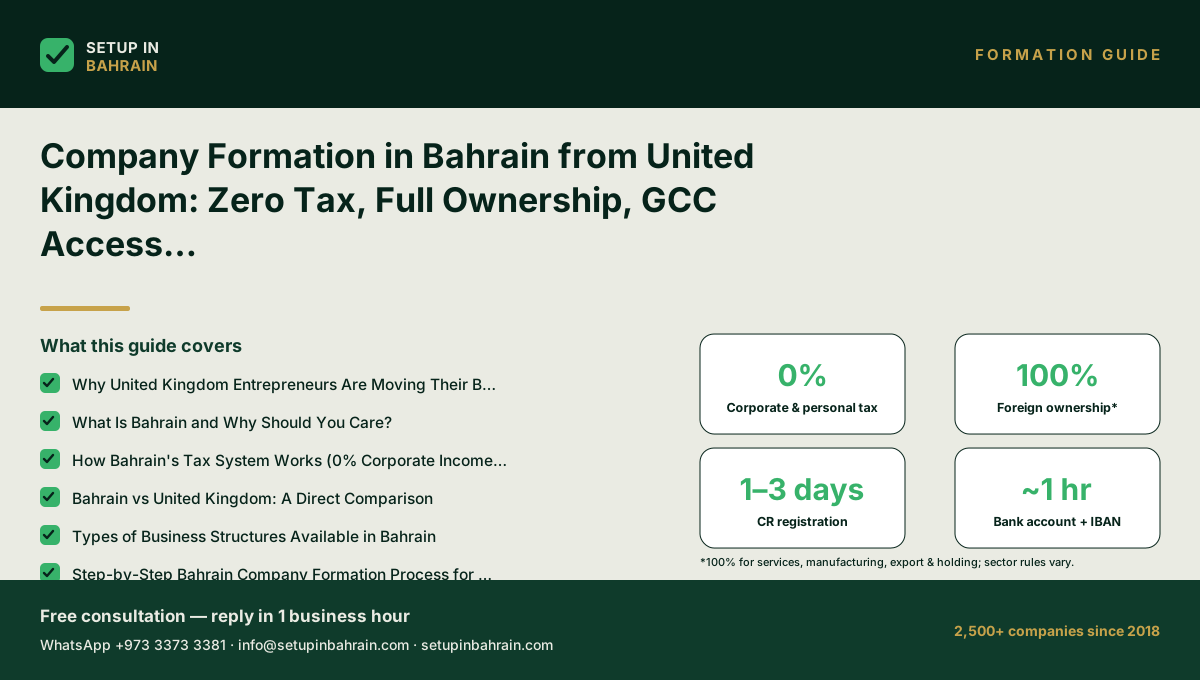
Set up your Bahrain company from the United Kingdom with generally no corporate income tax for most sectors. Fast registration, full foreign ownership & access to Gulf markets for UK entrepreneurs.
Key Takeaways
- Why United Kingdom Entrepreneurs Are Moving Their Business to Bahrain
- What Is Bahrain and Why Should You Care?
- How Bahrain's Tax System Works (0% Corporate Income Tax Explained)
- Bahrain vs United Kingdom: A Direct Comparison
- Types of Business Structures Available in Bahrain
→ Complete guide: Company Formation in Bahrain — the full 2026 guide
View details
Ownership & capital
A Bahrain WLL can be owned by a single person — 100% foreign ownership applies to most activities, with no local partner required for services, manufacturing, export trading and holding companies. The minimum share capital is BHD 1 ; we recommend BHD 1,000 . This Makes bank account opening and investor visa approval smoother.
Last month, I sat across from David, a cybersecurity consultancy owner from Birmingham who had just finished reviewing his 2024-25 tax position with his accountant. His company turned £380,000 in profit—genuinely impressive for a seven-person team. The corporation tax bill? £95,000. Two years earlier, that same profit would have cost him £72,200 in tax. David looked exhausted, not from running his business. From the relentless arithmetic of keeping less while working more.
"I'm not looking for a loophole," he told me. "I just want a jurisdiction where building a profitable company isn't treated like a crime."
David isn't alone. Since April 2023, when UK corporation tax jumped from 19% to 25%, I've spoken with hundreds of British entrepreneurs asking the same question: where can I operate legitimately, pay reasonable taxes, access growing markets, and actually keep more of what I've built?
The answer, more and more, is a six-hour flight east.
Bahrain has emerged as the most compelling destination for United Kingdom business owners seeking genuine tax efficiency, unrestricted foreign ownership. Direct access to the £2.4 trillion GCC economy. This isn't about brass-plate companies in obscure jurisdictions. Bahrain offers a transparent, OECD-compliant environment where Generally no corporate income tax for most sectors isn't an aggressive planning strategy—it's simply the law.
This guide covers everything UK founders need to know about establishing a company in Bahrain in 2026: precise costs in pounds and dinars, the step-by-step formation process, banking realities, UK tax obligations you absolutely cannot ignore, and the practical considerations that determine whether Bahrain makes sense for your specific situation.
Why United Kingdom Entrepreneurs Are Moving Their Business to Bahrain
The April 2023 corporation tax increase wasn't merely a rate adjustment. It fundamentally altered the arithmetic of running a profitable UK business.
Consider what actually changed. A company earning £250,000 in profits paid £47,500 in corporation tax at 19%. That identical profit now attracts £62,500 at the full 25% rate—a £15,000 annual increase that compounds year after year. For a business growing from £250,000 to £500,000 in profits, the additional tax burden becomes even more severe, with the marginal rate effectively reaching 26.5% in the taper band between £50,000 and £250,000.
But corporation tax represents only one pressure point in an more and more hostile environment for UK entrepreneurs.
The IR35 Classification Nightmare
IR35 off-payroll rules have created a minefield for any UK company engaging contractors. Since the April 2021 extension to the private sector, the responsibility for determining employment status shifted to the engaging company. Get it wrong. You face retrospective National Insurance contributions, penalties, and interest that can easily exceed the original contract value.
I recently spoke with a Leeds-based software agency that faced a £68,000 retrospective liability after HMRC reclassified two long-term contractors as employees. The contractors themselves had been working through their own limited companies, paying their own taxes, operating for multiple clients. None of that mattered. The agency bore the full cost of the reclassification—plus their legal fees defending the position.
This isn't an edge case. HMRC opened 1,800 new IR35 compliance enquiries in 2024-25, according to their published statistics. The mere existence of this risk creates a chilling effect on how UK companies engage talent, especially in technology, consulting. Creative sectors where project-based work is the norm.
Post-Brexit EU Market Access Barriers
If you were selling services into the European Union before January 2021, you remember what frictionless access felt like. Now, every engagement with an EU client requires consideration of work permits, professional recognition, data protection adequacy. VAT registration thresholds in 27 individual member states.
A Manchester-based marketing agency told me they lost three major EU contracts in 2024—not because their work wasn't good enough, but because the compliance burden of engaging a UK supplier had become prohibitive for their German and Dutch clients. The contracts went to Dublin-based competitors who could still operate seamlessly across the single market.
This isn't about politics. It's about the commercial reality that UK-based service exporters now face structural disadvantages when selling into the world's largest single market.
Making Tax Digital: Death by a Thousand Submissions
Making Tax Digital for VAT became mandatory for all VAT-registered businesses from April 2022. MTD for Income Tax Self Assessment begins rolling out in 2026 for businesses with income over £50,000. The requirement to maintain digital records and submit quarterly updates adds genuine administrative burden—and cost.
The average UK SME now spends £4,800 annually on accounting software and compliance support specifically related to digital tax requirements, according to the Federation of Small Businesses. That's before your accountant's fees for year-end accounts, corporation tax returns. The strategic advice you actually need.
The Complete Cost Picture
When you aggregate these factors, the true cost of operating a profitable UK business becomes staggering:
- Corporation tax at 25% on profits over £250,000
- Employer's National Insurance at 13.8% on all earnings above £9,100
- Dividend tax at 39.35% (additional rate) when extracting profits
- Business rates averaging £23,000 annually for modest commercial premises
- Compliance costs of £8,000-£15,000 annually for a typical SME
- Professional services inflation running at 7-9% year-on-year
A UK company earning £400,000 in profit, after paying corporation tax of £100,000, still faces extraction challenges. The founder wanting to access those funds personally faces additional dividend taxation, meaning the effective rate from profit to pocket can exceed 50%.
Compare this to Bahrain: 0% corporate income tax, 0% personal income tax, 0% dividend tax, 0% capital gains tax. The contrast isn't subtle.
What Is Bahrain and Why Should You Care?
Bahrain occupies a strategic position that most UK entrepreneurs massively underestimate. This archipelago of 33 islands sits in the heart of the Arabian Gulf, connected to Saudi Arabia by the 25-kilometre King Fahd Causeway. Its population of 1.5 million includes over 600,000 expatriates, creating a genuinely international business environment where English is the de facto commercial language.
But geography alone doesn't explain why Bahrain has become the preferred destination for UK entrepreneurs. Let me give you the context that matters.
A Financial Services Pedigree
Bahrain established its offshore banking sector in 1975—before the UAE even existed as an independent nation. The Central Bank of Bahrain (CBB) has spent five decades developing regulatory frameworks that balance accessibility with credibility. Today, Bahrain hosts over 400 licensed financial institutions, including regional headquarters for HSBC, Standard Chartered, Citibank. BNP Paribas.
This matters because Bahrain's regulatory environment has been stress-tested through multiple regional crises. The CBB's approach to licensing and supervision is rigorous enough to maintain correspondent banking relationships with major international banks—something that cannot be said for every Gulf jurisdiction.
The GCC Gateway Effect
Bahrain's membership in the Gulf Cooperation Council provides immediate access to a combined market of 55 million consumers with aggregate GDP exceeding $2 trillion. But the practical value lies in trade agreements and regulatory harmonisation that make Bahrain an ideal base for serving clients across Saudi Arabia, UAE, Kuwait, Qatar, and Oman.
The King Fahd Causeway handles over 40,000 vehicle crossings daily, putting Bahrain within 30 minutes of Saudi Arabia's Eastern Province—home to Saudi Aramco and the kingdom's petrochemical industry. UK entrepreneurs serving energy sector clients can maintain a Bahrain base while accessing Saudi contracts through day trips rather than complex visa arrangements.
The Bahrain Economic Development Board
The EDB functions as Bahrain's investment promotion agency, but its practical role extends far beyond marketing. The EDB operates Bahrain Investor Centre facilities that consolidate company formation, licensing, visa processing. Banking introductions into a single location. Their UK-specific team understands the exact pain points British entrepreneurs face and can provide realistic assessments of whether Bahrain suits your particular situation.
This isn't a faceless bureaucracy. EDB representatives attend UK business events, maintain relationships with British accounting firms and law practices. Can connect you with established UK entrepreneurs already operating in Bahrain.
How Bahrain's Tax System Works (0% Corporate Income Tax Explained)
Let me be absolutely clear about what zero percent corporate tax actually means in practice. This is because The simplicity of this statement often creates confusion for UK entrepreneurs accustomed to complexity.
What You Pay
Corporate Income Tax: 0% Bahrain does not impose corporate income tax on business profits. This isn't a temporary incentive, a special economic zone benefit, or a reduced rate for qualifying activities. It's the standard tax treatment for all commercial companies operating in Bahrain, enshrined in law since the kingdom's modern incorporation.
The only exception applies to oil and gas companies operating under production-sharing agreements. This Pay a 46% tax rate. Unless you're extracting hydrocarbons from Bahrain's seabed, this exception doesn't affect you.
Personal Income Tax: 0% Bahrain imposes no tax on individual income, regardless of source. Salaries, dividends, capital gains, rental income, interest—all untaxed. This applies equally to Bahrain nationals and expatriate residents.
Capital Gains Tax: 0% Gains from selling shares, property, or business assets attract no tax in Bahrain.
Withholding Tax: 0% Bahrain doesn't impose withholding tax on dividends, interest, or royalties paid to non-residents. This eliminates the double-taxation complications that arise when operating through jurisdictions with withholding obligations.
What You Actually Pay
While Bahrain has no income taxes, operating a business isn't entirely cost-free:
Value Added Tax: 10% Bahrain introduced VAT in January 2019 at 5%, increasing to 10% in January 2022. This applies to most goods and services, though certain categories (basic food items, healthcare, education) are zero-rated or exempt. The registration threshold is BHD 37,500 (about £79,000) in annual taxable supplies.
Social Insurance Contributions If you employ Bahraini nationals, contributions are required:
- Employer: 12% of gross salary
- Employee: 8% of gross salary (deducted from wages)
For expatriate employees:
- Employer: 3% of gross salary
- Employee: 1% of gross salary
Municipal Fees Commercial properties attract municipal charges of about 10% of annual rental value, typically passed through from landlords.
Labour Market Fees Work permits for expatriate employees cost BHD 300-500 (£630-£1,050) per employee annually, depending on the permit type and company category.
Why This Matters for UK Companies
The contrast with UK taxation becomes stark when you model actual numbers:
| Scenario | UK Tax Liability | Bahrain Tax Liability |
| £300,000 company profit | £75,000 corporation tax | £0 |
| £100,000 dividend extraction | £39,350 dividend tax (additional rate) | £0 |
| £50,000 capital gain on share sale | £10,000 CGT (20% rate) | £0 |
| £200,000 annual payroll (5 staff) | £27,600 employer's NI | £6,000 social insurance |
Bahrain vs United Kingdom: A Direct Comparison
Let me lay out the practical differences that matter for day-to-day business operations:
| Factor | United Kingdom | Bahrain |
| Corporate tax rate | 25% (profits over £250,000) | 0% |
| Personal income tax | Up to 45% | 0% |
| Dividend tax | Up to 39.35% | 0% |
| Capital gains tax | 10-20% | 0% |
| VAT rate | 20% | 10% |
| Foreign ownership | 100% permitted | 100% permitted |
| Company formation time | 24-48 hours | 3-7 business days |
| Formation cost | £12-50 (Companies House) | £530-£1,580 (WLL) |
| Minimum share capital | £1 (no real requirement) | BHD 50-250,000 varies |
| Annual filing requirements | Confirmation statement, accounts, CT600 | Simplified annual returns |
| Banking access | Straightforward for residents | Requires setup of substance |
| Language of commerce | English | English and Arabic (documents bilingual) |
| Time zone difference | GMT | GMT+3 |
| Flight time from London | N/A | 6.5 hours direct |
Where Bahrain Genuinely Excels
Regulatory Efficiency: The Ministry of Industry and Commerce (MOIC) has digitised most company formation processes through the Sijilat portal. What takes UK companies weeks to arrange—memorandum and articles, registered office, share certificates—can be completed in Bahrain within days.
Banking Relationships: While opening a Bahrain corporate account requires more documents than UK equivalents, the accounts themselves offer genuine utility. BHD accounts are pegged to USD (1 BHD = 2.65 USD), providing currency stability. Multi-currency accounts supporting GBP, EUR, and USD are standard with major banks.
Employment Flexibility : Bahrain's labour laws are greatly more employer-friendly than UK equivalents. Probation periods can extend to three months, notice requirements are measured in weeks rather than months. There's no equivalent to UK unfair dismissal protection for employees with less than two years' service.
Where the UK Still Holds Advantages
Professional Services Depth: Despite Bahrain's financial services cluster, the depth of professional expertise—especially in niche areas like intellectual property litigation, complex tax structuring, and sector-specific regulation—remains stronger in London.
Funding Ecosystem: UK venture capital and private equity investment dwarfs Bahrain's nascent startup scene. If your growth strategy requires significant external investment, UK incorporation may provide better access to capital.
Consumer Market Size: The UK's 67 million population creates a domestic market that Bahrain simply cannot match. If your business is fundamentally consumer-facing within the UK, relocating to Bahrain makes limited sense.
Types of Business Structures Available in Bahrain
Bahrain offers several corporate forms, each suited to different business models and operational requirements. Understanding these options before engaging formation agents saves time and ensures you establish the right structure from the outset.
With Limited Liability Company (WLL)
The WLL is Bahrain's most common structure for SMEs and the typical choice for UK entrepreneurs establishing operational presence. Key characteristics:
- Ownership: 100% foreign ownership permitted for most activities
- Shareholders: Minimum 2, maximum 50 shareholders
- Minimum Capital: BHD 50 (about £105) for service companies; higher for certain regulated activities
- Directors: Minimum one director; no residency requirement, but practical considerations favour local presence
- Liability: Limited to share capital contribution
The WLL structure provides genuine limited liability protection while allowing flexible profit distribution and straightforward governance. For consulting firms, digital agencies, trading companies. Professional services—the businesses most UK entrepreneurs operate—the WLL represents the optimal choice.
single-shareholder WLL
Introduced to accommodate sole entrepreneurs, the WLL allows single-shareholder ownership:
- Ownership: 100% foreign ownership permitted
- Shareholders: Exactly one (individual or corporate)
- Minimum Capital: BHD 50 for standard commercial activities
- Directors: The shareholder typically serves as director
The WLL suits individual consultants or holding company structures where single ownership is preferred. But, certain licensed activities require WLL rather tha single-shareholder WLL structures.
Bahrain Shareholding Company (BSC)
The BSC exists in two forms—closed (BSC(c)) and public—and is designed for larger enterprises:
- Minimum Capital: BHD 250,000 (about £525,000) for closed; BHD 1,000,000 for public
- Shareholders: Minimum 2 for closed; minimum 7 for public
- Board Requirements: Minimum 3 directors
- Audit Requirements: Mandatory annual audit by CBB-licensed auditor
UK entrepreneurs rarely use BSC structures initially due to capital requirements. They become relevant for businesses seeking Bahrain Stock Exchange listing or those requiring substantial capitalisation for regulatory purposes.
Partnership Structures
Bahrain recognises general partnerships (where all partners bear unlimited liability) and limited partnerships (combining general and limited partners). These structures are uncommon for UK entrepreneurs due to liability exposure and the superior flexibility of WLL arrangements.
Branch Office
Foreign companies can establish branch offices in Bahrain without creating a separate legal entity:
- Parent Company: Must be an established foreign corporation
- Liability: Parent company bears full liability for branch activities
- Capital: No minimum capital requirement
- Activities: Limited to activities conducted by parent company
- Taxation: Treated identically to local companies (generally no corporate income tax for most sectors)
Branches suit UK companies wanting Bahrain presence without establishing a subsidiary. But, branches cannot engage in activities outside the parent company's scope and may face limitations for certain licensed activities.
Holding Company
Bahrain's holding company regime allows setup of vehicles specifically for holding shares in subsidiaries:
- Minimum Capital: BHD 1 (we recommend BHD 1,000)
- Activities: Limited to holding investments and providing management services to subsidiaries
- Benefits: Clean structure for regional operations with multiple subsidiaries
Holding companies become relevant for UK entrepreneurs expanding regional presence through acquisitions or establishing multiple operating entities across GCC markets.
Step-by-Step Bahrain Company Formation Process for United Kingdom Entrepreneurs
Let me walk you through exactly what forming a Bahrain company involves, based on hundreds of formations I've guided UK entrepreneurs through.
Phase 1: Pre-Formation Planning (1-2 Weeks)
Define Your Business Activities
Bahrain's commercial registration system uses specific activity codes. Your company can only conduct activities listed on its Commercial Registration (CR). Adding activities later requires amendment applications and potentially additional licenses.
Common activities for UK entrepreneurs:
- Management consultancy services
- Information technology consultancy
- Digital marketing services
- Software development
- Professional training services
- Trading in specific products
- Import and export of specific categories
Determine Structure and Capital
For most UK service businesses, a WLL with minimum capital of BHD 50-20,000 suffices. But, certain activities require higher capitalisation:
- Financial services: Varies by license type (BHD 25,000 to several million)
- Construction: BHD 50,000-200,000 depending on grade
- Trading with warehouse facilities: BHD 20,000
Select Company Name
Bahrain name approval requires:
- Name must be unique within the commercial registry
- Arabic translation required (MOIC provides translation services)
- Name cannot imply government affiliation
- Certain words (bank, insurance, investment) require regulatory approval
Reserve your preferred name through Sijilat before proceeding.
Phase 2: Documents Preparation (1-2 Weeks)
Required Documents from UK
Prepare the following before starting formal registration:
- Passport copies: All shareholders and directors; must be valid for minimum 6 months
- Proof of address: UK utility bills or bank statements dated within 3 months
- Company documents (if shareholder is UK company): Certificate of incorporation, memorandum and articles, board resolution authorising Bahrain investment, certificate of good standing
- Bank reference letters: Some formation agents request these; not mandatory for MOIC
- CV/professional history: For directors of regulated businesses
Document Legalisation
UK documents require legalisation for Bahrain use:
- Notarisation by UK solicitor
- Apostille from the Foreign, Commonwealth & Development Office
- Authentication by Bahrain Embassy in London (£35-50 per document)
Allow 2-3 weeks for complete legalisation chain. Some documents can be legalised in Bahrain, which may be faster.
Phase 3: Company Registration (3-7 Business Days)
Submit Through Sijilat
The MOIC's Sijilat portal handles company registration electronically. Your formation agent submits:
- Application form with company details
- Memorandum of Association (standard template available)
- Articles of Association
- Shareholder identification documents
- Registered office address documents
- Activity selection and supporting documents
Fees
Government registration fees for a standard WLL:
- Commercial Registration: BHD 10 (about £21)
- Activity licensing: BHD 200-500 depending on activities
- Municipality registration: BHD 100-200
- Chamber of Commerce: BHD 50-100
Total government fees: BHD 360-810 (about £750-£1,700)
Formation agent fees vary from BHD 300-1,500 depending on service level.
Approval and Issuance
MOIC reviews applications within 3-5 business days for standard activities. You receive:
- Commercial Registration certificate (CR)
- Tax registration certificate
- Chamber of Commerce membership certificate
Regulated activities (financial services, healthcare, education) require additional approvals from sector regulators, extending timelines to 4-12 weeks.
Phase 4: Post-Formation Requirements (2-4 Weeks)
Corporate Bank Account
Banking represents the most complex post-formation step. Bahrain banks require:
- Commercial Registration: Original or certified copy
- Memorandum and Articles: Certified copies
- Board resolution: Authorising account opening and signatories
- Shareholder documents: Passport copies, proof of address, source of wealth declarations
- Business plan: Banks more and more request projected turnover and client information
- Physical meeting: Most banks require in-person meetings with signatories
Account opening timeline: 2-6 weeks depending on bank and documents completeness.
Recommended Banks
- National Bank of Bahrain: Strong correspondent banking relationships; good for international transfers
- Ahli United Bank: Established UK presence (acquired by Kuwait Finance House); familiar processes
- Bank of Bahrain and Kuwait: Competitive SME services; faster account opening
- Standard Chartered: International bank presence; may be smoother for UK entrepreneurs with existing SCB relationship
Registered Office
Your company requires a physical address in Bahrain. Options:
- Serviced office: BHD 150-400/month (about £315-£840) including reception services
- Co-working space: BHD 100-250/month for dedicated desk with mail handling
- Virtual office: BHD 50-100/month for address only (limited suitability for substantive operations)
- Commercial lease: BHD 300-800/month for small office in accessible locations
Bahrain Bay, Seef District, and Diplomatic Area represent premium business addresses. The Bahrain Financial Harbour hosts many professional services firms and fintech companies.
Bahrain's Special Economic Zones and Incentive Programs
Beyond the baseline zero-tax environment, Bahrain offers specific incentives that may benefit UK entrepreneurs depending on their business model.
Bahrain FinTech Bay
Located in Arcapita Building, FinTech Bay serves as Bahrain's fintech ecosystem hub. Benefits include:
- Regulatory Sandbox: CBB operates a sandbox allowing fintech companies to test products with real customers under relaxed regulatory conditions
- Fast-track licensing: Qualifying fintechs can access expedited CBB licensing processes
- Cluster benefits: Co-location with other fintech companies, banks, and regulators
UK fintech entrepreneurs exploring GCC market entry should investigate FinTech Bay as their operational base. The CBB's progressive approach to digital banking, cryptocurrency regulation. Open banking creates opportunities unavailable in more conservative jurisdictions.
Bahrain International Investment Park (BIIP)
BIIP offers industrial and logistics facilities with:
- Subsidised land rates (BHD 0.5-2 per square metre annually)
- Pre-built warehouse and light industrial units
- Customs bonded zone status for import/export operations
UK product companies requiring manufacturing or distribution facilities may benefit from BIIP infrastructure.
Tamkeen Support
Tamkeen, Bahrain's labour fund, provides wage subsidies and training support for companies employing Bahraini nationals:
- Wage subsidies covering 50-70% of Bahraini employee salaries for up to 3 years
- Training grants for employee development programmes
- Enterprise support grants for qualifying SMEs
While Bahrain doesn't mandate local employment ratios as stringently as Saudi Arabia, accessing Tamkeen support creates genuine cost advantages for companies building local teams.
Investment Treaty Benefits
Bahrain maintains bilateral investment protection agreements (BIPA) with the United Kingdom, providing:
- Protection against expropriation without compensation
- Fair and equitable treatment guarantees
- Free transfer of capital and returns
- Access to international arbitration for investment disputes
The UK-Bahrain BIPA, signed in 1991, provides genuine legal protection for UK investors that wouldn't exist in jurisdictions without treaty coverage.
Banking and Financial Services in Bahrain for United Kingdom Companies
Let me be direct about banking. This is because It's the area where UK entrepreneurs most often encounter unexpected challenges.
The Reality of International Banking in 2026
Opening corporate bank accounts internationally has become more difficult everywhere, not just in Bahrain. Enhanced due diligence requirements, de-risking by correspondent banks. Anti-money laundering obligations mean that banks scrutinise new account applications intensively.
For a UK entrepreneur establishing a Bahrain company, expect banks to ask:
- Why are you establishing a company in Bahrain rather than operating from the UK?
- What is your projected annual turnover?
- Who are your intended clients and suppliers?
- What is the source of your initial capital?
- Where do you expect funds to flow from and to?
These questions aren't hostile—they're standard. Having coherent answers supported by documents (business plan, client contracts, personal financial statements) greatly accelerates approval.
Practical Banking Approach
Start with an Existing Relationship
If you already bank with HSBC, Standard Chartered, or Citibank in the UK, approach their Bahrain branches first. Existing relationships provide warm introductions and shared KYC information that simplifies onboarding.
Prepare Comprehensive Documents
Before your first bank meeting, assemble:
- Company documents (CR, articles, board resolutions)
- Personal identification for all signatories
- Proof of UK address for all shareholders
- Business plan with financial projections
- Source of funds documents (UK bank statements, accounts)
- Intended client list or contracts
Budget Time for the Process
Account opening in Bahrain takes 2-6 weeks from initial application to active account. Plan your operations accordingly. Some entrepreneurs maintain UK accounts initially and fund Bahrain operations while local banking arrangements complete.
Multi-Currency and International Transfers
Bahrain's developed financial infrastructure supports sophisticated treasury operations:
- Multi-currency accounts: Most banks offer accounts in BHD, USD, GBP, and EUR within the same relationship
- SWIFT transfers: International wire transfers process within 1-3 business days
- Correspondent banking: Bahrain banks maintain relationships with major UK, US, and European banks, ensuring transfers don't encounter the friction common in less developed jurisdictions
- Payment processing: Bahrain hosts regional offices of major payment processors (Visa, Mastercard, American Express), supporting merchant account setup
Financial Services Licensing
UK entrepreneurs planning regulated financial services activities—payment services, investment management, insurance brokerage, cryptocurrency exchange—require CBB licensing beyond standard commercial registration.
The CBB operates category-based licensing:
- Category 1: Full banking license (not practical for new market entrants)
- Category 2: Investment firms, specialist financing
- Category 3: Representative offices
- Category 4: Ancillary service providers
Licensing requirements, capital adequacy, and ongoing compliance obligations vary by category. Budget 4-12 months and BHD 50,000-500,000 for regulated financial services setup.
Residence Permits and Visa Options for British Nationals
Establishing a company is only half the equation. If you intend to spend significant time in Bahrain managing your business, you need proper residence status.
Golden Residency Program
Bahrain's Golden Residency, launched in 2022, targets high-value individuals including:
- Business owners investing BHD 50,000+ in Bahrain
- Real estate purchasers acquiring property worth BHD 200,000+
- Professionals earning BHD 2,000+ monthly
- Retirees with pension income of BHD 4,000+ monthly
Golden Residency provides:
- 10-year renewable residence permit
- Ability to sponsor immediate family members
- No employer sponsorship requirement
- Right to work in self-employment
For UK entrepreneurs establishing substantive Bahrain operations, Golden Residency provides the most flexible residence option.
Self-Sponsorship Visa
Company owners can get self-sponsorship through their Bahrain entity:
- Must be shareholder or director of active company
- Commercial Registration must show substantive activities
- 2-year renewable residence permit
- Can sponsor employees and dependents
Processing time: 2-4 weeks with complete documents.
Investor Visa
The investor visa category covers individuals making qualifying investments:
- Minimum investment thresholds vary by activity type
- Provides 1-year renewable residence
- Can be upgraded to Golden Residency upon meeting criteria
UK-Bahrain Bilateral Visa Arrangements
British passport holders can enter Bahrain without prior visa application:
- 14-day visa on arrival (extendable)
- 90-day e-visa available online (BHD 29/about £61)
- Business visitor status permits meetings, contract negotiation, and site visits
For initial exploratory trips and early formation stages, British nationals can operate on visitor status while residence arrangements are finalised.
Tax Implications for United Kingdom Residents: What You Cannot Avoid
Here's where I need to be absolutely clear. This is because Misunderstanding this section has caused real problems for UK entrepreneurs.
Bahrain's zero-tax status does not automatically eliminate your UK tax obligations.
Your UK tax position depends on your personal tax residence and the place of effective management of your company. Simply forming a Bahrain company while continuing to live in London and make all decisions from your home office creates a UK tax resident company subject to 25% corporation tax—regardless of where it's incorporated.
UK Tax Residence for Companies
A company is UK tax resident if:
- It is incorporated in the UK, OR
- Its place of central management and control is in the UK
The second test catches UK entrepreneurs who form overseas companies but continue managing them from the UK. HMRC examines:
- Where are board meetings held?
- Where do directors live and work?
- Where are key decisions made?
- Where is the company's head office actually located?
If the answers are "UK, UK, UK. UK," your Bahrain company is likely UK tax resident, and you've achieved nothing except additional compliance costs.
Doing It Properly
For a Bahrain company to be genuinely non-UK tax resident:
Directors with Bahrain Presence At least some directors should be Bahrain resident. Board meetings should physically occur in Bahrain (documented with minutes, travel records, and evidence of substantive discussion).
Operational Substance The company should have genuine operations in Bahrain: employees, office space, local contracts, actual business activities. Brass-plate structures with no substance are exactly what HMRC targets.
Strategic Decisions in Bahrain Key business decisions—contracts, hiring, investments, pricing—should demonstrably be made in Bahrain, not rubber-stamped in Bahrain after being decided in London.
Your Personal Tax Position
If you remain UK tax resident while operating a Bahrain company, additional rules apply:
Controlled Foreign Company (CFC) Rules If you and connected persons control a Bahrain company, its profits may be attributed to you and taxed in the UK even if not distributed. CFC rules are complex, with exemptions for companies with genuine economic activity, but you need specialist advice.
Transfer Pricing Transactions between your UK personal activities and Bahrain company must be at arm's length prices. Charging below-market fees for services, or paying yourself above-market management fees, creates tax risks on both sides.
Personal Relocation The cleanest approach involves relocating your personal tax residence to Bahrain. UK tax residence tests (the Statutory Residence Test) are mechanical and can be planned around. Broadly:
- Spending fewer than 16 days in the UK (if previously resident)
- Spending fewer than 46 days (if other conditions met)
- Establishing overseas residence through full-time work abroad
Personal relocation isn't essential, but it simplifies everything. If you're genuinely building a life and business in Bahrain—renting property, establishing social connections, spending most of your time there—the tax benefits flow naturally from your changed circumstances.
Required Professional Advice
I cannot stress this enough: do not attempt to navigate UK-Bahrain tax structuring without specialist advice from advisors familiar with both jurisdictions. The cost of proper planning (£3,000-10,000) is trivial compared to the cost of getting it wrong (back taxes, penalties, interest, potential criminal exposure for serious cases).
Recommended approach:
- UK tax advisor with international experience assesses your personal situation
- Bahrain corporate services provider establishes company with appropriate structure
- Coordinated planning ensures substance requirements are met
- Annual review confirms ongoing compliance
Bahrain Business Guides for United Kingdom Citizens
Frequently Asked Questions
How long does it take to set up?
It takes 15 to 20 days. We file all forms for you. You do not need to wait long.
What does it cost?
Company formation: Standard BHD 1,340 with 3 months of office address; Gold BHD 1,700 with 6 months; Premium BHD 2,150 with 12 months and a cabin, officer table and chair, and two guest chairs. No formation package includes visas, including Premium. Investor/work visas are priced separately: BHD 755 for one year or BHD 953 for two years, in addition to the formation package. Ask for a written, itemized quotation confirming government fees and all inclusions before payment.
Do I need to visit Bahrain?
No. You can set up your firm from home. We do all the work online. Some banks may ask for one visit.
What tax will I pay?
You pay zero tax on your profits. Bahrain has no corporate income tax. This is a key benefit of the setup.
Can I own 100% of my firm?
Yes. Foreign owners can hold all shares. No local partner is needed. Full ownership is allowed.
What do I need to start?
You need a valid passport. You also need a trade name and a business address. We help you with all of these.
How do I open a bank account?
We guide you step by step. Most banks take 3 to 6 weeks. You will need your CR and firm papers.
Who issues the Commercial Registration (CR)?
The CR is issued by the MOICT. It is your legal right to trade in Bahrain. We file the CR for you.
Can I renew my CR each year?
Company renewal packages: BHD 530 with 3 months of office address; BHD 980 with 6 months; BHD 1,520 with 12 months. These are separate renewal packages, not visa fees.
How do I get started?
Fill in our form on this page. Our team will call you back. We map your best setup plan at no cost.
Steps to Form Your Company
- Pick your trade name. We check if it is free.
- Choose your business type. WLL is the most common.
- Sign the MOA. We draft and file all legal docs.
- Pay the state fees. About BHD 432 in total.
- Get your CR. Takes 15 to 20 days.
- Open your bank account. We guide each step.
- Start trading. You are ready to do business.
Key Facts
- Tax rate: 0%
- Foreign ownership: 100%
- Setup time: 15 to 20 days
- Company formation: Standard BHD 1,340 with 3 months of office address; Gold BHD 1,700 with 6 months; Premium BHD 2,150 with 12 months and a cabin, officer table and chair, and two guest chairs. No formation package includes visas, including Premium. Investor/work visas are priced separately: BHD 755 for one year or BHD 953 for two years, in addition to the formation package. Ask for a written, itemized quotation confirming government fees and all inclusions before payment.
- Company renewal packages: BHD 530 with 3 months of office address; BHD 980 with 6 months; BHD 1,520 with 12 months. These are separate renewal packages, not visa fees.
- Client rating: 4.8 stars
- Clients served: 2,500 and more
Quick Facts
- Tax rate: 0%
- Own all of your firm: Yes, 100%
- Time to set up: 15 to 20 days
- Company formation: Standard BHD 1,340 with 3 months of office address; Gold BHD 1,700 with 6 months; Premium BHD 2,150 with 12 months and a cabin, officer table and chair, and two guest chairs. No formation package includes visas, including Premium. Investor/work visas are priced separately: BHD 755 for one year or BHD 953 for two years, in addition to the formation package. Ask for a written, itemized quotation confirming government fees and all inclusions before payment.
- Company renewal packages: BHD 530 with 3 months of office address; BHD 980 with 6 months; BHD 1,520 with 12 months. These are separate renewal packages, not visa fees.
- Rating: 4.8 stars
- Clients: 2,500 and more
Why Bahrain?
Bahrain has no tax. You keep all your profits. This is rare in the Gulf.
You can own all of your firm. No local partner is needed. The law allows full foreign ownership.
Setup takes 15 to 20 days. We file all forms for you. You can do it all from home.
Bahrain has a free trade deal with the US. Your goods face low or no tariffs. This gives you access to big markets.
We have served 2,800+ clients from 44+ countries and maintain records to substantiate that total where needed. We have 113 Google reviews; reviews represent only some clients and are not the same as the total clients served.
Our Steps
- Tell us your plan. We advise you for free.
- We pick the right firm type for you.
- We file all your forms with MOICT.
- You get your CR in 15 to 20 days.
- We help you open a bank account.
- You are ready to trade. We stay with you.
Next Steps for United Kingdom Citizens
You can set up a firm in Bahrain from United Kingdom. You do not need to fly there first. We do all the work online.
Tell us your plan. We call you back the same day. We map the best route for you at no cost.
We file all your forms. We deal with MOICT and the state. You get your CR in 15 to 20 days.
After your CR, we help you get a bank account. We also help with your Investor Visa. One firm guides you at each step.
Why Our Clients from United Kingdom Choose Us
- We speak your language. We know your needs.
- We have helped clients from United Kingdom before.
- Our fee is clear. No surprise costs.
- We have a 4.8 star rating on Google.
- We have helped more than 2,500 clients set up in Bahrain.
Fill in the form on this page. We will be in touch soon. Let us help you start your Bahrain firm today.
Ready to set up in Bahrain from United Kingdom?
Tell us your business idea. We map the right entity, ownership and timeline — then handle the filing while you focus on what matters.