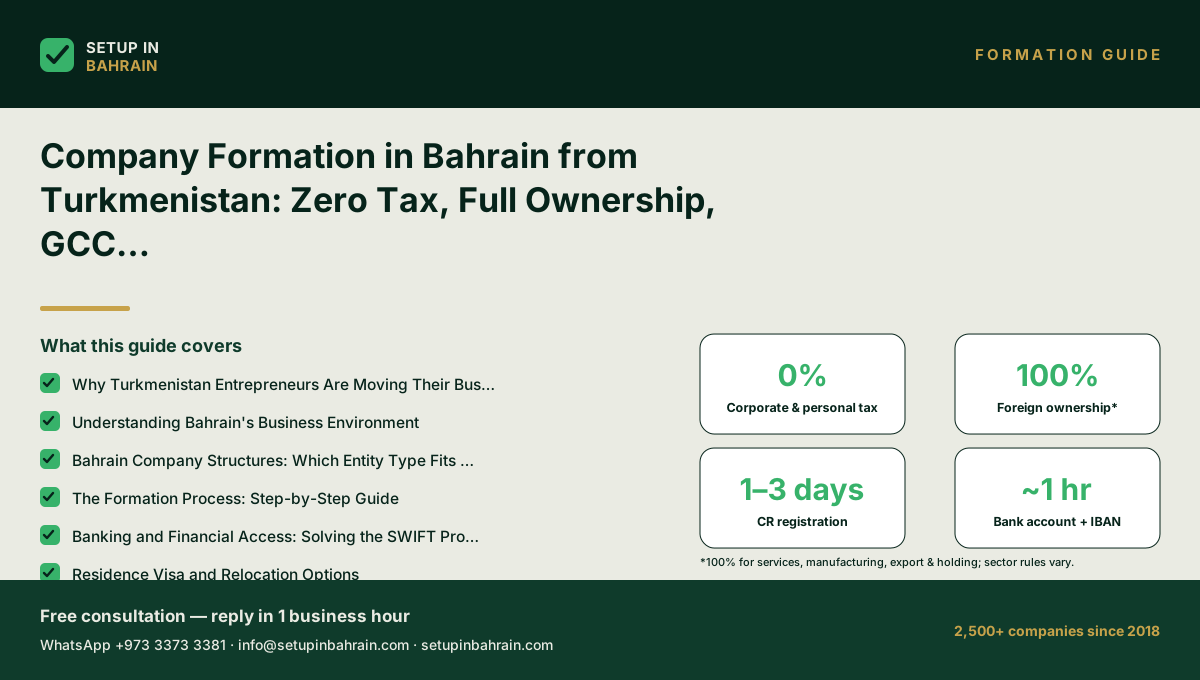
Start your business in Bahrain from Turkmenistan with generally no corporate income tax for most sectors. Enjoy strategic location, easy setup process, and full foreign ownership benefits.
Key Takeaways
- Why Turkmenistan Entrepreneurs Are Moving Their Business to Bahrain
- Understanding Bahrain's Business Environment
- Bahrain Company Structures: Which Entity Type Fits Your Business?
- The Formation Process: Step-by-Step Guide
- Banking and Financial Access: Solving the SWIFT Problem
→ Complete guide: Company Formation in Bahrain — the full 2026 guide
View details
Ownership & capital
A Bahrain WLL can be owned by a single person — 100% foreign ownership applies to most activities, with no local partner required for services, manufacturing, export trading and holding companies. The minimum share capital is BHD 1 ; we recommend BHD 1,000 . This Makes bank account opening and investor visa approval smoother.
Merdan runs a construction materials trading business from a cramped office in Ashgabat. His company has grown 40% year-on-year since 2021, supplying steel reinforcement and cement additives to Turkmenistan's state-driven housing projects. On paper, his 8% corporate tax rate looks enviable—the lowest headline rate in Central Asia. His suppliers in Dubai and Istanbul regularly comment on how competitive his tax position appears.
But Merdan hasn't slept well in months.
Last quarter, when a Dubai-based steel supplier requested payment in US dollars, Merdan spent eleven weeks navigating Turkmenistan's banking system. The official TMT/USD rate his transaction eventually cleared at bore no resemblance to the street rate his competitor in Mary was paying through informal channels. By the time funds actually transferred, the artificial currency gap had effectively added over 300% to his cost of goods. His profit margin on that shipment vanished entirely.
This isn't a story about tax rates. It's about being systematically trapped in an economic architecture designed for a different era—one where international commerce was the exception, not the foundation of competitive business.
For Turkmenistan entrepreneurs like Merdan—smart, ambitious professionals running legitimate businesses—the daily reality involves navigating state currency controls that disconnect official rates from economic reality, near-complete banking isolation from global SWIFT networks, internet restrictions that make international commerce feel like a diplomatic mission, and regulatory requirements that sometimes literally require presidential approval for routine foreign business activities.
Meanwhile, 3,200 kilometers southwest across the Arabian Peninsula, Bahrain operates as everything Turkmenistan's business environment isn't: Generally no corporate income tax for most sectors on most activities, unrestricted 100% foreign ownership, SWIFT-connected banking with same-day international transfers, a currency pegged to the USD at a rate that hasn't moved since 1980, and company registration that completes in days rather than months.
This guide exists for the Turkmenistan entrepreneur who has realized that working harder within a broken system produces diminishing returns—and that working smarter means restructuring where and how business gets done.
Why Turkmenistan Entrepreneurs Are Moving Their Business to Bahrain
The decision to establish a company in Bahrain typically crystallizes after a specific breaking point. For most Turkmenistan business owners, that moment involves one of three scenarios that expose the fundamental incompatibility between their ambitions and their operating environment.
The Banking Isolation Reality
Turkmenistan's banking system operates largely outside SWIFT for ordinary commercial transactions. This isn't speculation—it's operational reality that every business owner in Ashgabat, Mary, or Turkmenabat confronts when attempting routine international payments.
When Erdem, a textile manufacturer exporting to Turkey and Kazakhstan, attempted to pay a software licensing fee to a German vendor last year, his bank informed him that direct international transfers weren't available for his account category. The payment eventually routed through three intermediary banks over six weeks, accumulating fees that exceeded the original invoice amount by 23%.
The World Bank's 2024 Doing Business indicators place Turkmenistan among the most challenging environments globally for cross-border payments. While specific rankings have been discontinued, the operational reality remains: Turkmen banks cannot process routine SWIFT messages for most small and medium enterprises without extensive state approvals and documented proof of "social utility."
For comparison, a Bahrain-based company can initiate a USD transfer to any SWIFT-connected bank worldwide in under four hours. The Central Bank of Bahrain (CBB) regulates over 400 financial institutions, including 29 retail banks and 65 wholesale banks, creating a banking density that rivals Singapore and Hong Kong.
The Currency Trap
Turkmenistan's manat remains artificially fixed by state decree. The official rate published by the Central Bank of Turkmenistan bears more and more little relationship to the rate businesses actually experience when attempting to acquire foreign currency for legitimate commercial purposes.
A textile exporter from Ashgabat described his situation precisely: every major payment requires routing through state-controlled channels where the TMT sits fixed at an artificial rate. When he tried to pay a supplier in Dubai, the transaction stalled for eleven weeks. The client paid in USD. By the time funds reached his account, the effective rate had shifted against him by nearly 18%. He closed the Turkmen entity and opened a Bahrain WLL in 11 business days.
The Bahraini dinar, by contrast, has been pegged to the US dollar at a rate of 0.376 BHD to 1 USD since 1980—over four decades of currency stability. This peg is maintained by the Central Bank of Bahrain through transparent monetary policy and substantial foreign exchange reserves. When you invoice a client in dollars from your Bahrain company, you know exactly what those dollars are worth in local banking terms.
The Regulatory Maze
In Turkmenistan, certain business activities—especially those involving foreign entities, export transactions, or sectors that might compete with state monopolies—require approval chains that can extend to the presidential level. This isn't hyperbole. Registering a foreign business entity, engaging in telecommunications, or handling cotton or oil-related transactions often requires documents that passes through six or more government agencies.
The Economic Development Board (EDB) of Bahrain, by contrast, operates a single-window system where company registration, licensing. Commercial permits can be processed through one coordinated application. The EDB reports that standard company formations complete within 2-3 business days for most entity types, with some Sijilat (online registry) applications processing in under 24 hours.
Understanding Bahrain's Business Environment
Before examining the mechanics of company formation, understanding what makes Bahrain structurally different from Turkmenistan helps clarify why the jurisdiction works specifically for entrepreneurs escaping closed economic systems.
The Zero Tax Structure
Bahrain levies no corporate tax on most business activities. This isn't a temporary incentive or a free zone gimmick—it's the standard tax treatment for companies operating in the Kingdom. The only exception applies to oil and gas companies, which face a 46% rate. For every other sector—trading, consulting, technology, manufacturing, professional services—the corporate tax rate is genuinely zero.
Compare this to Turkmenistan's 8% corporate tax. This Appears competitive until you factor in the effective costs of currency conversion, banking isolation, and regulatory compliance. A Turkmenistan business owner who calculates their true effective rate—including the spread between official and market exchange rates, intermediary banking fees, and opportunity costs of delayed transactions—often discovers they're paying effective rates of 25-40% when measured against what their revenue could purchase in freely convertible currency.
Bahrain does levy a 10% Value Added Tax, introduced in 2019 in coordination with GCC neighbors. But, exports are zero-rated. Businesses with turnover below BHD 37,500 (about USD 100,000) are exempt from VAT registration entirely.
100% Foreign Ownership
Under Bahrain's Commercial Companies Law, as amended by Legislative Decree No. 28 of 2020, foreign nationals can own 100% of companies in most sectors without requiring a local partner. This represents a fundamental shift from the region's historical model, which typically required 51% local ownership.
For Turkmenistan entrepreneurs accustomed to navigating state partnership requirements and approval processes, this is transformative. You can structure your Bahrain company exactly as your business requires—wholly owned by you personally, held through a family trust, or structured for future investment—without negotiating ownership splits with parties whose interests may diverge from yours.
The Bahrain Investors Center (BIC), operated by the Ministry of Industry and Commerce (MOIC), specifically facilitates foreign company formation and has processed applications from entrepreneurs across Central Asia, including Turkmenistan, Kazakhstan, and Uzbekistan.
GCC Market Access
A Bahrain company positions you at the center of the Gulf Cooperation Council market—six nations with a combined GDP exceeding USD 2 trillion and a population of about 60 million. The GCC Customs Union allows goods to move between member states with reduced friction. Professional services firms can access clients across the region from a single Bahrain base.
For Turkmenistan entrepreneurs whose geographic market has historically been limited to Russia, Iran. Central Asian neighbors, this represents market access expansion of an order of magnitude. Dubai is a 45-minute flight from Bahrain. Riyadh is 90 minutes. The entire Arabian Peninsula becomes your operating territory.
Bahrain Company Structures: Which Entity Type Fits Your Business?
Selecting the appropriate legal structure determines your liability exposure, banking options, visa eligibility, and operational flexibility. Bahrain offers several entity types, each with distinct characteristics relevant to Turkmenistan entrepreneurs.
With Limited Liability Company (WLL)
The WLL structure suits most Turkmenistan entrepreneurs establishing their first Bahrain presence. Key characteristics include:
Ownership: 100% foreign ownership permitted in most sectors since the 2020 legislative reforms. a single shareholder (one person can own 100%) required, maximum 50.
Capital Requirements: No statutory minimum capital for most activities, though banks typically prefer to see at least BHD 20,000-50,000 (USD 53,000-133,000) for account opening purposes. Certain licensed activities (financial services, insurance, real estate) require higher capital.
Liability: Shareholders' liability limited to their capital contribution—your personal assets remain protected from company obligations.
Management: Managed by one or more managers who may be shareholders or external appointees. Foreign managers can get investor residence visas.
Banking Access: WLLs can open multi-currency accounts at any Bahrain retail bank, with full SWIFT access for international transfers.
A WLL registration typically completes within 10-15 business days through the Sijilat online system, including commercial registration, licensing. Chamber of commerce enrollment.
single-shareholder WLL
For solo entrepreneurs who want complete control without nominal secondary shareholders, the WLL structure offers an alternative:
Ownership: Single shareholder permitted—you can be the sole owner and sole manager at once.
Capital Requirements: No statutory minimum for most activities.
Liability: Limited liability applies; the single shareholder's personal assets are protected.
Limitations: Cannot engage in insurance or banking activities. Some professional service categories require the WLL structure.
The WLL structure works well for consultants, freelancers. Single-operator trading businesses where adding a second shareholder creates unnecessary complexity.
Branch Office
If your Turkmenistan company has legitimate reasons to maintain operations domestically while establishing Bahrain presence, a branch office allows your existing entity to operate directly in Bahrain:
Structure: Not a separate legal entity—operates as an extension of the parent company.
Liability: Parent company bears full liability for branch operations.
Taxation: Branch profits are subject to Bahrain's Generally no corporate income tax for most sectors rate, though the parent company's home jurisdiction (Turkmenistan) may tax worldwide income.
Requirements: Requires proof of parent company's good standing, financial statements, and board resolution authorizing branch setup.
For most Turkmenistan entrepreneurs, the WLL structure offers superior asset protection and cleaner separation from domestic regulatory complications. Branch offices make sense primarily for established enterprises with complex group structures.
Bahrain Free Zone Companies
Bahrain's free zones—including Bahrain International Investment Park (BIIP), Bahrain Logistics Zone (BLZ). The newer Investment Gateway Bahrain—offer enhanced incentives for specific activities:
Tax Benefits: Same Generally no corporate income tax for most sectors as mainland, plus exemptions from customs duties on imported equipment and materials.
Ownership: 100% foreign ownership guaranteed regardless of sector.
Lease Terms: Standardized land and facility leases with transparent pricing.
Target Sectors: Manufacturing, logistics, technology, and light industrial activities.
Free zone structures make sense for Turkmenistan entrepreneurs planning physical operations—warehousing, manufacturing, or distribution—where duty exemptions on imported equipment create meaningful cost savings.
The Formation Process: Step-by-Step Guide
Understanding exactly what the formation process involves helps Turkmenistan entrepreneurs plan timelines, prepare documents, and budget appropriately. This section walks through each stage from initial planning to operational launch.
Step 1: Activity Selection and Preliminary Approval
Before filing formation documents, you must identify the specific commercial activities your company will pursue. Bahrain's commercial registry uses a detailed activity classification system—you'll need to select activities that accurately describe your business operations.
Timeline: 1-3 days for preparation
Key Considerations: Some activities require additional licensing from sector regulators. Financial services require Central Bank of Bahrain approval. Healthcare requires Ministry of Health licensing. Educational services require Ministry of Education approval.
For most trading, consulting. General commercial activities, no pre-approval is required beyond the standard commercial registration process.
Step 2: Name Reservation
Company names must be unique within Bahrain's registry and comply with naming conventions (no names suggesting government affiliation, no offensive terms, Arabic transliteration required).
Timeline: 1-2 business days through Sijilat system
Cost: BHD 30 (about USD 80) for name reservation
Validity: Reserved names remain valid for 60 days
Step 3: Document Preparation and Authentication
This stage typically requires the most attention from Turkmenistan entrepreneurs, as documents must be properly authenticated for use in Bahrain.
Required Documents:
- Passport copies of all shareholders and managers (notarized)
- Proof of address for all shareholders (utility bill or bank statement, notarized)
- Memorandum and Articles of Association (drafted in Arabic and English)
- Board resolution or shareholder consent authorizing company formation
- Manager appointment letter (if manager differs from shareholders)
Authentication Chain : Documents originating from Turkmenistan must be notarized by a Turkmen notary, authenticated by the Ministry of Foreign Affairs of Turkmenistan. Then legalized by the Bahrain Embassy or a Bahrain-authorized consulate. Since Bahrain has no embassy in Ashgabat, entrepreneurs typically route documents through the Bahrain Embassy in Moscow or handle authentication during an initial visit to Bahrain.
Timeline: 1-3 weeks depending on authentication routing
Step 4: Sijilat Registration
Bahrain's Sijilat system allows online submission of company formation applications. The system integrates commercial registration, licensing, and chamber of commerce enrollment into a single application flow.
Timeline: 2-5 business days for standard applications
Costs:
- Commercial Registration: BHD 100-300 depending on entity type
- Municipal License: BHD 100-200 depending on activity
- Chamber of Commerce: BHD 50-100 annual membership
Total government fees for a standard WLL formation typically range from BHD 300-600 (USD 800-1,600).
Step 5: Post-Registration Compliance
Once the commercial registration certificate issues, several follow-up steps complete the formation process:
Labor Authority Registration: Required before hiring any employees, including the owner-manager. Enables issuance of work permits and residence visas.
Social Insurance Registration: Companies with employees must register with the Social Insurance Organization (SIO) and contribute 12% of employee salaries (employer contribution) plus 7% (employee contribution).
VAT Registration: Required for businesses expecting turnover exceeding BHD 37,500 annually. Voluntary registration available for smaller businesses wanting to reclaim input VAT.
Step 6: Bank Account Opening
For Turkmenistan entrepreneurs escaping banking isolation, this step often represents the primary objective of the entire formation process.
Timeline: 2-4 weeks for full account activation
Required Documents:
- Commercial registration certificate
- Memorandum and Articles of Association
- Passport copies of all signatories
- Proof of address (Bahrain address preferred)
- Business plan or activity description
- Expected transaction volumes and source of funds explanation
Bank Selection Considerations : Bahrain hosts international banks (HSBC, Standard Chartered, Citibank), regional banks (National Bank of Bahrain, Bank ABC, Gulf International Bank). Islamic banks (Al Baraka, Bahrain Islamic Bank). International banks typically offer superior correspondent banking networks for USD transfers. Regional banks often provide more flexible account opening terms for new businesses.
Due Diligence Reality: Banks will conduct enhanced due diligence on Turkmenistan-connected applicants given the country's position on international compliance indices. Be prepared to explain your business model, show legitimate source of funds, and provide additional documents if requested. This is normal procedure, not an obstacle—banks approve Turkmenistan-connected accounts regularly when documents is complete and transparent.
Banking and Financial Access: Solving the SWIFT Problem
For Turkmenistan entrepreneurs, banking access represents the single most compelling reason to establish a Bahrain company. This section examines exactly what becomes possible once you have an operational Bahrain corporate account.
International Payment Capabilities
A Bahrain corporate bank account connects directly to the global SWIFT network. You can:
- Receive payments from any SWIFT-connected bank worldwide in USD, EUR, GBP, and other major currencies
- Make payments to suppliers, contractors, and partners anywhere in the world with same-day processing for most destinations
- Hold multi-currency balances without forced conversion—keep USD as USD, EUR as EUR
- Access online banking with international IP connections (unlike Turkmenistan banks that may restrict foreign IP access)
The contrast with Turkmenistan's banking reality cannot be overstated. Transactions that take weeks through Turkmen banking intermediaries complete in hours from a Bahrain account. Transfer fees that accumulate through multiple correspondent banks compress to single-digit percentages of the previous cost.
Currency Stability and Convertibility
The Bahraini dinar's peg to the USD at 0.376 BHD = 1 USD has held since 1980. The Central Bank of Bahrain maintains this peg through a combination of foreign exchange reserves (about USD 5 billion) and disciplined monetary policy.
For practical purposes, your Bahrain company operates in a dollar-equivalent currency environment. You can:
- Invoice clients in USD and receive payment into BHD accounts at a known, stable rate
- Hold USD directly in multi-currency accounts at most Bahrain banks
- Transfer between BHD and USD with spreads typically under 0.5%
Compare this to Turkmenistan's TMT, where the official rate diverges from the market rate by margins that have historically reached 200-400%. The "low tax rate" advantage of operating in Turkmenistan evaporates when measured against real-world currency conversion costs.
Opening Account Remotely vs. In-Person
Most Bahrain banks prefer in-person account opening meetings, especially for new company relationships. But, several approaches can work for Turkmenistan entrepreneurs:
Option 1: Formation Trip Plan a 5-7 day visit to Bahrain to complete company formation, bank account opening. Initial meetings in person. Visa on arrival is available for Turkmenistan passport holders for stays up to 14 days, costing about BHD 25 (USD 66). This approach typically produces the fastest account opening timeline.
Option 2: Remote Formation, In-Person Banking Complete company formation remotely through a registered agent, then visit Bahrain specifically for bank account opening once the commercial registration is issued. This separates the administrative process from the banking process.
Option 3: Fully Remote (Limited Options) Some banks, especially digital-first institutions and certain regional banks, offer remote account opening for Bahrain-registered companies. This typically requires video verification calls and extended due diligence timelines (4-6 weeks vs. 2-3 weeks for in-person applications).
Correspondent Banking Relationships
When selecting a Bahrain bank, consider their correspondent banking relationships in jurisdictions where you'll frequently transact. For Turkmenistan entrepreneurs:
- Turkey: Major trade partner—ensure your bank has strong correspondent relationships with Turkish banks
- UAE/Dubai: Regional hub—most Bahrain banks maintain direct relationships with UAE banks
- China: Growing trade relationship—some Bahrain banks offer RMB accounts and direct China correspondent access
- Europe: For EU suppliers—banks with strong European correspondent networks (HSBC, Standard Chartered) offer advantages
Residence Visa and Relocation Options
Establishing a Bahrain company creates pathways to residence permits, enabling physical relocation if the business environment in Turkmenistan becomes untenable.
Investor Visa
Company owners and shareholders can get investor residence visas through their Bahrain company:
Eligibility: Shareholders holding at least 20% of a Bahrain company with minimum capital of BHD 1 (we recommend BHD 1,000) (about USD 133,000)
Duration: Initially issued for 1 year, renewable for 2-year periods
Benefits: Legal residence in Bahrain, ability to sponsor family members, freedom to exit and re-enter Bahrain without visa applications
Sponsorship: Your company sponsors your visa—you're not dependent on an employer or government entity
Self-Employment Visa (Flexi Permit)
For entrepreneurs who want residence flexibility without the capital requirements of an investor visa:
Eligibility: Self-employed professionals and freelancers with a Bahrain company
Duration: 1-2 year permits available
Cost: Approximately BHD 500-800 annually (USD 1,300-2,100)
Limitations: Cannot sponsor family members under this permit category
Golden Residency
Bahrain's Golden Residency program offers long-term residence for significant investors:
Investment Threshold: BHD 250,000 (about USD 665,000) in Bahrain real estate or business investment
Duration: 10-year renewable residence permit
Benefits: Sponsor unlimited family members, no requirement to maintain business activity, streamlined renewal process
Family Sponsorship
Once you hold an investor visa or employment visa, you can sponsor immediate family members:
Eligible Relatives: Spouse, children (daughters until marriage, sons until 18 or 25 if studying)
Requirements: Proof of relationship (marriage certificate, birth certificates), minimum salary/income threshold (about BHD 400-600 monthly), accommodation proof
Processing Time: 2-4 weeks for family visa applications
Taxation: Comprehensive Analysis
Understanding Bahrain's tax structure helps Turkmenistan entrepreneurs calculate their actual effective rate and compare meaningfully against alternatives.
Corporate Income Tax: Zero for Most Activities
Bahrain levies no corporate income tax on business profits except for:
- Oil and gas exploration and production companies (46% rate)
- Oil refineries (46% rate)
All other business activities—trading, consulting, manufacturing, technology, professional services, real estate, hospitality—operate at a generally no corporate income tax for most sectors.
This isn't a time-limited incentive or a special economic zone benefit. It's the standard tax treatment under Bahrain's tax code, applicable indefinitely.
Value Added Tax: 10%
Bahrain introduced VAT in January 2019 at an initial rate of 5%, increased to 10% in January 2022. Key provisions:
Registration Threshold: Mandatory registration for businesses with taxable turnover exceeding BHD 37,500 (about USD 100,000). Voluntary registration available below this threshold.
Exempt Supplies: Basic food items, healthcare, education, residential real estate, financial services
Zero-Rated Supplies: Exports of goods and services, international transportation, newly constructed residential buildings (first sale)
Filing: Quarterly VAT returns required, submitted through the National Bureau for Revenue (NBR) online portal
For export-focused Turkmenistan entrepreneurs, VAT often creates a refund position—you charge 0% on exports while reclaiming 10% on local purchases.
Personal Income Tax: Zero
Bahrain levies no personal income tax on individuals regardless of source. Salary income, business distributions, investment returns, and capital gains are all untaxed at the individual level.
For owner-operators of Bahrain companies, this creates an extraordinarily efficient structure: company profits are untaxed. Distributions to shareholders are untaxed. The effective rate on business income flowing to individual owners is 0%.
Social Insurance Contributions
Employers must contribute to Bahrain's Social Insurance Organization:
Employer Contribution: 12% of employee's basic salary (capped at BHD 4,000 monthly) Employee Contribution: 7% of basic salary (deducted from payroll)
For self-employed company owners, a separate contribution schedule applies—about BHD 79 monthly for basic coverage.
Withholding Taxes: None
Bahrain imposes no withholding taxes on:
- Dividends paid to shareholders
- Interest paid to lenders
- Royalties paid for intellectual property
- Payments to foreign contractors
This simplifies international structuring and eliminates the double-taxation friction common in jurisdictions with withholding regimes.
Tax Treaties
Bahrain has signed double taxation agreements with over 40 countries, including Turkey, China, France, the UK. Several GCC nations. While Turkmenistan is not currently a treaty partner, this may be less relevant since Bahrain's zero-tax structure means there's rarely Bahrain-source tax to offset against foreign obligations.
Comparison: Bahrain vs. Alternative Jurisdictions
Turkmenistan entrepreneurs evaluating international options typically consider UAE, Turkey, Georgia, and Kazakhstan alongside Bahrain. This comparison highlights how Bahrain addresses Turkmenistan-specific pain points.
| Factor | Bahrain | UAE (Mainland) | UAE (Free Zone) | Turkey | Georgia |
| Corporate Tax | 0% | 9% (above AED 375,000) | 0% | 25% | 15% |
| Foreign Ownership | 100% | 100% (most sectors) | 100% | 100% | 100% |
| Minimum Capital | None (practical) | Varies by activity | AED 50,000-1,000,000 | TRY 50,000-250,000 | GEL 0 |
| Bank Account Opening | 2-4 weeks | 4-8 weeks | 2-4 weeks | 4-6 weeks | Banking: approximately 1 hour in 99% of our reported cases; our last 100 applications handled in 2026 were approved; subsidiaries or CIS shareholders: 3 days to 2 weeks. Subject to the bank’s final review. |
| Formation Timeline | 5-10 days | 2-4 weeks | 1-2 weeks | 2-3 weeks | 1-2 days |
| Currency Stability | USD-pegged (40+ years) | USD-pegged | USD-pegged | Floating (volatile) | Floating (stable) |
| Investor Visa | Available | Available | Varies by zone | Available | Available |
| GCC Market Access | Full | Full | Limited | None | None |
| Turkmenistan Direct Flights | Ashgabat-Bahrain (seasonal) | Ashgabat-Dubai | Ashgabat-Dubai | Ashgabat-Istanbul | Ashgabat-Tbilisi |
Why Bahrain Over UAE?
The UAE's introduction of a 9% corporate tax in 2023 fundamentally changed the comparison. Bahrain now offers:
- Zero tax vs. UAE's 9% (for profits above the threshold)
- Lower formation costs than UAE mainland
- Faster bank account opening than UAE (which has tightened due diligence greatly)
- GCC market access equivalent to UAE
- Lower living costs than Dubai (about 25-30% lower for comparable accommodation)
UAE free zones remain zero-tax but impose constraints on doing business outside the zone and often require higher capital.
Why Bahrain Over Turkey?
Turkey's 25% corporate tax rate, currency volatility (the lira has lost about 80% of its USD value since 2018). More and more complex regulatory environment make it less attractive despite geographic proximity to Turkmenistan:
- Tax: 0% vs. 25%—this alone represents a 25% efficiency improvement
- Currency: BHD stability vs. TRY volatility eliminates exchange rate risk
- Banking: Bahrain's international banking connections vs. Turkey's more and more restricted correspondent relationships
Why Bahrain Over Georgia?
Georgia offers fast, inexpensive company formation and a small business tax regime (1% for companies with turnover under GEL 500,000). But:
Banking : Bahrain offers superior international banking infrastructure Market Access : Bahrain provides GCC access. Georgia provides limited market reach Currency : BHD's USD peg vs. GEL's smaller, more volatile position Professional Services : Bahrain hosts international law firms, Big Four accounting firms. Wealth management institutions
Costs: Complete Budget Breakdown
Understanding the full cost profile helps Turkmenistan entrepreneurs plan capital requirements accurately.
Formation Costs (One-Time)
| Item | Cost (BHD) | Cost (USD) |
| Name Reservation | 30 | 80 |
| Commercial Registration | 100-300 | 265-795 |
| Municipal License | 100-200 | 265-530 |
| Chamber of Commerce | 50-100 | 133-265 |
| Document Authentication (estimate) | 100-200 | 265-530 |
| Registered Agent/Formation Service (optional) | 500-1,500 | 1,330-3,990 |
| Total Formation | 880-2,330 | 2,340-6,190 |
Annual Maintenance Costs
| Item | Cost (BHD) | Cost (USD) |
| Commercial Registration Renewal | 100-300 | 265-795 |
| Municipal License Renewal | 100-200 | 265-530 |
| Chamber of Commerce Renewal | 50-100 | 133-265 |
| Registered Office (if required) | 500-1,200 | 1,330-3,190 |
| Accounting/Bookkeeping | 600-2,400 | 1,595-6,380 |
| Annual Audit (if required) | 1,000-3,000 | 2,660-7,980 |
| Total Annual | 2,350-7,200 | 6,250-19,140 |
Banking Costs
| Item | Typical Range |
| Account Opening Fee | BHD 0-100 |
| Monthly Maintenance | BHD 15-50 |
| International Wire (Outgoing) | BHD 10-30 per transfer |
| International Wire (Incoming) | BHD 0-15 per transfer |
| Currency Conversion | 0.25-0.75% spread |
Residence Visa Costs
| Item | Cost (BHD) | Cost (USD) |
| Investor Visa (initial) | 200-400 | 530-1,060 |
| Investor Visa (renewal) | 200-300 | 530-795 |
| Family Member Visa (each) | 150-300 | 400-795 |
| Medical Examination | 30-50 | 80-133 |
| CPR Card (national ID) | 20-30 | 53-80 |
Legal Framework and Regulatory Bodies
Bahrain's legal infrastructure operates transparently with clear regulatory authority, contrasting sharply with Turkmenistan's opaque administrative processes.
Key Regulatory Authorities
Ministry of Industry and Commerce (MOIC): Primary authority for company registration, commercial licensing, and business regulation. Operates the Sijilat online registry and Bahrain Investors Center.
Central Bank of Bahrain (CBB): Regulates financial services, banking, insurance, and capital markets. Authorizes financial institution licenses and oversees anti-money laundering compliance.
Economic Development Board (EDB) : Investment promotion agency that assists foreign investors with setup, sector-specific guidance. Government coordination.
Bahrain Chamber of Commerce and Industry (BCCI): Mandatory membership for commercial entities. Provides export certification, trade facilitation, and business networking.
Labour Market Regulatory Authority (LMRA): Governs employment permits, work visas, and labor market compliance.
Bahrain Investment Promotion Agency (BIPA): Facilitates foreign direct investment and supports investor inquiries and setup.
Legal System
Bahrain's legal system combines civil law traditions with Sharia principles (for personal status matters). Commercial disputes are adjudicated through:
- Civil Courts: First instance courts handling commercial claims
- High Civil Court: Appeals from first instance decisions
- Court of Cassation: Final appellate court
- Bahrain Chamber for Dispute Resolution (BCDR): International arbitration center affiliated with the American Arbitration Association
For international commercial contracts, parties can specify arbitration under BCDR rules, ICC rules, or other recognized arbitration frameworks. Bahrain is a signatory to the New York Convention on Recognition and Enforcement of Foreign Arbitral Awards.
Compliance Requirements
Operating a Bahrain company requires ongoing compliance with:
Annual Requirements:
- Commercial registration renewal
- Municipal license renewal
- Chamber of commerce membership renewal
- Financial statements preparation
- VAT returns (quarterly if registered)
Corporate Governance:
- Annual general meeting of shareholders
- Updated share register maintenance
- Board resolution documents for significant decisions
Employment Compliance:
- Work permit renewals for foreign employees
- Social insurance contributions (monthly)
- LMRA fee payments
Practical Challenges and Solutions for Turkmenistan Entrepreneurs
Establishing a Bahrain company from Turkmenistan presents specific practical challenges. Anticipating these allows for planning rather than reaction.
Challenge 1: Document Authentication
Problem: Bahrain has no embassy in Turkmenistan. Document authentication requires routing through Ashgabat's Ministry of Foreign Affairs, then to a Bahrain embassy in a third country (typically Moscow).
Solution: Either:
- Plan a Moscow stopover during travel to Bahrain to handle authentication in person
- Use a Moscow-based apostille service to handle authentication remotely
- Prepare documents in Bahrain during an initial visit (some formation agents can arrange local notarization that eliminates the need for Turkmenistan-authenticated documents)
Challenge 2: Limited Direct Connectivity
Problem: Direct flights between Turkmenistan and Bahrain operate seasonally
Bahrain Business Guides for Turkmenistan Citizens
Frequently Asked Questions
How long does it take to set up?
It takes 15 to 20 days. We file all forms for you. You do not need to wait long.
What does it cost?
Company formation: Standard BHD 1,340 with 3 months of office address; Gold BHD 1,700 with 6 months; Premium BHD 2,150 with 12 months and a cabin, officer table and chair, and two guest chairs. No formation package includes visas, including Premium. Investor/work visas are priced separately: BHD 755 for one year or BHD 953 for two years, in addition to the formation package. Ask for a written, itemized quotation confirming government fees and all inclusions before payment.
Do I need to visit Bahrain?
No. You can set up your firm from home. We do all the work online. Some banks may ask for one visit.
What tax will I pay?
You pay zero tax on your profits. Bahrain has no corporate income tax. This is a key benefit of the setup.
Can I own 100% of my firm?
Yes. Foreign owners can hold all shares. No local partner is needed. Full ownership is allowed.
What do I need to start?
You need a valid passport. You also need a trade name and a business address. We help you with all of these.
How do I open a bank account?
We guide you step by step. Most banks take 3 to 6 weeks. You will need your CR and firm papers.
Who issues the Commercial Registration (CR)?
The CR is issued by the MOICT. It is your legal right to trade in Bahrain. We file the CR for you.
Can I renew my CR each year?
Company renewal packages: BHD 530 with 3 months of office address; BHD 980 with 6 months; BHD 1,520 with 12 months. These are separate renewal packages, not visa fees.
How do I get started?
Fill in our form on this page. Our team will call you back. We map your best setup plan at no cost.
Steps to Form Your Company
- Pick your trade name. We check if it is free.
- Choose your business type. WLL is the most common.
- Sign the MOA. We draft and file all legal docs.
- Pay the state fees. About BHD 432 in total.
- Get your CR. Takes 15 to 20 days.
- Open your bank account. We guide each step.
- Start trading. You are ready to do business.
Key Facts
- Tax rate: 0%
- Foreign ownership: 100%
- Setup time: 15 to 20 days
- Company formation: Standard BHD 1,340 with 3 months of office address; Gold BHD 1,700 with 6 months; Premium BHD 2,150 with 12 months and a cabin, officer table and chair, and two guest chairs. No formation package includes visas, including Premium. Investor/work visas are priced separately: BHD 755 for one year or BHD 953 for two years, in addition to the formation package. Ask for a written, itemized quotation confirming government fees and all inclusions before payment.
- Company renewal packages: BHD 530 with 3 months of office address; BHD 980 with 6 months; BHD 1,520 with 12 months. These are separate renewal packages, not visa fees.
- Client rating: 4.8 stars
- Clients served: 2,500 and more
Quick Facts
- Tax rate: 0%
- Own all of your firm: Yes, 100%
- Time to set up: 15 to 20 days
- Company formation: Standard BHD 1,340 with 3 months of office address; Gold BHD 1,700 with 6 months; Premium BHD 2,150 with 12 months and a cabin, officer table and chair, and two guest chairs. No formation package includes visas, including Premium. Investor/work visas are priced separately: BHD 755 for one year or BHD 953 for two years, in addition to the formation package. Ask for a written, itemized quotation confirming government fees and all inclusions before payment.
- Company renewal packages: BHD 530 with 3 months of office address; BHD 980 with 6 months; BHD 1,520 with 12 months. These are separate renewal packages, not visa fees.
- Rating: 4.8 stars
- Clients: 2,500 and more
Why Bahrain?
Bahrain has no tax. You keep all your profits. This is rare in the Gulf.
You can own all of your firm. No local partner is needed. The law allows full foreign ownership.
Setup takes 15 to 20 days. We file all forms for you. You can do it all from home.
Bahrain has a free trade deal with the US. Your goods face low or no tariffs. This gives you access to big markets.
We have served 2,800+ clients from 44+ countries and maintain records to substantiate that total where needed. We have 113 Google reviews; reviews represent only some clients and are not the same as the total clients served.
Our Steps
- Tell us your plan. We advise you for free.
- We pick the right firm type for you.
- We file all your forms with MOICT.
- You get your CR in 15 to 20 days.
- We help you open a bank account.
- You are ready to trade. We stay with you.
Why Set Up in Bahrain?
Bahrain is a great place to run a firm. It has no tax. You keep all your profits. This is rare in the Gulf.
You can own your firm 100%. No local partner is needed. The law is clear and fair.
It is fast to set up. You can have a CR in 15 to 20 days. We file all forms for you.
Bahrain has a free trade deal with the US. Your goods face low or no tariffs. This gives you access to big markets.
The banks are good. The roads are good. The schools are good. It is a well-run state.
We have served 2,800+ clients from 44+ countries and maintain records to substantiate that total where needed. We have 113 Google reviews; reviews represent only some clients and are not the same as the total clients served.
Our Services
- Company formation: Standard BHD 1,340 with 3 months of office address; Gold BHD 1,700 with 6 months; Premium BHD 2,150 with 12 months and a cabin, officer table and chair, and two guest chairs. No formation package includes visas, including Premium. Investor/work visas are priced separately: BHD 755 for one year or BHD 953 for two years, in addition to the formation package. Ask for a written, itemized quotation confirming government fees and all inclusions before payment.
- Company renewal packages: BHD 530 with 3 months of office address; BHD 980 with 6 months; BHD 1,520 with 12 months. These are separate renewal packages, not visa fees.
- Investor Visa — from BHD 755
- Work Visa — LMRA managed
- Virtual office — from BHD 600 per year
- Bank account opening — 3 to 6 weeks
- Family visa — for spouse and kids
- UBO filing — as required by law
Bahrain at a Glance
- Tax rate: 0%
- Foreign ownership: 100%
- Setup time: 15 to 20 days
- Free trade deal: Yes, with the US
- Language: Arabic and English
- Currency: Bahraini Dinar (BHD)
- Time zone: UTC+3
- GDP growth: Steady and strong
How to Start
- Fill in the form on this page. It takes 3 minutes.
- We call you back the same day.
- We map the best plan for your firm type and goals.
- We file all forms. We deal with MOICT for you.
- You get your CR in 15 to 20 days.
- We help you open a bank account and get your visa.
- You are ready to trade. We stay with you.
Common Questions
Do I need to visit Bahrain to set up?
No. You can do it all from home. We file online. You may need one visit to open a bank account.
Is Bahrain safe for business?
Yes. Bahrain is a stable state. It has a clear legal system. Your firm and funds are safe here.
Can I hire staff from any country?
Yes. You can hire from any country. Each hire needs a work permit from LMRA. We manage this for you.
What type of firm should I set up?
Most clients choose a WLL. This is a limited liability firm. It is flexible and well-known in Bahrain. We advise you on the best type for your case.
How do I get in touch?
Fill in our form. We call you back the same day. You can also email us or use the chat on this page.
Ready to set up in Bahrain from Turkmenistan?
Tell us your business idea. We map the right entity, ownership and timeline — then handle the filing while you focus on what matters.