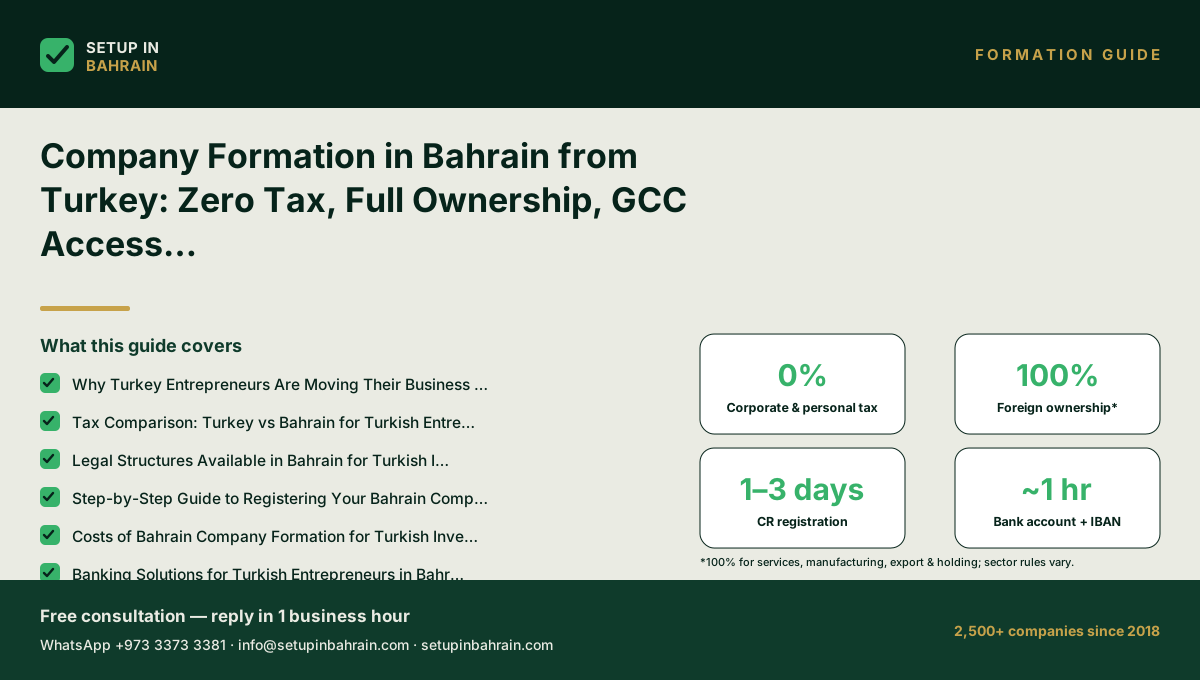
Start your Bahrain company from Turkey with generally no corporate income tax for most sectors. Fast registration, full support for Turkish entrepreneurs. Unlock tax-free business growth today.
Key Takeaways
- Why Turkey Entrepreneurs Are Moving Their Business to Bahrain
- Tax Comparison: Turkey vs Bahrain for Turkish Entrepreneurs
- Legal Structures Available in Bahrain for Turkish Investors
- Step-by-Step Guide to Registering Your Bahrain Company
- Costs of Bahrain Company Formation for Turkish Investors
→ Complete guide: Company Formation in Bahrain — the full 2026 guide
View details
Ownership & capital
A Bahrain WLL can be owned by a single person — 100% foreign ownership applies to most activities, with no local partner required for services, manufacturing, export trading and holding companies. The minimum share capital is BHD 1 ; we recommend BHD 1,000 . This Makes bank account opening and investor visa approval smoother.
Emre had spent nine years building his Istanbul-based fintech company into a legitimate success story. By late 2024, his payment processing platform was handling ₺850 million in annual transaction volume, serving merchants across Turkey, the Balkans. More and more, the Gulf region. His team had grown to 47 employees. International clients were signing contracts faster than his operations team could onboard them.
On paper, everything pointed upward. In reality, Emre was drowning.
When Turkey's corporate tax rate jumped from 20% to 25% in 2023, the immediate impact hit harder than he'd anticipated—an additional ₺3.8 million in annual tax liability that he hadn't budgeted for. But that was just the beginning. The mandatory e-Fatura system rollout in 2024 forced him to overhaul his entire invoicing infrastructure, costing another ₺420,000 in software integration and compliance consulting. His CFO now spent roughly 30% of her time managing GİB reporting requirements instead of actual financial strategy.
The currency situation made everything worse. Emre's international clients paid in euros and dollars. BDDK regulations meant he couldn't hold foreign currency freely. Every time he converted USD to TRY to meet payroll and tax obligations, the lira's relentless depreciation—down another 34% against the dollar in 2024—ate into his margins. He calculated that currency conversion timing losses alone cost him nearly ₺2.1 million that year.
"I was working twice as hard to end up with less money than I'd made three years earlier," Emre explained when we first connected. "The business was growing, but my actual returns were shrinking. Something had to change."
Fourteen months later, Emre's Bahrain-based holding company now invoices all international clients directly. His intellectual property sits in Manama. The Gulf entity handles regional expansion across Saudi Arabia, UAE, and Qatar. His Istanbul operation remains fully active—employing his Turkish team, serving domestic clients. Complying completely with local regulations—but the profitable international segment operates from a jurisdiction that rewards growth rather than penalizing it.
His effective group tax burden dropped from 31% to about 6%. More importantly, he sleeps better knowing his dollar revenues stay in dollars until he actually needs them elsewhere.
This guide provides the complete roadmap for Turkish entrepreneurs considering the same strategic restructuring. You'll learn exactly how Bahrain's regulatory framework differs from Turkey's, the specific incorporation steps and timelines involved, realistic cost breakdowns, and the critical compliance considerations that determine whether this strategy creates legitimate value or regulatory headaches.
Why Turkey Entrepreneurs Are Moving Their Business to Bahrain
The migration of Turkish business owners toward Gulf jurisdictions didn't emerge from a single policy change. It accumulated through years of compounding pressures that eventually reached a breaking point for thousands of entrepreneurs who simply couldn't sustain profitable operations under current conditions.
The Corporate Tax Acceleration
Turkey's corporate tax rate sat at a manageable 20% for years—competitive enough that most business owners accepted it as a reasonable cost of operating in a large, dynamic market. The 2023 increase to 25% changed the calculation fundamentally.
For a company generating ₺10 million in taxable profit, that five-point increase translates to ₺500,000 in additional annual taxes. For larger operations, the numbers become genuinely painful. A business with ₺50 million in profit now pays ₺2.5 million more than it did two years ago—money that previously funded expansion, hiring, or research and development.
But the headline rate only tells part of the story. Turkish companies face layered obligations that push effective rates greatly higher:
- Social security contributions (SGK) for employees
- Stamp duty on contracts and official documents
- BSMV (banking and insurance transaction tax) on financial operations
- Various municipal taxes depending on business location
- Withholding requirements on dividend distributions
When Deloitte Turkey analyzed effective tax burdens for mid-sized enterprises in 2024, they found that total fiscal obligations routinely exceeded 30-35% of gross profit once all levies were included. For businesses with thin margins—common in competitive sectors like manufacturing, logistics. Digital services—these rates become existential threats.
The Lira's Relentless Decline
Since 2018, the Turkish lira has lost over 80% of its value against the US dollar. In January 2018, one dollar bought about 3.75 TRY. By December 2024, that same dollar fetched over 34 TRY. The depreciation hasn't been gradual or predictable—it's come in violent bursts that make financial planning nearly impossible.
For Turkish entrepreneurs with international operations, this creates a brutal dynamic. Ayşe, who runs a successful B2B software company serving European clients, described it this way: "My German customers pay me €15,000 per month for our platform. Three years ago, that converted to roughly ₺180,000. Now it's over ₺570,000 in nominal terms. My operating costs—salaries, rent, utilities—have tripled in the same period. The lira figure looks bigger, but my actual purchasing power hasn't improved at all. Meanwhile, my tax liability keeps growing because GİB calculates everything in inflated lira terms."
The BDDK regulations compound this problem. Turkish authorities have implemented more and more strict controls on foreign currency transactions, limiting companies' ability to hold dollar or euro balances. Businesses must convert foreign currency revenues within specified timeframes, often at unfavorable rates. Face restrictions on purchasing FX for imports or international payments.
These controls exist for macroeconomic reasons—Turkey needs to defend the lira and prevent capital flight—but they create genuine operational nightmares for legitimate businesses trying to manage international supply chains and customer relationships.
The e-Fatura Compliance Burden
The GİB (Revenue Administration) mandated electronic invoicing through the e-Fatura system, with the latest expansion in 2024 pulling thousands of additional businesses into mandatory compliance. The system requires real-time transmission of invoice data to government servers, specific formatting requirements, digital signature integration. Retention protocols.
For large corporations with dedicated IT departments, e-Fatura integration represents an inconvenience. For small and medium enterprises—the backbone of Turkey's economy—it represents a significant operational and financial burden.
A typical SME implementing e-Fatura compliance faces:
- Software licensing fees of ₺15,000-50,000 annually
- Integration consulting costs of ₺30,000-100,000 depending on system complexity
- Ongoing maintenance and update requirements
- Staff training and process redesign
- Potential penalties for formatting errors or late submissions
The administrative overhead extends beyond direct costs. Business owners report spending greatly more time on tax compliance activities than they did five years ago, time that previously went toward customer development, product improvement, or strategic planning.
MASAK Reporting and Banking Friction
Turkey's Financial Crimes Investigation Board (MASAK) has progressively tightened anti-money laundering requirements for businesses, especially those with international transactions. While these regulations serve legitimate purposes, their implementation creates friction for ordinary commercial activities.
Turkish entrepreneurs routinely report:
- Bank accounts frozen pending documents reviews
- International wire transfers delayed for compliance verification
- Requirements to document the commercial purpose of routine business transactions
- Enhanced scrutiny of relationships with foreign partners or customers
One logistics company owner in Mersin described waiting 23 days for a routine payment from his Dutch client to clear—the bank required extensive documents proving the commercial nature of the transaction before releasing funds. "I had a container sitting in Rotterdam because I couldn't pay the shipping company," he said. "My reputation with that client is permanently damaged."
Why Bahrain Specifically?
Turkish entrepreneurs exploring international restructuring have numerous options: UAE free zones, Georgian incorporations, Estonian e-residency, Portuguese NHR regimes. Various Caribbean jurisdictions all compete for this business.
Bahrain emerges as especially attractive for Turkish business owners for several interconnected reasons:
Geographic and Cultural Proximity: Bahrain sits roughly 3,200 kilometers from Istanbul—closer than London and within the same broad time zone band. Direct flights connect Turkish cities to Bahrain International Airport. The Gulf Arab business culture shares certain characteristics with Turkish commercial traditions, including relationship-based dealmaking and hospitality norms that feel familiar.
Genuine Zero Tax, Not Temporary Incentives: Unlike many competing jurisdictions that offer "tax holidays" or reduced rates for limited periods, Bahrain imposes no corporate income tax and no personal income tax as permanent policy. There's no sunset clause, no renewal requirements, no risk that your tax advantage disappears after five years. The Kingdom generates revenue primarily through oil production, allowing it to sustain this zero-tax environment indefinitely.
Full Foreign Ownership Outside Free Zones: Most Gulf countries restrict foreign ownership of mainland companies, requiring local partners or sponsors. Bahrain permits 100% foreign ownership for most business activities through standard commercial registrations—not just within designated free zones. This means operational flexibility that competitors can't match.
GCC Market Access: Bahrain's membership in the Gulf Cooperation Council provides access to a combined market of over 55 million consumers and about $2 trillion in annual GDP. More importantly, it positions companies to engage with Saudi Arabia—the region's dominant economy—from a base just 25 kilometers across the King Fahd Causeway.
Regulatory Credibility: Bahrain's financial sector supervision by the Central Bank of Bahrain (CBB) meets international standards. The Economic Development Board (EDB) actively supports foreign investment. This isn't a Caribbean shell-company jurisdiction—it's a legitimate financial center with real regulatory infrastructure.
Tax Comparison: Turkey vs Bahrain for Turkish Entrepreneurs
Understanding the precise fiscal differences between Turkey and Bahrain requires examining multiple tax categories, not just headline corporate rates.
Corporate Income Tax
| Tax Element | Turkey | Bahrain |
| Standard corporate rate | 25% | 0% |
| Minimum corporate tax | Applies based on revenue thresholds | None |
| Tax on retained earnings | Subject to future taxation upon distribution | None |
| Loss carryforward | 5 years with limitations | Not applicable (no tax) |
Bahrain imposes no corporate income tax on commercial companies regardless of profit levels, ownership structure, or business activity. The only exception involves oil and gas extraction companies. This Pay a specific hydrocarbon tax—irrelevant for virtually all Turkish entrepreneurs establishing service, trading, or holding companies.
Personal Income Tax
| Tax Element | Turkey | Bahrain |
| Top marginal rate | 40% (on income exceeding ₺1,900,000) | 0% |
| Capital gains | Taxed as regular income | 0% |
| Dividend income | 10% withholding + potential additional tax | 0% |
| Salary income | Progressive rates from 15% to 40% | 0% |
Bahrain imposes no personal income tax whatsoever. Salary payments, dividend distributions. Capital gains from selling business interests all remain completely untaxed at the individual level.
Value Added Tax
| Tax Element | Turkey | Bahrain |
| Standard VAT rate | 20% | 10% |
| Reduced rates | 1%, 10% on specified goods/services | None |
| Registration threshold | ₺320,000 annual turnover | BHD 37,500 (~$100,000) |
| Compliance complexity | High (multiple rates, extensive reporting) | Low (single rate, simpler administration) |
Withholding Taxes
| Payment Type | Turkey Withholding | Bahrain Withholding |
| Dividends to foreign shareholders | 10-15% depending on treaty | 0% |
| Royalties | 20% (reduced by treaties) | 0% |
| Service fees to non-residents | 20% (reduced by treaties) | 0% |
| Interest payments | 0-10% depending on recipient | 0% |
Bahrain imposes no withholding taxes on any outbound payments. Dividends flow to shareholders without deduction. Royalty and service payments leave the country at full value. This simplifies international group structures and maximizes capital efficiency.
Illustrative Annual Comparison
Consider a Turkish software company generating $500,000 in annual profit from international clients:
Scenario A: Operating Entirely Through Turkish Entity
- Corporate tax (25%): $125,000
- SGK contributions (estimated): $18,000
- Stamp duty and various fees: $5,000
- Currency conversion losses (estimated 8%): $40,000
- Compliance costs (e-Fatura, accounting, legal): $15,000
- Total Burden: $203,000 (40.6% effective rate)
Scenario B: Operating Through Bahrain Entity with Minimal Turkish Presence
- Bahrain corporate tax: $0
- Bahrain licensing and compliance: $8,000
- Turkish tax on reduced domestic operations: $12,000
- Professional fees for structure maintenance: $10,000
- Total Burden: $30,000 (6% effective rate)
The savings in Scenario B—about $173,000 annually—fund substantial business expansion, team growth, or founder distributions. Over five years, the cumulative difference exceeds $865,000.
These calculations assume legitimate business substance in Bahrain and proper structuring to comply with Turkish controlled foreign corporation rules. The strategy doesn't work through paper arrangements alone—you need real operations, actual decision-making. Genuine commercial purposes for the Gulf entity.
Legal Structures Available in Bahrain for Turkish Investors
Bahrain offers several corporate vehicles suitable for Turkish entrepreneurs, each with distinct characteristics affecting liability protection, capital requirements, operational flexibility. Regulatory obligations.
Limited Liability Company (WLL)
The With Limited Liability (WLL) structure represents Bahrain's most common vehicle for small to medium foreign-owned businesses. Key characteristics include:
- Minimum shareholders: 2 (can be individuals or corporate entities)
- Maximum shareholders: 50
- Minimum capital: BHD 1 (we recommend BHD 1,000)for fully foreign-owned companies
- Liability protection: Shareholders' liability limited to capital contributions
- Management: Managed by appointed managers, not necessarily shareholders
- Audit requirements: Annual audit required for companies exceeding revenue thresholds
The WLL structure suits Turkish entrepreneurs establishing trading companies, service businesses, or regional holding entities. The BHD 1 (we recommend BHD 1,000)capital requirement—while not trivial—provides genuine commercial credibility and isn't merely held in escrow; it can be deployed for business operations after incorporation.
single-shareholder WLL
Bahrain permits single-shareholder companies for foreign investors, eliminating the need for nominee arrangements or artificial second shareholders:
- Shareholders: Exactly 1 (individual or corporate)
- Minimum capital: BHD 1 (we recommend BHD 1,000)for foreign-owned WLLs
- Liability protection: Full limited liability for the sole shareholder
- Management: Shareholder can serve as manager or appoint others
- Flexibility: Simpler decision-making without multi-party consent requirements
The WLL appeals to Turkish entrepreneurs who prefer complete control without involving partners, family members, or corporate service providers as nominal shareholders.
Bahrain Shareholding Company (BSC)
Larger enterprises or those planning eventual public offerings may consider the BSC structure:
- Minimum shareholders: 2 for closed BSC
- Minimum capital: BHD 250,000 (~$665,000) for closed companies; BHD 1,000,000 for public companies
- Share transferability: Shares can be transferred subject to constitutional provisions
- Governance: Board of directors required; more formal governance structures
- Audit requirements: Mandatory annual audit regardless of size
The BSC suits substantial operations but involves higher costs and compliance complexity than most Turkish SMEs require.
Branch Office
Foreign companies can establish branch offices in Bahrain without creating separate legal entities:
- Legal status: Extension of parent company, not separate legal person
- Liability: Parent company fully liable for branch obligations
- Capital requirement: None specified; operational funding required
- Taxation: Same zero-tax treatment as local companies
- Activities: Can conduct same activities as parent company
Branch registration makes sense for Turkish companies wanting Bahrain presence without creating separate corporate vehicles. But, the unlimited liability exposure and inability to ring-fence Gulf operations from Turkish company risks make this structure less popular than limited liability alternatives.
Bahrain International Investment Park (BIIP)
Companies focused on manufacturing, logistics, or industrial activities may benefit from BIIP registration:
- Land access: Leasehold access to industrial land at favorable rates
- Infrastructure: Ready-built facilities and utilities
- Customs benefits: Streamlined import/export procedures
- Minimum investment: Varies by facility type; typically BHD 50,000+
BIIP suits Turkish manufacturers establishing regional production or assembly operations, though most service-focused entrepreneurs find standard WLL structures more appropriate.
Holding Company Structures
Turkish entrepreneurs with multiple business lines or international subsidiaries often establish Bahrain holding companies to centralize ownership:
- Permitted activities: Owning shares in subsidiaries, providing group services, holding intellectual property
- Tax efficiency: Dividends from subsidiaries received tax-free; no withholding on distributions to shareholders
- Substance requirements: Must maintain genuine management presence and decision-making authority
- Typical structure: Bahrain holding company owns operating subsidiaries in various jurisdictions
This structure allows Turkish groups to extract profits from various countries through the Bahrain holding company, where they accumulate tax-free, rather than repatriating directly to Turkey where they face immediate taxation.
Step-by-Step Guide to Registering Your Bahrain Company
The incorporation process involves several distinct phases, each with specific documents requirements and timeline expectations. Understanding this sequence helps Turkish entrepreneurs plan appropriately and avoid delays.
Phase 1: Name Reservation and Activity Selection (Days 1-3)
Selecting Your Company Name
Bahrain's Ministry of Industry and Commerce (MOIC) maintains naming rules that affect registration approval:
- Names must be unique within Bahrain's commercial registry
- Arabic names required (with English transliterations permitted)
- Names cannot imply government affiliation or mislead about business activities
- Certain words require special approval (e.g., "National," "Gulf," "Islamic")
Submit three name options in order of preference through the Sijilat online portal. MOIC typically confirms availability within 24-48 hours. Reserved names remain valid for 30 days pending company registration completion.
Determining Business Activities
Bahrain uses standardized activity codes (ISIC classifications) to specify permitted business operations. Your registration must include appropriate codes covering intended activities:
- International trading and e-commerce
- Management consulting and professional services
- Software development and IT services
- Regional holding company operations
- Import/export activities
Selecting overly narrow activity codes limits future operational flexibility. Work with your incorporation advisor to ensure activity selections accommodate both immediate plans and potential expansion.
Phase 2: Document Preparation (Days 4-10)
Turkish entrepreneurs must gather and authenticate several documents for Bahrain registration:
From Turkey:
- Passport copies (notarized, then apostilled through Turkish authorities)
- Proof of address (utility bills or bank statements, apostilled)
- Bank reference letters from Turkish banks (recent, stating relationship in good standing)
- Corporate documents if a Turkish company will serve as shareholder (trade registry excerpts, authorization resolutions, apostilled)
For the Bahrain Application:
- Memorandum of Association (constitutional document establishing company)
- Articles of Association (operating rules and governance provisions)
- Shareholder and director identification documents
- Registered office lease agreement or virtual office contract
- Initial capital deposit evidence
Documents originating in Turkey require apostille certification for Bahrain recognition. The apostille process typically takes 3-5 business days through Turkish authorities and should be initiated early to avoid holding up the registration timeline.
Phase 3: Capital Arrangement (Days 5-12)
Bahrain requires foreign-owned companies to deposit minimum share capital before completing registration. For a WLL with 100% foreign ownership, the BHD 1 (we recommend BHD 1,000)requirement must be evidenced through:
- Bank letter confirming deposit in a Bahrain bank account
- Alternatively, blocked account pending registration completion
- Some structures permit partial initial deposit with balance committed
Practical Considerations for Turkish Entrepreneurs:
Opening a Bahrain bank account before company registration creates a chicken-and-egg problem—banks want to see incorporated entities. Incorporation requires capital evidence. Solutions include:
- Pre-incorporation accounts: Certain Bahrain banks offer accounts for companies in formation, releasing funds upon registration completion
- Escrow arrangements: Corporate service providers maintain escrow accounts where capital deposits are held pending incorporation
- Phased capital: Some structures permit demonstrating capital commitment through undertaking letters rather than immediate full deposit
Given BDDK restrictions on Turkish residents' foreign currency transactions, planning capital movement carefully becomes essential. Consult with Turkish tax and banking advisors about compliant mechanisms for transferring incorporation funds to Bahrain.
Phase 4: Sijilat Submission and MOIC Review (Days 10-18)
Bahrain's Sijilat system provides online registration for new companies. The submission includes:
- Completed application forms
- Uploaded supporting documents (apostilled, translated as needed)
- Activity code selections
- Shareholder and director declarations
- Registered office details
- Capital deposit evidence
MOIC reviews submissions for completeness and compliance. Straightforward applications typically receive approval within 5-7 business days. Complex structures, unusual activities, or document deficiencies may trigger queries extending this timeline.
Upon approval, MOIC issues a Commercial Registration (CR) number—your company's primary business identifier for all subsequent activities.
Phase 5: Post-Registration Compliance (Days 18-30)
Commercial registration marks the beginning, not the end, of setup procedures. New companies must complete several additional steps:
CR Certificate Collection Physical CR certificate available from MOIC offices or delivered by courier. Digital certificates accessible through Sijilat portal.
Tax Registration with National Bureau for Revenue (NBR) Companies meeting VAT thresholds must register for Value Added Tax within 30 days of exceeding BHD 37,500 in taxable supplies. Even below-threshold companies often register voluntarily to claim input tax credits.
Social Insurance Registration (SIO) Companies employing Bahraini nationals or GCC citizens must register with Social Insurance Organization and make contributions on their behalf.
Municipality Registration Local municipality registration required for physical office premises, though waived for virtual office arrangements in some cases.
Bank Account Activation Convert pre-incorporation banking arrangements to full operating accounts. Bahrain banks conduct enhanced due diligence on new company accounts, especially for foreign-owned entities, requiring:
- Detailed business plans
- Source of funds documents
- Beneficial ownership declarations
- Expected transaction profiles
Allow 2-3 weeks for bank account activation—a realistic expectation given current compliance environments.
Realistic Timeline Summary
| Phase | Duration | Key Dependencies |
| Name reservation | 2-3 days | Name availability |
| Document preparation | 5-7 days | Turkish apostille timing |
| Capital arrangement | 5-10 days | Banking procedures |
| MOIC review | 5-8 days | Application completeness |
| Post-registration | 10-14 days | Bank account opening |
| Total | 27-42 days | Various factors |
Costs of Bahrain Company Formation for Turkish Investors
Transparency about costs helps Turkish entrepreneurs budget appropriately and avoid surprises during the setup process.
Government Fees
| Fee Category | Amount (BHD) | Amount (USD) |
| Commercial Registration | 100-300 | 265-800 |
| Activity licensing | 50-200 per activity | 130-530 |
| Name reservation | 10 | 27 |
| Setup card (immigration) | 12 | 32 |
| Municipality registration | 20-100 | 53-265 |
| Total Government Fees | 192-622 | 507-1,654 |
Professional Service Fees
| Service | Typical Range (USD) |
| Full incorporation package (standard WLL) | 3,500-6,500 |
| Registered office (annual) | 1,500-4,000 |
| Resident director service (if required) | 3,000-6,000 annually |
| Bank account opening assistance | 1,000-2,500 |
| Legal document drafting and review | 1,500-3,500 |
| PRO services (government liaison) | 500-1,500 |
| Total Professional Fees (Year 1) | 11,000-24,000 |
Capital Requirements
| Structure | Minimum Capital (BHD) | Minimum Capital (USD) |
| WLL (100% foreign owned) | 50,000 | 133,000 |
| WLL (100% foreign owned) | 50,000 | 133,000 |
| Branch office | No minimum | No minimum |
| Partnership | No minimum | No minimum |
Ongoing Annual Costs
| Item | Annual Cost (USD) |
| Commercial registration renewal | 300-800 |
| Registered office | 1,500-4,000 |
| Accounting and bookkeeping | 2,500-6,000 |
| Audit fees (if required) | 2,000-5,000 |
| VAT compliance | 1,000-2,500 |
| Corporate governance maintenance | 500-1,500 |
| Total Annual Maintenance | 7,800-19,800 |
Total First-Year Budget
A Turkish entrepreneur establishing a standard foreign-owned WLL in Bahrain should budget:
- Government fees: ~$1,000
- Professional fees: ~$15,000 (mid-range)
- Capital requirement: ~$133,000 (becomes working capital)
- Contingency (10%): ~$1,600
- Total First-Year Requirement: ~$150,600
Excluding the capital deposit (which remains company assets), actual out-of-pocket setup costs typically run $15,000-25,000 for a properly structured entity with appropriate professional support.
Banking Solutions for Turkish Entrepreneurs in Bahrain
Opening and operating bank accounts represents one of the most critical—and sometimes challenging—aspects of establishing Bahrain operations. Turkish entrepreneurs face unique considerations given their home country's currency situation and regulatory environment.
Major Banking Options
Bahrain hosts numerous banks suitable for commercial accounts, each with different strengths:
National Bank of Bahrain (NBB) The largest domestic bank offers comprehensive commercial banking services with strong local relationships. NBB understands regional business practices and provides efficient domestic payment processing.
Ahli United Bank (AUB) A prominent regional institution with operations across GCC countries, AUB suits entrepreneurs with multi-country Gulf operations needing consolidated banking relationships.
Bank ABC Formerly Arab Banking Corporation, Bank ABC specializes in trade finance and international transactions—relevant for Turkish companies focused on import/export or cross-border service delivery.
Bank of Bahrain and Kuwait (BBK) Strong retail and commercial presence with growing appetite for SME banking. BBK often provides more flexible account opening procedures than larger international competitors.
International Banks (HSBC, Standard Chartered, Citi) Global banks operating in Bahrain apply international compliance standards and offer seamless connectivity to worldwide banking networks. But, their risk-averse onboarding procedures may create longer account opening timelines.
Account Opening Requirements
Banks uniformly require:
- Commercial registration certificate
- Memorandum and Articles of Association
- Board resolution authorizing account opening
- Signatory identification documents
- Proof of registered office address
- Detailed business plan describing activities, expected transaction volumes, and geographic scope
- Source of funds documents (especially important for initial capital)
- Ultimate beneficial owner identification
Turkey-Specific Documents Requests
Banks reviewing applications from Turkish entrepreneurs typically request additional information:
- Explanation of business rationale for Bahrain presence
- Turkish company financial statements (if corporate shareholder)
- Personal tax returns or wealth declarations
- Evidence of legitimate business history in Turkey
- References from Turkish banks
This enhanced scrutiny reflects general compliance caution about emerging market entrepreneurs rather than specific Turkey concerns. Patience and thorough documents preparation smooth the process.
Multi-Currency Account Benefits
Bahrain banks routinely offer accounts holding multiple currencies—USD, EUR, GBP, BHD, and others—within single banking relationships. For Turkish entrepreneurs, this provides critical advantages:
- Receive client payments in original currencies without forced conversion
- Hold reserves in stable currencies protected from TRY volatility
- Pay international suppliers directly without round-tripping through Turkish banks
- Time currency conversions strategically rather than immediately upon receipt
One Turkish e-commerce entrepreneur described opening his Bahrain USD account as "finally having control over my own money again." His European marketplace revenues now accumulate in dollars, converted only when needed for specific purposes.
Correspondent Banking Considerations
Bahrain banks maintain correspondent relationships with major international institutions, enabling reliable wire transfers globally. But, payments involving certain countries—including those under international sanctions—face restrictions.
For Turkish entrepreneurs, verify that your Bahrain bank's correspondent network supports:
- Receiving payments from your key customer geographies
- Making payments to your supplier locations
- Transferring funds to Turkey when needed (subject to Turkish regulations)
- Connecting to international payment platforms (Wise, PayPal merchant, Stripe where available)
Digital Banking Alternatives
Bahrain's fintech-friendly regulatory environment has attracted digital banking providers offering accounts with streamlined onboarding:
- Rain (cryptocurrency-focused but expanding traditional services)
- Tarabut Gateway (open banking platform)
- Various neobank initiatives under CBB sandbox frameworks
While these alternatives may offer faster account opening, most Turkish entrepreneurs find that traditional bank accounts provide necessary credibility for significant commercial relationships.
Frequently Asked Questions: Turkish Investors in Bahrain
Can I form a Bahrain company entirely remotely from Turkey?
Yes, physical presence in Bahrain is not required for company formation. The entire process—from document submission through commercial registration—can be completed remotely. But, bank account opening typically requires at least one trip to Bahrain for in-person verification, though some banks accommodate video-based KYC for certain account types.
Do I need a Bahraini partner or sponsor?
No. Bahrain permits 100% foreign ownership of companies in most business sectors without requiring local partners, sponsors, or shareholders. This distinguishes Bahrain from historical practices in some other Gulf countries. Certain regulated activities (banking, insurance, media) may have specific ownership requirements, but standard commercial, trading. Service businesses face no local partnership obligations.
How does Bahrain's zero tax affect my Turkish tax obligations?
Turkish tax residents remain subject to worldwide income taxation in Turkey. But, properly structured Bahrain operations can provide legitimate tax efficiency through:
- Deferral of Turkish taxation until profits are repatriated
- Reduced Turkish taxable base by shifting genuinely value-creating activities to Bahrain
- Potential treaty benefits under the Turkey-Bahrain double taxation agreement
Turkish controlled foreign corporation (CFC) rules require careful analysis. If your Bahrain company is deemed a "low-tax controlled foreign corporation" under Turkish law, profits may be attributed to you for Turkish tax purposes regardless of actual distribution. Professional Turkish tax advice is essential before implementing any structure.
What business activities can I conduct from Bahrain?
Bahrain permits virtually all lawful commercial activities, including:
- International trading and e-commerce
- Software development and IT services
- Management consulting and professional services
- Regional holding company operations
- Logistics and supply chain management
- Manufacturing (with BIIP registration)
- Financial services (with CBB licensing)
Some activities require specific licenses or regulatory approvals. The overall environment accommodates most business types Turkish entrepreneurs typically pursue.
How quickly can I have a fully operational company?
From initial engagement through operational bank account, expect 6-10 weeks for straightforward structures. The timeline breaks down about as:
- Document preparation and submission: 2-3 weeks
- MOIC review and approval: 1-2 weeks
- Post-registration procedures: 1-2 weeks
- Bank account opening: 2-3
Bahrain Business Guides for Turkey Citizens
Frequently Asked Questions
How long does it take to set up?
It takes 15 to 20 days. We file all forms for you. You do not need to wait long.
What does it cost?
Company formation: Standard BHD 1,340 with 3 months of office address; Gold BHD 1,700 with 6 months; Premium BHD 2,150 with 12 months and a cabin, officer table and chair, and two guest chairs. No formation package includes visas, including Premium. Investor/work visas are priced separately: BHD 755 for one year or BHD 953 for two years, in addition to the formation package. Ask for a written, itemized quotation confirming government fees and all inclusions before payment.
Do I need to visit Bahrain?
No. You can set up your firm from home. We do all the work online. Some banks may ask for one visit.
What tax will I pay?
You pay zero tax on your profits. Bahrain has no corporate income tax. This is a key benefit of the setup.
Can I own 100% of my firm?
Yes. Foreign owners can hold all shares. No local partner is needed. Full ownership is allowed.
What do I need to start?
You need a valid passport. You also need a trade name and a business address. We help you with all of these.
How do I open a bank account?
We guide you step by step. Most banks take 3 to 6 weeks. You will need your CR and firm papers.
Who issues the Commercial Registration (CR)?
The CR is issued by the MOICT. It is your legal right to trade in Bahrain. We file the CR for you.
Can I renew my CR each year?
Company renewal packages: BHD 530 with 3 months of office address; BHD 980 with 6 months; BHD 1,520 with 12 months. These are separate renewal packages, not visa fees.
How do I get started?
Fill in our form on this page. Our team will call you back. We map your best setup plan at no cost.
Steps to Form Your Company
- Pick your trade name. We check if it is free.
- Choose your business type. WLL is the most common.
- Sign the MOA. We draft and file all legal docs.
- Pay the state fees. About BHD 432 in total.
- Get your CR. Takes 15 to 20 days.
- Open your bank account. We guide each step.
- Start trading. You are ready to do business.
Key Facts
- Tax rate: 0%
- Foreign ownership: 100%
- Setup time: 15 to 20 days
- Company formation: Standard BHD 1,340 with 3 months of office address; Gold BHD 1,700 with 6 months; Premium BHD 2,150 with 12 months and a cabin, officer table and chair, and two guest chairs. No formation package includes visas, including Premium. Investor/work visas are priced separately: BHD 755 for one year or BHD 953 for two years, in addition to the formation package. Ask for a written, itemized quotation confirming government fees and all inclusions before payment.
- Company renewal packages: BHD 530 with 3 months of office address; BHD 980 with 6 months; BHD 1,520 with 12 months. These are separate renewal packages, not visa fees.
- Client rating: 4.8 stars
- Clients served: 2,500 and more
Quick Facts
- Tax rate: 0%
- Own all of your firm: Yes, 100%
- Time to set up: 15 to 20 days
- Company formation: Standard BHD 1,340 with 3 months of office address; Gold BHD 1,700 with 6 months; Premium BHD 2,150 with 12 months and a cabin, officer table and chair, and two guest chairs. No formation package includes visas, including Premium. Investor/work visas are priced separately: BHD 755 for one year or BHD 953 for two years, in addition to the formation package. Ask for a written, itemized quotation confirming government fees and all inclusions before payment.
- Company renewal packages: BHD 530 with 3 months of office address; BHD 980 with 6 months; BHD 1,520 with 12 months. These are separate renewal packages, not visa fees.
- Rating: 4.8 stars
- Clients: 2,500 and more
Why Bahrain?
Bahrain has no tax. You keep all your profits. This is rare in the Gulf.
You can own all of your firm. No local partner is needed. The law allows full foreign ownership.
Setup takes 15 to 20 days. We file all forms for you. You can do it all from home.
Bahrain has a free trade deal with the US. Your goods face low or no tariffs. This gives you access to big markets.
We have served 2,800+ clients from 44+ countries and maintain records to substantiate that total where needed. We have 113 Google reviews; reviews represent only some clients and are not the same as the total clients served.
Our Steps
- Tell us your plan. We advise you for free.
- We pick the right firm type for you.
- We file all your forms with MOICT.
- You get your CR in 15 to 20 days.
- We help you open a bank account.
- You are ready to trade. We stay with you.
Why Set Up in Bahrain?
Bahrain is a great place to run a firm. It has no tax. You keep all your profits. This is rare in the Gulf.
You can own your firm 100%. No local partner is needed. The law is clear and fair.
It is fast to set up. You can have a CR in 15 to 20 days. We file all forms for you.
Bahrain has a free trade deal with the US. Your goods face low or no tariffs. This gives you access to big markets.
The banks are good. The roads are good. The schools are good. It is a well-run state.
We have served 2,800+ clients from 44+ countries and maintain records to substantiate that total where needed. We have 113 Google reviews; reviews represent only some clients and are not the same as the total clients served.
Our Services
- Company formation: Standard BHD 1,340 with 3 months of office address; Gold BHD 1,700 with 6 months; Premium BHD 2,150 with 12 months and a cabin, officer table and chair, and two guest chairs. No formation package includes visas, including Premium. Investor/work visas are priced separately: BHD 755 for one year or BHD 953 for two years, in addition to the formation package. Ask for a written, itemized quotation confirming government fees and all inclusions before payment.
- Company renewal packages: BHD 530 with 3 months of office address; BHD 980 with 6 months; BHD 1,520 with 12 months. These are separate renewal packages, not visa fees.
- Investor Visa — from BHD 755
- Work Visa — LMRA managed
- Virtual office — from BHD 600 per year
- Bank account opening — 3 to 6 weeks
- Family visa — for spouse and kids
- UBO filing — as required by law
Bahrain at a Glance
- Tax rate: 0%
- Foreign ownership: 100%
- Setup time: 15 to 20 days
- Free trade deal: Yes, with the US
- Language: Arabic and English
- Currency: Bahraini Dinar (BHD)
- Time zone: UTC+3
- GDP growth: Steady and strong
How to Start
- Fill in the form on this page. It takes 3 minutes.
- We call you back the same day.
- We map the best plan for your firm type and goals.
- We file all forms. We deal with MOICT for you.
- You get your CR in 15 to 20 days.
- We help you open a bank account and get your visa.
- You are ready to trade. We stay with you.
Common Questions
Do I need to visit Bahrain to set up?
No. You can do it all from home. We file online. You may need one visit to open a bank account.
Is Bahrain safe for business?
Yes. Bahrain is a stable state. It has a clear legal system. Your firm and funds are safe here.
Can I hire staff from any country?
Yes. You can hire from any country. Each hire needs a work permit from LMRA. We manage this for you.
What type of firm should I set up?
Most clients choose a WLL. This is a limited liability firm. It is flexible and well-known in Bahrain. We advise you on the best type for your case.
How do I get in touch?
Fill in our form. We call you back the same day. You can also email us or use the chat on this page.
Ready to set up in Bahrain from Turkey?
Tell us your business idea. We map the right entity, ownership and timeline — then handle the filing while you focus on what matters.