Complete guide for Tunisia entrepreneurs: form a company in Bahrain with generally no corporate income tax for most sectors, 100% foreign ownership. GCC market access. Costs, steps, visas, banking.
Key Takeaways
- Why Tunisia Entrepreneurs Are Moving Their Business to Bahrain
- Understanding Bahrain's Economic Landscape: A Beacon of Stability
- Key Legal Structures for Tunisian Businesses in Bahrain
- The Step-by-Step Company Formation Process in Bahrain
- Navigating Licenses, Visas, and Banking in Bahrain
→ Complete guide: Company Formation in Bahrain — the full 2026 guide
View details
Ownership & capital
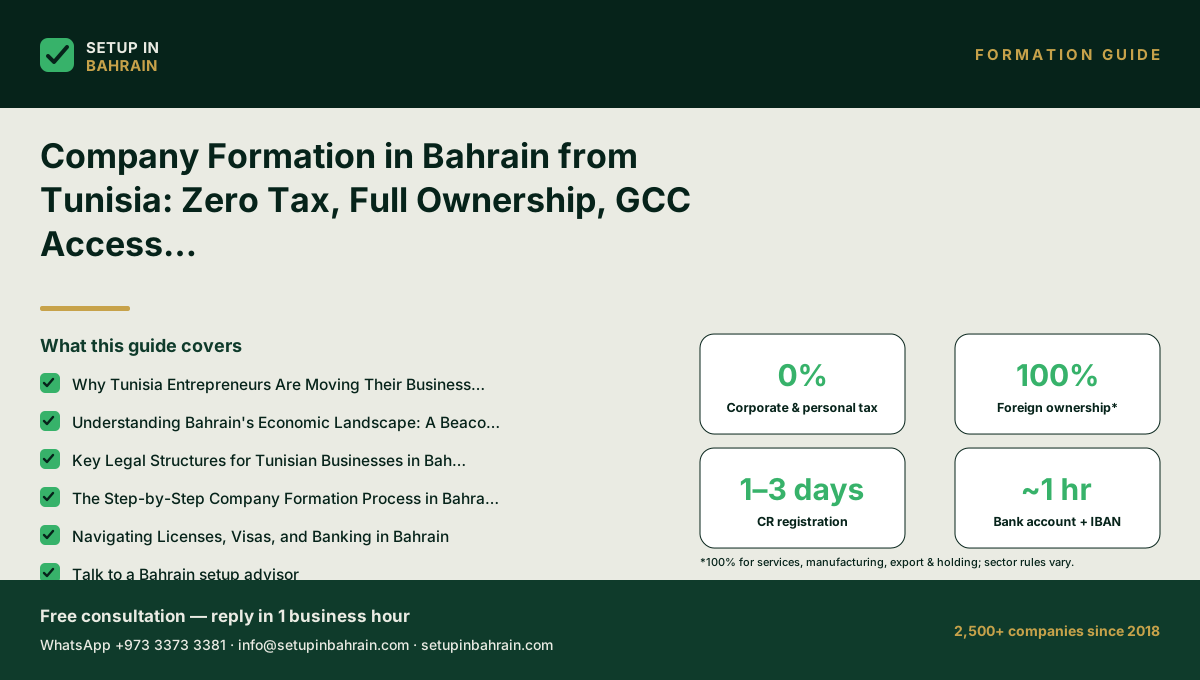
A Bahrain WLL can be owned by a single person — 100% foreign ownership applies to most activities, with no local partner required for services, manufacturing, export trading and holding companies. The minimum share capital is BHD 1 ; we recommend BHD 1,000 . This Makes bank account opening and investor visa approval smoother.
For many entrepreneurs in Tunisia, the dream of scaling internationally often collides with a stark reality: complex tax regimes, currency volatility. An intricate web of regulatory hurdles that stifle growth before it even begins. Imagine running a successful manufacturing business in Sousse, for instance, producing high-quality olive oil or textile products. You’ve built a strong local brand, but global expansion means importing specialized machinery or raw materials.
Suddenly, you’re battling the BCT’s forex controls , watching the Tunisian Dinar (TND) depreciate by over 40% since 2010 , making your import costs skyrocket. You’re also navigating the DGI’s complex bi-annual tax filings , paying a standard corporate tax of 15% (or a hefty 25% if you’re in financial services), and on top of it all, contributing a mandatory 25% to CNSS for your employees.
The uncertainty introduced by the IMF’s structural adjustment program and the political consolidation since 2021 adds yet another layer of risk, making long-term planning a constant tightrope walk.
This isn't just a hypothetical scenario; it's the daily reality for countless Tunisian business owners. They are innovative, resilient. Ready to compete on the global stage, but the local economic environment often acts as an anchor rather than a launchpad.
This is precisely why a growing number of forward-thinking Tunisian entrepreneurs are turning their gaze eastward, towards Bahrain. This small, dynamic island nation in the Arabian Gulf offers not just a breath of fresh air but a completely different economic paradigm.
It’s a place where your business can operate with 0% corporate income tax , achieve 100% foreign ownership without needing a local partner, and gain unparalleled access to the lucrative GCC market through its strategic position just 25km from Saudi Arabia via the King Fahd Causeway. In Bahrain, the currency is stable, pegged to the US Dollar at BHD 1 = USD 2.65, offering predictability that the Tunisian Dinar simply cannot.
This article is designed to be your definitive guide, a roadmap for Tunisian entrepreneurs looking to establish a thriving international presence in Bahrain. We’ll delve into the precise advantages, navigate the setup process, unravel the financial implications. Provide a clear comparison to the challenges you currently face in Tunisia. By 2026, many ambitious Tunisian businesses will have already made this leap; will yours be among them?
Why Tunisia Entrepreneurs Are Moving Their Business to Bahrain
The decision to relocate or expand a business internationally is never taken lightly. It involves significant research, planning, and often, a leap of faith. But, for Tunisian entrepreneurs, the motivations for considering Bahrain are not merely aspirational; they are rooted in practical, financial. Strategic necessities driven by the stark realities of their home market.
The Weight of Tunisian Economic Realities
Let’s unpack the core challenges that are compelling Tunisian businesses to seek greener pastures:
Currency Volatility and Forex Controls: The Tunisian Dinar (TND) has depreciated by over 40% against major international currencies since 2010 . This relentless erosion of value directly impacts businesses dealing with international trade. Importing raw materials, machinery, or even accessing global digital services becomes exponentially more expensive. Compounding this, the Central Bank of Tunisia (BCT) maintains strict forex controls , making it difficult, slow. Often frustrating to transfer funds internationally, repatriate profits, or even pay for essential overseas services.
This isn't just an inconvenience; it's a fundamental barrier to global operations and competitive pricing. High Corporate Taxation: In Tunisia, a standard corporate income tax rate of 15% is applied to most businesses. For companies in the vital financial services sector, this jumps to a hefty 25% . These rates greatly reduce retained earnings, limiting reinvestment and growth potential.
Complex Tax Filings and Compliance: The Direction Générale des Impôts (DGI) in Tunisia is known for its intricate tax codes and bi-annual installment filings . This requires constant attention, professional accounting support. Can be a significant drain on administrative resources, especially for SMEs. Errors can lead to penalties, adding another layer of risk. Mandatory Social Security Contributions (CNSS): Beyond corporate tax, Tunisian businesses are mandated to contribute 25% of salaries to the Caisse Nationale de Sécurité Sociale (CNSS) .
While essential for employee welfare, this adds substantial overhead to labor costs, making it more expensive to hire and expand teams. Economic Instability and Political Consolidation: The period following 2010 has seen significant economic and political shifts in Tunisia. The ongoing IMF’s structural adjustment program and the political consolidation since 2021 have introduced layers of uncertainty, impacting investor confidence and making long-term strategic planning a precarious exercise.
Entrepreneurs need stability and predictability to thrive, and these elements have been consistently challenging in Tunisia.
A Tale of Two Balance Sheets: Tunisia vs. Bahrain
To truly understand the impact, let’s consider a concrete example, similar to the scenario often observed by the Bahrain Economic Development Board (EDB) in its outreach to North African entrepreneurs:
Consider a Tunis-based software developer who built a small team serving European clients. In 2023, his company reported TND 420,000 in profit. After the 15% corporate tax (TND 63,000), CNSS contributions at 25% on salaries (let's estimate TND 40,000 for simplicity based on average salaries), And navigating the DGI bi-annual installment filings, He retained roughly TND 260,000 in the company after direct taxes and contributions.
Then, the Dinar lost another 7% against the Euro that year, further eroding the international purchasing power of what remained.
The next year, he decided to move the same operation to Bahrain as a WLL (With Limited Liability). The identical revenue now faces generally no corporate income tax for most sectors . There is 0% withholding tax on dividends he wishes to distribute. His operational costs for salaries (minus CNSS. This Is not applicable for non-Bahraini employees/companies in Bahrain) are more transparent.
Crucially, his operating capital and profits are held in a currency pegged to the US Dollar at BHD 1 = USD 2.65 , eliminating the currency erosion risk that plagued his Tunisian operations. While he still files Tunisian personal returns on distributions if he remains a resident, the corporate tax burden and currency risk are effectively removed from his primary business operations.
This stark comparison isn't just theoretical; it's the financial reality check that resonates deeply with Tunisian entrepreneurs.
Bahrain's Unrivaled Value Proposition
Against this backdrop of challenges, Bahrain presents a compelling counter-narrative:
0% Corporate Income Tax: This is perhaps the most significant draw. For most business activities in Bahrain, there is no corporate income tax. This means more capital for reinvestment, expansion, and higher profit retention. 100% Foreign Ownership: Unlike many jurisdictions that mandate local partners or specific shareholding structures, Bahrain allows 100% foreign ownership in most sectors. This gives Tunisian entrepreneurs complete control over their business operations and strategic direction.
Zero Withholding Tax on Dividends, Royalties, and Interest: Repatriating profits or paying out dividends to shareholders is unburdened by additional taxes, making Bahrain an attractive hub for international profit centers. Stable Currency Pegged to the USD: The fixed exchange rate of BHD 1 = USD 2.65 provides unparalleled financial stability and predictability, eliminating the currency risk that plagues TND-denominated businesses.
Gateway to the $1.6 Trillion GCC Market: Bahrain's strategic location, especially its physical link to Saudi Arabia via the King Fahd Causeway, positions it as an ideal launchpad into the affluent Gulf Cooperation Council (GCC) market. This market represents over 50 million consumers with high purchasing power.
Pro-Business Regulatory Environment: The Kingdom of Bahrain, through entities like the Ministry of Industry and Commerce (MOIC) and the EDB, actively fosters an environment conducive to business growth, with streamlined processes and supportive policies.
These benefits collectively paint a picture of Bahrain as a genuine economic safe harbor and a powerful launchpad for Tunisian businesses with global ambitions.
Understanding Bahrain's Economic Landscape: A Beacon of Stability
Bahrain, often called the "Pearl of the Gulf," is more than just a tax haven; it's a strategically positioned, economically diversified. Forward-thinking nation that has consistently invested in its business infrastructure and human capital.
Strategic Location and GCC Gateway
Bahrain's geographical advantage is undeniable. Situated in the heart of the Arabian Gulf, it serves as a natural bridge between East and West. Proximity to Saudi Arabia: The King Fahd Causeway , a 25-kilometer bridge, connects Bahrain directly to Saudi Arabia, facilitating swift movement of goods and people. This direct link provides unmatched access to Saudi Arabia’s massive consumer market and industrial base, making Bahrain an ideal logistics and distribution hub for the entire GCC.
Access to a $1.6 Trillion GCC Market: Beyond Saudi Arabia, Bahrain offers easy access to the broader GCC market, encompassing the UAE, Qatar, Kuwait. Oman. This collective market represents significant purchasing power and diverse opportunities across various sectors. Excellent Air and Sea Connectivity: Bahrain International Airport (BIA) is a modern, efficient hub with direct flights to major cities globally. Its deep-water Khalifa Bin Salman Port provides state-of-the-art logistics capabilities for international trade.
Robust Regulatory Framework and Pro-Business Policies
Bahrain has deliberately cultivated an open, transparent. Stable regulatory environment, making it an attractive destination for foreign direct investment. Role of EDB, MOIC, and CBB: * The Bahrain Economic Development Board (EDB) acts as a one-stop-shop for investors, proactively attracting foreign investment and helping businesses navigate the local landscape. Its mandate is to cut red tape and help growth.
* The Ministry of Industry and Commerce (MOIC) is responsible for commercial registration, licensing. Regulating business activities, continuously striving to simplify processes via its Sijilat portal. * The Central Bank of Bahrain (CBB) is a highly respected regulator, known for its progressive approach to financial services and its robust oversight, ensuring the stability and integrity of the financial sector. This creates a secure environment for banking and financial transactions.
Business-Friendly Policies: Bahrain consistently ranks high in global ease of doing business indices (e.g., World Bank's Doing Business Report). Its legal system is based on common law principles, providing clarity and predictability for international investors.
Diversified Economy Beyond Oil
While historically an oil producer, Bahrain has made significant strides in diversifying its economy, reducing reliance on hydrocarbons. This diversification strategy has created vibrant sectors ripe for investment: Financial Services: Bahrain is a long-standing financial hub in the Middle East, home to over 350 financial institutions, including conventional and Islamic banks, investment firms, and insurance companies. It has a strong regulatory framework (CBB) and a skilled workforce. Information and Communication Technology (ICT): Bahrain is a regional leader in digital transformation.
It hosts Amazon Web Services (AWS) MENA region data center, highlighting its advanced digital infrastructure and commitment to cloud computing and data sovereignty. This makes it ideal for tech startups and software companies. Logistics and Manufacturing: With its strategic location and excellent connectivity, Bahrain is developing as a regional logistics and light manufacturing hub, leveraging its Free Zones like the Bahrain International Investment Park (BIIP) and Bahrain Logistics Zone (BLZ).
Tourism: The government is investing heavily in tourism infrastructure, offering opportunities in hospitality, entertainment, and related services.
Digital Transformation and Innovation Hub
Bahrain is not just catching up; it's leading in certain aspects of digital innovation. Fintech Hub: The CBB has been proactive in establishing a regulatory sandbox for FinTech companies, making Bahrain a testing ground for innovative financial technologies. This includes open banking initiatives and blockchain adoption. Cloud Computing Adoption: Hosting AWS's regional data center positions Bahrain as a leader in cloud services, offering businesses secure and scalable digital infrastructure.
This provides a significant advantage for data-intensive Tunisian businesses looking to modernize their operations.
This stable, diversified. Forward-looking economic landscape provides the perfect foundation for Tunisian entrepreneurs to build and grow their international ventures with confidence.
Key Legal Structures for Tunisian Businesses in Bahrain
Choosing the right legal structure is a foundational decision for any business. In Bahrain, the options are clear, with one particular structure standing out as the most suitable for the vast majority of Tunisian small and medium-sized enterprises (SMEs) and individual entrepreneurs.
Understanding the WLL (With Limited Liability) – The Go-To Choice
The With Limited Liability (WLL) company is by far the most popular and versatile legal entity in Bahrain for foreign investors. It offers a balance of flexibility, protection, and straightforward compliance, making it ideal for Tunisian entrepreneurs.
Key features and benefits of a WLL:
100% Foreign Ownership: This is a critical advantage. Unlike some other GCC nations that historically required local partners, a WLL in Bahrain can be 100% owned by foreign nationals . This means Tunisian entrepreneurs retain full control, decision-making power, and equity in their venture. Single Shareholder Possible: Critically, a WLL can be established with just one shareholder .
There is no requirement for multiple partners, making it perfect for solo entrepreneurs or those wishing to maintain complete control without involving external parties. This explicitly addresses the need for a "Single Person Company" type structure without calling it a single-shareholder WLL. This Does not exist in Bahrain. Limited Liability Protection: As the name suggests, the liability of the shareholders is limited to the amount of their capital contribution.
This protects personal assets from business debts and obligations, providing a crucial layer of security. Operational Flexibility: WLLs can engage in a wide range of commercial activities, from trading and services to manufacturing and technology. The permitted activities are defined during the registration process and specified in the company's Commercial Registration (CR). Minimum Share Capital: Legally, the minimum share capital for a WLL is only BHD 1 .
But, for practical purposes, especially for securing a corporate bank account and obtaining an investor's visa, it is highly recommended to allocate a minimum of BHD 1,000 as share capital. This shows financial credibility to banks and immigration authorities. We will elaborate on this crucial point later. Ease of Management: WLLs typically have a simpler management structure compared to larger public companies, making them easier to administer for small to medium-sized operations.
For a Tunisian entrepreneur moving from the complexities of the DGI, the clarity and directness of the WLL structure in Bahrain are immensely appealing.
Branch Office vs. WLL: When is a branch suitable?
While a WLL is generally recommended for new standalone businesses, a Tunisian company with an existing strong brand and operations might consider establishing a Branch Office in Bahrain. Purpose: A branch office is an extension of the parent company and carries out activities identical to the parent. It is not a separate legal entity. Liability: The liability of a branch office is unlimited, as it's directly tied to the parent company.
Suitability: This option is usually preferred by larger, established corporations that want to test the market or execute specific projects without setting up a completely new entity. For most Tunisian SMEs seeking full independence and limited liability, a WLL is superior.
No WLL (Single Person Company): Clarifying a Common Misconception
It is critical to understand that Bahrain does NOT have a specific "single-shareholder WLL" legal structure in the way some other jurisdictions might. But, as noted, the WLL company allows for a single shareholder, effectively serving the same purpose as a single-shareholder WLL. This means a sole Tunisian entrepreneur can own and operate a WLL entirely by themselves, without the need for any partners. This distinction is crucial to avoid confusion during the company formation process.
Other Structures (Briefly)
While less common for initial Tunisian SME entry, other structures exist:
- Public Shareholding Company (BSC): For larger enterprises seeking to raise capital from the public.
- Partnership Company: For two or more individuals agreeing to share profits and losses, with varying liability structures (general or limited).
- Sole Proprietorship: Generally reserved for Bahraini nationals or GCC citizens for specific activities.
For the vast majority of Tunisian entrepreneurs, the WLL provides the optimal blend of control, protection. Operational freedom.
The Step-by-Step Company Formation Process in Bahrain
Establishing a company in Bahrain, especially a WLL, is designed to be efficient and transparent, largely thanks to the Ministry of Industry and Commerce's (MOIC) digital Sijilat portal. While relatively straightforward, understanding each phase is key to a smooth process.
Phase 1: Planning and Research – Laying the Groundwork
Before you even touch an application form, thorough planning is essential.
Define Your Business Activity: Clearly articulate what your company will do. Bahrain has specific classifications for business activities. Be precise, as this impacts licensing requirements. For instance, "IT Services" is broad, but "Software Development & Consulting" or "Cloud Computing Services" is more specific. The EDB and MOIC provide lists of permissible activities. Choose a Trade Name: Select a unique and appropriate company name.
It must be in Arabic and English, comply with MOIC regulations (e.g., no offensive terms, not infringing on existing trademarks). Reflect your business. You'll need to reserve this name. Determine Share Capital: As discussed, while the legal minimum for a WLL is BHD 1, commit to a practical BHD 1,000 for better bank account and investor visa approval prospects. This amount signifies genuine intent and financial stability.
Identify Shareholders and Directors: For a WLL, you can be a sole shareholder and director. Gather all necessary personal documents (passport copies, CVs) for all involved parties. Physical Office Space (Virtual vs. Physical): While not always required at the initial MOIC registration stage (some virtual office solutions are accepted initially), you will eventually need a physical address for most commercial activities and certainly for obtaining certain licenses and residency visas. Consider a serviced office or a dedicated commercial space.
Phase 2: MOIC Pre-Approval and Registration – The Core Application
This is where your plan starts to take legal shape through the MOIC's Sijilat portal (www.sijilat.bh).
Trade Name Reservation: The first step on Sijilat is to check the availability of your proposed company name and reserve it. This usually takes less than 24 hours. Document Preparation: * Memorandum of Association (MOA) & Articles of Association (AOA): These are the foundational legal documents outlining the company's purpose, share capital, management structure, and shareholder rights.
Templates are available, but it's advisable to have these drafted or reviewed by a local legal professional to ensure compliance with Bahraini law and tailored to your specific business. * Shareholder/Director Details: Copies of passports, IDs, CVs, proof of address. Potentially a No Objection Certificate (NOC) if employed in Bahrain. For Tunisian individuals, this will primarily be passport copies and possibly translated personal documents. Submit Application via Sijilat: All required documents are uploaded to the Sijilat portal.
The system guides you through the process, prompting for details on business activities, capital, and management. The Sijilat portal is a streamlined digital platform specifically designed by the MOIC and EDB to make company registration efficient. Initial MOIC Review: The MOIC reviews your application for completeness and compliance. If everything is in order, pre-approval is granted, and your commercial registration (CR) number is issued. This CR number is your company's unique identifier.
Phase 3: Licensing and Approvals – Industry-Specific Requirements
Depending on your specific business activity, you might need additional approvals from relevant ministries or regulatory bodies after receiving your initial CR.
General CR vs. Specialized Licenses: While the MOIC issues your Commercial Registration, many activities require specific licenses: * Financial Services: Regulated by the Central Bank of Bahrain (CBB) . * Healthcare: Ministry of Health (MoH). * Education: Ministry of Education. * Telecommunications: Telecommunications Regulatory Authority (TRA). * Industrial/Manufacturing: Ministry of Industry and Commerce (with specific industrial directorates). Process: These regulatory bodies will review your business plan, qualifications. Operational setup to ensure compliance with industry-specific standards.
This phase can take longer depending on the complexity of the license.
Phase 4: Post-Registration Formalities – Getting Operational
Once your CR is issued and all necessary licenses are in hand, you'll complete the final steps to become fully operational.
Issuance of Commercial Registration (CR): The official document confirming your company's legal existence in Bahrain. This will be available digitally through Sijilat. Opening a Corporate Bank Account: This is a crucial step. You'll need your CR, MOA, AOA, and shareholder/director passports. The BHD 1,000 recommended share capital is especially important here, as most Bahraini banks (e.g., National Bank of Bahrain, BBK, Ahli United Bank) require a minimum deposit to open a corporate account. BHD 1,000 shows sufficient initial capitalization.
This also helps with the CBB's stringent Know Your Customer (KYC) regulations designed to combat financial crime. Applying for Visas: As an investor/owner, you will apply for an investor visa (discussed in detail below). Once you have your residency, you can sponsor family members and apply for employee visas.
Register with GOSI (General Organisation for Social Insurance): If you plan to hire Bahraini nationals, your company must register with GOSI for social security contributions (this is distinct from Tunisia's CNSS and applies only to Bahraini employees).
Timeline and Key Documents
General Timeframe: For a standard WLL with no complex licensing, the MOIC registration can take 2-4 weeks . Obtaining specialized licenses can extend this process. Required Documents (from Tunisia): * Certified passport copy of all shareholders/directors (valid for at least 6 months). * National ID (if applicable). * Curriculum Vitae (CV) for key personnel. * Proof of residential address (e.g., utility bill). * Bank reference letter (sometimes requested, but not always mandatory for MOIC).
* For existing Tunisian companies opening a branch: Parent company's commercial registration, board resolution authorizing the branch, audited financial statements. * All foreign documents should ideally be attested by the Bahraini Embassy in Tunis or through apostille where applicable.
Navigating this process, especially from a distance, can benefit greatly from local expertise. Consulting with a Bahrain-based business setup specialist or legal firm can streamline the application and ensure all compliance requirements are met, saving time and potential pitfalls.
Navigating Licenses, Visas, and Banking in Bahrain
Once your company is registered, the next vital steps involve ensuring you have the necessary operational permissions, a secure financial conduit. The legal right to reside and work in Bahrain. These elements are interconnected and crucial for any Tunisian entrepreneur.
Obtaining Business Licenses
As outlined, your Commercial Registration (CR) from the MOIC is your foundational permit to operate. But, many specific industries require additional licenses:
General CR: This covers broad commercial activities. Specialized Licenses: * Financial Services: For banking, insurance, investment, FinTech, regulated by the Central Bank of Bahrain (CBB) . The CBB is renowned for its stringent yet supportive regulatory framework, ensuring stability and integrity. * Healthcare/Pharmaceuticals: Ministry of Health. * Education: Ministry of
Bahrain Business Guides for Tunisia Citizens
Frequently Asked Questions
How long does it take to set up?
It takes 15 to 20 days. We file all forms for you. You do not need to wait long.
What does it cost?
Company formation: Standard BHD 1,340 with 3 months of office address; Gold BHD 1,700 with 6 months; Premium BHD 2,150 with 12 months and a cabin, officer table and chair, and two guest chairs. No formation package includes visas, including Premium. Investor/work visas are priced separately: BHD 755 for one year or BHD 953 for two years, in addition to the formation package. Ask for a written, itemized quotation confirming government fees and all inclusions before payment.
Do I need to visit Bahrain?
No. You can set up your firm from home. We do all the work online. Some banks may ask for one visit.
What tax will I pay?
You pay zero tax on your profits. Bahrain has no corporate income tax. This is a key benefit of the setup.
Can I own 100% of my firm?
Yes. Foreign owners can hold all shares. No local partner is needed. Full ownership is allowed.
What do I need to start?
You need a valid passport. You also need a trade name and a business address. We help you with all of these.
How do I open a bank account?
We guide you step by step. Most banks take 3 to 6 weeks. You will need your CR and firm papers.
Who issues the Commercial Registration (CR)?
The CR is issued by the MOICT. It is your legal right to trade in Bahrain. We file the CR for you.
Can I renew my CR each year?
Company renewal packages: BHD 530 with 3 months of office address; BHD 980 with 6 months; BHD 1,520 with 12 months. These are separate renewal packages, not visa fees.
How do I get started?
Fill in our form on this page. Our team will call you back. We map your best setup plan at no cost.
Steps to Form Your Company
- Pick your trade name. We check if it is free.
- Choose your business type. WLL is the most common.
- Sign the MOA. We draft and file all legal docs.
- Pay the state fees. About BHD 432 in total.
- Get your CR. Takes 15 to 20 days.
- Open your bank account. We guide each step.
- Start trading. You are ready to do business.
Key Facts
- Tax rate: 0%
- Foreign ownership: 100%
- Setup time: 15 to 20 days
- Company formation: Standard BHD 1,340 with 3 months of office address; Gold BHD 1,700 with 6 months; Premium BHD 2,150 with 12 months and a cabin, officer table and chair, and two guest chairs. No formation package includes visas, including Premium. Investor/work visas are priced separately: BHD 755 for one year or BHD 953 for two years, in addition to the formation package. Ask for a written, itemized quotation confirming government fees and all inclusions before payment.
- Company renewal packages: BHD 530 with 3 months of office address; BHD 980 with 6 months; BHD 1,520 with 12 months. These are separate renewal packages, not visa fees.
- Client rating: 4.8 stars
- Clients served: 2,500 and more
Quick Facts
- Tax rate: 0%
- Own all of your firm: Yes, 100%
- Time to set up: 15 to 20 days
- Company formation: Standard BHD 1,340 with 3 months of office address; Gold BHD 1,700 with 6 months; Premium BHD 2,150 with 12 months and a cabin, officer table and chair, and two guest chairs. No formation package includes visas, including Premium. Investor/work visas are priced separately: BHD 755 for one year or BHD 953 for two years, in addition to the formation package. Ask for a written, itemized quotation confirming government fees and all inclusions before payment.
- Company renewal packages: BHD 530 with 3 months of office address; BHD 980 with 6 months; BHD 1,520 with 12 months. These are separate renewal packages, not visa fees.
- Rating: 4.8 stars
- Clients: 2,500 and more
Why Bahrain?
Bahrain has no tax. You keep all your profits. This is rare in the Gulf.
You can own all of your firm. No local partner is needed. The law allows full foreign ownership.
Setup takes 15 to 20 days. We file all forms for you. You can do it all from home.
Bahrain has a free trade deal with the US. Your goods face low or no tariffs. This gives you access to big markets.
We have served 2,800+ clients from 44+ countries and maintain records to substantiate that total where needed. We have 113 Google reviews; reviews represent only some clients and are not the same as the total clients served.
Our Steps
- Tell us your plan. We advise you for free.
- We pick the right firm type for you.
- We file all your forms with MOICT.
- You get your CR in 15 to 20 days.
- We help you open a bank account.
- You are ready to trade. We stay with you.
Next Steps for Tunisia Citizens
You can set up a firm in Bahrain from Tunisia. You do not need to fly there first. We do all the work online.
Tell us your plan. We call you back the same day. We map the best route for you at no cost.
We file all your forms. We deal with MOICT and the state. You get your CR in 15 to 20 days.
After your CR, we help you get a bank account. We also help with your Investor Visa. One firm guides you at each step.
Why Our Clients from Tunisia Choose Us
- We speak your language. We know your needs.
- We have helped clients from Tunisia before.
- Our fee is clear. No surprise costs.
- We have a 4.8 star rating on Google.
- We have helped more than 2,500 clients set up in Bahrain.
Fill in the form on this page. We will be in touch soon. Let us help you start your Bahrain firm today.
Ready to set up in Bahrain from Tunisia?
Tell us your business idea. We map the right entity, ownership and timeline — then handle the filing while you focus on what matters.