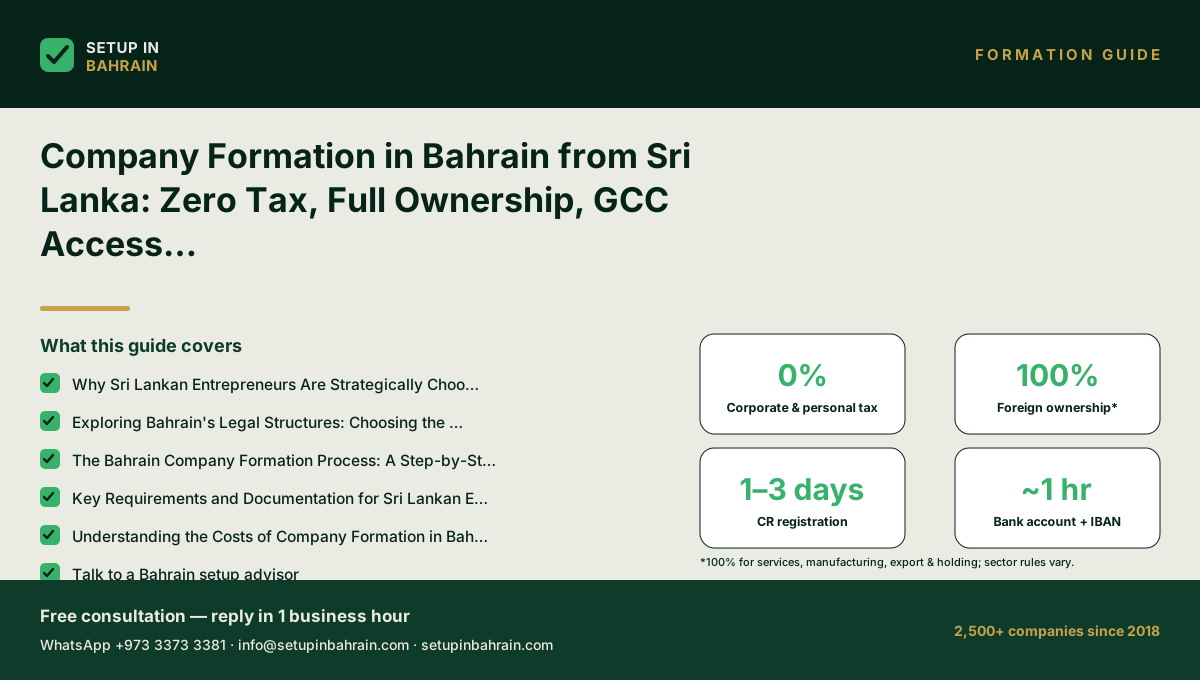
Complete guide for Sri Lanka entrepreneurs: form a company in Bahrain with generally no corporate income tax for most sectors, 100% foreign ownership, and GCC market access. Costs, steps, visas, banking.
→ Complete guide: Company Formation in Bahrain — the full 2026 guide
View details
Ownership & capital
A Bahrain WLL can be owned by a single person — 100% foreign ownership applies to most activities, with no local partner required for services, manufacturing, export trading and holding companies. The minimum share capital is BHD 1; we recommend BHD 1,000, which makes bank account opening and investor visa approval smoother.
For many Sri Lankan entrepreneurs, the dream of scaling a business internationally, protecting hard-earned profits, and accessing vast new markets feels increasingly distant, almost elusive. The last few years have presented unprecedented challenges back home, from the severe economic crisis of 2022 to ongoing fiscal adjustments that continue to reshape the business landscape. You’re likely grappling with soaring taxes, pervasive currency instability, capital controls that stifle international trade, and a banking system that’s, shall we say, less than straightforward for cross-border transactions in the wake of sovereign default.
Last year, a Colombo-based software exporter named Ruwan watched his company pay a staggering LKR 18.4 million in corporate income tax on LKR 61 million in profits. The very same week, his bank informed him that USD remittances for essential server upgrades would be delayed another 11 days because of capital control queues and a persistent scarcity of foreign exchange. Just two months later, the Inland Revenue Department requested three years of extensive transfer pricing documentation for his modest international dealings. Ruwan began exploring Bahrain company formation after a Singapore-based client, seeking greater financial predictability, specifically asked whether he could invoice from a jurisdiction with no withholding tax on royalties.
This isn't an isolated story. Many of you are living it. You’re wrestling with a 30% corporate income tax rate, the LKR currency's collapse (losing more than 45% of its value in 2022), the frustrating capital controls preventing free USD outflows, the post-2022 sovereign default affecting international banking relations, and the looming spectre of an 18% VAT. These are not minor inconveniences; they are fundamental threats to your business's growth and profitability.
But what if there was a direct, viable pathway to a stable, tax-free, and internationally connected business environment, just a few hours' flight away? Imagine operating your venture in a jurisdiction where your profits are truly yours, where your currency is stable and globally accepted, and where the world’s fastest-growing markets are literally at your doorstep, accessible without punitive tariffs or complex trade barriers.
This isn't a pipe dream. It's the tangible reality Bahrain offers.
This comprehensive 2026 guide is crafted exclusively for you, the Sri Lankan entrepreneur. We understand the unique pressures you face. We’ll show you exactly why Bahrain isn't just an alternative, but a strategic imperative for your business's long-term future, offering a direct, powerful contrast to these domestic challenges. We'll walk you through the precise steps, realistic costs, and undeniable advantages, addressing every single one of your pain points with real numbers, actionable advice, and a deep understanding of your entrepreneurial journey.
Before we dive in, let’s establish a crucial exchange rate for our discussions: For practical purposes throughout this guide, we will use an approximate conversion of BHD 1 ≈ LKR 870. Please note that currency rates are subject to fluctuation, but this figure provides a realistic benchmark for your financial planning.
Why Sri Lankan Entrepreneurs Are Strategically Choosing Bahrain
The decision to expand internationally is rarely taken lightly, particularly when it involves navigating complex regulations and significant investment. For Sri Lankan entrepreneurs, however, the decision often stems from a pressing need to safeguard their businesses against domestic volatility and unlock growth opportunities that are increasingly out of reach at home. Bahrain stands out as a beacon of stability and opportunity, directly addressing the core pain points you are experiencing.
Escaping Punitive Taxation: From 30% to Zero
Let's confront the most immediate and significant burden: taxation. Sri Lanka’s corporate income tax rate, currently at a flat 30%, is among the highest in the region. This means nearly one-third of your hard-earned profits are siphoned off before you even consider reinvestment or personal gain. For a business generating LKR 100 million in profit, LKR 30 million disappears into government coffers.
Bahrain offers a stark contrast: a 0% corporate income tax rate. This is not a temporary incentive or a complex scheme; it's a fundamental pillar of Bahrain's economic policy. For most business activities, your company will pay no corporate income tax. This means 100% of your profits remain within your business, available for reinvestment, expansion, or distribution. Imagine the difference this makes to your cash flow, your growth trajectory, and your overall profitability. This tax advantage alone can be a game-changer, rapidly accelerating your business's ability to scale.
Stabilizing Your Capital: From LKR Collapse to USD Peg
The memory of the LKR's dramatic collapse in 2022, when it lost over 45% of its value against the USD, is still fresh for every Sri Lankan entrepreneur. This currency depreciation eroded purchasing power, dramatically increased import costs, and created immense financial uncertainty. Hedging strategies became prohibitively expensive, and long-term financial planning became a gamble.
Bahrain’s currency, the Bahraini Dinar (BHD), offers unparalleled stability. The BHD has been pegged to the US Dollar at a rate of BHD 1 = USD 2.65 for over two decades. This unwavering peg provides a level of financial predictability that is simply unavailable in Sri Lanka. Your revenues and assets in Bahrain will be shielded from currency volatility, allowing you to plan with confidence, import goods at predictable costs, and protect the value of your investments. For businesses reliant on international trade or importing raw materials, this stability is not just a benefit; it's an operational necessity.
Freedom of Capital Movement: Breaking Through Capital Controls
Sri Lanka’s capital controls, particularly on USD outflows, have become a major impediment to international business operations. The delays, the extensive paperwork, and the outright restrictions on moving funds freely for imports, dividends, or international investments are not just frustrating; they choke growth. Many entrepreneurs find themselves in a constant battle with banks to simply pay their foreign suppliers or receive foreign earnings without excessive friction.
Bahrain boasts a fully liberalized economy with no foreign exchange controls, no restrictions on repatriation of capital, profits, or dividends, and no restrictions on inward or outward remittances. This means your business can operate with true financial freedom. You can move money in and out of Bahrain seamlessly, pay international suppliers without delays, and repatriate your profits back to Sri Lanka (or any other jurisdiction) as you see fit, without seeking multiple approvals or battling a dwindling supply of foreign currency. This free flow of capital is a fundamental advantage for any internationally oriented business.
Rebuilding Banking Trust: A Robust, Regulated Financial Hub
The post-2022 sovereign default in Sri Lanka profoundly impacted international banking relations. Many international banks became wary of transactions originating from or destined for Sri Lanka, leading to increased scrutiny, longer processing times, and in some cases, outright refusal of services. This 'de-risking' by global financial institutions adds another layer of complexity for Sri Lankan businesses trying to operate on the global stage.
Bahrain, on the other hand, is a well-established and highly respected financial hub, regulated by the Central Bank of Bahrain (CBB). The CBB maintains stringent regulatory standards, fostering a secure and transparent banking environment. Opening a corporate bank account in Bahrain connects you to a network of local, regional, and international banks that operate with integrity and efficiency. Your Bahraini entity will be viewed as a credible, low-risk counterparty by international financial institutions, streamlining your international transactions and restoring faith in your financial dealings. This access to a robust, internationally trusted banking system is invaluable.
Beyond the Horizon: Accessing the $1.6 Trillion GCC Market
While Sri Lanka offers its own market, its reach for many businesses is limited, and export opportunities can be challenging to navigate.
Establishing a company in Bahrain immediately positions your business at the heart of the $1.6 trillion Gulf Cooperation Council (GCC) market. Bahrain is a signatory to the GCC Customs Union and the GCC Common Market, meaning goods produced or substantially value-added in Bahrain can move freely across the borders of Saudi Arabia, UAE, Qatar, Kuwait, and Oman without customs duties. Furthermore, Bahrain's strategic location provides unparalleled access to the broader Middle East and North Africa (MENA) region, a rapidly growing consumer base of over 400 million people. For service providers, this means direct access to booming economies seeking expertise in IT, consulting, logistics, and more. This geographical and economic leverage is a critical growth accelerator.
Combating Rising VAT & Bureaucracy: A Predictable, Streamlined Environment
The current 15% VAT in Sri Lanka, with discussions around increasing it to 18%, adds another layer of cost and administrative burden. Coupled with evolving and often opaque regulatory processes, navigating the business landscape can be a constant challenge.
Bahrain offers a more predictable and streamlined regulatory environment. While Bahrain does have a standard VAT rate of 10% (which is competitive globally), the overall administrative burden for businesses is significantly lower. The Bahrain Economic Development Board (EDB) and the Ministry of Industry and Commerce (MOIC) are actively committed to making the Kingdom one of the easiest places to do business globally. This commitment is reflected in Bahrain's consistently high rankings in the World Bank's Ease of Doing Business reports, often outperforming many regional peers. Less bureaucracy, clear regulations, and a stable policy environment mean you spend less time on compliance and more time on growing your business.
In essence, Bahrain offers Sri Lankan entrepreneurs a rare combination of financial stability, significant tax advantages, unrestricted capital movement, a trusted banking system, and unparalleled market access. It’s not just about forming a company; it’s about securing a future for your enterprise.
Exploring Bahrain's Legal Structures: Choosing the Right Foundation
When you decide to establish your presence in Bahrain, selecting the appropriate legal structure is a foundational decision that impacts everything from ownership to liability and operational flexibility. For Sri Lankan entrepreneurs, given the desire for full control and ease of setup, the With Limited Liability Company (WLL) is overwhelmingly the most popular and recommended option.
The Workhorse: With Limited Liability Company (WLL)
The WLL is the most common form of business entity in Bahrain, favored by both local and international investors due to its flexibility and the protection it offers.
- 100% Foreign Ownership: This is a critical point for Sri Lankan entrepreneurs. Unlike some jurisdictions that require local partners or nominee shareholders, a WLL in Bahrain can be 100% owned by a single individual (who can be a foreign national) or a single corporate entity, with zero partners required. This ensures you maintain complete control over your business decisions and profits, eliminating the complexities and potential conflicts associated with local equity requirements.
- Limited Liability: As the name suggests, the liability of the shareholders is limited to the amount of their capital contribution. This means your personal assets are protected from the company’s debts and obligations, offering crucial financial security.
- Minimum Share Capital: Legally, the minimum share capital for a WLL is BHD 1. However, and this is an important practical consideration, to facilitate bank account approval and successfully apply for an investor visa, we strongly recommend establishing the company with a minimum paid-up share capital of BHD 1,000 (approximately LKR 870,000). While BHD 1 is legally permissible, it is insufficient to demonstrate financial substance to banks and immigration authorities. Think of BHD 1,000 as the practical entry point for seamless operations.
- Activities: A WLL can engage in a wide range of commercial, industrial, and service activities. Certain regulated activities (e.g., financial services, healthcare, education) may require specific additional licenses from relevant ministries or regulatory bodies, such as the Central Bank of Bahrain (CBB) for financial firms.
- Management: A WLL must have at least one director (manager). This can be a single individual, who can also be the sole shareholder.
- Audit Requirements: Generally, WLLs are required to appoint an auditor and submit audited financial statements annually, depending on their turnover and number of employees.
Why the WLL is ideal for Sri Lankan Entrepreneurs: The WLL provides the perfect balance of control, protection, and operational scope. It allows you to establish a fully owned, legally distinct entity, tap into the Bahraini market, and utilize it as a gateway to the GCC, all while enjoying the peace of mind of limited liability and a clear path to residency.
Other Structures (Briefly):
While the WLL is typically the best fit, it's worth knowing about other structures:
- Foreign Branch Office: Suitable for established foreign companies wanting to have a direct presence to conduct specific activities. It is an extension of the parent company, not a separate legal entity, and thus its liabilities extend to the parent.
- Establishment (Sole Proprietorship): Owned by a single individual, but offers no limited liability protection. Not generally recommended for serious business ventures requiring asset protection.
- Public Shareholding Company (BSC): Used for larger enterprises that intend to offer shares to the public. More complex regulatory requirements.
- Partnership Company (General Partnership, Limited Partnership): Involves two or more partners, with varying degrees of liability. Less common for initial foreign entry due to complexity or lack of limited liability.
Recommendation: For 99% of Sri Lankan entrepreneurs looking to start fresh in Bahrain, gain full ownership, limited liability, and facilitate an investor visa, the WLL is the definitive choice.
The Bahrain Company Formation Process: A Step-by-Step Guide
Navigating the bureaucratic landscape of a new country can seem daunting. However, Bahrain has made significant strides in streamlining its company formation process, largely through its "Sijilat" electronic registration system. While it's efficient, understanding the sequence and requirements is key.
Step 1: Initial Consultation and Activity Definition
Before anything else, you need a clear vision. What exact business activities will your Bahraini company undertake? This is crucial because your chosen activities dictate the type of licenses you'll need.
- Expert Guidance: Engage with a reputable business setup consultant in Bahrain. They will help you define your activities accurately, ensuring they align with MOIC classifications and advising on any specific regulatory approvals required. This initial consultation, often complimentary, can save you significant time and prevent costly mistakes.
Step 2: Name Reservation
Your company name needs to be unique and comply with Bahraini naming conventions.
- Application: Submit an application to the Ministry of Industry and Commerce (MOIC) via the Sijilat portal, proposing three name options in order of preference.
- Approval: Name approval is typically quick, often within 24-48 hours. Ensure the name reflects your business activity and is not offensive or already in use.
Step 3: Drafting Constitutive Documents
This involves preparing the legal groundwork for your WLL.
- Memorandum of Association (MOA): This document outlines the company’s name, objectives, share capital (BHD 1,000 recommended), shareholder details (you, as 100% owner), director details, and registered address.
- Articles of Association (AOA): Defines the internal regulations for the company’s management and operations.
- Power of Attorney (if applicable): If you are appointing a consultant to act on your behalf, a notarized Power of Attorney will be required.
- Notarization: These documents typically need to be prepared in Arabic (or bilingual) and notarized by a public notary in Bahrain.
Step 4: Initial Approvals and Licensing
Depending on your business activities, you might need pre-approvals from relevant government bodies before final registration.
- General Activities: Many standard commercial or service activities might only require MOIC approval.
- Regulated Activities: If your business is in finance, healthcare, education, or certain industrial sectors, you'll need approvals from the Central Bank of Bahrain (CBB), Ministry of Health, Ministry of Education, or Ministry of Industry, respectively. Your consultant will identify these early.
- MOIC Application: Submit all drafted documents, along with shareholder and director KYC (Know Your Customer) documents (passport copies, CVs, utility bills), to the MOIC via Sijilat.
Step 5: Bank Account Opening and Capital Deposit
This is a critical step, especially for Sri Lankan entrepreneurs.
- Provisional Approval: Once the MOIC grants provisional approval, you can proceed to open a corporate bank account.
- Bank Due Diligence: Be prepared for extensive due diligence from Bahraini banks. They will scrutinize your background, source of funds, and business plan. This is where a strong business plan and a reputable consultant are invaluable.
- Recommended Capital: Deposit the recommended BHD 1,000 (or higher) as the paid-up share capital. The bank will issue a capital deposit certificate.
Pain Point Address: For Sri Lankan entrepreneurs, opening an international bank account can be challenging due to the 'de-risking' practices by global banks post-2022. Bahraini banks are CBB-regulated and robust, but they will require clear evidence of legitimate business activity, transparent source of funds, and a solid business case. Work closely with your consultant to present a compelling profile.
Step 6: Final Registration and Commercial Registration (CR) Issuance
With bank account and capital deposit complete, you submit the final documents.
- Capital Deposit Certificate: Submit the bank's certificate confirming the deposit of your share capital to the MOIC.
- Final Review: The MOIC conducts a final review of all documents.
- CR Issuance: Upon approval, your Commercial Registration (CR) certificate is issued. This is your official license to operate in Bahrain. The CR will list your company name, activities, CR number, and registered address.
Step 7: Office Space and Lease Agreement
Every company in Bahrain needs a physical presence.
- Virtual vs. Physical: While virtual offices are initially permissible for registration in some cases, a physical address is typically required for full operational setup, especially for visa applications. Serviced offices are an excellent starting point, offering flexibility and prestige.
- Lease Agreement: Secure a lease agreement for your office space. This document will be required for the final stages of registration and for your Labour Market Regulatory Authority (LMRA) registration.
Step 8: LMRA Registration and Visa Application (If Applicable)
If you intend to reside in Bahrain and operate your business directly, you’ll need to apply for an investor visa.
- LMRA Registration: Register your company with the Labour Market Regulatory Authority (LMRA). This is essential for employing staff and processing your own visa.
- Investor Visa: As a shareholder and/or director, you can apply for an investor visa (also known as a self-sponsorship visa). This visa typically lasts for two years initially and is renewable. It allows you to reside in Bahrain and manage your business. You can also sponsor your immediate family members (spouse and children).
Timeline: The entire process, from initial consultation to receiving your CR, can typically take 2-4 weeks if all documents are in order and approvals are swift. If specialized licenses are required, it could extend to 6-8 weeks.
Key Requirements and Documentation for Sri Lankan Entrepreneurs
Successful company formation hinges on meticulous preparation of the required documents. As a Sri Lankan entrepreneur, you'll need to provide comprehensive personal and business documentation.
Personal Documents for the Shareholder(s) and Director(s):
- Passport Copy: Valid passport with at least 6 months validity from the date of application.
- National ID Card Copy (Sri Lanka NIC): A clear copy of your Sri Lankan National Identity Card.
- Curriculum Vitae (CV)/Resume: A detailed CV outlining your educational background, professional experience, and relevant skills. This helps the authorities understand your profile and credibility.
- Proof of Residential Address: A recent utility bill (electricity, water, telephone) or bank statement, not older than three months, showing your current residential address in Sri Lanka.
- Bank Reference Letter: A letter from your personal bank in Sri Lanka, confirming your banking relationship (account holder, account opening date, and good standing). This is crucial for due diligence in Bahrain.
- Police Clearance Certificate (PCC) / Good Conduct Certificate: While not always mandatory for initial registration, this is typically required for investor visa applications. Obtainable from the Sri Lankan Police Department, certifying no criminal record.
- No Objection Letter (NOL): If you are currently employed in Sri Lanka, your current employer might require you to provide a "No Objection Letter" stating they have no objection to you establishing a business abroad, especially if you intend to maintain your employment. While not a Bahraini requirement, it's a good practice for personal compliance.
- Photographs: Recent passport-sized photographs (usually white background).
Company Documents (if shareholder is a corporate entity):
If your Bahraini WLL will be owned by an existing company in Sri Lanka:
- Certificate of Incorporation: Legal proof of your Sri Lankan company's registration.
- Memorandum & Articles of Association: The founding documents of the Sri Lankan parent company.
- Board Resolution: A resolution from the board of directors of the Sri Lankan company, explicitly approving the establishment of a subsidiary in Bahrain, naming the authorized signatory, and committing the required capital.
- Good Standing Certificate: From the Sri Lankan Registrar of Companies, confirming the company is active and compliant.
- Audited Financial Statements: Recent audited financial statements of the Sri Lankan company (usually for the last 1-2 years).
Business-Related Documents:
- Business Plan: A well-structured business plan is vital. It should include:
- Trade Name (Reserved): The approved company name from MOIC.
- Office Lease Agreement: A valid lease contract for your physical office space in Bahrain.
- Bank Capital Deposit Certificate: Proof from a Bahraini bank that the minimum share capital (BHD 1,000 recommended) has been deposited.
Attestation and Legalization:
- Many documents originating from Sri Lanka (e.g., passport copies, certificates of incorporation, MOA/AOA, police clearance) will need to be attested by the Ministry of Foreign Affairs in Sri Lanka and then by the Bahraini Embassy in Colombo.
- Alternatively, documents can be issued in Sri Lanka, apostilled (if Sri Lanka is a Hague Convention signatory for apostille, which it is as of 2011), and then authenticated by the Bahraini embassy. Your consultant will guide you on the most efficient attestation process.
Pro-Tip: Start gathering and attesting your documents early. Delays in document authentication are a common cause of slowdowns in the company formation process. Ensure all copies are clear, legible, and officially certified where required.
Understanding the Costs of Company Formation in Bahrain
One of the first questions any entrepreneur asks is, "How much will this cost?" While Bahrain is generally considered cost-effective compared to other GCC hubs, it's important to understand the various components that contribute to the total investment. For transparency, we’ll break down estimated costs in Bahraini Dinars (BHD) and provide an approximate conversion to Sri Lankan Rupees (LKR).
1. Government Fees (One-Time & Annual)
These are mandatory fees paid directly to the Bahraini government bodies.
- Commercial Registration (CR) Fee:
- Commercial Name Reservation Fee: BHD 10 (LKR 8,700).
- Ministry of Industry and Commerce (MOIC) Activities Fees: Varies based on the number and type of commercial activities listed on your CR.
- Labour Market Regulatory Authority (LMRA) Fees:
2. Share Capital Deposit
Recommended Minimum: BHD 1,000 (LKR 870,000). This is the practical minimum required to satisfy bank account opening requirements and investor visa criteria. This is your* money, held in your company's bank account, and can be used for operational expenses once the company is fully registered and active.
3. Professional Services Fees (One-Time)
Engaging a reputable local consultant is not an option; it's a necessity for a smooth process. They handle documentation, liaise with government bodies, and provide crucial advice.
- Company Formation Services: These fees vary based on the scope of services, the complexity of your business activities, and the reputation of the firm.
- Legal & Advisory Fees: If your business has specific legal requirements or needs in-depth financial advisory, additional fees may apply.
4. Office Space Costs (Annual/Monthly)
Every company needs a registered address.
- Serviced Office/Virtual Office: A cost-effective solution for startups.
- Physical Office Space: Rent for a dedicated office can range from BHD 250 - BHD 1,000+ (LKR 217,500 - LKR 870,000+) per month, depending on location, size, and amenities.
5. Visa and Residency Costs (If Applicable)
If you plan to live and work in Bahrain through your company.
- Investor Visa Fee:
Bahrain Business Guides for Sri Lanka Citizens
Ready to set up in Bahrain from Sri Lanka?
Tell us your business idea. We map the right entity, ownership and timeline — then handle the filing while you focus on what matters.