
Set up your Bahrain company from Spain and enjoy generally no corporate income tax for most sectors. Fast registration, full support for Spanish entrepreneurs expanding to the Gulf.
Key Takeaways
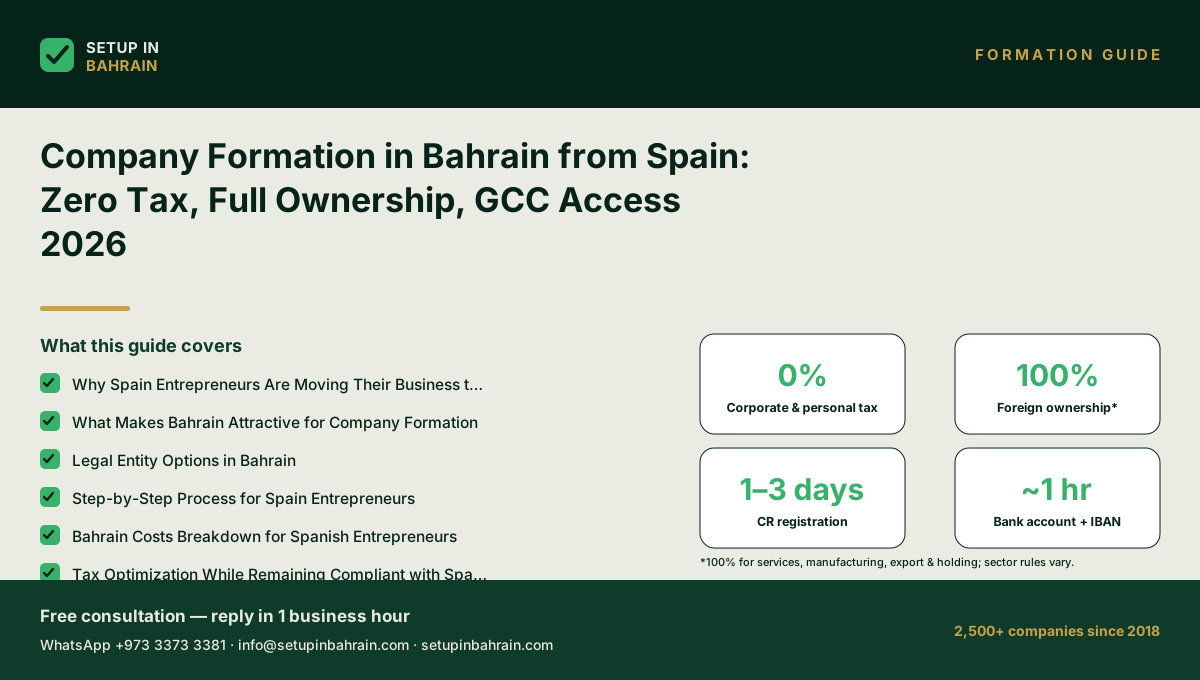
- Why Spain Entrepreneurs Are Moving Their Business to Bahrain
- What Makes Bahrain Attractive for Company Formation
- Legal Entity Options in Bahrain
- Step-by-Step Process for Spain Entrepreneurs
- Bahrain Costs Breakdown for Spanish Entrepreneurs
→ Complete guide: Company Formation in Bahrain — the full 2026 guide
View details
Ownership & capital
A Bahrain WLL can be owned by a single person — 100% foreign ownership applies to most activities, with no local partner required for services, manufacturing, export trading and holding companies. The minimum share capital is BHD 1 ; we recommend BHD 1,000 . This Makes bank account opening and investor visa approval smoother.
The call came on a rainy Tuesday afternoon in Barcelona. Javier had just finished reviewing his annual tax summary with his gestor when the reality hit him like a punch to the gut. His IT services company had posted €540,000 in revenue—a record year by any measure. But after the 25% Impuesto sobre Sociedades, the relentless quarterly pagos fraccionados that never aligned with his actual cash flow, the monthly modelo 303 VAT submissions, and the crushing 29.9% employer Social Security contributions for his team of twelve, he was left staring at a figure that made his stomach turn.
"You kept about €187,000 after everything," his accountant said, almost apologetically. "The Catalonia autonomous community surcharge pushed your effective rate higher than last year."
Javier did the mental math. He'd worked 2,800 hours that year. His company had grown 34%. And he was keeping roughly 35 cents of every euro his business generated. Not because he was doing anything wrong—because he was doing everything right, inside a system that systematically extracts wealth from entrepreneurs who build profitable companies.
That conversation happened eighteen months ago. Today, Javier operates through a Bahrain WLL company. His corporate tax bill last year was exactly €0. He still serves his Spanish and European clients, still employs staff (some in Spain as contractors, others in Bahrain). Still visits his family in Catalonia every few months. The difference isn't geography—it's structure. He moved genuine operational substance to Bahrain, established proper economic presence. Stopped feeding a fiscal system that treats business success as a problem to be corrected through taxation.
This guide exists for Spanish entrepreneurs who've done the math and recognize the numbers no longer work. Not for tax evasion—that path leads to prison and deserves to. But for legitimate international restructuring that positions your business inside one of the world's most competitive tax environments while opening doors to the €2.4 trillion GCC economy sitting just 25 kilometers across the King Fahd Causeway from Saudi Arabia.
If you're running a profitable service business, consultancy, SaaS company, or trading operation from Spain and wondering why your growth never seems to compound the way it should, the answer probably isn't your business model. It's your jurisdiction.
Why Spain Entrepreneurs Are Moving Their Business to Bahrain
Spanish entrepreneurs aren't relocating because they hate their country. Most genuinely love Spain—the culture, the lifestyle, the family connections, the food that makes everywhere else taste slightly disappointing. They're leaving because the arithmetic of building generational wealth while paying Spanish tax rates has become nearly impossible for service-based businesses, consultancies, and digital operations.
The frustration isn't abstract or theoretical. It's the January pago fraccionado demand arriving when your Q4 invoices haven't been collected yet. It's the modelo 303 requiring submission by the 20th of each month while you're trying to close deals and serve clients. It's watching your effective tax rate climb above 45% when you combine corporate tax, personal income tax on dividends. The various social contributions that nobody explained when you started your empresa.
Let me paint the picture with real numbers that Spanish business owners will immediately recognize.
The True Cost of Operating in Spain
Consider a Spanish SL (Sociedad Limitada) generating €400,000 in annual profit before taxes. Here's what actually happens to that money:
Corporate Level (Impuesto sobre Sociedades):
- Base rate: 25% = €100,000
- Remaining for distribution: €300,000
If You Pay Yourself a Salary (€80,000 gross):
- Employer Social Security (29.9%): €23,920
- Employee Social Security (~6.35%): €5,080
- IRPF withholding (~24% marginal): €19,200
- Net to your pocket: about €55,800
If You Take Dividends Instead:
- First €6,000: 19% = €1,140
- €6,000-€50,000: 21% = €9,240
- €50,000-€200,000: 23% = €34,500
- Dividend tax on €150,000: about €44,880
Additional Hidden Costs:
- Gestoría fees for modelo 303, modelo 200, modelo 202: €3,000-6,000 annually
- Autonomous community variations (Catalunya adds 0.5-2% depending on circumstances)
- Wealth tax (Impuesto sobre el Patrimonio) if net worth exceeds thresholds
The entrepreneur who generated €400,000 in profit ends up with somewhere between €180,000 and €220,000 in actual usable income. That's a combined effective rate approaching 50% when you trace every euro from company revenue to personal spending power.
Why Bahrain Changes the Equation Completely
Now run the same €400,000 profit scenario through a Bahrain WLL:
Corporate Level:
- Corporate tax: 0%
- Remaining for distribution: €400,000
Personal Taxation in Bahrain:
- Personal income tax: 0%
- Dividend withholding: 0%
- Capital gains tax: 0%
Actual Costs:
- Annual CR renewal: ~€200
- Accounting and compliance: €2,000-4,000
- Office space (if physical): €3,000-8,000 annually
The same entrepreneur keeps about €390,000. The difference—roughly €170,000-€200,000 annually—isn't a one-time benefit. It compounds. Over a decade, that's €1.7-2 million in additional retained capital available for reinvestment, hiring, expansion, or building genuine wealth.
This isn't theoretical arbitrage. It's the mathematical reality that's driving thousands of European entrepreneurs to restructure through Gulf jurisdictions, with Bahrain emerging as the preferred destination for reasons we'll explore throughout this guide.
The Spanish Tax Pain Points That Push Entrepreneurs Away
Beyond the headline rates, Spanish entrepreneurs face operational friction that compounds daily:
Pagos Fraccionados (Quarterly Advance Payments): The Agencia Tributaria demands payment of 18% of your previous year's tax liability in April, October. December—regardless of current year performance. If you had a strong 2024 but 2025 started slow, you're paying taxes on profits you haven't made yet, creating cash flow crises that have bankrupted otherwise healthy businesses.
Modelo 303 Monthly/Quarterly VAT: Spanish IVA (21% standard rate) must be declared and paid even when clients haven't paid their invoices. You're financing the government's VAT collection from your own cash reserves, sometimes for months. Chasing payment from slow-paying Spanish corporates.
Social Security for Autónomos: The 2024 autónomo base starts at €377/month and scales upward based on income. High-earning autónomos pay over €500/month just for the privilege of working for themselves, regardless of whether they're actually generating revenue that month.
Employer Contributions: At 29.9% of gross salary, hiring employees in Spain carries a 30% surcharge invisible on pay stubs but very visible on your P&L. A €50,000 employee costs €64,950 before they see a single euro.
Regional Complexity: Operating across autonomous communities means navigating different rules for everything from commercial registers to minor fiscal variations. A company in Madrid faces slightly different requirements than one in Catalunya, Andalucía, or País Vasco—each with their own bureaucratic quirks.
Juzgado de lo Mercantil Delays: When clients don't pay or disputes arise, Spanish commercial courts move at glacial pace. Cases drag for 18-36 months routinely, tying up management attention and legal fees while the underlying business problem festers unresolved.
The cumulative effect isn't just financial. It's psychological. Spanish entrepreneurs spend enormous cognitive energy managing tax compliance rather than building businesses. They structure decisions around fiscal consequences rather than market opportunities. They hesitate to hire, invest, or expand because every growth step carries disproportionate tax consequences.
Bahrain offers the opposite environment: minimal compliance burden, Generally no corporate income tax for most sectorsation, and a regulatory framework explicitly designed to attract exactly the kind of ambitious, growth-oriented entrepreneurs that Spain's system seems designed to punish.
What Makes Bahrain Attractive for Company Formation
Bahrain's appeal to Spanish entrepreneurs extends far beyond the zero tax rate, though that headline figure certainly captures attention. The Kingdom has built a comprehensive ecosystem for international business that addresses nearly every pain point that frustrated you operating in Spain.
Generally no corporate income tax for most sectors with No Catches
Unlike jurisdictions that advertise low taxes then reveal hidden fees, Bahrain's generally no corporate income tax for most sectors is genuine. There's no alternative minimum tax, no branch profit tax, no accumulated earnings tax, no capital gains tax on share disposals. The Central Bank of Bahrain (CBB) and the Ministry of Industry and Commerce (MOIC) have maintained this position consistently for decades, providing the regulatory certainty that entrepreneurs need for long-term planning.
The only corporate-level taxation that exists applies to oil and gas companies (46% on petroleum extraction) and large multinationals meeting the OECD Pillar Two thresholds (15% minimum). For Spanish service businesses, consultancies, trading companies, and SMEs—the tax rate is and remains zero.
100% Foreign Ownership Since 2017
Before 2017, Bahrain required local partners for most business structures—a common Gulf requirement that created complications and costs. The Commercial Companies Law amendments removed this restriction entirely for non-strategic sectors. Spanish entrepreneurs can now own 100% of their Bahrain company in activities including:
- Professional services and consulting
- Technology and software development
- Trading and distribution
- Manufacturing
- Tourism and hospitality
- Education and training
- Healthcare (with appropriate licensing)
- Financial services (with CBB authorization)
The Bahrain Economic Development Board (EDB) actively promotes this foreign ownership advantage, positioning the Kingdom as the most accessible GCC entry point for European businesses.
No Personal Income Tax
This feature often gets overlooked in corporate discussions, but it's crucial for entrepreneur compensation planning. Bahrain imposes zero personal income tax on salaries, dividends, capital gains, or wealth. If you relocate personally and establish genuine residency, your worldwide income becomes tax-free at source (though Spanish exit tax and CRS reporting obligations must be managed properly—more on this later).
For Spanish autónomos accustomed to watching 40-50% of their earnings disappear into various contribution schemes, the contrast is almost surreal. Income earned is income kept.
Strategic GCC Market Access
Bahrain sits at the geographic and economic center of the Gulf Cooperation Council market. The King Fahd Causeway connects directly to Saudi Arabia's Eastern Province—home to Aramco, SABIC. The Kingdom's industrial heartland. Bahrain serves as the testing ground and regional headquarters for companies targeting the broader GCC:
- Saudi Arabia: €700 billion GDP, 35 million consumers, Vision 2030 spending billions on diversification
- UAE: €400 billion GDP, regional trading hub, diversified economy
- Qatar: €200 billion GDP, highest per-capita income globally
- Kuwait: €140 billion GDP, sovereign wealth funds actively investing
- Oman: €80 billion GDP, strategic logistics position
Spanish companies establishing in Bahrain gain proximity credentials that matter for Gulf procurement. Arabic-language capabilities, local incorporation, and physical presence signal commitment that European-based competitors cannot match. The GCC free trade agreement means goods and many services flow between member states with minimal barriers.
Financial Services Hub
The Central Bank of Bahrain regulates one of the region's most sophisticated financial sectors. Over 400 financial institutions operate in the Kingdom, providing:
- International banking relationships (HSBC, Standard Chartered, Citibank all have substantial presence)
- Trade finance and letters of credit for GCC commerce
- Islamic finance options for clients preferring Sharia-compliant structures
- Investment banking and capital markets access
For Spanish fintech companies, Bahrain's regulatory sandbox program allows testing innovative products under CBB supervision before full licensing—a pathway that's attracted European firms unable to navigate more restrictive home regulators.
Quality of Life That Spaniards Appreciate
Beyond business considerations, Bahrain offers lifestyle elements that resonate with Mediterranean sensibilities:
- Warm climate year-round (hot in summer, pleasant October-April)
- Cosmopolitan expat community with European restaurants, entertainment, and social options
- Direct flights to Madrid and Barcelona (6-7 hours)
- English widely spoken in business; Arabic adds optional market advantage
- Safe, family-friendly environment with excellent international schools
- Greatly lower cost of living than UAE or Qatar
- No restrictions on alcohol consumption (unlike Saudi Arabia)
Spanish entrepreneurs report that Bahrain feels more "livable" than other Gulf options. It's smaller and less flashy than Dubai. This Some find appealing after the overwhelming scale of UAE cities.
Legal Entity Options in Bahrain
Choosing the right corporate structure is arguably the most important decision in your Bahrain company formation journey. The Ministry of Industry and Commerce (MOIC) recognizes several entity types, each with distinct characteristics suited to different business models and business situations.
WLL (With Limited Liability Company)
The WLL is Bahrain's equivalent of a Spanish SL and represents the most popular choice for Spanish entrepreneurs establishing genuine operational businesses.
Key Characteristics:
- Minimum capital: BD 20,000 (~€48,000) for activities on the restricted list; no minimum for most service activities since 2018 reforms
- Shareholders: Minimum 2, maximum 50 (a common arrangement uses the entrepreneur plus a nominee or family member)
- 100% foreign ownership: Permitted since Commercial Companies Law amendments
- Local director not required: Foreign nationals can serve as sole directors
- Registered office: Required within Bahrain
- Annual audit: Mandatory for companies exceeding certain thresholds
Best Suited For: Spanish consultancies, service providers, trading companies. Businesses planning genuine GCC expansion with local staff, contracts, and operational substance.
Typical Timeline: 2-4 weeks for straightforward applications; 6-8 weeks with additional licensing requirements.
single-shareholder WLL
Introduced to accommodate solo entrepreneurs, the WLL allows single-shareholder incorporation while maintaining limited liability protection.
Key Characteristics:
- Single shareholder: Individual or corporate
- Minimum capital: No statutory minimum for most activities
- Liability: Limited to contributed capital
- Suitable for: Freelancers, consultants, and solo operators establishing Bahrain presence
Limitations: WLLs cannot undertake certain regulated activities and may face credibility challenges with larger corporate clients expecting traditional company structures. Some Spanish entrepreneurs start with WLLs then convert to WLLs as operations expand.
Branch Office
Spanish companies preferring to maintain their existing SL structure while establishing Bahrain presence can register a branch office.
Key Characteristics:
- Not a separate legal entity: Branch is extension of parent company
- Parent company liability: Unlimited for branch obligations
- Local registration: Required with MOIC
- Accounting: Branch must maintain separate accounts but files with parent
Tax Implications: This is where Spanish entrepreneurs must be careful. A branch's profits may be attributed back to the Spanish parent company under Spanish tax law, eliminating Bahrain's zero-tax advantage. Branch structures work better for specific purposes (construction projects, temporary presence) rather than ongoing operations.
Holding Company
For Spanish entrepreneurs with multiple business interests or investment portfolios, Bahrain holding company structures offer:
Key Characteristics:
- Asset protection: Separates operating businesses from investment holdings
- Dividend flows: Zero withholding on dividends received or distributed
- Regional consolidation: Efficient structure for GCC portfolio management
CBB Licensing: Holding companies with financial assets may require CBB authorization, adding regulatory complexity but providing institutional credibility.
Free Zone Companies (Bahrain Investment Wharf, Bahrain Logistics Zone)
Bahrain's free zones offer streamlined incorporation for specific activities:
Bahrain Investment Wharf:
- Manufacturing and light industrial focus
- Customs duty exemptions on imports/exports
- Dedicated infrastructure for production operations
Bahrain Logistics Zone:
- Distribution and warehousing
- Strategic location near port and airport
- Third-party logistics facilitation
Consideration for Spanish Entrepreneurs: Free zone companies face restrictions on direct Bahrain mainland trading. If your clients are GCC corporates (rather than re-export operations), mainland WLL incorporation typically offers more flexibility despite lacking customs duty benefits.
Comparison Table: Entity Selection for Spanish Entrepreneurs
| Factor | WLL | WLL | Branch | Holding Co |
| Minimum shareholders | 2 | 1 | N/A | 1+ |
| Limited liability | Yes | Yes | No | Yes |
| 100% foreign ownership | Yes | Yes | Yes | Yes |
| Spanish tax efficiency | Excellent | Excellent | Poor | Excellent |
| Client credibility | High | Medium | Medium | High |
| Setup complexity | Medium | Low | Medium | High |
| Typical timeline | 3-4 weeks | 2-3 weeks | 4-6 weeks | 4-8 weeks |
| Best for | Operating businesses | Solo consultants | Temporary projects | Investment portfolios |
Step-by-Step Process for Spain Entrepreneurs
Forming a Bahrain company from Spain involves navigating both Bahrain's registration requirements and Spanish exit considerations. The process, while straightforward compared to many jurisdictions, requires attention to sequence and documents.
Phase 1: Pre-Formation Planning (Weeks 1-2)
Activity Selection and License Determination: Before filing anything, identify your business activities using Bahrain's standardized classification system. The MOIC maintains activity codes that determine licensing requirements, permitted corporate structures, and any regulatory approvals needed.
Common Spanish business activities and their Bahrain classifications:
- Management consulting: Professional services license
- Software development: IT services license
- Digital marketing: Marketing services license
- Import/export trading: Commercial license
- Training and education: Educational services license (may require Ministry of Education approval)
Name Reservation: Bahrain company names must:
- Be available (not registered by existing entity)
- Not conflict with trademarks
- Include appropriate suffix (WLL, WLL, etc.)
- Not imply government affiliation without authorization
The MOIC's Sijilat system allows online name searches and reservations. Expect 2-3 business days for confirmation.
Registered Office Arrangement: Every Bahrain company requires a physical registered address. Options range from:
- Serviced offices in Bahrain Financial Harbour, World Trade Centre, or Diplomatic Area (€300-800/month)
- Virtual office with registered agent (€100-200/month for address only)
- Traditional office lease (€400-1,500/month depending on location and size)
For Spanish entrepreneurs not immediately relocating, virtual office arrangements with professional registered agent services provide compliant solutions while minimizing overhead.
Phase 2: Documents Preparation (Weeks 2-3)
Required Documents for Spanish Nationals:
- Passport copies: Clear color copies of biographical pages for all shareholders and directors
- Proof of address: Spanish utility bill, bank statement, or empadronamiento certificate (apostilled and translated)
- Bank reference letter: From your Spanish bank confirming good standing (apostilled and translated)
- Professional CV/Resume: For principal shareholders demonstrating relevant experience
- Articles of Association: Drafted according to Bahrain Commercial Companies Law requirements
- Memorandum of Association: Specifying share capital, distribution, and corporate governance
Apostille and Translation Requirements: Spain participates in the Hague Apostille Convention, simplifying document authentication. Your documents require:
- Spanish notarization (where applicable)
- Apostille stamp from the Ministerio de Justicia or Tribunal Superior
- Arabic or English translation by certified translator
- Some documents may require UAE/Bahrain embassy attestation depending on MOIC officer discretion
Capital Verification: While many activities no longer require minimum capital, some licenses mandate BD 20,000 (about €48,000) deposits. This amount must be available in a Bahrain bank account before incorporation completes, though can be used for operating purposes afterward.
Phase 3: Incorporation Filing (Weeks 3-4)
MOIC Submission via Sijilat: Bahrain's Sijilat platform handles most incorporation steps electronically:
- Create Sijilat account and verify identity
- Submit company name reservation
- Upload translated and authenticated documents
- Pay initial registration fees (typically BD 100-300 depending on entity type)
- Schedule any required in-person meetings
Commercial Registration (CR) Issuance: Upon document approval, MOIC issues the Commercial Registration—your company's primary operating license. The CR specifies:
- Company legal name
- Registration number
- Permitted activities
- Registered address
- Shareholder and director details
This document enables bank account opening, visa applications, and contract signing. Guard it carefully; it's required for virtually every business interaction in Bahrain.
Phase 4: Post-Incorporation Setup (Weeks 4-6)
Corporate Bank Account: Opening a Bahrain corporate bank account requires:
- CR copy and Memorandum/Articles
- Shareholder and director passport copies
- Proof of business activities (contracts, website, business plan)
- Source of funds documents
- In-person or video verification meeting
Recommended banks for Spanish entrepreneurs:
- HSBC Bahrain: Strong European correspondent network, familiar to Spanish banks
- Standard Chartered: Efficient onboarding, good digital banking
- Ahli United Bank: Largest Bahrain bank, extensive local relationships
- NBB (National Bank of Bahrain): Competitive fees, reliable service
Bank account opening typically takes 2-4 weeks after CR issuance, depending on due diligence requirements and your documents preparation.
Social Insurance Registration: If hiring Bahraini nationals or residents, register with the Social Insurance Organization (SIO). Contributions vary by nationality:
- Bahraini employees: 19% total (12% employer, 7% employee)
- Expat employees: 7% total (3% employer, 4% employee)
These rates are greatly lower than Spanish Social Security contributions, especially for expatriate staff.
Municipality License: Depending on your registered address and activities, additional municipality licensing may apply. Your registered agent or legal counsel will advise on requirements.
Immigration and Visa Processing: To work legally in Bahrain or sponsor employee visas, you'll need:
- CR showing appropriate activities
- Approval from Labour Market Regulatory Authority (LMRA)
- Employment visa applications for foreign staff
- Residence permit processing
Spanish entrepreneurs planning personal relocation should budget 4-8 weeks for residence permit processing after company incorporation.
Timeline Summary: Spain to Bahrain Company Formation
| Phase | Duration | Key Milestones |
| Planning | Weeks 1-2 | Activity selection, name reservation, registered office |
| Documents | Weeks 2-3 | Apostille, translation, capital preparation |
| Incorporation | Weeks 3-4 | MOIC filing, CR issuance |
| Post-incorporation | Weeks 4-6 | Bank account, immigration, operational setup |
| Total | 4-6 weeks | Fully operational Bahrain entity |
Bahrain Costs Breakdown for Spanish Entrepreneurs
Understanding actual costs prevents budget surprises and enables accurate comparison with Spanish operating expenses. Bahrain's cost structure is generally favorable, though certain items surprise entrepreneurs accustomed to European pricing.
Initial Formation Costs
| Item | Cost Range (EUR) | Notes |
| Company name reservation | €25-50 | Via Sijilat platform |
| CR registration fees | €150-400 | Varies by entity type and activities |
| Memorandum/Articles drafting | €500-1,500 | Legal counsel recommended |
| Document apostille (Spain) | €50-100 | Per document at Ministerio de Justicia |
| Translation and certification | €200-500 | Depending on document volume |
| Registered agent fees (Year 1) | €1,000-3,000 | Includes registered office |
| Share capital deposit | €0-48,000 | Activity dependent; refundable for operations |
| Legal/formation service | €2,000-5,000 | Optional but recommended for Spanish entrepreneurs |
Compare this with Spanish SL formation: €3,000 minimum capital (frozen for the share capital), notary fees of €300-600, registro mercantil fees of €150-400, and gestoría setup charges of €500-1,000. The Bahrain premium of €1,000-5,000 over Spanish formation costs pays for itself within the first quarter of zero tax operation.
Annual Operating Costs
| Item | Annual Cost (EUR) | Notes |
| CR renewal | €150-300 | Mandatory annual renewal |
| Registered office/address | €1,200-10,000 | Virtual to dedicated office range |
| Accounting and bookkeeping | €2,000-6,000 | Depends on transaction volume |
| Annual audit | €2,000-5,000 | Required above certain thresholds |
| Registered agent retainer | €1,500-3,000 | Ongoing compliance support |
| Bank fees | €200-600 | Account maintenance and transfers |
| LMRA fees (if employing) | €150-400/employee | Annual work permit renewals |
A comparable Spanish SL faces:
- Impuesto sobre Sociedades: 25% of profit
- Gestoría monthly retainer: €200-500/month (€2,400-6,000/year)
- Modelo 303 preparation: included or €50-100/month additional
- Registro mercantil annual fees: €100-200
- Audit (if required): €3,000-8,000
The Spanish company pays €7,000-15,000 in administrative costs before the 25% corporate tax. The Bahrain entity's annual costs represent its total fiscal burden—no additional percentage extracted from profits.
Cost Comparison: €300,000 Profit Scenario
| Cost Element | Spain SL | Bahrain WLL |
| Corporate tax | €75,000 | €0 |
| Administrative/compliance | €8,000 | €12,000 |
| Social contributions (owner) | €6,000 | €0 |
| Total annual cost | €89,000 | €12,000 |
| Net retained | €211,000 | €288,000 |
| Additional Bahrain benefit | €77,000/year |
Tax Optimization While Remaining Compliant with Spanish Law
This section addresses the most important consideration for Spanish entrepreneurs: how to legitimately benefit from Bahrain's zero-tax environment while remaining fully compliant with Spanish law and international transparency requirements.
Let me be direct: Spain's Agencia Tributaria is sophisticated, well-resourced. More and more focused on international structures. The Common Reporting Standard (CRS) means your Bahrain bank accounts are automatically reported to Spanish authorities. Attempting to hide a Bahrain company while maintaining Spanish tax residence is not optimization—it's evasion. It will eventually result in substantial penalties, interest, and potential criminal prosecution.
The legitimate path involves genuine restructuring of your business and, typically, your personal tax residence.
Understanding Spanish Tax Residence Rules
Spain taxes its tax residents on worldwide income. You remain Spanish tax resident if:
- Physical presence: You spend more than 183 days in Spain during the calendar year, OR
- Economic interest center: Your principal business activities or economic interests are located in Spain, OR
- Family ties: Your spouse and/or minor children reside in Spain (presumption that can be rebutted with evidence)
Breaking Spanish tax residence requires demonstrating that none of these conditions apply. Simply incorporating in Bahrain while continuing to live in Barcelona achieves nothing except creating reporting obligations.
The Exit Tax (Impuesto de Salida)
Spain imposes an exit tax on unrealized capital gains when tax residents relocate to non-EU countries. If your net worth in shares, participations, or similar assets exceeds €4 million, or if you hold more than 25% of any company worth over €1 million, you may face immediate taxation on paper gains upon establishing non-Spanish tax residence.
For entrepreneurs with valuable Spanish SL participations, this requires careful planning:
- Valuation of existing Spanish company shares
- Potential restructuring before relocation
- Deferral elections available for moves within EU (not applicable to Bahrain)
- Installment payment options in certain circumstances
Professional tax advice is essential before triggering exit tax events. The tax due can be substantial. It's a one-time cost compared to ongoing annual taxation at Spanish rates.
Legitimate Bahrain Company Structures for Spanish Entrepreneurs
Scenario 1: Full Relocation
The cleanest structure involves genuinely relocating to Bahrain:
- Establish Bahrain WLL with proper substance
- Get Bahrain residence permit
- Spend fewer than 183 days in Spain
- Ensure your economic interest center is genuinely in Bahrain
- File final Spanish tax return and formally notify Agencia Tributaria of residency change
Spanish-source income (like rent from Spanish property or dividends from Spanish companies you retain) remains taxable in Spain under the Spain-Bahrain relationship, but your Bahrain company profits and personal income become tax-free.
Scenario 2: Split Operations (Higher Complexity)
Some entrepreneurs maintain Spanish tax residence while operating a genuine Bahrain subsidiary:
- Spanish parent company holds Bahrain subsidiary
- Bahrain subsidiary has real substance: local employees, office, decisions made in Bahrain
- Transfer pricing between Spanish parent and Bahrain subsidiary follows arm's length principles
- Bahrain subsidiary profits accumulate tax-free
- Dividends to Spanish parent taxed at participation exemption rates (potentially exempt if meeting conditions)
This structure requires meticulous compliance with Controlled Foreign Corporation (CFC) rules and transfer pricing documents. The Agencia Tributaria will scrutinize arrangements where Spanish-resident shareholders control low-tax subsidiaries.
Scenario 3: Portuguese/Other EU Staging
Some Spanish entrepreneurs use Portugal's Non-Habitual Resident (NHR) regime as an intermediate step, though recent changes have reduced NHR benefits. The concept involves establishing EU tax residence before ultimately relocating to Bahrain, potentially reducing exit tax impact.
This is complex territory requiring specialized tax counsel. I mention it only to note that experienced advisors consider multiple jurisdictional options rather than direct Spain-to-Bahrain moves.
CRS and FATCA Reporting Realities
The Common Reporting Standard (CRS) automatically shares your Bahrain bank account information with Spanish authorities. This includes:
- Account balances
- Interest and dividend income
- Gross proceeds from sales
- Account holder identity
If you maintain Spanish tax residence while holding Bahrain accounts, this information will appear in Agencia Tributaria systems. Failing to report the income yourself constitutes tax fraud.
FATCA applies to U.S. persons (citizens, green card holders, substantial U.S. presence); Spanish entrepreneurs without U.S. connections generally face only CRS obligations.
Substance Requirements: What "Real" Means
Spanish and international anti-avoidance rules target companies lacking genuine economic substance. To ensure your Bahrain company is respected as a legitimate business rather than a tax-driven fiction:
Physical Presence:
- Maintain a real office (not just a registered address)
- Equipment, furniture, signage appropriate to your business
Personnel:
- Employees or full-time contractors in Bahrain
- Decision-makers spending substantial time in-country
- Board meetings held physically in Bahrain (document minutes)
Operational Reality:
- Contracts signed in Bahrain
- Clients and suppliers with genuine business relationships
- Bank accounts actively used for business transactions
- Local professional advisors (accountant, lawyer)
The test is whether your Bahrain company would exist and operate greatly the same way if tax rates were identical everywhere. If the only purpose is tax reduction, substance arguments become difficult to sustain.
Documents for Spanish Tax Authority Inquiries
Maintain comprehensive documents proving legitimate business purpose:
- Business plan explaining Bahrain market entry rationale
- Client contracts demonstrating GCC relationships
- Records of physical presence (flight records, accommodation, meeting notes)
- Board meeting minutes dated and located in Bahrain
- Employee records, payroll, visa documents
- Contracts with Bahrain vendors and service providers
Bahrain vs. UAE: Why Spanish Entrepreneurs Prefer Bahrain
Spanish entrepreneurs evaluating Gulf jurisdictions often compare Bahrain against the UAE, especially Dubai. While both offer Generally no corporate income tax for most sectorsation and GCC access, meaningful differences affect the optimal choice for Spanish businesses.
Cost Comparison
| Factor | Bahrain | UAE (Dubai) |
| Company formation | €4,000-10,000 | €8,000-25,000 |
Bahrain Business Guides for Spain Citizens
Frequently Asked Questions
How long does it take to set up?
It takes 15 to 20 days. We file all forms for you. You do not need to wait long.
What does it cost?
Company formation: Standard BHD 1,340 with 3 months of office address; Gold BHD 1,700 with 6 months; Premium BHD 2,150 with 12 months and a cabin, officer table and chair, and two guest chairs. No formation package includes visas, including Premium. Investor/work visas are priced separately: BHD 755 for one year or BHD 953 for two years, in addition to the formation package. Ask for a written, itemized quotation confirming government fees and all inclusions before payment.
Do I need to visit Bahrain?
No. You can set up your firm from home. We do all the work online. Some banks may ask for one visit.
What tax will I pay?
You pay zero tax on your profits. Bahrain has no corporate income tax. This is a key benefit of the setup.
Can I own 100% of my firm?
Yes. Foreign owners can hold all shares. No local partner is needed. Full ownership is allowed.
What do I need to start?
You need a valid passport. You also need a trade name and a business address. We help you with all of these.
How do I open a bank account?
We guide you step by step. Most banks take 3 to 6 weeks. You will need your CR and firm papers.
Who issues the Commercial Registration (CR)?
The CR is issued by the MOICT. It is your legal right to trade in Bahrain. We file the CR for you.
Can I renew my CR each year?
Company renewal packages: BHD 530 with 3 months of office address; BHD 980 with 6 months; BHD 1,520 with 12 months. These are separate renewal packages, not visa fees.
How do I get started?
Fill in our form on this page. Our team will call you back. We map your best setup plan at no cost.
Steps to Form Your Company
- Pick your trade name. We check if it is free.
- Choose your business type. WLL is the most common.
- Sign the MOA. We draft and file all legal docs.
- Pay the state fees. About BHD 432 in total.
- Get your CR. Takes 15 to 20 days.
- Open your bank account. We guide each step.
- Start trading. You are ready to do business.
Key Facts
- Tax rate: 0%
- Foreign ownership: 100%
- Setup time: 15 to 20 days
- Company formation: Standard BHD 1,340 with 3 months of office address; Gold BHD 1,700 with 6 months; Premium BHD 2,150 with 12 months and a cabin, officer table and chair, and two guest chairs. No formation package includes visas, including Premium. Investor/work visas are priced separately: BHD 755 for one year or BHD 953 for two years, in addition to the formation package. Ask for a written, itemized quotation confirming government fees and all inclusions before payment.
- Company renewal packages: BHD 530 with 3 months of office address; BHD 980 with 6 months; BHD 1,520 with 12 months. These are separate renewal packages, not visa fees.
- Client rating: 4.8 stars
- Clients served: 2,500 and more
Quick Facts
- Tax rate: 0%
- Own all of your firm: Yes, 100%
- Time to set up: 15 to 20 days
- Company formation: Standard BHD 1,340 with 3 months of office address; Gold BHD 1,700 with 6 months; Premium BHD 2,150 with 12 months and a cabin, officer table and chair, and two guest chairs. No formation package includes visas, including Premium. Investor/work visas are priced separately: BHD 755 for one year or BHD 953 for two years, in addition to the formation package. Ask for a written, itemized quotation confirming government fees and all inclusions before payment.
- Company renewal packages: BHD 530 with 3 months of office address; BHD 980 with 6 months; BHD 1,520 with 12 months. These are separate renewal packages, not visa fees.
- Rating: 4.8 stars
- Clients: 2,500 and more
Why Bahrain?
Bahrain has no tax. You keep all your profits. This is rare in the Gulf.
You can own all of your firm. No local partner is needed. The law allows full foreign ownership.
Setup takes 15 to 20 days. We file all forms for you. You can do it all from home.
Bahrain has a free trade deal with the US. Your goods face low or no tariffs. This gives you access to big markets.
We have served 2,800+ clients from 44+ countries and maintain records to substantiate that total where needed. We have 113 Google reviews; reviews represent only some clients and are not the same as the total clients served.
Our Steps
- Tell us your plan. We advise you for free.
- We pick the right firm type for you.
- We file all your forms with MOICT.
- You get your CR in 15 to 20 days.
- We help you open a bank account.
- You are ready to trade. We stay with you.
Why Set Up in Bahrain?
Bahrain is a great place to run a firm. It has no tax. You keep all your profits. This is rare in the Gulf.
You can own your firm 100%. No local partner is needed. The law is clear and fair.
It is fast to set up. You can have a CR in 15 to 20 days. We file all forms for you.
Bahrain has a free trade deal with the US. Your goods face low or no tariffs. This gives you access to big markets.
The banks are good. The roads are good. The schools are good. It is a well-run state.
We have served 2,800+ clients from 44+ countries and maintain records to substantiate that total where needed. We have 113 Google reviews; reviews represent only some clients and are not the same as the total clients served.
Our Services
- Company formation: Standard BHD 1,340 with 3 months of office address; Gold BHD 1,700 with 6 months; Premium BHD 2,150 with 12 months and a cabin, officer table and chair, and two guest chairs. No formation package includes visas, including Premium. Investor/work visas are priced separately: BHD 755 for one year or BHD 953 for two years, in addition to the formation package. Ask for a written, itemized quotation confirming government fees and all inclusions before payment.
- Company renewal packages: BHD 530 with 3 months of office address; BHD 980 with 6 months; BHD 1,520 with 12 months. These are separate renewal packages, not visa fees.
- Investor Visa — from BHD 755
- Work Visa — LMRA managed
- Virtual office — from BHD 600 per year
- Bank account opening — 3 to 6 weeks
- Family visa — for spouse and kids
- UBO filing — as required by law
Bahrain at a Glance
- Tax rate: 0%
- Foreign ownership: 100%
- Setup time: 15 to 20 days
- Free trade deal: Yes, with the US
- Language: Arabic and English
- Currency: Bahraini Dinar (BHD)
- Time zone: UTC+3
- GDP growth: Steady and strong
How to Start
- Fill in the form on this page. It takes 3 minutes.
- We call you back the same day.
- We map the best plan for your firm type and goals.
- We file all forms. We deal with MOICT for you.
- You get your CR in 15 to 20 days.
- We help you open a bank account and get your visa.
- You are ready to trade. We stay with you.
Common Questions
Do I need to visit Bahrain to set up?
No. You can do it all from home. We file online. You may need one visit to open a bank account.
Is Bahrain safe for business?
Yes. Bahrain is a stable state. It has a clear legal system. Your firm and funds are safe here.
Can I hire staff from any country?
Yes. You can hire from any country. Each hire needs a work permit from LMRA. We manage this for you.
What type of firm should I set up?
Most clients choose a WLL. This is a limited liability firm. It is flexible and well-known in Bahrain. We advise you on the best type for your case.
How do I get in touch?
Fill in our form. We call you back the same day. You can also email us or use the chat on this page.
Ready to set up in Bahrain from Spain?
Tell us your business idea. We map the right entity, ownership and timeline — then handle the filing while you focus on what matters.