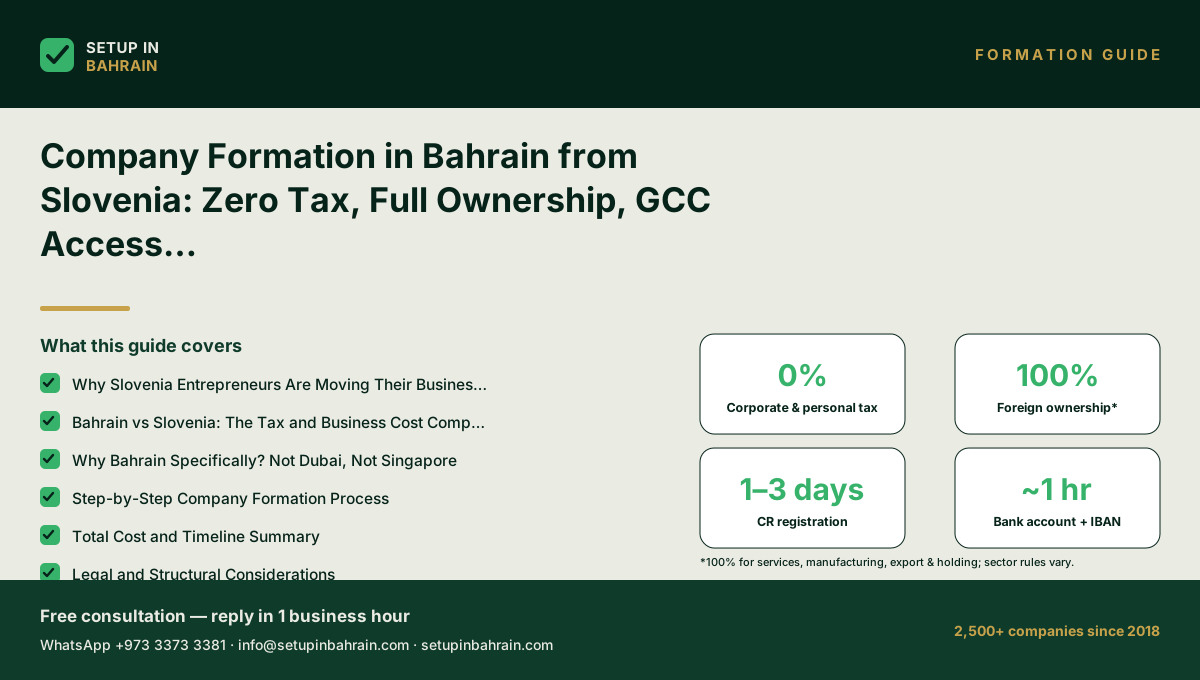
Register your Bahrain company from Slovenia with generally no corporate income tax for most sectors. Fast setup, full support for Slovenian entrepreneurs expanding to the Gulf.
→ Complete guide: Company Formation in Bahrain — the full 2026 guide
View details
Ownership & capital
A Bahrain WLL can be owned by a single person — 100% foreign ownership applies to most activities, with no local partner required for services, manufacturing, export trading and holding companies. The minimum share capital is BHD 1; we recommend BHD 1,000, which makes bank account opening and investor visa approval smoother.
Why Slovenia Entrepreneurs Are Moving Their Business to Bahrain
Let me tell you about a conversation I had last month in Ljubljana. I was sitting across from Marko, who runs a successful software development agency. His company cleared €340,000 in profit last year. After the 19% corporate tax hit, another 15.5% in employer social contributions, and the endless FURS e-filing loops that required an external accountant at €4,800 annually, he kept roughly €165,000. Less than half.
"I spent three weeks dealing with FURS e-filing errors last spring," he told me during our consultation. "The system kept rejecting my submissions because of formatting issues with the XML schema. My accountant charges €180 per hour just to troubleshoot these technical problems. And when I finally got everything submitted correctly, I watched 19% of my corporate profit disappear before I could even think about paying myself."
Marko's story isn't unique. Across Slovenia, entrepreneurs running profitable businesses face the same mathematical reality: a 19% corporate income tax rate that compounds into something far more painful when you add mandatory social contributions, complex compliance requirements, and personal income tax bands that climb as high as 50% for higher earners.
Here's what changed for Marko: In February 2025, he incorporated a WLL in Bahrain. Total setup cost: approximately €2,800. Time from first application to operating bank account: 11 days. Corporate tax on his first year's Bahrain-sourced profit: zero.
The shift isn't about avoiding responsibilities—it's about recognizing that Slovenia's tax infrastructure wasn't designed for the modern, location-independent service economy. When your clients are in Germany, the UK, Saudi Arabia, and the UAE, and your team works remotely, the question becomes: why are you paying Ljubljana rates for a business that could legally operate from anywhere?
Bahrain offers something Slovenia cannot: a genuine 0% corporate income tax rate with no sunset clause, no cap, and no hidden catches.
Bahrain vs Slovenia: The Tax and Business Cost Comparison
Let's put the numbers side by side. This isn't about theory—it's about what stays in your pocket.
| Cost Category | Slovenia (d.o.o.) | Bahrain (WLL) | Annual Difference |
| Corporate Income Tax | 19% of profit | 0% | Full 19% savings |
| Personal Income Tax (high earners) | Up to 50% | 0% | Up to 50% savings |
| Employer Social Contributions | 16.10% of gross salary | 0% (no payroll tax) | 16.10% savings |
| Minimum Capital Requirement | €7,500 (locked in bank) | €0 (no minimum) | €7,500 freed up |
| VAT | 22% (standard rate) | 10% (standard rate) | 12% lower |
| Annual Compliance Costs (accounting, filing) | €4,000–€8,000 | €1,500–€3,000 | €2,500–€5,000 savings |
| Setup Time | 2–4 weeks (FURS registration, court, notary) | 5–11 days | 1–3 weeks faster |
- Slovenia: €95,000 in corporate tax + €80,500 in social contributions (on €500,000 salary) + ~€5,000 in compliance = €180,500 gone
- Bahrain: €0 tax + €0 social contributions + ~€2,000 in compliance = €2,000 gone
That's €178,500 more retained annually. Over three years, that's over half a million euros that can be reinvested in growth, hiring, or R&D.
The Real Pain Points Slovenia Entrepreneurs Face
1. The FURS E-Filing Nightmare
Every Slovenian entrepreneur knows the dread. The FURS eDavki system is a labyrinth of XML schemas, digital certificates, and confusing error codes. One wrong checkbox triggers an audit. One misplaced decimal in the XML leads to rejected submissions. You need to speak Slovenian fluently to navigate it—which means hiring expensive local accountants for every transaction.
Bahrain's Sijilat platform is fully bilingual (Arabic and English). The Ministry of Industry and Commerce (MOIC) processes applications within 24–48 hours. No XML schemas. No digital certificate gymnastics. Just straightforward online forms.
2. Mandatory d.o.o. Minimum Capital of €7,500
For a small business, locking away €7,500 in a bank account with near-zero interest is dead capital. That's money that could buy equipment, cover payroll, or fund marketing. In Bahrain, there's zero minimum share capital for most WLLs. You decide how much to invest—typically as little as BD 1,000 (€2,500) for a basic setup.
3. Slovenian Language Court Proceedings
Disputes happen. When they do in Slovenia, every document, every hearing, every filing is in Slovenian. If your supplier or client is non-Slovene, you're paying thousands in translation fees. Bahrain operates a bilingual legal system (English and Arabic). Contracts, court filings, and arbitration can all proceed in English—a massive advantage for international businesses.
4. Limited Venture Capital Ecosystem
Slovenia's venture capital scene is small: roughly €50–€80 million in total deal volume annually, concentrated in Ljubljana and Maribor. Outside tech and biotech, funding is scarce. Bahrain, by contrast, is home to over 100 registered VC firms and family offices, with deal flow exceeding $500 million in 2024 alone. The Bahrain Development Bank (BDB) provides SME loans at 0% interest for qualifying businesses.
5. Restricted Bilateral Trade with GCC
Slovenia has no direct free trade agreement with the Gulf Cooperation Council (GCC). Exporting to Saudi Arabia, UAE, or Qatar means navigating complex customs, certifications, and agent requirements. Bahrain, as a GCC member, grants you tariff-free access to the entire bloc—a market of 55 million people with a combined GDP exceeding $3.6 trillion.
Why Bahrain Specifically? Not Dubai, Not Singapore
I get asked this constantly: "Why not Dubai?" or "Why not Singapore?"
Here's the honest answer from someone who's advised over 200 company formations across multiple jurisdictions:
Dubai: The Tempting But Costly Alternative
Dubai's Mainland company formation requires a local sponsor (service agent) unless you're in a free zone. Free zones restrict trading within the UAE market. Office space in Dubai Marina costs €40–€60 per square foot annually. A basic visa package runs €5,000–€10,000. The cost of living for a family of four: €8,000–€12,000 per month.
Singapore: Excellent But Remote
Singapore has a 17% corporate tax rate (not zero). The personal income tax tops out at 24%. Setup costs are higher (€5,000–€10,000). Distance from Europe is significant—12 hours from Ljubljana via Doha or Dubai. Not exactly a quick hop for client meetings.
Bahrain: The Undiscovered Gem
- 0% corporate and personal income tax (genuine, no sunset clause)
- 100% foreign ownership across most sectors (financial services, tech, consulting)
- No minimum capital requirement for WLLs
- GCC market access via the Bahrain-Saudi Arabia King Fahd Causeway (25 km to Saudi Arabia)
- Lower cost of living than Dubai or Singapore—about 30–40% less
- English-first business environment with a bilingual legal system
- World-class banking regulated by the Central Bank of Bahrain (CBB)
- Excellent connectivity: Bahrain International Airport (BAH) with direct flights to London, Istanbul, Doha, Dubai, and 50+ destinations
The Central Bank of Bahrain (CBB) regulates over 370 financial institutions, including HSBC, Standard Chartered, and local giants like BBK and Ahli United Bank. The Economic Development Board (EDB) actively courts foreign entrepreneurs with streamlined registration, visa support, and sector-specific incentives.
Step-by-Step Company Formation Process
Let me walk you through exactly how to incorporate in Bahrain from Slovenia. This isn't generic advice—it's the process I've used with dozens of Slovenian clients.
Step 1: Business Activity Classification (Week 1)
Before you register, the Ministry of Industry and Commerce (MOIC) requires you to classify your business activity. Bahrain follows the International Standard Industrial Classification (ISIC) system. Common categories for Slovenian entrepreneurs:
- 6201: Computer programming activities (software development, SaaS)
- 7020: Management consultancy activities
- 7310: Advertising agencies
- 8510: Education and training (online courses, coaching)
- 7490: Other professional, scientific, and technical activities (consulting)
Cost: BD 25 (€63) for classification certificate
Step 2: Company Name Reservation (Week 1–2)
Choose three name options in order of preference. The MOIC checks for conflicts, offensive terms, and compliance with naming conventions. Your company name must end with "W.L.L." (With Limited Liability).
Cost: BD 15 (€38)
Step 3: Memorandum of Association (MOA) Drafting (Week 1–2)
This is the most critical document. The MOA defines:
- Company name
- Business activities
- Share capital (minimum BD 1,000 for most WLLs, but often BD 10,000–BD 50,000 recommended for credibility)
- Shareholder details (names, nationalities, passport copies)
- Director details
- Registered office address
Tip: Use a local law firm or PRO (Public Relations Officer) to draft the MOA. Cost: BD 200–BD 500 (€500–€1,250). Do not attempt to DIY this—errors can delay registration by weeks.
Cost: BD 50 (€125) for notarization at the Notary Public
Step 4: Commercial Registration (CR) Application (Week 2–3)
Submit the notarized MOA, classification certificate, and passport copies to the MOIC's Sijilat portal. Processing time: 24–48 hours.
Cost: BD 200–BD 500 (€500–€1,250), depending on activity type
Step 5: Chamber of Commerce Membership (Week 3)
All commercial companies must register with the Bahrain Chamber of Commerce and Industry (BCCI). This costs BD 100–BD 300 (€250–€750) annually.
Step 6: Commercial Registration License (Week 3–4)
Once the MOIC approves your CR, you receive your Commercial Registration License. This is your company's legal identity in Bahrain.
Step 7: Bank Account Opening (Week 3–5)
This is often the bottleneck. Bahrain's banks require:
- Passport copies of all shareholders and directors
- Proof of address (utility bill or bank statement from Slovenia)
- Company CR license
- MOA
- Board resolution authorizing account opening
- Business plan or financial projections (for some banks)
Recommendation: Use a bank with experience in foreign entrepreneurs. The following are SME-friendly:
| Bank | Account Opening Time | Minimum Deposit | Online Banking Quality |
| BBK | 5–10 business days | BD 500 (€1,250) | Excellent |
| Ahli United Bank | 7–14 business days | BD 1,000 (€2,500) | Good |
| Al Salam Bank | 3–5 business days (premium service) | BD 2,000 (€5,000) | Excellent |
| HSBC Middle East | 10–15 business days | BD 5,000 (€12,500) | Excellent |
Step 8: Visa Application for Shareholders/Directors (Week 4–6)
Bahrain offers a range of visa options:
- Employment Visa (Work Permit): For shareholders who plan to work in Bahrain
- Investor Visa: For business owners investing BD 50,000+ (€125,000)
- Golden Visa (Premium Residency): For investors, entrepreneurs, and professionals. Minimum investment BD 100,000 (€250,000) in real estate or business. Grants 10-year renewable residency
Cost: BD 500–BD 1,500 (€1,250–€3,750) depending on visa type and family size
Timeline: 2–4 weeks from application to visa stamping
Step 9: Office Lease (Week 4–6)
Bahrain requires commercial companies to have a registered office address. Options:
- Physical office: 1,000–2,000 sq ft in a business district. Cost: BD 500–BD 1,500 per month (€1,250–€3,750)
- Serviced office (Regus, The Business Centre): BD 300–BD 600 per month (€750–€1,500)
- Virtual office: BD 100–BD 200 per month (€250–€500). Accepted for most non-regulated activities
Total Setup Cost: Approximately €2,800–€6,000 depending on bank selected, office type, and visa requirements
Total Cost and Timeline Summary
| Service | Cost (EUR) | Timeline |
| Activity Classification | €63 | 1 day |
| Name Reservation | €38 | 1 day |
| MOA Drafting & Notarization | €500–€1,250 | 3–5 days |
| Commercial Registration (CR) | €500–€1,250 | 2–5 days |
| Chamber of Commerce | €250–€750 | 1 day |
| Bank Account Opening | €125–€500 deposit | Banking: approximately 1 hour in 99% of our reported cases; our last 100 applications handled in 2026 were approved; subsidiaries or CIS shareholders: 3 days to 2 weeks. Subject to the bank’s final review. |
| Visa Application (single person) | €1,250–€3,750 | 2–4 weeks |
| Office Lease (virtual) | €250–€500/month | 1–2 days |
| Total (excluding office) | €2,800–€6,000 | 5–11 days (setup), 4–6 weeks (visa) |
Frequently Asked Questions (FAQs)
Can I incorporate in Bahrain while living in Slovenia?
Yes. The entire process can be handled remotely through a local PRO or law firm. You only need to visit Bahrain for visa stamping (a 2–3 day trip). All documents can be notarized via power of attorney.
Is generally no corporate income tax for most sectors really permanent?
Bahrain has no corporate income tax for most activities. The only exceptions are oil and gas companies (46% tax) and certain regulated financial activities (10% for some licensing). For software, consulting, marketing, trading (outside oil), and services, the rate is genuinely zero. There is no sunset clause, and the government has repeatedly confirmed no plans to introduce a general corporate tax.
Will I still owe Slovenian tax?
You may have tax obligations in Slovenia depending on your residency status. If you remain a Slovenian tax resident (spend more than 183 days in Slovenia annually), your worldwide income is taxable in Slovenia. However, if you relocate to Bahrain and become a non-resident of Slovenia, your Bahrain-sourced income (through your WLL) is exempt from Slovenian tax. Always consult a Slovenian tax advisor before making residency decisions.
How do I pay myself from Bahrain?
You can pay yourself a salary, dividends, or director fees from your Bahrain WLL. Since Bahrain has no personal income tax, all payments to you are tax-free locally. You'll need to declare this income in Slovenia (or your new residence country) according to local laws.
What about VAT?
Bahrain implemented VAT at 10% (reduced from 5% in 2025 to fund social programs). If your turnover exceeds BD 37,500 (€93,750), you must register for VAT. Most B2B service exports are zero-rated, so you likely won't charge VAT to international clients.
Can I access Saudi Arabia from Bahrain?
Yes. The King Fahd Causeway connects Bahrain to Saudi Arabia's Eastern Province. As a Bahrain-licensed company, you can:
- Trade with Saudi clients without additional licensing (within GCC rules)
- Obtain Saudi visas for business travel
- Participate in Saudi government tenders (certain sectors)
- Establish a branch in Saudi if needed
The Saudi Vision 2030 initiative is creating massive demand for consulting, software, and professional services—all of which you can deliver from Bahrain.
Is Bahrain safe for Slovenian entrepreneurs?
Absolutely. Bahrain is politically stable (constitutional monarchy with parliamentary elections), has a low crime rate, and is a regional hub for expatriates. The cost of living for a single person is approximately €1,500–€2,500 per month (rent, utilities, food, transport)—significantly lower than Dubai or Singapore. The healthcare system is excellent, with both public and private options.
Legal and Structural Considerations
Choosing Your Company Structure
For most Slovenian entrepreneurs, the WLL (With Limited Liability) is the best option. Here's why:
| Structure | Minimum Capital | Liability | Best For |
| WLL (With Limited Liability) | BD 1,000 (€2,500) | Limited | Most service businesses, consulting, trading |
| single-shareholder WLL | BD 50,000 (€125,000) | Limited | Sole traders wanting full limited liability |
| Branch of Foreign Company | None | Parent company liable | Established Slovenian companies opening a base |
| Holding Company | BD 100,000 (€250,000) | Limited | Investment holding, IP ownership |
Double Tax Treaties
Bahrain has signed 45+ Double Tax Treaties (DTTs), including with Slovenia (BIPA—Bilateral Investment Protection Agreement). This means:
- No withholding tax on dividends, interest, or royalties between Bahrain and Slovenia
- No capital gains tax on shares
- Reduced or 0% tax on income from certain activities
BIPA (Bilateral Investment Protection Agreement)
The Slovenia-Bahrain BIPA protects investors from expropriation, guarantees fair treatment, and allows dispute resolution through international arbitration. This is a critical safety net for Slovenian entrepreneurs.
Common Mistakes to Avoid
- Not classifying your business activity correctly: Wrong ISIC code leads to rejection or licensing issues later
- Skipping legal review of the MOA: Errors in the MOA can delay registration by weeks
- Opening a bank account before CR: Banks reject applications without the CR license
- Underestimating visa timelines: Rush visas cost 3–5x more
- Ignoring Slovenian tax residency rules: Stay less than 183 days in Slovenia to avoid full tax liability
- Using a cheap PRO (Public Relations Officer): Cut-rate PROs often delay filings or submit incomplete documents
Your Action Plan for the Next Two Weeks
Week 1: Research and Prep
- Day 1: Review this article. Decide if Bahrain fits your business model
- Day 2: Classify your business activity (ISIC code)
- Day 3: Shortlist 3 company formation agents in Bahrain (check reviews on Google and LinkedIn)
- Day 4: Collect passport copies, proof of address, and business details
- Day 5: Contact your Slovenian tax advisor to discuss residency implications
Week 2: Initial Steps
- Day 6–7: Submit company name reservation via your chosen agent
- Day 8: Draft the MOA with legal guidance
- Day 9: Prepare bank account opening documents
- Day 10: Plan your 2–3 day trip to Bahrain for visa stamping
- Day 11: Submit the CR application via Sijilat
- Day 12: Receive CR license (if approved quickly)
- Day 13: Open the bank account (online or in person)
- Day 14: Begin visa application process
Conclusion: The Opportunity Is Real
I've seen a Slovenian entrepreneur go from paying 40% of his profit in tax to retaining 100% of his profit—and using that capital to hire two more developers and expand into Saudi Arabia. That's not a fantasy. That's the reality of incorporating in Bahrain.
The question isn't whether Bahrain offers advantages—it's whether you're willing to take the step. The setup cost is €2,800–€6,000. The time is 5–11 days for the company, 4–6 weeks for the visa. The tax savings are 19% corporate + personal income tax + social contributions. The market access is the entire GCC.
Marko, the client I mentioned at the start, is now operating from Bahrain. His company generated €580,000 in revenue in the first three months of 2026. His tax liability? Zero. His stress level? Way down. His team? Thriving.
If you're reading this in Ljubljana, Maribor, or anywhere in Slovenia, and you're tired of the FURS e-filing battles, the €7,500 capital lockup, and the tax drag on your growth—Bahrain is your answer.
Take the next step: contact the Bahrain Economic Development Board (EDB) or a licensed PRO in Manama. Your first consultation is usually free. Your first 5 minutes of reading this article have already saved you weeks of research.
The window is open. Move now.
Disclaimer: This information is for educational purposes and does not constitute legal or tax advice. Always consult with qualified professionals before making cross-border business decisions. Tax laws and company regulations may change. Verify current requirements with the Ministry of Industry and Commerce (MOIC), Central Bank of Bahrain (CBB), and your Slovenian tax advisor.
Bahrain Business Guides for Slovenia Citizens
Ready to set up in Bahrain from Slovenia?
Tell us your business idea. We map the right entity, ownership and timeline — then handle the filing while you focus on what matters.