Complete guide for Peru entrepreneurs: form a company in Bahrain with generally no corporate income tax for most sectors, 100% foreign ownership, and GCC market access. Costs, steps, visas, banking.
→ Complete guide: Company Formation in Bahrain — the full 2026 guide
View details
Ownership & capital
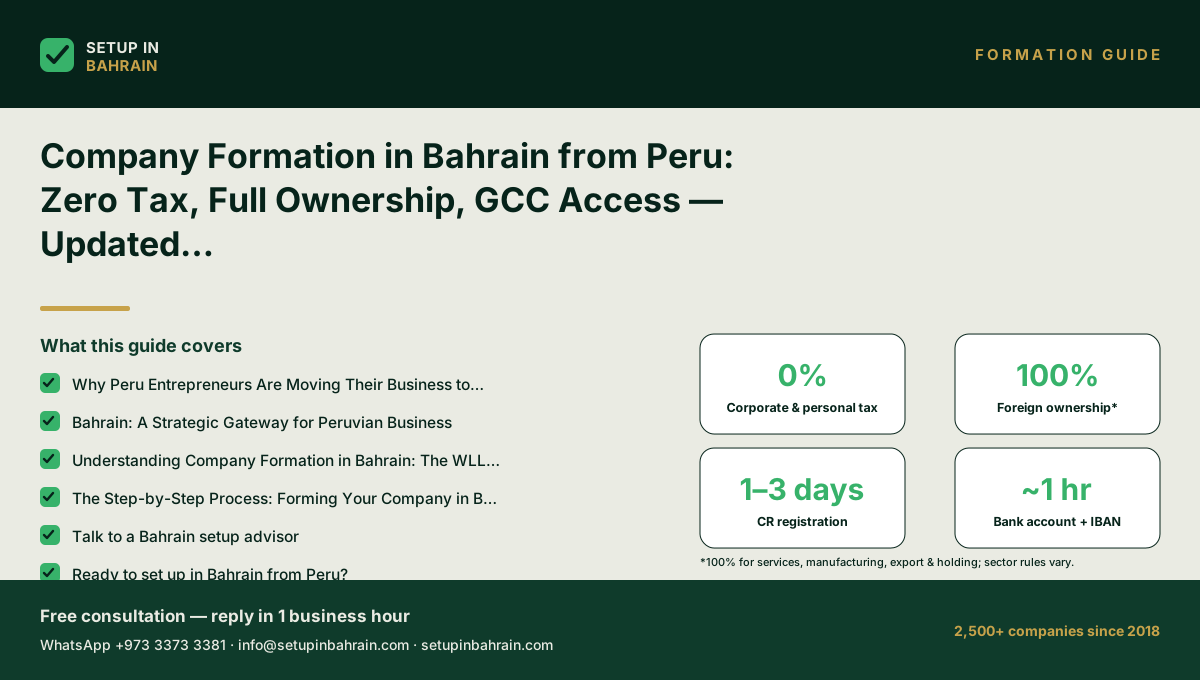
A Bahrain WLL can be owned by a single person — 100% foreign ownership applies to most activities, with no local partner required for services, manufacturing, export trading and holding companies. The minimum share capital is BHD 1; we recommend BHD 1,000, which makes bank account opening and investor visa approval smoother.
The entrepreneurial spirit in Peru is undeniable. From the bustling streets of Lima to the innovative minds in Arequipa and Trujillo, Peruvian businesses are constantly pushing boundaries. Yet, for many years, this drive has been met with a labyrinth of high taxes, complex compliance, and economic instability that can stifle even the most ambitious ventures. Imagine, for a moment, a different landscape: one where your hard-earned profits aren’t eroded by a 29.5% Impuesto a la Renta, where currency volatility isn't a constant threat, and where the world’s fastest-growing markets are within easy reach. This isn't a distant fantasy; it's the reality offered by the Kingdom of Bahrain.
This guide is specifically crafted for you, the Peruvian entrepreneur. It's not a generic overview; it directly addresses the unique challenges you face at home – the mandatory AFP and ONP pension contributions, the arduous SUNAT monthly PDT filing, the unpredictable swings of the Sol linked to political crises, the burdens of CTS and double vacation provisions, and the restrictions on large USD outflows by the BCRP. We're here to show you how Bahrain offers a strategic, sustainable, and surprisingly straightforward pathway to international expansion and greater profitability, completely free from the fiscal and operational burdens that have become an unwelcome part of your daily business life in Peru.
Why Peru Entrepreneurs Are Moving Their Business to Bahrain
Let's start with a scenario that might sound painfully familiar. Picture Maria, a software developer from Miraflores, Lima. For years, her small but rapidly growing tech consultancy has served clients across Latin America. She’s passionate, innovative, and her team is brilliant. But every month, she stares at her profit and loss statement, feeling a knot of frustration tighten in her stomach. That 29.5% Impuesto a la Renta on her corporate profits feels like a constant drain. Then there are the additional mandatory employer contributions to AFP and ONP, adding another 13% on top of salaries, not to mention the bi-annual headache of CTS payments and the generous (but costly) double vacation provisions for her staff. Just last quarter, the Sol swung 8% against the dollar following yet another political upheaval, eroding her hard-won margins on international projects. Maria is not alone in these struggles.
Many Peruvian founders are asking the same question: what happens if the next tax hike or regulatory change makes it even harder to compete? What if the next political crisis triggers capital controls or further currency depreciation? These are not hypothetical concerns; they are the lived experience of entrepreneurs navigating Peru's complex economic landscape. The World Bank's Ease of Doing Business report, while no longer updated, previously highlighted Peru's challenges in areas like paying taxes and enforcing contracts. In this environment, the proactive Peruvian entrepreneur seeks not just a solution, but a strategic advantage.
Bahrain provides precisely that advantage, offering a stark contrast to Peru’s operational realities. It’s a jurisdiction where your business can flourish without the pervasive weight of high taxes, bureaucratic hurdles, or economic instability.
The Burden of Peruvian Taxation: A Relentless Drain on Profits
For entrepreneurs in Peru, the tax regime is often cited as one of the most significant impediments to growth.
- 29.5% Impuesto a la Renta (Corporate Income Tax): This is a substantial chunk of your hard-earned profits. Imagine dedicating nearly a third of your net income to taxes before you even consider reinvestment or personal remuneration. For a business generating $500,000 in annual net profit, this translates to $147,500 gone before it ever touches your balance sheet for growth. In Bahrain, the equivalent corporate income tax is 0%. This difference alone can be transformative for profitability and reinvestment capacity.
- Mandatory AFP and ONP Pension Contributions: Beyond the direct corporate tax, Peruvian employers bear additional significant costs. Mandatory contributions to the Administradoras de Fondos de Pensiones (AFP) or the Oficina de Normalización Previsional (ONP) typically add around 13% to an employee's gross salary, paid by the employer. This is a non-negotiable payroll overhead that increases the total cost of employment, making it more expensive to hire and expand your team in Peru. Bahrain’s system for social insurance contributions is significantly different and generally less burdensome for foreign-owned entities.
- CTS (Compensación por Tiempo de Servicios) and Double Vacation Provisions: These are unique Peruvian labor benefits that further impact cash flow. CTS is a mandatory deposit made twice a year by the employer into a bank account for each employee, acting as a form of unemployment insurance. While beneficial for employees, it represents a considerable financial outflow for businesses, particularly small to medium-sized enterprises (SMEs). Additionally, Peruvian law often mandates generous vacation benefits, effectively requiring employers to budget for double payments during vacation periods for specific roles or circumstances. These provisions tie up capital and add complexity to financial planning, unlike the more streamlined labor laws found in competitive international jurisdictions like Bahrain.
Navigating Peru's Regulatory Maze: SUNAT and Bureaucracy
Beyond direct financial costs, the administrative burden in Peru is a constant source of frustration.
- SUNAT Complex Monthly PDT Filing: The Declaración Mensual del Impuesto General a las Ventas e Impuesto a la Renta (PDT) filing is notorious for its complexity and demanding schedule. Businesses must accurately report sales, purchases, and income tax withholdings monthly, a process that requires meticulous record-keeping and often specialized accounting expertise. Errors can lead to audits, fines, and wasted time. This constant, intricate compliance drains resources that could otherwise be spent on innovation and growth.
- Permit Delays and Red Tape: Obtaining licenses, permits, and navigating local government bureaucracy can be a prolonged and unpredictable process in Peru. Delays are common, and the lack of transparent, streamlined procedures can stall business operations and expansion plans. Bahrain, in contrast, prides itself on its digital-first approach to government services, with the Sijilat portal offering a centralized and efficient platform for business registration and licensing.
Economic Volatility and Currency Risks: The Shifting Sands of the Sol
The Peruvian economy, while resilient in many respects, has shown susceptibility to political instability, directly impacting business planning.
- PEN Currency Volatility Linked to Political Crises: The Peruvian Sol (PEN) has experienced significant fluctuations, often directly correlated with political events. With five presidents in a three-year span recently, the political landscape has been anything but stable. Each political shift can trigger investor uncertainty, leading to capital flight and a depreciating Sol. For businesses engaged in international trade or those with foreign currency-denominated costs, this volatility can decimate profit margins and make long-term financial forecasting a nightmare. Hedging against such risks adds another layer of cost and complexity.
- Restrictions on Large USD Outflows by the BCRP: While not a permanent fixture, the Banco Central de Reserva del Perú (BCRP) has, at times, implemented measures to manage capital outflows or to stabilize the Sol. For entrepreneurs looking to repatriate profits or make significant international investments, potential restrictions on large USD outflows can be a serious impediment. This creates uncertainty and limits financial flexibility. Bahrain, with its fixed exchange rate to the US Dollar (BHD 0.376 per USD) and liberal capital movement policies, offers complete freedom for profit repatriation and capital flows, eliminating this significant concern.
Strategic Access to Global Markets: Beyond Latin America
For ambitious Peruvian entrepreneurs, the domestic market and even the broader Latin American region, while important, can feel restrictive. Growth often requires looking further afield.
- GCC as a High-Growth Market: The Gulf Cooperation Council (GCC) market – comprising Saudi Arabia, UAE, Qatar, Kuwait, Oman, and Bahrain – represents a consumer base of over 55 million people with immense purchasing power. Bahrain, strategically located at the heart of this region, offers unparalleled access, particularly to Saudi Arabia, the largest economy in the GCC, via the King Fahd Causeway, which facilitates significant trade. For a Peruvian business, this opens up an entirely new, affluent customer segment.
- MENA and Asia Expansion: Beyond the immediate GCC, Bahrain serves as a bridge to the wider Middle East and North Africa (MENA) region, as well as emerging markets in Asia. Its excellent air and sea connectivity make it an ideal hub for logistics and distribution.
- Free Trade Agreements: Bahrain is signatory to numerous Free Trade Agreements (FTAs) with major global economies, including the United States, Singapore, and various European nations. These agreements reduce tariffs and trade barriers, making it significantly easier for Bahrain-registered companies to access these lucrative markets. This stands in contrast to Peru, which, while having its own FTAs, may not offer the same strategic positioning for rapid expansion into the GCC and broader Asian markets.
Bahrain: A Strategic Gateway for Peruvian Business
The Kingdom of Bahrain, often described as the "Pearl of the Gulf," is more than just an island nation; it's a meticulously developed economic ecosystem designed to attract and nurture international business. For Peruvian entrepreneurs, it presents a coherent, compelling alternative to the challenges faced at home. Its reputation for innovation, liberal economic policies, and a highly accessible government make it a prime location for international expansion.
Bahrain's economic vision is underpinned by a commitment to diversification and fostering a competitive, knowledge-based economy. Institutions like the Bahrain Economic Development Board (EDB) play a pivotal role in this, actively working to attract foreign direct investment by showcasing the Kingdom's advantages in financial services, ICT, manufacturing, logistics, and tourism.
Generally no corporate income tax for most sectors Advantage: Keep More of What You Earn
This is arguably Bahrain's most compelling proposition for Peruvian entrepreneurs:
- No Corporate Income Tax: Unlike Peru's 29.5%, Bahrain generally levies no corporate income tax on companies, with a few exceptions primarily for oil and gas companies. This means your business can retain 100% of its profits for reinvestment, expansion, or distribution. Imagine the exponential growth potential when nearly a third of your profits aren't siphoned off by the government.
- No Personal Income Tax: Further enhancing its appeal, Bahrain also has no personal income tax for individuals. This means that as a business owner and resident, your personal earnings from your company are also untaxed, providing a significant boost to your net income and overall financial well-being.
- Competitive VAT System: While Bahrain introduced a Value Added Tax (VAT) in 2019, its standard rate is a modest 10%. This is generally applied to goods and services, with many essential items and services zero-rated or exempt. This is a common and transparent form of consumption tax, and a far cry from the income tax burdens found in many other jurisdictions.
100% Foreign Ownership and Repatriation: True Control, Absolute Freedom
One of the cornerstones of Bahrain's investor-friendly environment is its commitment to full foreign ownership.
- 100% Foreign Ownership in Most Sectors: For a vast majority of business activities, foreign investors can own 100% of their company in Bahrain. This is a crucial distinction from some other GCC nations or even Peru, where certain sectors might require local partners or limits on foreign equity. This policy ensures full control over your business operations and strategic direction, eliminating the complexities and potential conflicts that can arise with mandatory local partnerships.
- No Local Partner Required: For a With Limited Liability (WLL) company, the most common structure for foreign investors, there is no requirement to have a local Bahraini partner. This is a critical point of difference and a significant benefit for Peruvian entrepreneurs seeking complete autonomy.
- Full Profit and Capital Repatriation: Bahrain has no restrictions on the repatriation of profits, capital, or dividends. This means you can freely move your earnings out of Bahrain to any international account without facing limitations or complex approvals, a direct solution to the BCRP's potential USD outflow restrictions faced in Peru.
World-Class Business Infrastructure: Built for the Future
Bahrain has invested heavily in creating an infrastructure that supports a modern, digital economy.
- Advanced Digital Infrastructure: Bahrain was the first in the GCC to launch commercial 5G networks, boasting one of the most connected and digitally advanced economies in the region. It hosts major global data centers and cloud computing providers like Amazon Web Services (AWS), ensuring robust and reliable connectivity crucial for tech-driven businesses.
- Strategic Logistics Hub: The Khalifa Bin Salman Port is a state-of-the-art facility, handling significant cargo volumes and offering efficient connections to global shipping lanes. The Bahrain International Airport is also undergoing substantial expansion, enhancing air cargo and passenger links. Crucially, the King Fahd Causeway provides direct road access to Saudi Arabia, facilitating swift land-based distribution into the largest GCC market. For an export-focused Peruvian business, this logistics framework is a game-changer.
- Skilled and Bilingual Workforce: Bahrain has a highly educated local workforce, many of whom are bilingual in Arabic and English. The government has invested significantly in education and vocational training to ensure a ready supply of skilled professionals. This, combined with a diverse expatriate community, provides access to a broad talent pool.
A Stable and Predictable Economic Environment: Foundation for Growth
Stability is a prized commodity for entrepreneurs, and Bahrain delivers this on multiple fronts.
- Fixed Exchange Rate to the US Dollar: The Bahraini Dinar (BHD) has been pegged to the US Dollar at a rate of BHD 0.376 per USD since 2001. This long-standing peg provides unparalleled currency stability, eliminating the foreign exchange risks that plague Peruvian businesses dealing with the volatile Sol. For international transactions, this predictability is invaluable.
- Strong Regulatory Framework (CBB): The Central Bank of Bahrain (CBB) is a highly respected and robust regulator, particularly in the financial services sector. Its clear, consistent, and transparent regulatory environment provides certainty for businesses, fostering trust and stability. This contrasts sharply with the often-changing and complex regulatory landscape in Peru.
- Political Stability: Compared to the recent political upheavals in Peru, Bahrain enjoys a stable political environment, providing a secure backdrop for long-term business planning and investment. This stability translates into greater investor confidence and a more predictable operational landscape.
Understanding Company Formation in Bahrain: The WLL Advantage
When establishing a business in Bahrain as a foreign investor, the most common and advantageous structure is the With Limited Liability Company (WLL). It’s crucial to understand its features and clarify some common misconceptions.
CRITICAL FACT: There is NO single-shareholder WLL legal entity in Bahrain. While some jurisdictions offer a single-shareholder WLL, Bahrain does not. However, a WLL company can be owned by a single shareholder. This distinction is important for precise terminology.
Why a WLL (With Limited Liability) is Ideal for Peruvian Entrepreneurs
The WLL structure offers significant benefits that align perfectly with the needs of foreign investors:
- Limited Liability Protection: As the name suggests, the liability of the shareholders is limited to the amount of their capital contribution. This protects your personal assets from any business debts or legal obligations, a fundamental advantage for any entrepreneur.
- Single Shareholder Possible (100% Foreign Ownership): This is a critical point for Peruvian entrepreneurs seeking full control. A WLL company in Bahrain can be established with just one shareholder, who can be a foreign individual or a foreign corporate entity. This means you, as a Peruvian entrepreneur, can own 100% of your Bahraini company without needing any local partners or nominee shareholders. This eliminates the complexities and potential risks associated with joint ventures.
- No Minimum Number of Directors: While a WLL requires a minimum of one shareholder, it does not impose a minimum number of directors. A single director can manage the company, offering flexibility in corporate governance.
- Flexibility in Business Activities: The WLL structure is highly versatile and suitable for a vast range of business activities, from trading and consulting to tech and logistics. The Ministry of Industry and Commerce (MOIC) maintains a comprehensive list of commercial activities (CR categories) that can be registered.
Capital Requirements: The BHD 1 vs. BHD 1,000 Reality Check
This is an area where precise understanding is paramount to avoid potential pitfalls.
- Legal Minimum Share Capital is BHD 1: Legally, the Companies Law of Bahrain states that the minimum share capital for a WLL company is just One Bahraini Dinar (BHD 1). This ultra-low legal minimum reflects Bahrain's commitment to making company formation accessible.
- Practical Recommendation: BHD 1,000 as Starting Capital: While BHD 1 is legally permissible, I strongly recommend setting your initial share capital at a minimum of BHD 1,000. Why?
Therefore, while BHD 1 is the legal floor, think of BHD 1,000 as the practical and highly advisable minimum to ensure smooth bank account opening and enhance your overall business credibility.
Key Regulatory Bodies in Bahrain
Understanding the roles of these government entities is crucial for navigating the company formation process:
- Ministry of Industry and Commerce (MOIC): This is the primary authority for commercial registration and licensing of businesses in Bahrain. The MOIC oversees the Companies Law and processes all company formation applications through its digital portal, Sijilat.
- Central Bank of Bahrain (CBB): The CBB is the financial regulator, responsible for licensing and supervising banks, financial institutions, and insurance companies. If your business involves financial services, fintech, or money transfer, you will need CBB approval and licensing. They also set the regulatory framework that banks follow for opening corporate accounts.
- Bahrain Economic Development Board (EDB): While not a direct regulator in the sense of issuing licenses, the EDB is a government agency mandated to attract foreign investment. They act as a facilitator, providing invaluable support, guidance, and connections to investors throughout the setup process. The EDB offers practical assistance, from identifying suitable business activities to connecting entrepreneurs with local service providers and government contacts.
The Step-by-Step Process: Forming Your Company in Bahrain
Forming a company in Bahrain is notably streamlined, thanks to the government’s commitment to digital transformation and ease of doing business. The Sijilat portal is a one-stop shop for most of the process.
Phase 1: Planning and Preparation
Before you even touch the Sijilat portal, some crucial groundwork needs to be done.
- Define Your Business Activity (CR Categories):
- Company Name Reservation:
- Gathering Essential Documents:
Note on Legalization: Documents originating from Peru (like your DNI, company registration documents) will likely need to be apostilled by the Peruvian Ministry of Foreign Affairs and then attested by the Bahraini Embassy in Peru (if available) or the nearest Bahraini consulate, and finally by the Ministry of Foreign Affairs in Bahrain upon arrival. An experienced consultant can guide you through this process.
Phase 2: Application and Registration with MOIC
This is the core of the company formation process, primarily conducted through the Sijilat portal.
- Online Application Submission via Sijilat:
- MOIC Approval Process:
- Commercial Registration (CR) Issuance:
Phase 3: Post-Registration and Operational Setup
With your CR in hand, you move to the practical steps of getting your business fully operational.
- Opening a Corporate Bank Account:
- Leasing Office Space (Virtual vs. Physical):
- Obtaining Necessary Licenses:
Bahrain Business Guides for Peru Citizens
Ready to set up in Bahrain from Peru?
Tell us your business idea. We map the right entity, ownership and timeline — then handle the filing while you focus on what matters.