Norwegian entrepreneurs can form a company in Bahrain with generally no corporate income tax for most sectors. Enjoy tax-free profits, easy setup, and full foreign ownership from Norway.
Key Takeaways
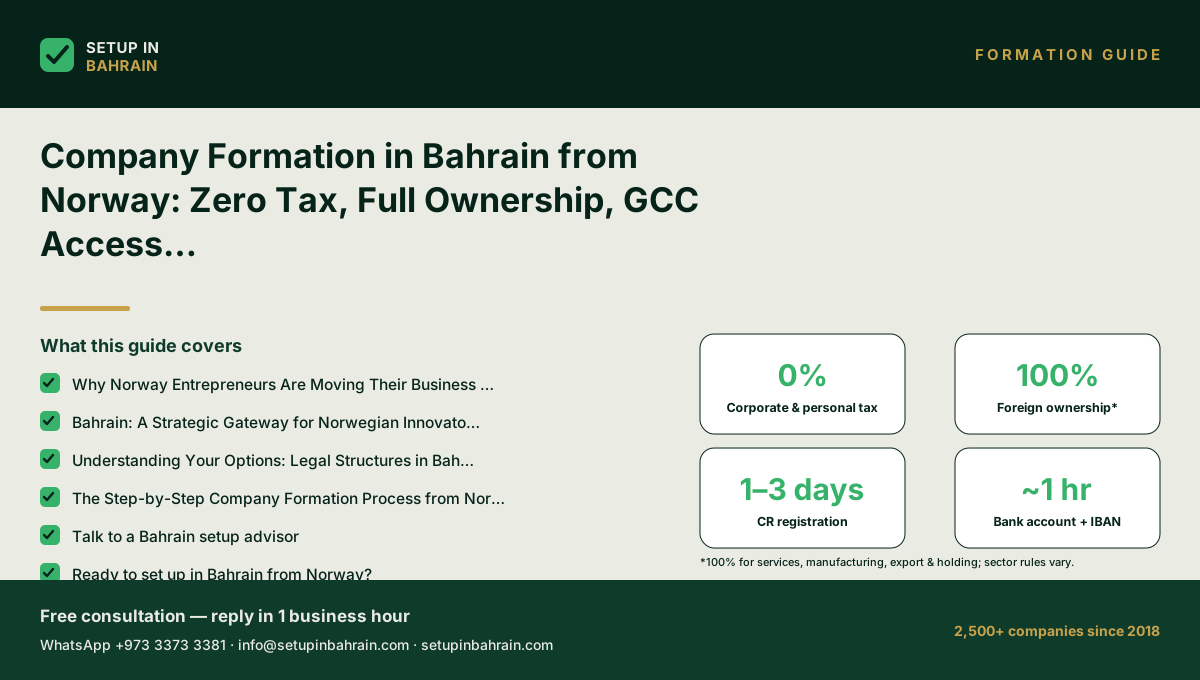
- Why Norway Entrepreneurs Are Moving Their Business to Bahrain
- Bahrain: A Strategic Gateway for Norwegian Innovators
- Understanding Your Options: Legal Structures in Bahrain
- The Step-by-Step Company Formation Process from Norway
→ Complete guide: Company Formation in Bahrain — the full 2026 guide
View details
Ownership & capital
A Bahrain WLL can be owned by a single person — 100% foreign ownership applies to most activities, with no local partner required for services, manufacturing, export trading and holding companies. The minimum share capital is BHD 1 ; we recommend BHD 1,000 . This Makes bank account opening and investor visa approval smoother.
Estimated reading time: 18 minutes
Let me tell you about Erik, a software entrepreneur from Bergen who, for twelve years, had meticulously built a robust SaaS platform serving Nordic maritime companies. His team of forty-seven delivered complex projects on time, earning a stellar reputation. By 2024, his company was generating a respectable NOK 18.2 million in pre-tax profit. But when his accountant presented the annual summary, Erik’s frustration boiled over. NOK 4 million vanished into Norway's 22% corporate tax. Another NOK 2.1 million disappeared into employer social security contributions—a relentless 14.1% on salaries.
"I’m effectively keeping only forty-two øre of every krone I earn," Erik told me during our initial consultation. "And the administrative overhead? The complex Altinn portal for non-resident reporting, the strict FINFO anti-money-laundering declarations, the Brønnøysund Register filings... that alone cost us another NOK 340,000 last year in pure compliance. It’s a constant drain."
Then there was the market shift. "Half my clients are now in Saudi Arabia and the UAE," he continued. "I’m flying to Riyadh six times a year. I’m running everything through Norway, burdened by NOK currency volatility against the USD, and missing out on direct regional opportunities."
Erik's story isn’t unique. It’s a narrative I hear with increasing frequency from Norwegian entrepreneurs—from Trondheim to Stavanger—who’ve built successful, internationally-focused businesses. They've poured their expertise, passion. Capital into building something significant, only to see a substantial portion siphoned away before it truly settles in their bank accounts.
If you, like Erik, are feeling over-policed by FINFO audits, mystified by NUF vs. AS registration complexities, battered by NOK forex swings, or simply chained to local compliance that seems disproportionate to your global ambitions, then this guide is for you. This isn’t about sidestepping responsibilities; it’s about strategic restructuring.
This guide exists because the conventional wisdom about keeping your business anchored exclusively in Norway no longer serves every entrepreneur. For certain Norwegian innovators—especially those serving GCC markets, running digital businesses, or operating international consultancies—Bahrain offers something Norway structurally cannot: a zero-tax, fully foreign-owned business environment positioned 25 kilometers from the largest economy in the Middle East, offering a streamlined path to global expansion.
We’ve built this guide using the latest data from the Central Bank of Bahrain (CBB), the Economic Development Board (EDB), the Ministry of Industry, Commerce, and Tourism (MOIC), the World Bank, and the Bahrain Investors Protection Agency (BIPA), mapped to every specific friction and real number that matters to a Norwegian entrepreneur.
Let’s examine whether this applies to you.
Why Norway Entrepreneurs Are Moving Their Business to Bahrain
The decision to look beyond Norway isn't about a lack of patriotism. Norwegian entrepreneurs deeply value their country’s robust infrastructure, educated workforce, and high quality of life. But, for internationally-minded businesses, the motivation to consider a move to Bahrain stems from pure arithmetic, strategic market positioning. A desire for financial efficiency.
Let's break down the specific anchors that are weighing down many Norwegian businesses:
The Norwegian Tax Anchor: 22% Corporate Tax & 14.1% Social Security
This is often the primary driver. For companies registered as an Aksjeselskap (AS) in Norway, the standard corporate tax rate of 22% directly impacts profitability. While not the highest in Europe, it’s a significant cut into hard-earned profits, especially when compared to jurisdictions offering generally no corporate income tax for most sectors.
But the corporate tax is only one part of the equation. Every Norwegian employer faces mandatory social security contributions, known as arbeidsgiveravgift (arb.g.avgift). This averages 14.1% of gross salaries and is payable by the employer on top of employee salaries. For a business with even a modest payroll, this adds a substantial, non-negotiable cost. Consider a business paying NOK 5 million in total salaries annually; an additional NOK 705,000 (14.1% of NOK 5 million) disappears into these contributions, regardless of the company's ultimate profit. These contributions are designed to fund Norway’s generous welfare state. For a global business, they represent a significant competitive disadvantage.
In Bahrain? The vast majority of business activities are subject to 0% corporate income tax. There are no mandatory employer social security contributions on the salaries of foreign employees if they are not Bahraini residents. This fundamental difference means that your business can retain a far greater percentage of its profits, allowing for reinvestment, higher dividends, or greater operational flexibility.
The Altinn Maze and FINFO’s Grip: Compliance Burdens
Norway prides itself on transparency and robust regulation. For an entrepreneur operating internationally, this often translates into complexity and administrative overhead.
Altinn Complexity for Non-Residents: The Altinn portal is Norway’s digital hub for reporting to public agencies. While efficient for domestic operations, filing for non-resident entities or managing international revenue streams often requires specific, less intuitive modules. Entrepreneurs frequently report encountering "error code 542" or similar issues when attempting to reconcile international income or declare activities outside the EEA. The annual accounting and payroll reporting alone can cost NOK 35,000 or more, specifically due to the specialized knowledge required for international compliance. FINFO’s Strict Anti-Money Laundering (AML) Compliance: The Norwegian Financial Intelligence Unit (FINFO) enforces rigorous AML compliance. For businesses dealing with international clients, especially those outside the EEA, this means extensive due diligence, stringent documents requirements. Often prolonged verification processes for transactions. While crucial for integrity, these measures can cause significant delays in client onboarding, payment processing. General business operations, creating friction for fast-moving global enterprises. NUF vs. AS Registration: Many Norwegian entrepreneurs initially consider a Norskregistrert Utenlandsk Foretak (NUF) to operate internationally. But, the Brønnøysund Register often demands proof of a "real business" test for such structures. The benefits can be limited if the main operational base or management remains in Norway, leading to complex tax residency debates. Establishing an AS offers stability but comes with the full weight of Norwegian tax and compliance.
In Bahrain? The regulatory environment, overseen by the MOIC and the CBB, is designed to be streamlined and efficient. The Sijilat portal is a user-friendly digital platform for company registration and ongoing compliance. While robust AML/CFT (Countering Financing of Terrorism) frameworks exist, Bahrain's approach is often seen as more business-friendly for legitimate international operations, with clear guidelines and a focus on facilitating ease of doing business. The concept of foreign branches is straightforward. The process for establishing a fully independent, foreign-owned entity is greatly less burdened by local "real business" tests for international operations.
NOK Volatility vs. GCC Stability: Managing Your Cash Flow
For any business operating internationally, currency stability is paramount. The Norwegian Krone (NOK). A strong currency, is susceptible to fluctuations driven by oil prices and global economic sentiment. For a Norwegian business earning revenue in, say, US Dollars (USD) or Saudi Riyals (SAR) but incurring expenses and taxes in NOK, these currency swings introduce a significant layer of unpredictability. A sudden depreciation of the NOK can erode margins on international contracts. An appreciation can make Norwegian exports more expensive. Hedging strategies can mitigate this, but they come with their own costs and complexities.
In Bahrain? The Bahraini Dinar (BHD) is firmly pegged to the US Dollar at a rate of 1 BHD = 2.652 USD. This peg offers immense financial predictability. For businesses earning revenue in USD (the global business lingua franca) or other GCC currencies (which are also often pegged or closely tied to the USD), this eliminates currency conversion risks and simplifies financial planning. Your revenue and capital are safeguarded from the volatility inherent in floating currencies, providing a stable foundation for international growth. This stability is a massive advantage for long-term strategic planning and profit repatriation.
Beyond the Nordics: Unlocking the GCC Market
While the Nordic market is strong, for businesses with a global vision, especially those targeting the rapidly expanding economies of the Middle East, anchoring operations solely in Norway presents logistical and strategic disadvantages. Flying repeatedly between Oslo and Riyadh, navigating different time zones. Lacking a regional base can hinder responsiveness and market penetration.
The Gulf Cooperation Council (GCC) — comprising Bahrain, Kuwait, Oman, Qatar, Saudi Arabia. The UAE — is a market of immense scale and growth potential. Saudi Arabia, in particular, with its ambitious Vision 2030 program and an economy projected to exceed $1 trillion soon, represents an unparalleled opportunity. Businesses need proximity to capitalize on this.
In Bahrain? Bahrain is quite literally the gateway to this dynamic region. Connected to Saudi Arabia by the 25-kilometer King Fahd Causeway, Bahrain offers direct, physical access to the GCC’s largest economy. It functions as a cost-effective, culturally accessible hub from which to serve the entire GCC. The EDB has actively positioned Bahrain as a launchpad for businesses targeting the $1.6 trillion GCC market, streamlining regulations to make this access as easy as possible. This strategic location isn't just about geography; it's about being embedded within the market you aim to serve.
Bahrain: A Strategic Gateway for Norwegian Innovators
Moving your business is a significant decision, not to be taken lightly. It requires a clear understanding of the benefits that outweigh the disruption. For Norwegian entrepreneurs, Bahrain offers a compelling suite of advantages that collectively address the pain points outlined above, providing a platform for truly global growth.
The Unbeatable Fiscal Advantage: generally no corporate income tax for most sectors
Let's reiterate this core benefit: Bahrain generally imposes 0% corporate income tax on most business activities. This isn't a temporary incentive; it's a foundational pillar of its economic policy designed to attract foreign direct investment (FDI). For a Norwegian company currently paying 22% of its profits to corporate tax, this represents a massive improvement to the bottom line. Imagine retaining the entire 22% that would otherwise go to the Norwegian tax authorities, ready for reinvestment, expansion, or distribution to shareholders. This isn't just about saving money; it's about unlocking significant capital for growth that simply isn't available under Norway's tax regime. The only exception often applies to oil and gas companies, or specific financial services entities. This Are not typically the focus for Norwegian software, consultancy, or digital service providers.
100% Foreign Ownership: Full Control, No Local Partner Mandate
Unlike many jurisdictions in the Middle East that historically required a local sponsor or majority partner, Bahrain fully embraces 100% foreign ownership across almost all sectors. This means you, as the Norwegian entrepreneur, retain complete control over your company, its operations, and its profits. There’s no need to negotiate complex partnership agreements, share equity, or manage potential conflicts of interest with a local stakeholder. This provides unparalleled autonomy and streamlines decision-making, ensuring your strategic vision remains uncompromised. This policy, championed by the MOIC and EDB, is a testament to Bahrain's commitment to creating a truly international business environment.
Strategic Location & Unparalleled GCC Access
As mentioned, Bahrain's geographical position is one of its greatest assets. Situated in the heart of the Arabian Gulf, it offers immediate access to the entire GCC market. King Fahd Causeway: The direct land link to Saudi Arabia is a game-changer. It means your Bahraini entity is just a short drive from Dammam, the Eastern Province's commercial hub. Strategically positioned to engage with the massive economic initiatives of Saudi Vision 2030, including NEOM, The Red Sea Project, and Qiddiya. Logistical Hub: Bahrain International Airport (BIA) is a modern, efficient airport. Khalifa Bin Salman Port is a deep-water harbor handling significant cargo volumes. These infrastructure assets help efficient movement of people and goods across the region and globally. Time Zone Advantage: Operating from Bahrain means being in a convenient time zone (GMT+3) that overlaps effectively with European, Asian. African markets, enabling smoother coordination for global operations than an Oslo-based entity.
A Stable, Pro-Business Regulatory Environment
Bahrain has consistently ranked high in global "ease of doing business" reports, including those by the World Bank. The government, through bodies like the EDB and MOIC, is genuinely committed to fostering a vibrant, transparent. Accessible business ecosystem. Clear Laws: The Bahrain Commercial Companies Law provides a robust and predictable legal framework. Digital Platforms: The Sijilat portal is a single-window online system for business registration and licensing, greatly reducing bureaucratic hurdles and processing times. Judicial System: Bahrain operates under a well-established legal system based on civil law, with independent courts, offering a transparent dispute resolution mechanism. Economic Diversification: Bahrain has actively diversified its economy away from oil, focusing heavily on financial services, ICT, logistics, manufacturing. Tourism. This creates a dynamic and varied business landscape, attracting a wide array of specialized services and talent.
The Power of the Bahraini Dinar: USD Pegging for Financial Predictability
For Norwegian entrepreneurs grappling with NOK volatility, the stability of the Bahraini Dinar (BHD) is a tremendous relief. Pegged to the US Dollar at a fixed rate of 1 BHD = 2.652 USD since 1987, the BHD offers unparalleled currency stability.
- No Forex Risk: For businesses transacting in USD, the primary global currency for international trade, this eliminates exchange rate risk. Your pricing, revenue projections, and profit repatriation remain stable and predictable.
- Simplified Accounting: Accounting and financial planning become much simpler without the constant need to track fluctuating exchange rates.
- Investor Confidence: This long-standing peg signals economic stability and builds investor confidence, making Bahrain an attractive destination for capital.
Bahrain's Commitment to Economic Diversification & Digital Transformation
Bahrain has aggressively pursued economic diversification, with a strong emphasis on fostering innovation and a knowledge-based economy. This translates into concrete opportunities for Norwegian entrepreneurs, especially those in technology, fintech, and professional services. Fintech Hub: The CBB has been proactive in establishing Bahrain as a leading fintech hub in the Middle East, introducing sandboxes for innovative financial products and supporting blockchain initiatives. Startup Ecosystem: Initiatives like Tamkeen (Labour Fund) and the Bahrain Startup Bahrain initiative provide support, funding. Mentorship for new ventures. Digital Infrastructure: Investments in high-speed connectivity and digital government services create a fertile ground for digital businesses. Norwegian software consultancies, cybersecurity firms, or data analytics companies will find a receptive market and robust infrastructure.
Understanding Your Options: Legal Structures in Bahrain
Choosing the right legal entity is a critical first step. It impacts everything from liability to capital requirements and operational flexibility. Bahrain offers several options, but for most Norwegian entrepreneurs, a few stand out.
Commercial Registration (CR): The Foundation
A Commercial Registration (CR) is the basic license to operate a business in Bahrain. It's not a legal entity in itself but rather the official recognition of your business activity. Every company, regardless of its legal structure, must get a CR from the MOIC. It defines your permitted business activities (NOC codes), which are crucial for subsequent licensing.
With Limited Liability (W.L.L.): The Most Common Choice
For the vast majority of Norwegian entrepreneurs, the With Limited Liability (W.L.L.) company is the most practical and popular choice. It offers excellent flexibility and protection.
Limited Liability: As the name suggests, the liability of shareholders is limited to their capital contribution. Your personal assets are protected from business debts and obligations. Ownership: Can be owned by a single individual (single-person W.L.L.) or multiple shareholders, with 100% foreign ownership permitted. Minimum Capital Requirements: While historically higher, the minimum share capital for a W.L.L. in Bahrain is now BHD 20 (about NOK 550, or USD 53). This extremely low threshold makes it highly accessible for startups and SMEs, removing a significant barrier to entry often seen in other jurisdictions. This capital does not need to be physically deposited in a bank account upfront, only pledged, further simplifying the process. Shareholders and Directors: A W.L.L. typically a single shareholder (one person can own 100%), though a single-shareholder WLL bypasses this. A minimum of one director is required. They do not need to be a resident of Bahrain (though having a resident director can simplify certain local matters).
single-shareholder WLL: For Sole Entrepreneurs
For solo Norwegian entrepreneurs who want 100% control and limited liability, the single-shareholder WLL is an excellent option. It’s essentially a W.L.L. but with a single shareholder. All the benefits of a W.L.L. apply, but the administrative burden related to multiple shareholders is eliminated. This is perfect for consultants, digital nomads, or sole proprietorships looking to scale internationally without partners.
Branches of Foreign Companies: When to Consider It
If your Norwegian AS has a significant brand presence and you wish to extend its operations directly into Bahrain without creating a separate legal entity, you can register a Branch of a Foreign Company . Legal Continuity: The branch is legally considered an extension of the parent company (your Norwegian AS), not a separate entity. Liability: The parent company bears full liability for the branch's operations. Capital: There are generally no minimum capital requirements for a branch. Restrictions: Some activities may be restricted. It may not offer the same fiscal independence as a locally incorporated W.L.L. For most Norwegian entrepreneurs looking for tax efficiency and full ownership, a W.L.L.-W.L.L. is usually preferred over a branch, as it creates a distinct legal and tax entity in Bahrain.
Closed Shareholding Company (BSC): For Larger Ventures
For larger ventures, especially those looking to raise capital through private placement, the Bahraini Closed Shareholding Company (BSC) might be suitable.
- Capital Requirements: Historically, BSCs required a minimum capital of BHD 250,000, though this can be negotiated with the MOIC.
- Shareholders: a single shareholder (one person can own 100%).
- Corporate Governance: More stringent governance requirements compared to a W.L.L.
Free Zones vs. Onshore: Dispelling Myths for Norwegian Businesses
Unlike some other GCC countries, the distinction between "free zone" and "onshore" in Bahrain is far less critical, especially about foreign ownership and corporate tax.
- 0% Tax Across the Board: Bahrain's generally no corporate income tax for most sectors generally applies to all onshore entities, not just those in specific free zones. This is a crucial differentiator. You don't need to restrict your operations to a geographically limited free zone to benefit from tax exemption.
- 100% Foreign Ownership Onshore: Similarly, 100% foreign ownership is allowed for most activities onshore.
- Bahrain International Investment Park (BIIP) & Bahrain Logistics Zone (BLZ): These are specialized zones offering excellent infrastructure and customs benefits, especially for manufacturing, industrial, and logistics companies. If your Norwegian business involves physical goods, assembly, or supply chain management, these zones offer distinct advantages, including duty-free access for certain imports.
- Value Proposition: For most Norwegian digital, consultancy, or service-based businesses, an onshore W.L.L. provides all the necessary benefits (0% tax, 100% ownership, USD-pegged currency) without the geographical limitations or specific zone-related rules. The choice between onshore or free zone often comes down to the nature of your business activity and logistical requirements, rather than fundamental tax or ownership differences.
The Step-by-Step Company Formation Process from Norway
Establishing a company in Bahrain is designed to be efficient, especially through its digital platforms. Here’s a pragmatic, phased approach for Norwegian entrepreneurs.
Phase 1: Preparation and Planning
Thorough preparation is key to a smooth process.
Business Activity Classification (NOC): Before anything else, clearly define your business activities. Bahrain uses the National Classification of Economic Activities (NOC) codes. Your chosen activities will determine the licenses required. For instance, a software development company will have different codes and licensing requirements than a management consultancy. Be precise. Choosing Your Company Name & Structure: Select a unique company name. It should ideally reflect your business and comply with MOIC naming conventions (no offensive words, no misleading claims). Decide on your legal structure (most likely W.L.L.). Required Documents: What to Gather in Norway: * Shareholder/Director Details: Clear passport copies of all shareholders and directors, showing validity for at least six months. * Curriculum Vitae (CV): For all shareholders and directors, detailing professional experience. * Proof of Address: Recent utility bill or bank statement (not older than 3 months) for each shareholder/director. * Bank Reference Letter: From your Norwegian bank, confirming you have an account in good standing. * Police Clearance Certificate (PCC) / Good Conduct Certificate: From the Norwegian Police (Politiet). This must be translated into Arabic and attested by the Norwegian Ministry of Foreign Affairs and then by the Bahraini Embassy in London (or closest equivalent, as there is no Bahraini embassy in Oslo). This step can take time. *Memorandum of Association (MoA) /
Bahrain Business Guides for Norway Citizens
Frequently Asked Questions
How long does it take to set up?
It takes 15 to 20 days. We file all forms for you. You do not need to wait long.
What does it cost?
Company formation: Standard BHD 1,340 with 3 months of office address; Gold BHD 1,700 with 6 months; Premium BHD 2,150 with 12 months and a cabin, officer table and chair, and two guest chairs. No formation package includes visas, including Premium. Investor/work visas are priced separately: BHD 755 for one year or BHD 953 for two years, in addition to the formation package. Ask for a written, itemized quotation confirming government fees and all inclusions before payment.
Do I need to visit Bahrain?
No. You can set up your firm from home. We do all the work online. Some banks may ask for one visit.
What tax will I pay?
You pay zero tax on your profits. Bahrain has no corporate income tax. This is a key benefit of the setup.
Can I own 100% of my firm?
Yes. Foreign owners can hold all shares. No local partner is needed. Full ownership is allowed.
What do I need to start?
You need a valid passport. You also need a trade name and a business address. We help you with all of these.
How do I open a bank account?
We guide you step by step. Most banks take 3 to 6 weeks. You will need your CR and firm papers.
Who issues the Commercial Registration (CR)?
The CR is issued by the MOICT. It is your legal right to trade in Bahrain. We file the CR for you.
Can I renew my CR each year?
Company renewal packages: BHD 530 with 3 months of office address; BHD 980 with 6 months; BHD 1,520 with 12 months. These are separate renewal packages, not visa fees.
How do I get started?
Fill in our form on this page. Our team will call you back. We map your best setup plan at no cost.
Steps to Form Your Company
- Pick your trade name. We check if it is free.
- Choose your business type. WLL is the most common.
- Sign the MOA. We draft and file all legal docs.
- Pay the state fees. About BHD 432 in total.
- Get your CR. Takes 15 to 20 days.
- Open your bank account. We guide each step.
- Start trading. You are ready to do business.
Key Facts
- Tax rate: 0%
- Foreign ownership: 100%
- Setup time: 15 to 20 days
- Company formation: Standard BHD 1,340 with 3 months of office address; Gold BHD 1,700 with 6 months; Premium BHD 2,150 with 12 months and a cabin, officer table and chair, and two guest chairs. No formation package includes visas, including Premium. Investor/work visas are priced separately: BHD 755 for one year or BHD 953 for two years, in addition to the formation package. Ask for a written, itemized quotation confirming government fees and all inclusions before payment.
- Company renewal packages: BHD 530 with 3 months of office address; BHD 980 with 6 months; BHD 1,520 with 12 months. These are separate renewal packages, not visa fees.
- Client rating: 4.8 stars
- Clients served: 2,500 and more
Quick Facts
- Tax rate: 0%
- Own all of your firm: Yes, 100%
- Time to set up: 15 to 20 days
- Company formation: Standard BHD 1,340 with 3 months of office address; Gold BHD 1,700 with 6 months; Premium BHD 2,150 with 12 months and a cabin, officer table and chair, and two guest chairs. No formation package includes visas, including Premium. Investor/work visas are priced separately: BHD 755 for one year or BHD 953 for two years, in addition to the formation package. Ask for a written, itemized quotation confirming government fees and all inclusions before payment.
- Company renewal packages: BHD 530 with 3 months of office address; BHD 980 with 6 months; BHD 1,520 with 12 months. These are separate renewal packages, not visa fees.
- Rating: 4.8 stars
- Clients: 2,500 and more
Why Bahrain?
Bahrain has no tax. You keep all your profits. This is rare in the Gulf.
You can own all of your firm. No local partner is needed. The law allows full foreign ownership.
Setup takes 15 to 20 days. We file all forms for you. You can do it all from home.
Bahrain has a free trade deal with the US. Your goods face low or no tariffs. This gives you access to big markets.
We have served 2,800+ clients from 44+ countries and maintain records to substantiate that total where needed. We have 113 Google reviews; reviews represent only some clients and are not the same as the total clients served.
Our Steps
- Tell us your plan. We advise you for free.
- We pick the right firm type for you.
- We file all your forms with MOICT.
- You get your CR in 15 to 20 days.
- We help you open a bank account.
- You are ready to trade. We stay with you.
Next Steps for Norway Citizens
You can set up a firm in Bahrain from Norway. You do not need to fly there first. We do all the work online.
Tell us your plan. We call you back the same day. We map the best route for you at no cost.
We file all your forms. We deal with MOICT and the state. You get your CR in 15 to 20 days.
After your CR, we help you get a bank account. We also help with your Investor Visa. One firm guides you at each step.
Why Our Clients from Norway Choose Us
- We speak your language. We know your needs.
- We have helped clients from Norway before.
- Our fee is clear. No surprise costs.
- We have a 4.8 star rating on Google.
- We have helped more than 2,500 clients set up in Bahrain.
Fill in the form on this page. We will be in touch soon. Let us help you start your Bahrain firm today.
Ready to set up in Bahrain from Norway?
Tell us your business idea. We map the right entity, ownership and timeline — then handle the filing while you focus on what matters.