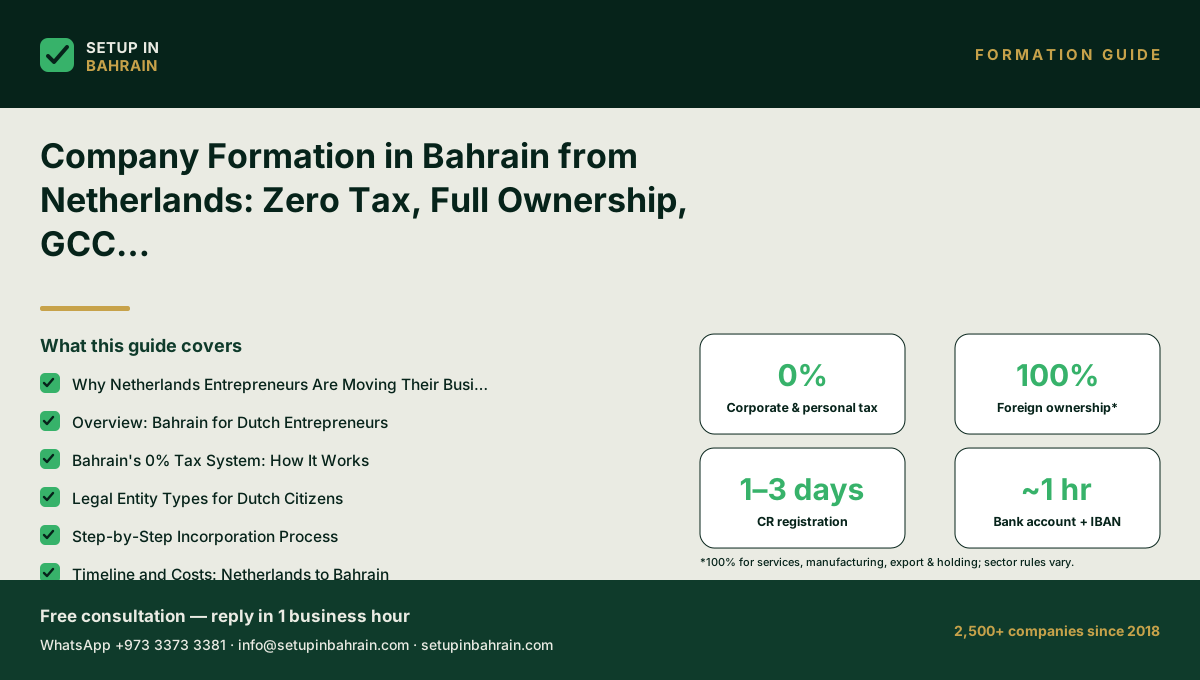
Start your Bahrain company from the Netherlands with generally no corporate income tax for most sectors. Enjoy tax-free profits, easy setup, and full foreign ownership for Dutch entrepreneurs.
Key Takeaways
- Why Netherlands Entrepreneurs Are Moving Their Business to Bahrain
- Overview: Bahrain for Dutch Entrepreneurs
- Bahrain's 0% Tax System: How It Works
- Legal Entity Types for Dutch Citizens
- Step-by-Step Incorporation Process
→ Complete guide: Company Formation in Bahrain — the full 2026 guide
View details
Ownership & capital
A Bahrain WLL can be owned by a single person — 100% foreign ownership applies to most activities, with no local partner required for services, manufacturing, export trading and holding companies. The minimum share capital is BHD 1 ; we recommend BHD 1,000 . This Makes bank account opening and investor visa approval smoother.
Last month, I sat across from Jeroen, a SaaS founder from Rotterdam who'd just finished his third consecutive all-nighter reconciling his Dutch-language boekhouding for the Belastingdienst. His situation was painfully common: €340,000 in annual profit, €87,720 disappearing to VPB, another €18,000 to his accountant for mandatory Dutch-language accounting, and an Amsterdam-Zuid office costing him €892 per square meter annually—just to maintain "substance" for his holding company.
"I'm working six months of the year just to pay for the privilege of doing business in the Netherlands," he told me. "There has to be another way."
There is. And for Dutch entrepreneurs specifically, Bahrain represents perhaps the most compelling alternative available anywhere in 2026.
This guide exists because the path from the Netherlands to Bahrain carries specific complexities that generic offshore guides simply don't address. The BEPS-driven substance requirements, the ATAD II implications, the CFC rules embedded in Article 13ab of the Wet VPB—these aren't footnotes. They're the entire framework that determines whether your Bahrain structure saves you hundreds of thousands of euros or creates a compliance nightmare with the Belastingdienst.
Let me show you exactly how this works.
Why Netherlands Entrepreneurs Are Moving Their Business to Bahrain
The pattern I've observed over the past three years is unmistakable: Dutch entrepreneurs aren't leaving the Netherlands because they hate windmills or gezelligheid. They're leaving because the arithmetic has become impossible to ignore.
Consider what happened to Marieke, who runs a B2B consulting firm from her home in Haarlem. Her business generates €280,000 in annual profit. Here's her current reality:
- VPB on first €200,000: €38,000 (19%)
- VPB on remaining €80,000: €20,640 (25.8%)
- Total VPB liability: €58,640
- Accountant fees for Dutch-language compliance: €14,500
- KvK registration and filing costs: €850
- Office space for substance (minimal): €18,000
- Total annual cost of Dutch operations: €91,990
Now consider Maarten, who runs a similar consultancy from Bahrain. Same €280,000 profit:
- Corporate tax: €0
- Accounting fees (English-language): €4,200
- CR registration and renewal: €1,100
- Office space (Bahrain Bay): €8,400
- Total annual cost of Bahrain operations: €13,700
The difference? €78,290 annually. Over five years, that's €391,450—enough to fund an entirely new product line, hire three senior developers, or simply live a fundamentally different life.
But the tax savings tell only part of the story. What's driving sophisticated Dutch entrepreneurs toward Bahrain isn't just the generally no corporate income tax for most sectors. It's the convergence of five factors that make the Netherlands more and more hostile to growth-oriented businesses.
The Substance Nightmare Post-BEPS
Since the OECD's Base Erosion and Profit Shifting initiatives took full effect, the Netherlands has implemented some of Europe's strictest substance requirements for holding companies. If you're running a Dutch BV that holds foreign subsidiaries or receives royalties, you now need to show:
- Qualified decision-makers physically present in the Netherlands
- Real office space (not just a registered address)
- Local bank accounts with actual transaction flow
- Board meetings held on Dutch soil with documented minutes
- Employees or contracted staff performing genuine management functions
The Belastingdienst has become remarkably aggressive in challenging structures they deem lacking substance. I've personally witnessed three Dutch holding companies lose their participation exemption benefits in 2024 alone because they couldn't prove sufficient local management.
ATAD II and the Hybrid Mismatch Rules
The Anti-Tax Avoidance Directive's second iteration created a labyrinth of hybrid mismatch rules that catch Dutch entrepreneurs off guard. If your Bahrain entity pays expenses that are deductible in Bahrain (or would be, if Bahrain had corporate tax) while at once being excluded from income in the Netherlands, you trigger anti-hybrid provisions.
The solution isn't to avoid Bahrain—it's to structure properly. A genuine Bahrain operating company with real substance doesn't trigger ATAD II concerns because there's no hybrid mismatch. The income is simply earned abroad by a legitimate foreign business.
CFC Rules Under Article 13ab Wet VPB
Here's where many Dutch entrepreneurs make fatal errors. The Netherlands' Controlled Foreign Company rules can attribute passive income from low-taxed foreign subsidiaries directly to the Dutch parent. If more than 30% of your Bahrain company's income comes from passive sources (royalties, interest, dividends from portfolio investments). You maintain significant Dutch ownership, you may face CFC inclusion.
The key word is "passive." An active trading company, a consulting firm with genuine client relationships, a software business licensing its own developed products—these generate active income that falls outside CFC attribution. Structure matters enormously.
Commercial Rent Insanity
Amsterdam commercial rents have reached genuinely absurd levels. According to CBRE's Q4 2024 Netherlands Market Report, prime office space in Amsterdam's South Axis commands €650-€750 per square meter annually. Even secondary locations in Rotterdam or Utrecht now exceed €350 per square meter.
For a 100-square-meter office—barely enough for a small team—you're paying €65,000-€75,000 annually in Amsterdam. The equivalent space in Bahrain Bay Business District costs $180-$220 per square meter, translating to roughly €16,500-€20,000 for the same footprint.
The Dutch-Language Compliance Burden
This issue frustrates internationally-minded Dutch entrepreneurs more than almost any other. Despite operating businesses with entirely English-speaking clients, Dutch law requires that official annual accounts be prepared in Dutch. The Kamer van Koophandel accepts only Dutch-language filings. Your notarial deed of incorporation must be in Dutch.
This creates artificial dependency on Dutch-speaking accountants and notaries, limiting your options and inflating costs. A straightforward annual accounts preparation that might cost €3,000 in English-language jurisdictions routinely exceeds €12,000 in the Netherlands once translation, notarization, and KvK formatting requirements are satisfied.
Overview: Bahrain for Dutch Entrepreneurs
Bahrain occupies a unique position that specifically addresses the pain points Dutch entrepreneurs face. Let me contextualize why this 780-square-kilometer island nation has become the destination of choice for sophisticated European business owners.
Geographic and Economic Context
Bahrain sits at the center of the Gulf Cooperation Council, connected to Saudi Arabia by the 25-kilometer King Fahd Causeway. This physical link to the world's 18th largest economy matters enormously. While the UAE positions itself as a regional hub, Bahrain offers something Dubai cannot: direct land access to Saudi Arabia's $1.1 trillion GDP and 35 million consumers.
The flight from Amsterdam Schiphol to Bahrain International Airport takes about 6 hours and 15 minutes—roughly the same as flying to New York. Gulf Air and KLM both operate direct routes, making physical presence requirements genuinely manageable.
The Bahrain Economic Development Board (EDB) Mandate
The EDB, established under Royal Decree, operates with a singular focus: attracting and supporting foreign investment. Unlike economic development agencies in many countries that function primarily as marketing organizations, the EDB maintains direct authority to expedite licensing, resolve bureaucratic conflicts, and help government interactions.
For Dutch entrepreneurs, this translates to something remarkable: a single point of contact who can navigate the entire incorporation process. The EDB assigns relationship managers to qualifying foreign investments. These managers genuinely advocate for your interests within the Bahraini bureaucracy.
World Bank Recognition
Bahrain consistently ranks among the top 50 countries globally in the World Bank's Ease of Doing Business index. More specifically, Bahrain ranks first in the MENA region for starting a business, with an average registration time of 48 hours for straightforward applications. The Central Bank of Bahrain (CBB) has received particular recognition for its regulatory sandbox program. This Allows fintech companies to test products in a controlled environment before full licensing.
Bahrain's 0% Tax System: How It Works
The question I receive most frequently from Dutch entrepreneurs: "Is the generally no corporate income tax for most sectors really zero, or are there hidden charges?"
Let me be unequivocal: Bahrain imposes no corporate income tax on standard business activities. No income tax. No capital gains tax. No withholding tax on dividends, royalties, or interest paid abroad. No inheritance tax. No wealth tax.
This isn't a temporary incentive or a rate that applies only to free zone companies. It's the structural reality of Bahrain's tax system, which generates government revenue primarily through:
- Oil and gas revenues (declining but still significant)
- Value Added Tax at 10% (increased from 5% in January 2022)
- Municipal fees and government service charges
- Import duties (typically 5% on most goods)
What Dutch Entrepreneurs Actually Pay
While Bahrain has no corporate income tax, operating a legitimate business involves certain costs:
Government Fees:
- Commercial Registration (CR) initial issuance: BHD 100-300 (€245-€735)
- CR annual renewal: BHD 50-200 (€122-€490)
- LMRA work permit fees: BHD 400-600 per employee annually (€980-€1,470)
- Municipality fees: BHD 200-500 annually (€490-€1,225)
VAT Considerations:
- 10% VAT applies to domestic sales exceeding BHD 37,500 annually
- B2B services exported outside Bahrain: 0% VAT (zero-rated)
- Financial services: largely exempt
For most Dutch service businesses serving international clients, VAT obligations are minimal because exports of services are zero-rated. A software consultancy billing clients in Europe, North America, and Asia pays no Bahraini VAT on those revenues.
Comparison: Netherlands vs. Bahrain Tax Reality
Let me construct a concrete comparison using realistic figures for a €500,000-profit business:
| Tax Category | Netherlands | Bahrain |
| Corporate Tax Rate | 19% (≤€200K) / 25.8% (>€200K) | 0% |
| Tax on €500K Profit | €115,400 | €0 |
| Dividend Withholding | 15% on distributions | 0% |
| Tax on €200K Dividend | €30,000 | €0 |
| Capital Gains Tax | Included in VPB | 0% |
| Social Contributions | 9.65% employer portion | ~4% total (GOSI) |
| Total Tax Burden | €145,400+ | ~€8,000 |
The Bahrain-Netherlands Tax Treaty
Bahrain and the Netherlands do not currently have a comprehensive Double Taxation Agreement in force. This might initially seem like a disadvantage, but for most business structures, it's actually neutral or beneficial.
Here's why: The Netherlands provides unilateral tax relief under the Besluit voorkoming dubbele belasting for income earned through a genuine foreign permanent setup. If your Bahrain company constitutes a permanent setup from which you conduct active business, the Netherlands exempts that business income from Dutch taxation under the participation exemption or the object exemption methods.
Without a treaty, there's also no automatic exchange of information specifically between Dutch and Bahraini tax authorities (though both countries participate in the Common Reporting Standard through separate multilateral agreements). This doesn't enable evasion—both countries share information through multilateral frameworks—but it does mean the administrative burden is somewhat reduced.
Legal Entity Types for Dutch Citizens
Bahrain offers several corporate structures. For Dutch entrepreneurs, two dominate practical consideration: the Limited Liability Company (WLL) and the single-shareholder WLL.
Limited Liability Company (WLL)
The WLL functions similarly to a Dutch BV in terms of limited liability protection, but with crucial differences:
Ownership: Since 2021 reforms, 100% foreign ownership is permitted for most business activities. You no longer need a Bahraini sponsor or local partner for the vast majority of sectors.
Capital Requirements: Minimum paid-up capital of BHD 20,000 (about €49,000) for wholly foreign-owned companies. This capital must be deposited in a Bahrain bank and can be used for business operations after incorporation.
Management: At least one director required; no nationality restrictions. You can serve as the sole director of your own company.
Shareholders: a single shareholder (one person can own 100%) for a standard WLL (can be individuals or corporate entities). Maximum 50 shareholders.
Best For: Dutch entrepreneurs planning to bring partners, seeking external investment, or wanting a structure that international banks and clients immediately recognize.
single-shareholder WLL
The WLL represents Bahrain's solution for solo entrepreneurs who don't want the complexity of multiple shareholders:
Ownership: 100% owned by a single individual or corporate entity.
Capital Requirements: BHD 1 minimum capital (we recommend BHD 1,000) (about €122,500). This higher threshold reflects the reduced oversight that comes with single ownership.
Management: Owner serves as director by default, though additional directors can be appointed.
Best For: Dutch solo consultants, freelancers scaling up, or entrepreneurs using a corporate vehicle as the single shareholder to maintain flexibility.
Branch Office
A branch office allows your Dutch BV to establish direct presence in Bahrain without creating a separate legal entity. The branch operates as an extension of the parent company.
Considerations for Dutch Entrepreneurs: While seemingly simpler, branch structures often trigger Dutch CFC rules more readily than subsidiaries because the Dutch parent directly recognizes branch income. Also, branches don't provide liability separation—creditors can pursue the parent company's Dutch assets.
Best For: Exploratory market entry, fixed-term project work, or situations where clients specifically require contracting with your established Dutch entity.
Free Zone Options: Bahrain Investment Wharf and Bahrain Logistics Zone
Bahrain's free zones offer additional benefits for specific activities:
Bahrain Investment Wharf: Focused on light manufacturing, assembly, and logistics. Import/export duty exemptions. Ideal for Dutch e-commerce businesses warehousing products for GCC distribution.
Bahrain Logistics Zone: Adjacent to Khalifa Bin Salman Port. Expedited customs processing. Suitable for trading companies managing physical goods.
For most Dutch service businesses, standard onshore incorporation provides sufficient benefits without free zone complexity. The free zones add value primarily when you're moving physical products.
Step-by-Step Incorporation Process
The practical process of forming a Bahrain company from the Netherlands follows a predictable sequence. Here's exactly what happens:
Phase 1: Pre-Application Preparation (1-2 Weeks)
Step 1: Select and Reserve Company Name Submit three name choices to the Ministry of Industry and Commerce (MOIC). Names must:
- Be unique within Bahrain's commercial register
- Not conflict with existing trademarks
- Avoid restricted terms (bank, insurance, royal) without additional licensing
- Include appropriate suffix (W.L.L., S.P.C., etc.)
Step 2: Prepare Foundational Documents Required documents for Dutch nationals:
- Passport copy (notarized)
- Proof of address (recent utility bill or bank statement, apostilled)
- CV/professional background summary
- Business plan outlining activities, projected revenues, and Bahrain market rationale
- For corporate shareholders: Dutch KvK extract (apostilled) and board resolution authorizing Bahrain incorporation
Step 3: Dutch-Side Preparations Crucial and often overlooked:
- Notify your Dutch accountant of planned structure changes
- Review CFC implications with a Netherlands tax advisor
- Consider Dutch exit taxation if personally relocating
- Ensure your Dutch BV's articles permit foreign subsidiary ownership
Phase 2: Formal Application (2-3 Weeks)
Step 4: Submit to MOIC via Sijilat System Bahrain's Sijilat online portal handles most commercial registration functions. Your application includes:
- Memorandum of Association (standard template available)
- Articles of Association (standard template available)
- Capital undertaking declaration
- Shareholder and director identification
- Activity selection (choose from standardized MOIC activity codes)
Step 5: Initial Approval and Capital Deposit Upon preliminary approval:
- Open a bank account with initial capital deposit
- Get bank confirmation letter
- Submit confirmation to MOIC
Step 6: Commercial Registration Issuance MOIC issues your Commercial Registration certificate, assigning your unique CR number. This is your primary business identifier in Bahrain.
Phase 3: Operational Setup (1-3 Weeks)
Step 7: Get Additional Licenses (If Required) Certain activities require supplementary licensing:
- Financial services: Central Bank of Bahrain (CBB) license
- Healthcare: National Health Regulatory Authority (NHRA)
- Food services: Ministry of Health
- Construction: Ministry of Works
For standard consulting, technology, and professional services, the CR itself suffices.
Step 8: Register with LMRA The Labour Market Regulatory Authority manages all employment-related matters. Even if you're initially operating solo, LMRA registration enables future visa sponsorship.
Step 9: Establish Banking Relationships Open operational bank accounts with documents:
- CR certificate
- Memorandum and Articles of Association
- Shareholder and director identification
- Initial deposit
- Expected transaction profile documents
Phase 4: Compliance Activation
Step 10: VAT Registration (If Applicable) If projected taxable supplies exceed BHD 37,500 annually, register with the National Bureau for Revenue for VAT purposes. Registration is mandatory above threshold, optional below.
Step 11: GOSI Social Insurance Registration Register with the General Organization for Social Insurance for any Bahraini or GCC national employees. Expatriate employees have different contribution structures.
Timeline and Costs: Netherlands to Bahrain
Dutch entrepreneurs consistently ask: "How long, really, and how much, truly?"
Realistic Timeline
| Phase | Duration | Key Dependencies |
| Document preparation | 5-10 business days | Apostille processing in Netherlands |
| Name reservation | 1-3 business days | Name availability |
| MOIC application review | 3-7 business days | Application completeness |
| Bank account opening | 5-15 business days | Bank due diligence |
| CR issuance | 1-2 business days | Post-approval processing |
| Additional licenses | 7-30 business days | Sector-specific requirements |
| Total: Standard Case | 3-6 weeks | |
| Total: Regulated Sector | 8-16 weeks |
Complete Cost Breakdown
Government Fees:
- Name reservation: BHD 10 (€24)
- CR application: BHD 100-300 (€245-€735)
- CR issuance: BHD 100 (€245)
- Municipal registration: BHD 200-500 (€490-€1,225)
- LMRA registration: BHD 100 (€245)
- Government Total: BHD 510-1,010 (€1,249-€2,474)
Professional Services:
- Corporate service provider: BHD 1,500-3,000 (€3,675-€7,350)
- Legal review (optional but recommended): BHD 500-1,500 (€1,225-€3,675)
- Dutch tax advisory (critical): €2,000-€5,000
- Apostille and notarization in Netherlands: €200-€500
- Professional Total: €7,100-€16,525
Capital Requirements:
- WLL minimum capital: BHD 20,000 (€49,000)
- WLL minimum capital: BHD 1 (we recommend BHD 1,000)
- Note: This is working capital, not a sunk cost
First-Year Operational Budget:
- Virtual office/registered address: BHD 1,200-2,400 (€2,940-€5,880)
- Physical office (optional, 50 sqm): BHD 6,000-12,000 (€14,700-€29,400)
- Accounting services: BHD 1,500-3,000 (€3,675-€7,350)
- Bank fees: BHD 200-500 (€490-€1,225)
- Annual Operations: €22,000-€44,000 (with physical office)
- Annual Operations: €8,000-€15,000 (virtual setup)
Total First-Year Investment
For a Dutch entrepreneur forming a Bahrain WLL with virtual office:
- Formation costs: €8,000-€19,000
- Capital deposit: €49,000 (available for use)
- First-year operations: €8,000-€15,000
- Total Cash Requirement: €65,000-€83,000
Compare this to the €91,990 annual cost Marieke was paying just to operate in the Netherlands. The Bahrain structure pays for itself in year one for any business with significant profitability.
Substance Requirements: Staying Compliant with Dutch CFC Rules
Here's where the expert knowledge separates successful structures from problematic ones. Dutch CFC rules under Article 13ab Wet VPB can attribute income from your Bahrain company to your Dutch tax base if you don't establish genuine economic substance.
What Triggers CFC Attribution
The Netherlands applies CFC rules when all three conditions are met:
- Control Test: You (alone or with connected persons) hold more than 50% of the foreign entity's capital, voting rights, or profit entitlements.
- Low-Tax Test: The foreign entity is subject to an effective tax rate below 9% (roughly half the Dutch headline rate). Bahrain's 0% rate clearly meets this threshold.
- Passive Income Test: More than 30% of the entity's income derives from passive sources: interest, royalties from non-self-developed IP, dividends from portfolio investments, rental income, or certain financial lease income.
How to Structure Around CFC Attribution
The solution isn't to avoid Bahrain—it's to ensure your Bahrain company generates active business income. Specifically:
Genuine Trading Activities: If you're buying and selling goods or services, establishing real customer relationships. Adding value through your business activities, this constitutes active income regardless of where your office sits.
Self-Developed Intangibles: If your Bahrain company develops its own intellectual property through genuine R&D activities. Licenses that IP to third parties, the resulting royalties are typically not passive income for CFC purposes. The key is that development must occur in Bahrain through actual staff or contracted expertise.
Management and Consulting Services: Providing services to third-party clients (not related entities) generates active service income. A Dutch marketing consultant billing international clients from Bahrain is earning active income.
Sufficient Local Substance: Beyond the income character, having genuine Bahrain substance—local staff, physical office, actual decision-making occurring in Bahrain—supports the characterization of your entity as a legitimate operating business rather than a passive holding vehicle.
Practical Substance Indicators
The Belastingdienst evaluates substance through several lenses:
Personnel: Do you have employees or contractors in Bahrain performing core business functions? A single full-time employee in Bahrain often suffices for small operations.
Office Facilities: Is there a physical location where business is conducted? Virtual offices are more and more scrutinized; shared office space or a small dedicated office provides stronger substance.
Decision-Making: Are strategic decisions made in Bahrain, or are you simply rubber-stamping instructions from the Netherlands? Board minutes, email trails, and contract negotiations should reflect genuine Bahrain-based decision-making.
Bank Accounts and Cash Management: Are operational funds held in Bahrain accounts? Are payments processed from Bahrain?
Third-Party Relationships: Do customers, suppliers. Service providers interact with your Bahrain presence, or do they deal exclusively with you in the Netherlands?
The Golden Rule
If your Bahrain company would make economic sense even without tax benefits—if you'd locate it there to access GCC markets, to serve regional clients, to benefit from Bahrain's talent pool—then your structure stands on solid ground. If the only rationale is tax savings, you're vulnerable.
Opening a Corporate Bank Account from the Netherlands
Banking represents the most frequently underestimated challenge for Dutch entrepreneurs establishing in Bahrain. Global de-risking by correspondent banks has made Middle Eastern banking relationships more complex than they were a decade ago.
Bank Options in Bahrain
Major Local Banks:
- Bank of Bahrain and Kuwait (BBK): Strong regional network, experienced with foreign companies
- National Bank of Bahrain (NBB): Oldest commercial bank, conservative but stable
- Ahli United Bank: Pan-GCC presence, good for regional operations
International Banks with Bahrain Presence:
- HSBC Bahrain: Familiar to Dutch entrepreneurs, easier integration with European banking
- Standard Chartered: Strong trade finance capabilities
- Citibank Bahrain: Corporate focus, higher minimums
Documents Requirements
Banks typically require:
Company Documents:
- Commercial Registration certificate
- Memorandum and Articles of Association
- Board resolution authorizing account opening
- Certificate of Incumbency (who are the directors and shareholders)
- VAT registration certificate (if applicable)
Personal Documents:
- Passport copies (all shareholders and directors)
- Proof of residential address (apostilled)
- Professional CV or resume
- Personal bank references
- Source of funds explanation
Business Documents:
- Business plan
- Projected financials (12-month minimum)
- Details of expected transaction volumes and counterparties
- Explanation of business model and client base
The Due Diligence Reality
Expect thorough questioning about:
- Why Bahrain? (Have a genuine business rationale beyond tax)
- Who are your clients? (Be prepared to name them)
- Where does your revenue come from? (Countries and industries)
- What is your source of initial capital? (Trace the funds)
- What is your expected transaction profile? (Volume, frequency, size)
Banks are not hostile to Dutch entrepreneurs—they're cautious about money laundering and sanctions compliance. A coherent business story and transparent documents smooths the process considerably.
Timeline Expectation
First meeting to account activation: 2-6 weeks First account to full functionality: 1-2 additional weeks
Some entrepreneurs open accounts in person during an initial Bahrain visit. Others complete the process remotely with courier document delivery. In-person presence accelerates approval by roughly 40% based on observed cases.
Multi-Currency Capabilities
Bahrain banks routinely offer multi-currency accounts. The Bahraini Dinar (BHD) is pegged to the US Dollar at a fixed rate of 1 BHD = 2.659 USD. For Dutch entrepreneurs billing in EUR, maintaining both EUR and USD accounts in Bahrain provides flexibility without constant conversion friction.
Residency Pathways: Work Visas, Golden Residency, and Investor Visas
If you're planning genuine presence in Bahrain—and for substance purposes, some presence is advisable—understanding visa pathways matters.
Self-Sponsorship Through Your Company
The most common pathway: your Bahrain company sponsors your own work visa.
Requirements:
- Valid Commercial Registration
- Approved quota from LMRA for expatriate employees
- Minimum capital compliant with visa category requirements
- Clean criminal background
- Medical examination in Bahrain
Process:
- Company obtains LMRA work permit approval
- Applicant enters Bahrain on business visa
- Medical examination at approved facility
- Residence permit issuance
- ID card (CPR) registration
Timeline: 2-4 weeks from work permit approval Validity: 1-2 years, renewable
Golden Residency Program
Bahrain launched its Golden Residency program to attract high-net-worth individuals and talented professionals. As a Dutch entrepreneur with a successful business, you likely qualify.
Eligibility Criteria (any one of the following):
- Own property in Bahrain worth BHD 200,000+ (about €490,000)
- Maintain retirement income of BHD 4,000/month (about €9,800/month)
- Hold professional qualifications in high-demand fields
- Demonstrate exceptional talent in business, arts, or sciences
Benefits:
- 10-year renewable residency
- No employer sponsor required
- Freedom to work or establish businesses
- Family inclusion (spouse and dependents)
- Pathway to permanent residency
Investor Visa
For substantial investments, Bahrain offers dedicated investor visas:
Requirements:
- Investment of BHD 50,000+ in Bahrain-registered company (about €122,500)
- Viable business plan
- Clean background
Benefits:
- Residency tied to investment, not employment
- Greater flexibility than standard work permits
- Family inclusion available
Tax Residency Considerations
A critical point for Dutch entrepreneurs: obtaining Bahrain residency does not automatically make you non-resident in the Netherlands for tax purposes. The Netherlands applies complex residency rules considering:
- Where is your permanent home?
- Where is your center of vital interests?
- Where do you habitually live?
- What is your nationality?
If you maintain a home in the Netherlands, have family there, or spend significant time there, the Belastingdienst may still consider you Dutch tax resident despite Bahrain residency. This creates potentially unlimited Dutch tax liability on worldwide income.
The solution: Clean breaks work best. If you're genuinely relocating to Bahrain, terminate your Dutch lease, move your family, enroll children in Bahrain schools, establish Bahrain banking as primary, and limit Netherlands visits to clearly temporary stays. Document your Bahrain center of life fully.
Industry-Specific Considerations
Different business types face different considerations when establishing in Bahrain. Here's sector-specific guidance:
Technology and SaaS Companies
Advantages:
- No restrictions on foreign ownership in tech sector
- Central Bank of Bahrain's regulatory sandbox for fintech
- AWS and Microsoft Azure regional data centers in nearby locations
- Growing tech talent pool with reasonable salary expectations
Considerations:
- Data localization rules for Bahrain government contracts
- Licensing requirements for telecommunications-adjacent services
- GDPR implications for serving EU customers (applicable regardless of location)
Practical Reality: Most Dutch SaaS founders find Bahrain operationally seamless. Your code doesn't care where your company is registered, and your international clients don't either.
Consulting and Professional Services
Advantages:
- No special licensing for most consulting activities
- Professional services fully permitted under standard CR
- Excellent flight connections for client visits
- English as de facto business language
Considerations:
- Certain professional designations (lawyer, accountant, architect) face practice restrictions
- Client contracting may require explanation of Bahrain entity
- Some large European corporates have vendor policies limiting low-tax jurisdiction suppliers
Practical Reality: Consulting firms represent the smoothest transition cases. Your expertise travels with you, and clients care about your capabilities, not your incorporation jurisdiction.
E-Commerce and Trading
Advantages:
- Strategic position for GCC fulfillment
- Free zone options for duty-free warehousing
- Excellent port and logistics infrastructure
- Direct Saudi market access via causeway
Considerations:
- VAT applies to Bahrain domestic sales
- Import duties on goods (typically 5%)
- Consumer protection regulations for Bahrain sales
- Product certification requirements for certain categories
Practical Reality: Dutch e-commerce businesses often establish Bahrain entities specifically to serve GCC customers, maintaining separate Dutch or EU entities for European market fulfillment.
Financial Services
Advantages:
- Bahrain is the established financial center of the Gulf
- Central Bank of Bahrain maintains sophisticated regulatory framework
- Regulatory sandbox enables fintech innovation
- Strong Islamic finance ecosystem
Considerations:
- Financial services require CBB licensing (significant process)
- Compliance obligations are substantial
- Capital requirements vary by license category
- Ongoing regulatory reporting mandatory
Risk Factors and Common Mistakes
After guiding dozens of Dutch entrepreneurs through Bahrain incorporation, I've catalogued the errors that create problems:
Mistake #1: Treating Structure as Optional
"I'll figure out the Dutch tax side later" is a recipe for disaster. The moment you incorporate in Bahrain without proper Dutch-side planning, you've potentially triggered immediate tax consequences. Capital gains on transferred assets, exit taxation on unrealized gains, deemed dividends on corporate restructuring—these are not theoretical risks.
Solution: Engage a Dutch-qualified tax advisor before incorporating. The €3,000-€5,000 you spend on proper planning saves multiples in unexpected tax bills.
Mistake #2: Insufficient Substance
Incorporating a Bahrain company but conducting all real business from your Amsterdam apartment invites CFC attribution, challenges from the Belastingdienst. Potential treaty benefit denial.
Solution: If you're establishing in Bahrain, establish in Bahrain. Hire a local employee, rent an office, hold meetings there, make decisions there. The cost of genuine substance is a fraction of the tax benefits you're seeking.
Mistake #3: Ignoring Dutch Residency Rules
Obtaining Bahrain residency while maintaining a home, family. Substantial presence in the Netherlands does not make you non-resident for Dutch tax
Bahrain Business Guides for Netherlands Citizens
Frequently Asked Questions
How long does it take to set up?
It takes 15 to 20 days. We file all forms for you. You do not need to wait long.
What does it cost?
Company formation: Standard BHD 1,340 with 3 months of office address; Gold BHD 1,700 with 6 months; Premium BHD 2,150 with 12 months and a cabin, officer table and chair, and two guest chairs. No formation package includes visas, including Premium. Investor/work visas are priced separately: BHD 755 for one year or BHD 953 for two years, in addition to the formation package. Ask for a written, itemized quotation confirming government fees and all inclusions before payment.
Do I need to visit Bahrain?
No. You can set up your firm from home. We do all the work online. Some banks may ask for one visit.
What tax will I pay?
You pay zero tax on your profits. Bahrain has no corporate income tax. This is a key benefit of the setup.
Can I own 100% of my firm?
Yes. Foreign owners can hold all shares. No local partner is needed. Full ownership is allowed.
What do I need to start?
You need a valid passport. You also need a trade name and a business address. We help you with all of these.
How do I open a bank account?
We guide you step by step. Most banks take 3 to 6 weeks. You will need your CR and firm papers.
Who issues the Commercial Registration (CR)?
The CR is issued by the MOICT. It is your legal right to trade in Bahrain. We file the CR for you.
Can I renew my CR each year?
Company renewal packages: BHD 530 with 3 months of office address; BHD 980 with 6 months; BHD 1,520 with 12 months. These are separate renewal packages, not visa fees.
How do I get started?
Fill in our form on this page. Our team will call you back. We map your best setup plan at no cost.
Steps to Form Your Company
- Pick your trade name. We check if it is free.
- Choose your business type. WLL is the most common.
- Sign the MOA. We draft and file all legal docs.
- Pay the state fees. About BHD 432 in total.
- Get your CR. Takes 15 to 20 days.
- Open your bank account. We guide each step.
- Start trading. You are ready to do business.
Key Facts
- Tax rate: 0%
- Foreign ownership: 100%
- Setup time: 15 to 20 days
- Company formation: Standard BHD 1,340 with 3 months of office address; Gold BHD 1,700 with 6 months; Premium BHD 2,150 with 12 months and a cabin, officer table and chair, and two guest chairs. No formation package includes visas, including Premium. Investor/work visas are priced separately: BHD 755 for one year or BHD 953 for two years, in addition to the formation package. Ask for a written, itemized quotation confirming government fees and all inclusions before payment.
- Company renewal packages: BHD 530 with 3 months of office address; BHD 980 with 6 months; BHD 1,520 with 12 months. These are separate renewal packages, not visa fees.
- Client rating: 4.8 stars
- Clients served: 2,500 and more
Quick Facts
- Tax rate: 0%
- Own all of your firm: Yes, 100%
- Time to set up: 15 to 20 days
- Company formation: Standard BHD 1,340 with 3 months of office address; Gold BHD 1,700 with 6 months; Premium BHD 2,150 with 12 months and a cabin, officer table and chair, and two guest chairs. No formation package includes visas, including Premium. Investor/work visas are priced separately: BHD 755 for one year or BHD 953 for two years, in addition to the formation package. Ask for a written, itemized quotation confirming government fees and all inclusions before payment.
- Company renewal packages: BHD 530 with 3 months of office address; BHD 980 with 6 months; BHD 1,520 with 12 months. These are separate renewal packages, not visa fees.
- Rating: 4.8 stars
- Clients: 2,500 and more
Why Bahrain?
Bahrain has no tax. You keep all your profits. This is rare in the Gulf.
You can own all of your firm. No local partner is needed. The law allows full foreign ownership.
Setup takes 15 to 20 days. We file all forms for you. You can do it all from home.
Bahrain has a free trade deal with the US. Your goods face low or no tariffs. This gives you access to big markets.
We have served 2,800+ clients from 44+ countries and maintain records to substantiate that total where needed. We have 113 Google reviews; reviews represent only some clients and are not the same as the total clients served.
Our Steps
- Tell us your plan. We advise you for free.
- We pick the right firm type for you.
- We file all your forms with MOICT.
- You get your CR in 15 to 20 days.
- We help you open a bank account.
- You are ready to trade. We stay with you.
Next Steps for Netherlands Citizens
You can set up a firm in Bahrain from Netherlands. You do not need to fly there first. We do all the work online.
Tell us your plan. We call you back the same day. We map the best route for you at no cost.
We file all your forms. We deal with MOICT and the state. You get your CR in 15 to 20 days.
After your CR, we help you get a bank account. We also help with your Investor Visa. One firm guides you at each step.
Why Our Clients from Netherlands Choose Us
- We speak your language. We know your needs.
- We have helped clients from Netherlands before.
- Our fee is clear. No surprise costs.
- We have a 4.8 star rating on Google.
- We have helped more than 2,500 clients set up in Bahrain.
Fill in the form on this page. We will be in touch soon. Let us help you start your Bahrain firm today.
Ready to set up in Bahrain from Netherlands?
Tell us your business idea. We map the right entity, ownership and timeline — then handle the filing while you focus on what matters.