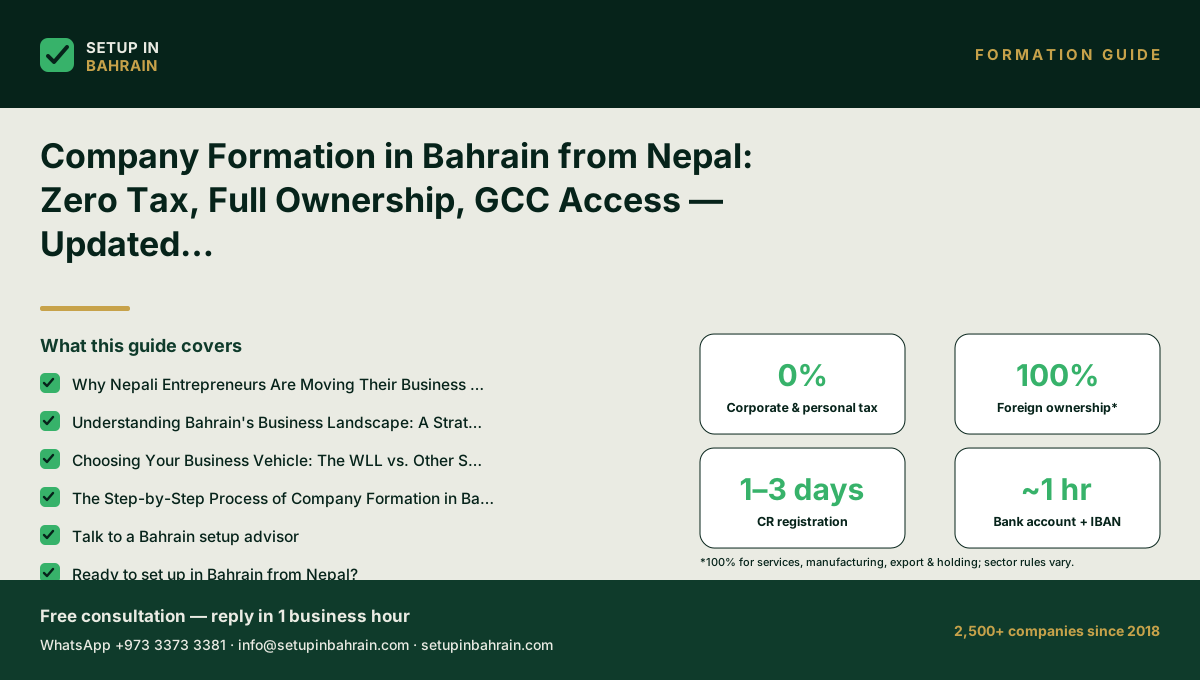
Complete guide for Nepal entrepreneurs: form a company in Bahrain with generally no corporate income tax for most sectors, 100% foreign ownership. GCC market access. Costs, steps, visas, banking.
Key Takeaways
- Why Nepali Entrepreneurs Are Moving Their Business to Bahrain
- Understanding Bahrain's Business Landscape: A Strategic Overview for Nepalis
- Choosing Your Business Vehicle: The WLL vs. Other Structures
- The Step-by-Step Process of Company Formation in Bahrain (MOIC & Sijilat Portal)
→ Complete guide: Company Formation in Bahrain — the full 2026 guide
View details
Ownership & capital
A Bahrain WLL can be owned by a single person — 100% foreign ownership applies to most activities, with no local partner required for services, manufacturing, export trading and holding companies. The minimum share capital is BHD 1 ; we recommend BHD 1,000 . This Makes bank account opening and investor visa approval smoother.
If you’re a Nepali entrepreneur, the phrase "company formation" likely conjures images of bureaucratic mazes, endless paperwork. The persistent weight of a 25% corporate tax. You've poured your lifeblood into building your business in Nepal, navigating the intricate demands of the Nepal Rastra Bank (NRB) for foreign investment approvals, grappling with the complex Inland Revenue Office (IRO) filing system, and constantly strategizing around an NPR currency that, while pegged to the INR, feels like a fortress when you need to convert it to USD or GCC currencies for international trade.
The idea of a business environment where your profits remain entirely yours, where you can own 100% of your global enterprise without a local partner, and where you can effortlessly access one of the world's most lucrative markets, might sound almost suspiciously easy, perhaps even a distant dream. But what if this dream is not only achievable but also surprisingly straightforward?
This guide is written specifically for you, the pioneering Nepali entrepreneur. It’s not just about forming a company; it’s about strategically relocating your financial and operational base to a jurisdiction that empowers your growth, provides unparalleled stability, and opens doors to a global stage, starting with the immense opportunities across the King Fahd Causeway in Saudi Arabia. We’ll delve into the practical, 2026-specific answers you won’t find on generic "international company formation" websites, offering actionable insights tailored to your unique challenges as a Nepal-based business.
Every section below is crafted to address your real regulatory, currency. Logistics barriers at home, showing you how Bahrain offers a tangible, human-centric solution to expand your horizons.
Why Nepali Entrepreneurs Are Moving Their Business to Bahrain
Let’s start with a story that echoes through many Kathmandu boardrooms. Meet Anil Sharma, a software exporter from Baneshwor. Last year, his company, ‘TechHimal,’ cleared NPR 48 lakh in profit after dutifully paying the Nepal government's 25% corporate tax. When Anil tried to move even a portion of that hard-earned money abroad to hire specialized developers in Dubai for an international project, Nepal Rastra Bank (NRB) rejected his application not once, but twice. The paperwork demanded three years of audited statements, a meticulously detailed project report, and proof that the foreign investment aligned with Nepal’s elusive "priority sectors." By the time a conditional approval eventually arrived, nine months had passed, and the lucrative client contract had already gone to a competitor.
Stories like Anil’s are common. They highlight a fundamental friction point: Nepali business ambition often clashes with domestic regulatory realities. This isn't a critique of Nepal. An acknowledgment of the distinct challenges its entrepreneurs face when trying to scale globally.
So, what pushes discerning Nepali entrepreneurs like Anil to look beyond their borders, specifically towards Bahrain? The answer lies in a compelling contrast of business environments.
The Burden of Nepal's Corporate Tax (25%)
For years, Nepali businesses have grappled with one of the higher corporate tax rates in the region: a hefty 25% of their net profits. For a growing company, a quarter of its earnings being siphoned off annually can severely restrict reinvestment, innovation. Expansion capabilities. This isn't just about the tax itself; it's about the opportunity cost. That 25% could be funding R&D, hiring more talent, upgrading technology, or exploring new markets. In Nepal, every NPR 100 earned means only NPR 75 remains for the business to grow.
Contrast with Bahrain: Bahrain stands out globally with a 0% corporate income tax rate for most business activities. This means that every Dinar (BHD) your company earns is yours to reinvest, distribute, or repatriate. For a Nepali entrepreneur, this translates into immediate and substantial savings, directly impacting profitability and cash flow. Imagine keeping 100% of your profits, year after year – that's the Bahraini advantage.
Navigating Nepal Rastra Bank’s Approval Labyrinth
The NRB’s strict foreign exchange regulations and approval processes are perhaps the most significant hurdle for Nepali businesses with international aspirations. Whether it’s attempting to invest abroad, receive foreign currency payments directly, or repatriate profits from international operations, the process is often characterized by:
Protracted Delays: As Anil’s story illustrates, approvals can take months, often missing critical market windows. Opaque Criteria: The requirements can feel subjective, with success often depending on alignment with nebulous "national priority sectors" or the interpretation of specific officials. Excessive Documents: Demands for exhaustive project reports, multi-year audited statements. Intricate justifications create an immense administrative burden. Risk of Rejection: Even with meticulous preparation, there's no guarantee of approval, leaving businesses in limbo.
This labyrinth stifles global competitiveness, forcing Nepali entrepreneurs to operate with one hand tied behind their back when engaging with the international market.
Contrast with Bahrain: Bahrain, as a leading financial hub in the GCC, boasts unrestricted capital flows. Repatriation of profits and capital is seamless, with no currency controls or bureaucratic bottlenecks. The Central Bank of Bahrain (CBB) ensures a stable, transparent financial environment where businesses can move funds freely and efficiently, directly supporting international trade and investment.
The IRO Filing System and Compliance Overheads
Beyond the 25% tax, the sheer complexity and administrative burden of Nepal's IRO filing system add significant non-monetary costs. Businesses are often forced to spend considerable resources – time, money, and skilled personnel – simply to remain compliant. For many small to medium-sized enterprises (SMEs), this means an annual compliance bill of anywhere from NPR 400,000 to NPR 600,000 (roughly $3,000 to $4,500), just on legal and audit fees, excluding internal costs. This overhead drains resources that could otherwise be used for productive growth.
Contrast with Bahrain: While Bahrain has its own regulatory framework, it is designed for efficiency and transparency, aiming to reduce administrative burdens. The Ministry of Industry, Commerce and Tourism (MOIC) has streamlined many processes through its Sijilat online portal, making company registration and compliance greatly faster. While there's a 5% Value Added Tax (VAT) on certain goods and services, the overall tax compliance landscape is much simpler, reducing both direct costs and the opportunity cost of administrative time.
The Inconvertibility of NPR: A Silent Killer for Global Ambitions
Nepal's currency, the Nepali Rupee (NPR), is pegged to the Indian Rupee (INR). While this offers stability with its southern neighbor, it presents a significant challenge for businesses dealing with USD, Euro, or GCC currencies. Converting NPR to these hard currencies for international transactions or investments is notoriously difficult due to strict foreign exchange controls. All outbound payments and profits must flow through "approved channels," often with delays and a standing risk of procedural rejection. This makes international sourcing, hiring, and profit repatriation incredibly challenging and unpredictable.
Contrast with Bahrain: The Bahraini Dinar (BHD) is pegged to the US Dollar (USD) at a stable rate of BHD 1 = USD 2.65. This peg offers immense currency stability and predictability for international trade and investment. Businesses operating in Bahrain can freely convert BHD to USD and other major global currencies without restrictions, eliminating the currency conversion headaches that plague Nepali entrepreneurs. This financial freedom is a cornerstone of Bahrain’s appeal.
The Allure of 100% Foreign Ownership and Zero Tax in Bahrain
One of the most immediate and striking benefits for Nepali entrepreneurs is the ability to maintain complete control over their business. In many sectors in Nepal, foreign investment rules or practical considerations often necessitate local partners, leading to potential disagreements, profit-sharing complexities. A dilution of control.
In Bahrain, for most business activities, you can own 100% of your company. This is a game-changer. There's no requirement for local equity participation, no silent partners to appease. No need to share decision-making power. Your vision, your company, 100% yours.
Combine this with the Generally no corporate income tax for most sectors and you have an unbeatable proposition: full ownership and full retention of profits. This financial and operational autonomy is a powerful magnet for Nepali founders seeking to scale their ventures globally.
Bahrain as Your Gateway to the GCC Market (Especially Saudi Arabia)
Beyond the direct financial and ownership benefits, Bahrain offers an unparalleled strategic advantage: direct, frictionless access to the entire Gulf Cooperation Council (GCC) market, especially Saudi Arabia.
- King Fahd Causeway: Bahrain is physically connected to Saudi Arabia via the King Fahd Causeway, a 25-kilometer bridge that facilitates immense trade and movement of people. This makes Bahrain an ideal logistics and operations hub for businesses targeting the Saudi market, the largest economy in the Middle East.
- Free Trade Agreements: As a member of the GCC, Bahrain is part of a robust economic bloc with free trade agreements, customs unions, and a common market approach. This means businesses registered in Bahrain can export goods and services throughout the GCC with minimal tariffs and simplified customs procedures.
- Strategic Location: Bahrain's central location in the Gulf, with excellent air and sea links, positions it as a perfect regional distribution and services hub. It’s equidistant from major Asian, African, and European markets, making it an attractive base for international operations.
For a Nepali business aiming to expand beyond South Asia, Bahrain isn't just an offshore entity; it's a strategically located launchpad into a vibrant, high-net-worth market of over 50 million people, offering unprecedented growth opportunities.
Understanding Bahrain's Business Landscape: A Strategic Overview for Nepalis
Stepping into Bahrain's business environment means entering a world designed for efficiency, stability, and growth. For Nepali entrepreneurs, understanding this landscape is key to leveraging its full potential.
Bahrain's Vision 2030 and Economic Diversification
The Kingdom of Bahrain is not resting on its laurels. Driven by its "Economic Vision 2030," the country has aggressively pursued economic diversification, moving beyond its traditional oil and gas reliance. This vision focuses on creating a sustainable economy built on three key pillars: sustainability, fairness, and competitiveness. Key sectors targeted for growth include:
Financial Services: Bahrain is a long-established financial hub, home to over 300 financial institutions, including conventional and Islamic banks, investment firms. Insurance companies. The Central Bank of Bahrain (CBB) is a respected regulator, fostering an environment of innovation, especially in FinTech. Manufacturing and Logistics: Leveraging its strategic location and excellent infrastructure, Bahrain is positioning itself as a regional manufacturing and logistics hub. The Khalifa Bin Salman Port and Bahrain International Airport offer world-class connectivity. Information and Communication Technology (ICT): With significant investment in digital infrastructure and a push for smart government initiatives, Bahrain is attracting tech companies and fostering a vibrant startup ecosystem. Tourism and Hospitality: As a cultural bridge in the Gulf, tourism remains a significant growth area, attracting visitors from across the region and beyond.
For Nepali entrepreneurs, this diversification means a wide array of opportunities, whether you're in IT, consulting, trading, or a specialized manufacturing niche.
The Ease of Doing Business: Global Rankings and Local Realities
Bahrain consistently ranks high in global indices for ease of doing business. For instance, the World Bank’s Doing Business Report has historically highlighted Bahrain's strengths in areas like starting a business, dealing with construction permits, and trading across borders. While the World Bank no longer publishes these reports, the underlying reforms and infrastructure remain.
What does this mean in practice for you?
Streamlined Processes: The Ministry of Industry, Commerce and Tourism (MOIC) has digitized many processes through its Sijilat portal, greatly reducing the time and effort required for company registration and renewals. Investor-Friendly Policies: The Bahrain Economic Development Board (EDB) actively works to attract foreign investment by providing support, facilitating connections. Championing policy improvements. The EDB acts as a primary point of contact for international investors, guiding them through the entire process. Transparent Regulations: Bahrain's legal and regulatory framework is based on common law principles, providing clarity and predictability, a welcome contrast to more complex jurisdictions.
Key Economic Sectors Ripe for Nepali Investment
Considering your background and Nepal's emerging economy, several sectors in Bahrain hold particular promise:
- IT and Software Development: With Nepal's strong talent pool in IT outsourcing and software development, setting up a Bahraini entity can provide access to high-paying GCC clients, stable payment structures, and a regulatory environment conducive to digital businesses.
- Trading and E-commerce: Leveraging Bahrain's logistics infrastructure and GCC market access, Nepali entrepreneurs can establish trading companies for various goods – from manufactured products to specialized commodities – reaching a broader, wealthier consumer base.
- Consulting Services: Whether it’s management consulting, engineering, or specialized advisory, Bahrain’s diverse economy offers a demand for professional services. Nepali consultants can find a sophisticated client base, free from the currency conversion woes of home.
- FinTech and Blockchain: Given Bahrain’s progressive stance on financial innovation, entrepreneurs in these cutting-edge fields will find a supportive regulatory sandbox and a forward-thinking financial ecosystem.
Regulatory Framework: CBB, EDB, MOIC – Your Guiding Stars
Understanding the key regulatory bodies is crucial:
Ministry of Industry, Commerce and Tourism (MOIC): This is your primary point of contact for company registration, commercial licenses. Ongoing compliance. The Sijilat portal, managed by MOIC, is where most of your interaction will happen. Bahrain Economic Development Board (EDB): Often referred to interchangeably with the Bahrain Investment Promotion Agency (BIPA), the EDB is the investment promotion arm of the government. They are instrumental in attracting and supporting foreign direct investment, acting as a facilitator and advisor for new businesses. For Nepali entrepreneurs, the EDB can be an invaluable resource for market insights, networking. Navigating the initial setup. Central Bank of Bahrain (CBB): The CBB regulates the financial services industry, ensuring stability, transparency, and consumer protection. If your business involves financial activities, banking, or payments, the CBB will be your regulatory authority. Labour Market Regulatory Authority (LMRA): The LMRA oversees all aspects of expatriate employment, including work permits, visas. Ensuring fair labor practices. You'll interact with LMRA when hiring staff, including yourself as an investor.
These bodies, working in concert, create a robust yet accessible regulatory environment designed to foster business growth.
Choosing Your Business Vehicle: The WLL vs. Other Structures
When forming a company in Bahrain, selecting the right legal structure is foundational. For most Nepali entrepreneurs, especially those starting their first venture in the Kingdom, the With Limited Liability (WLL) company will be the optimal choice.
The Workhorse: Limited Liability Company (WLL) Explained
The Bahraini WLL is the most popular and flexible legal entity for foreign investors due to its key advantages:
100% Foreign Ownership: This is paramount for Nepali entrepreneurs. Unlike many jurisdictions or even certain local partnership requirements in Nepal, a WLL in Bahrain can be owned 100% by a single foreign individual or a single foreign corporate entity. You do not need a local partner, a silent partner, or any Bahraini equity participation whatsoever. This ensures full control and retention of profits. Single Shareholder Permitted: A WLL can be established with just one shareholder. This is a critical distinction from other structures and ensures that even if you are a solo entrepreneur, you can form a fully independent company. There is NO single-shareholder WLL legal entity in Bahrain; the WLL serves this purpose perfectly for sole owners. Limited Liability: As the name suggests, your personal liability is limited to the amount of capital you've invested in the company. This protects your personal assets from business debts and obligations. Minimum Share Capital: Legally, the minimum share capital required for a WLL is BHD 1 . Yes, just one Dinar. But. This is a crucial practical insight, we strongly recommend a minimum paid-up capital of BHD 1,000 for practical reasons. * Bank Account Approval: While BHD 1 is legal, most banks in Bahrain will require a higher initial deposit (typically BHD 1,000 to BHD 5,000) to open a corporate bank account. This is essential for your company to operate. * Investor Visa: A higher share capital shows serious intent and financial capacity. This Can help the approval of your investor visa and those of your employees. * Credibility: It simply looks more professional and financially stable to potential clients, partners, and suppliers. Flexibility: A WLL can conduct a wide range of commercial activities, making it suitable for consulting, trading, IT services. Many other business types.
For most Nepali entrepreneurs, the WLL offers the perfect balance of control, liability protection. Operational flexibility, making it the default and most recommended choice.
When to Consider a Branch Office or Representative Office
While a WLL is generally preferred, a Branch Office or Representative Office might be considered if your existing Nepal-based company wants to establish a presence in Bahrain without creating a separate legal entity.
- Branch Office: This is an extension of your parent company in Nepal. It can engage in commercial activities but is not a separate legal entity. The liabilities of the branch are the liabilities of the parent company. It requires the parent company's legal documents to be attested and translated.
- Representative Office: This is even more limited. It can only conduct promotional, marketing, or liaison activities. It cannot engage in direct commercial transactions or generate revenue in Bahrain. It's primarily for market research or brand presence.
For most Nepali startups or SMEs looking for full operational autonomy and access to the zero-tax environment, a WLL is almost always the better choice as it separates your Bahraini operations from your Nepali entity and offers greater flexibility.
Structures Less Common for Initial Nepali Ventures
Other legal forms exist, but they are typically for larger, more complex operations:
- Public Shareholding Company (BSC Public): For companies seeking to list on the stock exchange.
- Closed Shareholding Company (BSC Closed): Similar to a WLL but with shares transferable more easily, often used for family businesses or joint ventures with many shareholders.
- Partnership Companies (General Partnership, Limited Partnership): These involve unlimited liability for at least one partner and are less common for foreign investors seeking liability protection.
Stick with the WLL; it offers the optimal blend of benefits for your initial entry into Bahrain.
The Step-by-Step Process of Company Formation in Bahrain (MOIC & Sijilat Portal)
Forming a company in Bahrain is notably efficient, largely thanks to the digital Sijilat portal managed by the Ministry of Industry, Commerce and Tourism (MOIC). Here's a practical, step-by-step breakdown:
Step 1: Business Activity Selection & Initial Approval (MOIC)
Your first move is to define your core business activities. Bahrain's Commercial Registration (CR) system requires you to specify these clearly.
Check Permitted Activities: The Sijilat portal lists all permissible commercial activities. Ensure your intended activities are available and fit the WLL structure. Some specialized activities (e.g., financial services, education, healthcare) require specific approvals from relevant ministries (e.g., CBB, Ministry of Education, National Health Regulatory Authority) before* MOIC approval.
- Initial Approval: Submit your application through Sijilat. This initial stage involves providing basic details about the proposed company, shareholders, and activities. The MOIC will review this for feasibility and compliance with Bahraini law. This often includes a security clearance for shareholders and directors.
Step 2: Reserving Your Company Name
Once your activities receive initial clearance, you can reserve your company name through the Sijilat portal.
- Uniqueness: The name must be unique and not already registered or too similar to existing companies.
- Relevance: It should generally reflect your business activities.
- Forbidden Words: Avoid any words that are offensive, religiously sensitive, or imply government affiliation.
Step 3: Drafting Memorandum and Articles of Association (MAA)
These are the foundational legal documents for your WLL. They outline the company's purpose, share capital, shareholder rights, management structure, and operational rules.
- Standard Templates: The MOIC provides standard templates for MAA for a WLL, which can be customized.
- Key Details: This document will include the company name, registered address, share capital (BHD 1,000 recommended), details of shareholders (including percentage of ownership), directors, and the company's objectives.
- Notarization: Once drafted, the MAA must be signed by the shareholders (or their authorized representatives) and notarized by a public notary in Bahrain. If shareholders are not present in Bahrain, a Power of Attorney (POA) can be used.
Step 4: Share Capital Deposit and Bank Account Opening
This is a critical step, especially for Nepali entrepreneurs used to NRB restrictions.
- Initial Deposit: You will need to open a temporary corporate bank account in Bahrain and deposit the recommended share capital (BHD 1,000) into it. This deposit confirms that the capital is available for the company's operations.
- Bank Selection: Bahrain has a robust banking sector with international and local banks (e.g., NBB, BBK, HSBC, Standard Chartered). Choose a bank that suits your business needs, considering transaction fees, online banking facilities, and customer service.
- Documents for Bank: Banks will require a variety of documents:
Practical Tip for Nepalis: Ensure your funds for the capital deposit are transferred legally from Nepal. This may involve obtaining necessary NRB clearances for outward remittance from Nepal, even if it's for capital investment in your own foreign company. Plan this well in advance to avoid delays. Once in Bahrain, subsequent transactions will be seamless.
Step 5: Obtaining Commercial Registration (CR)
With the MAA signed and capital deposited, you can finalize your CR application through Sijilat.
- Submission: Upload all required documents (notarized MAA, bank deposit certificate, shareholder IDs, application forms).
- MOIC Review: The MOIC will conduct a final review. Assuming all documents are in order and approvals are secured, your Commercial Registration (CR) will be issued. This CR is your company's official birth certificate and legal authorization to operate.
- CR Certificate: The CR certificate will list your company’s details, activities, shareholders, and registration number.
Step 6: Licensing and Permits (If Applicable)
Depending on your specific business activities, you might need additional licenses or permits from sector-specific regulatory bodies after receiving your CR.
- Examples: A financial advisory firm needs a license from the CBB; a restaurant needs permits from the Ministry of Health and municipality; an educational institution needs approval from the Ministry of Education.
- Guidance: Your local consultant can help identify and secure these specific licenses.
Step 7: Post-Formation Compliance: CPR, LMRA, Social Insurance
Once your CR is issued, several immediate steps are required to operationalize your company and allow you, as the owner. Your employees to work and reside in Bahrain.
- Central Population Registry (CPR) Card: As an investor/resident, you will need to apply for your CPR card (Bahrain's national ID). This is essential for virtually all official transactions, from opening personal bank accounts to utilities.
- Labour Market Regulatory Authority (LMRA) Registration: Your company must register with LMRA. This is the body that issues work permits and oversees employment regulations for expatriates.
- Social Insurance Organization (SIO): Register
Bahrain Business Guides for Nepal Citizens
Frequently Asked Questions
How long does it take to set up?
It takes 15 to 20 days. We file all forms for you. You do not need to wait long.
What does it cost?
Company formation: Standard BHD 1,340 with 3 months of office address; Gold BHD 1,700 with 6 months; Premium BHD 2,150 with 12 months and a cabin, officer table and chair, and two guest chairs. No formation package includes visas, including Premium. Investor/work visas are priced separately: BHD 755 for one year or BHD 953 for two years, in addition to the formation package. Ask for a written, itemized quotation confirming government fees and all inclusions before payment.
Do I need to visit Bahrain?
No. You can set up your firm from home. We do all the work online. Some banks may ask for one visit.
What tax will I pay?
You pay zero tax on your profits. Bahrain has no corporate income tax. This is a key benefit of the setup.
Can I own 100% of my firm?
Yes. Foreign owners can hold all shares. No local partner is needed. Full ownership is allowed.
What do I need to start?
You need a valid passport. You also need a trade name and a business address. We help you with all of these.
How do I open a bank account?
We guide you step by step. Most banks take 3 to 6 weeks. You will need your CR and firm papers.
Who issues the Commercial Registration (CR)?
The CR is issued by the MOICT. It is your legal right to trade in Bahrain. We file the CR for you.
Can I renew my CR each year?
Company renewal packages: BHD 530 with 3 months of office address; BHD 980 with 6 months; BHD 1,520 with 12 months. These are separate renewal packages, not visa fees.
How do I get started?
Fill in our form on this page. Our team will call you back. We map your best setup plan at no cost.
Steps to Form Your Company
- Pick your trade name. We check if it is free.
- Choose your business type. WLL is the most common.
- Sign the MOA. We draft and file all legal docs.
- Pay the state fees. About BHD 432 in total.
- Get your CR. Takes 15 to 20 days.
- Open your bank account. We guide each step.
- Start trading. You are ready to do business.
Key Facts
- Tax rate: 0%
- Foreign ownership: 100%
- Setup time: 15 to 20 days
- Company formation: Standard BHD 1,340 with 3 months of office address; Gold BHD 1,700 with 6 months; Premium BHD 2,150 with 12 months and a cabin, officer table and chair, and two guest chairs. No formation package includes visas, including Premium. Investor/work visas are priced separately: BHD 755 for one year or BHD 953 for two years, in addition to the formation package. Ask for a written, itemized quotation confirming government fees and all inclusions before payment.
- Company renewal packages: BHD 530 with 3 months of office address; BHD 980 with 6 months; BHD 1,520 with 12 months. These are separate renewal packages, not visa fees.
- Client rating: 4.8 stars
- Clients served: 2,500 and more
Quick Facts
- Tax rate: 0%
- Own all of your firm: Yes, 100%
- Time to set up: 15 to 20 days
- Company formation: Standard BHD 1,340 with 3 months of office address; Gold BHD 1,700 with 6 months; Premium BHD 2,150 with 12 months and a cabin, officer table and chair, and two guest chairs. No formation package includes visas, including Premium. Investor/work visas are priced separately: BHD 755 for one year or BHD 953 for two years, in addition to the formation package. Ask for a written, itemized quotation confirming government fees and all inclusions before payment.
- Company renewal packages: BHD 530 with 3 months of office address; BHD 980 with 6 months; BHD 1,520 with 12 months. These are separate renewal packages, not visa fees.
- Rating: 4.8 stars
- Clients: 2,500 and more
Why Bahrain?
Bahrain has no tax. You keep all your profits. This is rare in the Gulf.
You can own all of your firm. No local partner is needed. The law allows full foreign ownership.
Setup takes 15 to 20 days. We file all forms for you. You can do it all from home.
Bahrain has a free trade deal with the US. Your goods face low or no tariffs. This gives you access to big markets.
We have served 2,800+ clients from 44+ countries and maintain records to substantiate that total where needed. We have 113 Google reviews; reviews represent only some clients and are not the same as the total clients served.
Our Steps
- Tell us your plan. We advise you for free.
- We pick the right firm type for you.
- We file all your forms with MOICT.
- You get your CR in 15 to 20 days.
- We help you open a bank account.
- You are ready to trade. We stay with you.
Next Steps for Nepal Citizens
You can set up a firm in Bahrain from Nepal. You do not need to fly there first. We do all the work online.
Tell us your plan. We call you back the same day. We map the best route for you at no cost.
We file all your forms. We deal with MOICT and the state. You get your CR in 15 to 20 days.
After your CR, we help you get a bank account. We also help with your Investor Visa. One firm guides you at each step.
Why Our Clients from Nepal Choose Us
- We speak your language. We know your needs.
- We have helped clients from Nepal before.
- Our fee is clear. No surprise costs.
- We have a 4.8 star rating on Google.
- We have helped more than 2,500 clients set up in Bahrain.
Fill in the form on this page. We will be in touch soon. Let us help you start your Bahrain firm today.
Ready to set up in Bahrain from Nepal?
Tell us your business idea. We map the right entity, ownership and timeline — then handle the filing while you focus on what matters.