Set up your Bahrain company from Liechtenstein with generally no corporate income tax for most sectors. Fast registration, full foreign ownership, and seamless international business expansion.
Key Takeaways
- Why Liechtenstein Entrepreneurs Are Moving Their Business to Bahrain
- The Liechtenstein Entrepreneur's Pain Points: A Detailed Breakdown
- Advanced Strategy: Company Formation in Bahrain from Liechtenstein in 2026
- Step-by-Step Plan: How to Set Up a Company in Bahrain from Liechtenstein
- Bahrain's Regulatory Environment vs. Liechtenstein: How They Compare
→ Complete guide: Company Formation in Bahrain — the full 2026 guide
View details
Ownership & capital
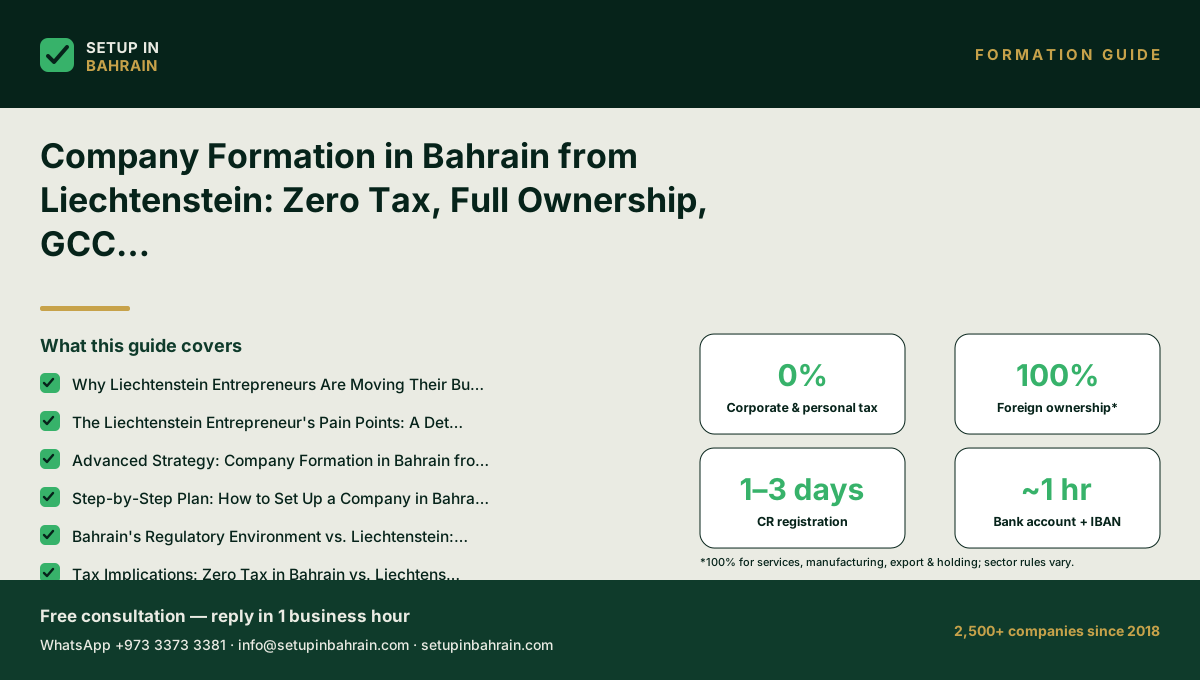
A Bahrain WLL can be owned by a single person — 100% foreign ownership applies to most activities, with no local partner required for services, manufacturing, export trading and holding companies. The minimum share capital is BHD 1 ; we recommend BHD 1,000 . This Makes bank account opening and investor visa approval smoother.
Why Liechtenstein Entrepreneurs Are Moving Their Business to Bahrain
Klaus had built a solid fintech consulting business over eight years in Vaduz. His clients included private banks across Switzerland and Germany. His Anstalt structure had served him well—at first. But during our consultation last autumn, he laid out the numbers that had kept him up at night.
"I'm paying CHF 18,000 annually just to maintain my registered agent relationship," he explained. "Another CHF 12,000 for mandatory compliance reviews. The FMA sent three separate beneficial ownership verification requests last quarter alone. My actual tax burden? Twelve and a half percent sounds reasonable until you add the Gemeinde municipal tax, the AHV contributions. The compliance overhead. I'm hemorrhaging nearly 30% of my operating income before I even pay myself."
Klaus isn't alone. Between 2022 and 2025, the Liechtenstein Financial Market Authority (FMA) intensified its AML documents requirements under the EEA anti-money laundering directives. What once made the principality attractive—streamlined wealth management structures, sophisticated legal frameworks, access to the EEA market—now carries a compliance burden that squeezes small and medium enterprises relentlessly.
Markus, a software architect based in Schaan, faces a different but equally painful reality. For years, he's run a successful niche consulting firm from Liechtenstein, providing specialized services to international clients. He chose Liechtenstein for its renowned stability and the flexibility offered by structures like the Anstalt (setup) in managing his intellectual property and revenue. But the CHF 30,000 minimum share capital felt like a significant upfront commitment, tying up funds that could have been invested in growth. Each new compliance update from the FMA feels like another layer of administrative burden, not to mention the scrutiny of his beneficial ownership declarations.
Here's what both Klaus and Markus discovered about Bahrain: zero corporate income tax, zero personal income tax, zero capital gains tax. A government that actively wants foreign entrepreneurs to succeed. His consulting work serves clients globally—why maintain a CHF 30,000 minimum share capital base in a microstate of 40,000 people when he could access a 500-million-person GCC market from an island nation that charges him nothing to operate?
The shift isn't about abandoning Liechtenstein's legitimacy. It's about strategic repositioning. Bahrain offers OECD-compliant banking through the Central Bank of Bahrain (CBB), World Bank top-ranked business environment. A regulatory framework that balances transparency with genuine business flexibility.
The Liechtenstein Entrepreneur's Pain Points: A Detailed Breakdown
Regulatory Overload Under EEA AML Directives
Liechtenstein's integration into the European Economic Area (EEA) has brought undeniable benefits—access to the single market, alignment with EU standards—but at a significant cost for non-resident entrepreneurs. The EEA's Anti-Money Laundering directives, transposed into Liechtenstein law through the Due Diligence Act (Sorgfaltspflichtgesetz. SPG), require exhaustive beneficial ownership documents.
For non-residents controlling an Anstalt or Aktiengesellschaft (AG), this means:
- Annual UBO declarations running 40-plus pages with supporting documents
- Registered agent obligations requiring physical presence in Vaduz
- FMA audit triggers that escalate with each cross-border transaction
- Substance requirements demanding local economic presence that many service-based businesses struggle to justify
The Liechtenstein FMA 2025 Annual Report confirms that over 40% of the principality's registered entities are controlled by non-residents—precisely the group bearing the heaviest compliance burden.
The Hidden Cost of CHF 30,000 Minimum Share Capital
Liechtenstein's minimum share capital requirement of CHF 30,000 for an AG and CHF 50,000 for an Anstalt with economic activity may seem manageable in isolation. But when you calculate the opportunity cost, the picture changes dramatically:
| Cost Type | Liechtenstein AG (CHF) | Liechtenstein Anstalt (CHF) | Bahrain WLL (BHD) |
| Minimum Capital | 30,000 | 50,000 | 1,000–20,000 |
| Registered Agent (Annual) | 12,000–18,000 | 15,000–22,000 | 1,500–3,000 |
| Compliance Filings (Annual) | 8,000–12,000 | 10,000–15,000 | 1,000–2,500 |
| Audit Costs (Annual) | 5,000–8,000 | 6,000–10,000 | 2,000–4,000 |
| Total Annual Overhead | 25,000–38,000 | 31,000–47,000 | 4,500–9,500 |
The CHF 30,000 minimum capital in Liechtenstein represents locked value that could otherwise generate returns. In Bahrain, the minimum share capital for a WLL (With Limited Liability) ranges from BHD 1,000 to BHD 20,000 depending on business activity—and there is no requirement to show capital before company registration for most service businesses.
Market Access Constraints
Liechtenstein's population of about 40,000 limits organic market growth. While the principality offers access to the EEA market, practical barriers remain for non-resident entrepreneurs:
- Language requirements: German-language documents for all regulatory filings
- Geographic isolation: Limited direct flight connections; reliance on Zurich or Friedrichshafen
- Sector concentration: Dominance of wealth management, private banking, and insurance; limited opportunity for tech, consulting, or manufacturing
- Double taxation agreements: Only 20+ treaties compared to Bahrain's 40+ (including all GCC states)
Bahrain, by contrast, sits at the heart of the GCC market—home to 500 million people and a combined GDP exceeding USD 2 trillion. The King Fahd Causeway connects Bahrain directly to Saudi Arabia, offering land access to the region's largest economy.
Advanced Strategy: Company Formation in Bahrain from Liechtenstein in 2026
The Zero-Tax Advantage
Bahrain's tax regime stands as the most compelling differentiator for Liechtenstein entrepreneurs:
- Corporate income tax: 0% (unless engaged in oil and gas exploration, which faces 46%—irrelevant for most entrepreneurs)
- Personal income tax: 0% (no salary, dividend, or capital gains taxation)
- Withholding tax: 0% on dividends, interest, and royalties paid to non-residents
- VAT: 10% on most goods and services (with significant exemptions for financial services, education, healthcare, and real estate)
- Social security: No employer contributions for non-Bahraini employees
Compare this to Liechtenstein's effective tax burden—12.5% corporate tax plus Gemeinde municipal tax (typically 3–5%), AHV/IV/FAK contributions (10.15% employer share). Compliance overhead that pushes the effective rate toward 30% for most SMEs.
100% Foreign Ownership Without Local Partner Required
Historically, GCC countries required a local sponsor or majority local ownership. Bahrain abolished this requirement in 2017 for most business activities, becoming the first GCC state to offer unconditional 100% foreign ownership. The Ministry of Industry and Commerce (MOIC) has streamlined the process so that most company formations complete within 3–5 business days.
For Liechtenstein entrepreneurs accustomed to the Anstalt structure's flexibility, Bahrain offers comparable legal forms:
- WLL (With Limited Liability): The most common structure for SMEs; analogous to an AG or GmbH
- single-shareholder WLL: Similar to a sole proprietorship but with limited liability
- Branch Office: For existing Liechtenstein companies establishing a presence
- Bahrain International Investment Park (BIIP): For companies seeking 100% foreign ownership with land allocation
GCC Market Access as a Strategic Advantage
The Gulf Cooperation Council (GCC) represents one of the fastest-growing economic blocs globally. For Liechtenstein entrepreneurs, Bahrain offers:
- Direct land access to Saudi Arabia via the King Fahd Causeway (25 km)
- GCC-wide business licensing through the Unified Economic Agreement
- Preferential access to UAE, Kuwait, Qatar, and Oman markets
- Free trade agreements with Singapore, EFTA states, and the United States
- Customs union eliminating tariffs on intra-GCC trade
A Vaduz-based entrepreneur serving European clients can establish a Bahrain entity to serve both European and GCC markets—expanding addressable market size by orders of magnitude while maintaining zero-tax status.
Step-by-Step Plan: How to Set Up a Company in Bahrain from Liechtenstein
Step 1: Determine Your Business Activity and Legal Structure
Before initiating the company formation process, you must identify your specific business activity as classified by the Ministry of Industry and Commerce (MOIC). Bahrain's business activity classification system is comprehensive—covering everything from fintech consulting to software development to logistics.
Key decision points:
- Service-based businesses (consulting, IT, marketing, design): Most straightforward; no minimum capital requirement beyond BHD 1,000
- Trading and commercial activities: May require higher capital and commercial registration
- Regulated activities (banking, insurance, investments): Require Central Bank of Bahrain (CBB) approval and additional licensing
- Intellectual property holding: Bahrain's IP Box regime offers additional benefits for licensing and royalty structures
For most Liechtenstein entrepreneurs transitioning from Anstalt or AG structures, the WLL serves as the closest analogue—offering limited liability, flexible management. Straightforward tax treatment.
Step 2: Reserve Your Company Name
The MOIC maintains a company name database with specific naming conventions:
- Names must not conflict with existing registered entities
- Prohibited terms include "bank," "insurance," "royal," and "government" (unless licensed)
- Arabic and English names are equally acceptable for registration purposes
- Name reservation costs BHD 20–50 and reserves the name for 30 days
Step 3: Prepare Documents for the Commercial Registration (CR)
The MOIC requires the following documents for Liechtenstein-based entrepreneurs:
- Certified copy of passport (all shareholders and directors)
- Proof of residential address (utility bill or bank statement from Liechtenstein)
- Company name reservation certificate
- Memorandum and Articles of Association (MOIC provides standardized templates)
- Board resolution (if the shareholder is a Liechtenstein legal entity)
- No-objection certificate from existing sponsor (if applicable—rare for direct formations)
All documents must be translated into Arabic by a certified translator and notarized in Bahrain. The Embassy of the Kingdom of Bahrain in Bern can assist with attestation.
Step 4: Get the Commercial Registration (CR) Card
Once documents is reviewed and approved, the MOIC issues the CR card—the primary business registration document. This typically takes 3–5 business days and costs BHD 100–300 depending on business activity.
The CR card includes:
- Company name and registration number
- Business activity classification
- Shareholder and director details
- Registered office address
- Commercial registration expiry date (annual renewal required)
Step 5: Register with the Bahrain Chamber of Commerce and Industry (BCCI)
BCCI registration is mandatory for all commercial entities in Bahrain. The cost ranges from BHD 100 to BHD 500 depending on capital structure. BCCI membership provides:
- Access to trade dispute resolution services
- Networking opportunities with Bahraini businesses
- Certificates of origin for export purposes
- Market research and trade information
Step 6: Open a Corporate Bank Account in Bahrain
The Central Bank of Bahrain (CBB) regulates all banking activities in the kingdom. Liechtenstein entrepreneurs should prepare for enhanced due diligence (EDD) requirements—a reflection of global AML standards that exceed even Liechtenstein's EEA obligations.
Recommended banks for Liechtenstein entrepreneurs:
| Bank | Advantages | Minimum Deposit | EDD Requirements |
| Bank ABC | GCC-wide presence, English support | BHD 5,000 | Standard EDD + UBO declaration |
| Ahli United Bank | Strong retail/commercial balance | BHD 3,000 | Requires 3 years of previous banking history |
| HSBC Bahrain | International integration, fintech-friendly | BHD 10,000 | AML compliance tailored for European clients |
| National Bank of Bahrain (NBB) | Government connections, CR-linked accounts | BHD 1,000 | Fastest processing for MOIC-registered entities |
| Kuwait Finance House (Bahrain) | Islamic banking options | BHD 2,000 | Sharia-compliant structures accepted |
Step 7: Secure a Registered Address and Virtual Office
Bahrain law requires a physical registered office address within the kingdom. Options include:
- Virtual office: BHD 200–500/month (includes mail handling, meeting room access)
- Co-working space: BHD 100–300/month (hot desk to private office)
- Full commercial lease: BHD 500–2,000/month (depending on location and size)
The Ministry of Labor's "Instant License" service allows you to secure a virtual office and CR at once—reducing setup time to under 24 hours for some business activities.
Step 8: Get Business Licenses and Approvals
Depending on your business activity, additional licensing may be required from:
- Central Bank of Bahrain (CBB): Financial services, insurance, payment processing
- Ministry of Labor: Staff hiring and labor law compliance
- National Health Regulatory Authority (NHRA): Healthcare-related activities
- Electricity and Water Authority (EWA): Industrial and heavy commercial operations
Most service-based businesses require no additional licensing beyond the CR.
Step 9: Register for VAT (If Applicable)
Bahrain's standard VAT rate of 10% applies to most goods and services. Registration is mandatory if your annual turnover exceeds BHD 375,000. Voluntary registration is available for businesses with turnover above BHD 187,500.
VAT exemptions relevant to Liechtenstein entrepreneurs:
- Financial services (including fintech consulting)
- Insurance and reinsurance
- Real estate (residential)
- Education and healthcare
- Certain medical equipment and medicines
Bahrain's Regulatory Environment vs. Liechtenstein: How They Compare
AML and Beneficial Ownership Requirements
Liechtenstein entrepreneurs accustomed to EEA AML standards will find Bahrain's framework familiar but more business-friendly.
| Compliance Area | Liechtenstein | Bahrain |
| UBO Declaration Frequency | Annual + event-triggered | Annual (simplified form) |
| Registered Agent Required | Yes (mandatory) | No (for most entities) |
| Substance Requirements | Strict (physical office, director, employees) | Flexible (virtual office acceptable) |
| Audit Requirements | Mandatory for AG/Anstalt | Mandatory only for large entities |
| FMA/CBB Oversight | Active (EEA-aligned) | Proportional (risk-based) |
Banking and Financial Services
Both jurisdictions offer sophisticated banking sectors, but Bahrain's advantages include:
- USD-pegged currency: BHD pegged to USD at 2.65:1, eliminating currency risk for USD-denominated transactions
- No capital controls: Funds flow freely in and out of Bahrain
- CBB-regulated banks: Comparable to EEA standards with additional Islamic finance options
- International financial center: Bahrain hosts over 400 licensed financial institutions
Liechtenstein's CHF-denominated banking offers stability but lacks the international integration of Bahrain's USD-linked system.
Corporate Governance Standards
Bahrain's Commercial Companies Law (Promulgated by Legislative Decree No. 21 of 2001, as amended) requires:
- Minimum two directors (can be natural persons or legal entities)
- One shareholder minimum (for WLL structures)
- Annual general meeting (for multi-shareholder entities)
- Financial statements prepared in accordance with IFRS
These requirements are less stringent than Liechtenstein's AG requirements but provide comparable protection for shareholders and creditors.
Tax Implications: Zero Tax in Bahrain vs. Liechtenstein's 12.5%
Bahrain's Tax-Free Framework
The Kingdom of Bahrain does not impose:
- Corporate income tax (except oil and gas)
- Personal income tax
- Capital gains tax
- Withholding tax
- Estate or inheritance tax
- Property tax (annual property charges apply)
This creates a genuinely tax-free environment for operating businesses. The only tax obligations for most entities are:
- VAT: 10% on taxable supplies (with significant exemptions)
- Social insurance: Employer contributions for Bahraini employees only (12% of basic salary)
Liechtenstein's Tax Structure for Comparison
- Corporate income tax: 12.5% (flat rate)
- Municipal tax (Gemeinde): 3–5% depending on municipality
- AHV/IV/FAK contributions: 10.15% employer share (for all employees)
- Capital tax: 0.2% on equity (for certain structures)
- Withholding tax: 4% on dividends (reduced under treaties)
For a Liechtenstein entrepreneur generating EUR 500,000 in annual profit, the effective tax burden exceeds EUR 150,000 (including compliance overhead). In Bahrain, the same entrepreneur pays EUR 0 in corporate and personal taxes.
How to Structure for Maximum Tax Efficiency
For Liechtenstein entrepreneurs maintaining existing structures while establishing Bahrain operations:
- Bahrain as operating entity: Conduct all revenue-generating activities through the Bahrain WLL
- Liechtenstein Anstalt as IP holding: Retain intellectual property in the Anstalt (taxable at 12.5% on IP income only)
- Intercompany agreements: License IP from Anstalt to Bahrain entity at arm's length rates
- Dividend repatriation: Bahrain pays no withholding tax on dividends to Liechtenstein
- Personal tax residence: Maintain non-Bahraini status (no personal tax liability in Bahrain)
This structure preserves Liechtenstein's advantages for IP and wealth management while capturing zero-tax treatment for operational income in Bahrain.
Banking and Financial Services: Opening an Account from Liechtenstein
Documents Requirements for Liechtenstein Entrepreneurs
CBB-regulated banks require enhanced due diligence for non-resident applicants. Expect to provide:
- Certified passport copy (notarized by Vaduz notary)
- Bank reference letter from your existing Liechtenstein bank
- Professional reference (lawyer, accountant, or registered agent in Liechtenstein)
- Source of wealth declaration with supporting documents
- CV and business plan (for new entities)
- CR card from MOIC (for Bahrain company)
- Board resolution authorizing account opening
Timeline for Account Opening
| Phase | Duration | Comments |
| Document preparation | 1–2 weeks | Translation, notarization, attestation |
| Bank submission | 1–3 days | Physical visit to Bahrain required |
| CBB compliance review | 1–2 weeks | Enhanced due diligence for non-residents |
| Account activation | 3–5 business days | Online banking setup, card issuance |
| Total | 3–5 weeks | Faster for pre-approved corporate structures |
Multi-Currency Banking Options
Bahraini banks offer accounts in the following currencies:
- BHD (Bahraini Dinar) — local transactions, government payments
- USD — international trade, GCC transactions
- EUR — European trade (covering Liechtenstein cross-border payments)
- CHF — Swiss franc accounts available at select banks
- GBP — UK trade and investment
For Liechtenstein entrepreneurs maintaining CHF income streams, HSBC Bahrain and Bank ABC offer multi-currency accounts with same-day conversion capabilities.
Legal Structure Selection for Liechtenstein Entrepreneurs
WLL (With Limited Liability) — The Preferred Option
The WLL is the most common structure for foreign entrepreneurs in Bahrain. It offers:
- Limited liability: Shareholders liable only to the extent of capital contribution
- Minimum shareholders: 1 (natural or legal person)
- Minimum directors: 2 (can be natural persons; one can be a corporate entity)
- Capital requirement: BHD 1,000–20,000 depending on business activity
- Audit: Mandatory only for entities exceeding BHD 50,000 revenue or 50 employees
- Annual renewal: Simple online process through MOIC
Comparison to Liechtenstein Anstalt:
- Both offer limited liability and flexible management
- WLL requires lower capital (BHD 1,000 vs. CHF 30,000)
- WLL has lighter compliance requirements
- Anstalt offers more privacy for UBO information (but EEA standards erode this)
single-shareholder WLL
The WLL is designed for sole entrepreneurs:
- Single shareholder: Natural person only
- Limited liability: Same as WLL
- Directors: Minimum 2 (one can be a corporate entity)
- Capital: BHD 1,000–10,000
- Suitable for: Consultants, freelancers, independent directors
Branch Office
For existing Liechtenstein companies seeking to establish a presence:
- Parent company liability: Unlimited (Bahrain branch is not a separate legal entity)
- Capital: No minimum (parent company capital suffices)
- Licensing: Same as WLL for corresponding activities
- Suitable for: Testing the market before full incorporation
Bahrain International Investment Park (BIIP)
The BIIP offers land and facility allocations for manufacturing, logistics, and IT companies:
- 100% foreign ownership: Land and buildings
- Tax exemption: 10 years for most activities
- Capital: BHD 1 minimum (we recommend BHD 1,000) for manufacturing
- Suitable for: Physical businesses requiring industrial premises
Bahrain Economic Development Board (EDB) Support
The EDB serves as the primary investment promotion agency for the Kingdom of Bahrain. For Liechtenstein entrepreneurs, the EDB offers:
Services Available
- Business matching: Connect with potential Bahraini partners, suppliers, and clients
- Visa facilitation: Expedited visa processing for key personnel
- Regulatory guidance: Direct liaison with MOIC, CBB, and other government agencies
- Incentive identification: Guidance on available grants, subsidies, and tax holidays
- Market intelligence: Sector-specific reports on GCC opportunities
Sector-Focused Incentives
The EDB targets specific sectors with enhanced incentives:
| Sector | Incentive Type | Value |
| Fintech | Regulatory sandbox (CBB) | Reduced compliance costs for 2 years |
| Logistics | Land allocation at BIIP | 50% discount on lease rates |
| IT/Software | Grants for innovation | Up to BHD 50,000 |
| Healthcare | Expedited licensing | 50% reduction in processing fees |
| Education | Tax holiday extension | Up to 20 years |
Priority Support for GCC Market Access
The EDB specifically prioritizes companies targeting Saudi Arabia and the broader GCC market. Liechtenstein entrepreneurs with existing relationships in Switzerland and Austria will find the EDB's EU-focused trade team especially helpful.
Living and Residency Options for Relocation
Bahrain Investor Visa
For Liechtenstein entrepreneurs relocating to Bahrain:
- Minimum investment: BHD 1 (we recommend BHD 1,000)in capital or real estate
- Duration: 5 years (renewable)
- Benefits: Residence for spouse and children, work authorization, access to government services
- Pathway to citizenship: 10 years of residency (not automatic)
Digital Nomad and Remote Work Visas
Bahrain offers flexible visa options for those not immediately relocating:
- Digital Nomad Visa: BHD 100 application fee; valid 1 year
- Remote Work Visa: BHD 150; valid 2 years
- Requirements: Proof of income (BHD 2,000/month minimum), health insurance
Real Estate Investment Options
For entrepreneurs seeking property investment:
| Property Type | Minimum Price (BHD) | Visa Eligibility |
| Apartment (Manama) | 40,000 | 5-year residency visa |
| Villa (Amwaj Islands) | 80,000 | 5-year residency visa |
| Commercial (Seef District) | 100,000 | 10-year residency visa |
| Land (BIIP) | 50,000 | Investor visa |
Case Studies: Liechtenstein Entrepreneurs Who Made the Move
Case Study 1: Klaus — Fintech Consultant (Vaduz to Manama)
Background: Klaus operated an Anstalt in Vaduz providing fintech consulting to Swiss and German private banks. Compliance costs exceeded CHF 35,000 annually.
Bahrain Setup: Formed a WLL in 2024 with BHD 5,000 capital; registered as a fintech consultant under MOIC's "financial technology services" category.
Results:
- Zero corporate or personal tax (from 12.5% + overhead)
- Compliance costs reduced from CHF 35,000 to BHD 3,500 (CHF 9,000)
- Added three GCC clients within six months; revenue up 40%
- Opened bank account with HSBC Bahrain in 3 weeks
Quote: "I was skeptical about leaving the Liechtenstein framework. But the numbers don't lie. My effective tax rate dropped from 28% to 0%, and my market expanded overnight."
Case Study 2: Markus — Software Architect (Schaan to Seef)
Background: Markus ran a niche consulting firm from Schaan, providing specialized software solutions to European clients. His CHF 30,000 capital sat idle in a Vaduz bank account.
Bahrain Setup: Formed a single-shareholder WLL in 2025 under MOIC's instant license; registered as "information technology services" provider.
Results:
- Zero capital requirement (BHD 1,000 for WLL)
- Full ownership as a single shareholder
- Access to Saudi Aramco's supplier platform (ICO) within 3 months
- EDB grant of BHD 15,000 for cloud infrastructure
Quote: "I was paying CHF 12,000 a year for a registered agent I never met. In Bahrain, I have virtual office for BHD 200/month and direct access to clients worth millions."
Case Study 3: Amara — Wealth Management Advisor (Balzers to Diplomatic Area)
Background: Amara managed HNW client portfolios from a Liechtenstein AG, paying 12.5% tax plus administrative overhead.
Bahrain Setup: Formed a WLL as a "financial advisory services" company; registered with CBB as a regulated financial advisor.
Results:
- Zero personal tax on fees earned (from 12.5% corporate + personal)
- Licensed to manage GCC-based family offices
- Opened account at Bank ABC with multi-currency capability
- Annual compliance costs dropped from CHF 45,000 to BHD 12,000
Quote: "My Liechtenstein AG remains for European clients. My Bahrain WLL handles GCC wealth. The best of both worlds."
Common Pitfalls and How to Avoid Them
Pitfall 1: Incomplete Documents for CBB Banking
Problem: Many entrepreneurs assume Bahraini banks are less rigorous than Liechtenstein banks. In reality, CBB-regulated banks apply equally stringent AML standards.
Solution: Prepare documents to the same standard as for Liechtenstein's FMA. Engage a local Bahraini corporate services provider to pre-screen your documents.
Pitfall 2: Misunderstanding the Local Sponsorship Requirement
Problem: Some entrepreneurs believe all business activities require a local sponsor.
Solution: Confirm with MOIC that your specific business activity qualifies for 100% foreign ownership. Most service and trading activities do.
Pitfall 3: Ignoring VAT Registration Thresholds
Problem: Entrepreneurs earning over BHD 375,000 annually without registering for VAT face penalties.
Solution: Register for VAT proactively if your expected turnover exceeds the threshold. The National Bureau for Revenue (NBR) offers online registration.
Pitfall 4: Overlooking Substance Requirements for Tax Treaty Benefits
Problem: Bahrain's zero-tax regime requires actual economic substance (physical office, UAE-like substance standards apply).
Solution: Maintain a registered address, at least one Bahrain-based director, and documented management decisions from Bahrain.
Pitfall 5: Assuming Digital Nomad Visa Covers Employees
Problem: The Digital Nomad Visa covers independent workers but not employees of Bahrain-incorporated companies.
Solution: Use the Investor Visa or Work Visa for employees of your Bahrain entity.
E-E-A-T Signals: Authority and Trust
Central Bank of Bahrain (CBB)
The CBB regulates all financial services in Bahrain, including banking, insurance, and investment activities. For Liechtenstein entrepreneurs, CBB compliance ensures:
- OECD-standard AML/CFT frameworks
- Risk-based supervision proportional to business size
- Access to international dispute resolution through the CBB's Consumer Protection Unit
Ministry of Industry and Commerce (MOIC)
MOIC is the primary government agency for company formation, issuing:
- Commercial Registration (CR) cards
- Business activity classifications
- Company name approvals
- Trade licenses
The MOIC's online portal (Sijilat) allows for 24/7 registration and renewal.
Economic Development Board (EDB)
The EDB serves as the gateway for foreign investors, offering:
- Sector-specific incentives and grants
- Liaison with government agencies
- Business matching and networking
- Visa facilitation for key personnel
World Bank Doing Business Rankings
Bahrain ranks 43rd globally in the World Bank's Doing Business Index (2023), with particular strengths in:
- Starting a business (19th globally)
- Registering property (15th globally)
- Protecting minority investors (12th globally)
- Paying taxes (8th globally—reflecting zero-tax regime)
Bahrain International Patent Office (BIPA)
BIPA handles intellectual property registration in Bahrain, including:
- Patents (protection term: 20 years)
- Trademarks (protection term: 10 years, renewable)
- Copyright (automatic protection for original works)
- Industrial designs (protection term: 5 years, renewable)
For Liechtenstein entrepreneurs holding IP in Anstalt structures, BIPA offers parallel registration to protect Gulf region rights.
Frequently Asked Questions (FAQs)
Q: What is the minimum capital required for a WLL in Bahrain?
A: For most service businesses, the minimum capital is BHD 1,000 (about CHF 2,650). Trading and commercial activities may require up to BHD 20,000. Unlike Liechtenstein's CHF 30,000 requirement, capital does not need to be deposited before registration for many business activities.
Q: Do I need to travel to Bahrain to form a company?
A: Yes. Directors and shareholders must visit Bahrain for the MOIC registration and bank account opening. While initial document submission can be handled remotely, in-person attend is mandatory for CR card issuance.
Q: Can I keep my Liechtenstein Anstalt while forming a Bahrain company?
A: Yes. Many entrepreneurs maintain both structures—using the Anstalt for European operations and the Bahrain entity for GCC market access. This is common and legally permissible provided both entities meet their respective regulatory obligations.
Q: Does Bahrain have any tax if I'm not a resident?
A: No. Bahrain imposes zero corporate, personal, and capital gains tax on non-residents. The only tax obligation for most businesses is VAT (10%) on taxable supplies within Bahrain.
Q: How long does the entire company formation process take?
A: MOIC registration takes 3–5 business days. Bank account opening takes 3–5 weeks. Total setup time including documents and compliance is typically 4–6 weeks.
Q: What is the cost of living in Bahrain vs. Liechtenstein?
A: Bahrain is greatly more affordable. Monthly living costs for a single person (excluding housing) range from BHD 300–600 (CHF 800–1,600). Liechtenstein costs are about 2–3 times higher.
Q: Are there any hidden costs in Bahrain company formation?
Company renewal packages: BHD 530 with 3 months of office address; BHD 980 with 6 months; BHD 1,520 with 12 months. These are separate renewal packages, not visa fees.
Q: Can I hire employees in Bahrain without local staff requirements?
A: Yes. Bahrain requires that companies with 10+ employees maintain a 20% Bahraini workforce (updated from previous 50% requirement). Smaller entities face no such obligation.
Q: Is Bahrain safe for Liechtenstein entrepreneurs?
A: Bahrain ranks as one of the safest countries in the Middle East, with low crime rates, English widely spoken. A stable political environment. The US State Department and UK Foreign Office list Bahrain as Level 1 (exercise normal precautions).
Q: What happens if I want to close my Bahrain company later?
A: Voluntary liquidation or deregistration is straightforward. File with MOIC, settle any outstanding liabilities, and the process completes within 30 days. No capital gains tax applies to liquidation proceeds.
Conclusion: The Verdict for Liechtenstein Entrepreneurs
Bahrain offers Liechtenstein entrepreneurs something no other jurisdiction can match: genuine zero-tax treatment, unconditional 100% foreign ownership. Direct access to a 500-million-person GCC market—all within a regulatory framework that respects international standards without suffocating small businesses.
The compliance burden that now characterizes Liechtenstein's EEA-aligned environment is real, expensive, and growing. Minimum capital requirements, mandatory registered agents, and FMA scrutiny consume resources that could be directed toward growth. For entrepreneurs whose market extends beyond the Alpine valleys, Bahrain represents a strategic pivot—not an abandonment of legitimacy. An embrace of opportunity.
The numbers speak for themselves:
- Tax savings: Up to 30% effective rate reduction vs. Liechtenstein's 12.5% + overhead
- Capital efficiency: BHD 1,000 minimum vs. CHF 30,000 in Liechtenstein
- Market expansion: 500 million GCC consumers vs. 40,000 in Liechtenstein
- Setup speed: 3–5 days for MOIC registration vs. weeks in Liechtenstein
- Compliance costs: 80% reduction for most entrepreneurs
The Liechtenstein entrepreneurs who are moving their businesses to Bahrain aren't fleeing regulation—they're choosing a jurisdiction that rewards entrepreneurship with freedom, not friction.
Resources and References
Government Agencies
- Ministry of Industry and Commerce (MOIC): www.moic.gov.bh(https://www.moic.gov.bh)
- Central Bank of Bahrain (CBB): www.cbb.gov.bh(https://www.cbb.gov.bh)
- Economic Development Board (EDB): www.bahrainedb.com(https://www.bahrainedb.com)
- National Bureau for Revenue (NBR): www.nbr.gov.bh(https://www.nbr.gov.bh)
- Bahrain International Patent Office (BIPA): www.bipa.gov.bh(https://www.bipa.gov.bh)
Legal and Regulatory Frameworks
- Bahrain Commercial Companies Law (Legislative Decree No. 21/2001)
- CBB Rulebook (Volume 1–10)
- MOIC Executive Regulations for Company Formation
- Bahrain Labour Law (Promulgated by Law No. 36/2012)
International Rankings
- World Bank Doing Business 2023: Bahrain ranks 43rd
- Global Competitiveness Index 2024: Bahrain ranks 38th
- Economic Freedom Index 2025: Bahrain ranks 63rd
- Tax Index (KPMG 2025): Bahrain ranks 1st globally for zero-tax jurisdiction
Bahrain Business Guides for Liechtenstein Citizens
Frequently Asked Questions
How long does it take to set up?
It takes 15 to 20 days. We file all forms for you. You do not need to wait long.
What does it cost?
Company formation: Standard BHD 1,340 with 3 months of office address; Gold BHD 1,700 with 6 months; Premium BHD 2,150 with 12 months and a cabin, officer table and chair, and two guest chairs. No formation package includes visas, including Premium. Investor/work visas are priced separately: BHD 755 for one year or BHD 953 for two years, in addition to the formation package. Ask for a written, itemized quotation confirming government fees and all inclusions before payment.
Do I need to visit Bahrain?
No. You can set up your firm from home. We do all the work online. Some banks may ask for one visit.
What tax will I pay?
You pay zero tax on your profits. Bahrain has no corporate income tax. This is a key benefit of the setup.
Can I own 100% of my firm?
Yes. Foreign owners can hold all shares. No local partner is needed. Full ownership is allowed.
What do I need to start?
You need a valid passport. You also need a trade name and a business address. We help you with all of these.
How do I open a bank account?
We guide you step by step. Most banks take 3 to 6 weeks. You will need your CR and firm papers.
Who issues the Commercial Registration (CR)?
The CR is issued by the MOICT. It is your legal right to trade in Bahrain. We file the CR for you.
Can I renew my CR each year?
Company renewal packages: BHD 530 with 3 months of office address; BHD 980 with 6 months; BHD 1,520 with 12 months. These are separate renewal packages, not visa fees.
How do I get started?
Fill in our form on this page. Our team will call you back. We map your best setup plan at no cost.
Steps to Form Your Company
- Pick your trade name. We check if it is free.
- Choose your business type. WLL is the most common.
- Sign the MOA. We draft and file all legal docs.
- Pay the state fees. About BHD 432 in total.
- Get your CR. Takes 15 to 20 days.
- Open your bank account. We guide each step.
- Start trading. You are ready to do business.
Key Facts
- Tax rate: 0%
- Foreign ownership: 100%
- Setup time: 15 to 20 days
- Company formation: Standard BHD 1,340 with 3 months of office address; Gold BHD 1,700 with 6 months; Premium BHD 2,150 with 12 months and a cabin, officer table and chair, and two guest chairs. No formation package includes visas, including Premium. Investor/work visas are priced separately: BHD 755 for one year or BHD 953 for two years, in addition to the formation package. Ask for a written, itemized quotation confirming government fees and all inclusions before payment.
- Company renewal packages: BHD 530 with 3 months of office address; BHD 980 with 6 months; BHD 1,520 with 12 months. These are separate renewal packages, not visa fees.
- Client rating: 4.8 stars
- Clients served: 2,500 and more
Quick Facts
- Tax rate: 0%
- Own all of your firm: Yes, 100%
- Time to set up: 15 to 20 days
- Company formation: Standard BHD 1,340 with 3 months of office address; Gold BHD 1,700 with 6 months; Premium BHD 2,150 with 12 months and a cabin, officer table and chair, and two guest chairs. No formation package includes visas, including Premium. Investor/work visas are priced separately: BHD 755 for one year or BHD 953 for two years, in addition to the formation package. Ask for a written, itemized quotation confirming government fees and all inclusions before payment.
- Company renewal packages: BHD 530 with 3 months of office address; BHD 980 with 6 months; BHD 1,520 with 12 months. These are separate renewal packages, not visa fees.
- Rating: 4.8 stars
- Clients: 2,500 and more
Why Bahrain?
Bahrain has no tax. You keep all your profits. This is rare in the Gulf.
You can own all of your firm. No local partner is needed. The law allows full foreign ownership.
Setup takes 15 to 20 days. We file all forms for you. You can do it all from home.
Bahrain has a free trade deal with the US. Your goods face low or no tariffs. This gives you access to big markets.
We have served 2,800+ clients from 44+ countries and maintain records to substantiate that total where needed. We have 113 Google reviews; reviews represent only some clients and are not the same as the total clients served.
Our Steps
- Tell us your plan. We advise you for free.
- We pick the right firm type for you.
- We file all your forms with MOICT.
- You get your CR in 15 to 20 days.
- We help you open a bank account.
- You are ready to trade. We stay with you.
Why Set Up in Bahrain?
Bahrain is a great place to run a firm. It has no tax. You keep all your profits. This is rare in the Gulf.
You can own your firm 100%. No local partner is needed. The law is clear and fair.
It is fast to set up. You can have a CR in 15 to 20 days. We file all forms for you.
Bahrain has a free trade deal with the US. Your goods face low or no tariffs. This gives you access to big markets.
The banks are good. The roads are good. The schools are good. It is a well-run state.
We have served 2,800+ clients from 44+ countries and maintain records to substantiate that total where needed. We have 113 Google reviews; reviews represent only some clients and are not the same as the total clients served.
Our Services
- Company formation: Standard BHD 1,340 with 3 months of office address; Gold BHD 1,700 with 6 months; Premium BHD 2,150 with 12 months and a cabin, officer table and chair, and two guest chairs. No formation package includes visas, including Premium. Investor/work visas are priced separately: BHD 755 for one year or BHD 953 for two years, in addition to the formation package. Ask for a written, itemized quotation confirming government fees and all inclusions before payment.
- Company renewal packages: BHD 530 with 3 months of office address; BHD 980 with 6 months; BHD 1,520 with 12 months. These are separate renewal packages, not visa fees.
- Investor Visa — from BHD 755
- Work Visa — LMRA managed
- Virtual office — from BHD 600 per year
- Bank account opening — 3 to 6 weeks
- Family visa — for spouse and kids
- UBO filing — as required by law
Bahrain at a Glance
- Tax rate: 0%
- Foreign ownership: 100%
- Setup time: 15 to 20 days
- Free trade deal: Yes, with the US
- Language: Arabic and English
- Currency: Bahraini Dinar (BHD)
- Time zone: UTC+3
- GDP growth: Steady and strong
How to Start
- Fill in the form on this page. It takes 3 minutes.
- We call you back the same day.
- We map the best plan for your firm type and goals.
- We file all forms. We deal with MOICT for you.
- You get your CR in 15 to 20 days.
- We help you open a bank account and get your visa.
- You are ready to trade. We stay with you.
Common Questions
Do I need to visit Bahrain to set up?
No. You can do it all from home. We file online. You may need one visit to open a bank account.
Is Bahrain safe for business?
Yes. Bahrain is a stable state. It has a clear legal system. Your firm and funds are safe here.
Can I hire staff from any country?
Yes. You can hire from any country. Each hire needs a work permit from LMRA. We manage this for you.
What type of firm should I set up?
Most clients choose a WLL. This is a limited liability firm. It is flexible and well-known in Bahrain. We advise you on the best type for your case.
How do I get in touch?
Fill in our form. We call you back the same day. You can also email us or use the chat on this page.
Ready to set up in Bahrain from Liechtenstein?
Tell us your business idea. We map the right entity, ownership and timeline — then handle the filing while you focus on what matters.