Register your Bahrain company from Latvia with generally no corporate income tax for most sectors. Fast setup, full support for Latvian entrepreneurs. Start your tax-free business today.
Key Takeaways
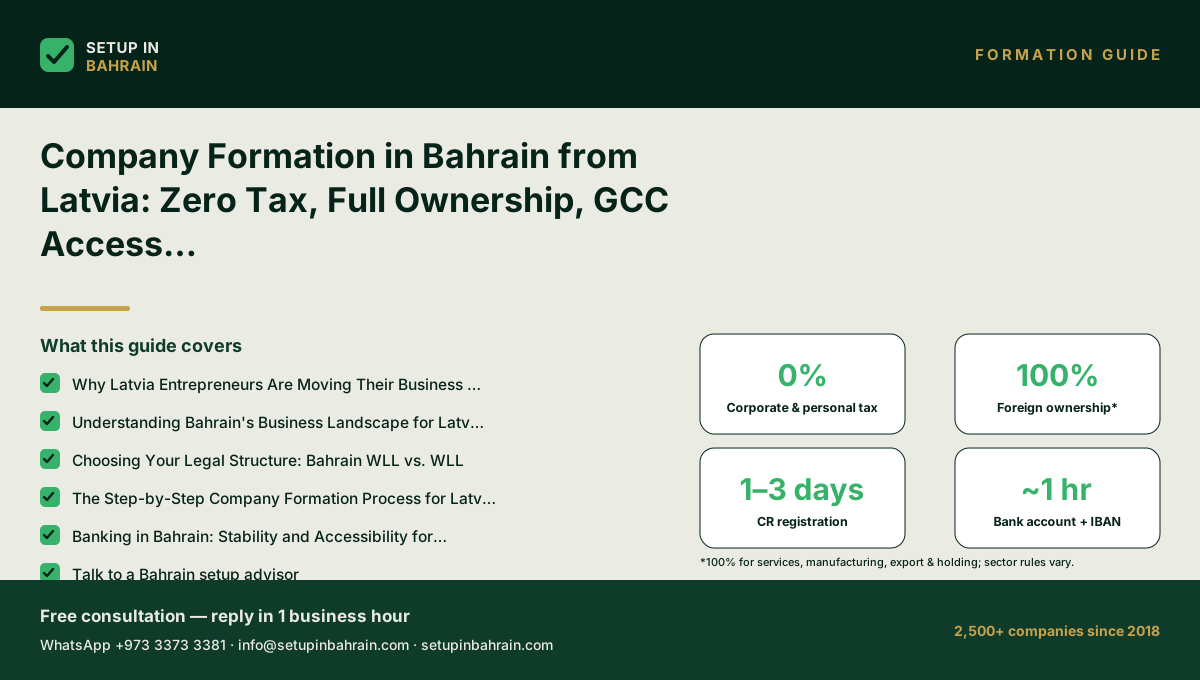
- Why Latvia Entrepreneurs Are Moving Their Business to Bahrain
- Understanding Bahrain's Business Landscape for Latvian Investors
- Choosing Your Legal Structure: Bahrain WLL vs. WLL
- The Step-by-Step Company Formation Process for Latvians
- Banking in Bahrain: Stability and Accessibility for International Businesses
→ Complete guide: Company Formation in Bahrain — the full 2026 guide
View details
Ownership & capital
A Bahrain WLL can be owned by a single person — 100% foreign ownership applies to most activities, with no local partner required for services, manufacturing, export trading and holding companies. The minimum share capital is BHD 1 ; we recommend BHD 1,000 . This Makes bank account opening and investor visa approval smoother.
Mārtiņš had been running his logistics software company from Riga for seven years. His team of twelve developers had built something genuinely valuable—a fleet management system that attracted clients across the Baltics and, more and more, from the Middle East. Last year, the company generated a healthy €340,000 in profit. When he sat down with his accountant to discuss dividend distribution, the conversation turned frustratingly familiar.
"If you distribute those profits, you're looking at €68,000 in corporate tax right off the top, Mārtiņš," the accountant explained. "That's before your personal income tax on dividends. Alternatively, keep the money in the company. Then you're sitting on cash you can't use personally or even deploy optimally without a very specific, approved reinvestment plan."
Latvia's distributed-profits tax model had trapped Mārtiņš in a familiar bind. Reinvest everything and live on a modest salary, or take profits and watch over 20% disappear to the Valsts ieņēmumu dienests (VID – State Revenue Service) before the money even reaches your pocket. For entrepreneurs with international ambitions, this creates a structural disadvantage that compounds year after year, stifling rapid scaling and global competitiveness.
This wasn't Mārtiņš's only challenge. Just a few months prior, his corporate bank account at a respected Riga-based institution was frozen without warning. The reason: an "AML compliance review of non-resident transactions." Three weeks of lost invoices, delayed payroll. Two significant international clients walking away due to payment uncertainty. "I wasn't doing anything wrong," he told me over coffee in Jūrmala. "My VID file was clean, my declarations precise. But the system, after the ABLV crisis, penalizes any international success with endless scrutiny."
Kristaps, an IT company founder from Riga, echoed this sentiment. He spent weeks wrangling with the VID after his bank flagged his international payments under AML scrutiny—a familiar post-ABLV Bank headache for many Latvian business owners. Frustrated by endless compliance, unstable banking, and the sense he’s running a local business by global rules, Kristaps asked: "Is there anywhere a founder from Latvia can scale, tax-free, and avoid the compliance gridlock?"
This guide exists because Mārtiņš and Kristaps aren't alone. Thousands of Latvian entrepreneurs face the same arithmetic, the same banking frustrations. The same feeling of being constrained by a system that, while well-intentioned, often hinders international growth. Many are now discovering that Bahrain offers something Latvia simply cannot: a jurisdiction where profitable companies aren't penalized for success, where banking is robust yet accessible, and where international ambition is actively supported.
Why Latvia Entrepreneurs Are Moving Their Business to Bahrain
An honest conversation reveals: most Latvian entrepreneurs aren’t trying to dodge taxes—they’re fighting for oxygen in a system that is both expensive and volatile, especially for companies trading beyond the Baltics. The shift isn't about aggressive offshore scheming; it's about rational business planning in a global economy where your competitors aren't bound by the same constraints.
Let's break down the core frustrations driving this migration and how Bahrain provides a compelling alternative.
The Distributed-Profits Tax: A Drag on Growth
Consider the position of a Latvian IT services company with Middle Eastern clients. Every invoice paid into a Latvian bank account eventually faces the distributed-profits question. Latvia’s corporate income tax (CIT) system, applied at a flat rate of 20% on distributed profits (including dividends, deemed distributions. Certain non-business expenses), creates a permanent drag on capital accumulation.
Imagine a Latvian startup with €500,000 annual profit. If that profit is distributed in any form, the 20% tax immediately carves €100,000 away—not in flexible installments. As a lump sum. This impacts cash flow severely. If you try to optimize cash flow by retaining profits, those funds become less flexible for future, unforeseen investments or opportunities without triggering a tax event. It forces entrepreneurs into a perpetual cycle of short-term cash-flow planning rather than long-term strategic investment. Meanwhile, a competitor incorporated in Bahrain reinvests 100% of their profits, compounds growth faster. Builds substantial reserves for expansion, R&D, or market penetration. This single factor creates a significant competitive disadvantage for Latvian businesses on the global stage.
The Banking Gauntlet: AML, VID, and Frozen Accounts
Post-2018 ABLV Bank collapse, the Latvian banking sector has undergone a profound transformation, leading to some of the most stringent Anti-Money Laundering (AML) regulations in Europe. While necessary for integrity, this has unfortunately led to a climate where legitimate non-resident companies, especially those with complex international transaction flows, face disproportionate scrutiny.
Many Latvian entrepreneurs can tell stories similar to Mārtiņš's: bank accounts frozen for weeks or even months due to AML flags, lengthy and often opaque information requests from the VID, and a general reluctance from local banks to engage with businesses perceived as "high-risk" due to their non-resident ownership or international client base. This isn't just an inconvenience; it's an operational nightmare that can halt business, damage client relationships. Lead to lost revenue. The constant fear of an AML review or account closure creates an unstable environment for any business trying to scale internationally.
Navigating Linguistic and Bureaucratic Hurdles
While Latvia boasts a highly educated workforce, the administrative language for statutory documents, communication with the VID. Most official processes remains Latvian. For an entrepreneur focused on global markets, dealing with certified translations and navigating local bureaucratic nuances can be a time-consuming and costly distraction. While professional services can mitigate this, it adds another layer of complexity compared to jurisdictions where English is widely accepted in official capacities. This can also lead to misinterpretations or delays that impact critical business decisions.
Bahrain's Antidote: A Pro-Business Ecosystem
Bahrain directly addresses these pain points, offering a compelling alternative for Latvian entrepreneurs:
Generally no corporate income tax for most sectors: The most significant draw. Businesses operating in Bahrain (with some exceptions like oil and gas. Specific financial services) pay zero* corporate income tax. This means 100% of your profits can be reinvested, accumulated, or distributed without the 20% initial hit that stifles growth in Latvia. Stable and Accessible Banking: Regulated by the Central Bank of Bahrain (CBB), Bahrain's banking sector is renowned for its stability, transparency. Pro-business approach. While AML/KYC checks are thorough, they are clear, efficient. Designed to help legitimate international business, not impede it. Latvian founders report a stark contrast in banking experience, finding Bahraini banks welcoming to international operations. Full Foreign Ownership: In most sectors, foreign investors can own 100% of their companies in Bahrain, providing complete control over your enterprise. English as a Business Language: English is widely used in business, government. Legal processes, simplifying communication and reducing the need for constant translation. Strategic Global Gateway: Bahrain's geographic location positions it as a natural bridge between the East and West. It offers unparalleled access to the lucrative GCC market (a consumer base of over 50 million people with high purchasing power), the broader MENA region, and more and more, South Asia and Africa. Currency Stability: The Bahraini Dinar (BHD) is pegged to the US Dollar at a fixed rate of 1 USD = 0.376 BHD, offering currency stability and predictability for international transactions.
In essence, Bahrain offers a high-compliance, zero-tax, full-ownership gateway that allows ambitious Latvian founders to scale their businesses, avoid compliance gridlock, and access new markets without the structural disadvantages inherent in their home country's current system.
Understanding Bahrain's Business Landscape for Latvian Investors
Stepping into a new jurisdiction requires understanding its economic DNA. Bahrain is not a "fly-by-night" offshore haven; it is a sovereign nation with a sophisticated, diversified economy and a long-term strategic vision.
Economic Diversification and Vision 2030
For decades, Bahrain has been a pioneer in economic diversification among its GCC peers. Recognizing the finite nature of oil reserves, the Kingdom launched its Economic Vision 2030, a comprehensive plan to transform its economy from one based on oil wealth to a productive, globally competitive economy driven by a thriving private sector. Key pillars include:
Financial Services: Bahrain is a well-established regional financial hub, hosting numerous international banks, investment firms. A growing FinTech sector. The CBB ensures a robust regulatory framework. Manufacturing and Logistics: Leveraging its strategic location and advanced infrastructure, Bahrain is becoming a logistics and manufacturing hub, especially for goods destined for the GCC and beyond. Information and Communication Technology (ICT): The government actively promotes digital transformation and attracts tech companies, offering incentives and a skilled workforce. Initiatives like AWS's Middle East Region data center in Bahrain underscore its commitment to the digital economy. Tourism: A growing sector, attracting regional and international visitors.
This commitment to diversification means that businesses in various sectors, from IT services to e-commerce. Logistics to consulting, can find fertile ground and government support. For a Latvian software company, this means accessing a market with strong demand for digital solutions and a government keen to foster technological innovation.
Regulatory Clarity: The Role of CBB and MOIC
The regulatory environment in Bahrain is clear, robust, and designed to foster legitimate business. This is a critical distinction for Latvian entrepreneurs who have experienced the ambiguities and stringent-to-the-point-of-punitive nature of their home country's post-ABLV banking landscape.
Central Bank of Bahrain (CBB): The CBB is the single regulatory body for Bahrain's financial sector. It oversees banks, insurance firms, investment firms, and ancillary service providers. Its regulations are internationally benchmarked, ensuring stability and investor confidence. For businesses, this means predictable and transparent banking operations. Ministry of Industry and Commerce (MOIC): The MOIC is responsible for company registration, commercial licensing. Regulating trade and industry in Bahrain. Their online portal, "Sijilat," has greatly streamlined the business registration process, making it one of the most efficient in the region. Bahrain Economic Development Board (EDB): The EDB is a proactive government agency dedicated to attracting foreign investment. They provide invaluable support to new businesses, from initial inquiries and market insights to navigating regulatory processes and connecting investors with local partners. For Latvian entrepreneurs, the EDB can be an essential partner in understanding the local landscape and accelerating their setup.
This transparent regulatory framework, coupled with supportive government bodies, means less ambiguity and more certainty for your business operations—a welcome change from the compliance gridlock often encountered in Latvia.
Bahrain's Competitive Edge in the GCC
Bahrain offers several unique advantages within the highly competitive Gulf Cooperation Council (GCC) market:
- Lowest Operating Costs: Independent studies, including those by KPMG, consistently rank Bahrain as having the lowest operating costs for businesses across the GCC, especially for real estate, utilities, and labor. This directly translates to higher profit margins for your company.
- Access to Saudi Arabia: Bahrain is connected to Saudi Arabia, the largest economy in the GCC, by the King Fahd Causeway, a 25-kilometer bridge. This provides immediate land access to a market of over 35 million people, making Bahrain an ideal logistics and distribution hub for companies targeting the Saudi market.
- Highly Skilled Workforce: Bahrain has a highly educated and bilingual (Arabic/English) local workforce, alongside a diverse pool of expatriate talent. The government invests heavily in education and training, ensuring a ready supply of skilled professionals.
- Open and Liberal Business Environment: Bahrain has a reputation for being one of the most liberal economies in the Middle East, with strong legal protections for foreign investors and a welcoming attitude towards international businesses. The World Bank's Ease of Doing Business report consistently ranks Bahrain highly (e.g., 43rd globally in 2020), a testament to its efficient processes and pro-business reforms.
For a Latvian entrepreneur looking to expand beyond the limited Baltics and European markets, Bahrain is not just a tax-efficient jurisdiction; it's a strategically positioned launchpad into one of the world's wealthiest and fastest-growing regions.
Choosing Your Legal Structure: Bahrain WLL vs. WLL
Just as in Latvia you might choose between an SIA (Sabiedrība ar ierobežotu atbildību) or an individual merchant, Bahrain offers distinct legal structures. For most Latvian entrepreneurs, the choice will primarily be between a Limited Liability Company (WLL) and a single-shareholder WLL.
The Limited Liability Company (WLL)
The With Limited Liability (WLL) company is the most common legal entity in Bahrain, comparable to Latvia's SIA.
- Shareholders: a single shareholder (one person can own 100%) and a maximum of 50.
- Liability: Shareholders' liability is limited to their capital contribution.
- Management: Managed by one or more directors.
- Minimum Capital: Historically, the minimum share capital for a WLL was BHD 20,000 (approx. €50,000). But, for many commercial activities, this requirement has been abolished, making it greatly more accessible. For certain regulated activities (e.g., financial services), higher capital might still be required.
- Flexibility: Ideal for ventures with multiple founders, future partners, or those seeking external investment.
The single-shareholder WLL
The single-shareholder WLL is essentially a WLL but structured for a sole owner, much like a sole proprietorship with limited liability in Latvia, but offering full corporate advantages.
- Shareholder: Only one shareholder is required (who can also be the director).
- Liability: The shareholder's liability is limited to the company's capital.
- Minimum Capital: Similar to a WLL, capital requirements have been largely relaxed for most activities, though some regulated sectors may have specific thresholds.
- Simplicity: Offers administrative simplicity for individual entrepreneurs who want the protection of limited liability without the need for additional partners.
Other Options: Branches, Holding Companies, Free Zones
While WLLs and WLLs cover most needs, other structures exist:
Branch of a Foreign Company: If you intend to operate your existing Latvian company directly in Bahrain, you can register a branch. But, this structure is generally subject to local sponsorship requirements and doesn't offer the same tax advantages as an independently incorporated Bahraini entity. Holding Company: Bahrain is an excellent jurisdiction for holding companies due to its zero-tax environment and double taxation treaty network (though not with Latvia currently). This can be a strategic move for managing a portfolio of international assets. Free Zones: While Bahrain has free zones (like Bahrain International Investment Park – BIIP. Bahrain Logistics Zone – BLZ), they are typically sector-specific and target manufacturing, logistics, or industrial operations. For most service-based Latvian entrepreneurs, a mainland WLL will offer greater flexibility and access to the broader Bahraini and GCC markets without the geographical restrictions or specific activity requirements of a free zone.
Comparison Table: WLL vs. WLL for Latvian Entrepreneurs
| Feature | With Limited Liability (WLL) | single-shareholder WLL |
| :---------------------- | :------------------------------------------------------------- | :-------------------------------------------------------------- |
| Number of Shareholders | Minimum 2, Maximum 50 | 1 (individual or corporate entity) |
| Liability | Limited to capital contribution | Limited to capital contribution |
| Management | Minimum 1 director | 1 director (can be the sole shareholder) |
| Minimum Capital | Largely abolished for most activities (BHD 20,000 was historical) | Largely abolished for most activities (BHD 1 (we recommend BHD 1,000)was historical) |
| Flexibility | Ideal for partnerships, future investors, team ventures | Simpler for sole founders, direct control |
| Perceived Credibility | Often preferred by larger clients or investors | Suitable for smaller operations, individual consultants |
| Setup Complexity | Slightly more involved with multiple parties | Relatively straightforward |
The Step-by-Step Company Formation Process for Latvians
Navigating company formation in a new country can seem daunting. But, Bahrain has made significant strides in streamlining its processes, especially through the MOIC's "Sijilat" portal. The process is considerably more efficient and transparent than many would expect, especially when compared to the sometimes opaque and document-heavy processes faced in Latvia.
Pre-Registration Checklist: From Business Plan to Capital
Before you even touch the Sijilat portal, solid preparation is key:
Define Your Commercial Activities: Be very specific. What services will your company provide? What goods will it trade? Each activity needs to be precisely categorized according to Bahrain's commercial activities list. This impacts licensing. Choose Your Company Name: Select three potential names in order of preference. Ensure they are unique, available. Comply with Bahraini naming conventions (e.g., not offensive, not misleading, doesn't imply royal patronage). Identify Shareholder(s) and Director(s): Determine who will be involved. You'll need their passport copies (notarized and apostilled for non-Bahraini residents, often achievable via a Latvian notary and the Ministry of Foreign Affairs). Determine Capital Structure: Decide on the share capital and how it will be divided. While minimums are often abolished, having a reasonable capital (e.g., BHD 1,000 to BHD 5,000) can enhance credibility with banks. Secure a Registered Office Address: You'll need a physical address in Bahrain. This can be a dedicated office, co-working space, or for many service-based businesses, a virtual office solution provided by a business setup consultant. Appoint a Local Service Provider: This is highly recommended. A reputable business setup firm or legal consultant in Bahrain can guide you through every step, prepare documents, liaise with government bodies. Ensure compliance. They will be your invaluable bridge to the local system, especially helpful for overcoming initial language and procedural hurdles.
Reserving Your Company Name
The first official step is to log on to the Sijilat portal (www.sijilat.bh) and apply for your chosen company name. This is typically a quick process, often approved within hours if the name is available and compliant. You'll receive a reservation confirmation.
Drafting Your Memorandum of Association (MOA)
This is the foundational legal document for your company, akin to your company's articles of association in Latvia. It outlines:
- Company name and type
- Commercial activities
- Shareholders' details and capital contributions
- Management structure (directors)
- Registered office address
- Rules for profit distribution, meetings, and dissolution
Your chosen local service provider will prepare the MOA for you. Once drafted, all shareholders (or their authorized representatives) must sign it. If you are not physically in Bahrain, your consultant can help signing via power of attorney or secure digital signing methods. For Latvian individuals, ensure any Power of Attorney is notarized in Latvia and then apostilled to be recognized in Bahrain.
Share Capital Deposit (if applicable)
For activities that still require minimum share capital, or if you choose to inject capital for credibility, this typically involves opening a provisional bank account and depositing the funds. Once the company is fully registered, this account becomes your operational corporate account.
Registering with the Ministry of Industry and Commerce (MOIC)
With your MOA signed and any capital deposited, your consultant will submit the complete application package via Sijilat. This includes:
- Signed MOA
- Passport copies of shareholders and directors (with apostille/notarization if required)
- Proof of registered office address
- Any required forms or declarations
The MOIC reviews the application. This stage typically takes 3-5 working days, assuming all documents is correct. Any queries will be raised via the Sijilat portal.
Obtaining Your Commercial Registration (CR)
Upon successful review, the MOIC will issue your Commercial Registration (CR) certificate. This is your company's official birth certificate, containing its CR number, legal name, and approved commercial activities. The CR is crucial for all subsequent steps, including opening bank accounts and obtaining specific licenses. For Latvian entrepreneurs, receiving this CR is a tangible step forward, signifying formal setup in a zero-tax environment.
Post-Registration: Licenses and Banking
Your CR isn't the final step. Depending on your chosen commercial activities, you may need additional licenses:
- Sector-Specific Licenses: An IT consulting firm might need a license from the Ministry of Transportation and Telecommunications (MTT). A financial services firm will need CBB approval. Your consultant will advise on these.
- Municipality License: This is often required for the physical office space.
- Opening a Corporate Bank Account: This is a crucial step where many Latvian entrepreneurs experience relief compared to their home country. While KYC (Know Your Customer) and AML requirements are stringent (as they should be in any reputable financial center), Bahraini banks are generally welcoming to legitimate international businesses. We'll delve into this further in the next section.
- Registering with the Social Insurance Organization (SIO): If you plan to hire employees in Bahrain, this is mandatory.
- VAT Registration: If your projected annual turnover exceeds the BHD 37,500 threshold, you'll need to register for VAT.
The entire process, from initial name reservation to obtaining the CR, can often be completed within 2-4 weeks if all documents are in order and no complex licenses are required. With an experienced local partner, this timeline is highly achievable, contrasting sharply with the often protracted and unpredictable timelines some experience in Latvia.
Banking in Bahrain: Stability and Accessibility for International Businesses
For a Latvian entrepreneur weary of AML-driven account closures and the VID's intense scrutiny on non-resident transactions, Bahrain's banking sector offers a breath of fresh air. It's stable, internationally connected, and, crucially, pro-business without compromising on regulatory integrity.
The Central Bank of Bahrain (CBB) Framework
The CBB is widely regarded as one of the most progressive and robust regulators in the Middle East. It supervises all financial institutions in Bahrain, ensuring adherence to international best practices in areas like capital adequacy, corporate governance, and, critically, Anti-Money Laundering (AML) and Counter-Financing of Terrorism (CFT).
What this means for you:
- High Standards, Clear Rules: The CBB's regulations are transparent and aligned with global standards (e.g., FATF recommendations). This predictability is a stark contrast to the often arbitrary and punitive interpretations of AML rules some Latvian banks have adopted.
- Strong Financial Sector: Bahrain hosts a diverse range of local and international banks (e.g., Ahli United Bank, Bank ABC, NBB, HSBC, Standard Chartered), offering a competitive landscape for corporate banking services.
- Investor Confidence: The CBB's robust oversight contributes greatly to Bahrain's reputation as a trusted financial hub, attracting legitimate international investment.
Opening a Corporate Bank Account: What to Expect
Once your company has its Commercial Registration (CR), opening a corporate bank account is a priority. While the process is generally straightforward for legitimate businesses, it requires thorough preparation.
Typical documents required by Bahraini banks include:
- Company Commercial Registration (CR)
- Memorandum of Association (MOA)
- Board Resolution to Open Bank Account
- Passport copies and IDs of all shareholders, directors, and authorized signatories
- Proof of residence for key individuals
- Detailed Business Plan: This is crucial. Banks want to understand your operations, source of funds, expected transaction volumes, target clients, and geographic reach. Be prepared to articulate your business model clearly, especially if it involves international transactions.
- Source of Funds/Wealth Declaration: For beneficial owners, this is standard.
My insight: Unlike some Latvian banks that might view any non-resident activity with suspicion, Bahraini banks are accustomed to international business. They are looking for legitimate, transparent operations. If your business is sound and your documents is complete, the process. Thorough, is typically efficient and results in a stable banking relationship.
Navigating AML/KYC for Latvian Residents
Given the recent history in Latvia, it's natural for Latvian entrepreneurs to be wary of banking scrutiny. But, Bahrain's approach to AML, while strict, is fundamentally different:
Focus on Substance: Bahraini banks are interested in the substance* of your business and the legitimacy of your transactions, not simply flagging non-resident status. *
Bahrain Business Guides for Latvia Citizens
Frequently Asked Questions
How long does it take to set up?
It takes 15 to 20 days. We file all forms for you. You do not need to wait long.
What does it cost?
Company formation: Standard BHD 1,340 with 3 months of office address; Gold BHD 1,700 with 6 months; Premium BHD 2,150 with 12 months and a cabin, officer table and chair, and two guest chairs. No formation package includes visas, including Premium. Investor/work visas are priced separately: BHD 755 for one year or BHD 953 for two years, in addition to the formation package. Ask for a written, itemized quotation confirming government fees and all inclusions before payment.
Do I need to visit Bahrain?
No. You can set up your firm from home. We do all the work online. Some banks may ask for one visit.
What tax will I pay?
You pay zero tax on your profits. Bahrain has no corporate income tax. This is a key benefit of the setup.
Can I own 100% of my firm?
Yes. Foreign owners can hold all shares. No local partner is needed. Full ownership is allowed.
What do I need to start?
You need a valid passport. You also need a trade name and a business address. We help you with all of these.
How do I open a bank account?
We guide you step by step. Most banks take 3 to 6 weeks. You will need your CR and firm papers.
Who issues the Commercial Registration (CR)?
The CR is issued by the MOICT. It is your legal right to trade in Bahrain. We file the CR for you.
Can I renew my CR each year?
Company renewal packages: BHD 530 with 3 months of office address; BHD 980 with 6 months; BHD 1,520 with 12 months. These are separate renewal packages, not visa fees.
How do I get started?
Fill in our form on this page. Our team will call you back. We map your best setup plan at no cost.
Steps to Form Your Company
- Pick your trade name. We check if it is free.
- Choose your business type. WLL is the most common.
- Sign the MOA. We draft and file all legal docs.
- Pay the state fees. About BHD 432 in total.
- Get your CR. Takes 15 to 20 days.
- Open your bank account. We guide each step.
- Start trading. You are ready to do business.
Key Facts
- Tax rate: 0%
- Foreign ownership: 100%
- Setup time: 15 to 20 days
- Company formation: Standard BHD 1,340 with 3 months of office address; Gold BHD 1,700 with 6 months; Premium BHD 2,150 with 12 months and a cabin, officer table and chair, and two guest chairs. No formation package includes visas, including Premium. Investor/work visas are priced separately: BHD 755 for one year or BHD 953 for two years, in addition to the formation package. Ask for a written, itemized quotation confirming government fees and all inclusions before payment.
- Company renewal packages: BHD 530 with 3 months of office address; BHD 980 with 6 months; BHD 1,520 with 12 months. These are separate renewal packages, not visa fees.
- Client rating: 4.8 stars
- Clients served: 2,500 and more
Quick Facts
- Tax rate: 0%
- Own all of your firm: Yes, 100%
- Time to set up: 15 to 20 days
- Company formation: Standard BHD 1,340 with 3 months of office address; Gold BHD 1,700 with 6 months; Premium BHD 2,150 with 12 months and a cabin, officer table and chair, and two guest chairs. No formation package includes visas, including Premium. Investor/work visas are priced separately: BHD 755 for one year or BHD 953 for two years, in addition to the formation package. Ask for a written, itemized quotation confirming government fees and all inclusions before payment.
- Company renewal packages: BHD 530 with 3 months of office address; BHD 980 with 6 months; BHD 1,520 with 12 months. These are separate renewal packages, not visa fees.
- Rating: 4.8 stars
- Clients: 2,500 and more
Why Bahrain?
Bahrain has no tax. You keep all your profits. This is rare in the Gulf.
You can own all of your firm. No local partner is needed. The law allows full foreign ownership.
Setup takes 15 to 20 days. We file all forms for you. You can do it all from home.
Bahrain has a free trade deal with the US. Your goods face low or no tariffs. This gives you access to big markets.
We have served 2,800+ clients from 44+ countries and maintain records to substantiate that total where needed. We have 113 Google reviews; reviews represent only some clients and are not the same as the total clients served.
Our Steps
- Tell us your plan. We advise you for free.
- We pick the right firm type for you.
- We file all your forms with MOICT.
- You get your CR in 15 to 20 days.
- We help you open a bank account.
- You are ready to trade. We stay with you.
Next Steps for Latvia Citizens
You can set up a firm in Bahrain from Latvia. You do not need to fly there first. We do all the work online.
Tell us your plan. We call you back the same day. We map the best route for you at no cost.
We file all your forms. We deal with MOICT and the state. You get your CR in 15 to 20 days.
After your CR, we help you get a bank account. We also help with your Investor Visa. One firm guides you at each step.
Why Our Clients from Latvia Choose Us
- We speak your language. We know your needs.
- We have helped clients from Latvia before.
- Our fee is clear. No surprise costs.
- We have a 4.8 star rating on Google.
- We have helped more than 2,500 clients set up in Bahrain.
Fill in the form on this page. We will be in touch soon. Let us help you start your Bahrain firm today.
Ready to set up in Bahrain from Latvia?
Tell us your business idea. We map the right entity, ownership and timeline — then handle the filing while you focus on what matters.