
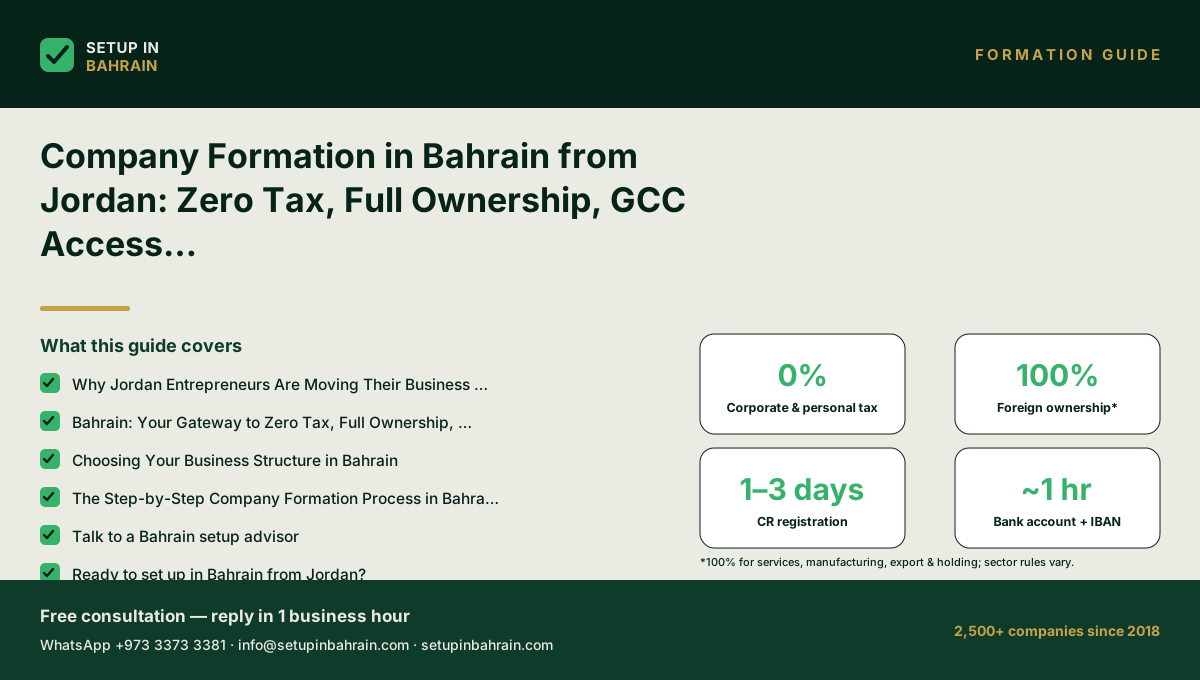
Complete guide for Jordan entrepreneurs: form a company in Bahrain with generally no corporate income tax for most sectors, 100% foreign ownership. GCC market access. Costs, steps, visas, banking.
Key Takeaways
- Why Jordan Entrepreneurs Are Moving Their Business to Bahrain
- The Weight of Taxation in Jordan
- Navigating Bureaucracy and Compliance
- The Regional Market Access Challenge
- Forex Limitations and Operational Costs
→ Complete guide: Company Formation in Bahrain — the full 2026 guide
View details
Ownership & capital
A Bahrain WLL can be owned by a single person — 100% foreign ownership applies to most activities, with no local partner required for services, manufacturing, export trading and holding companies. The minimum share capital is BHD 1 ; we recommend BHD 1,000 . This Makes bank account opening and investor visa approval smoother.
For many years, Jordan has been a cradle of business spirit in the Levant, fostering innovation and talent against a backdrop of regional dynamism. Yet, for all its vibrant business community, the economic realities on the ground in Jordan can present significant headwinds. High corporate taxation, intricate compliance burdens. Limitations on market reach often force ambitious entrepreneurs to consider how to scale and truly optimize their operations.
Imagine you've built a successful software development firm in Amman, or perhaps a thriving e-commerce platform shipping goods from Irbid. You’re generating substantial profits, but year after year, a significant chunk – 20% of your corporate income, potentially 35% if you're in specific sectors like banking or telecommunications – vanishes into the Income Tax Department's coffers. Then there's the 21.75% Social Security Corporation contributions on salaries, adding a heavy layer to your payroll costs.
You find yourself navigating complex filing requirements, experiencing licensing delays with the Ministry of Industry and Trade. Even grappling with operational costs that subtly increase due to factors like water scarcity, adding 8% to 12% to utility bills. The limited forex liquidity for the Jordanian Dinar, despite its USD peg, creates another layer of friction for international transactions.
And crucially, while your business is robust locally, expanding into the lucrative GCC market, especially Saudi Arabia, feels like a logistical puzzle without direct causeway access.
This scenario isn't hypothetical for hundreds of Jordanian entrepreneurs; it's a daily reality. This detailed guide is written specifically for you – a Jordanian business owner seeking not just a change of scenery. A strategic leap forward. We'll explore why Bahrain has emerged as the premier destination for Jordanian companies looking to thrive, offering an unparalleled blend of Generally no corporate income tax for most sectors, 100% foreign ownership, and direct access to the trillion-dollar Gulf Cooperation Council (GCC) market.
Why Jordan Entrepreneurs Are Moving Their Business to Bahrain
Let's be candid. You're reading this because you've likely encountered some significant friction points in Jordan that are hindering your growth and profitability. You're not alone. Many Jordanian business owners, from nascent tech startups to established trading houses, are actively seeking jurisdictions that offer greater fiscal efficiency, operational simplicity, and wider market access.
Ahmed, who runs a mid-sized IT services firm in Amman, spent three months last year preparing his corporate tax return. His company cleared JOD 420,000 in profit. After the 20% corporate income tax hit, plus another JOD 18,000 in accountant and filing fees, he was left with roughly JOD 318,000. The following quarter he lost two Saudi clients because delivery times from Jordan through multiple borders kept slipping.
When he looked at Bahrain, the contrast was immediate: generally no corporate income tax for most sectors, no local partner requirement. A 25 km causeway straight into the Saudi market.
This isn't an isolated anecdote; it's a pattern we observe frequently. Jordanian entrepreneurs keep running into the same walls, and Bahrain offers a clear path around them.
The Weight of Taxation in Jordan
For a business owner, profit is paramount. But in Jordan, a significant portion of that hard-earned profit is siphoned off by corporate income tax.
Corporate Income Tax: For most businesses, this stands at a substantial 20% . If your company operates in specific, higher-profit sectors like banking or telecommunications, this rate skyrockets to an eye-watering 35% . This means for every JOD 100,000 in profit, you could be losing JOD 20,000, or even JOD 35,000, before you even consider other deductions. In Bahrain, for the vast majority of activities, this figure is 0% .
Imagine the difference that makes to your bottom line and your reinvestment capacity. Social Security Contributions: Beyond corporate tax, payroll costs are further inflated by the 21.75% Social Security Corporation contributions on salaries . This is a significant burden, especially for businesses with a growing workforce. While such contributions exist in Bahrain, the overall tax environment is far more favorable.
Indirect Costs: The high tax burden can lead to less capital available for investment, innovation. Expansion, subtly stifling growth compared to more fiscally attractive environments.
Navigating Bureaucracy and Compliance
Beyond the monetary costs, there's the equally draining cost of time and effort spent on bureaucratic hurdles.
Income Tax Department Complex Filing: The process of filing taxes in Jordan is often described as complex and time-consuming. It requires significant attention to detail and, frequently, the engagement of professional accountants, adding to operational expenses. This complexity can divert valuable business energy away from core business activities. Licensing Delays: Entrepreneurs often report experiencing significant delays with the Ministry of Industry and Trade when seeking new licenses or renewing existing ones.
These delays translate directly into lost revenue opportunities and increased frustration. In a fast-paced global economy, agility is key, and slow administrative processes can be a critical disadvantage. Red Tape: The World Bank's Ease of Doing Business reports. Now discontinued, often highlighted areas where Jordan could improve its regulatory environment.
This translates to more paperwork, more approvals, and a less streamlined path to market compared to highly efficient jurisdictions like Bahrain. This Consistently ranks among the top global economies for business friendliness.
The Regional Market Access Challenge
One of the most pressing strategic challenges for Jordanian businesses is effective and efficient access to the wider GCC market.
Limited Direct Access to Saudi Arabia: For businesses looking to tap into the colossal Saudi Arabian market, Jordan presents a geographical and logistical hurdle. Shipping goods or delivering services requires navigating multiple borders, customs checks, and complex overland routes. This adds considerable cost, time, and unpredictability to supply chains. Ahmed's experience losing Saudi clients due to delivery delays is a common lament.
Intra-GCC Trade Agreements: While Jordan has trade agreements within the Arab world, the deep economic integration and free movement of goods, services, and capital within the GCC bloc (Bahrain, Saudi Arabia, UAE, Kuwait, Qatar, Oman) offers an undeniable advantage. Establishing a base within* the GCC, especially one with direct access to Saudi Arabia via a causeway, fundamentally changes the game.
Logistical Bottlenecks: The lack of direct causeway access means higher transportation costs, longer transit times. Increased exposure to border-related delays. This greatly impacts competitive pricing and delivery reliability, especially for time-sensitive goods or services.
Forex Limitations and Operational Costs
Even seemingly minor financial and operational details can accumulate into significant challenges.
JOD Pegged to USD, but Limited Forex Liquidity: While the Jordanian Dinar's peg to the US Dollar provides some stability, the practical reality of limited foreign exchange (forex) liquidity can create friction for international transactions. For businesses dealing heavily in imports, exports, or international service delivery, this can lead to delays and increased transaction costs. Rising Operational Costs: Factors such as water scarcity in Jordan can subtly yet greatly increase operational expenses.
Reports indicate that utility bills, especially for water-intensive industries, can see an 8% to 12% increase. While this might seem minor on its own, combined with higher taxes and logistical costs, it contributes to an overall less competitive operating environment. Talent Retention: The economic environment can also impact talent retention. Highly skilled individuals, especially in tech and finance, are often drawn to regions offering better financial prospects and career growth opportunities.
These pain points collectively paint a picture of why Jordanian entrepreneurs are more and more looking beyond their borders. They are seeking a business environment that not only minimizes costs but maximizes opportunities. This brings us to Bahrain.
Bahrain: Your Gateway to Zero Tax, Full Ownership, and GCC Dominance
Stepping into Bahrain's business landscape feels like entering a different world for many Jordanian entrepreneurs. It's a world built on principles of efficiency, openness. Strategic foresight, deliberately crafted to attract foreign direct investment and foster growth. The Kingdom consistently ranks high in global indices for ease of doing business, human capital, and economic freedom.
The Economic Development Board (EDB) of Bahrain, the national investment promotion agency, plays a pivotal role in this, actively working to streamline processes and attract leading businesses from around the globe.
The Unbeatable Tax Advantage
Let's cut straight to one of Bahrain's most compelling draws: its tax regime.
0% Corporate Income Tax: For the vast majority of business activities, Bahrain imposes zero corporate income tax . This isn't a temporary incentive; it's a foundational principle of the Kingdom's economic policy. For most Jordanian businesses, especially those in IT, consulting, trading. Manufacturing, this means that every dinar your company earns is yours to reinvest, distribute, or save. Compared to Jordan's 20% (or 35%) corporate tax, this is a monumental difference that directly impacts your profitability and growth potential.
No Personal Income Tax: As an individual working and residing in Bahrain, you will also pay zero personal income tax on your earnings. This enhances the overall financial appeal for you and your employees. No Withholding Tax: Bahrain generally does not impose withholding tax on dividends, interest, or royalties paid to foreign entities, further enhancing its appeal as an investment hub.
VAT (Value Added Tax): It's important to note that Bahrain implemented a Value Added Tax (VAT) in 2019, currently at a standard rate of 10% . While this applies to goods and services, it's a consumption tax, not a tax on corporate profits or individual income. Businesses can typically reclaim VAT on their input costs.
Unrestricted Foreign Ownership: A Game Changer
For entrepreneurs, control and autonomy over their venture are paramount. Bahrain understands this.
100% Foreign Ownership: In Bahrain, foreign investors, including Jordanians, can own 100% of their company's shares in most sectors, without the requirement for a local partner or sponsor. This is a crucial distinction. For instance, a With Limited Liability (WLL) company, the most popular and versatile structure for SMEs, can be owned entirely by a single individual (or entity) from Jordan. There is no need for a Bahraini shareholder, ensuring you retain full strategic and operational control.
This eliminates the complexities, potential conflicts. Profit-sharing arrangements often associated with local partnership requirements in other jurisdictions. No single-shareholder WLL: It's vital to clarify a common misconception: While a WLL can be owned by a single person, Bahrain does NOT have a distinct legal entity known as a "Single Person Company" (WLL) as some other GCC countries might. You simply register a WLL with one shareholder.
Direct Access to the Trillion-Dollar GCC Market
Location, location, location. Bahrain's geographical position isn't just convenient; it's a strategic asset.
The King Fahd Causeway: This 25-kilometer engineering marvel directly connects Bahrain to Saudi Arabia's Eastern Province, home to major economic centers like Dammam and Khobar. This means your goods can be on Saudi soil within minutes of leaving Bahrain. For Jordanian businesses that struggled with multi-border logistics, this offers unparalleled access to the GCC's largest economy, valued at over a trillion dollars.
It's not just about physical goods; it's about facilitating faster service delivery, direct client engagement. Streamlined supply chains. GCC Customs Union and Free Trade: As a member of the GCC, Bahrain is part of a customs union that allows for the free movement of goods, services, and capital among member states (Saudi Arabia, UAE, Kuwait, Qatar, Oman). This greatly reduces trade barriers and opens up a market of over 50 million affluent consumers.
Your company in Bahrain becomes a launching pad to the entire region. Air and Sea Connectivity: Beyond the causeway, Bahrain boasts a modern international airport (Bahrain International Airport) and Khalifa bin Salman Port, offering excellent air cargo and sea freight connectivity to global markets. This robust infrastructure ensures your business remains connected, regardless of your target market.
A Modern, Efficient Business Ecosystem
Bahrain has invested heavily in creating an environment that supports business growth and innovation.
Ease of Doing Business: Bahrain consistently ranks high in the World Bank's Ease of Doing Business reports (before their cessation), especially for factors like starting a business, getting credit, and protecting minority investors. This reflects a commitment from the Ministry of Industry, Commerce and Tourism (MOIC) and the EDB to streamline processes and reduce bureaucratic hurdles. Digital Transformation: The government has embraced digital transformation, with many registration and licensing processes available online, greatly reducing the time and paperwork involved.
This commitment to e-government services means faster approvals and more transparent interactions. Robust Legal Framework: Bahrain operates under a modern and transparent legal framework, rooted in common law principles but adapted to local context, ensuring predictability and investor protection. The Central Bank of Bahrain (CBB) maintains a strong regulatory environment, especially for financial services, instilling confidence. The Bahrain Investors Protection Agency (BIPA) further underscores the Kingdom's commitment to safeguarding investor interests.
Skilled Workforce and Expat-Friendly Environment: The Kingdom has a highly educated and multi-national workforce, with a strong emphasis on English proficiency. It's also an incredibly expat-friendly country, offering a high quality of life, excellent healthcare. Diverse recreational opportunities, making it easier to attract and retain international talent.
Cost-Effective Operations
While Bahrain offers premium advantages, it does so at a competitive operational cost.
Competitive Operating Costs: Compared to some of its GCC neighbors, Bahrain offers relatively lower operating costs, especially for office space, utilities. General living expenses. This means your business capital goes further, enhancing overall profitability. Strategic Incentive Programs: The EDB, in collaboration with MOIC, often offers various incentives and support programs for foreign investors, especially in strategic sectors like FinTech, manufacturing, and logistics, further reducing the initial setup and operational burden.
For a Jordanian entrepreneur, the choice becomes clear: stay in a high-tax, logistically challenging environment, or pivot to a zero-tax, 100% ownership jurisdiction with direct access to the entire GCC market. The strategic advantages of Bahrain are undeniable and represent a significant opportunity for growth and optimization.
Choosing Your Business Structure in Bahrain
Selecting the right legal entity is a foundational decision for your company's success in Bahrain. The choice depends on your business activity, ownership structure, capital requirements, and long-term goals. While there are several options, for the vast majority of Jordanian small to medium-sized enterprises (SMEs) and entrepreneurs, the With Limited Liability (WLL) company stands out as the most practical and popular choice.
Limited Liability Company (WLL): The Gold Standard for Jordanian SMEs
The WLL is the workhorse of Bahraini corporate structures, offering flexibility, limited liability protection. Suitability for a wide range of commercial activities.
Key Features of a WLL: * Limited Liability: As the name suggests, the liability of shareholders is limited to the amount of their share capital contribution. This protects your personal assets from business debts and obligations. * 100% Foreign Ownership: This is a crucial point for you as a Jordanian entrepreneur. A WLL can be fully owned by foreign individuals or corporate entities. There is absolutely no requirement for a Bahraini partner or sponsor. You retain complete control.
* Single Shareholder Permitted: Contrary to what you might hear about "Single Person Companies" in some jurisdictions, in Bahrain, a WLL can simply be registered with a single shareholder . This means you, as a Jordanian individual, can be the sole owner of your Bahraini WLL. This is a significant advantage for entrepreneurs who prefer to operate independently without the complexities of finding or managing co-shareholders.
* Versatile for Most Activities: A WLL is suitable for a broad spectrum of commercial activities, including trading, consulting, services, IT, manufacturing, contracting. More. Certain regulated activities (like banking, insurance, or investment funds) might require specific licensing from the Central Bank of Bahrain (CBB) and potentially a different corporate structure, but for most general business purposes, the WLL is ideal. * Corporate Personality: A WLL is a separate legal entity, distinct from its owners.
It can enter into contracts, own property, sue, and be sued in its own name.
Capital Requirements for a WLL: This is a critical point that often causes confusion. Let's be absolutely clear: * Legal Minimum Share Capital: BHD 1. The Commercial Companies Law of Bahrain stipulates a legal minimum share capital of just BHD 1 (Bahraini Dinar one). Yes, you read that right. * Practical Recommended Share Capital: BHD 1,000.
But, and this is an original insight based on practical experience. The legal minimum is BHD 1, we strongly recommend a minimum share capital of BHD 1,000 for your WLL. Why? * Bank Account Approval: Many Bahraini banks, while officially accepting the BHD 1 legal minimum, will be highly reluctant, if not outright refuse, to open a corporate bank account for a company with such nominal capital.
A BHD 1,000 capital shows a more serious commitment and financial standing, making bank account approval greatly smoother and faster. Without a bank account, your business cannot operate effectively. * Investor Visa: If you, as the owner, intend to apply for an Investor Visa to reside in Bahrain, having a more substantial share capital (BHD 1,000 or more) adds credibility to your application and shows a genuine investment in the Bahraini economy.
While not a strict legal requirement for the visa, it certainly helps the overall perception of your commitment. * Credibility: For potential clients, suppliers, or investors, a company with merely BHD 1 capital might raise questions about its financial stability. BHD 1,000 provides a baseline level of perceived credibility.
So. Legally you can form a WLL with BHD 1, practically, budget for BHD 1,000 as your starting share capital. This capital must be deposited into the company's bank account after registration.
- Directors and Secretary: A WLL requires at least one director. The director can be any nationality and does not need to be a resident of Bahrain (though a resident director can simplify some operational aspects). While a company secretary is not legally mandatory for a WLL, it is often recommended for good corporate governance, especially if you have multiple shareholders or complex compliance needs.
- Activity Restrictions: Certain activities might require higher share capital or specific licensing from regulatory bodies. For example, a financial services consultancy might need CBB approval, or a general trading company might have specific MOIC requirements related to imported goods. Always verify the specific requirements for your intended business activity.
Other Company Types (Brief Overview)
While the WLL is often the best fit, it's useful to be aware of other structures:
Bahrain Shareholding Company (BSC) – Public/Closed: Suitable for larger enterprises that intend to raise capital from the public (Public BSC) or a limited number of investors (Closed BSC). Requires higher minimum capital (BHD 1,000,000 for Public, BHD 250,000 for Closed) and more stringent regulatory compliance. Not typically for SMEs. Partnership Company: Involves two or more partners who are personally liable for the company's debts. Less common for foreign investors due to unlimited liability.
Branch of a Foreign Company: Allows a foreign company to establish a presence in Bahrain without creating a separate legal entity. The parent company remains fully liable for the branch's obligations. Good for testing the market or handling specific projects. Representative Office: Similar to a branch but with significant restrictions. It can only promote the activities of the foreign parent company and cannot engage in commercial transactions or generate revenue in Bahrain. Useful for market research or initial liaison.
For a Jordanian entrepreneur focused on launching a new, independent commercial venture, scaling an existing SME, or accessing the GCC market, the Limited Liability Company (WLL) with its 100% foreign ownership and single-shareholder option is almost certainly your most strategic choice.
The Step-by-Step Company Formation Process in Bahrain
The process of forming a company in Bahrain is notably streamlined, thanks to the Kingdom's commitment to ease of doing business. The Ministry of Industry, Commerce and Tourism (MOIC) is the primary regulatory body overseeing commercial registration, often working in conjunction with the Economic Development Board (EDB) to help foreign investment. Here's a comprehensive breakdown of the typical steps:
Phase 1: Pre-Registration and Planning
This initial phase is about strategic planning and gathering all necessary information and documents. Don't rush this; thorough preparation here saves time and avoids delays later.
Activity Selection and Licensing: * Define Your Core Business Activity (or Activities): Be precise. Do you offer IT consultancy, e-commerce, general trading, real estate, manufacturing, or something else? Your chosen activity (or activities) will dictate the required licenses and approvals. * MOIC Classification: MOIC classifies business activities. Some are "standard" and require only MOIC approval.
Others are "regulated" and require additional approvals from specific government bodies (e.g., Central Bank of Bahrain (CBB) for financial services, Ministry of Health for healthcare, Ministry of Education for training centers). Verify these upfront. * Pro Tip: If your business has multiple activities, list them clearly. MOIC allows for a primary activity and several secondary activities.
Name Reservation: * Check Availability: You'll need to propose a few company names, in order of preference. These names must be unique, not offensive, and not similar to existing registered companies. MOIC has an online portal for name reservation checks. * Reservation: Once approved, the name will be reserved for a limited period (e.g., 6 months).
- Share Capital Determination:
Due Diligence and Documents Gathering: This is crucial. Prepare these documents well in advance. For individuals (shareholders, directors): * Passport Copy: Clear, color copy of the biodata page, valid for at least 6 months. * Curriculum Vitae (CV): Detailing educational background and professional experience. * Bank Reference Letter: From your personal bank in Jordan, confirming you have an account in good standing. This isn't always mandatory but can strengthen your profile, especially for bank account opening later.
* Proof of Address: Utility bill (electricity, water, phone) from your home country, not older than 3 months. * Business Plan (Optional but Recommended): While not always a mandatory MOIC requirement for a WLL, a concise business plan (outlining your services, market, financials) is invaluable for securing bank accounts, attracting investors, and planning your operations. * No Criminal Record Certificate (Good Conduct Certificate): Often required for visa applications and sometimes for MOIC approvals, especially if you're the sole director/shareholder.
Get this from the relevant authority in Jordan.
For corporate shareholders (if another company owns the Bahraini WLL): * Certificate of Incorporation/Commercial Registration of the parent company. * Memorandum and Articles of Association of the parent company. * Board Resolution approving the setup of the Bahraini subsidiary and appointing representatives. * Passport copies of the directors/shareholders of the parent company.
* All corporate documents must be notarized, attested, and legalized by the Ministry of Foreign Affairs in Jordan and then by the Bahraini Embassy in Jordan (or vice versa if attesting in Bahrain). This can be a lengthy process, so start early.
Phase 2: MOIC Registration
This is where the actual company registration takes place with the Ministry of Industry, Commerce and Tourism (MOIC).
Application Submission: * You (or your appointed agent/consultant) will submit the application for commercial registration (CR) through the "Sijilat" portal, Bahrain's integrated online business registration system. This portal aims to simplify the process greatly. * Attach all required documents. * MOIC Fees: You will pay government fees for the CR application. These vary based on the company type and number of activities.
Memorandum of Association (MOA) and Articles of Association (AOA): * These are the foundational legal documents for your WLL. * MOA: Outlines the company's name, objectives (activities), share capital, and details of the initial shareholders. * AOA: Governs the internal management of the company, including shareholder rights, director appointments, meeting procedures, etc. * These documents must be prepared in Arabic and English (the Arabic version is the legally binding one) and notarized by a public notary in Bahrain.
Your consultant can assist with drafting. Initial Approvals: * MOIC will review your application and documents. If your activity is regulated, MOIC will forward your application to the relevant external ministries/agencies for their initial approval (e.g., CBB, Ministry of Health). This is often an automated internal referral process within Sijilat. Commercial Registration (CR) Issuance: * Once all approvals are obtained and fees paid, MOIC will issue your Commercial Registration (CR) certificate.
This is your company's official birth certificate and legal authorization to operate. * The CR will list your company name, CR number, legal type (WLL), registered activities, capital. Shareholder/director details. * Timeline: The MOIC registration process can range from a few days to a few weeks, depending on the complexity of your activities and responsiveness of external approvals. Simple WLLs with standard activities can be registered quite quickly.
Phase 3: Post-Registration and Operational Setup
Obtaining your CR is a major milestone, but several crucial steps follow to make your company fully operational.
Opening a Corporate Bank Account: * This is often cited as the most challenging and time-consuming part of the setup, especially for foreign-owned entities. * Requirements: Banks will require your company's CR, MOA/AOA, shareholder/director passport copies, proof of address, CVs. Often, a comprehensive business plan. They will conduct their own rigorous Know Your Customer (KYC) and Anti-Money Laundering (AML) checks.
* The BHD 1,000 Capital Factor: As mentioned, having a share capital of BHD 1,000 (rather than BHD 1) greatly improves your chances of securing a bank account. Be prepared for detailed questioning about the source of funds and the nature of your business. * Timeline: This can take anywhere from 2 weeks to 2 months, depending on the bank, the completeness of your documents. Their internal compliance processes. Patience and preparation are key.
* Choose Wisely: Research banks that are known to be more accommodating to new foreign-owned businesses. Many local and international banks operate in Bahrain (e.g., BBK, NBB, HSBC, Standard Chartered). Obtaining Necessary Licenses and Permits: * While your CR allows you to operate, specific activities may require additional operational licenses from various government bodies. For instance, a restaurant needs a health permit, a construction company needs municipal permits, etc.
* Your consultant can help identify and apply for all necessary post-CR licenses. Visa and Residence Permits (Investor Visa): * If you intend to live and work in Bahrain, you will need to apply for an Investor Visa. * Sponsorship: Your newly registered company will typically sponsor your visa. * Documents: This will involve submitting your passport, photographs, medical test results, fingerprinting. Potentially a No Criminal Record certificate from Jordan.
* Family Visas: Once your investor visa is approved, you can then sponsor your family members (spouse and children) for their dependent visas. * Timeline: The visa process usually takes 2-
Bahrain Business Guides for Jordan Citizens
Frequently Asked Questions
How long does it take to set up?
It takes 15 to 20 days. We file all forms for you. You do not need to wait long.
What does it cost?
Company formation: Standard BHD 1,340 with 3 months of office address; Gold BHD 1,700 with 6 months; Premium BHD 2,150 with 12 months and a cabin, officer table and chair, and two guest chairs. No formation package includes visas, including Premium. Investor/work visas are priced separately: BHD 755 for one year or BHD 953 for two years, in addition to the formation package. Ask for a written, itemized quotation confirming government fees and all inclusions before payment.
Do I need to visit Bahrain?
No. You can set up your firm from home. We do all the work online. Some banks may ask for one visit.
What tax will I pay?
You pay zero tax on your profits. Bahrain has no corporate income tax. This is a key benefit of the setup.
Can I own 100% of my firm?
Yes. Foreign owners can hold all shares. No local partner is needed. Full ownership is allowed.
What do I need to start?
You need a valid passport. You also need a trade name and a business address. We help you with all of these.
How do I open a bank account?
We guide you step by step. Most banks take 3 to 6 weeks. You will need your CR and firm papers.
Who issues the Commercial Registration (CR)?
The CR is issued by the MOICT. It is your legal right to trade in Bahrain. We file the CR for you.
Can I renew my CR each year?
Company renewal packages: BHD 530 with 3 months of office address; BHD 980 with 6 months; BHD 1,520 with 12 months. These are separate renewal packages, not visa fees.
How do I get started?
Fill in our form on this page. Our team will call you back. We map your best setup plan at no cost.
Steps to Form Your Company
- Pick your trade name. We check if it is free.
- Choose your business type. WLL is the most common.
- Sign the MOA. We draft and file all legal docs.
- Pay the state fees. About BHD 432 in total.
- Get your CR. Takes 15 to 20 days.
- Open your bank account. We guide each step.
- Start trading. You are ready to do business.
Key Facts
- Tax rate: 0%
- Foreign ownership: 100%
- Setup time: 15 to 20 days
- Company formation: Standard BHD 1,340 with 3 months of office address; Gold BHD 1,700 with 6 months; Premium BHD 2,150 with 12 months and a cabin, officer table and chair, and two guest chairs. No formation package includes visas, including Premium. Investor/work visas are priced separately: BHD 755 for one year or BHD 953 for two years, in addition to the formation package. Ask for a written, itemized quotation confirming government fees and all inclusions before payment.
- Company renewal packages: BHD 530 with 3 months of office address; BHD 980 with 6 months; BHD 1,520 with 12 months. These are separate renewal packages, not visa fees.
- Client rating: 4.8 stars
- Clients served: 2,500 and more
Quick Facts
- Tax rate: 0%
- Own all of your firm: Yes, 100%
- Time to set up: 15 to 20 days
- Company formation: Standard BHD 1,340 with 3 months of office address; Gold BHD 1,700 with 6 months; Premium BHD 2,150 with 12 months and a cabin, officer table and chair, and two guest chairs. No formation package includes visas, including Premium. Investor/work visas are priced separately: BHD 755 for one year or BHD 953 for two years, in addition to the formation package. Ask for a written, itemized quotation confirming government fees and all inclusions before payment.
- Company renewal packages: BHD 530 with 3 months of office address; BHD 980 with 6 months; BHD 1,520 with 12 months. These are separate renewal packages, not visa fees.
- Rating: 4.8 stars
- Clients: 2,500 and more
Why Bahrain?
Bahrain has no tax. You keep all your profits. This is rare in the Gulf.
You can own all of your firm. No local partner is needed. The law allows full foreign ownership.
Setup takes 15 to 20 days. We file all forms for you. You can do it all from home.
Bahrain has a free trade deal with the US. Your goods face low or no tariffs. This gives you access to big markets.
We have served 2,800+ clients from 44+ countries and maintain records to substantiate that total where needed. We have 113 Google reviews; reviews represent only some clients and are not the same as the total clients served.
Our Steps
- Tell us your plan. We advise you for free.
- We pick the right firm type for you.
- We file all your forms with MOICT.
- You get your CR in 15 to 20 days.
- We help you open a bank account.
- You are ready to trade. We stay with you.
Next Steps for Jordan Citizens
You can set up a firm in Bahrain from Jordan. You do not need to fly there first. We do all the work online.
Tell us your plan. We call you back the same day. We map the best route for you at no cost.
We file all your forms. We deal with MOICT and the state. You get your CR in 15 to 20 days.
After your CR, we help you get a bank account. We also help with your Investor Visa. One firm guides you at each step.
Why Our Clients from Jordan Choose Us
- We speak your language. We know your needs.
- We have helped clients from Jordan before.
- Our fee is clear. No surprise costs.
- We have a 4.8 star rating on Google.
- We have helped more than 2,500 clients set up in Bahrain.
Fill in the form on this page. We will be in touch soon. Let us help you start your Bahrain firm today.
Ready to set up in Bahrain from Jordan?
Tell us your business idea. We map the right entity, ownership and timeline — then handle the filing while you focus on what matters.