
Complete guide for Jamaica entrepreneurs: form a company in Bahrain with generally no corporate income tax for most sectors, 100% foreign ownership, and GCC market access. Costs, steps, visas, banking.
→ Complete guide: Company Formation in Bahrain — the full 2026 guide
View details
Ownership & capital
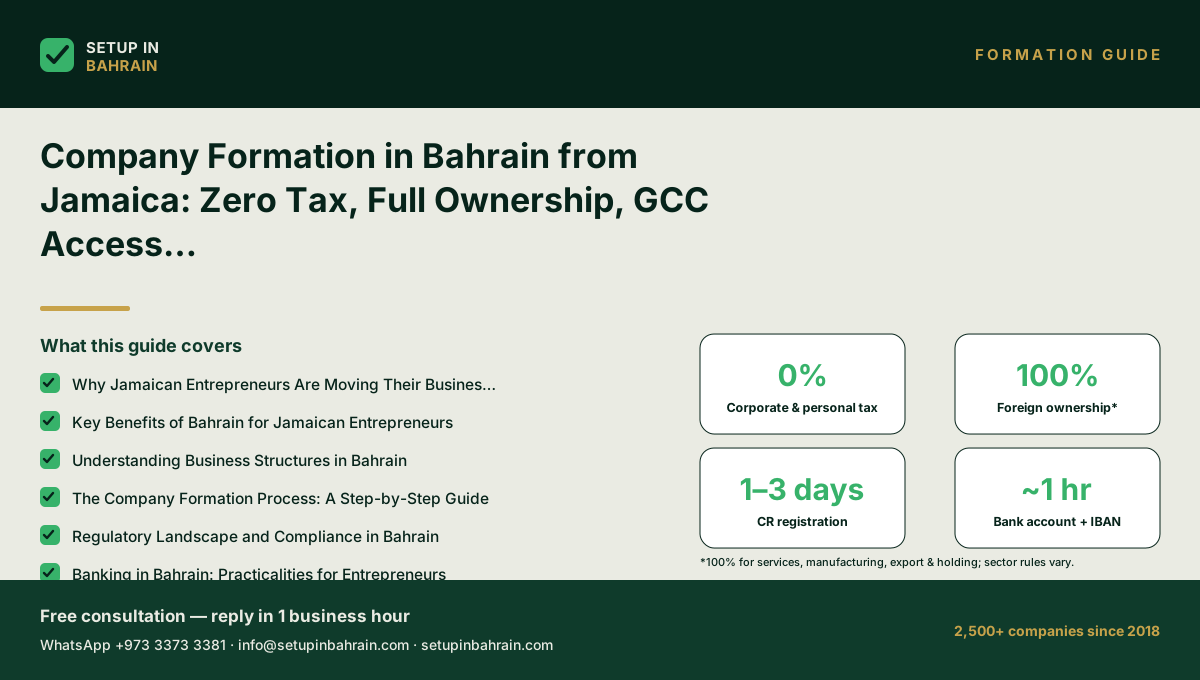
A Bahrain WLL can be owned by a single person — 100% foreign ownership applies to most activities, with no local partner required for services, manufacturing, export trading and holding companies. The minimum share capital is BHD 1; we recommend BHD 1,000, which makes bank account opening and investor visa approval smoother.
Entrepreneurship in Jamaica is a testament to resilience, innovation, and a powerful drive to create. From the vibrant streets of Kingston to the bustling tourist hubs of Montego Bay, Jamaican business owners navigate a dynamic, yet often challenging, economic landscape. You’ve built your brand, nurtured your customers, and consistently overcome hurdles that would deter many others.
But what if there was a path to significantly amplify your efforts, protect your profits from high taxes, and unlock a market almost unimaginable from the Caribbean? This isn't about leaving Jamaica behind; it's about strategic expansion, securing your financial future, and tapping into a global economy with unparalleled advantages.
This guide is crafted specifically for you, the Jamaican entrepreneur, looking beyond the familiar shores for a platform that offers stability, growth, and genuine financial freedom. We'll delve into why Bahrain, a thriving island nation in the heart of the Arabian Gulf, is rapidly becoming the destination of choice for savvy international investors, and how it directly addresses the very real pain points you face daily in Jamaica.
Why Jamaican Entrepreneurs Are Moving Their Business to Bahrain
Let's talk specifics. Marcus, who runs a mid-sized tour packaging company in Montego Bay, spent most of 2025 calculating what the 25% corporate income tax plus mandatory NIS (National Insurance Scheme) and NHT (National Housing Trust) contributions were really costing him. Every time he tried to move profits out to cover equipment purchases in Florida, the Bank of Jamaica’s (BOJ) approval process added weeks and an effective 2% handling fee due to stringent foreign exchange restrictions on large outward capital transfers. On top of that, his JMD revenues were losing 6% against the US dollar each year, eroding any margin he managed to keep after tax, even before the Tax Administration Jamaica’s (TAJ) complex quarterly filing requirements ate into his time.
This isn't a hypothetical scenario; it's the daily reality for countless Jamaican business owners. Imagine running a successful BPO operation in Portmore, scaling your team, winning significant contracts, and then watching nearly a quarter of your hard-earned corporate profits disappear into the TAJ coffers. Or perhaps you're an exporter of Jamaican goods, battling not just fluctuating global demand but also the persistent 5% to 8% annual depreciation of the Jamaican Dollar (JMD), making international payments a constant headache.
Now, flip that picture. Imagine a jurisdiction where your corporate profits are not subject to income tax. A place where you can own 100% of your business, repatriate profits freely, and operate with a currency pegged to the US Dollar, providing unparalleled stability against currency erosion. That place is Bahrain.
Bahrain isn't just an attractive option; for many Jamaican entrepreneurs, it’s a strategic imperative. Here’s why it’s standing out as a premier destination:
- Zero Corporate Income Tax: This is perhaps the most compelling advantage. Unlike Jamaica's 25% corporate income tax, Bahrain offers a generally no corporate income tax for most sectors on most business activities. This means a significantly larger portion of your hard-earned profits stays in your business, ready for reinvestment, expansion, or distribution. Imagine the difference this makes to your bottom line, especially if you're looking to scale rapidly.
- 100% Foreign Ownership: Forget the complexities of finding local partners or navigating joint venture regulations. In Bahrain, you can own 100% of your company in most sectors, particularly if you choose a With Limited Liability (WLL) company. This gives you complete control over your operations, strategy, and equity.
- Currency Stability: The Bahraini Dinar (BHD) is pegged to the US Dollar at a fixed rate of BHD 1 = USD 2.65. This eliminates the currency erosion risk you face with the JMD's 5% to 8% annual depreciation. Your revenues, assets, and profits maintain their value, offering predictable financial planning and protection against inflationary pressures.
- Strategic Gateway to the GCC Market: Bahrain is literally a bridge to a market of over 50 million affluent consumers in the Gulf Cooperation Council (GCC) countries (Saudi Arabia, UAE, Qatar, Kuwait, Oman). With Saudi Arabia just a 25-minute drive across the King Fahd Causeway, Bahrain serves as an ideal base for regional expansion, granting duty-free access to a staggering USD 1.6 trillion economy. This is a scale of opportunity simply not available from the Caribbean.
- Favourable Business Environment: The World Bank's Ease of Doing Business Report consistently ranks Bahrain highly, reflecting its streamlined regulatory processes, investor-friendly policies, and robust legal framework. The Economic Development Board (EDB) of Bahrain actively promotes foreign direct investment through supportive initiatives and a proactive approach to simplifying company formation and operations.
- No BOJ Forex Restrictions: One of the most frustrating aspects for Jamaican entrepreneurs looking to expand internationally is the labyrinthine process of moving significant capital out of the country due to BOJ's foreign exchange restrictions. In Bahrain, there are no such restrictions on capital repatriation. You have the freedom to move your profits and capital globally with ease, offering unparalleled financial flexibility.
- Global Talent Pool & Logistics: Bahrain offers a diverse, skilled, and multilingual workforce, along with world-class logistics infrastructure, including a modern international airport, a deep-water port, and free zones designed for efficient global trade. This supports scalable operations, whether you’re running a BPO, an e-commerce venture, or a logistics hub.
Key Benefits of Bahrain for Jamaican Entrepreneurs
Beyond the immediate relief from Jamaican specific pain points, Bahrain offers a suite of advantages that position it as a truly world-class business destination.
1. Unmatched Tax Efficiency and Financial Freedom
The absence of corporate income tax is a game-changer. For a Jamaican business currently paying 25% of its profits to TAJ, relocating your profit-generating entity to Bahrain can immediately boost your net earnings by a substantial margin. But it's not just corporate tax. Bahrain also has:
- No Personal Income Tax: You, as the business owner, will not pay personal income tax on your earnings from your Bahraini company.
- No Withholding Tax: Dividends, interest, and royalties paid out from Bahrain are typically not subject to withholding tax.
- No Capital Gains Tax: Profits from the sale of assets are generally exempt from capital gains tax.
- No Estate or Inheritance Tax: Your wealth is preserved for future generations without additional levies.
While a 10% Value Added Tax (VAT) was introduced in 2019, it's a consumption tax, meaning businesses primarily act as collectors. The overall tax burden for a profitable enterprise remains dramatically lower than in almost any other developed economy, certainly compared to Jamaica. This financial freedom allows for accelerated growth, larger retained earnings, and a more secure financial future for you and your enterprise.
2. Strategic Location and Unrivalled Market Access
Bahrain's geographical position is not merely central; it is strategic. Located at the heart of the Arabian Gulf, it acts as a natural hub for businesses looking to access:
- The GCC Market: As mentioned, the GCC represents a significant, affluent market. Bahrain's close ties, shared customs union, and excellent logistics make it the perfect springboard. Many multinational corporations establish their GCC headquarters in Bahrain precisely for this reason.
- MENA Region: Beyond the GCC, Bahrain provides access to the broader Middle East and North Africa (MENA) region, a market of over 400 million people.
- Asia and Africa: Bahrain’s well-connected air and sea routes facilitate trade with emerging markets in Asia and established markets in Africa, making it a truly global logistics node.
Imagine your Jamaican products or services, traditionally limited by Caribbean market size, now having a direct, duty-free route to Saudi Arabia, the UAE, and beyond. This expansion potential is immense and transformative.
3. A Robust and Diversified Economy
Bahrain has historically been a pioneer in economic diversification among its GCC peers. While oil and gas still contribute, the Kingdom has made significant strides in developing its financial services, ICT, logistics, manufacturing, and tourism sectors.
- Financial Hub: Bahrain is a long-established financial hub, home to over 380 financial institutions including conventional and Islamic banks, insurance companies, and investment firms. The Central Bank of Bahrain (CBB) is a respected and progressive regulator, fostering innovation while maintaining stability. This means access to sophisticated banking services, investment capital, and a skilled financial workforce.
- Digital Economy Pioneer: Bahrain is at the forefront of digital transformation in the region, with initiatives like the Bahrain FinTech Bay, and supportive regulations for cloud computing and data centers. This creates a fertile ground for tech-focused businesses, e-commerce platforms, and digital service providers.
- Pro-Business Government: The Government of Bahrain, particularly through the Economic Development Board (EDB), actively works to attract and support foreign investment. This includes streamlined licensing processes, investor care services, and a commitment to continuous regulatory improvement.
4. Quality of Life and Infrastructure
While primarily a business decision, the quality of life offered in Bahrain is a significant factor. For entrepreneurs and their families, Bahrain presents:
- Modern Infrastructure: World-class roads, telecommunications, healthcare, and education systems.
- Diverse Expatriate Community: A welcoming and diverse expatriate community, making settling in easier.
- Safe and Stable Environment: Bahrain is known for its safety, stability, and welcoming culture.
- Affordable Living: Compared to other major GCC cities like Dubai or Doha, Bahrain offers a relatively lower cost of living, particularly for housing and schooling.
- Cultural Blend: A unique blend of traditional Arabian culture and modern international influences.
For Jamaican entrepreneurs considering a move, Bahrain offers a seamless transition with familiar comfort and new opportunities.
Understanding Business Structures in Bahrain
Choosing the right legal structure for your company is a critical decision. Bahrain offers several options, but for most foreign entrepreneurs, two types stand out: the With Limited Liability Company (WLL) and the Bahrain Shareholding Company (BHSC). It's important to clarify a key point upfront: there is NO single-shareholder WLL legal form in Bahrain. Do not be misled by outdated information or comparisons to other jurisdictions.
1. With Limited Liability Company (WLL)
The WLL is by far the most popular and recommended option for foreign entrepreneurs due to its flexibility and the protection it offers.
- 100% Foreign Ownership: Crucially for Jamaican entrepreneurs, a WLL can be 100% owned by a single individual or a corporate entity. You do not need a Bahraini partner. This is a significant advantage, providing full control and profit retention.
- Limited Liability: As the name suggests, the liability of the shareholders is limited to their capital contribution. Your personal assets are protected from business debts and obligations.
- Minimum Share Capital: Legally, the minimum share capital for a WLL is BHD 1 (approximately USD 2.65). However, it is strongly recommended to set a minimum share capital of BHD 1,000 (approximately USD 2,650). Why? A BHD 1,000 capital demonstrates sufficient financial backing to commercial banks, making it significantly easier to open a corporate bank account. Furthermore, this amount is often a practical requirement for securing investor visas and residency permits for the business owner.
- Director Requirements: A WLL requires a minimum of one director. This director can be a foreign national and does not need to be a Bahraini resident at the time of incorporation, though residency will be required later for visa purposes.
- Wide Range of Activities: WLLs can engage in a broad spectrum of commercial activities, from trading and services to consulting and technology.
2. Bahrain Shareholding Company (BHSC)
BHSCs are typically chosen for larger ventures, especially those planning to go public or requiring a more complex capital structure. There are two types: Public and Closed.
- Public BHSC: Suitable for companies seeking to raise capital from the public by listing shares on the Bahrain Bourse. Requires a minimum of seven founders and a substantial minimum share capital (BHD 1,000,000).
- Closed BHSC: Does not offer shares to the public. Requires a minimum of two founders and a minimum share capital of BHD 250,000.
- Governance: BHSCs have more stringent governance and reporting requirements compared to WLLs, making them less suitable for most small to medium-sized foreign enterprises initially.
3. Branches of Foreign Companies
If you already have an established company in Jamaica or another jurisdiction, you can register a branch office in Bahrain.
- No Separate Legal Entity: A branch is an extension of the parent company and does not have a separate legal personality.
- Full Liability of Parent: The parent company is fully liable for all obligations of the branch.
- Specific Activities: Activities are restricted to those of the parent company.
4. Partnerships
Less common for foreign investors, general partnerships (unlimited liability) and limited partnerships (some partners with limited liability, others unlimited) are also options but typically used for local, smaller ventures.
For most Jamaican entrepreneurs, the With Limited Liability (WLL) company offers the ideal balance of control, protection, and operational flexibility, making it the go-to choice for company formation in Bahrain.
The Company Formation Process: A Step-by-Step Guide
Forming a company in Bahrain is a streamlined process, largely managed by the Ministry of Industry and Commerce (MOIC) through their "Sijilat" portal, an integrated online business registration system. This digital platform is designed to make company formation efficient and transparent.
Here's a breakdown of the typical steps:
Step 1: Business Activity Identification & Licensing Requirements
Before anything else, you need to clearly define your business activities. The MOIC maintains a classification of commercial activities. Each activity has specific requirements and may need approval from relevant regulatory bodies (e.g., CBB for financial services, Ministry of Health for healthcare, Ministry of Education for training centers).
- Pro-Tip: Engage with a local business consultant (corporate service provider) early. They can help you accurately classify your activities and identify all necessary approvals, saving you significant time and potential rejections.
Step 2: Name Reservation
You’ll need to propose a few unique company names for approval by the MOIC. The name must not be identical or confusingly similar to an existing registered company name and should reflect your business activities.
Step 3: Draft Constitutional Documents
For a WLL, this primarily involves drafting the Memorandum of Association (MoA) and Articles of Association (AoA). These documents outline:
- The company's name, objectives, and activities.
- The share capital (remember the BHD 1,000 practical recommendation).
- Shareholder details (you, as the 100% owner).
- Director details.
- Registered office address in Bahrain.
These documents must be professionally prepared and then signed and notarized.
Step 4: Obtain Initial Approvals
Depending on your business activities, you may need initial approvals from relevant government entities. For example:
- Central Bank of Bahrain (CBB): For financial services, insurance, fintech.
- National Health Regulatory Authority (NHRA): For medical or pharmaceutical activities.
- Ministry of Education: For educational or training institutions.
- General Directorate of Nationality, Passports & Residence Affairs (GDNPR): For certain visa-related aspects.
The MOIC acts as a central coordinator, often streamlining these approvals through the Sijilat portal.
Step 5: Capital Deposit (if applicable)
While the legal minimum capital for a WLL is BHD 1, if you’ve opted for the recommended BHD 1,000 (or higher), you will need to deposit this capital into a temporary bank account in Bahrain once your company's name and initial documents are approved. The bank will then issue a letter confirming the deposit, which is required for the final registration.
Step 6: Final Registration with MOIC
Once all documents are prepared, initial approvals secured, and capital deposited (if needed), you submit the full application package to the MOIC through Sijilat. This includes:
- Completed application form.
- Notarized MoA and AoA.
- Copy of your passport (as owner/director).
- Proof of registered office address (lease agreement).
- Bank deposit confirmation letter.
- Any specific regulatory approvals.
The MOIC will review your application. If everything is in order, they will issue your Commercial Registration (CR) certificate. This CR is your official license to operate.
Step 7: Post-Registration Formalities
With your CR in hand, you’ll need to:
- Open a Corporate Bank Account: This is a crucial step. With your BHD 1,000 capital, your CR, and your physical presence, this process becomes much smoother. Choose a reputable bank with strong international services.
- Register with the General Organization for Social Insurance (GOSI): For any employees, including yourself if you plan to be an employee of your Bahraini company, GOSI registration is mandatory.
- Obtain an Investor Visa and CPR: As the owner, you will need to apply for an investor visa and subsequently a Central Population Registration (CPR) card, which acts as your national ID. This allows you to legally reside and work in Bahrain. Your corporate service provider can assist extensively with this.
- Register for VAT: If your annual turnover exceeds BHD 37,500, you will need to register for VAT with the National Bureau for Revenue (NBR).
Typical Timeline: The entire process, from initial application to receiving your CR, can take anywhere from 2 to 4 weeks if all documents are in order and no complex approvals are needed. The subsequent banking and visa processes can add another 2-4 weeks. Working with experienced local consultants significantly accelerates this.
Regulatory Landscape and Compliance in Bahrain
Bahrain’s regulatory environment is modern, transparent, and designed to foster business growth while ensuring stability. Key institutions play crucial roles:
Ministry of Industry and Commerce (MOIC)
The MOIC is the primary body responsible for business registration and regulation. It oversees commercial companies, business names, intellectual property, and consumer protection. The Sijilat portal is their flagship initiative for streamlining all commercial registration services.
Economic Development Board (EDB)
The EDB is Bahrain’s investment promotion agency. Their mandate is to attract foreign direct investment, support economic diversification, and advocate for pro-business policies. The EDB provides invaluable support to foreign investors, acting as a single point of contact, offering market intelligence, and facilitating connections with relevant government agencies. They are a critical partner for any entrepreneur considering Bahrain.
Central Bank of Bahrain (CBB)
The CBB is the single regulatory authority for Bahrain's entire financial sector. This includes conventional and Islamic banks, insurance companies, investment firms, and ancillary service providers. The CBB is known for its progressive stance on FinTech and regulatory innovation (e.g., regulatory sandbox), making Bahrain an attractive hub for financial technology companies.
Bahrain Investors and Entrepreneurs Protection Association (BIPA)
While not a government entity, BIPA is a non-profit organization dedicated to protecting the rights and interests of investors and entrepreneurs in Bahrain. They advocate for policy improvements, provide information, and offer support to ensure a fair and equitable business environment.
World Bank's Ease of Doing Business Index
Bahrain consistently ranks among the top countries in the MENA region in the World Bank's Ease of Doing Business Report. In 2020, Bahrain ranked 43rd globally and 4th in the MENA region, reflecting its commitment to creating a business-friendly environment through reforms in areas like starting a business, getting electricity, and protecting minority investors. While the World Bank has paused this report, Bahrain's historical performance underscores its robust regulatory framework.
Understanding these key players and their roles provides confidence that your business will operate within a well-governed and supportive ecosystem.
Banking in Bahrain: Practicalities for Entrepreneurs
Opening a corporate bank account is often cited as one of the most challenging post-incorporation steps globally. While Bahrain has a robust banking sector, it still requires preparation and understanding.
Why BHD 1,000 Share Capital is Crucial
As mentioned, the legal minimum for a WLL is BHD 1. However, this amount is often insufficient to impress a bank's compliance department. Banks are increasingly scrutinizing new accounts to prevent financial crime. A capital of BHD 1,000 or more signals:
- Commitment: You are serious about your business.
- Credibility: Your business has initial operating funds.
- Risk Mitigation: The bank sees a lower risk profile.
Without at least BHD 1,000, you might face delays, rejections, or be pushed towards less reputable banking options.
Choosing the Right Bank
Bahrain hosts a wide array of local and international banks. Consider:
- Services Offered: Does the bank offer robust online banking, international transfers, trade finance, and multi-currency accounts?
- Fees and Charges: Compare transaction fees, maintenance fees, and foreign exchange rates.
- Customer Service: Especially important for foreign entrepreneurs, seek a bank known for good English-speaking support and a dedicated business banking unit.
- Islamic Banking: If Sharia-compliant finance is important to you, Bahrain is a global leader in Islamic banking.
Some reputable banks include National Bank of Bahrain (NBB), Al Salam Bank, Bahrain Islamic Bank (BisB), and HSBC Bahrain.
Required Documents for Account Opening
Typically, you'll need:
- Original Commercial Registration (CR) certificate.
- Original Memorandum and Articles of Association.
- Passport copies and visa/CPR for all signatories.
- Proof of address for signatories.
- Board resolution authorizing account opening and signatories (if corporate owner).
- Business plan (sometimes requested to understand your operations).
- Proof of source of funds for the initial deposit.
The Process
- Appointment: Schedule a meeting with the bank's business banking unit.
- Submission: Submit all required documents.
- Due Diligence: The bank will conduct its Know Your Customer (KYC) and Anti-Money Laundering (AML) checks. This can take a few days to a few weeks.
- Activation: Once approved, your account will be activated, and you'll receive debit cards, checkbooks, and online banking access.
Original Insight: Be prepared for in-person meetings. While Bahrain is digital-forward, banks often require face-to-face interaction for initial account opening and signatory verification, especially for foreign entrepreneurs. This is why having your investor visa and CPR is so crucial.
Investor Visa and Residency for Entrepreneurs
Securing your investor visa and residency permit (CPR card) is as important as your company registration. It allows you to legally reside in Bahrain, manage your business, and avail yourself of all the benefits.
Types of Visas
- Investor Visa: This is the most common path for entrepreneurs. It's typically sponsored by your own company and requires demonstrating sufficient investment (e.g., your share capital of BHD 1,000+).
- Self-Sponsorship Visa: Bahrain has recently introduced a self-sponsorship residency permit for retirees and wealthy individuals, and is expanding this to include talented professionals and entrepreneurs. This can offer more flexibility but has higher financial requirements.
Application Process (Investor Visa)
- Company Registration: Your company must be fully registered with MOIC and have its CR.
- CPR Number for Company: Your company itself will be issued a CPR (Central Population Registration) number by the Information & eGovernment Authority.
- Application Submission: The application for your investor visa is submitted to the Nationality, Passports and Residence Affairs (NPRA). Your PRO (Public Relations Officer) or corporate service provider will handle this.
- Required Documents:
- Biometrics & Medical: You will undergo a medical examination at an authorized clinic in Bahrain and register your fingerprints.
- Visa Issuance: Once approved, your investor visa will be stamped in your passport.
- CPR Card Application: With your visa, you can then apply for your CPR card (Bahrain ID). This is vital for almost all daily activities – banking, utilities, leases, etc.
Dependent Visas: Once you have your investor visa, you can sponsor visas for your immediate family members (spouse and children). This usually requires demonstrating sufficient income and having a suitable residence in Bahrain.
Timeline: The visa and CPR process can take 4-8 weeks, sometimes longer if there are complications with document verification. Starting this immediately after company registration is essential.
Post-Formation Compliance and Growth in Bahrain
Forming your company is just the beginning. Ongoing compliance and strategic growth are crucial for long-term success.
Ongoing Compliance Requirements
- Annual Renewals: Your Commercial Registration (CR) must be renewed annually with the MOIC.
- Annual Audits: Most WLLs are required to submit audited financial statements to the MOIC annually. Ensure you appoint a reputable, licensed auditor in Bahrain.
- VAT Filings: If registered for VAT, you will need to file periodic VAT returns (typically quarterly) with the National Bureau for Revenue (NBR).
- GOSI Contributions: If you employ staff (including yourself), mandatory social insurance contributions (GOSI) must be paid monthly.
- Record Keeping: Maintain accurate accounting records for at least 10 years, as per Bahraini law.
Original Insight: Unlike Jamaica's complex quarterly filing with TAJ, Bahrain's tax compliance (mainly VAT if applicable) is generally simpler due to the absence of corporate income tax filings. This significantly reduces administrative burden.
Leveraging Bahrain for Growth
- Access to Free Zones: Bahrain hosts several free zones, such as the Bahrain International Investment Park (BIIP) and the Bahrain Logistics Zone (BLZ). These offer additional benefits like 100% foreign ownership, duty-free trade within the zone, and specific incentives for manufacturing, logistics, and export-oriented businesses.
- Government Support and Funding: The EDB and various government initiatives actively support SMEs and innovative startups, offering guidance, access to funding programs, and networking opportunities.
- Digital Transformation: Embrace Bahrain's digital infrastructure. The country is well-connected, with a high internet penetration rate and a government keen on e-services. This facilitates e-commerce, digital marketing, and cloud-based operations.
- Networking: Actively participate in business chambers, industry associations, and networking events. Bahrain has a vibrant business community, and connections can lead to partnerships and new opportunities.
Comparing Jamaica and Bahrain: A Direct Look
To truly appreciate the strategic move, let's put the key differences side-by-side.
| Feature | Jamaica | Bahrain |
| :-------------------- | :------------------------------------------------- | :------------------------------------------------------------- |
| Corporate Income Tax | 25% | 0% (on most business activities) |
| Personal Income Tax | Progressive rates (up to 25% for high earners) | 0% |
| Currency Stability | JMD depreciation (5-8% annually vs. USD) | BHD pegged to USD (1 BHD = 2.65 USD) – stable |
| Foreign Ownership | Often requires local partners/complex structures | 100% foreign ownership (e.g., WLL) |
| Forex Restrictions | BOJ restrictions on outward capital transfers | No restrictions on capital repatriation |
| GCC Market Access | Limited/Indirect | Direct, duty-free access to a $1.6 Trillion market of 50M+ consumers |
| Minimum WLL Capital | N/A | BHD 1 (legal), BHD 1,000 (recommended) for bank/visa |
| Compliance Complexity | TAJ complex quarterly filings, NIS, NHT | Streamlined MOIC, NBR (VAT only if applicable) |
| Ease of Doing Business | Lower global ranking (e.g., 61st in 2020) | Higher global ranking (e.g., 43rd in 2020) |
| Access to Finance | More limited, higher interest rates | Sophisticated financial hub, diverse funding options |
| Government Support | Various agencies, but smaller scale | EDB, MOIC, CBB actively promote FDI, investor care services |
Frequently Asked Questions (FAQs) for Jamaican Entrepreneurs
Here are some common questions specific to your journey from Jamaica to Bahrain:
Q1: Can I really own 100% of my company in Bahrain as a Jamaican? A1: Yes, absolutely. For a With Limited Liability (WLL) company, which is the most common and recommended structure for foreign investors, you can hold 100% ownership as a single individual or corporate entity. No local partner is required.
**Q2: What is the true minimum capital for a WLL? I heard BHD 1, but you recommend BHD 1,0
Bahrain Business Guides for Jamaica Citizens
Ready to set up in Bahrain from Jamaica?
Tell us your business idea. We map the right entity, ownership and timeline — then handle the filing while you focus on what matters.