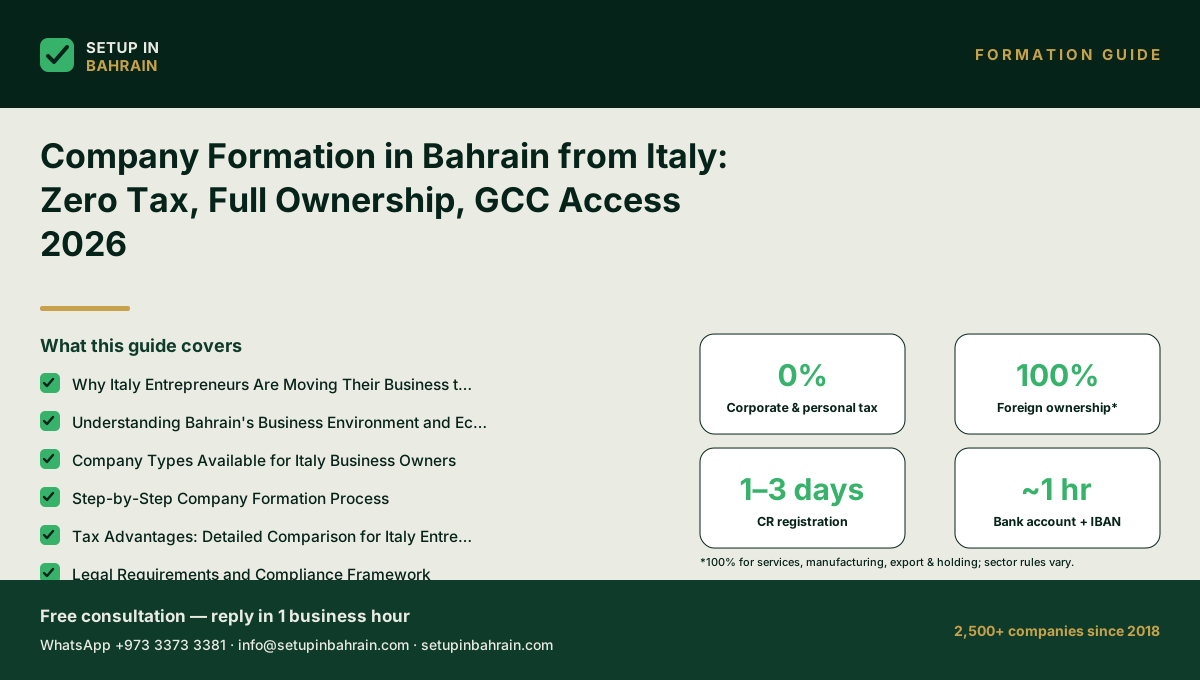
Start your Bahrain company from Italy with generally no corporate income tax for most sectors. Fast registration, full foreign ownership & easy setup for Italian entrepreneurs. Get started today.
Key Takeaways
- Why Italy Entrepreneurs Are Moving Their Business to Bahrain
- Understanding Bahrain's Business Environment and Economy
- Company Types Available for Italy Business Owners
- Step-by-Step Company Formation Process
- Tax Advantages: Detailed Comparison for Italy Entrepreneurs
→ Complete guide: Company Formation in Bahrain — the full 2026 guide
View details
Ownership & capital
A Bahrain WLL can be owned by a single person — 100% foreign ownership applies to most activities, with no local partner required for services, manufacturing, export trading and holding companies. The minimum share capital is BHD 1 ; we recommend BHD 1,000 . This Makes bank account opening and investor visa approval smoother.
Marco Ferretti remembers the exact moment he decided something had to change. It was 2:47 AM on a February Tuesday in his Milan apartment. He was staring at his fourth espresso, trying to reconcile the numbers from his software consulting business. His commercialista had just emailed the preliminary tax calculation for 2024: 24% IRES national corporate tax, plus 3.9% IRAP regional tax for Lombardy, plus quarterly IVA filings that required a dedicated part-time bookkeeper just to manage the submissions. Total effective corporate tax rate: 27.9%. Before INPS social contributions. Before the €2,300 notarized deed costs for restructuring his SRL. Before the looming possibility of a commercial court dispute with a former supplier that his lawyer warned could drag on for five to seven years through the Tribunale delle Imprese.
That year, Marco's company generated €847,000 in revenue—a record that should have felt like triumph. Instead, he watched €236,000 disappear into the combination of corporate taxes, regional levies, and mandatory contributions. His effective take-home from that banner year barely exceeded what he'd earned in 2019 with half the revenue.
Marco isn't an outlier. He's the norm.
Across Italy, from tech founders in Turin to import-export operators in Naples, from fashion brand owners in Florence to industrial component manufacturers in Brescia, entrepreneurs are confronting an uncomfortable reality: the Italian business environment, despite its cultural richness and strategic European positioning, has become a high-friction system that penalizes growth and rewards stagnation.
For a growing number of these founders, the answer sits 4,200 kilometers southeast, in a 780-square-kilometer island nation that charges precisely zero percent corporate income tax, allows complete foreign ownership without a local sponsor requirement, and positions your business 25 kilometers via causeway from Saudi Arabia—the largest economy in the Middle East.
This guide exists because Italian entrepreneurs face specific obstacles that generic "offshore company formation" content completely ignores. Your challenges aren't abstract theories about tax optimization. They're rooted in the CCNL collective bargaining agreements that govern your workforce costs, the notarized atto costitutivo requirements that inflate your SRL formation expenses by €2,000 or more, the quarterly dichiarazione IVA submissions that consume days of productive time, and the Agenzia delle Entrate's more and more aggressive stance on cross-border structuring.
Bahrain offers a genuine alternative—but only if you understand exactly how every piece fits together for an Italian founder specifically.
Why Italy Entrepreneurs Are Moving Their Business to Bahrain
Let's be direct about what's happening on the ground in Italy. This is because The numbers tell a story that no amount of "Made in Italy" pride can obscure.
The Italian Tax Reality That's Pushing Founders Out
Consider what Lucia experiences running her e-commerce brand selling Italian leather goods from her base in Florence. Her company structure—a standard Società a Responsabilità Limitata formed in 2018—made perfect sense when she launched. Sales were modest at €180,000 annually, margins were reasonable at 22%. The complexity of Italian bureaucracy felt manageable when spread across relatively small operations.
By 2024, everything changed except the bureaucracy. Revenue climbed to €1.2 million. Customers now span 47 countries, with 31% of sales going to GCC nations like Saudi Arabia, the UAE. Kuwait. Her products became premium items in Riyadh department stores. The business succeeded beyond her initial projections.
Yet here's what success actually meant for Lucia's operational reality:
Corporate taxation consumed €94,800 through the IRES and IRAP combination on her €340,000 taxable profit. That's 27.9%—higher than Germany's 29.9% average but applied to a far less supportive business infrastructure, higher than the UK's 25%. Dramatically higher than Ireland's 12.5% or Cyprus's 12.5%.
Her commercialista fees reached €14,400 annually for handling the quarterly IVA submissions, the annual bilancio preparation, the comunicazioni IVA, the dichiarazione dei redditi società, and the constant back-and-forth with Agenzia delle Entrate on technical interpretations of cross-border e-commerce VAT rules.
The notarized deed for adding a new minority shareholder cost €2,700 and required two separate appointments at the notaio's office over three weeks, during which the potential investor nearly walked away due to the delays.
A dispute with a former Italian supplier over defective materials has now entered its fourth year in the Tribunale delle Imprese of Florence, with no resolution in sight and €47,000 spent on legal fees that would have funded an entire product line launch.
Lucia's situation isn't unusual. According to World Bank Doing Business methodology (before the program's 2021 discontinuation), Italy ranked 58th globally for ease of doing business, and the specific metric for "enforcing contracts" placed Italy at 122nd worldwide—meaning commercial disputes took an average of 1,120 days to resolve through the court system.
What Bahrain Actually Offers Italian Founders
Now contrast Lucia's reality with what Bahrain provides:
Zero percent corporate income tax for the overwhelming majority of businesses. Not a reduced rate. Not a temporary incentive. Zero. The only exceptions are oil and gas companies subject to a 46% tax on profits. This Doesn't apply to any service, trading, consulting, technology, or manufacturing business you'd realistically establish.
100% foreign ownership permitted across virtually all sectors since 2017 reforms eliminated the previous requirement for a local Bahraini sponsor or partner. You maintain complete control of your company from incorporation through exit.
Zero personal income tax on salary, dividends, or capital gains. The money you extract from your Bahrain company arrives in your accounts without an additional layer of taxation at the personal level within Bahrain's jurisdiction.
Company formation in 3-5 business days through the Sijilat online portal, with total government fees ranging from BHD 100-350 (€245-860) depending on your license type—compare that to the €2,000+ notary costs alone for an Italian SRL.
Commercial disputes resolved in months, not years. The Bahrain Chamber for Dispute Resolution (BCDR-AAA), established in partnership with the American Arbitration Association, handles business conflicts through internationally recognized arbitration procedures that typically conclude within 6-12 months.
Physical access to Saudi Arabia's $1.1 trillion GDP economy via the 25-kilometer King Fahd Causeway, with 34 million potential consumers a 45-minute drive from Bahrain's business districts.
Bilateral Investment Treaty with Italy through the Bahrain Investment Promotion Agreement (signed 2006), providing legal protections for Italian investors including fair and equitable treatment standards, protection against expropriation, and access to international arbitration for investment disputes.
The contrast isn't subtle. It's structural.
Understanding Bahrain's Business Environment and Economy
Before committing capital and operational energy to any jurisdiction, you need to understand what kind of economy you're entering. Bahrain isn't simply a "tax haven"—it's a diversified financial and commercial hub with distinct characteristics that matter enormously for Italian entrepreneurs.
Economic Structure and Diversification Progress
Bahrain's GDP reached about $44 billion in 2024, making it the smallest economy among the GCC states. But, this figure obscures a critical reality: Bahrain has achieved the highest level of economic diversification in the Gulf region, with non-oil sectors now contributing over 85% of GDP.
This matters for Italian founders because it indicates genuine commercial activity beyond hydrocarbon extraction. Financial services alone contribute about 17% of GDP, with over 400 financial institutions regulated by the Central Bank of Bahrain (CBB). Aluminum production through Aluminium Bahrain (ALBA)—one of the largest smelters globally—contributes greatly to manufacturing GDP. Tourism, logistics, and professional services round out an economy that functions independently of oil price fluctuations.
The Economic Development Board (EDB) of Bahrain has invested heavily since 2017 in attracting foreign companies, with particular focus on fintech, logistics, ICT, and manufacturing sectors. Italian companies entering these spaces find an administration actively seeking their presence rather than merely tolerating it.
Geographic Positioning and Market Access
Bahrain's location provides access advantages that simply don't exist for Italy-based operations targeting Middle Eastern markets:
Saudi Arabia sits 25 kilometers away via the King Fahd Causeway. The Kingdom's Vision 2030 transformation program involves over $1 trillion in planned infrastructure and development spending through 2030, creating opportunities across construction, technology, professional services, and consumer goods sectors.
The broader GCC market encompasses 55 million consumers with per-capita GDP levels averaging $31,000—higher than Italy's €34,000 and representing substantial purchasing power for premium Italian products and services.
Time zone positioning places Bahrain at GMT+3, allowing same-business-day communication with both European clients (morning overlap) and Asian partners (afternoon overlap). Milan's morning meeting at 9:00 AM occurs at 11:00 AM in Bahrain; a Singapore partner's 5:00 PM is Bahrain's 12:00 PM.
Aviation connectivity through Bahrain International Airport provides direct flights to major Italian cities, with connections via Rome, Milan. Seasonal routes to other European hubs. Flight time to Milan Malpensa runs about 5.5 hours, making supervision visits straightforward.
Regulatory Environment and International Compliance
Italian entrepreneurs—especially those accustomed to the EU's comprehensive regulatory framework—often express concern about whether Bahrain maintains legitimate financial and commercial standards. This concern deserves direct address.
The Central Bank of Bahrain implements Basel III banking standards and maintains a financial regulatory framework that FATF (Financial Action Task Force) has evaluated as greatly compliant with anti-money laundering requirements. Bahrain was removed from the FATF grey list in 2001 and has maintained compliant status since.
The Bahrain Bourse operates with transparent listing requirements and settlement systems that meet international standards. The Kingdom's financial services regulations specifically aim to attract legitimate financial institutions. The CBB actively monitors and disciplines firms that fail compliance requirements.
For Italian founders, this means your Bahrain company operates within a framework that European banks, payment processors. Commercial partners recognize as legitimate. Opening business banking relationships, establishing merchant accounts. Conducting international transactions doesn't encounter the friction associated with jurisdictions lacking regulatory credibility.
Company Types Available for Italy Business Owners
Selecting the correct legal structure in Bahrain determines everything from your capital requirements to your operational flexibility. Italian entrepreneurs typically choose among four main options, each suited to different business models and growth trajectories.
Limited Liability Company (WLL) - The Standard Choice
The Bahraini Sharikat That Masouliya Mahdouda, equivalent to Italy's SRL, remains the most common structure for Italian founders establishing operational businesses.
Minimum capital requirement: BHD 20,000 (about €49,000) for companies undertaking commercial activities with foreign ownership. This capital must be deposited in a Bahraini bank account during formation but can be used for operational purposes once the company becomes active.
Ownership structure: Up to 50 shareholders permitted, with 100% foreign ownership allowed since 2017 reforms. No requirement for Bahraini partners or sponsors for most business activities.
Liability protection: Shareholders' personal assets remain protected from company liabilities, with exposure limited to their capital contribution—identical in function to your Italian SRL's protections.
Management: Managed by one or more directors who need not be Bahraini nationals. Foreign directors can manage the company without residency requirements, though having at least one director with a Bahraini residence visa simplifies certain administrative procedures.
Suitable for: Operational businesses with employees, companies holding contracts with GCC clients, trading operations, service providers establishing a genuine commercial presence.
single-shareholder WLL - Solo Entrepreneurs
Introduced specifically to attract foreign entrepreneurs, the WLL allows a single shareholder to operate a limited liability entity—something not available in traditional Italian company law until recent reforms, and even then with restrictions.
Minimum capital requirement: BHD 1 (we recommend BHD 1,000). This higher threshold compared to WLLs reflects the single-shareholder structure's different risk profile.
Ownership structure: One shareholder only, who can be an individual or a corporate entity. This makes WLLs ideal for wholly-owned subsidiaries of Italian parent companies.
Management: The sole shareholder can serve as the sole director, eliminating the need for additional personnel in the corporate governance structure.
Suitable for: Individual consultants establishing a GCC presence, Italian companies creating wholly-owned subsidiaries, professionals offering services that don't require significant local staff.
Branch Office of Foreign Company
Italian companies wishing to maintain their domestic corporate structure while establishing a Bahraini presence can register a branch office.
Capital requirement: No separate capital requirement exists, as the branch operates as an extension of the Italian parent company rather than a separate legal entity.
Legal status: The branch has no independent legal personality—it is simply an operational arm of the parent company. This means the Italian parent company bears full liability for the branch's obligations.
Taxation: Branch profits are subject to Bahrain's Generally no corporate income tax for most sectors regime, though profits repatriated to Italy may trigger Italian taxation depending on your specific structure and the applicable double taxation treaty provisions.
Registration requirements: Requires notarized and apostilled documents from the Italian parent company, including the atto costitutivo, current bilancio. Board resolution authorizing the branch setup.
Suitable for: Companies wanting to maintain centralized Italian control while establishing a GCC operational presence, testing the Bahraini market before committing to a separate subsidiary, projects with defined timeframes.
Bahrain Free Zone Company - Manufacturing and Logistics Focus
The Bahrain International Investment Park (BIIP) and Bahrain Logistics Zone (BLZ) offer free zone structures with additional incentives for manufacturing and logistics operations.
Key benefits:
- 100% foreign ownership guaranteed through free zone regulations
- Zero customs duties on imports and exports
- No minimum capital requirements for certain license types
- Streamlined customs procedures for goods in transit
Limitations:
- Physical operations must occur within designated free zone areas
- Additional licensing fees and zone-specific requirements apply
- Less flexibility for service-based businesses
Suitable for: Italian manufacturers establishing GCC production facilities, logistics companies serving regional distribution, import-export trading operations handling physical goods.
Comparative Analysis: Which Structure Fits Your Model?
Factor WLL WLL Branch Free Zone |--------|-----|-----|--------|-----------| Minimum Capital BHD 20,000 BHD 1 (we recommend BHD 1,000) None Varies Shareholders 2-50 1 only N/A 1+ Foreign Ownership 100% 100% 100% 100% Separate Legal Entity Yes Yes No Yes Setup Time 3-5 days 3-5 days 7-14 days 5-10 days Best For Most businesses Solo founders Testing market Manufacturing Most Italian entrepreneurs establishing service businesses, consulting firms, technology companies, or trading operations should default to the WLL structure. The BHD 20,000 capital requirement is manageable for serious commercial ventures. The flexibility around shareholders allows for future investment rounds or partner additions.
Step-by-Step Company Formation Process
The actual mechanics of forming a Bahrain company differ greatly from Italian procedures. Where Italy requires notarized deeds, multiple appointments. Weeks of waiting, Bahrain has invested heavily in digital systems that compress the timeline dramatically.
Phase 1: Pre-Formation Planning (1-2 Weeks Before Submission)
Define your commercial activity scope. Bahraini commercial licenses specify permitted activities, and operating outside your license scope creates regulatory problems. Consider not just your current services but expansion possibilities over the coming 3-5 years. Adding activities later is possible but requires additional fees and processing time.
Select your company name. Bahraini naming rules require Arabic names for companies, with English translations permitted for official use. Names cannot duplicate existing registrations or use restricted terms (bank, insurance, royal) without appropriate licensing. The Ministry of Industry and Commerce (MOIC) maintains a name reservation system—reserve your preferred name before proceeding.
Determine your initial shareholding structure. If forming a WLL with multiple shareholders, define ownership percentages and capital contributions before beginning the formation process. Changes after incorporation require formal procedures and fees.
Identify your registered office address. Every Bahraini company requires a physical registered address within the Kingdom. This can be a serviced office arrangement if you're not immediately establishing physical operations. It must be a genuine address capable of receiving official correspondence.
Prepare shareholder documents. Each shareholder needs:
- Passport copy (notarized for Italian residents)
- Proof of address (utility bill or bank statement, translated and notarized)
- Bank reference letter for individual shareholders over certain thresholds
- For corporate shareholders: company registration documents, board resolution, and power of attorney
Phase 2: Application Submission Through Sijilat
The Sijilat (سجلات) online portal serves as Bahrain's unified business registration system, managed by the Ministry of Industry and Commerce.
Create your Sijilat account. Foreign applicants can register using passport details. The system accepts English submissions but generates Arabic documents automatically.
Submit the Commercial Registration application. This includes:
- Proposed company name (Arabic and English)
- Selected business activities (choose from standardized categories)
- Registered office address
- Shareholder details and ownership percentages
- Proposed directors and their details
- Initial capital amount and shareholder contributions
Pay the registration fees. Fees vary by business activity but typically range from BHD 100-350 (€245-860) for standard commercial registrations. Payment is processed online through the Bahrain government payment gateway.
Upload supporting documents. All shareholder documents, memorandum of association. Any additional requirements specific to your business activities upload directly through the portal.
Phase 3: Ministry Review and Approval (2-4 Business Days)
The MOIC reviews applications for completeness and compliance with Bahraini commercial law. Unlike the Italian camera di commercio registration process. This Can take weeks, Bahraini processing typically completes within 48-72 hours for straightforward applications.
Potential review outcomes:
- Approved: Proceed directly to certificate issuance
- Clarification requested: Minor document issues or questions about business scope
- Additional licensing required: Certain activities (healthcare, education, financial services) require sector-specific approvals before commercial registration completes
If your business activities fall under CBB supervision (financial services, insurance, investment activities), you'll need CBB licensing approval before or concurrent with your commercial registration. This extends timelines greatly—budget 2-4 months for CBB-regulated activities.
Phase 4: Post-Registration Procedures
Once the Commercial Registration Certificate issues, several additional steps complete your company setup:
Get your Commercial Registration (CR) number. This unique identifier appears on all official documents and is required for banking, contracts, and government interactions.
Open corporate bank accounts. Major Bahraini banks serving foreign-owned companies include:
- National Bank of Bahrain (NBB)
- Bank of Bahrain and Kuwait (BBK)
- Ahli United Bank
- Standard Chartered Bahrain
- HSBC Bahrain
Account opening typically requires the CR certificate, memorandum of association, shareholder passport copies, and completed account opening forms. Initial deposits to fulfill capital requirements happen at this stage.
Register for any applicable taxes. Bahrain implemented a 10% VAT effective January 1, 2022, for businesses with annual supplies exceeding BHD 37,500 (about €92,000). Registration through the National Bureau for Revenue (NBR) is mandatory once you exceed this threshold.
Get any sector-specific licenses. Depending on your activities:
- Food import/export: Ministry of Health approvals
- Professional services: Relevant professional body registration
- Construction: Municipal and Ministry of Works permits
- Technology: Telecommunications Regulatory Authority (TRA) notifications for certain services
Arrange visa sponsorship capability. If you plan to relocate personally or hire employees who need Bahraini work visas, your company must be approved as a visa sponsor through the Labour Market Regulatory Authority (LMRA).
Complete Timeline Comparison: Italy vs. Bahrain
| Stage | Italy (SRL) | Bahrain (WLL) |
| Name reservation | 2-3 days | Same day |
| Document preparation | 1-2 weeks | 3-5 days |
| Notarization requirement | Yes (€2,000+) | No |
| Registration submission | In-person at notaio | Online via Sijilat |
| Government processing | 7-14 days | 2-4 days |
| Bank account opening | 2-4 weeks | Banking: approximately 1 hour in 99% of our reported cases; our last 100 applications handled in 2026 were approved; subsidiaries or CIS shareholders: 3 days to 2 weeks. Subject to the bank’s final review. |
| Operational capability | 4-8 weeks | 1-3 weeks |
| Total typical timeline | 6-12 weeks | 2-4 weeks |
| Total government fees | €600-900 | €245-860 |
| Total including notary | €2,600-3,500 | €245-860 |
Tax Advantages: Detailed Comparison for Italy Entrepreneurs
Understanding the full tax picture requires examining not just headline rates but actual operational impact. Italian entrepreneurs often underestimate how much the Italian tax system costs them beyond the stated corporate tax percentages.
Italian Tax Burden: The Complete Picture
Your Italian SRL faces multiple tax layers:
IRES (Imposta sul Reddito delle Società): 24% on taxable corporate profits. This is the national corporate income tax, comparable to other European corporate taxes in structure if not always in rate.
IRAP (Imposta Regionale sulle Attività Produttive): 3.9% standard rate (varies by region from 2.68% to 4.82%). IRAP applies to a broader base than IRES—it includes labor costs in its calculation, meaning you're effectively taxed on employing people. For labor-intensive service businesses, IRAP can represent a more significant burden than its stated rate suggests.
Combined effective rate: 27.9% for most Italian regions, though Calabria, Sardinia. Other regions with reduced IRAP rates see lower combined rates around 26.7-27.1%.
IVA (Imposta sul Valore Aggiunto): While VAT is theoretically neutral for businesses (you collect it from customers and remit to the state), the administrative burden is substantial. Quarterly IVA returns require precise record-keeping, and errors trigger penalties plus interest. Most Italian SMEs spend €3,600-€7,200 annually on commercialista fees specifically for IVA compliance.
INPS contributions: Social security contributions for employees run about 23-24% of gross salary paid by the employer, plus 9.19-10.49% from the employee's portion. For founders who draw salary, the gestione separata contribution rate reaches 26.23% on the self-employment income.
Withholding taxes on dividends: Dividends distributed from an Italian SRL to individual shareholders face 26% withholding tax. If you're trying to extract profits from your successful company, over a quarter disappears immediately.
Bahraini Tax Environment: What You Actually Pay
Corporate income tax: 0% for all non-oil-and-gas businesses. Your software consulting company, trading operation, holding company, or service business pays nothing on profits.
Personal income tax: 0% on salary, dividends, or any personal income sourced from Bahrain. The money you withdraw from your company arrives without additional taxation.
Capital gains tax: 0% on the sale of shares or business assets. Exit your company, and the proceeds face no Bahraini taxation.
Value Added Tax: 10% since January 2022. Only for businesses exceeding BHD 37,500 (€92,000) in annual taxable supplies. Smaller operations remain entirely outside the VAT system.
Social insurance contributions: The Social Insurance Organization (SIO) requires contributions for Bahraini employees only—6% employer contribution and 7% employee contribution on salary. Foreign employees are not covered by the SIO system, eliminating this cost for expatriate-staffed operations.
Real Scenario: Five-Year Tax Comparison
Consider an Italian software development company with the following profile:
- Annual revenue: €500,000
- Operating costs (excluding tax): €280,000
- Taxable profit: €220,000
- Owner salary extraction: €80,000
- Remaining profit for dividend/reinvestment: €140,000
Operating from Italy (Milan-based SRL):
| Item | Amount |
| IRES (24% on €220,000) | €52,800 |
| IRAP (3.9% on labor-inclusive base ~€300,000) | €11,700 |
| Commercialista fees | €8,400 |
| INPS on owner salary (26.23%) | €20,984 |
| Dividend withholding (26% on €140,000) | €36,400 |
| Total annual tax/compliance cost | €130,284 |
| Item | Amount |
| Corporate income tax | €0 |
| Personal income tax on salary | €0 |
| Tax on dividend extraction | €0 |
| VAT registration/compliance (if applicable) | €2,400 |
| Audit and accounting fees | €4,500 |
| Total annual tax/compliance cost | €6,900 |
This €617,000 represents capital available for product development, market expansion, hiring, or personal wealth accumulation. It's not theoretical optimization—it's real money that stays in your control rather than funding the Italian state apparatus.
Important Caveat: Italian Tax Residency Rules
Italian tax law follows the worldwide taxation principle for Italian tax residents. Simply forming a Bahraini company doesn't automatically eliminate Italian tax obligations—the analysis must consider:
Personal tax residency: If you remain personally resident in Italy (more than 183 days per year, or maintaining your center of vital interests in Italy), you face Italian taxation on worldwide income, including foreign company profits.
Corporate tax residency: An Italian-controlled foreign company can be deemed Italian tax resident if its effective place of management is in Italy—meaning if strategic decisions are made from Italy, the company may face Italian taxation regardless of its legal domicile.
CFC (Controlled Foreign Corporation) rules: Italian CFC legislation targets foreign companies controlled by Italian residents operating in low-tax jurisdictions. Bahrain, with its generally no corporate income tax for most sectors, qualifies as a low-tax jurisdiction under Italian law.
But, CFC rules include exceptions for companies conducting genuine economic activity. If your Bahraini company:
- Maintains a physical office and appropriate staff
- Conducts real commercial operations (not merely passive holding)
- Has actual management presence in Bahrain
- Serves clients/markets that justify the Bahraini location
Then CFC attribution may not apply. The key is substance over form—Bahrain must be a genuine operational base, not a mailbox arrangement.
This is why many Italian entrepreneurs who establish Bahrain companies also relocate personally, at least for sufficient time to establish non-Italian tax residency. The combination of corporate restructuring plus personal relocation creates a legally defensible position that maximizes tax efficiency.
Legal Requirements and Compliance Framework
Operating a Bahrain company requires understanding ongoing obligations that differ greatly from Italian requirements—generally simpler. Still present.
Annual Compliance Requirements
Commercial Registration renewal: Your CR requires annual renewal through the Sijilat system. The process is straightforward—pay the renewal fee (BHD 30-100 depending on activity type) and confirm your company details remain accurate. Non-renewal leads to license suspension and eventual cancellation.
Financial statements: All Bahraini companies must maintain proper accounting records. Companies exceeding certain thresholds (varies by activity but typically BHD 500,000 in revenue or BHD 250,000 in assets) require audited financial statements prepared by a CBB-licensed auditor.
VAT returns: If VAT-registered, you must file returns through the NBR portal—monthly for larger businesses, quarterly for those between BHD 37,500 and BHD 1,000,000 in annual supplies.
Economic Substance Requirements: Bahrain implemented economic substance rules in 2019 following OECD guidance. Companies engaged in certain activities (holding companies, intellectual property businesses, distribution and service centers, shipping, and others) must show adequate substance in Bahrain, including:
- Relevant decision-making in Bahrain
- Adequate employees with appropriate qualifications
- Adequate premises
- Adequate operating expenditure
These requirements specifically target structures designed to shift profits to Bahrain without genuine business activity. Companies with real operations—actual clients served from Bahrain, genuine employees, physical presence—satisfy substance requirements naturally.
Corporate Governance Obligations
Director meetings: WLLs must hold at least one shareholder meeting annually to approve financial statements. Additional governance requirements depend on your memorandum of association terms.
Record keeping: Maintain all corporate records (shareholder register, meeting minutes, financial records) for at least 5 years and make them available to authorities upon request.
Beneficial ownership disclosure: Bahrain requires disclosure of ultimate beneficial owners to the MOIC. This information isn't publicly available but must be maintained accurately and updated within 30 days of any changes.
Comparison: Italian vs. Bahraini Compliance Burden
| Requirement | Italy | Bahrain |
| Annual financial filing | Yes, with camera di commercio | Yes, if exceeding thresholds |
| External audit requirement | Only for larger companies | Only for larger companies |
| Tax return filing | Annual IRES/IRAP, quarterly IVA | Annual VAT summary only |
| Estimated tax payments | Yes, quarterly acconti | No corporate tax exists |
| Labor compliance reporting | Extensive INPS/INAIL filings | Minimal LMRA reporting |
| Corporate governance minutes | Required and deposited | Required but not filed |
| Regulatory communication volume | High (multiple agencies) | Low (primarily MOIC) |
Banking and Financial Services in Bahrain
Establishing functional banking relationships represents one of the most important post-formation activities. Bahrain's status as a regional financial center means sophisticated banking options exist. Navigating them requires understanding the landscape.
Major Banks Serving Foreign-Owned Companies
National Bank of Bahrain (NBB): The largest local bank, with comprehensive corporate services and strong domestic relationships. Good choice for companies needing local payment processing and government-related transactions.
Bank of Bahrain and Kuwait (BBK): Another major local institution with trade finance capabilities and GCC-wide correspondent relationships.
Ahli United Bank: Regional presence across multiple GCC countries, useful for companies operating in several Gulf markets at once.
HSBC Bahrain: International bank with full corporate banking services and seamless connectivity to European banking systems. Often preferred by Italian entrepreneurs due to HSBC's European presence and multilingual service capabilities.
Standard Chartered Bahrain: Another international option with strong trade finance and treasury management services.
Account Opening Requirements
Corporate account opening in Bahrain requires:
- Commercial Registration Certificate
- Memorandum of Association and Articles
- Board resolution authorizing account opening
- Shareholder passport copies and proof of address
- Company ownership chart showing ultimate beneficial owners
- Business plan or description of activities
- Expected transaction volumes and currencies
- Reference from existing bank (especially for HSBC and Standard Chartered)
Timeline: Expect 1-3 weeks for account approval and opening, potentially longer for companies in sensitive industries or with complex ownership structures.
Initial deposit: Most banks require a minimum opening deposit of BHD 1,000-5,000 (€2,500-12,300) for corporate accounts. Some premium relationship accounts require higher balances.
Multi-Currency and International Transfer Capabilities
Italian entrepreneurs typically need:
EUR account: For receiving payments from European clients and paying European suppliers. All major Bahraini banks offer EUR accounts with SEPA connectivity.
USD account: The primary currency for GCC business. Essential for Saudi, Emirati, and broader regional transactions.
BHD account: Required for local expenses, government fees, and any VAT obligations.
International wire transfers: Standard SWIFT transfers available at all banks. Transfer fees typically BHD 10-25 (€25-60) for outgoing wires, with competitive exchange rates compared to Italian retail banks.
Online banking: All mentioned banks offer comprehensive online platforms allowing transfer initiation, account monitoring, and statement downloads. Mobile apps available with varying functionality levels.
Payment Processing for E-Commerce and Online Businesses
Italian e-commerce entrepreneurs will need:
Payment gateway integration: Benefit, the national payment network, processes Bahraini debit cards. For international card acceptance, integrate through:
- Checkout.com (strong regional presence)
- PayTabs (Bahrain-headquartered)
- Stripe (available through regional partners)
- Traditional merchant acquirers through your corporate bank
Cryptocurrency: Bahrain has established a regulatory framework for cryptocurrency businesses through the CBB's crypto-asset module. But, using cryptocurrency for standard commercial payments remains uncommon in the GCC.
Residency Options and Visa Procedures
Many Italian entrepreneurs want to accompany
Bahrain Business Guides for Italy Citizens
Frequently Asked Questions
How long does it take to set up?
It takes 15 to 20 days. We file all forms for you. You do not need to wait long.
What does it cost?
Company formation: Standard BHD 1,340 with 3 months of office address; Gold BHD 1,700 with 6 months; Premium BHD 2,150 with 12 months and a cabin, officer table and chair, and two guest chairs. No formation package includes visas, including Premium. Investor/work visas are priced separately: BHD 755 for one year or BHD 953 for two years, in addition to the formation package. Ask for a written, itemized quotation confirming government fees and all inclusions before payment.
Do I need to visit Bahrain?
No. You can set up your firm from home. We do all the work online. Some banks may ask for one visit.
What tax will I pay?
You pay zero tax on your profits. Bahrain has no corporate income tax. This is a key benefit of the setup.
Can I own 100% of my firm?
Yes. Foreign owners can hold all shares. No local partner is needed. Full ownership is allowed.
What do I need to start?
You need a valid passport. You also need a trade name and a business address. We help you with all of these.
How do I open a bank account?
We guide you step by step. Most banks take 3 to 6 weeks. You will need your CR and firm papers.
Who issues the Commercial Registration (CR)?
The CR is issued by the MOICT. It is your legal right to trade in Bahrain. We file the CR for you.
Can I renew my CR each year?
Company renewal packages: BHD 530 with 3 months of office address; BHD 980 with 6 months; BHD 1,520 with 12 months. These are separate renewal packages, not visa fees.
How do I get started?
Fill in our form on this page. Our team will call you back. We map your best setup plan at no cost.
Steps to Form Your Company
- Pick your trade name. We check if it is free.
- Choose your business type. WLL is the most common.
- Sign the MOA. We draft and file all legal docs.
- Pay the state fees. About BHD 432 in total.
- Get your CR. Takes 15 to 20 days.
- Open your bank account. We guide each step.
- Start trading. You are ready to do business.
Key Facts
- Tax rate: 0%
- Foreign ownership: 100%
- Setup time: 15 to 20 days
- Company formation: Standard BHD 1,340 with 3 months of office address; Gold BHD 1,700 with 6 months; Premium BHD 2,150 with 12 months and a cabin, officer table and chair, and two guest chairs. No formation package includes visas, including Premium. Investor/work visas are priced separately: BHD 755 for one year or BHD 953 for two years, in addition to the formation package. Ask for a written, itemized quotation confirming government fees and all inclusions before payment.
- Company renewal packages: BHD 530 with 3 months of office address; BHD 980 with 6 months; BHD 1,520 with 12 months. These are separate renewal packages, not visa fees.
- Client rating: 4.8 stars
- Clients served: 2,500 and more
Quick Facts
- Tax rate: 0%
- Own all of your firm: Yes, 100%
- Time to set up: 15 to 20 days
- Company formation: Standard BHD 1,340 with 3 months of office address; Gold BHD 1,700 with 6 months; Premium BHD 2,150 with 12 months and a cabin, officer table and chair, and two guest chairs. No formation package includes visas, including Premium. Investor/work visas are priced separately: BHD 755 for one year or BHD 953 for two years, in addition to the formation package. Ask for a written, itemized quotation confirming government fees and all inclusions before payment.
- Company renewal packages: BHD 530 with 3 months of office address; BHD 980 with 6 months; BHD 1,520 with 12 months. These are separate renewal packages, not visa fees.
- Rating: 4.8 stars
- Clients: 2,500 and more
Why Bahrain?
Bahrain has no tax. You keep all your profits. This is rare in the Gulf.
You can own all of your firm. No local partner is needed. The law allows full foreign ownership.
Setup takes 15 to 20 days. We file all forms for you. You can do it all from home.
Bahrain has a free trade deal with the US. Your goods face low or no tariffs. This gives you access to big markets.
We have served 2,800+ clients from 44+ countries and maintain records to substantiate that total where needed. We have 113 Google reviews; reviews represent only some clients and are not the same as the total clients served.
Our Steps
- Tell us your plan. We advise you for free.
- We pick the right firm type for you.
- We file all your forms with MOICT.
- You get your CR in 15 to 20 days.
- We help you open a bank account.
- You are ready to trade. We stay with you.
Why Set Up in Bahrain?
Bahrain is a great place to run a firm. It has no tax. You keep all your profits. This is rare in the Gulf.
You can own your firm 100%. No local partner is needed. The law is clear and fair.
It is fast to set up. You can have a CR in 15 to 20 days. We file all forms for you.
Bahrain has a free trade deal with the US. Your goods face low or no tariffs. This gives you access to big markets.
The banks are good. The roads are good. The schools are good. It is a well-run state.
We have served 2,800+ clients from 44+ countries and maintain records to substantiate that total where needed. We have 113 Google reviews; reviews represent only some clients and are not the same as the total clients served.
Our Services
- Company formation: Standard BHD 1,340 with 3 months of office address; Gold BHD 1,700 with 6 months; Premium BHD 2,150 with 12 months and a cabin, officer table and chair, and two guest chairs. No formation package includes visas, including Premium. Investor/work visas are priced separately: BHD 755 for one year or BHD 953 for two years, in addition to the formation package. Ask for a written, itemized quotation confirming government fees and all inclusions before payment.
- Company renewal packages: BHD 530 with 3 months of office address; BHD 980 with 6 months; BHD 1,520 with 12 months. These are separate renewal packages, not visa fees.
- Investor Visa — from BHD 755
- Work Visa — LMRA managed
- Virtual office — from BHD 600 per year
- Bank account opening — 3 to 6 weeks
- Family visa — for spouse and kids
- UBO filing — as required by law
Bahrain at a Glance
- Tax rate: 0%
- Foreign ownership: 100%
- Setup time: 15 to 20 days
- Free trade deal: Yes, with the US
- Language: Arabic and English
- Currency: Bahraini Dinar (BHD)
- Time zone: UTC+3
- GDP growth: Steady and strong
How to Start
- Fill in the form on this page. It takes 3 minutes.
- We call you back the same day.
- We map the best plan for your firm type and goals.
- We file all forms. We deal with MOICT for you.
- You get your CR in 15 to 20 days.
- We help you open a bank account and get your visa.
- You are ready to trade. We stay with you.
Common Questions
Do I need to visit Bahrain to set up?
No. You can do it all from home. We file online. You may need one visit to open a bank account.
Is Bahrain safe for business?
Yes. Bahrain is a stable state. It has a clear legal system. Your firm and funds are safe here.
Can I hire staff from any country?
Yes. You can hire from any country. Each hire needs a work permit from LMRA. We manage this for you.
What type of firm should I set up?
Most clients choose a WLL. This is a limited liability firm. It is flexible and well-known in Bahrain. We advise you on the best type for your case.
How do I get in touch?
Fill in our form. We call you back the same day. You can also email us or use the chat on this page.
Ready to set up in Bahrain from Italy?
Tell us your business idea. We map the right entity, ownership and timeline — then handle the filing while you focus on what matters.