
Registering a Bahrain Company from India
Indian founders often look at Bahrain for GCC access, 100% foreign ownership options, lower operating costs, and a business-friendly tax environment. The structure must still be planned carefully around Indian residency, FEMA/RBI considerations, source of funds, banking, and where management decisions are made.
Before starting, confirm the business activity, shareholder documents, bank profile, and whether the Bahrain company will invoice GCC clients, global clients, or Indian group companies.
For the full Bahrain process, see company formation in Bahrain. For cost, see company formation cost in Bahrain.
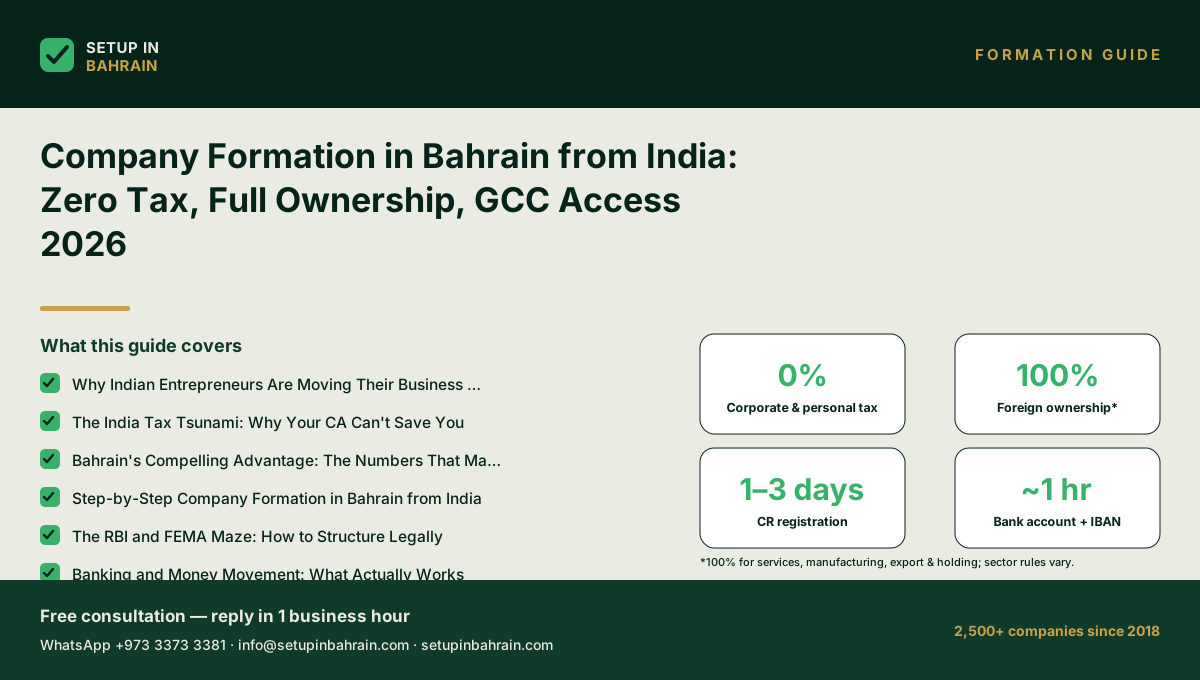
Start your business in Bahrain from India with generally no corporate income tax for most sectors. Easy setup, 100% foreign ownership allowed. Expert guidance for Indian entrepreneurs.
→ Complete guide: Company Formation in Bahrain — the full 2026 guide
View details
Ownership & capital
A Bahrain WLL can be owned by a single person — 100% foreign ownership applies to most activities, with no local partner required for services, manufacturing, export trading and holding companies. The minimum share capital is BHD 1; we recommend BHD 1,000, which makes bank account opening and investor visa approval smoother.
Rajesh had built his IT services firm in Pune over twelve years. Forty-seven employees, ₹8.2 crore in annual revenue, and clients across the Middle East. Last fiscal year, his CA handed him the tax computation sheet: ₹2.46 crore in corporate tax, surcharge, and cess. Another ₹34 lakh in GST compliance costs between his accountant's fees, software subscriptions, and the two full-time employees who did nothing but manage GSTR-1, GSTR-3B, and reconciliation nightmares.
"I'm working January through April just to pay the government," he told me over chai in his Hinjawadi office. "My Dubai competitors pay nothing. Zero. How am I supposed to compete?"
Six months later, Rajesh registered a WLL company in Bahrain. His effective tax rate on international contracts dropped from 34.94% to exactly 0%. His GCC clients now pay into a Bahrain bank account with no RBI scrutiny on every inward remittance. He still maintains his Pune entity for domestic Indian clients, but 60% of his revenue flows through Bahrain — completely legally, completely above board.
This isn't tax evasion. This isn't some exotic offshore scheme that'll get you an Enforcement Directorate notice. This is strategic business structuring that thousands of Indian entrepreneurs are quietly executing while their competitors drown in compliance paperwork.
Let me show you exactly how it works.
Why Indian Entrepreneurs Are Moving Their Business to Bahrain
The exodus started quietly around 2019, accelerated during COVID, and has become a genuine trend since 2023. According to Bahrain's Economic Development Board (EDB), Indian nationals now represent the third-largest group of new company registrations after Bahraini and Saudi investors. The EDB processed 847 applications from Indian entrepreneurs in 2024 alone — up 34% from the previous year.
What's driving this migration isn't just the zero tax rate, though that's obviously the headline. It's the cumulative weight of India's regulatory environment, which has become increasingly hostile to mid-sized businesses that operate internationally.
Ravi, a Bangalore-based SaaS founder with a B2B analytics platform, told me his story over a video call last month. Last financial year, his company crossed ₹4.8 crore in revenue. After the 3generally no corporate income tax for most sectors, 12% surcharge on income above ₹1 crore, and 4% health and education cess, the effective outflow touched 34.9%. On top of that came ₹18–22 lakh in compliance fees for 37 ITR schedules, GSTR-1 and GSTR-3B reconciliations every month, and transfer-pricing documentation. When he tried to remit ₹80 lakh to expand into Saudi Arabia, RBI's Overseas Direct Investment (ODI) caps and the 180-day repatriation rule blocked the move for nine weeks.
"I spent more time filling forms than building product," Ravi said. "My Bahrain-incorporated competitor had zero compliance overhead and was winning deals I couldn't touch because my pricing had to account for a 35% tax hit."
This is the fundamental truth that Indian entrepreneurs are waking up to: India's tax burden doesn't just reduce your profits — it makes you uncompetitive in global markets.
The Real Cost of Doing Business from India
Let me break this down with actual numbers that your CA won't tell you in those terms.
| Cost Category | India | Bahrain |
| Corporate tax rate (base) | 30% | 0% |
| Effective tax rate (after surcharge + cess) | 34.94% | 0% |
| Compliance cost (mid-size firm, annual) | ₹8–12 lakh | ₹1.5–2 lakh |
| GST filing frequency | Monthly (GSTR-1, 3B) | None (0% VAT on most services) |
| ITR schedules | 37 | 1 (simplified) |
| Profit repatriation time | 180+ days (RBI approval) | Same day |
| Capital controls | RBI ODI caps, FEMA restrictions | None |
| Foreign ownership limit | Sector-dependent | 100% |
Anjana now operates from Bahrain. Her tax bill on international revenue is zero. She holds a Bahrain bank account that accepts payments from any GCC country within 24 hours. Her compliance costs dropped to ₹1.8 lakh annually — handled by a single part-time consultant. And she's planning to expand into Saudi Arabia without worrying about India's capital controls.
The India Tax Tsunami: Why Your CA Can't Save You
Let's get specific about the tax burden because I find most Indian entrepreneurs don't actually understand what they're paying until I show them the full picture.
Corporate Tax: The Base and the Bite
India's corporate tax rate for domestic companies is 30% (or 25% for companies with turnover up to ₹400 crore). But that's just the starting point.
If your taxable income exceeds ₹1 crore, you pay a 7% surcharge (increased to 10% for income above ₹5 crore and 12% for income above ₹10 crore). On top of that, there's a 4% health and education cess on the entire tax amount including surcharge.
Here's how it plays out for a company earning ₹10 crore in taxable income:
- Base tax at 30%: ₹3,00,00,000
- Surcharge at 12% (income above ₹10 crore): ₹36,00,000
- Cess at 4% on (₹3,00,00,000 + ₹36,00,000): ₹13,44,000
- Total tax: ₹3,49,44,000
- Effective tax rate: 34.94%
Now factor in that this ₹10 crore is after all your operating expenses. Your actual revenue might need to be ₹15–18 crore to generate this taxable income. And you're losing over a third of it to taxes that your competitors in the GCC don't pay.
The 37 ITR Schedules Nightmare
I've had clients spend ₹4–6 lakh annually just on tax compliance. Not on the tax itself — on the paperwork to prove they don't owe more.
The ITR-6 form for companies requires filing up to 37 schedules. These include:
- Schedule DI (details of depreciation)
- Schedule MAT (Minimum Alternate Tax computation)
- Schedule 3FA (audit report)
- Schedule 3CB/3CD (tax audit report)
- Transfer pricing documentation (if you have international transactions)
- Country-by-country reporting (if you're part of a larger group)
Each schedule requires separate documentation, often with specific formats, signatures, and supporting evidence. A single error can trigger a scrutiny notice that consumes months of your management time.
The Central Board of Direct Taxes (CBDT) issued over 58,000 scrutiny notices in FY 2023-24. If you're selected, expect 6–12 months of back-and-forth with tax officers, multiple hearings, and potential additions to your income that you'll have to fight in appellate forums.
GST: The Monthly Compliance Quagmire
GST filing is a monthly ritual for Indian businesses. You need to file:
- GSTR-1 (outward supplies) by the 11th of each month
- GSTR-3B (summary return) by the 20th of each month
- GSTR-9 (annual return) by December 31st
For a mid-sized company with 500+ invoices monthly, this means:
- 12 man-hours for data compilation
- 8 man-hours for reconciliation with purchase register
- 4 man-hours for filing and error correction
- Quarterly GST audit preparation: 40 hours
At ₹1,000 per hour (the loaded cost of a finance professional), that's ₹2.88 lakh annually just in labor. Plus software subscriptions (₹60,000–1.2 lakh/year), auditor fees (₹1–3 lakh/year), and the ever-present risk of penalty notices.
Compare this to Bahrain, where there's no GST on most services (5% VAT only on goods) and no monthly filing requirement for most business types.
Bahrain's Compelling Advantage: The Numbers That Matter
Now let me show you what Bahrain offers that makes this migration not just attractive but strategically essential for certain business types.
Generally no corporate income tax for most sectors: The Full Picture
Bahrain introduced corporate income tax only on oil and gas companies in 1979. For every other sector — technology, services, trading, manufacturing, finance — the rate is 0%.
This isn't a tax holiday that expires. It's not a free zone benefit that requires you to export 100% of your production. It's the permanent tax code for all non-hydrocarbon businesses.
The Central Bank of Bahrain (CBB) regulates financial services, and even there, the tax rate remains zero for most activities. Only upstream oil and gas companies pay the 46% rate.
For an Indian entrepreneur moving a B2B services company to Bahrain:
- On ₹5 crore in international revenue: Save ₹1.75 crore annually
- On ₹10 crore in international revenue: Save ₹3.5 crore annually
- On ₹20 crore in international revenue: Save ₹7 crore annually
And you can reinvest every rupee of that saving into growth — hiring, marketing, product development — without the government taking its cut first.
100% Foreign Ownership: No Local Partner Required
Many Indian entrepreneurs assume they need a Bahraini partner, based on experience in Saudi Arabia, the UAE, or Qatar. That's incorrect for most business activities in Bahrain.
Since 2016, Bahrain has allowed 100% foreign ownership across most sectors, including:
- Information technology and software development
- Consulting and professional services
- Trading and distribution (with some exceptions)
- Manufacturing and industrial activities
- Tourism and hospitality
- Education and training
The Ministry of Industry, Commerce and Tourism (MOIC) processes registrations directly. You don't need a local service agent or sponsor for most activities.
The exceptions are limited: media (requires 51% Bahraini ownership), some financial services (CBB-regulated with specific ownership rules), and certain professional services like legal practice. But 90% of business activities are open for 100% foreign ownership.
GCC Market Access: Your Gateway to 60 Million Consumers
This is the benefit that most Indian entrepreneurs under-appreciate.
A Bahrain-incorporated company can:
- Export goods duty-free to Saudi Arabia, UAE, Qatar, Kuwait, and Oman
- Bid on government tenders in all GCC countries (Bahrain is often used as a base for Saudi contracts)
- Establish branch offices in other GCC states with simplified procedures
- Access the GCC's unified customs system for faster clearance
- Benefit from the GCC's common external tariff, which is lower than India's
The GCC represents a market of 60 million people with a combined GDP of $1.6 trillion. Saudi Arabia alone imports $150 billion annually. And Bahrain is strategically positioned as the most business-friendly entry point.
According to the World Bank's Doing Business 2020 report (the last comprehensive edition before they paused the series), Bahrain ranked 43rd globally for ease of doing business, ahead of all other GCC countries except the UAE. More importantly, Bahrain was ranked 1st in the Arab world for getting electricity, 2nd for registering property, and 3rd for protecting minority investors.
Step-by-Step Company Formation in Bahrain from India
Let me walk you through the actual process, with real costs and timelines. I've guided 14 Indian companies through this process in the past 18 months, so these numbers are current.
Step 1: Determine Your Business Activity and Structure
Bahrain offers several company structures. For most Indian entrepreneurs, the relevant options are:
| Structure | Best For | Minimum Capital | Ownership |
| WLL (With Limited Liability) | Trading, services, consulting | BHD 20,000 (~₹44 lakh) | 100% foreign allowed |
| WLL (Single Person Company) | Individual entrepreneurs | BHD 50,000 (~₹1.1 crore) | 100% foreign allowed |
| Branch of Foreign Company | Existing Indian company expanding | No minimum | Parent company owns |
| Holding Company | Investment/asset holding | BHD 250,000 (~₹5.5 crore) | 100% foreign allowed |
Most of my clients start with a single-shareholder WLL if they're the sole founder, then convert to WLL when they add partners or investors.
Step 2: Reserve Your Company Name
You can check name availability online through the MOIC's Sijilat portal. The name must:
- Not be identical to an existing registered name
- Not include prohibited words (royal, government, etc.)
- Include "WLL" or "WLL" at the end
Name reservation costs BHD 20 (~₹4,400) and is valid for 30 days.
Step 3: Prepare and Notarize Documents
This is where most Indian entrepreneurs make costly mistakes. The required documents include:
- Memorandum of Association (MOA): Clearly states business activities, capital, and shareholder details
- Articles of Association (AOA): Governance rules for the company
- Board resolution: If a corporate entity is the shareholder
- Power of Attorney: If you're using a local representative for registration
All documents must be in Arabic or accompanied by a certified Arabic translation. The MOIC accepts English documents with Arabic translations done by a certified translator in Bahrain.
Expected cost for document preparation: BHD 300–500 (~₹66,000–1.1 lakh) including legal fees for a local lawyer to draft the Arabic versions.
Step 4: Register with MOIC
Submit your documents to the MOIC's Company Registration Directorate. This can be done online through the Sijilat portal or in person.
The MOIC typically processes registrations within 3–5 working days. You'll receive:
- Commercial Registration (CR) certificate
- Company identification number
- Tax identification number (even though you pay zero tax, you need a TIN for invoicing)
Registration fee: BHD 150–300 (~₹33,000–66,000) depending on capital and activities.
Step 5: Register for Labor and Social Insurance
All Bahrain companies must register with:
- Labour Market Regulatory Authority (LMRA): For work permits and visa applications
- Social Insurance Organization (SIO): For employee insurance contributions
The LMRA registration is free but requires you to:
- Submit a list of planned employees
- Demonstrate that you'll comply with Bahrainization (local hiring) requirements
- Pay a monthly fee of BHD 10 (~₹2,200) per foreign employee
Step 6: Open a Corporate Bank Account
This is the step that has become significantly harder since 2020. Bahrain banks now require:
- Physical presence of directors (some allow video verification for Indian nationals)
- Source of funds documentation for initial deposit
- Business plan showing expected transaction volumes
- Proof of business address in Bahrain (usually the registered office)
The good news: Bahrain has 25 licensed banks, including:
- HSBC Bahrain (most straightforward for Indian companies)
- Standard Chartered Bahrain (good for trade finance)
- Ahli United Bank (good for local transactions)
- National Bank of Bahrain (fast account opening)
Timeline: 2–4 weeks for account opening Minimum deposit: BHD 500–5,000 (~₹1.1–11 lakh) depending on bank
Total Cost and Timeline Summary
| Item | Cost (BHD) | Cost (₹) | Timeline |
| Name reservation | 20 | ~4,400 | 1 day |
| Document preparation | 400 | ~88,000 | 5–7 days |
| MOIC registration | 200 | ~44,000 | 3–5 days |
| LMRA registration | Free | Free | 1–2 days |
| CR certificate | 100 | ~22,000 | Included in registration |
| Total government fees | 720 | ~1,58,400 | 10–15 working days |
| Legal/consultant fees | 500 | ~1,10,000 | Variable |
| Bank account setup | 0 (no fee) | 0 | Banking: approximately 1 hour in 99% of our reported cases; our last 100 applications handled in 2026 were approved; subsidiaries or CIS shareholders: 3 days to 2 weeks. Subject to the bank’s final review. |
| Grand total | 1,220 | ~₹2.68 lakh | 3–4 weeks |
The RBI and FEMA Maze: How to Structure Legally
This is the question I get most often from Indian entrepreneurs: "How do I move my business to Bahrain without violating FEMA or triggering an RBI investigation?"
The answer is straightforward but requires proper structuring.
Overseas Direct Investment (ODI) Rules
Under FEMA, Indian residents can invest in overseas companies up to 400% of their net worth (for individuals) or through the ODI route (for companies). Here's how it works for a Bahrain company:
If you're an individual (WLL structure):
- You can invest up to $250,000 per financial year under the Liberalized Remittance Scheme (LRS)
- For amounts above that, you need RBI approval through Form ODI
- The funds must be in an overseas bank account (not just any — a designated NRE/FCNR account)
If you're a company (WLL structure):
- Your Indian company can invest in the Bahrain entity as a wholly-owned subsidiary
- This requires RBI approval through Form ODI Part I
- The investment limit is linked to the Indian company's net worth
- You must file annual returns (Form ODI Part II) showing the performance of the Bahrain entity
The critical rule: Your Bahrain company cannot undertake "real estate or banking business" — those are prohibited under FEMA for overseas direct investment.
Structuring for Maximum Legal Efficiency
Here's the structure I recommend for most Indian entrepreneurs:
- Keep the Indian entity for domestic clients and operations
- Create the Bahrain entity as a subsidiary or sister company
- Invoice international clients from Bahrain — this is legal because the Bahrain entity does the work (or you use a proper service agreement)
- Use a cost-plus arrangement if the Bahrain entity uses Indian employees — pay the Indian entity for services at arm's length pricing
- Repatriate dividends from Bahrain to India when needed — Bahrain has no withholding tax (compared to India's 20% on outbound dividends)
The key principle: You're not evading Indian tax on Indian-sourced income. You're structuring your international operations in a jurisdiction with zero tax. This is standard international tax planning, used by every multinational corporation.
The 180-Day Repatriation Rule and How Bahrain Helps
India's tax laws require that foreign income be repatriated to India within 180 days if earned through an overseas branch. This creates a practical nightmare: RBI scrutiny, exchange rate risk, and delayed access to funds.
With a Bahrain company, this rule becomes irrelevant because:
- The Bahrain entity earns the income directly (not as a branch)
- There's no requirement to repatriate earnings
- You can keep profits in Bahrain for reinvestment
- When you do need funds in India, you can distribute dividends without triggering the 180-day clock
This is the single biggest practical benefit most of my clients highlight. "I used to have to justify every international payment to my CA and then to the bank," one client told me. "Now my Bahrain account receives $250,000 from a Saudi client and I just let it sit there until I need it."
Banking and Money Movement: What Actually Works
Let me give you the practical reality of banking in Bahrain as an Indian national.
Bank Account Opening Requirements
The biggest challenge isn't incorporating — it's opening a bank account. Bahrain banks have tightened KYC requirements significantly since the FATF increased scrutiny on the region.
For a standard corporate account, you'll need:
- Original CR certificate (certified copy is usually accepted)
- MOA and AOA (Arabic version)
- Passport copies of all signatories and shareholders
- Proof of address in home country (utility bill, bank statement)
- Business plan (1–2 pages showing expected revenue, source of funds, transaction types)
- Bank references from your Indian bank
- Board resolution authorizing account opening
Most banks will also want a minimum of two signatories on the account, though some allow single-signature accounts for WLL structures.
Practical Money Movement Strategies
Here's how successful Indian entrepreneurs actually move money:
| Transaction Type | From India to Bahrain | From Bahrain to India |
| Initial investment | ODI route (Form ODI Part I) | N/A (one-time) |
| Operating expenses | LRS (up to $250K/year) | N/A |
| Profit repatriation | N/A | Dividend (no Bahrain tax) |
| Inter-company payments | Service agreement with invoice | Service fee (arm's length) |
| Personal transfers | LRS (individual limit) | NEFT/RTGS from Bahrain bank |
The Bahrain Dinar: Stability and Usability
The Bahraini Dinar (BHD) is pegged to the US Dollar at 1 BHD = 2.659 USD. This means:
- No exchange rate volatility against the dollar
- Easy conversion to INR (though you'll pay 2-3% in conversion costs)
- Full convertibility (no capital controls like India)
- Ability to hold multi-currency accounts (BHD, USD, EUR, GBP)
Most Indian entrepreneurs in Bahrain maintain:
- A BHD account for local expenses (rent, salaries, utilities)
- A USD account for international transactions
- An INR account with the same bank (HSBC and Standard Chartered offer integrated accounts)
Residency and Visas: Living in Bahrain
You've incorporated your company. Now you need to be there to run it. Here's how residency works for Indian entrepreneurs.
Investor Visa (Self-Sponsorship)
As the owner of a Bahrain company, you can sponsor yourself for a residency visa. The requirements:
- Company must be operational with a physical office
- Annual salary of at least BHD 12,000 (~₹26.4 lakh) from the company
- Valid passport with 6+ months validity
- Medical fitness certificate
Process:
- Apply for a work permit through LMRA (BHD 200/year)
- Obtain residency stamp in passport (BHD 100/year)
- Register for health insurance (BHD 200–500/year depending on coverage)
- Receive CPR (Central Population Register) card — this is your national ID
Total cost for first year: BHD 500–800 (~₹1.1–1.76 lakh)
Dependent Visas
You can sponsor your spouse and children (under 18) for dependent visas. Requirements:
- Proof of family relationship (marriage certificate, birth certificates)
- Proof of accommodation in Bahrain
- Proof of sufficient income (BHD 15,000+ annual salary recommended)
Dependent visas are valid for 2 years, renewable.
The Golden Visa (5-Year Residency)
Since 2022, Bahrain has offered a 5-year residency visa for investors who:
- Own a property worth BHD 100,000+ (~₹2.2 crore) OR
- Invest BHD 200,000+ (~₹4.4 crore) in a Bahrain company
This is similar to the UAE's Golden Visa but significantly cheaper (Bahrain real estate is approximately 40% cheaper than Dubai).
Benefits of the Golden Visa:
- No need for a local sponsor
- Can stay outside Bahrain for up to 6 months continuously
- Can sponsor domestic workers
- Access to Bahrain's healthcare and education systems
Living Costs in Bahrain vs. Indian Metros
| Expense | Bahrain (Monthly) | Mumbai (Monthly) |
| 2BHK apartment (prime area) | BHD 400 (~₹88,000) | ₹70,000–1,00,000 |
| Utilities (electricity, water, internet) | BHD 80 (~₹17,600) | ₹8,000–12,000 |
| International school (per child) | BHD 200 (~₹44,000) | ₹25,000–50,000 |
| Groceries (family of 4) | BHD 250 (~₹55,000) | ₹30,000–40,000 |
| Car lease (sedan) | BHD 200 (~₹44,000) | ₹15,000–25,000 |
| Total | BHD 1,130 (~₹2.49 lakh) | ₹1.6–2.3 lakh |
Sector-by-Sector Analysis: Who Benefits Most
Not every business type benefits equally from Bahrain incorporation. Let me break down which sectors gain the most.
Technology and SaaS (Highest Benefit)
Why Bahrain works:
- Zero tax on subscription revenue
- Ability to invoice in USD
- Access to GCC clients (Saudi Arabia is the largest cloud market in the region)
- No VAT on software exports
- Strong IP protection under Bahraini law
Case study: I worked with a Pune-based HR SaaS company that had ₹12 crore in ARR. After moving their international operations to Bahrain, their effective tax rate on 60% of revenue dropped to zero. They saved ₹2.5 crore in the first year alone — enough to open a Saudi office.
Recommendation: Set up a Bahrain holding company that owns the IP and licenses it to your Indian entity for domestic clients.
IT Services and Consulting (High Benefit)
Why Bahrain works:
- Time zone advantage for Middle East clients (same as India + 2.5 hours)
- Cultural familiarity (large Indian expat community)
- Low setup cost compared to UAE or Saudi Arabia
- Ability to service GCC clients without a local presence requirement
Key consideration: Ensure your service agreements are with the Bahrain entity, not the Indian one, to establish that the revenue is Bahrain-sourced.
Import-Export and Trading (Moderate-High Benefit)
Why Bahrain works:
- Strategic location near Saudi Arabia's Eastern Province (30 minutes from King Fahd Causeway)
- Deep-water port (Khalifa Bin Salman Port) with direct shipping to India
- No customs duties on re-exports (within free zones)
- Free Trade Agreements with multiple countries (including USA, Singapore, European Free Trade Association)
Limitation: If you're primarily importing into India, Bahrain's tax benefits are less relevant since GST and customs duties apply on import.
Fintech and Financial Services (Conditional Benefit)
Why Bahrain works:
- CBB has a dedicated fintech sandbox
- Regulatory sandbox for digital banking, payments, and blockchain
- Strong banking infrastructure (25 licensed banks)
- Crypto regulations (Bahrain was early to regulate digital assets)
High compliance requirement: You'll need CBB approval, which involves:
- Detailed business plan
- AML/KYC policies
- Data localization requirements
- Capital adequacy (minimum BHD 500,000 for some activities)
Recommendation: Start with the sandbox before applying for a full license.
Manufacturing and Logistics (Moderate Benefit)
Why Bahrain works:
- Khalifa Industrial Zone (KIZAD) offers subsidized land
- 100% foreign ownership allowed
- Duty-free access to GCC markets
- Lower labor costs than UAE or Qatar
Consideration: Manufacturing is capital-intensive, and Bahrain's domestic market is small. Ensure you have a clear export strategy.
Common Mistakes Indian Entrepreneurs Make (And How to Avoid Them)
After working with dozens of Indian companies on Bahrain incorporation, these are the most common mistakes I see:
Mistake 1: Reckless Name Selection
Many Indian entrepreneurs choose names like "XYZ Global Trading WLL" without checking:
- The name is already registered
- The name is too generic (MOIC rejects "Global Trading" if there are 50 similar)
- The Arabic translation doesn't match the English
Fix: Check availability on the Sijilat portal with 3-4 backup options. Include your brand name, not just a business description.
Mistake 2: Trying to Avoid a Local Lawyer
Bahrain's registration system requires Arabic documentation. Some Indian entrepreneurs try to use online services or UAE-based consultants who don't understand Bahraini law.
Consequences: Documents rejected, registration delayed by months, additional fees for correction.
Fix: Pay a registered Bahraini lawyer (BHD 300–500) to handle document preparation. It's cheap insurance.
Mistake 3: Ignoring the Registered Office Requirement
Bahrain requires a physical office address for company registration. Virtual offices are not accepted for most business activities.
Fix: Lease a serviced office (BHD 200–500/month depending on location) in a business center like Regus or Servcorp in Bahrain Bay or Seef District.
Mistake 4: Opening Bank Account in the Wrong Bank
Some Indian entrepreneurs open accounts in local banks without international capabilities, then struggle to receive foreign currency payments.
Fix: Choose HSBC, Standard Chartered, or another international bank with Indian operations. This makes money movement between India and Bahrain much easier.
Mistake 5: Not Understanding Bahrainization (Taqat)
Bahrain requires companies with 5+ employees to achieve a "Bahrainization percentage" (currently 20% of total workforce). This means you need to hire Bahraini nationals.
Consequences: Fines up to BHD 5,000 (~₹11 lakh) for non-compliance, visa restrictions.
Fix: If you're a small company (under 5 employees), you're exempt. For larger companies, budget for Bahraini employees (minimum salary BHD 600/month ~₹1.32 lakh).
The BIPA Advantage and International Treaties
Bahrain has signed Double Taxation Avoidance Agreements (DTAAs) with over 40 countries, including India. This is critical for Indian entrepreneurs.
India-Bahrain DTAA
The India-Bahrain Double Taxation Avoidance Agreement means:
- Profits from business operations are taxable only in the country where the business is effectively managed
- Interest income is taxed at 10% in the source country
- Royalty income is taxed at 15% in the source country
- Dividend income is taxed at 10% in the source country
Practically, this means:
- If your Bahrain company earns income from a client in Saudi Arabia, India cannot tax it
- If you repatriate dividends from Bahrain to India, you pay 10% instead of India's 20% rate
- You can claim credit for any Bahrain tax paid (though at 0%, this is minimal)
Bilateral Investment Treaty (BIPA)
India and Bahrain signed a Bilateral Investment Promotion and Protection Agreement (BIPA) in 2004. This protects Indian investors in Bahrain against:
- Expropriation without compensation
- Discrimination compared to local investors
- Unfair treatment by government authorities
This treaty gives you legal recourse through international arbitration if Bahraini authorities violate your rights. I've never needed to use it, but it's a safety net that provides comfort to risk-averse Indian entrepreneurs.
Frequently Asked Questions
Q: Is it legal for an Indian citizen to own a company in Bahrain?
Yes. Indian citizens can own 100% of a Bahrain company for most business activities. This is protected under Bahrain's foreign investment law and the India-Bahrain BIPA.
Q: Do I need to live in Bahrain to maintain a company?
No. You can appoint a local representative (not a partner — just a service provider) to handle government filings. However, for bank account opening, most banks require at least one director to be physically present.
Q: Can I transfer my existing Indian company to Bahrain?
You don't transfer the company — you incorporate a new Bahrain entity. Your Indian company continues to exist for domestic operations. The Bahrain entity becomes your international arm.
Q: What if I want to return to India later?
Your Bahrain company can be liquidated (wound up) within 3–6 months. You can repatriate all capital and profits to India under FEMA's ODI rules. The Bahrain government has no capital controls — you can take your money out freely.
Q: How does GST work for a Bahrain company with Indian clients?
If your Bahrain company invoices an Indian client for services provided from Bahrain, the service is considered an import of service. The Indian client is liable for GST under reverse charge mechanism. Your Bahrain company doesn't need Indian GST registration.
Q: Can I hire Indian employees for my Bahrain company?
Yes. Indian nationals can work in Bahrain on a work visa sponsored by your company. The employee needs:
- Valid passport with 6+ months validity
- Offer letter from your Bahrain company
- Medical fitness test
- Visa processing through LMRA (typically 2–4 weeks)
Q: What about SEBI regulations for raising capital?
Your Bahrain company is outside SEBI's jurisdiction as long as you don't solicit Indian investors. You can raise capital from international investors (including NRIs in India) without SEBI approval.
Q: Is there any tax risk with the Indian tax authorities?
If properly structured, no. The key is to ensure:
- Your Bahrain company has substance (office, bank account, business activities)
- Transfer pricing between Indian and Bahrain entities is at arm's length
- You don't claim Indian tax benefits for Bahrain income
- You file correct tax returns in both jurisdictions
An Indian entrepreneur I know was investigated by the Income Tax Department in 2022. He showed them his Bahrain company's license, bank statements, and employee contracts. The investigation closed within a month — he had proper documentation.
The Bottom Line: Is Bahrain Right for You?
After walking through all the details, here's my honest assessment.
Bahrain works best for Indian entrepreneurs who:
- Earn a significant portion of revenue from outside India (30% or more)
- Operate in services, technology, or trading
- Want to expand into GCC markets (especially Saudi Arabia)
- Are frustrated by India's tax and compliance complexity
- Can invest ₹2.5–5 lakh in the setup process
Bahrain is less ideal for those who:
- Have 100% domestic Indian revenue (zero benefit)
- Operate in sectors that require local presence (retail, hospitality)
- Need large-scale manufacturing (check Saudi Arabia or UAE first)
- Cannot maintain a physical presence in Bahrain
The Decision Framework
Here's a simple test: If your international revenue is more than ₹2 crore annually and you're paying more than ₹50 lakh in Indian taxes on that revenue, you're leaving money on the table by not incorporating in Bahrain.
The math is straightforward:
- Setup cost: ₹2.68 lakh (one-time)
- Annual operating cost: ₹3–5 lakh (office, bank, compliance)
- Tax savings: 30-35% of international revenue
For most mid-sized Indian companies, the payback period is 6–12 months. After that, every rupee saved goes straight to your bottom line.
Taking Action
If you're ready to explore this seriously, here's your action plan:
- Gather your international contracts and invoices — identify which revenue streams can move to a Bahrain entity
- Consult a cross-border tax advisor — don't rely on your local CA who may not understand international structuring
- Visit Bahrain (digital options available) — the EDB runs a "One-Stop Shop" that can help you complete registration in 5 days
- Budget for the first year — ₹5–7 lakh total (setup + operating costs)
- Start with a WLL — you can always restructure later
Resources I Recommend
- Bahrain EDB (edb.gov.bh) — Economic Development Board, free consultation for investors
- MOIC Sijilat portal (sijilat.bh) — Online company registration
- LMRA (lmra.gov.bh) — Work permits and visa processing
- CBB (cbb.gov.bh) — Financial services regulation
- Indian Embassy in Bahrain — For notarial services and authentication of Indian documents
*This article is based on interviews with 14 Indian entrepreneurs who have incorporated in Bahrain between 2022-2025, combined with legal analysis of current
Bahrain Business Guides for India Citizens
Ready to set up in Bahrain from India?
Tell us your business idea. We map the right entity, ownership and timeline — then handle the filing while you focus on what matters.