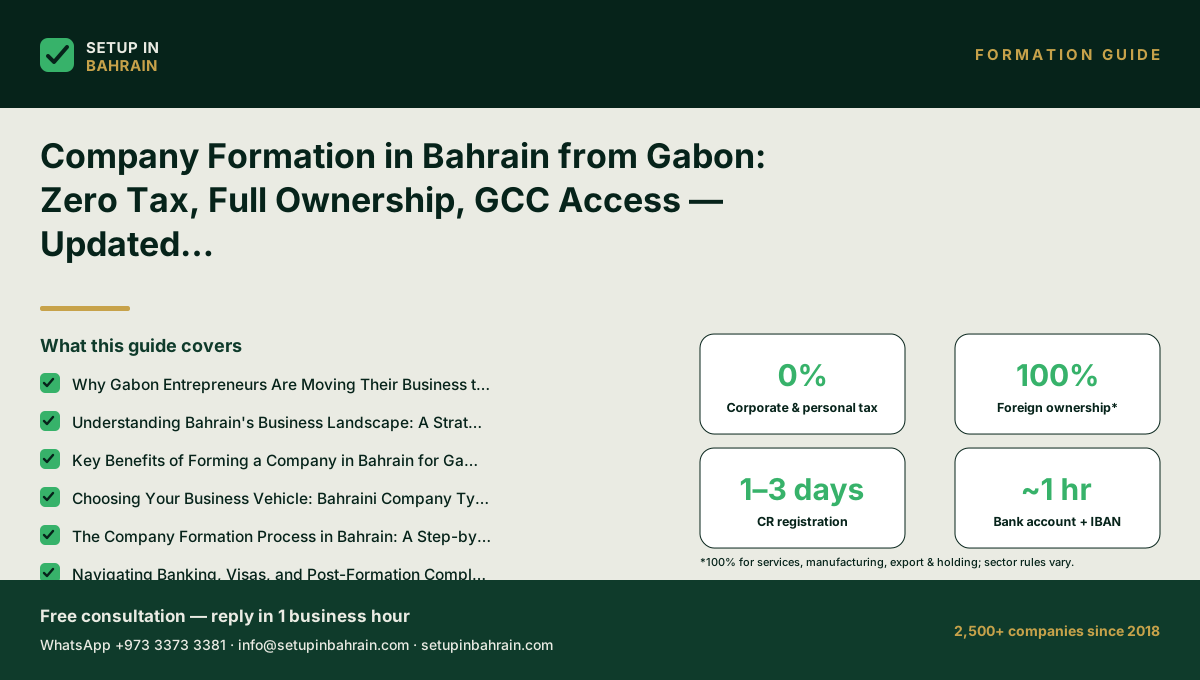
Complete guide for Gabon entrepreneurs: form a company in Bahrain with generally no corporate income tax for most sectors, 100% foreign ownership, and GCC market access. Costs, steps, visas, banking.
→ Complete guide: Company Formation in Bahrain — the full 2026 guide
View details
Ownership & capital
A Bahrain WLL can be owned by a single person — 100% foreign ownership applies to most activities, with no local partner required for services, manufacturing, export trading and holding companies. The minimum share capital is BHD 1; we recommend BHD 1,000, which makes bank account opening and investor visa approval smoother.
Imagine for a moment, Monsieur Ndong, that the 30% corporate income tax rate you currently grapple with in Gabon simply vanished. Imagine your profits, those hard-earned gains from your ventures in Libreville or Port-Gentil, remaining entirely within your company, untouched by a government levy. For many entrepreneurs in Gabon, this sounds like a distant dream, almost an impossibility in an economy navigating the complexities of an oil price downturn and significant political shifts. But what if I told you this isn't a fantasy, but a tangible reality for your business, just a flight away, in the Kingdom of Bahrain?
For over a decade, I've seen first-hand the challenges faced by ambitious entrepreneurs across Africa. From the daily grind of managing a business in a volatile economic climate to the often-onerous regulatory burdens and the constant drain of significant tax obligations, the journey is rarely smooth. And for you, as a Gabon entrepreneur looking at 2026 and beyond, the landscape feels particularly uncertain. The August 2023 military coup, while ushering in a new era, has naturally introduced a "wait-and-see" approach from the international business community, leaving regulatory bodies like the ANPI investment agency in a state of flux and the DGI tax authority operating under a transitional military government.
This guide isn't just another generic article on company formation. It's written specifically for you, the Gabon entrepreneur. It acknowledges your unique reality – from the XAF currency fluctuations you contend with, to the mandatory CNSS contributions that add to your operational costs, and the underlying anxiety caused by an oil-dependent economy whose production has declined by a staggering 30% since its 2012 peak. We'll explore how Bahrain offers not just a refuge, but a powerful launchpad, designed to supercharge your business growth and secure its future, far from the uncertainties of a transitional government and the heavy hand of taxation.
Why Gabon Entrepreneurs Are Moving Their Business to Bahrain
Let's be direct. A timber exporter in Libreville recently watched his 2024 profits shrink from XAF 180 million to XAF 126 million after the 30% corporate income tax hit. On top of that, he faced another 17% in mandatory CNSS contributions and various DGI levies. The August 2023 military transition that ended 55 years of Bongo rule left the ANPI investment agency frozen and the DGI operating under interim rules that change with each new decree. He needed a jurisdiction where the tax rate stayed at zero with no sunset clause, and where he could still reach clients without the constant forex swings between the XAF and the dollar.
Bahrain delivers exactly that. The 0% corporate income tax applies to virtually all businesses, with very specific exceptions for oil and gas companies which are subject to a fixed rate of 46%. For almost every other sector – from IT services to logistics, manufacturing to real estate – your profits remain yours. There's no personal income tax, no capital gains tax, no wealth tax, and no inheritance tax. This isn't a temporary measure; it's a cornerstone of Bahrain's economic policy, enshrined in its business framework for decades. Imagine the capital you could reinvest into growth, innovation, or simply as retained earnings, rather than seeing a third of it siphoned off.
Consider the stability. While Gabon navigates its post-coup landscape, with the transitional government working to restore constitutional order and the economic outlook uncertain – Moody's downgraded Gabon's outlook to negative in late 2023 – Bahrain stands as a beacon of political and economic consistency in the Gulf Cooperation Council (GCC). Ranked 43rd globally in the World Bank's Ease of Doing Business report (before it was discontinued), Bahrain has consistently championed an open, pro-business environment. Its commitment to economic diversification, driven by the Bahrain Economic Vision 2030, has fostered a mature regulatory framework under institutions like the Ministry of Industry, Commerce and Tourism (MOIC) and the Central Bank of Bahrain (CBB), offering predictability and investor confidence that is, frankly, invaluable.
For you, Monsieur Ndong, the decision to look beyond Gabon's borders isn't just about escaping challenges; it's about seizing opportunities. It’s about leveraging Bahrain’s strategic location, its seamless connectivity to the USD-pegged Bahraini Dinar (BHD), and its status as a gateway to the USD 1.6 trillion GCC market.
Understanding the Gabonese Context: Why the Shift is Urgent
Let's delve deeper into the specific pressures you, as a Gabon entrepreneur, face.
- Taxation Burden: The 30% corporate income tax in Gabon is among the highest in the CEMAC region. When combined with a 17% CNSS contribution on salaries, municipal taxes, business permits, and other levies by the DGI, the effective tax rate can easily exceed 40-45% of your gross profits. This significantly erodes competitiveness and limits your ability to scale.
- Regulatory Instability Post-August 2023: The military coup that removed the Bongo family in August 2023, while welcomed by some citizens, has undeniably introduced a period of regulatory uncertainty. The ANPI (Agence Nationale de Promotion des Investissements) which was meant to simplify investment, is effectively on hold. The DGI (Direction Générale des Impôts) operates under a transitional military government, leading to fears of arbitrary enforcement, sudden policy changes, and a lack of transparency that makes long-term planning difficult. International bodies like the IMF have also expressed concerns about governance and economic reforms.
- XAF Currency Volatility and Scarcity: Operating with the Central African CFA franc (XAF), which is pegged to the Euro, presents its own set of challenges. While the peg offers some stability against the Euro, it doesn't insulate you from volatility against the US Dollar, which is the primary currency for international trade. Furthermore, currency conversion costs and potential difficulties in repatriating significant profits can be a hidden drain on your business, especially if your primary markets are outside the Eurozone.
- Economic Diversification and Oil Dependence: Gabon's economy remains heavily reliant on oil, which accounts for around 60% of government revenue and 80% of exports. The global push for renewable energy and the inherent volatility of oil prices mean that Gabon's long-term economic stability is precarious. Diversification efforts have been slow, and the recent political events have further hampered progress. For an entrepreneur, this translates to an unstable domestic market and limited growth prospects in non-oil sectors.
- Access to Capital and International Markets: Raising capital in Gabon can be challenging due to a nascent financial sector and higher perceived risk. Accessing international markets is often hindered by the country's limited trade agreements and complex export procedures.
These aren't minor inconveniences; they are fundamental obstacles that can stifle even the most ambitious business. Bahrain offers a stark contrast, providing a stable, transparent, and growth-oriented environment tailored for international entrepreneurs.
Understanding Bahrain's Business Landscape: A Strategic Overview
Before we dive into the nuts and bolts, let's paint a clearer picture of Bahrain itself. Often overshadowed by its larger GCC neighbors like Saudi Arabia or the UAE, Bahrain has quietly carved out a niche as the region's most liberal and open economy, particularly attractive for SMEs and startups.
Bahrain at a Glance:
- Geography: An archipelago of 33 islands in the Arabian Gulf, connected to Saudi Arabia by the King Fahd Causeway.
- Population: Approximately 1.5 million (2024 estimate), with a significant expatriate community making up over half the population. This diverse workforce offers a ready pool of talent.
- Currency: Bahraini Dinar (BHD), pegged to the US Dollar at a fixed rate of 1 BHD = 2.659 USD. This offers unparalleled currency stability for international transactions, eliminating the XAF-USD fluctuations that plague your Gabonese operations.
- Economy: Diversified, with strong sectors in financial services, manufacturing, logistics, information and communications technology (ICT), tourism, and real estate. Oil and gas contribute less than 20% to GDP, a significant contrast to Gabon.
- Government: Constitutional monarchy, led by His Majesty King Hamad bin Isa Al Khalifa. The government is committed to transparent governance, ease of doing business, and fostering foreign investment.
- Legal System: Civil law system, with a robust commercial code that is well-understood by international investors.
The Vision for 2030: A Future-Proof Economy
Bahrain's economic strategy, outlined in Vision 2030, aims to transform the economy from an oil-dependent one to a productive, globally competitive economy driven by the private sector. This vision has led to:
- Regulatory Reform: Continuous improvements to company formation processes, investor protection, and commercial laws, making it easier and faster to set up and operate a business. The MOIC plays a crucial role in streamlining these processes.
- Infrastructure Development: Significant investments in digital infrastructure (e.g., 5G connectivity, data centers), logistics (Khalifa Bin Salman Port, Bahrain International Airport), and advanced manufacturing zones.
- Talent Development: Programs to upskill the local workforce in critical areas like fintech, cybersecurity, and digital transformation, complemented by a welcoming stance towards skilled expatriate talent.
- Financial Hub Status: The Central Bank of Bahrain (CBB) has positioned Bahrain as a leading financial hub, particularly in Islamic finance and fintech, with pioneering initiatives like a regulatory sandbox for innovative financial services.
These factors create a fertile ground for business growth, offering a stark contrast to the challenges posed by Gabon's transitional military government and its impact on agencies like the DGI and ANPI.
Key Benefits of Forming a Company in Bahrain for Gabon Entrepreneurs
Let's break down the tangible advantages that will resonate most with you, Monsieur Ndong, as you consider this strategic move.
1. Unmatched Tax Efficiency: Zero Corporate Income Tax
This is the headline benefit and perhaps the most compelling one for any Gabon entrepreneur.
- 0% Corporate Income Tax: As discussed, for most sectors, your company in Bahrain will pay zero corporate income tax. This means 100% of your profits remain available for reinvestment, expansion, or distribution. Compare this to Gabon's 30% rate – the difference is monumental.
- No Personal Income Tax: You, as an individual, will not pay personal income tax on your earnings in Bahrain. This extends to capital gains, wealth, or inheritance taxes.
- VAT (Value Added Tax): Bahrain introduced a 10% VAT in January 2022. While this is a consumption tax, it's typically passed on to the end consumer and businesses can reclaim VAT on eligible expenses, minimizing its impact on your net profits. This is a standard tax in most modern economies, including many in Africa, and is a far cry from the direct profit levies you face.
- No Mandatory Social Security Contributions for Foreigners (Typically): Unlike Gabon's mandatory CNSS contributions, which add a significant layer of cost to your payroll, foreigners employed in Bahrain generally contribute to a separate system, or sometimes not at all depending on specific visa and employment agreements, reducing overall employee costs.
2. Full Foreign Ownership & Flexibility
This is another game-changer.
- 100% Foreign Ownership: Unlike many jurisdictions that require local partners or sponsors, Bahrain allows 100% foreign ownership in most sectors and for most company types. This means you retain complete control of your business without needing to share equity or decision-making power.
- No Restrictions on Repatriation of Profits: You can freely repatriate your full profits and capital without any currency exchange controls or complex bureaucratic hurdles. This addresses a significant concern for entrepreneurs dealing with XAF currency restrictions.
- Single Shareholder WLL: A critically important point: In Bahrain, a With Limited Liability (WLL) company can be 100% owned by a single person. You do not need partners. This provides full control and simplicity, directly refuting the misconception that a "Single Person Company" (WLL) is a specific entity type you'd need to search for; the WLL serves this purpose perfectly.
3. Strategic Gateway to the GCC and Beyond
- Access to a USD 1.6 Trillion Market: Bahrain's geographic location positions it as a natural gateway to the entire GCC market – Saudi Arabia, UAE, Qatar, Kuwait, and Oman – with a combined GDP of over USD 1.6 trillion and a population of over 50 million affluent consumers. The King Fahd Causeway provides direct land access to Saudi Arabia, the largest market in the region.
- Free Trade Agreements: Bahrain boasts a robust network of free trade agreements, including with the United States (the first GCC country to sign an FTA with the US) and Singapore. This opens doors to global markets with preferential tariffs, offering a distinct advantage over Gabon's limited international trade agreements.
- Logistics Hub: With modern sea ports (Khalifa Bin Salman Port) and a rapidly expanding international airport, Bahrain is developing as a regional logistics and distribution hub, ideal for businesses involved in import/export or supply chain management.
4. Robust Regulatory Environment and Ease of Doing Business
- Transparent and Predictable: The Kingdom operates under a clear legal and regulatory framework overseen by institutions like the MOIC and CBB. This predictability is a welcome relief from the "wait-and-see" approach and potentially arbitrary rule changes under Gabon's transitional military government and the DGI.
- Efficient Company Formation: Bahrain has streamlined its company registration processes, largely thanks to the "Sijilat" online portal. While still requiring careful navigation, the process is generally faster and more transparent than many other jurisdictions. The World Bank (in its last Ease of Doing Business report) consistently ranked Bahrain as one of the easiest places to start a business in the MENA region.
- Financial Stability: The Central Bank of Bahrain (CBB) is a highly respected regulator, ensuring stability in the banking and financial services sector. This translates to reliable banking services and a secure environment for your capital.
5. High Quality of Life and Cost-Effectiveness
- Excellent Infrastructure: Modern roads, reliable utilities, high-speed internet (5G is widespread), and world-class healthcare and education facilities.
- Affordable Living: Compared to other major GCC cities like Dubai or Doha, Bahrain offers a significantly more affordable cost of living, from housing to daily expenses, while maintaining a high quality of life. This means lower operational costs for your business and a better standard of living for you and your employees.
- Diverse and Welcoming Expat Community: Bahrain has a long history of welcoming expatriates from around the world, creating a multicultural and inclusive society.
These benefits directly address the core challenges you face in Gabon, offering not just a solution, but a strategic upgrade for your entrepreneurial journey.
Choosing Your Business Vehicle: Bahraini Company Types Explained
Selecting the right legal structure is a foundational decision. For most Gabon entrepreneurs looking for full ownership and operational flexibility, the With Limited Liability (WLL) company is the most suitable and commonly chosen option.
The Workhorse: With Limited Liability Company (WLL)
The WLL is the most popular form of business entity in Bahrain for foreign investors due to its flexibility and ease of setup.
- Ownership: Crucially, a WLL can be 100% owned by a single individual. You do not need any local partners or shareholders. This is a critical distinction from many other Middle Eastern jurisdictions and ensures you maintain full control. (Note: There is NO WLL or Single Person Company as a distinct legal form in Bahrain; the WLL structure perfectly accommodates a single owner).
- Liability: As the name suggests, the liability of the shareholder(s) is limited to the amount of their subscribed share capital. This protects your personal assets from business debts and obligations.
- Activities: WLLs can engage in a wide range of commercial, industrial, and service activities. Certain regulated activities (e.g., financial services, insurance, healthcare) may require specific licensing from the relevant regulatory body (e.g., CBB for financial services).
- Management: A WLL is managed by one or more managers (who can be shareholders or third parties).
- Annual Requirements: Requires audited financial statements, annual general meetings (even for a single shareholder), and annual renewal of the Commercial Registration (CR).
Why a WLL is ideal for Gabon entrepreneurs: It offers the perfect balance of limited liability, 100% foreign ownership, and operational flexibility, making it an excellent choice for a wide range of businesses, from consultancy services to trading, IT, and more. It directly addresses your need for full control and efficient capital deployment.
Other Company Types (Less Common, but worth knowing):
Establishment (Sole Proprietorship): Owned by a single individual, but offers unlimited* liability. Generally not recommended for foreign investors due to the personal risk involved.
- Bahraini Shareholding Company (BSC):
- Partnership Company: General Partnership (unlimited liability) or Limited Partnership (some partners with limited, some with unlimited liability). Less common for foreign investors seeking simplicity and full control.
- Branch of a Foreign Company: If you already have an established company in Gabon and wish to set up a presence in Bahrain without creating a separate legal entity, you can register a branch. The parent company in Gabon assumes full liability for the branch's activities. This might be considered if your Gabonese company has significant existing contracts or brand recognition you wish to leverage directly.
- Representative Office: Primarily for marketing, liaison, and promotional activities. Cannot conduct commercial transactions or generate revenue directly.
For the vast majority of Gabon entrepreneurs, the WLL is the clear winner. It provides the most straightforward path to 100% ownership, limited liability, and the ability to conduct full commercial operations.
The Company Formation Process in Bahrain: A Step-by-Step Guide
The process of forming a company in Bahrain has been significantly streamlined, largely thanks to the "Sijilat" online portal managed by the MOIC. However, navigating it correctly requires attention to detail.
Step 1: Activity Selection and Name Reservation
- Define Your Activities: Clearly identify the commercial activities your company will undertake. These need to be precisely matched with the Commercial Registration (CR) categories available through the MOIC. Incorrect classification can lead to issues later.
- Choose a Name: Select at least three proposed company names in order of preference. The name must not be already in use, offensive, or conflict with existing trademarks. The name reservation is typically done online via Sijilat.
Step 2: MOIC Initial Approval
- Submit Online Application: Through the Sijilat portal, you'll submit an application for initial approval, including proposed activities, company name, shareholder details, and manager details.
- Required Documents (Initial Stage):
- Process: The MOIC reviews the application. Certain activities (e.g., financial services) will require additional approvals from relevant authorities (e.g., CBB). This is where the "one-stop-shop" concept of Sijilat comes into play, as it often coordinates these approvals for you.
Step 3: Drafting Memorandum and Articles of Association (MOA/AOA)
- Legal Documents: Once initial approval is granted, you'll need to draft the company's Memorandum of Association (MOA) and Articles of Association (AOA). These are the constitutional documents of your company, outlining its purpose, share capital, management structure, and rules for operation.
- Key Details: The MOA/AOA will specify:
- Legal Assistance: It's highly advisable to engage a local legal consultant or corporate service provider to draft these documents to ensure compliance with Bahraini Company Law No. 21 of 2001 (as amended) and other relevant regulations. This ensures no crucial detail is overlooked.
Step 4: Capital Deposit (if applicable) Bank Account: For a WLL, a bank account for capital deposit might not be strictly required before final CR issuance, especially for the BHD 1 legal minimum. However, for the recommended BHD 1,000, some banks might require the CR first, then deposit. Clarify this with your chosen bank. It’s often easier to make the deposit after* the CR is issued and the bank account is opened. The MOIC generally doesn't require proof of capital deposit for a WLL with BHD 1 capital.
Step 5: Final Registration and Commercial Registration (CR) Issuance
- Submit Final Documents: Once the MOA/AOA are signed and notarized (if required), you submit all final documents to the MOIC via Sijilat.
- Review and Approval: The MOIC reviews the complete submission.
- CR Issuance: Upon successful review, your company's Commercial Registration (CR) will be issued. This is the official document confirming your company's legal existence in Bahrain. It will list your company name, CR number, activities, share capital, and details of shareholders and managers.
Step 6: Post-Formation Essentials
- Company Seal: Obtain an official company seal.
- Labour Market Regulatory Authority (LMRA) Registration: Your company must register with LMRA, the authority responsible for regulating the labor market, issuing work permits, and managing expatriate employment. This is crucial for hiring staff and for your own investor visa.
- General Organisation for Social Insurance (GOSI) Registration: Register with GOSI for social insurance purposes for your employees (local Bahrainis).
- VAT Registration (if applicable): If your taxable supplies or imports exceed BHD 37,500 annually, you will need to register for VAT with the National Bureau for Revenue (NBR).
- Business Bank Account: Open a corporate bank account with a Bahraini bank. This is a crucial step that often requires physical presence and compliance checks.
- Office Space: Secure physical office space (virtual offices are acceptable for initial registration but physical presence often required for visa or certain activities).
Timeline: The entire process, from initial application to CR issuance, can take anywhere from 2-4 weeks if all documents are in order and no complex external approvals are needed. Post-CR steps like bank account opening and visa processing can add another 4-8 weeks.
Critical Note: While Sijilat simplifies much of this, having a reliable local corporate service provider or legal firm guide you through these steps is invaluable. They can ensure compliance, expedite processes, and handle local intricacies, especially considering the language barrier and administrative differences from Gabon.
Navigating Banking, Visas, and Post-Formation Compliance
Company formation is just the first step. To operate effectively, you need a robust banking relationship and the necessary residency permits.
Opening a Corporate Bank Account in Bahrain
This can sometimes be more time-consuming than company registration itself, due to stringent Know Your Customer (KYC) and Anti-Money Laundering (AML) regulations imposed by the CBB.
- Required Documents:
- Process:
- Challenges for Gabon Entrepreneurs: Banks may exercise additional caution due to the current political climate in Gabon. Be prepared to provide comprehensive documentation regarding the source of your funds, your business history in Gabon, and a clear, compelling business plan for Bahrain. Transparency is key. A strong, well-prepared business plan demonstrating legitimate commercial activity in Bahrain will significantly help. Remember, the BHD 1,000 practical capital recommendation helps here, demonstrating serious intent.
Obtaining Your Investor Visa and Residency Permit
As a business owner, you will need an investor visa to reside and work in Bahrain.
- Eligibility: Typically, an investor visa is granted to foreign shareholders and managers of Bahraini companies. The investment amount and type of activity can influence eligibility.
- Application Process (through LMRA):
- Dependents: You can typically sponsor your immediate family (spouse and children) for dependent visas once your own investor visa is secured.
- Timeline: The visa process can take anywhere from 4 to 8 weeks or even longer, depending on the completeness of your application and current processing times at LMRA and the Ministry of Interior. Patience and meticulous documentation are crucial.
Ongoing Compliance and Renewal
Operating your business in Bahrain involves continuous adherence to regulations.
- Annual CR Renewal: Your Commercial Registration (CR) must be renewed annually with the MOIC. This requires submitting updated financial statements (if required) and paying renewal fees.
- Audited Financial Statements: All WLL companies are required to submit audited financial statements annually to the MOIC. Engage a local accounting firm for this.
- VAT Filings: If registered for VAT, you will need to submit VAT returns periodically (usually quarterly) to the National Bureau for Revenue (NBR).
- LMRA & GOSI Compliance: Ensure timely payment of LMRA fees and GOSI contributions (for Bahraini employees).
- Tax Compliance: While there's no corporate income tax, your company must still comply with any other applicable tax regulations (e.g., withholding tax on certain payments to non-
Bahrain Business Guides for Gabon Citizens
Ready to set up in Bahrain from Gabon?
Tell us your business idea. We map the right entity, ownership and timeline — then handle the filing while you focus on what matters.