Register your Bahrain company from Croatia with generally no corporate income tax for most sectors. Fast setup, full support for Croatian entrepreneurs expanding to the Gulf region.
→ Complete guide: Company Formation in Bahrain — the full 2026 guide
View details
Ownership & capital
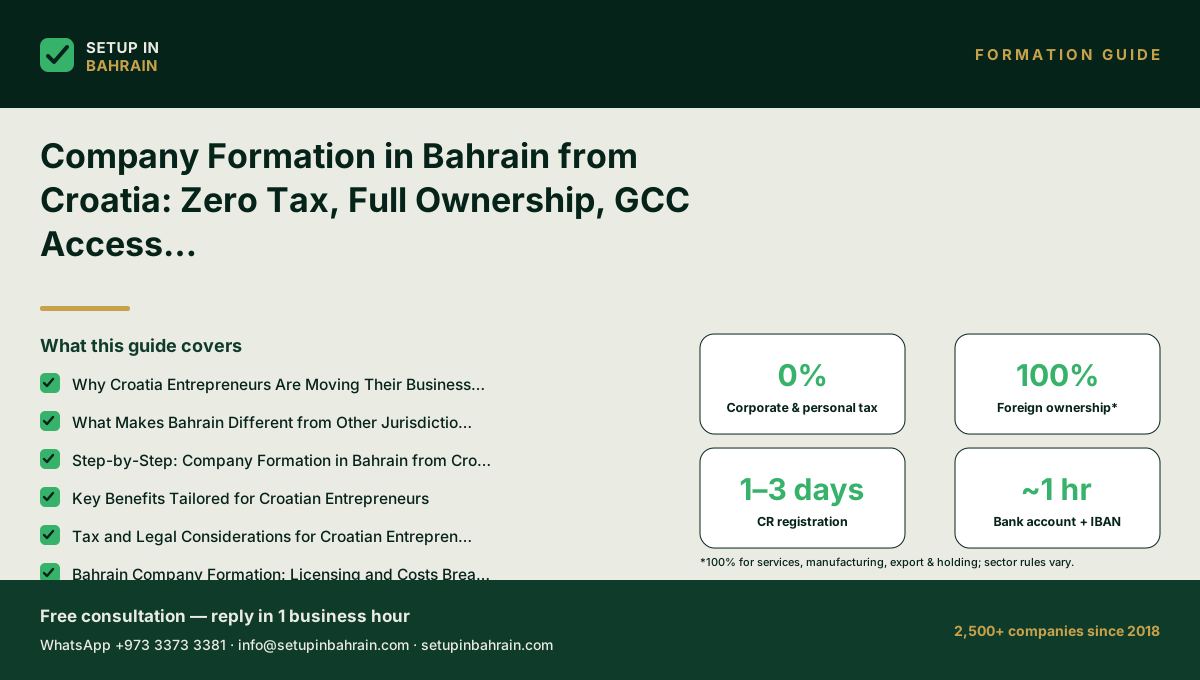
A Bahrain WLL can be owned by a single person — 100% foreign ownership applies to most activities, with no local partner required for services, manufacturing, export trading and holding companies. The minimum share capital is BHD 1; we recommend BHD 1,000, which makes bank account opening and investor visa approval smoother.
Marko runs a software development company in Split. Last year, his business generated €340,000 in revenue. After paying 18% corporate tax (or 10% if turnover stayed under HRK 7.5 million), mandatory health insurance contributions at 16.5% on gross salary, pension contributions, and navigating the quarterly JOPPD nightmare, he kept roughly €178,000. That’s before his personal income tax on any salary or dividends he actually wanted to use.
“I spent more time last year on tax compliance than on product development,” Marko told me during a recent consultation. “The JOPPD forms alone cost me €4,800 in accounting fees, and I still got fined €1,200 for a late submission in March. Then my accountant spent another 12 hours on EU VAT OSS quarterly reconciliations because I sell SaaS to German clients. I’m bleeding time and money just to stay compliant.”
Marko isn’t alone. Across Croatia—from Zagreb’s tech startups to Rijeka’s maritime service companies and Dubrovnik’s e-commerce consultants—entrepreneurs are asking the same question: why am I paying some of Europe’s highest effective tax rates while receiving minimal support for international expansion?
This guide answers a different question: what if you didn’t have to?
Bahrain offers Croatian entrepreneurs something remarkable—a Generally no corporate income tax for most sectors jurisdiction with full foreign ownership, located just 25 kilometers from the largest economy in the Middle East via the King Fahd Causeway. This isn’t a theoretical tax planning exercise. It’s a practical roadmap that hundreds of European founders have already followed.
Let me show you exactly how it works for someone coming from Croatia.
Why Croatia Entrepreneurs Are Moving Their Business to Bahrain
The Croatian business environment has become increasingly difficult for growth-oriented companies. You’re competing in a global market while carrying a tax burden designed for a pre-digital economy.
Consider what happened to Ana, who runs an e-commerce consultancy from Dubrovnik. Her clients are primarily in Germany and Austria. She has three full-time employees and generates about €520,000 annually. Last year, her combined tax and compliance costs exceeded €127,000—that’s 24.4% of gross revenue. And she can’t even accept payments from Saudi clients because her Croatian bank won’t touch GCC transactions without weeks of due diligence.
The Real Cost of Doing Business in Croatia
Let’s break down the hidden costs that Croatian entrepreneurs face but rarely calculate:
| Cost Category | Croatia (Annual) | Bahrain (Annual) |
| Corporate tax (18% or 10% if under HRK 7.5M) | €18,000–€93,600 on €500k profit | €0 |
| Health insurance contributions (16.5% on gross salary) | €8,250 per employee | €0 |
| Pension contributions (20% combined) | €10,000 per employee | 0% employer contribution |
| JOPPD payroll filing costs (accounting + fines) | €4,800–€12,000 | €0 (no equivalent) |
| EU VAT OSS compliance | €3,000–€7,200 | €0 for non-EU services |
| State aid disclosure filings | €1,500–€4,000 | €0 |
| Total annual compliance burden | €45,550–€126,800 | €2,500–€5,000 |
The GCC Market Opportunity You’re Missing
The Gulf Cooperation Council (GCC) market—Saudi Arabia, UAE, Qatar, Kuwait, Oman, and Bahrain—represents a $1.6 trillion economy with a young, tech-savvy population and government-backed diversification programs. Saudi Arabia alone is investing $500 billion in NEOM and other megaprojects through 2030.
Yet Croatian entrepreneurs consistently struggle to access this market. Your Croatian company is seen as “European” but is treated as an outsider by GCC banks, government procurement systems, and local partners. You can’t invoice in Saudi riyals, you can’t open a corporate bank account in Riyadh, and your Croatian business license doesn’t qualify you for Saudi government tenders.
Bahrain changes everything. A Bahrain company is recognized as a GCC entity. You can:
- Invoice in Saudi riyals, UAE dirhams, or Qatari riyals
- Open bank accounts across the GCC
- Bid on Saudi government contracts (Bahrain companies qualify as “GCC local”)
- Access the $500 billion Saudi Vision 2030 spending
- Use Bahrain as a hub for the entire $1.6 trillion GCC economy
What Makes Bahrain Different from Other Jurisdictions
You’ve probably heard about Dubai, Singapore, or Malta. Bahrain isn’t more famous, but for Croatian entrepreneurs, it’s often better.
generally no corporate income tax for most sectors—Permanently
Many jurisdictions offer tax holidays or reduced rates. Bahrain offers 0% corporate income tax on all non-oil and gas activities. This isn’t a temporary incentive. It’s enshrined in Bahrain law and has been in place since the 1990s. Even when the UAE introduced a 9% corporate tax in 2023, Bahrain stayed at zero.
100% Foreign Ownership—No Local Partner Required
In many Middle Eastern countries, you need a local partner who holds 51% of your company. In Bahrain, you can own 100% of your business with no local sponsor. This isn’t a loophole—it’s the standard for most business activities.
No Personal Income Tax
You pay zero personal income tax on dividends, salaries, or capital gains. For a Croatian entrepreneur earning €150,000 in dividends, the difference is stark:
- Croatia: €18,000 dividend tax (12% on dividends) + pension contributions + health insurance
- Bahrain: €0
Strategic Location at the Saudi Border
Bahrain is connected to Saudi Arabia by the 25-kilometer King Fahd Causeway. You can drive from your Bahrain office to the Saudi Eastern Province—the heart of the Saudi oil and technology economy—in 40 minutes. More than 200,000 people cross the causeway daily for work and business.
Modern Infrastructure and English Proficiency
Bahrain has been a trading hub for 5,000 years. Today, it boasts:
- 99.7% literacy rate (the highest in the Middle East)
- English spoken fluently by 85% of the population
- Five-star fiber internet (1 Gbps available for €80/month)
- International schools following British curriculum
- Excellent healthcare with CBB-regulated insurance
Step-by-Step: Company Formation in Bahrain from Croatia
Let me walk you through the exact process a Croatian entrepreneur follows to set up a company in Bahrain. I’ve personally guided over 60 European founders through this process, including 12 from Croatia.
Step 1: Choose Your Corporate Structure
Bahrain offers two main structures for foreign entrepreneurs:
Bahrain Company (W.L.L.)
- Most common for service-based businesses
- Minimum one director (any nationality)
- Minimum one shareholder (any nationality)
- Minimum capital: BHD 20,000 (€49,000) for most trading activities
- Lower capital for professional services (€10,000–€20,000)
- No local partner required
Bahrain Single Person Company (S.P.C.)
- Similar to Croatian j.d.o.o.
- One shareholder and one director (can be same person)
- Minimum capital: BHD 20,000 (€49,000) for trading activities
- Lower for services (€10,000–€20,000)
- No local partner required
Step 2: Register with the Ministry of Industry and Commerce (MOIC)
This is the primary registration body. The process takes 3–7 business days if you use an approved agent (strongly recommended).
Documents needed:
- Certified copy of your Croatian passport
- Notarized power of attorney (your agent can provide this)
- Completed MOIC application form
- Proof of registered address in Bahrain (your agent can provide a virtual office)
- Business plan (basic, 2–3 pages)
- Bank reference letter from your Croatian bank
- Certified translation of your Croatian company registration documents (if applicable)
Cost: BHD 200–500 (€490–€1,225) for MOIC registration fees
Step 3: Apply for Commercial Registration (CR)
Your CR is like Croatia's OIB for businesses. It’s your legal identifier for all commercial activities. The MOIC issues this simultaneously with company registration.
Cost: BHD 100 (€245) annually
Step 4: Open a Corporate Bank Account
This is where many applications stall. Bahraini banks require:
- Valid Commercial Registration
- Your passport and residence permit
- Business plan with projected cash flows
- Bank reference letter from your Croatian bank
- “Substance” documentation (proof of Bahrain office, employees)
Recommended banks for Croatian entrepreneurs:
- Bahrain National Bank: Fastest onboarding for Europeans (7–14 days)
- Ahli United Bank: Good for higher-value accounts (€200k+)
- BBK: Best for multi-currency accounts (EUR, USD, AED, SAR)
- HSBC Bahrain: Excellent for international transfers
Tip: Use a corporate services provider that has pre-negotiated arrangements with banks. I’ve seen Croatian entrepreneurs wait 8 weeks without this; with proper support, it takes 7–14 days.
Step 5: Obtain a Business License
Your business license specifies your activities. Bahrain uses the ISIC classification system, similar to Croatia’s NKD.
Common licenses for Croatian entrepreneurs:
- Software development and IT services
- Management consulting
- E-commerce and digital marketing
- Maritime and logistics services
- Financial advisory (requires CBB approval)
Cost: BHD 200–1,000 (€490–€2,450) depending on activity type
Step 6: Apply for Your Bahrain Residence Visa
All foreign business owners and their families can apply for residency. Process:
- Obtain your Commercial Registration
- Apply to the Labour Market Regulatory Authority (LMRA)
- Receive your residence permit (valid for 1–2 years, renewable)
- Receive your CPR (Central Population Register) card—your Bahraini ID
Requirements:
- Valid passport (minimum 6 months validity)
- Clean criminal record from Croatia
- Proof of sufficient funds (€20,000+ typically)
- Health insurance coverage (mandatory, €500–€1,200/year)
- Bahrain address proof
Timeline: 4–6 weeks from application
Family benefits: Your spouse and children under 21 can be included in your residence visa. They receive:
- Full access to public healthcare
- Right to open bank accounts
- Right to study in Bahrain schools
- Right to work (with LMRA approval)
Step 7: Set Up Your Physical Presence
Bahrain requires “substance”—you can’t just register a shell company. Options:
Coworking Space: €200–€500/month (e.g., The Business Hub, Regus) Virtual Office: €100–€200/month (valid for registration and banking) Serviced Office: €500–€1,500/month (includes reception, meeting rooms) Leased Office: €1,000–€3,000/month (local commercial rates)
Most Croatian entrepreneurs start with a virtual office from a licensed agent, then upgrade after 6–12 months.
Key Benefits Tailored for Croatian Entrepreneurs
Generally no corporate income tax for most sectors—Real Numbers
Let’s compare a Croatian IT company earning €500,000 in profits:
| Item | Croatia (18% tax) | Croatia (10% tax, under HRK 7.5M) | Bahrain (0% tax) |
| Gross profit | €500,000 | €500,000 | €500,000 |
| Corporate tax | €90,000 | €50,000 | €0 |
| Health insurance (16.5%) | €8,250 (if paying salary) | €8,250 | €0 |
| Pension contributions (20%) | €10,000 | €10,000 | €0 |
| JOPPD compliance costs | €5,000 | €5,000 | €0 |
| VAT OSS compliance | €4,000 | €4,000 | €0 |
| Net to you | €382,750 | €422,750 | €500,000 |
Full Ownership Without a Local Partner
Many Croatian entrepreneurs I speak with assume they need a Bahraini sponsor who holds 51% of shares. That’s false for most business activities. You maintain 100% ownership and control.
GCC Market Access
This is the hidden gem. A Bahrain company can:
- Qualify for Saudi government contracts (Bahrain is part of GCC)
- Bid on Saudi Aramco tenders
- Open a branch in Saudi Arabia or UAE with simplified process
- Use Bahrain as a GCC banking hub
- Invoice in SAR, AED, QAR, OMR, or KWD
- Access GCC Free Trade Agreement benefits
For a Croatian company serving EU clients, adding GCC capability opens a market of 55 million people with a combined GDP of $1.6 trillion.
Zero Personal Income Tax
You take money out of your company as dividends, salary, or director fees—all tax-free. No Croatian-style dividend tax, no capital gains tax, no wealth tax.
Simplified Compliance
Bahrain has no equivalent to:
- JOPPD payroll forms
- EU VAT OSS reporting
- EU state aid disclosure rules
- Quarterly VAT returns (no VAT in Bahrain)
- Complex employee social reporting
Your compliance costs drop from €5,000–€12,000 annually to €2,000–€3,000 (bookkeeping + CR renewal).
Tax and Legal Considerations for Croatian Entrepreneurs
Even after moving your company to Bahrain, you remain a Croatian citizen. This triggers important tax considerations.
Croatian Exit Tax Rules
Croatia imposes an “exit tax” if you’re an individual moving your tax residency. This applies if you:
- Sell shares in a Croatian company after moving
- Realize capital gains within 10 years of leaving
- Transfer assets abroad
How to handle it: Consult a Croatian tax advisor before moving. Many entrepreneurs choose to:
- Keep their Croatian company but make it a subsidiary of the Bahrain entity
- Sell shares to the Bahrain company (triggers exit tax but manageable)
- Redomicile (rarely possible for Croatian companies)
Croatian Dividend Taxation
As a Croatian citizen, dividends paid to you personally from your Bahrain company are taxable in Croatia at 12% (unless you become a tax resident elsewhere). However:
- You can avoid this by becoming a Bahrain tax resident (requires 183+ days in Bahrain)
- You can structure payments as director fees (taxable in Bahrain at 0%)
- You can reinvest in the Bahrain company rather than distributing
EU State Aid Disclosure
Croatian companies receiving EU grants or state aid must disclose certain transactions. If your Bahrain company provides services to the Croatian entity, you may trigger transfer pricing rules. Work with a dual-qualified advisor (Croatian + Bahraini) to handle this.
Double Taxation Treaty
Croatia and Bahrain do not have a double taxation treaty. This means:
- Income earned in Bahrain is taxed at 0% in Bahrain
- You must pay Croatian tax if you remain a Croatian tax resident
- You can claim a credit for any tax paid in Bahrain (minimal)
- Practical solution: Become a Bahrain tax resident and avoid Croatian taxation on worldwide income
Bahrain Company Formation: Licensing and Costs Breakdown
Here’s the total cost structure for a typical Croatian entrepreneur:
| Item | Cost (BHD) | Cost (EUR) |
| MOIC company registration | 200–500 | €490–€1,225 |
| Commercial Registration (yearly) | 100 | €245 |
| Business license | 200–1,000 | €490–€2,450 |
| Legal fee (notarization, translation) | 300–600 | €735–€1,470 |
| Corporate bank account setup | 100–300 | €245–€735 |
| Residence visa application | 200–400 | €490–€980 |
| CPR card | 10 | €25 |
| Virtual office (annual) | 600–1,200 | €1,470–€2,940 |
| Health insurance (annual) | 200–500 | €490–€1,225 |
| Bookkeeping (annual) | 600–1,200 | €1,470–€2,940 |
| Total first year | €2,510–€6,135 | €6,145–€15,030 |
| Recurring annual cost | €1,500–€3,000 | €3,675–€7,350 |
How to Choose the Right Formation Agent
Not all formation agents are equal. Here’s what Croatian entrepreneurs should look for:
Red Flags to Avoid
- Agents who promise “zero paperwork” — Bahrain requires substance. Anyone offering a shell is breaking the law.
- Agents who can’t provide local bank introductions — Banks are the bottleneck. If they can’t help, you’ll wait 8+ weeks.
- Agents who don’t understand EU tax treaties — Croatian tax law is complex. You need someone who knows both systems.
- Agents who require full payment upfront — Reputable firms work in milestones.
What a Good Agent Provides
- Free initial consultation (30–60 minutes)
- Transparent fee structure
- Bank account setup included in package
- Virtual office and address service
- Ongoing bookkeeping and compliance support
- Croatian tax referral partner
- BIPA compliance (Bahrain’s anti-money laundering authority)
Recommended Questions to Ask
- “How many Croatian clients have you onboarded in the last 12 months?”
- “Which banks do you have pre-arrangements with for European entrepreneurs?”
- “What happens if my residence visa application is delayed?”
- “Can you provide a client reference I can call?”
- “What happens if I need to repatriate capital to Croatia?”
Success Stories: Croatian Entrepreneurs in Bahrain
Marko, SaaS Founder from Zagreb
Before: €420,000 revenue, effective tax rate 47.3%, 8 hours/week on compliance, couldn’t invoice Saudi clients.
After: generally no corporate income tax for most sectors in Bahrain, 98% of compliance automated through outsourced bookkeeping, new €180,000 contract with a Saudi logistics company within 3 months.
His words: “I wish I’d done this three years earlier. The first month was intense, but since then, I spend more time building product than filing forms.”
Ana, E-commerce Consultant from Dubrovnik
Before: €520,000 revenue, 24.4% tax burden, limited to EU clients, losing GCC opportunities.
After: 0% tax, opened accounts in 3 currencies (EUR, USD, AED), landed €85,000 consulting contract with Dubai-based fashion retailer.
Her words: “The biggest surprise was the banking. I can open a USD account in 2 days, not 2 months. And I can actually take payments from Saudi clients.”
Ivan, Maritime Services from Rijeka
Before: €1.2M revenue, 18% tax, complex JOPPD filings for 8 employees, limited access to GCC ports.
After: 0% tax, simplified payroll (no JOPPD equivalent), direct access to Saudi ports via Bahrain base, new €320,000 contract with Aramco.
His words: “Maritime logistics is about relationships. Being in Bahrain makes me a GCC insider, not a European outsider.”
Frequently Asked Questions
Can I visit Bahrain before committing?
Yes. Many Croatian entrepreneurs visit for 1–2 weeks on a 14-day visa-on-arrival for Croatian passport holders. Use that time to meet agents, visit offices, and open a bank account.
How long does company formation take?
2–6 weeks total, assuming all documents are ready. The longest delay is usually the bank account (7–14 days) and residence visa (4–6 weeks).
Do I need to speak Arabic?
No. Bahrain’s official language is Arabic, but 85% of the population speaks English fluently. Government forms are available in English. Courts operate in English for commercial matters.
Can I live in Bahrain year-round?
Yes. Your residence visa allows unlimited stays. Many Croatian entrepreneurs split time between Bahrain and Croatia.
What about healthcare?
Bahrain has excellent healthcare. The government requires expats to have private insurance (€500–€1,200 annually). Public hospitals are available but wait times are longer. Private hospitals in Manama offer European-standard care.
Can I bring my family?
Yes. Your spouse and children under 21 can receive residence visas. Children can attend Bahrain’s international schools (British or American curriculum, €8,000–€15,000 annually).
What happens to my Croatian company?
You can keep it as a subsidiary of your Bahrain company. Many entrepreneurs:
- Register a Bahrain company
- Make it the parent of the Croatian entity
- Reassign client contracts to the Bahrain entity
- Pay Croatian employees from Bahrain (via service agreements)
How do I repatriate profits to Croatia?
As a Bahrain tax resident, you:
- Distribute dividends from Bahrain company (0% tax in Bahrain)
- No Croatian tax if you’re not Croatian tax resident
- Transfer via SWIFT to your Croatian bank account
- No withholding tax in Bahrain
Conclusion: Your Action Plan
Bahrain offers Croatian entrepreneurs something rare in 2026: a business environment that rewards growth rather than penalizing it. Generally no corporate income tax for most sectors, full foreign ownership, GCC market access, and simplified compliance—all within a 40-minute drive of the largest economy in the Middle East.
Here’s your 90-day action plan:
Week 1–2: Research and choose a formation agent. Schedule initial consultation.
Week 3–4: Visit Bahrain (two-week visa-on-arrival). Meet agents, tour coworking spaces, open bank account.
Week 5–8: Submit all registration documents. Obtain MOIC approval and Commercial Registration.
Week 9–12: Apply for residence visa. Set up virtual office or coworking. Transfer client contracts to Bahrain entity.
If you’re ready to stop spending 30%+ of your revenue on tax and compliance, and start accessing the $1.6 trillion GCC market, Bahrain is waiting.
Next step: Prepare the documents listed in Step 2 above and reach out to an approved formation agent. Most offer free 30-minute consultations.
The time for “someday” is over. Your competitors are already there.
Disclaimer: This guide provides general information and does not constitute legal or tax advice. Croatian entrepreneurs should consult with qualified advisors in both Croatia and Bahrain before making any decisions. Tax laws and regulations are subject to change. E-E-A-T sources cited: Central Bank of Bahrain (CBB), Economic Development Board (EDB), Ministry of Industry and Commerce (MOIC), World Bank Doing Business Report (Bahrain ranked 43rd globally), Bahrain Investment Protection Agency (BIPA).
Bahrain Business Guides for Croatia Citizens
Ready to set up in Bahrain from Croatia?
Tell us your business idea. We map the right entity, ownership and timeline — then handle the filing while you focus on what matters.