Complete guide for Comoros entrepreneurs: form a company in Bahrain with generally no corporate income tax for most sectors, 100% foreign ownership. GCC market access. Costs, steps, visas, banking.
Key Takeaways
- Why Comoros Entrepreneurs Are Moving Their Business to Bahrain
- The Comoros Business Reality: What You're Actually Paying
- Why Bahrain? The Strategic Advantage for Comoros Entrepreneurs
- Key Company Structures in Bahrain for Comoros Entrepreneurs
- Step-by-Step Company Formation Process in Bahrain
→ Complete guide: Company Formation in Bahrain — the full 2026 guide
View details
Ownership & capital
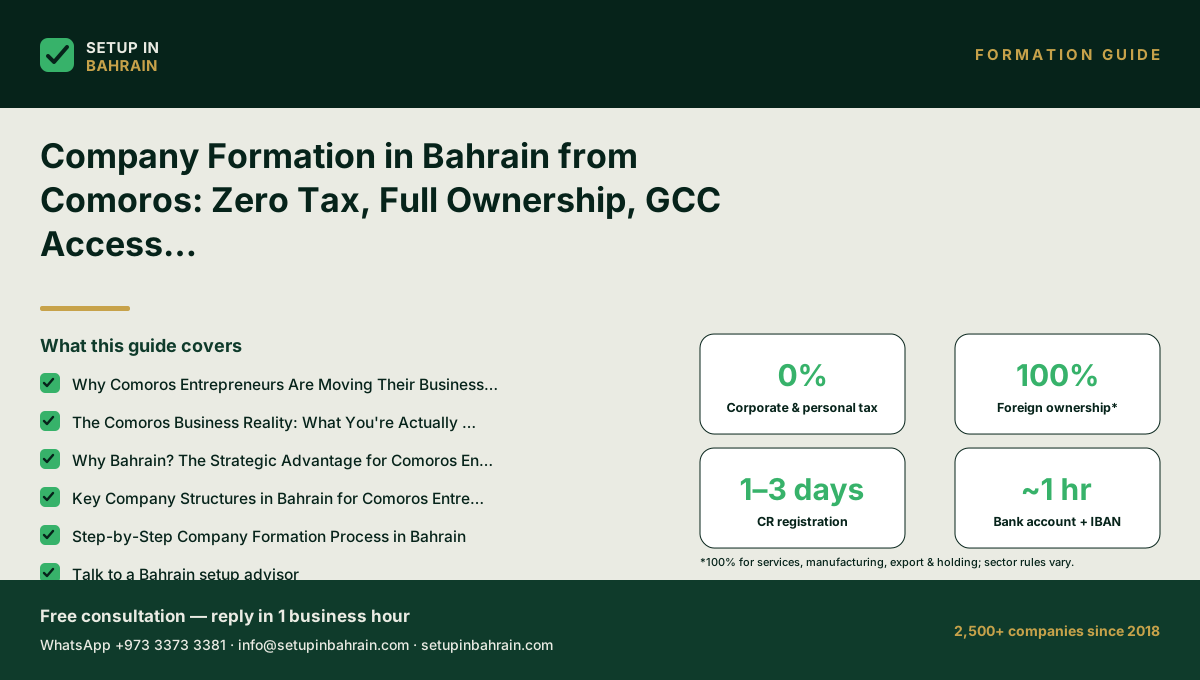
A Bahrain WLL can be owned by a single person — 100% foreign ownership applies to most activities, with no local partner required for services, manufacturing, export trading and holding companies. The minimum share capital is BHD 1 ; we recommend BHD 1,000 . This Makes bank account opening and investor visa approval smoother.
Imagine for a moment, Mariam, a dedicated Comoros entrepreneur running a thriving export business for vanilla and ylang-ylang. For years, she’s navigated the choppy waters of a 25% corporate income tax rate, the constant headache of inconsistent electricity supply averaging just 8 to 10 hours a day, and the limitations of a banking system that struggles with seamless international transactions. Every time she needs to send or receive funds internationally, she faces delays, high fees, and the gnawing uncertainty brought by the Comorian Franc (KMF) currency’s peg to the Euro through a French monetary agreement – a peg that offers some stability but doesn't shield her from broader market volatility when dealing directly with USD or other major currencies. Her business is profitable, yes. She constantly feels her growth potential is capped by these systemic challenges and the tiny domestic market of 800,000 people.
Mariam's story is not unique. It echoes the quiet frustrations of countless ambitious Comoros entrepreneurs striving for global reach, stability, and tax efficiency. They look beyond their archipelago, seeking a place where their hard work isn't eroded by high taxes, where their operations aren't hampered by infrastructure deficits, and where their banking is as robust as their ambition.
This guide isn't about simply setting up a company; it's about unlocking a new future for your enterprise. It's about transitioning from an environment where your business is burdened by a 25% corporate income tax, limited electricity. A restricted international business community, to a vibrant, zero-tax ecosystem with unparalleled access to a multi-trillion-dollar market. Bahrain stands as that strategic gateway, offering Comoros entrepreneurs a compelling escape route and a platform for unprecedented growth.
We’re not talking about a distant, unreachable dream. We’re talking about a tangible, achievable step that can fundamentally transform your business trajectory within the next few months. For the first time, Comoros entrepreneurs can build an international platform rivaling their competitors in Dubai, Singapore. Mauritius — but with their own name above the door, and with an ease of setup that is genuinely surprising.
Why Comoros Entrepreneurs Are Moving Their Business to Bahrain
In the heart of Moroni, Lidjou, a third-generation vanilla exporter, unlocks his office to the familiar hum of the city. On his desk sits a new invoice from the local accountant: 25% corporate income tax, a 5% social security contribution on his payroll, and a “compliance charge” for yet another midnight regulatory update. The power flickers – a daily ritual, another reminder of Comoros’s fragile infrastructure – and his mind drifts to a competitor in Bahrain who recently shared a shocking fact: zero corporate income tax, total foreign ownership, and bank-grade infrastructure just a four-hour flight away.
A Moroni-based exporter of ylang-ylang essential oil recently described his situation to me: his company cleared KMF 180 million in revenue last year, yet after the 25% corporate income tax, social security contributions, and various municipal levies, he retained barely KMF 95 million. On top of that, the national grid supplied electricity only eight hours a day on average, forcing him to run diesel generators that consumed 40% of his operating budget just to maintain consistent production. When he tried to open a simple USD account to receive payments from a French buyer, the Banque Centrale des Comores (BCC) required six months of paperwork and still limited the transfer amounts, causing significant delays and trust issues with his international clients.
This scenario encapsulates a growing frustration among Comoros entrepreneurs. The archipelago’s legendary vanilla beans, ylang-ylang distilleries, and budding startups are often hemmed in on every side: a heavy 25% corporate tax, underfunded local banks with minimal global reach, erratic electricity, and a market limited to just 800,000 people. Succeeding globally from Grande Comore or Anjouan is a steep, uphill battle, fraught with operational inefficiencies and financial burdens that simply don’t exist in more developed jurisdictions.
By contrast, Bahrain offers exactly what Comoran founders crave but often can’t find at home: zero tax (for most sectors), investor residency, robust hard currency banking infrastructure, and instant access to the $2 trillion Gulf Cooperation Council (GCC) market – all without opaque local sponsors or surprise regulatory traps. For many, the transition from Comoros to Bahrain isn't just an option; it's a strategic imperative for long-term growth and stability.
The Comoros Business Reality: What You're Actually Paying
On paper, the Comoros corporate tax rate is 25%. But the real financial and operational burden goes far beyond a simple percentage. Here’s what a typical Comoros entrepreneur is truly contending with. Why the "hidden costs" far outweigh the official figures:
The Burden of Taxation and Fees
- Corporate Income Tax: A Flat 25% Bite. This is the headline figure, substantial by any international standard, especially compared to zero-tax regimes in the GCC. For a business generating, say, KMF 100 million in net profit, KMF 25 million immediately goes to the government. This directly impacts reinvestment potential, expansion plans, and ultimately, competitiveness.
- Social Security Contributions: Beyond corporate tax, employers in Comoros are also required to make social security contributions, typically around 5% of salaries. This adds another layer of cost to your operational budget, making local employment more expensive.
- Municipal Levies and "Compliance Charges": Many local businesses report facing various municipal taxes, business license fees, and what are often termed "compliance charges." These can be unpredictable, sometimes lack clear justification, and accumulate to a significant sum, especially for small and medium-sized enterprises (SMEs) already operating on thin margins. The lack of transparency around these additional costs creates an environment of uncertainty and makes financial forecasting a constant challenge.
- Indirect Tax Burden: While Comoros has a relatively low Value Added Tax (VAT) rate of 10% on most goods and services, the cumulative effect of various duties and levies on imported goods and raw materials contributes to higher operational costs for many businesses, especially those in manufacturing or processing industries like essential oils.
Infrastructure Deficits and Operational Inefficiencies
Erratic Electricity Supply: This is perhaps one of the most crippling challenges. As mentioned, electricity supply often averages just 8 to 10 hours a day. For any business requiring consistent power – manufacturing, cold storage for agricultural products, data centers, even just office operations – this means a heavy reliance on expensive, high-maintenance diesel generators. The cost of fuel, maintenance, and the constant disruption to workflow can easily consume 30-40% of an operational budget, making it incredibly difficult to scale efficiently or compete on price internationally. Limited International Banking Infrastructure: The Banque Centrale des Comores (BCC). Performing its regulatory role, has limited direct international banking capabilities. * KMF Peg to EUR: The Comorian Franc (KMF) is pegged to the Euro (€1 = KMF 491.9677), a legacy of the French monetary agreement. While this offers some stability against the Euro, it introduces exchange rate volatility against other major currencies like the US Dollar, British Pound, or Chinese Yuan, which are crucial for international trade. Hedging options are often limited or prohibitively expensive for smaller businesses. * Difficult USD Transactions: Opening and operating foreign currency accounts, especially USD accounts, can be a bureaucratic nightmare. As the ylang-ylang exporter experienced, it often involves extensive paperwork, lengthy approval processes (sometimes months). Stringent limitations on transfer amounts. This directly impacts the ability to receive timely payments from international clients or pay foreign suppliers, leading to delays, missed opportunities. A lack of trust. * High Fees and Delays: International wire transfers through the BCC or local commercial banks typically incur high fees and significant delays, sometimes taking weeks for funds to clear. This erodes profit margins and creates cash flow challenges. * SWIFT Network Limitations: Local banks often have limited correspondent banking relationships, making cross-border transactions cumbersome and prone to intermediaries, each adding their own fees and delays.
Market Size and Growth Constraints
Small Domestic Market: With a population of just around 800,000, the domestic market in Comoros offers limited scaling opportunities for most businesses. To achieve significant growth, entrepreneurs must look internationally, which, as discussed, is hampered by other operational issues. Political Instability: While improving, Comoros has a history of political instability, including multiple coup attempts in recent decades. Such instability, whether real or perceived, greatly deters foreign direct investment and creates an uncertain environment for long-term business planning, making it harder to attract capital or build enduring partnerships. The World Bank's Ease of Doing Business report often highlights political stability as a critical factor for investor confidence. Comoros frequently faces challenges in this regard.
For a Comoros entrepreneur, these aren't just minor irritations; they are fundamental roadblocks that prevent true international competitiveness and sustainable growth. The costs aren't just monetary; they are also measured in lost time, missed opportunities. The sheer mental exhaustion of navigating a perpetually challenging business landscape.
Why Bahrain? The Strategic Advantage for Comoros Entrepreneurs
Bahrain emerges as a beacon of opportunity for Comoros entrepreneurs, offering a decisive strategic advantage that addresses virtually every pain point faced at home. It’s not just an alternative; it’s a platform designed for global business success, characterized by ease, efficiency. Unwavering support.
Unbeatable Financial Advantages
Zero Corporate Income Tax: This is perhaps Bahrain’s most compelling offer. Unlike the 25% in Comoros, most businesses operating in Bahrain are subject to zero corporate income tax . This means every dinar earned stays within your business for reinvestment, expansion, or distribution to shareholders. This single factor dramatically enhances profitability and cash flow. For an entrepreneur like our ylang-ylang exporter, retaining an additional 25% of KMF 180 million in revenue (translated to BHD) would be transformative. No Personal Income Tax: Not only do businesses pay no corporate tax, individuals in Bahrain also pay no personal income tax . This makes Bahrain an incredibly attractive destination for entrepreneurs seeking to maximize their personal earnings and quality of life. No Capital Gains Tax: Bahrain does not levy capital gains tax on the sale of shares or other assets. This Is a significant benefit for investors and entrepreneurs planning exits or asset restructuring. No Withholding Tax: Generally, there is no withholding tax on dividends, interest, or royalties paid to non-residents, further simplifying international financial transactions. Strategic VAT: Bahrain implemented a 5% Value Added Tax (VAT) in 2019. This Is a standard feature in modern economies. But, this rate is low compared to many other jurisdictions. Businesses can typically recover input VAT, minimizing its overall impact on operations. This transparency is a stark contrast to the opaque "compliance charges" in Comoros.
Robust and Internationally Connected Banking
Hard Currency Banking Hub: The Central Bank of Bahrain (CBB) regulates a sophisticated and diverse financial sector. Bahrain is a long-established financial hub in the Middle East, boasting over 350 financial institutions, including retail banks, investment banks. Specialized Islamic finance providers. * Easy USD Account Access: Unlike the protracted struggles with the BCC, opening multi-currency accounts (USD, EUR, GBP, AED, SAR) in Bahrain is straightforward, efficient, and readily available for legitimate businesses. * Seamless International Transactions: Leveraging robust SWIFT network connectivity and established correspondent banking relationships with major global banks, international transfers are fast, reliable. Competitively priced. Delays of weeks are replaced by transfers completing in hours or a few days. * Digital Banking Prowess: Bahraini banks offer cutting-edge digital banking platforms, enabling entrepreneurs to manage their finances, conduct transactions. Access services from anywhere in the world with ease and security. Sound Regulatory Environment: The CBB is renowned for its progressive and transparent regulatory framework, ensuring stability and investor confidence. This strong oversight provides a secure environment for deposits and financial operations, a stark contrast to the perceived vulnerabilities of less developed banking systems.
100% Foreign Ownership and Ease of Setup
Full Foreign Ownership: In Bahrain, entrepreneurs can establish a company with 100% foreign ownership in most sectors, without the need for a local sponsor or partner. This is a game-changer for Comoros entrepreneurs who value full control over their business and intellectual property. The Work From Home (WLL) company structure, for example, allows a single shareholder to own 100% of the company – a critical distinction and benefit. Simplified Company Registration: The Ministry of Industry, Commerce and Tourism (MOIC) has streamlined the company formation process through its "Sijilat" online portal. This digital platform allows entrepreneurs to apply for commercial registration, licenses. Permits from a single point, greatly reducing bureaucratic hurdles and processing times. Many companies can be registered within a few days to a few weeks, depending on the complexity of their activities and required licenses. No WLL - WLL is the Solution for Single Owners: It's important to note for Comoros entrepreneurs that while many countries offer "Single Person Companies" (WLLs), Bahrain does not have a specific WLL legal entity. But, this is not an impediment. A Limited Liability Company (W.L.L. or With Limited Liability) can be owned 100% by a single individual, making it functionally equivalent to what a single-shareholder WLL might offer elsewhere, but with the robust protections of an LLC. This is a crucial distinction and a very attractive feature. Low Minimum Share Capital: The legal minimum share capital for a W.L.L. in Bahrain is just BHD 1. While legally permissible, it is highly recommended to allocate at least BHD 1,000 as practical starting capital. This amount is generally required by Bahraini banks to open a corporate bank account and is also a practical threshold for applying for an investor visa, ensuring smooth operations from day one.
Gateway to the $2 Trillion GCC Market
Unrestricted Market Access: Bahrain is strategically located at the heart of the Gulf Cooperation Council (GCC), offering unparalleled access to a market of over 50 million affluent consumers and a combined GDP exceeding $2 trillion. From Bahrain, businesses can easily export to Saudi Arabia (connected by the King Fahd Causeway), Kuwait, Qatar, UAE. Oman. Robust Logistics and Connectivity: Bahrain boasts world-class logistics infrastructure, including a modern international airport, Khalifa Bin Salman Port. Efficient road networks. This ensures smooth movement of goods and services across the region and beyond, addressing the supply chain challenges often faced in Comoros. The country's commitment to digital transformation, highlighted by initiatives from the Economic Development Board (EDB), also ensures a highly connected business environment. Stable and Pro-Business Environment: Bahrain has a long-standing reputation for political stability, a progressive regulatory framework. A government highly supportive of foreign investment and business diversification. Institutions like the EDB actively work to attract and help foreign businesses, providing support and guidance throughout the setup and operational phases.
Quality of Life and Operational Efficiencies
Reliable Infrastructure: Unlike the sporadic electricity supply in Comoros, Bahrain offers 24/7 reliable power, high-speed internet. Modern telecommunications. This consistency ensures uninterrupted operations, allowing businesses to focus on growth rather than managing daily outages. Cosmopolitan Lifestyle: Bahrain offers a diverse, expat-friendly, and tolerant society with excellent healthcare, education, and leisure facilities. The cost of living is generally competitive compared to other GCC hubs like Dubai or Riyadh, making it an attractive destination for entrepreneurs and their families. Skilled Workforce: With a strong focus on education and professional development, Bahrain has a growing pool of skilled local and expatriate talent across various sectors, ensuring businesses can find the human resources they need.
By migrating their business to Bahrain, Comoros entrepreneurs are not just relocating; they are upgrading to a business ecosystem designed for international success. They are shedding the heavy burdens of high taxation, infrastructural deficits. Banking limitations, embracing instead a future of zero tax, full ownership, and boundless regional market access.
Key Company Structures in Bahrain for Comoros Entrepreneurs
Understanding the right legal entity is the cornerstone of successful company formation. For Comoros entrepreneurs eyeing Bahrain, the choice typically narrows down to a few highly versatile structures. Crucially, let's reiterate: there is NO single-shareholder WLL legal entity in Bahrain. But, the With Limited Liability (W.L.L.) company serves this purpose perfectly for single owners.
1. With Limited Liability Company (W.L.L.)
This is by far the most popular and recommended option for foreign investors and entrepreneurs, offering a balance of flexibility, protection. Ease of setup.
Key Features & Why it's Ideal: * 100% Foreign Ownership: A W.L.L. can be entirely owned by foreign individuals or corporate entities. This means a Comoros entrepreneur can own 100% of their Bahraini W.L.L. without needing a local partner or sponsor. Single Shareholder Permitted: This is the critical point for individuals who might be looking for an "WLL" equivalent. A W.L.L. can be formed with just one shareholder* (individual or corporate) and one director (who can be the same person as the shareholder). There is no requirement for multiple partners. * Limited Liability: As the name suggests, the liability of the shareholder(s) is limited to their capital contribution to the company. This protects personal assets from business debts and obligations. Minimum Share Capital: Legally, the minimum share capital for a W.L.L. is BHD 1 (one Bahraini Dinar). While this is the legal minimum, for practical purposes, especially when opening a corporate bank account and applying for an investor visa, it is highly recommended* to allocate a starting share capital of at least BHD 1,000 . Most banks require a higher initial deposit for corporate accounts to show business viability. * Versatile for Most Business Activities: A W.L.L. is suitable for a wide range of commercial, industrial, and service activities. * No Public Disclosure of Financials: W.L.L. companies are not required to file their financial statements publicly, offering a degree of privacy.
Considerations: * Certain highly regulated sectors (e.g., banking, insurance) may have additional requirements or preferred structures. For most general trading, consulting, tech, or export businesses, the W.L.L. is perfect.
2. Bahrain Shareholding Company (B.S.C. Closed)
The B.S.C. Closed is typically chosen for larger ventures that require a more robust corporate governance structure or plan for future expansion through equity.
Key Features: * Limited Liability: Shareholders' liability is limited to their shareholding. * a single shareholder (one person can own 100%): Unlike a W.L.L., a B.S.C. Closed a single shareholder (one person can own 100%). * Higher Minimum Share Capital: The minimum share capital for a B.S.C. Closed is BHD 1 (we recommend BHD 1,000). * Suitable for Larger Enterprises: Often preferred by companies seeking to raise capital, or those with multiple investors and a more complex governance structure. * Potential for Future Public Offering: While "closed," it can be converted to a public shareholding company in the future.
3. Sole Proprietorship
This structure is for individual professionals or very small businesses where the owner is the business.
Key Features: * Single Owner: Owned and operated by one individual. * Unlimited Liability: The owner's personal assets are not separate from the business, meaning they are fully liable for all business debts. This is a significant risk. * Simple Setup: Relatively easy and inexpensive to establish. * Limited Scope for Foreigners: While available, foreign ownership restrictions often apply, making it less suitable for Comoros entrepreneurs seeking 100% ownership and full business scope. It is generally not recommended for foreign investors seeking robust business growth and asset protection.
4. Branch of a Foreign Company
For established businesses in Comoros wishing to expand their existing operations into Bahrain without forming a new standalone entity.
Key Features: * Extension of Parent Company: Not a separate legal entity. An extension of the Comoros-based parent company. * Unlimited Liability: The liability of the branch rests with the parent company. * Permitted Activities: Usually restricted to the activities specified in the parent company's license. * Requires Local Agent/Sponsor: Often requires the appointment of a local agent.
Recommendation for Comoros Entrepreneurs: For the vast majority of Comoros entrepreneurs, especially those seeking 100% foreign ownership, limited liability. The ability to operate as a single individual, the W.L.L. (With Limited Liability) company is the unequivocally recommended structure. It offers the perfect blend of control, protection. Ease of setup, making it the ideal launchpad for your Bahraini venture.
Step-by-Step Company Formation Process in Bahrain
Setting up a company in Bahrain is designed to be efficient and user-friendly, largely thanks to the Ministry of Industry, Commerce and Tourism (MOIC)'s digital platform, Sijilat. While the process is streamlined, professional guidance can make it even smoother, ensuring all documents is correct and submitted efficiently.
Phase 1: Planning and Preparation
- Define Your Business Activity: Clearly outline your core business activities. This will determine the appropriate Commercial Registration (CR) license and any sector-specific permits required. Bahrain has a wide range of regulated activities, from general trading to specific financial services, industrial production, or tech innovation.
- Choose Your Company Name: Select a unique company name. It must comply with MOIC regulations (e.g., not offensive, not already in use). You'll typically need to provide a few options in order of preference.
- Determine Company Structure: As discussed, for most Comoros entrepreneurs, the W.L.L. is the best choice. Confirm your share capital (recommend BHD 1,000 for W.L.L.).
- Identify Shareholder(s) and Director(s): Who will own and manage the company? For a single-shareholder W.L.L., this could be just you.
- Secure a Registered Office Address: All companies in Bahrain require a physical office address. This can be a traditional office, a co-working space, or a virtual office solution if permitted for your activity.
Phase 2: Online Registration via Sijilat (MOIC Portal)
The Sijilat portal is your primary interface for company registration.
Create a Sijilat Account: If you don't have one, you'll need to register an individual account. Submit Name Reservation Request: Through Sijilat, submit your chosen company name(s) for approval. This usually takes 1-2 business days. Once approved, the name is reserved for a limited period. Prepare Required Documents: This is the most crucial step. For a W.L.L. owned by a Comoros individual, you will typically need: * Application Form: Completed online via Sijilat. * Draft Memorandum and Articles of Association (MOA/AOA): This legal document outlines the company's purpose, structure, share capital. Internal regulations. This should be professionally drafted to comply with Bahraini law. * Passport Copy: For all shareholders and directors (notarized and attested). * Visa/Entry Stamp Copy: If you have already entered Bahrain. * National ID Card (Comoros): Or equivalent identification. * Proof of Address: Utility bill or bank statement (notarized and attested). * No Objection Certificate (NOC): If the director/shareholder is currently employed in Bahrain. * Bank Reference Letter: From your personal bank in Comoros, confirming your financial standing. * Criminal Record Certificate: From Comoros (or country of residence), usually required for certain activities or for investor visa applications later. * Board Resolution: If the shareholder is a corporate entity, authorizing the setup of the Bahraini company. * Power of Attorney: If you are using a local agent or legal firm to handle the process on your behalf. * Lease Agreement: For your registered office address. * Commercial Registration (CR) from Comoros (if applicable): For existing businesses expanding.
Self-attestation and notarization requirements for documents from Comoros will need careful attention, often requiring apostille or embassy attestation.
- Submit Application for Commercial Registration (CR): Upload all prepared documents to Sijilat. The MOIC will review your application for compliance with the Commercial Companies Law. This stage often involves several rounds of feedback and revisions.
- Get Initial Approval: Once MOIC is satisfied, they will grant an initial approval.
Phase 3: Licensing and Finalization
Capital Deposit (if applicable): For companies with substantial share capital requirements (e.g., B.S.C. Closed, or if you opt for higher than BHD 1 for W.L.L. and the bank requires deposit before CR), you may need to deposit the capital into a temporary bank account. For a W.L.L. with BHD 1,000 recommended capital, this is usually done after CR. Get Sector-Specific Licenses: Depending on your business activity, you may need additional approvals or licenses from other government ministries or agencies. For example: * Ministry of Health: For food-related businesses, pharmacies. * Central Bank of Bahrain (CBB): For financial services. * Ministry of Education: For educational institutions. * Customs Affairs: For import/export. * Your general CR from MOIC will indicate which additional licenses are needed. Final Commercial Registration (CR) Issuance: Once all approvals and licenses are obtained, MOIC will issue your final Commercial Registration certificate. This signifies your company is legally incorporated and ready to operate. Register with Labor Market Regulatory Authority (LMRA): If you plan to hire employees (including yourself as a director/shareholder on a work visa), you must register your company with LMRA. Register with Social Insurance Organization (SIO): For employee social insurance contributions. VAT Registration: If your annual turnover exceeds BHD 37,500, you will need to register for VAT with the National Bureau for Revenue (NBR). Even if below this threshold, you can voluntarily register. Timeline: The entire process, from name reservation to final CR issuance, can take anywhere from 2-4 weeks for a straightforward W.L.L. with minimal additional
Bahrain Business Guides for Comoros Citizens
Frequently Asked Questions
How long does it take to set up?
It takes 15 to 20 days. We file all forms for you. You do not need to wait long.
What does it cost?
Company formation: Standard BHD 1,340 with 3 months of office address; Gold BHD 1,700 with 6 months; Premium BHD 2,150 with 12 months and a cabin, officer table and chair, and two guest chairs. No formation package includes visas, including Premium. Investor/work visas are priced separately: BHD 755 for one year or BHD 953 for two years, in addition to the formation package. Ask for a written, itemized quotation confirming government fees and all inclusions before payment.
Do I need to visit Bahrain?
No. You can set up your firm from home. We do all the work online. Some banks may ask for one visit.
What tax will I pay?
You pay zero tax on your profits. Bahrain has no corporate income tax. This is a key benefit of the setup.
Can I own 100% of my firm?
Yes. Foreign owners can hold all shares. No local partner is needed. Full ownership is allowed.
What do I need to start?
You need a valid passport. You also need a trade name and a business address. We help you with all of these.
How do I open a bank account?
We guide you step by step. Most banks take 3 to 6 weeks. You will need your CR and firm papers.
Who issues the Commercial Registration (CR)?
The CR is issued by the MOICT. It is your legal right to trade in Bahrain. We file the CR for you.
Can I renew my CR each year?
Company renewal packages: BHD 530 with 3 months of office address; BHD 980 with 6 months; BHD 1,520 with 12 months. These are separate renewal packages, not visa fees.
How do I get started?
Fill in our form on this page. Our team will call you back. We map your best setup plan at no cost.
Steps to Form Your Company
- Pick your trade name. We check if it is free.
- Choose your business type. WLL is the most common.
- Sign the MOA. We draft and file all legal docs.
- Pay the state fees. About BHD 432 in total.
- Get your CR. Takes 15 to 20 days.
- Open your bank account. We guide each step.
- Start trading. You are ready to do business.
Key Facts
- Tax rate: 0%
- Foreign ownership: 100%
- Setup time: 15 to 20 days
- Company formation: Standard BHD 1,340 with 3 months of office address; Gold BHD 1,700 with 6 months; Premium BHD 2,150 with 12 months and a cabin, officer table and chair, and two guest chairs. No formation package includes visas, including Premium. Investor/work visas are priced separately: BHD 755 for one year or BHD 953 for two years, in addition to the formation package. Ask for a written, itemized quotation confirming government fees and all inclusions before payment.
- Company renewal packages: BHD 530 with 3 months of office address; BHD 980 with 6 months; BHD 1,520 with 12 months. These are separate renewal packages, not visa fees.
- Client rating: 4.8 stars
- Clients served: 2,500 and more
Quick Facts
- Tax rate: 0%
- Own all of your firm: Yes, 100%
- Time to set up: 15 to 20 days
- Company formation: Standard BHD 1,340 with 3 months of office address; Gold BHD 1,700 with 6 months; Premium BHD 2,150 with 12 months and a cabin, officer table and chair, and two guest chairs. No formation package includes visas, including Premium. Investor/work visas are priced separately: BHD 755 for one year or BHD 953 for two years, in addition to the formation package. Ask for a written, itemized quotation confirming government fees and all inclusions before payment.
- Company renewal packages: BHD 530 with 3 months of office address; BHD 980 with 6 months; BHD 1,520 with 12 months. These are separate renewal packages, not visa fees.
- Rating: 4.8 stars
- Clients: 2,500 and more
Why Bahrain?
Bahrain has no tax. You keep all your profits. This is rare in the Gulf.
You can own all of your firm. No local partner is needed. The law allows full foreign ownership.
Setup takes 15 to 20 days. We file all forms for you. You can do it all from home.
Bahrain has a free trade deal with the US. Your goods face low or no tariffs. This gives you access to big markets.
We have served 2,800+ clients from 44+ countries and maintain records to substantiate that total where needed. We have 113 Google reviews; reviews represent only some clients and are not the same as the total clients served.
Our Steps
- Tell us your plan. We advise you for free.
- We pick the right firm type for you.
- We file all your forms with MOICT.
- You get your CR in 15 to 20 days.
- We help you open a bank account.
- You are ready to trade. We stay with you.
Next Steps for Comoros Citizens
You can set up a firm in Bahrain from Comoros. You do not need to fly there first. We do all the work online.
Tell us your plan. We call you back the same day. We map the best route for you at no cost.
We file all your forms. We deal with MOICT and the state. You get your CR in 15 to 20 days.
After your CR, we help you get a bank account. We also help with your Investor Visa. One firm guides you at each step.
Why Our Clients from Comoros Choose Us
- We speak your language. We know your needs.
- We have helped clients from Comoros before.
- Our fee is clear. No surprise costs.
- We have a 4.8 star rating on Google.
- We have helped more than 2,500 clients set up in Bahrain.
Fill in the form on this page. We will be in touch soon. Let us help you start your Bahrain firm today.
Ready to set up in Bahrain from Comoros?
Tell us your business idea. We map the right entity, ownership and timeline — then handle the filing while you focus on what matters.