
Complete guide for Cape Verde entrepreneurs: form a company in Bahrain with generally no corporate income tax for most sectors, 100% foreign ownership. GCC market access. Costs, steps, visas, banking.
Key Takeaways
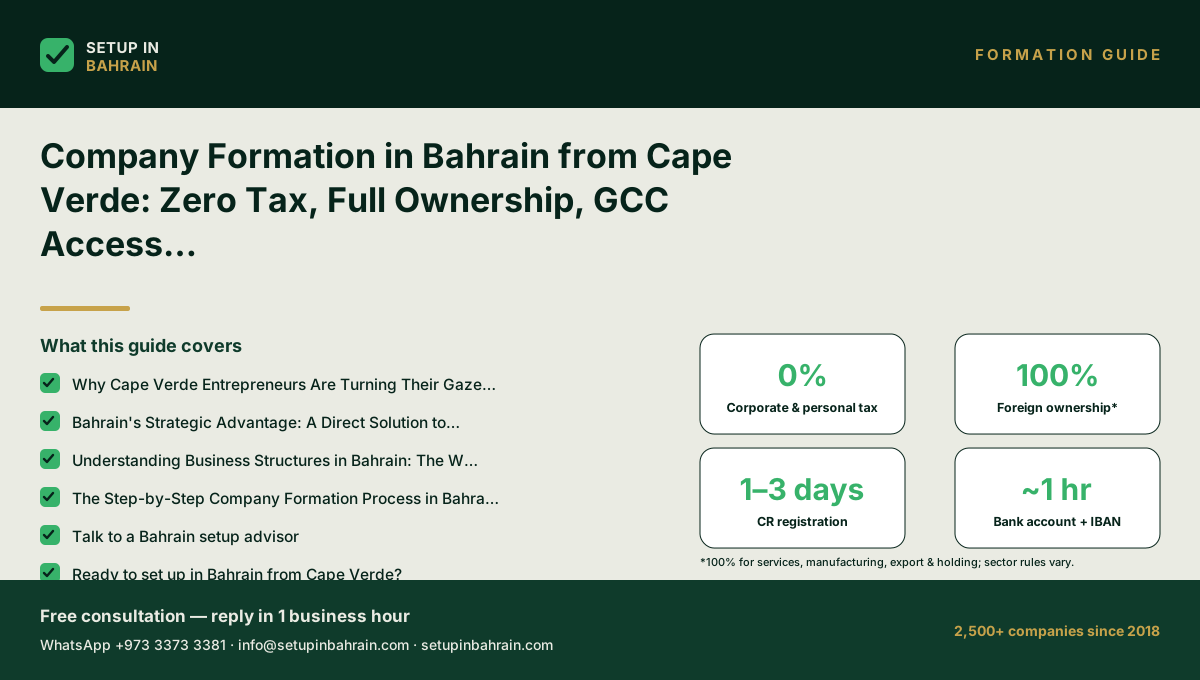
- Why Cape Verde Entrepreneurs Are Turning Their Gaze Towards Bahrain
- Bahrain's Strategic Advantage: A Direct Solution to Cape Verdean Pain Points
- Understanding Business Structures in Bahrain: The WLL Advantage
- The Step-by-Step Company Formation Process in Bahrain for Cape Verdeans
→ Complete guide: Company Formation in Bahrain — the full 2026 guide
View details
Ownership & capital
A Bahrain WLL can be owned by a single person — 100% foreign ownership applies to most activities, with no local partner required for services, manufacturing, export trading and holding companies. The minimum share capital is BHD 1 ; we recommend BHD 1,000 . This Makes bank account opening and investor visa approval smoother.
For many entrepreneurs in Cape Verde, the familiar rhythm of doing business on the islands often comes with a quiet, persistent frustration. You build, you innovate, you employ, and then, at the end of the financial year, you face a significant portion of your hard-earned profits disappearing into the 25% corporate income tax. It's a reality that can stifle growth, limit ambition. Make scaling beyond a small domestic market of 560,000 feel like an uphill battle against strong headwinds.
Let's talk about João, a Praia-based logistics entrepreneur who runs a modest freight forwarding operation serving the Sotavento islands. In 2024, his company cleared CVE 8.5 million in profit. After paying 25% corporate income tax, the municipal surcharges. The social security contributions for his five employees, he was left with just over CVE 4.8 million. That's a 43% effective tax burden on his net profit—and he's not alone.
Take the case of a Mindelo-based tourism operator who runs seasonal boat tours and villa rentals. After a strong summer season, he still handed over 25 percent of his profits to the Direcção Nacional de Receitas do Estado (DNRE), then watched another chunk disappear in social security contributions and compliance fees. The following quarter, when tourist arrivals dropped because of flight cancellations from Europe, revenue fell 40 percent, yet the tax bill remained a significant burden. This constant struggle for profitability and growth, often exacerbated by the challenges of a small, tourism-dependent economy, pushes many Cape Verdean visionaries to look beyond their shores.
Imagine, for a moment, a different scenario. A place where your business pays zero corporate income tax, where you retain 100% ownership without local partners. Where your capital isn't trapped by exchange controls. A place that not only offers a stable, USD-pegged currency but also serves as a direct gateway to a multi-trillion dollar market of over 50 million consumers, just a short drive away. This isn't a distant fantasy; it’s Bahrain, and it’s more and more becoming the strategic pivot point for visionary entrepreneurs from Cape Verde looking to redefine their commercial future in 2026 and beyond.
This guide is not a generic overview. It’s written specifically for you, the Cape Verdean entrepreneur. We understand the nuances of operating with the CVE pegged to the Euro but outside the Eurozone, the challenges of limited direct air connections to major GCC hubs, and the inherent difficulties of a small, tourism-dependent economy. We'll show you how Bahrain directly addresses these pain points, offering a robust, tax-efficient. Strategically located platform to not just survive, but to truly thrive on an international scale. Let’s explore how this island nation in the Arabian Gulf can become the springboard your Cape Verdean business has been searching for.
Why Cape Verde Entrepreneurs Are Turning Their Gaze Towards Bahrain
The decision to relocate or expand a business internationally is rarely taken lightly. For Cape Verdean entrepreneurs, it often stems from a deep-seated desire to overcome structural limitations at home and unlock new opportunities abroad. Bahrain, with its progressive economic policies and strategic location, presents a compelling alternative.
The Weight of Taxation: The 25% Burden on Cape Verdean Businesses
One of the most immediate and impactful drivers for Cape Verdean businesses considering international expansion is the corporate tax environment. Cape Verde imposes a 25% corporate income tax rate on company profits, a substantial levy that directly reduces reinvestment potential and overall profitability. While this rate is comparable to some European nations, it can feel especially heavy for businesses operating in a developing economy with a smaller domestic market and often higher operational costs relative to local purchasing power.
This 25% isn't just a number; it represents a quarter of your hard-earned profits that cannot be used for expansion, hiring new talent, product development, or simply building a stronger cash reserve. For a tourism business facing seasonal fluctuations or a logistics firm dealing with volatile fuel prices, this tax burden can mean the difference between steady growth and merely treading water. The DNRE, while modernizing, still requires significant manual interaction and adherence to a complex tax code that can be challenging to navigate, especially for small and medium-sized enterprises (SMEs).
Market Size and Reach: From 560,000 to 50 Million+ Consumers
Cape Verde’s domestic market, with a population hovering around 560,000, offers limited scalability for many businesses. While tourism provides a vital external revenue stream, relying solely on inbound visitors makes businesses susceptible to external shocks like global travel restrictions or economic downturns in key source markets. Expanding internationally from Cape Verde can be costly and logistically complex, with limited direct trade routes and a need to establish new distribution channels from scratch.
Bahrain, on the other hand, is not just an island nation of 1.5 million people. It is a vital node in the Gulf Cooperation Council (GCC), a formidable economic bloc comprising Saudi Arabia, UAE, Qatar, Kuwait, Oman. Bahrain. This bloc represents a combined GDP exceeding $2 trillion and a consumer base of over 50 million affluent individuals. The physical proximity to Saudi Arabia, connected by the King Fahd Causeway, makes the vast Saudi market virtually an extension of Bahrain's domestic economy. For a Cape Verdean entrepreneur, this is a leap from a relatively isolated market of half a million to direct access to millions of consumers, all within a day's drive or a short flight.
Currency Stability and Capital Flow: CVE vs. BHD
The Cape Verdean Escudo (CVE) is pegged to the Euro (EUR) at a fixed rate (1 EUR = 110.265 CVE). While this offers a degree of stability against one of the world's major currencies, it also means that the CVE's value fluctuates with the Euro, making businesses vulnerable to Eurozone economic shifts without having direct influence or being part of the Eurozone economic policies. Also, dealing with international transactions from Cape Verde can sometimes involve currency conversion fees and the complexities of capital controls or limitations imposed by the Banco de Cabo Verde (BCV) to manage foreign exchange reserves.
In stark contrast, the Bahraini Dinar (BHD) has been pegged to the US Dollar (USD) at a rate of 1 USD = 0.376 BHD since 1986. This long-standing peg provides unparalleled currency stability and predictability for international trade and investment. For businesses dealing with global suppliers or customers, especially those transacting in USD, this eliminates currency risk. More importantly, Bahrain maintains a liberal approach to capital repatriation, allowing businesses to freely transfer profits and capital out of the country without significant restrictions, a crucial factor for international investors.
Digital Infrastructure and Bureaucracy: DNRE vs. MOIC
Cape Verde's digital infrastructure, while developing, can still present hurdles. The DNRE's digital services are moderate, often requiring physical visits for complex matters or document submissions. This can translate into longer processing times and increased administrative burdens for businesses. The overall bureaucratic environment, though improving, can sometimes feel slow-moving for entrepreneurs accustomed to a faster pace of doing business.
Bahrain, consistently ranked as one of the freest economies in the Middle East and North Africa by the Heritage Foundation, boasts a highly digitized government and a greatly streamlined business environment. The Ministry of Industry, Commerce and Tourism (MOIC) has invested heavily in digital platforms like Sijilat, its online commercial registration portal. This allows for most company formation processes, license applications. Renewals to be completed entirely online, drastically reducing the time and effort required from entrepreneurs. The EDB (Economic Development Board) and BIPA (Bahrain Investors Protection Agency) are dedicated to attracting foreign investment and actively work to reduce red tape, offering a business-friendly ecosystem.
Banking Challenges: BCV's Limitations vs. Bahrain's Global Connectivity
For Cape Verdean businesses engaging in international trade, the Banco de Cabo Verde (BCV) and the domestic banking system can pose challenges related to international correspondent banking relationships. Limited direct access to a broad network of international correspondent banks can lead to slower international transfers, higher fees. Increased scrutiny for certain jurisdictions. This can complicate supplier payments, customer receipts, and overall cash flow management for globally ambitious enterprises.
Bahrain, as a long-established financial hub in the Middle East, offers a stark contrast. The Central Bank of Bahrain (CBB) regulates a sophisticated and robust banking sector with over 30 retail banks and numerous wholesale banks, including major international players. Bahraini banks maintain extensive correspondent banking networks globally, facilitating seamless and efficient international transactions. This highly liquid and well-regulated financial environment supports diverse financial services, from conventional banking to Islamic finance. Provides sophisticated payment gateways essential for modern e-commerce and global operations.
Bahrain's Strategic Advantage: A Direct Solution to Cape Verdean Pain Points
Having understood the key challenges faced by Cape Verdean entrepreneurs, let's now dive deeper into how Bahrain directly addresses and resolves these issues, presenting a compelling case for company formation.
Zero Corporate Income Tax: A Game-Changer for Profitability
This is perhaps the most significant and immediate draw for any entrepreneur. Bahrain currently levies zero corporate income tax on company profits. This isn't a temporary waiver or a tax holiday; it's a fundamental pillar of Bahrain's economic policy aimed at attracting foreign direct investment and fostering business growth. This applies to most sectors, with specific exceptions for oil and gas companies and certain petroleum industry activities. This Are taxed at 46%. For the vast majority of businesses – whether in services, technology, trade, or manufacturing – your net profits remain entirely yours.
Imagine the impact on João's logistics business or the Mindelo tourism operator. Instead of a quarter of their profits being siphoned off, that capital can be reinvested directly into the business. This translates to more resources for expansion, higher salaries for employees, more competitive pricing, faster innovation. Ultimately, accelerated growth. For a Cape Verdean business, transitioning from a 25% tax rate to 0% is not just an advantage; it's a fundamental shift in profitability and long-term sustainability.
100% Foreign Ownership: Unfettered Control for Entrepreneurs
A common hurdle in many emerging markets is the requirement for local partners or sponsors, often demanding a majority stake or significant control. This can dilute ownership, complicate decision-making, and create potential conflicts of interest. In Cape Verde. Foreign ownership is generally permitted, specific sectors or investment sizes might come with regulatory complexities.
Bahrain, under its progressive foreign investment laws, allows for 100% foreign ownership of companies in most sectors. This means you, as a Cape Verdean entrepreneur, can establish a company and retain complete control over your business, its assets. Its strategic direction. There is no need for a local sponsor or partner to hold a majority share, ensuring that your vision and management remain uncompromised. This level of autonomy is invaluable for entrepreneurs looking to protect their intellectual property and maintain full strategic agility. This applies to the most popular company types, like the With Limited Liability (WLL) company. This We'll discuss in detail.
Gateway to the GCC: Accessing a Multi-Trillion Dollar Market
Bahrain's strategic geographical position is not merely a convenience; it's a profound economic advantage. As mentioned, it serves as the most liberal gateway to the GCC market. The King Fahd Causeway, a 25-kilometer bridge connecting Bahrain to Saudi Arabia's Eastern Province, facilitates the seamless movement of goods and people. This means that a business established in Bahrain can efficiently serve not just the Bahraini market but also Saudi Arabia, the largest economy in the Middle East, with relative ease.
Beyond Saudi Arabia, Bahrain's well-developed logistics infrastructure, including Khalifa Bin Salman Port and Bahrain International Airport, ensures excellent air and sea connectivity across the entire GCC and beyond. For a Cape Verdean entrepreneur looking to expand beyond their island nation, Bahrain offers the logistical framework to reach a market of over 50 million consumers with significant purchasing power. This includes fast-growing sectors like technology, e-commerce, logistics, tourism. Financial services, all with high demand across the Gulf.
Economic Stability and the USD Peg: Your Financial Anchor
The long-standing peg of the Bahraini Dinar to the US Dollar provides a bedrock of financial stability. For businesses involved in international trade, especially those with revenues or expenses denominated in USD, this eliminates currency conversion risks and simplifies financial planning. This stability is especially reassuring for Cape Verdean entrepreneurs accustomed to the CVE's indirect reliance on the Euro.
Bahrain's economy is diversified, with strong sectors in finance, manufacturing, oil and gas. More and more, technology and tourism. The World Bank and International Monetary Fund consistently recognize Bahrain's commitment to economic reform and its robust regulatory environment, supervised by the Central Bank of Bahrain (CBB). This stability, coupled with an absence of capital controls, ensures that your profits can be freely repatriated. Your investments are secure.
Robust Digital Infrastructure and Pro-Business Government
Bahrain has invested greatly in its digital infrastructure, earning it high rankings in global connectivity indices. Its advanced telecommunications networks, widespread 5G coverage. Secure data centers provide a solid foundation for modern businesses, especially those in tech, e-commerce, and remote services. The government's "Cloud First" policy and initiatives like the Sijilat online portal show a clear commitment to fostering a digital-first business environment.
The MOIC (Ministry of Industry, Commerce and Tourism) and the EDB (Economic Development Board) are key enablers, actively assisting foreign investors throughout the company formation process and beyond. The BIPA (Bahrain Investors Protection Agency) further reinforces this commitment by safeguarding investor rights and promoting a fair business environment. For a Cape Verdean entrepreneur, this means less bureaucratic red tape, faster processing times. Access to a supportive ecosystem designed to help businesses thrive.
Understanding Business Structures in Bahrain: The WLL Advantage
Choosing the right legal structure is a foundational step in company formation. While Bahrain offers several company types, one stands out as the most popular and advantageous for foreign entrepreneurs, especially those seeking 100% ownership: the With Limited Liability (WLL) company.
Why the WLL (With Limited Liability) is Your Go-To Choice
The WLL company is the most common form of business entity in Bahrain and is highly recommended for Cape Verdean entrepreneurs. It offers the best balance of flexibility, protection, and operational ease for most business activities.
- Limited Liability Protection: As the name suggests, a WLL limits the liability of its owner(s) to the amount of their share capital contribution. This means your personal assets are protected from business debts and obligations, providing crucial peace of mind. 100% Foreign Ownership: Critically, a WLL can be owned 100% by a single foreign person or entity. You do not* need a local partner or sponsor to hold any percentage of shares. This is a significant advantage over many other jurisdictions.
- Flexibility in Management: A WLL can be managed by one or more directors, who do not necessarily need to be Bahraini residents.
- Wide Range of Activities: Most commercial, industrial, and service activities can be conducted under a WLL structure.
- Reputation: It is a recognized and respected company type globally, lending credibility to your operations.
No single-shareholder WLL – A Critical Distinction
It is absolutely crucial to understand that Bahrain does not have a "Single Person Company" (WLL) as a distinct legal entity type. If you encounter information suggesting a single-shareholder WLL in Bahrain, it is outdated or incorrect. Instead, the WLL structure is flexible enough to accommodate a sole shareholder. A WLL company can be established with just one shareholder, who can also be the sole director. This effectively serves the purpose of a single-owner entity while maintaining the robust legal framework of a WLL. Always remember: if you're a sole entrepreneur, you'll be forming a WLL with yourself as the 100% shareholder.
Share Capital Requirements: BHD 1 Legal, BHD 1,000 Practical
The legal minimum share capital for a WLL in Bahrain is remarkably low: BHD 1 (one Bahraini Dinar). This statutory minimum is designed to be highly accessible.
But, from a practical standpoint, we strongly recommend establishing a WLL with a minimum share capital of BHD 1,000. Why the difference?
- Bank Account Approval: Bahraini banks, especially for new corporate accounts, will typically require a more substantial initial deposit and capital to show genuine business intent and financial stability. A BHD 1,000 capital greatly increases your chances of seamless bank account approval.
- Investor Visa: If you, as the entrepreneur, intend to apply for an investor visa and residency in Bahrain, having a higher share capital (typically BHD 1,000 or more is seen favorably) shows a more serious commitment to your Bahraini enterprise. While not a strict legal requirement for the visa itself, it streamlines the process by satisfying the due diligence of various government bodies.
- Credibility: For potential clients, suppliers, or future investors, a company with a nominal capital of BHD 1 might raise questions about its financial standing. BHD 1,000 offers a more credible and professional image.
So. BHD 1 is the legal minimum, set your sights on BHD 1,000 as the practical starting capital for your WLL.
Key Features and Benefits of a Bahraini WLL
- Minimum Shareholders: One (single owner)
- Minimum Directors: One
- Nationality of Shareholders/Directors: Can be 100% foreign
- Share Capital: BHD 1 (legal minimum), BHD 1,000 (recommended practical minimum)
- Liability: Limited to share capital
- Registered Address: Required (physical or virtual office)
- Audit: Annual audit required by a CBB-licensed auditor
Other Company Types (Briefly Mentioned for Context)
While the WLL is ideal for most Cape Verdean entrepreneurs, Bahrain also offers other structures:
- Bahrain Shareholding Company (BSC): For larger enterprises, public offerings. Requires at least BHD 250,000 for a Closed BSC and BHD 1,000,000 for a Public BSC, with a minimum of 2 founders.
- Setup: For sole proprietorships where the owner's liability is unlimited. Less common for foreign investors due to the liability risk.
- Branch of a Foreign Company: If you already have an established company in Cape Verde or elsewhere and wish to create a subsidiary.
For the purpose of simplicity and maximum benefit, our focus will remain on the WLL.
The Step-by-Step Company Formation Process in Bahrain for Cape Verdeans
Navigating company formation in a new country can seem daunting. Bahrain’s streamlined online process, especially through the Sijilat portal, makes it surprisingly efficient. Here’s a breakdown of the typical steps for a Cape Verdean entrepreneur:
Phase 1: Planning and Preparation
This initial phase is crucial for laying a solid foundation for your Bahraini venture.
Choosing Your Business Activity
Before you register, you need to clearly define what your business will do. Bahrain's MOIC maintains a comprehensive list of permitted commercial activities.
- Specificity is Key: Be precise. Instead of "IT Services," specify "Software Development," "IT Consultancy," "Web Hosting," etc.
- Licensing: Different activities may require specific additional approvals or licenses from other ministries or regulatory bodies (e.g., healthcare activities from the Ministry of Health, financial services from the CBB). The Sijilat portal will automatically flag these requirements.
- Multiple Activities: You can register multiple activities under one company, provided they are compatible and you get all necessary licenses.
Selecting Your Company Name
The company name is your brand identity.
- Uniqueness: The proposed name must be unique and not already registered in Bahrain. You can check availability via the Sijilat portal.
- Regulations: Names cannot be offensive, controversial, or misleading. They typically must include the legal entity type (e.g., "Company Name W.L.L.").
- Arabic Translation: While not always legally mandatory for the primary name, having an Arabic translation for official documents and local recognition is often beneficial.
Understanding Licensing Requirements
Beyond commercial registration, most businesses require operational licenses. Commercial Registration (CR) : This is the primary license issued by the MOIC. Sector-Specific Licenses : Depending on your activity, you might need licenses from: * Ministry of Health : For medical clinics, pharmacies, food establishments. * Central Bank of Bahrain (CBB) : For financial services, insurance, fintech. * Ministry of Education : For training centers, schools. * National Tourism and Exhibitions Authority : For tourism-related businesses. Streamlined Process : Sijilat aims to integrate these approvals, allowing for a more consolidated application. But, be prepared for potential direct engagement with these authorities for detailed requirements.
Phase 2: MOIC Application and Approval
This is where the formal registration process begins, largely conducted online.
Required Documents (Specific to Cape Verdean Nationals)
For a Cape Verdean individual applying for a WLL, the typical documents include: Passport Copy : Clear, valid copy of the shareholder(s) and director(s) passports. National ID Card (if applicable) : For any Bahraini residents involved (though not mandatory for a 100% foreign-owned WLL). CV/Resume : For the shareholder(s) and director(s), detailing their experience. Proof of Address : Utility bill or bank statement (from Cape Verde or current residence) for the shareholder(s) and director(s). Power of Attorney (POA) : If using a local agent or consultant to submit the application on your behalf. This will need to be notarized in Cape Verde and legalized at the Bahraini embassy (if available) or via apostille. Proposed Company Name and Activities . Draft Memorandum of Association (MOA) : A legal document outlining the company's structure, objectives, share capital. Internal rules. (Often prepared by your consultant).
Note: All foreign documents should be in English or Arabic, or officially translated and attested.
Online Application via Sijilat
Bahrain's "Sijilat 2.0" portal is a world-class digital platform for commercial registration.
- Create an Account: Register as an individual or via a licensed agent.
- Select Company Type: Choose "With Limited Liability (WLL)".
- Enter Details: Input proposed company name, activities, shareholder/director information, and share capital (BHD 1,000 recommended).
- Upload Documents: Attach all required documents digitally.
- Pay Fees: Initial application and registration fees are paid online. These are generally reasonable, often in the range of BHD 100-200 for initial registration, plus fees for individual activities.
Initial Approval
The MOIC reviews your application. If all documents are in order and the proposed activities are compliant, you will receive an initial approval. This usually takes between 3-5 working days, though it can be faster if everything is perfectly prepared, or longer if queries arise. This approval confirms your name reservation and validates your proposed activities.
Phase 3: Legal and Financial Formalities
With initial approval in hand, you move to formalizing the company's legal and financial structure.
Drafting the Memorandum of Association (MOA)
Legal Document : The MOA is the company's constitution, detailing its purpose, capital structure. The rights and responsibilities of its shareholders. Standard Templates : The MOIC provides standard MOA templates. This Your legal consultant will adapt to your specific company details. Notarization : The MOA must be signed by all shareholders (or their authorized representative via POA) and notarized by a public notary in Bahrain. If you are not physically present, your appointed agent with a valid POA can sign on your behalf.
Capital Deposit and Bank Account Opening
This is a critical step, especially concerning the recommended BHD 1,000 capital. Provisional Bank Account : Once you have initial approval and your notarized MOA, you can approach a Bahraini bank (e.g., NBB, BBK, Ahli United Bank, HSBC Bahrain, Standard Chartered Bahrain) to open a provisional corporate bank account. Deposit Capital : Deposit the stated share capital (e.g., BHD 1,000) into this provisional account. The bank will issue a capital deposit certificate. Know Your Customer (KYC) : Banks in Bahrain conduct thorough KYC and anti-money laundering (AML) checks. Be prepared to provide comprehensive personal and business documents, including your CV, business plan. Explanation of source of funds. This process can take 2-4 weeks, or longer if information is incomplete. This is often the longest part of the setup process for foreign investors. BCV vs. CBB Context : The robust due diligence by CBB-regulated banks can be a different experience from BCV-regulated institutions. It ensures integrity and global connectivity. Commercial Registration Certificate Issuance
Once you have the capital deposit certificate from the bank, you upload it to Sijilat. The MOIC will then issue your final Commercial Registration (CR) Certificate. This officially brings your company into existence. The CR certificate will list
Bahrain Business Guides for Cape Verde Citizens
Frequently Asked Questions
How long does it take to set up?
It takes 15 to 20 days. We file all forms for you. You do not need to wait long.
What does it cost?
Company formation: Standard BHD 1,340 with 3 months of office address; Gold BHD 1,700 with 6 months; Premium BHD 2,150 with 12 months and a cabin, officer table and chair, and two guest chairs. No formation package includes visas, including Premium. Investor/work visas are priced separately: BHD 755 for one year or BHD 953 for two years, in addition to the formation package. Ask for a written, itemized quotation confirming government fees and all inclusions before payment.
Do I need to visit Bahrain?
No. You can set up your firm from home. We do all the work online. Some banks may ask for one visit.
What tax will I pay?
You pay zero tax on your profits. Bahrain has no corporate income tax. This is a key benefit of the setup.
Can I own 100% of my firm?
Yes. Foreign owners can hold all shares. No local partner is needed. Full ownership is allowed.
What do I need to start?
You need a valid passport. You also need a trade name and a business address. We help you with all of these.
How do I open a bank account?
We guide you step by step. Most banks take 3 to 6 weeks. You will need your CR and firm papers.
Who issues the Commercial Registration (CR)?
The CR is issued by the MOICT. It is your legal right to trade in Bahrain. We file the CR for you.
Can I renew my CR each year?
Company renewal packages: BHD 530 with 3 months of office address; BHD 980 with 6 months; BHD 1,520 with 12 months. These are separate renewal packages, not visa fees.
How do I get started?
Fill in our form on this page. Our team will call you back. We map your best setup plan at no cost.
Steps to Form Your Company
- Pick your trade name. We check if it is free.
- Choose your business type. WLL is the most common.
- Sign the MOA. We draft and file all legal docs.
- Pay the state fees. About BHD 432 in total.
- Get your CR. Takes 15 to 20 days.
- Open your bank account. We guide each step.
- Start trading. You are ready to do business.
Key Facts
- Tax rate: 0%
- Foreign ownership: 100%
- Setup time: 15 to 20 days
- Company formation: Standard BHD 1,340 with 3 months of office address; Gold BHD 1,700 with 6 months; Premium BHD 2,150 with 12 months and a cabin, officer table and chair, and two guest chairs. No formation package includes visas, including Premium. Investor/work visas are priced separately: BHD 755 for one year or BHD 953 for two years, in addition to the formation package. Ask for a written, itemized quotation confirming government fees and all inclusions before payment.
- Company renewal packages: BHD 530 with 3 months of office address; BHD 980 with 6 months; BHD 1,520 with 12 months. These are separate renewal packages, not visa fees.
- Client rating: 4.8 stars
- Clients served: 2,500 and more
Quick Facts
- Tax rate: 0%
- Own all of your firm: Yes, 100%
- Time to set up: 15 to 20 days
- Company formation: Standard BHD 1,340 with 3 months of office address; Gold BHD 1,700 with 6 months; Premium BHD 2,150 with 12 months and a cabin, officer table and chair, and two guest chairs. No formation package includes visas, including Premium. Investor/work visas are priced separately: BHD 755 for one year or BHD 953 for two years, in addition to the formation package. Ask for a written, itemized quotation confirming government fees and all inclusions before payment.
- Company renewal packages: BHD 530 with 3 months of office address; BHD 980 with 6 months; BHD 1,520 with 12 months. These are separate renewal packages, not visa fees.
- Rating: 4.8 stars
- Clients: 2,500 and more
Why Bahrain?
Bahrain has no tax. You keep all your profits. This is rare in the Gulf.
You can own all of your firm. No local partner is needed. The law allows full foreign ownership.
Setup takes 15 to 20 days. We file all forms for you. You can do it all from home.
Bahrain has a free trade deal with the US. Your goods face low or no tariffs. This gives you access to big markets.
We have served 2,800+ clients from 44+ countries and maintain records to substantiate that total where needed. We have 113 Google reviews; reviews represent only some clients and are not the same as the total clients served.
Our Steps
- Tell us your plan. We advise you for free.
- We pick the right firm type for you.
- We file all your forms with MOICT.
- You get your CR in 15 to 20 days.
- We help you open a bank account.
- You are ready to trade. We stay with you.
Next Steps for Cape Verde Citizens
You can set up a firm in Bahrain from Cape Verde. You do not need to fly there first. We do all the work online.
Tell us your plan. We call you back the same day. We map the best route for you at no cost.
We file all your forms. We deal with MOICT and the state. You get your CR in 15 to 20 days.
After your CR, we help you get a bank account. We also help with your Investor Visa. One firm guides you at each step.
Why Our Clients from Cape Verde Choose Us
- We speak your language. We know your needs.
- We have helped clients from Cape Verde before.
- Our fee is clear. No surprise costs.
- We have a 4.8 star rating on Google.
- We have helped more than 2,500 clients set up in Bahrain.
Fill in the form on this page. We will be in touch soon. Let us help you start your Bahrain firm today.
Ready to set up in Bahrain from Cape Verde?
Tell us your business idea. We map the right entity, ownership and timeline — then handle the filing while you focus on what matters.