
Start your Bahrain company from Australia with generally no corporate income tax for most sectors. Fast registration, full foreign ownership, and expert support for Australian entrepreneurs.
Key Takeaways
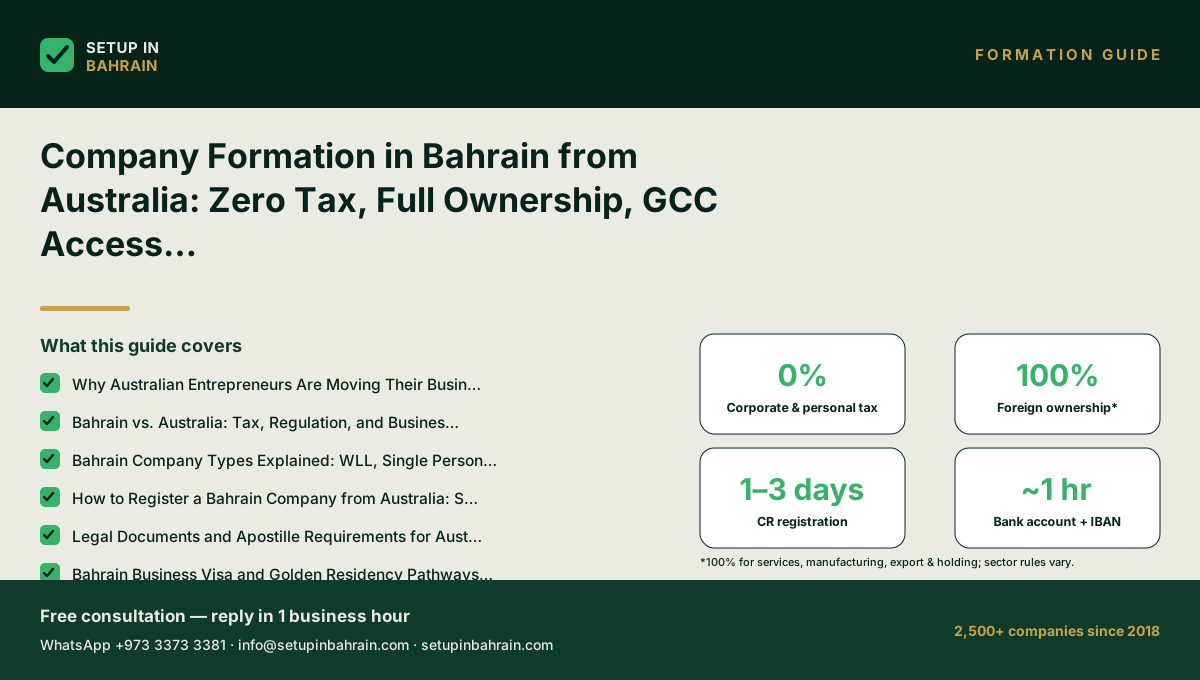
- Why Australian Entrepreneurs Are Moving Their Business to Bahrain
- Bahrain vs. Australia: Tax, Regulation, and Business Environment Comparison
- Bahrain Company Types Explained: WLL, Single Person Company, Branch
- How to Register a Bahrain Company from Australia: Step-by-Step
- Legal Documents and Apostille Requirements for Australian Citizens
→ Complete guide: Company Formation in Bahrain — the full 2026 guide
View details
Ownership & capital
A Bahrain WLL can be owned by a single person — 100% foreign ownership applies to most activities, with no local partner required for services, manufacturing, export trading and holding companies. The minimum share capital is BHD 1 ; we recommend BHD 1,000 . This Makes bank account opening and investor visa approval smoother.
Last month, I sat across from Marcus, a Sydney-based SaaS founder who'd just finished his quarterly BAS filing. His accountant had delivered the annual damage report: $847,000 in corporate tax on $2.8 million profit, plus another $156,000 in various compliance costs, superannuation contributions. Payroll tax. Marcus wasn't angry—he was exhausted. "I'm working 60-hour weeks to fund the ATO," he told me. "There has to be a better way."
There is. And it's 14,000 kilometers northwest of Sydney, across the Indian Ocean, in a small island kingdom that most Australians couldn't locate on a map.
Bahrain—a nation smaller than Greater Melbourne—has quietly become the most attractive jurisdiction in the Middle East for Australian entrepreneurs seeking to restructure their international operations. Generally no corporate income tax for most sectors for most businesses. Zero personal income tax. Zero capital gains tax. Zero withholding on dividends. Full foreign ownership since 2001. English-speaking government systems. And a geographic position that puts you 25 kilometers from the world's fastest-growing major economy: Saudi Arabia.
This guide breaks down exactly how Australian business owners can establish a legitimate Bahrain company, the real costs involved, the Australian tax implications you absolutely must understand, and the strategic opportunity that's drawing thousands of Western entrepreneurs to this Gulf state every year.
Here's what most Australian founders miss: the world isn't flat, but global business opportunities are. Your geographic distance from the MENA region doesn't have to be a barrier when you leverage a gateway like Bahrain.
Why Australian Entrepreneurs Are Moving Their Business to Bahrain
The exodus isn't dramatic. There's no mass migration announcement, no headlines in the Australian Financial Review about founders fleeing Melbourne for Manama. But if you pay attention to the numbers, the trend is unmistakable.
In 2024, the Bahrain Economic Development Board (EDB) reported a 34% increase in company registrations from Asia-Pacific nationals compared to the previous year. Australian-owned entities specifically grew by 28%, with particular concentration in technology services, consulting, and e-commerce sectors. The World Bank's 2024 Ease of Doing Business assessment ranked Bahrain first in the Arab world for starting a business—a position it's held consistently since 2019.
Let me paint you a picture I've seen play out repeatedly this quarter alone.
Matthew runs a $2.8 million IT consulting firm from his home office in Brisbane. He's been in business for seven years, employs 12 people. Last financial year paid $214,000 in corporate tax at the 30% rate. He spent another $38,000 on a tax accountant to navigate Division 7A implications, PAYG withholding complexities. BAS lodgements that arrive like clockwork every quarter. His superannuation guarantee costs him another $26,000 annually. His accountant recently warned him the ATO is increasing scrutiny on professional services firms claiming home office deductions.
Matthew earns $180,000 personally. After personal income tax at the marginal rate hitting 45% plus the 2% Medicare levy, he takes home roughly $108,000. That's a combined effective tax rate across his business and personal income exceeding 42%.
Then there's Emily, an experienced SaaS founder in Melbourne whose annual recurring revenue hit $5.5 million last year. She's proud of the growth, but frustration mounts as her accountant summarizes the annual numbers. After 3generally no corporate income tax for most sectors, complex PAYG withholding, monthly superannuation administration. Endless BAS and ATO filings, Emily's business ends up paying over $2 million each year—simply to exist in Australia. She's already scaled her team globally, but every attempt to optimize tax legitimately runs into opaque "anti-avoidance" rules. Her cross-border ambitions are tangled up with AUSTRAC's granular anti-money-laundering compliance requirements.
Sarah runs a specialist engineering consultancy in Perth supplying technical services to mining operations across the Middle East. Last financial year her company cleared $1.8 million in profit. After the 3generally no corporate income tax for most sectors hit, she handed over roughly $540,000 to the ATO. Then came quarterly BAS filings, PAYG withholding calculations, AUSTRAC transaction reporting for international payments. The constant scramble to reconcile everything before the next lodgement deadline. The real sting arrived when a Saudi client wanted to expand the contract greatly—but the complexity of servicing GCC clients from Australia made the expansion commercially unviable.
These aren't outliers. They represent thousands of Australian entrepreneurs facing the same arithmetic.
The Numbers That Drive the Decision
Australia's corporate tax structure creates a specific problem for growth-stage businesses. The 3generally no corporate income tax for most sectors applies to companies with aggregated turnover exceeding $50 million. The 25% rate covers smaller base rate entities. Either way, you're surrendering a quarter to a third of your profits before you can reinvest or distribute.
Compare that to Bahrain's structure: generally no corporate income tax for most sectors for most commercial activities. The only exception is oil and gas production companies. This Face a 46% rate—irrelevant for virtually every Australian entrepreneur considering the jurisdiction.
But taxation is only part of the equation. Australian compliance costs compound the burden:
Quarterly BAS Lodgements : Four times per year, every GST-registered business must calculate and remit goods and services tax, report PAYG withholding. Reconcile fuel tax credits. The administrative overhead for a mid-sized business typically runs 15-25 hours per quarter, plus accountant fees averaging $800-$2,500 per lodgement.
PAYG Withholding Complexity : Every employee payment requires withholding calculations based on variable rates. The Single Touch Payroll system demands real-time reporting. Contractors trigger different rules. International payments to non-residents require separate withholding considerations.
Superannuation Guarantee : Currently 11.5% of ordinary time earnings, increasing to 12% by July 2025, payable on top of salaries for every employee. The administrative burden of managing multiple super funds, processing contributions quarterly. Handling employee choice forms adds overhead that scales with headcount.
AUSTRAC Compliance : Australia's anti-money-laundering regime requires reporting entities to file suspicious matter reports, international funds transfer instructions. Threshold transaction reports. For businesses with international clients or suppliers, compliance review and documents can consume significant operational resources.
In Bahrain, none of these exist. No GST means no quarterly BAS filings. No income tax means no PAYG withholding for Bahrain-resident employees. No mandatory pension contributions at the Australian scale—Bahrain's Social Insurance Organisation requires contributions only for Bahraini nationals, at 19% (12% employer, 7% employee), not for expatriate workers. International payments face no withholding and minimal reporting friction.
Geographic Reality and the GCC Opportunity
Australia's physical isolation creates genuine strategic disadvantages for businesses targeting the Middle East and North Africa. The 14,000-kilometer distance from Sydney to Manama means flights take 16-18 hours minimum, usually with connections through Singapore, Kuala Lumpur, or Dubai. Timezone differences span 6-8 hours depending on daylight saving, making real-time collaboration challenging.
But here's what changes that calculation: if your client base is shifting toward the GCC, or if you're targeting that $1.8 trillion regional economy, proximity matters more than heritage.
Bahrain sits 25 kilometers from Saudi Arabia via the King Fahd Causeway—a 45-minute drive connects Manama to Dammam and the Eastern Province, home to Saudi Aramco and the kingdom's industrial heartland. The Gulf Cooperation Council encompasses Saudi Arabia, UAE, Kuwait, Qatar, Oman. Bahrain itself—six nations with a combined GDP exceeding $1.8 trillion and infrastructure spending projected at $2.3 trillion through 2030.
Saudi Vision 2030, the kingdom's economic diversification initiative, is creating unprecedented demand for technology services, professional consulting, engineering expertise. Knowledge-based businesses. Australian firms have strong reputations in mining services, environmental consulting, project management. Technical training—all sectors the GCC is actively importing expertise in.
Operating from Bahrain puts you within a two-hour flight of every GCC capital. Dubai is 45 minutes away. Riyadh is one hour. Doha is 45 minutes. You can attend a morning meeting in Abu Dhabi and be back in Manama for dinner. That's physically impossible from Perth or Sydney.
Bahrain vs. Australia: Tax, Regulation, and Business Environment Comparison
Understanding the structural differences between operating in Australia versus Bahrain requires looking beyond headline tax rates. The table below provides a comprehensive comparison:
| Factor | Australia | Bahrain |
| Corporate Tax Rate | 25-30% | 0% (except oil/gas) |
| Personal Income Tax | 0-45% + 2% Medicare levy | 0% |
| Capital Gains Tax | Included in income tax (with 50% discount if held >12 months) | 0% |
| Dividend Withholding | 0% for franked dividends; 30% unfranked to non-residents | 0% |
| VAT/GST | 10% GST | 10% VAT (since 2019) |
| Social Security Contributions | 11.5% superannuation (employer) | 12% employer + 7% employee (Bahrainis only) |
| Foreign Ownership Permitted | 100% | 100% (since 2001) |
| Minimum Capital Required | None for Pty Ltd | BHD 50 (~AUD 200) for WLL; varies by type |
| Local Director Required | At least one resident director | No |
| Local Sponsor Required | No | No (abolished 2001) |
| Average Company Formation Time | 1-3 days (ASIC online) | 1-3 days (Sijilat online) |
| Government Formation Fee | AUD 576 (ASIC) | BHD 200-500 (~AUD 800-2,000) |
| Annual Compliance Filing | Annual return + financial statements | CR renewal + audited accounts (some structures) |
| Language of Legal System | English | Arabic and English (dual system) |
| Currency | AUD (floating) | BHD (pegged to USD at 1:2.65) |
| Double Tax Treaty with Australia | N/A | No DTA currently in force |
| World Bank Ease of Doing Business | Ranked 14th (2020 final ranking) | Ranked 43rd; 1st in Arab world |
The generally no corporate income tax for most sectors Reality
Bahrain's Generally no corporate income tax for most sectors rate isn't a temporary incentive or a special economic zone benefit—it's the standard rate for commercial companies operating across the entire jurisdiction. The Legislative Decree No. 22 of 1979 established the income tax framework. This Has remained essentially unchanged: only companies engaged in oil and gas extraction and refining face the 46% hydrocarbon tax.
For Australian service businesses, tech companies, consultancies, trading operations. E-commerce ventures, the applicable corporate tax rate is genuinely zero. There's no alternative minimum tax, no accumulated earnings tax, no controlled foreign corporation rules on the Bahraini side.
This creates an immediate mathematical advantage. If your Australian company generates $1 million in taxable profit, you pay $250,000-$300,000 in corporate tax to the ATO. If a properly structured Bahrain company generates the same profit, it generally pays no corporate income tax in most sectors to the National Bureau for Revenue.
VAT Alignment and Simplicity
Both Australia and Bahrain operate value-added tax systems at 10%. Australia's GST has been in place since 2000. Bahrain introduced VAT in January 2019 as part of the GCC-wide framework.
The difference lies in administrative complexity. Bahrain's VAT system, administered by the National Bureau for Revenue (NBR), requires quarterly filing for most businesses and uses a straightforward online portal. There are no equivalent complexities to Australia's BAS system, which bundles GST with PAYG withholding, PAYG instalments. Fuel tax credits into a single return requiring reconciliation across multiple data sources.
Bahrain VAT registration is mandatory for businesses exceeding BHD 37,500 (~AUD 150,000) in annual taxable supplies. Below that threshold, registration is voluntary. The system offers input VAT recovery on business expenses, similar to Australia's GST credit mechanism. Without the administrative layering.
No Local Sponsor, No Local Director
One of Bahrain's most significant structural advantages is the absence of local partner or sponsor requirements for foreign-owned companies.
Before 2001, foreign businesses in most GCC countries required local sponsors—citizens who held at least 51% of company shares in exchange for lending their name and commercial registration. This created dependency relationships, profit-sharing obligations, and significant risks when partnerships soured.
Bahrain eliminated sponsor requirements in 2001, becoming the first GCC nation to permit 100% foreign ownership across most business activities. The UAE followed with its 2020 reforms, but many activities still require local partners there. Saudi Arabia has liberalized gradually but maintains sector-specific restrictions.
In Bahrain, you can establish a company that you own entirely—100% foreign shareholding—without a local partner, without a silent shareholder taking a cut, and without local director residency requirements. Your board can consist entirely of non-Bahraini, non-resident individuals.
Currency Stability and Repatriation Freedom
Australia's floating exchange rate creates currency risk for international operations. The AUD has fluctuated between USD 0.57 and USD 0.80 over the past decade, making long-term planning complicated for businesses with international revenue or expenses.
Bahrain's dinar (BHD) is pegged to the US dollar at a fixed rate of BHD 1 = USD 2.6596, a peg maintained since 1980. This creates effective currency stability for businesses operating in dollar-denominated markets—which describes most international B2B transactions.
More importantly, Bahrain imposes no restrictions on capital repatriation. You can transfer 100% of profits out of the country, in any currency, to any destination, without central bank approval, without exchange controls, and without exit taxes. The Central Bank of Bahrain (CBB) maintains this open capital account as a cornerstone of the kingdom's position as a regional financial center.
Bahrain Company Types Explained: WLL, Single Person Company, Branch
Bahrain offers several corporate structures suitable for Australian entrepreneurs. The choice depends on your ownership structure, liability preferences, operational model. Whether you need a physical presence or can operate remotely.
With Limited Liability Company (WLL)
The WLL (sometimes referenced as WLL or LLC in older documents) is Bahrain's equivalent of Australia's Pty Ltd—the most common structure for small and medium enterprises.
Key Characteristics:
- Minimum shareholders: 2 (can be individuals or corporate entities)
- Maximum shareholders: 50
- Minimum capital: BHD 50 (~AUD 200), though banks may require higher capital for account opening
- Liability: Limited to capital contribution
- Management: By one or more managers appointed by shareholders
- Foreign ownership: 100% permitted
- Annual requirements: Commercial registration renewal, audited financial statements for companies exceeding BHD 100,000 capital
The WLL requires a single shareholder (one person can own 100%). This Creates minor structuring considerations for solo founders. The standard approach involves either bringing in a trusted second shareholder (often a spouse or business partner) or using a corporate shareholder—your Australian Pty Ltd can hold 99% while you personally hold 1%, or vice versa.
WLL formation through the Ministry of Industry and Commerce (MOIC) Sijilat portal typically takes 1-3 business days once all documents is prepared. The process is fully online for most business activities, though certain regulated activities require additional licensing.
single-shareholder WLL
For solo founders who want full control without involving a second shareholder, the Single Person Company offers an alternative.
Key Characteristics:
- Shareholders: Exactly one (individual or corporate)
- Minimum capital: BHD 50 (~AUD 200)
- Liability: Limited to capital contribution
- Management: By the sole shareholder or appointed manager
- Foreign ownership: 100% permitted
- Restrictions: Cannot engage in banking, insurance, or investment management
The WLL provides the liability protection of a limited company without requiring a second shareholder. It's suitable for consultants, freelancers, and small service businesses operated by a single founder.
One limitation: WLLs cannot raise capital by admitting new shareholders without converting to a WLL structure first. If you anticipate bringing in co-founders or investors, starting with a WLL may be more practical.
Branch of a Foreign Company
Australian companies can establish a Bahrain branch rather than incorporating a new subsidiary. The branch operates as an extension of the Australian parent company, not as a separate legal entity.
Key Characteristics:
- Legal status: Extension of parent company, not separate entity
- Liability: Parent company fully liable for branch obligations
- Capital: No minimum, but may need to show adequate resources
- Management: Appointed branch manager (need not be Bahraini)
- Tax treatment: Same generally no corporate income tax for most sectors on Bahrain-sourced profits
- Accounting: Separate accounts required for Bahrain operations
Branches suit Australian companies that want a formal Bahrain presence for specific contracts or projects without creating a separate subsidiary. The branch can sign contracts, employ staff. Conduct business in Bahrain under the parent company's name and legal identity.
The key consideration is liability: the Australian parent company remains fully responsible for all branch obligations. There's no liability shield between Bahrain branch activities and the Australian parent's assets.
Holding Company Structures
For entrepreneurs planning more complex regional structures, Bahrain offers holding company frameworks that can own subsidiaries across multiple jurisdictions.
The Bahrain Holding Company can be established with 100% foreign ownership, hold shares in Bahraini and foreign companies. Benefit from Bahrain's treaty network and absence of withholding taxes on dividends, interest, or royalties paid out of Bahrain.
This structure becomes relevant when you're building a regional group with operating companies in multiple GCC countries, or when you want to consolidate ownership of various business interests under a single Bahrain umbrella.
How to Register a Bahrain Company from Australia: Step-by-Step
The actual formation process is more straightforward than most Australian entrepreneurs expect. The MOIC's Sijilat platform handles most company registrations entirely online. The government has invested heavily in digitizing business services.
Pre-Formation Preparation
Step 1: Define Your Structure and Activities
Before approaching registration, clarify your corporate structure (WLL, WLL, or branch) and identify your proposed business activities using Bahrain's classification system. The Commercial Registration (CR) specifies permitted activities. You'll want to ensure your planned operations fall within authorized categories.
Common activity codes for Australian entrepreneurs include:
- Computer programming and consultancy (IT services)
- Management consultancy
- Engineering consulting
- Marketing and communications services
- E-commerce and online retail
- Import/export trading
- Professional training and education services
Some activities require additional licensing beyond the basic CR. Financial services, healthcare, food production, and educational institutions need sector-specific approvals from relevant regulators.
Step 2: Name Reservation
Reserve your proposed company name through the Sijilat portal. Names must be unique, cannot duplicate existing registrations. Must comply with guidelines (no offensive terms, no names implying government affiliation, etc.). Arabic names are required; English trade names can be registered alongside.
Name reservation costs BHD 5 and remains valid for 60 days while you complete formation.
Step 3: Document Preparation
Required documents typically include:
- Passport copies for all shareholders and directors
- Proof of address for shareholders (utility bill, bank statement)
- Memorandum and Articles of Association (template available, or custom drafted)
- Board resolution authorizing incorporation (if corporate shareholders involved)
- Shareholder agreement (optional but recommended for multi-shareholder companies)
- Power of Attorney if using a formation agent
For Australian corporate shareholders, you'll need certified copies of the ASIC company extract showing current details. Document authentication requirements vary—some documents may need apostille or UAE embassy attestation, though Bahrain has more and more moved toward accepting certified copies for simpler formations.
Registration Process
Step 4: Submit Application Through Sijilat
The Sijilat portal (www.sijilat.bh) serves as the unified interface for commercial registration. Create an account, upload required documents, pay applicable fees, and submit your application.
Fees for WLL formation typically include:
- Commercial Registration: BHD 200-300 depending on activities
- MOIC processing: BHD 50-100
- Chamber of Commerce membership: BHD 150-300 annually
- Municipal license: varies by location and activity
Total government fees generally range BHD 400-700 (~AUD 1,600-2,800) for a standard commercial company.
Step 5: Receive Commercial Registration
Once approved, you receive your Commercial Registration certificate—the primary document establishing your company's legal existence. The CR specifies your company name, registration number, authorized activities, registered address. Validity period (typically one year, requiring annual renewal).
Most applications process within 1-3 business days. Complex applications or those requiring additional licensing may take longer.
Step 6: Post-Formation Requirements
With your CR in hand, several follow-up steps complete your operational setup:
- Social Insurance Registration: Register with the Social Insurance Organisation if employing Bahraini nationals
- VAT Registration: Register with the National Bureau for Revenue if expected turnover exceeds BHD 37,500
- Municipal License: Get from relevant municipality based on your office location
- Bank Account: Open a corporate bank account (see banking section below)
- Labor Authority Registration: Required before sponsoring employee visas
Using Formation Agents vs. Direct Registration
Australian entrepreneurs face a choice between direct registration and using a local corporate service provider.
Direct Registration Advantages:
- Lower cost (no agent fees)
- Direct control over documents
- Familiarity with your own company details
Direct Registration Challenges:
- Time zone complications (Bahrain operates on AST, GMT+3)
- Document authentication may require UAE embassy involvement
- Banking introductions often require local relationships
- No local expertise on navigating bureaucratic nuances
Formation Agent Advantages: Handle document preparation, apostilles. Attestations Navigate MOIC requirements efficiently Provide registered address if needed Help bank account introductions Ongoing support for annual renewals
Formation Agent Costs:
- Basic formation packages: BHD 500-1,500 (~AUD 2,000-6,000)
- Premium packages with virtual office, bank introduction, visa assistance: BHD 2,000-5,000 (~AUD 8,000-20,000)
For most Australian entrepreneurs forming their first Bahrain company, using an experienced corporate service provider justifies the cost through time savings and reduced friction, especially given the 14,000km distance and timezone challenges.
Legal Documents and Apostille Requirements for Australian Citizens
Australian documents destined for Bahrain use require authentication under the Hague Apostille Convention, to which both Australia and Bahrain are signatories.
Understanding Apostilles
An apostille is a certificate authenticating the origin of a public document, allowing it to be recognized in another convention member country. For Australian documents, the Department of Foreign Affairs and Trade (DFAT) issues apostilles.
Documents Typically Requiring Apostilles
Personal Documents:
- Passport (certified copy)
- Australian citizenship certificate (if relevant)
- Police clearance certificate (for visa applications)
- Educational qualifications (if required for professional licensing)
Corporate Documents (for Australian parent company):
- ASIC company extract
- Certificate of registration
- Board resolutions authorizing foreign subsidiary formation
- Power of Attorney appointing representatives
Australian Apostille Process
- Prepare documents: Original or certified copies as required
- Certification: Have copies certified by authorized persons (Justice of the Peace, lawyer, notary)
- DFAT submission: Apply online through DFAT's apostille service
- Processing: Standard processing takes 5-10 business days; priority service available
- Fee: AUD 88 per apostille (2024 rates)
Translation Requirements
Bahrain's legal system operates in Arabic and English, with most business registration processes accepting English documents. But, certain submissions may require Arabic translations, especially for:
- Memorandum and Articles of Association (Arabic version often required)
- Powers of Attorney
- Court documents or dispute resolution filings
Translation should be performed by certified legal translators. Costs typically run BHD 20-50 per page, depending on complexity.
Authentication Timing and Planning
Allow 2-3 weeks for document preparation, apostille processing, and any required translations. Rushing this process creates unnecessary friction and can delay your formation timeline.
A practical approach: gather all source documents first, identify which need apostilles, submit to DFAT as a batch. Arrange translations while awaiting apostille return.
Bahrain Business Visa and Golden Residency Pathways for Australians
Bahrain's immigration system offers several pathways for Australian entrepreneurs establishing businesses in the kingdom.
Business Visa (Visit Visa for Business)
For initial exploratory trips or short-term business activities, Australians can get visit visas on arrival or through e-visa applications.
On-Arrival Visa:
- Duration: 14 days, extendable to 28 days
- Cost: BHD 5 (~AUD 20)
- Eligibility: Australian passport holders
- Purpose: Business meetings, site visits, initial setup activities
E-Visa (Visit Visa):
- Duration: Up to 90 days
- Cost: BHD 29 (~AUD 116)
- Processing: Online, typically 1-3 days
- Purpose: Extended business activities, not employment
Investor Residency (Golden Residency)
Bahrain's Golden Residency program, launched in 2022, provides long-term residency for investors meeting qualifying criteria.
Real Estate Investment Route:
- Minimum investment: BHD 200,000 (~AUD 800,000) in approved real estate
- Residency period: 10 years, renewable
- Benefits: Work permit flexibility, family sponsorship
Business Investment Route:
- Setup of qualifying business in Bahrain
- Minimum capital thresholds vary by sector
- Residency tied to continued business operation
Self-Sponsorship:
- Available for entrepreneurs and professionals
- Requires demonstrating adequate income/resources
- Annual renewal required
Work Permit and Employee Visa
If you plan to relocate to Bahrain and work within your own company, you'll need a work permit sponsored by your Bahrain entity.
Process Overview:
- Company obtains Labor Market Regulatory Authority (LMRA) registration
- Apply for work permit through LMRA portal
- Receive visa authorization
- Enter Bahrain and complete residency processing
- Get CPR (Central Population Registration) card
Costs:
- Work permit: BHD 200-400 annually depending on salary bracket
- Medical examination: BHD 30-50
- Residency processing: BHD 50-100
Family Sponsorship
Employed residents can sponsor immediate family members (spouse, dependent children) for family residence visas. This allows your family to live in Bahrain legally and access local services, schools, and healthcare.
Visa-Free Operations
Critically, you don't need to relocate to Bahrain to operate a Bahrain company. Many Australian entrepreneurs maintain their Bahrain entities remotely, visiting periodically for banking and administrative matters while managing operations from Australia.
This model works especially well for:
- Service businesses with international clients
- E-commerce operations
- Investment holding structures
- Intellectual property licensing arrangements
The absence of physical presence requirements for company directors means you can structure your Bahrain entity to operate entirely without Bahrain-resident management, subject to practical banking and operational considerations.
Opening a Business Bank Account in Bahrain from Australia
Banking is often the most challenging aspect of establishing a foreign company, and Bahrain is no exception. But, the kingdom's position as a regional financial center means more options and more sophistication than most GCC jurisdictions.
Banking Landscape
Bahrain hosts over 100 licensed financial institutions, including retail banks, wholesale banks, and specialized investment firms. The Central Bank of Bahrain (CBB) regulates all licensed entities under a principles-based framework recognized internationally.
Major Local Banks:
- Bank of Bahrain and Kuwait (BBK)
- National Bank of Bahrain (NBB)
- Ahli United Bank
- Bahrain Islamic Bank
International Banks with Bahrain Presence:
- HSBC Bahrain
- Standard Chartered
- Citibank
- BNP Paribas
Account Opening Requirements
Bank account opening for new companies typically requires:
Corporate Documents:
- Commercial Registration certificate
- Memorandum and Articles of Association
- Board resolution authorizing account opening
- Shareholder details (passport copies, proof of address)
- Director details (same documents)
Business Information:
- Business plan or description of activities
- Expected transaction volumes and values
- Anticipated sources of funds
- Client and supplier details (for KYC purposes)
Compliance Documents:
- AML/KYC questionnaires
- Source of wealth declaration for significant shareholders
- Reference letters (bank references helpful but not always required)
The Physical Presence Question
Here's the reality most guides won't tell you directly: most Bahrain banks require at least one signatory to appear in person for account opening. Remote account opening for a new company with no existing Bahrain banking relationship is extremely difficult.
Practical Approaches:
Option 1: Initial Visit Plan a 3-5 day trip to Bahrain for company formation finalization and bank account opening. This is the most reliable approach and allows you to meet your bank relationship manager, sign documents in person. Complete biometric identification where required.
Option 2: Corporate Service Provider Facilitation Some formation agents maintain relationships with banks willing to work with introduced clients, potentially reducing physical presence requirements. This works better with smaller, more flexible banks than with international institutions.
Option 3: Fintech Alternatives For initial operational banking, consider multi-currency business accounts from international fintechs (Wise Business, Mercury, Payoneer) while establishing your Bahrain presence. These won't replace a local Bahrain bank account for all purposes but can provide working capital management during the setup period.
Banking Costs
Bahrain banking costs are generally moderate compared to other GCC jurisdictions:
- Account opening: Often free or BHD 100-500 one-time
- Monthly maintenance: BHD 20-50 for SME accounts
- International transfers: BHD 10-30 per transaction
- Currency conversion: Typically 1-2% spread
Multi-Currency Considerations
The BHD-USD peg means most Bahrain banks offer seamless USD account functionality. For Australian entrepreneurs with USD-denominated international clients, this provides practical currency management—receive USD, hold USD, pay suppliers in USD, without constant currency conversion.
For AUD requirements (paying Australian suppliers or transferring funds back to Australia), international transfer facilities work smoothly, though conversion costs apply.
Australian Tax Obligations: CFC Rules, CGT, and ATO Compliance
This section requires serious attention. Establishing a Bahrain company doesn't automatically reduce your Australian tax obligations—and structuring incorrectly can create significant ATO exposure.
Australian tax law includes comprehensive anti-avoidance provisions designed to prevent Australian residents from shifting profits to low-tax jurisdictions without genuine substance. Understanding these rules is essential before implementing any Bahrain structure.
Controlled Foreign Corporation (CFC) Rules
Australia's CFC rules, contained in Part X of the Income Tax Assessment Act 1936, attribute the income of foreign companies to their Australian controllers in certain circumstances.
When CFC Rules Apply:
A foreign company is a CFC if Australian residents hold:
- 50% or more of control (considering voting rights, dividend rights, or capital distribution rights), OR
- 40% or more, unless it's established that non-Australian residents control the company, OR
- An Australian resident together with associates has actual control
If your Bahrain company is a CFC (which it will be if you're the majority shareholder), its "attributable income" may be taxed in Australia in the year it's earned—regardless of whether dividends are actually paid.
Attributable Income:
Not all CFC income is attributable. The rules distinguish between:
Tainted Income (generally attributable):
- Passive income (interest, dividends, royalties, rent)
- Income from services provided to related parties
- Income from sales to or purchases from related parties
Active Business Income (potentially exempt): Active income exemption may apply if:
- The CFC passes the "active income test" (less than 5% of gross turnover is tainted services income)
- The income is derived from genuine active business operations
- There's real substance in the foreign jurisdiction
If your Bahrain company simply invoices Australian clients for services you personally provide while sitting in your Brisbane home office, the CFC rules will likely attribute that income to you personally in Australia—negating any tax benefit.
To achieve legitimate tax deferral or reduction, your Bahrain structure needs genuine economic substance: employees, office space, local management. Business activities that occur in Bahrain rather than just paperwork.
Capital Gains Tax on Foreign Shares
Australian residents are subject to CGT on worldwide capital gains, including gains from selling shares in foreign companies.
If you eventually sell your Bahrain company (or its shares), the capital gain will be assessable in Australia. The 50% CGT discount applies if shares are held for more than 12 months. The gain remains taxable.
Foreign Income Reporting
Australian tax residents must
Bahrain Business Guides for Australia Citizens
Frequently Asked Questions
How long does it take to set up?
It takes 15 to 20 days. We file all forms for you. You do not need to wait long.
What does it cost?
Company formation: Standard BHD 1,340 with 3 months of office address; Gold BHD 1,700 with 6 months; Premium BHD 2,150 with 12 months and a cabin, officer table and chair, and two guest chairs. No formation package includes visas, including Premium. Investor/work visas are priced separately: BHD 755 for one year or BHD 953 for two years, in addition to the formation package. Ask for a written, itemized quotation confirming government fees and all inclusions before payment.
Do I need to visit Bahrain?
No. You can set up your firm from home. We do all the work online. Some banks may ask for one visit.
What tax will I pay?
You pay zero tax on your profits. Bahrain has no corporate income tax. This is a key benefit of the setup.
Can I own 100% of my firm?
Yes. Foreign owners can hold all shares. No local partner is needed. Full ownership is allowed.
What do I need to start?
You need a valid passport. You also need a trade name and a business address. We help you with all of these.
How do I open a bank account?
We guide you step by step. Most banks take 3 to 6 weeks. You will need your CR and firm papers.
Who issues the Commercial Registration (CR)?
The CR is issued by the MOICT. It is your legal right to trade in Bahrain. We file the CR for you.
Can I renew my CR each year?
Company renewal packages: BHD 530 with 3 months of office address; BHD 980 with 6 months; BHD 1,520 with 12 months. These are separate renewal packages, not visa fees.
How do I get started?
Fill in our form on this page. Our team will call you back. We map your best setup plan at no cost.
Steps to Form Your Company
- Pick your trade name. We check if it is free.
- Choose your business type. WLL is the most common.
- Sign the MOA. We draft and file all legal docs.
- Pay the state fees. About BHD 432 in total.
- Get your CR. Takes 15 to 20 days.
- Open your bank account. We guide each step.
- Start trading. You are ready to do business.
Key Facts
- Tax rate: 0%
- Foreign ownership: 100%
- Setup time: 15 to 20 days
- Company formation: Standard BHD 1,340 with 3 months of office address; Gold BHD 1,700 with 6 months; Premium BHD 2,150 with 12 months and a cabin, officer table and chair, and two guest chairs. No formation package includes visas, including Premium. Investor/work visas are priced separately: BHD 755 for one year or BHD 953 for two years, in addition to the formation package. Ask for a written, itemized quotation confirming government fees and all inclusions before payment.
- Company renewal packages: BHD 530 with 3 months of office address; BHD 980 with 6 months; BHD 1,520 with 12 months. These are separate renewal packages, not visa fees.
- Client rating: 4.8 stars
- Clients served: 2,500 and more
Quick Facts
- Tax rate: 0%
- Own all of your firm: Yes, 100%
- Time to set up: 15 to 20 days
- Company formation: Standard BHD 1,340 with 3 months of office address; Gold BHD 1,700 with 6 months; Premium BHD 2,150 with 12 months and a cabin, officer table and chair, and two guest chairs. No formation package includes visas, including Premium. Investor/work visas are priced separately: BHD 755 for one year or BHD 953 for two years, in addition to the formation package. Ask for a written, itemized quotation confirming government fees and all inclusions before payment.
- Company renewal packages: BHD 530 with 3 months of office address; BHD 980 with 6 months; BHD 1,520 with 12 months. These are separate renewal packages, not visa fees.
- Rating: 4.8 stars
- Clients: 2,500 and more
Why Bahrain?
Bahrain has no tax. You keep all your profits. This is rare in the Gulf.
You can own all of your firm. No local partner is needed. The law allows full foreign ownership.
Setup takes 15 to 20 days. We file all forms for you. You can do it all from home.
Bahrain has a free trade deal with the US. Your goods face low or no tariffs. This gives you access to big markets.
We have served 2,800+ clients from 44+ countries and maintain records to substantiate that total where needed. We have 113 Google reviews; reviews represent only some clients and are not the same as the total clients served.
Our Steps
- Tell us your plan. We advise you for free.
- We pick the right firm type for you.
- We file all your forms with MOICT.
- You get your CR in 15 to 20 days.
- We help you open a bank account.
- You are ready to trade. We stay with you.
Next Steps for Australia Citizens
You can set up a firm in Bahrain from Australia. You do not need to fly there first. We do all the work online.
Tell us your plan. We call you back the same day. We map the best route for you at no cost.
We file all your forms. We deal with MOICT and the state. You get your CR in 15 to 20 days.
After your CR, we help you get a bank account. We also help with your Investor Visa. One firm guides you at each step.
Why Our Clients from Australia Choose Us
- We speak your language. We know your needs.
- We have helped clients from Australia before.
- Our fee is clear. No surprise costs.
- We have a 4.8 star rating on Google.
- We have helped more than 2,500 clients set up in Bahrain.
Fill in the form on this page. We will be in touch soon. Let us help you start your Bahrain firm today.
Ready to set up in Bahrain from Australia?
Tell us your business idea. We map the right entity, ownership and timeline — then handle the filing while you focus on what matters.