The Future of Co-working Space in Bahrain explores emerging trends, flexible office demand, startup growth, digital transformation. Investment
Quick Summary
- Bahrain: generally no corporate income tax for most sectors. 100% foreign ownership.
- Company formation in 15–20 business days.
- We have served 2,800+ clients from 44+ countries and maintain records to substantiate that total where needed. We have 113 Google reviews; reviews represent only some clients and are not the same as the total clients served.
- Full support from our team of experts.
- Company renewal packages: BHD 530 with 3 months of office address; BHD 980 with 6 months; BHD 1,520 with 12 months. These are separate renewal packages, not visa fees.
Key Takeaways
- The Future of Co-working Space in Bahrain: A Perfect Guide 2026
View details
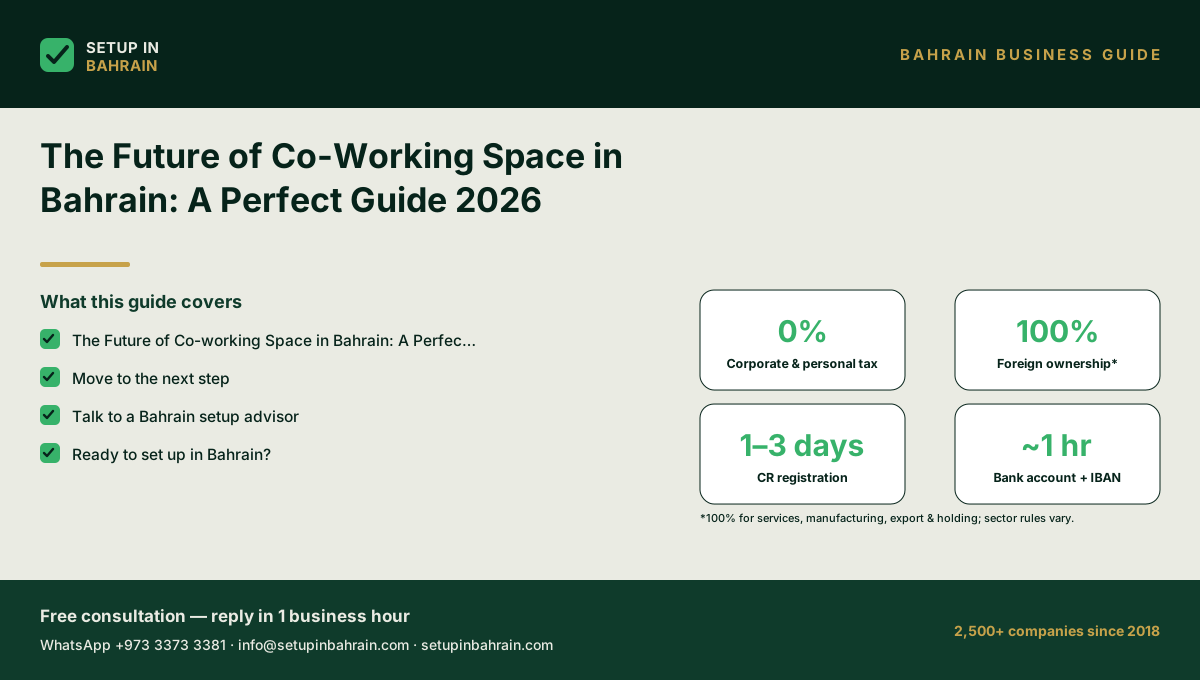
The Future of Co-Working Space in Bahrain is attracting attention from entrepreneurs, freelancers, startups. And global businesses seeking flexible, collaborative work environments. As Bahrain continues to invest in innovation and economic diversification, co‑working spaces have become more than just shared offices. They are hubs of creativity, networking, and business growth. The evolution of remote working trends and increased demand for flexible office solutions has made co‑working a strategic component of Bahrain’s business landscape.
With supportive government policies, modern infrastructure. And a growing startup ecosystem, Bahrain is positioned to become a regional leader in co‑working and hybrid work solutions. Companies both local and international are exploring co‑working not just for cost savings. But as a way to tap into dynamic communities, access mentors and investors. Expand into the GCC market. Understanding the future trajectory of co‑working spaces in Bahrain is vital for businesses planning long‑term growth and innovation.
For foreign businesses looking to register a company in Bahrain , get an investor visa . And open a corporate bank account , this digital logistics boom offers massive potential for growth and regional expansion.
The Future of Co-working Space in Bahrain: A Perfect Guide 2026
Table of Contents
- The Future of Co‑Working Space in Bahrain
- Evolution of Co‑Working in Bahrain
- Factors Driving Demand for Co‑Working
- Government Support and Strategic Initiatives
- Key Co‑Working Hubs in Bahrain
- Benefits of Co‑Working Spaces
- Co‑Working for Startups and SMEs
- Large Enterprises and Hybrid Work Models
- Pricing and Membership Trends
- Technology Integration in Co‑Working
- Collaboration and Community Building
- Sustainability and Green Work Spaces
- Challenges and Options
- Case Studies: Successful Co‑Working Models
- Future Outlook and Trends
- Frequently Asked Questions (FAQs)
1. The Future of Co-Working Space in Bahrain
Co-working spaces are reshaping Bahrain’s commercial landscape by offering flexible, scalable. And cost-efficient office solutions tailored to startups, freelancers, SMEs, and multinational firms. As workplace expectations shift from rigid long-term leases to agile environments, co-working spaces are evolving into innovation ecosystems where collaboration, technology. And entrepreneurship intersect.
Driven by economic diversification strategies and digital transformation initiatives in Bahrain, co-working is no longer a niche concept; it is becoming an integral component of modern business infrastructure.
2. Evolution of Co-Working in Bahrain
Co-working began gaining traction in the mid-2010s alongside the rise of startup culture and digital entrepreneurship. Initially centered around shared desks and open layouts, spaces have matured into fully serviced business hubs offering:
Year | Estimated Spaces | Key Development Trends |
2015 | 2–3 | Early startup-focused hubs |
2018 | 5–7 | Flexible packages and SME expansion |
2021 | 10–12 | Hybrid work acceleration, tech integration |
2024 | 15+ | Enterprise adoption, niche communities |
The steady increase reflects growing acceptance across multiple industries.
3. Key Drivers of Demand
Several structural and economic factors are fueling demand:
- Expansion of startups and SMEs
- Rise of hybrid and remote work models
- Cost optimization strategies by businesses
- Shorter lease commitments and scalability
- Increased focus on collaboration and networking
Businesses are prioritizing flexibility and operational efficiency over traditional office ownership.
4. Government Support and Strategic Alignment
Government initiatives aimed at innovation and SME growth have indirectly accelerated co-working adoption. Through business-friendly regulations, licensing simplification. And funding access, authorities have fostered an business environment aligned with Bahrain’s economic diversification goals.
Programs supporting digital transformation and fintech development have further increased demand for collaborative workspaces.
5. Key Co-Working Hubs in Bahrain
Several established hubs operate across the Kingdom, including innovation-driven centers such as Bahrain FinTech Bay . This Integrates co-working, acceleration programs. And investor access.
Other operators provide:
- Corporate-ready enterprise offices
- Creative and media-focused environments
- Women-focused business spaces
- Global franchise-style workspaces with standardized services
6. Benefits of Co-Working Spaces
Co-working offers measurable advantages:
- Reduced capital expenditure
- Access to high-quality infrastructure
- Immediate operational setup
- Community engagement and partnerships
- Business visibility within innovation networks
For growing companies, this translates into faster market entry and lower financial risk.
7. Co-Working for Startups and SMEs
Startups especially benefit from:
- Flexible desk-to-office scalability
- Mentorship and pitch events
- Exposure to venture capital networks
- Shared administrative services
- Collaborative knowledge sharing
The environment encourages innovation through proximity to other entrepreneurs.
8. Enterprise Adoption and Hybrid Work
Large corporations are integrating co-working into long-term real estate strategies by:
- Establishing satellite offices
- Supporting distributed teams
- Reducing long-term lease liabilities
- Creating innovation labs within shared environments
Hybrid workforce strategies have made co-working a strategic rather than temporary solution.
9. Pricing and Membership Trends
Membership pricing varies by service level and location.
Typical Co-Working Price Range in Bahrain
Membership Type | Estimated Monthly Cost (BHD) | Core Features |
Hot Desk | 50–100 | Shared seating, Wi-Fi access |
Dedicated Desk | 120–180 | Reserved desk, storage |
Private Office | 250–500 | Enclosed office, meeting room access |
Enterprise Suite | 500+ | Custom layout, premium services |
Flexible packages make co-working accessible across business sizes.
10. Technology Integration
Modern spaces emphasize digital infrastructure, including:
- High-speed secure internet
- Smart meeting room booking systems
- Cloud collaboration platforms
- Virtual office and mail handling services
- Digital member networking portals
Technology integration enhances productivity and operational efficiency.
11. Community and Collaboration
Community building is central to co-working success. Activities often include:
- Industry roundtables
- Pitch competitions
- Skills workshops
- Networking evenings
- Startup demo days
This ecosystem model encourages partnerships, knowledge exchange, and business development.
12. Sustainability and Green Workspaces
Sustainability is emerging as a differentiator, with operators adopting:
- Energy-efficient lighting systems
- Smart climate control
- Waste reduction initiatives
- Paperless management systems
- Eco-friendly interior designs
Green practices align with global ESG expectations and attract environmentally conscious members.
13. Challenges and Emerging Options
Key Challenges
- Increasing competition for premium locations
- Maintaining strong community engagement
- Balancing operational costs with membership pricing
- Adapting to evolving work behaviors
Strategic Options
- Sector-specific hubs (tech, design, women-led startups)
- Partnerships with universities and accelerators
- Integration of wellness facilities
- Expansion into mixed-use developments
Operators who innovate beyond desk space will sustain long-term growth.
14. Successful Co-Working Models
Leading co-working providers have succeeded by:
- Hosting accelerator programs
- Partnering with government entities
- Creating industry clusters
- Attracting international entrepreneurs
Such models show how shared workspaces can become engines of economic development.
15. Future Outlook and Trends
The future of co-working in Bahrain is shaped by:
- Stronger enterprise participation
- Growth in niche and specialized communities
- Integration of wellness and lifestyle amenities
- Expansion into suburban commercial zones
- Deeper collaboration with global workspace brands
As hybrid work becomes standard, co-working spaces are expected to evolve into full business ecosystems rather than simple office alternatives.
Quick Facts
- Bahrain: generally no corporate income tax for most sectors
- Foreign ownership: 100% allowed
- Setup time: 15 to 20 days
- Company formation: Standard BHD 1,340 with 3 months of office address; Gold BHD 1,700 with 6 months; Premium BHD 2,150 with 12 months and a cabin, officer table and chair, and two guest chairs. No formation package includes visas, including Premium. Investor/work visas are priced separately: BHD 755 for one year or BHD 953 for two years, in addition to the formation package. Ask for a written, itemized quotation confirming government fees and all inclusions before payment.
- Company renewal packages: BHD 530 with 3 months of office address; BHD 980 with 6 months; BHD 1,520 with 12 months. These are separate renewal packages, not visa fees.
- Rating: 4.8 stars on Google
- Clients served: 2,500 and more
Why Choose Bahrain?
Bahrain has no income tax. It is easy to set up a firm here. The rules are clear and fair.
You can own 100% of your firm. No local partner is needed. This is rare in the Gulf region.
You can open a bank account with ease. You can hire staff from any country. You can live and work here too.
Bahrain has free trade deals with the US and the GCC. This gives you access to large markets. It is a smart base for your business.
Why Set Up in Bahrain?
Bahrain is a great place to run a firm. It has no tax. You keep all your profits. This is rare in the Gulf.
You can own your firm 100%. No local partner is needed. The law is clear and fair.
It is fast to set up. You can have a CR in 15 to 20 days. We file all forms for you.
Bahrain has a free trade deal with the US. Your goods face low or no tariffs. This gives you access to big markets.
The banks are good. The roads are good. The schools are good. It is a well-run state.
We have served 2,800+ clients from 44+ countries and maintain records to substantiate that total where needed. We have 113 Google reviews; reviews represent only some clients and are not the same as the total clients served.
Our Services
- Company formation: Standard BHD 1,340 with 3 months of office address; Gold BHD 1,700 with 6 months; Premium BHD 2,150 with 12 months and a cabin, officer table and chair, and two guest chairs. No formation package includes visas, including Premium. Investor/work visas are priced separately: BHD 755 for one year or BHD 953 for two years, in addition to the formation package. Ask for a written, itemized quotation confirming government fees and all inclusions before payment.
- Company renewal packages: BHD 530 with 3 months of office address; BHD 980 with 6 months; BHD 1,520 with 12 months. These are separate renewal packages, not visa fees.
- Investor Visa — from BHD 755
- Work Visa — LMRA managed
- Virtual office — from BHD 600 per year
- Bank account opening — 3 to 6 weeks
- Family visa — for spouse and kids
- UBO filing — as required by law
Bahrain at a Glance
- Tax rate: 0%
- Foreign ownership: 100%
- Setup time: 15 to 20 days
- Free trade deal: Yes, with the US
- Language: Arabic and English
- Currency: Bahraini Dinar (BHD)
- Time zone: UTC+3
- GDP growth: Steady and strong
How to Start
- Fill in the form on this page. It takes 3 minutes.
- We call you back the same day.
- We map the best plan for your firm type and goals.
- We file all forms. We deal with MOICT for you.
- You get your CR in 15 to 20 days.
- We help you open a bank account and get your visa.
- You are ready to trade. We stay with you.
Common Questions
Do I need to visit Bahrain to set up?
No. You can do it all from home. We file online. You may need one visit to open a bank account.
Is Bahrain safe for business?
Yes. Bahrain is a stable state. It has a clear legal system. Your firm and funds are safe here.
Can I hire staff from any country?
Yes. You can hire from any country. Each hire needs a work permit from LMRA. We manage this for you.
What type of firm should I set up?
Most clients choose a WLL. This is a limited liability firm. It is flexible and well-known in Bahrain. We advise you on the best type for your case.
How do I get in touch?
Fill in our form. We call you back the same day. You can also email us or use the chat on this page.
Common Questions
Is it hard to set up a firm in Bahrain?
No. It is one of the easiest places in the Gulf. We do all the hard work for you. You can be set up in 20 days.
Do I need to live in Bahrain?
No. You can run your firm from home. You may visit once to open a bank account. The rest is done online.
How do I get started?
Fill in our form on this page. We call you back the same day. Our team maps your best plan at no cost to you.
Ready to set up in Bahrain?
Tell us your business idea. We'll map the right entity, ownership and timeline — then handle the filing while you build.
Official Bahrain government references
- Sijilat — MOICT commercial registration portalsijilat.bh
- Bahrain Economic Development Boardbahrainedb.com