How the GCC Unification is Benefiting Businesses in Bahrain: An Expert Guide 2026 — Explore how GCC economic integration is boosting cross-border trade,...
Quick Summary
- Bahrain: generally no corporate income tax for most sectors. 100% foreign ownership.
- Company formation in 15–20 business days.
- We have served 2,800+ clients from 44+ countries and maintain records to substantiate that total where needed. We have 113 Google reviews; reviews represent only some clients and are not the same as the total clients served.
- Full support from our team of experts.
- Company renewal packages: BHD 530 with 3 months of office address; BHD 980 with 6 months; BHD 1,520 with 12 months. These are separate renewal packages, not visa fees.
Key Takeaways
- How the GCC Unification is Benefiting Businesses in Bahrain: An Expert Guide 2026
View details
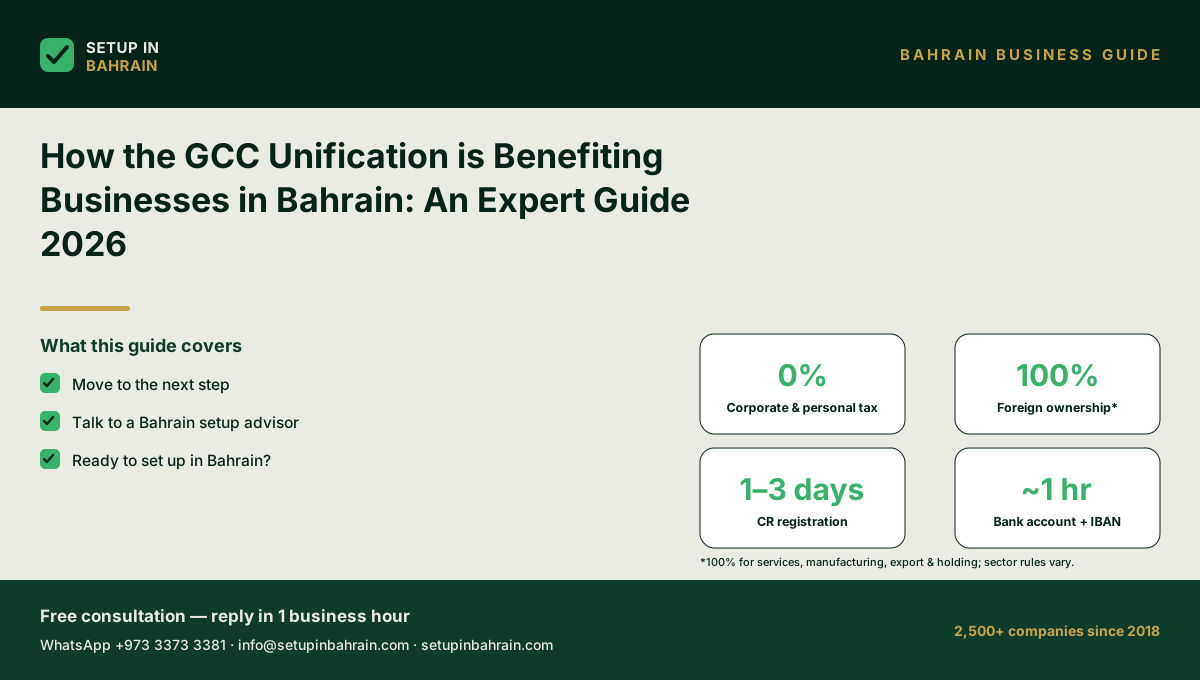
The Gulf Cooperation Council (GCC) has been steadily advancing toward deeper economic integration. And in 2026, this unification is creating significant advantages for businesses across the region, especially in Bahrain. As one of the most business-friendly economies in the GCC, Bahrain is uniquely positioned to benefit from unified trade policies, streamlined regulations. And improved cross-border collaboration. For entrepreneurs and investors, understanding how the GCC unification is benefiting businesses in Bahrain is key to unlocking new growth options.
In 2026, Bahrain continues to strengthen its role as a regional hub for finance, logistics, and trade. With reduced barriers between GCC countries, businesses operating in Bahrain can now access a wider market with greater ease. From simplified customs procedures to harmonized tax systems, GCC unification is transforming the business landscape and making Bahrain an even more attractive destination for startups and multinational companies alike.
For foreign businesses looking to register a company in Bahrain , get an investor visa . And open a corporate bank account , this digital logistics boom offers massive potential for growth and regional expansion.
How the GCC Unification is Benefiting Businesses in Bahrain: An Expert Guide 2026
Table of Contents
- What is GCC Unification and Its Impact on Bahrain
- Key Benefits
- Eligibility Criteria
- Minimum Investment Requirement
- GCC Unified Market vs Independent Markets
- Required Documents
- Application Process
- Processing Time
- Costs & Fees
- Business Setup Requirements
- Job/Operational Requirements
- Property Ownership Rules
- Taxation
- Common Reasons for Failure
- Advantages and Future Outlook
- FAQs
- Final Thoughts
1. What is GCC Unification and Its Impact on Bahrain
GCC unification refers to the integration of economic policies, trade regulations. Business frameworks among member countries, including Bahrain. This initiative aims to create a single economic market that allows the free movement of goods, services, capital. Labor. For Bahrain, this means enhanced connectivity with neighboring economies and increased options for businesses to expand regionally. Companies based in Bahrain can now operate more efficiently across GCC borders, benefiting from reduced bureaucracy and unified standards.
2. Key Benefits
How the GCC unification is benefiting businesses in Bahrain 2026 can be seen through several strategic advantages.
- Easier access to GCC markets
- Reduced trade barriers and tariffs
- Streamlined customs procedures
- Increased foreign investment
- Enhanced logistics and infrastructure
- Stronger regional partnerships
These benefits contribute to a more competitive and dynamic business environment in Bahrain.
3. Eligibility Criteria
Businesses looking to leverage GCC unification must meet certain requirements.
- Registered business entity in Bahrain
- Compliance with GCC regulations
- Valid trade license
- Financial stability
- Adherence to industry standards
Meeting these criteria ensures smooth operations within the unified GCC market.
4. Minimum Investment Requirement
The investment required depends on the type and scale of business.
| Business Type | Minimum Investment (USD) | Notes |
|---|---|---|
| Small Business | 5,000 – 20,000 | Ideal for startups |
| Medium Enterprise | 20,000 – 100,000 | Regional expansion |
| Large Corporation | 150,000+ | Multi-country operations |
Bahrain offers relatively low entry costs compared to other GCC countries.
5. GCC Unified Market vs Independent Markets
Understanding the difference helps businesses appreciate the benefits of unification.
| Feature | GCC Unified Market | Independent Markets |
|---|---|---|
| Trade Barriers | Minimal | Higher |
| Regulations | Harmonized | Different per country |
| Market Access | Wider | Limited |
| Operational Efficiency | High | Moderate |
How the GCC unification is benefiting businesses in Bahrain becomes clear when comparing these two models.
6. Required Documents
Businesses must prepare proper documents for operations within the GCC.
- Trade license
- Commercial registration
- Tax registration certificate
- Import/export permits
- Financial statements
Accurate documents ensures compliance and smooth cross-border operations.
7. Application Process
The process for leveraging GCC unification benefits involves several steps.
Step 1: Register business in Bahrain
Step 2: Get necessary licenses
Step 3: Ensure GCC compliance
Step 4: Set up trade operations
Step 5: Expand into GCC markets
Step 6: Maintain regulatory compliance
Proper execution of these steps is essential for success.
8. Processing Time
Business setup and expansion within the GCC typically takes 2 to 5 weeks. Bahrain is known for its efficient and fast approval processes. Timelines may vary depending on the nature of the business and regulatory requirements.
9. Costs & Fees
Understanding costs is essential for financial planning.
| Expense Type | Estimated Cost (USD) |
|---|---|
| Business Registration | 1,000 – 5,000 |
| Trade License | 2,000 – 6,000 |
| Office Setup | 3,000 – 15,000 |
| Compliance Costs | 1,000 – 4,000 |
Bahrain remains one of the most cost-effective destinations for business in the GCC.
10. Business Setup Requirements
Businesses must meet local setup requirements in Bahrain.
- Register with authorities
- Get commercial license
- Open corporate bank account
- Secure office space
- Comply with regulations
Bahrain offers a simplified and investor-friendly setup process.
11. Job/Operational Requirements
Operational efficiency is key to benefiting from GCC unification.
- Hire skilled workforce
- Maintain compliance with labor laws
- Ensure operational transparency
- Apply efficient supply chains
These requirements support sustainable business growth.
12. Property Ownership Rules
Bahrain allows foreign investors to own property in designated areas.
- Freehold ownership permitted
- Commercial property ownership allowed
- Minimal restrictions compared to other GCC countries
This flexibility enhances Bahrain’s appeal as a business hub.
13. Taxation
Bahrain offers a highly attractive tax environment.
- No personal income tax
- No corporate tax for most sectors
- VAT at 10%
- Customs duties on certain goods
This tax structure greatly boosts profitability for businesses.
14. Common Reasons for Failure
Despite strong advantages, businesses may face challenges.
- Lack of market understanding
- Poor compliance with GCC regulations
- Inadequate financial planning
- Inefficient operations
- Failure to adapt to regional standards
Avoiding these mistakes is crucial for long-term success.
15. Advantages and Future Outlook
How the GCC unification is benefiting businesses in Bahrain 2026 is evident in the country’s growing role as a regional business hub. With continued integration, businesses will experience even greater ease in cross-border trade and operations. Future developments are expected in sectors such as fintech, logistics, tourism, and manufacturing. Bahrain’s strategic location and business-friendly policies will continue to attract investors and entrepreneurs.
16. FAQs
- What is GCC unification?
It is the integration of economic policies among GCC countries. - How does it benefit businesses in Bahrain?
By reducing trade barriers and increasing market access. - Is Bahrain a good place for business in 2026?
Yes, due to its investor-friendly environment. - What is the minimum investment required?
It can start from USD 5,000. - Are there tax benefits in Bahrain?
Yes, including no personal income tax. - How long does business setup take?
Usually 2 to 5 weeks. - Can foreigners own businesses in Bahrain?
Yes, with full ownership in many sectors. - What sectors are growing in Bahrain?
Fintech, logistics, and tourism. - Is GCC trade easy from Bahrain?
Yes, due to unified regulations. - Do I need special licenses for GCC trade?
Yes, depending on your business activity. - Are there operational requirements?
Yes, including compliance and staffing. - Can I expand to other GCC countries easily?
Yes, due to unification benefits. - What are common challenges?
Regulatory compliance and market understanding. - Is Bahrain cost-effective for business?
Yes, compared to other GCC countries. - What is the future outlook?
Very positive with increasing options.
17. Final Thoughts
How the GCC unification is benefiting businesses in Bahrain 2026 highlights the region’s commitment to economic integration and growth. Bahrain stands out as a key beneficiary, offering businesses access to a unified market, favorable tax policies. And efficient regulatory systems. For entrepreneurs and investors, this is the ideal time to establish or expand operations in Bahrain. With proper planning and execution, businesses can leverage GCC unification to achieve long-term success and regional expansion.
Quick Facts
- Bahrain: generally no corporate income tax for most sectors
- Foreign ownership: 100% allowed
- Setup time: 15 to 20 days
- Company formation: Standard BHD 1,340 with 3 months of office address; Gold BHD 1,700 with 6 months; Premium BHD 2,150 with 12 months and a cabin, officer table and chair, and two guest chairs. No formation package includes visas, including Premium. Investor/work visas are priced separately: BHD 755 for one year or BHD 953 for two years, in addition to the formation package. Ask for a written, itemized quotation confirming government fees and all inclusions before payment.
- Company renewal packages: BHD 530 with 3 months of office address; BHD 980 with 6 months; BHD 1,520 with 12 months. These are separate renewal packages, not visa fees.
- Rating: 4.8 stars on Google
- Clients served: 2,500 and more
Why Choose Bahrain?
Bahrain has no income tax. It is easy to set up a firm here. The rules are clear and fair.
You can own 100% of your firm. No local partner is needed. This is rare in the Gulf region.
You can open a bank account with ease. You can hire staff from any country. You can live and work here too.
Bahrain has free trade deals with the US and the GCC. This gives you access to large markets. It is a smart base for your business.
How We Help You
We are a team of experts. We set up firms in Bahrain. We have helped 2,500 clients.
We do all the hard work. You just tell us your plan. We take care of the rest.
Our team files all forms. We deal with the state. We keep you up to date at each step.
We have a 4.8 star rating on Google. Our clients trust us. We are proud of that.
What You Get
- A valid CR in 15 to 20 days
- Zero tax on your profits
- Full foreign ownership — no local partner
- A bank account in 3 to 6 weeks
- An Investor Visa to live and work in Bahrain
- Staff from any country, via LMRA work permits
- A virtual office or a real one — your choice
Our Process
- You fill in our form. It takes 3 minutes.
- We call you back the same day.
- We check your plan and pick the right firm type.
- We draft your MOA and all legal files.
- We file with MOICT via the Sijilat portal.
- You get your CR in 15 to 20 days.
- We help you open your bank account.
- You can trade. You are done.
Key Numbers
- Tax rate: 0%
- Ownership: 100% foreign
- Time to set up: 15 to 20 days
- Company formation: Standard BHD 1,340 with 3 months of office address; Gold BHD 1,700 with 6 months; Premium BHD 2,150 with 12 months and a cabin, officer table and chair, and two guest chairs. No formation package includes visas, including Premium. Investor/work visas are priced separately: BHD 755 for one year or BHD 953 for two years, in addition to the formation package. Ask for a written, itemized quotation confirming government fees and all inclusions before payment.
- Company renewal packages: BHD 530 with 3 months of office address; BHD 980 with 6 months; BHD 1,520 with 12 months. These are separate renewal packages, not visa fees.
- Investor Visa: From BHD 755
- Virtual office: From BHD 600 per year
- Clients served: Over 2,500
- Star rating: 4.8 on Google
Bahrain vs Other GCC Markets
Bahrain is easy. The UAE needs a local sponsor for some firm types. Saudi Arabia has more rules.
Bahrain has zero tax. Qatar has no tax too, but the rules are more strict. Kuwait is more costly.
In Bahrain, you can own all of your firm. You do not need a local partner. This is a big plus.
Bahrain has a free trade deal with the US. This means your goods face low or no tariffs. No other GCC state has this deal.
Common Terms
- CR: Commercial Registration — your right to trade
- MOA: Memorandum of Association — your firm's legal deed
- WLL: With Limited Liability — the most common firm type
- LMRA: Labour Market Regulatory Authority — issues work and investor visas
- MOICT: Ministry of Industry — issues CRs and firm licenses
- Sijilat: The online portal to file your CR
Common Questions
Is it hard to set up a firm in Bahrain?
No. It is one of the easiest places in the Gulf. We do all the hard work for you. You can be set up in 20 days.
Do I need to live in Bahrain?
No. You can run your firm from home. You may visit once to open a bank account. The rest is done online.
How do I get started?
Fill in our form on this page. We call you back the same day. Our team maps your best plan at no cost to you.
Ready to set up in Bahrain?
Tell us your business idea. We'll map the right entity, ownership and timeline — then handle the filing while you build.
Official Bahrain government references
- Sijilat — MOICT commercial registration portalsijilat.bh
- Bahrain Economic Development Boardbahrainedb.com