Gulf Economies to Rebound on Higher Oil Output and Revenue Diversification, as easing OPEC+ production cuts, rising energy revenues. And rapid growth in
Quick Summary
- Bahrain: generally no corporate income tax for most sectors. 100% foreign ownership.
- Company formation in 15–20 business days.
- We have served 2,800+ clients from 44+ countries and maintain records to substantiate that total where needed. We have 113 Google reviews; reviews represent only some clients and are not the same as the total clients served.
- Full support from our team of experts.
- Company renewal packages: BHD 530 with 3 months of office address; BHD 980 with 6 months; BHD 1,520 with 12 months. These are separate renewal packages, not visa fees.
Key Takeaways
- Gulf Economies to Rebound on Higher Oil Output and Revenue Diversification 2026
- Table of Contents
- 6. Policy Reforms, Incentives, and Strategic Investments
View details
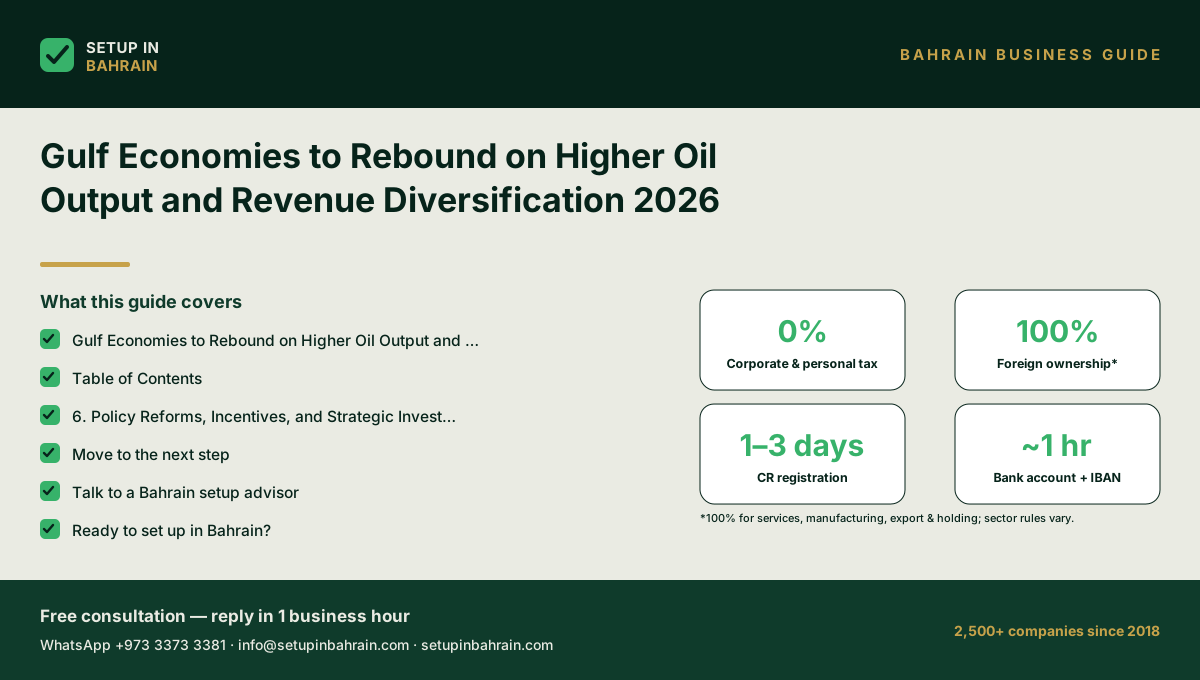
Gulf Economies to Rebound on Higher Oil Output and Revenue Diversification as GCC countries prepare for stronger economic momentum driven by increased crude production, firmer energy prices, and the gradual easing of OPEC+ supply limits. Alongside oil-led revenue gains, governments across the region are accelerating diversification strategies by expanding non-oil sectors such as tourism, financial services, logistics, manufacturing. And digital innovation, helping reduce dependence on hydrocarbons and strengthen long-term economic resilience heading into 2026.
After a period of slowed growth in 2023–2024, the Gulf economies are entering a strong rebound on higher oil output phase in 2025. This surge is powered by:
- Higher oil production quotasfollowing OPEC+ adjustments
- Rising global oil demanddriven by Asia’s industrial recovery
- Revenue diversification projectsaligned with GCC Vision strategies
Key Insight: GCC states, including Bahrain, are targeting a post-oil economy while still benefiting from a favorable oil cycle — creating a dual engine of growth . For foreign businesses looking to register a company in Bahrain , get an investor visa . And open a corporate bank account , this digital logistics boom offers massive potential for growth and regional expansion.
Gulf Economies to Rebound on Higher Oil Output and Revenue Diversification 2026
Table of Contents
- Introduction: Why 2025 is a Turning Point for Gulf Economies
- Key Drivers of Economic Growth: Oil & Beyond
- Sector-by-Sector Analysis: Who Will Benefit Most
- Impact on Investors and Business Owners in Bahrain
- Case Study: A Bahrain-Based Company Leveraging Diversification
- Policy Reforms, Incentives, and Strategic Investments
- Risks & Challenges Ahead for Gulf Economies
- Options for Foreign Entrepreneurs & Expats
- Checklist: Preparing Your Business for GCC Growth
- 20+ FAQs with Detailed Insights
1. Introduction: Why 2025 is a Turning Point for Gulf Economies
After a period of slowed growth in 2023–2024, the Gulf economies are entering a strong rebound phase in 2025. This surge is powered by:
2. Key Drivers of Economic Growth: Oil & Beyond
Growth Driver | Why It Matters in 2025 | Business Impact |
Oil Output Recovery | OPEC+ easing production cuts boosts revenues | Higher government spending, more contracts |
Public Sector Investments | Mega projects in infrastructure, tourism, healthcare | B2B options for suppliers & contractors |
SME Support & Grants | GCC governments promoting private sector | Easier company formation and financing |
FDI Incentives | Tax holidays, free zones, and investor visas | Attracts foreign entrepreneurs & capital |
3. Sector-by-Sector Analysis: Who Will Benefit Most
- 🏗Construction & Infrastructure: Major projects in Bahrain, Saudi Arabia, and UAE create demand for contractors.
- 🏥Healthcare & MedTech: GCC is investing in advanced healthcare systems — a chance for MedTech startups to enter.
- 📊Financial Services: Rising capital flows encourage fintech growth.
- 🌱Sustainable Energy & Green Tech: Diversification agendas focus on renewables — solar, wind, and hydrogen.
4. Impact on Investors and Business Owners in Bahrain
Bahrain is positioning itself as the smartest gateway to the GCC market thanks to:
- 0% personal income taxand low operational costs
- Streamlined business setup processes (start your business here)
- Growing financial and logistics sectors
- Proximity to Saudi Arabia — the region’s largest economy
This makes it an ideal base for exporters, manufacturers, and tech entrepreneurs looking to scale across GCC.
5. Case Study: A Bahrain-Based Company Leveraging Diversification
Client Profile: Renewable energy startup
Challenge: Needed access to GCC markets but faced high costs in UAE
Solution:
- Established operations in Bahrain using virtual office services
- Secured funding via Bahrain’s Tamkeen programs
- Partnered with Saudi distributors to sell solar panels
Outcome:
- Reduced setup costs by 30%
- Expanded into KSA within 8 months
- Increased revenue by 45% year-over-year
Quick Facts
- Bahrain: generally no corporate income tax for most sectors
- Foreign ownership: 100% allowed
- Setup time: 15 to 20 days
- Company formation: Standard BHD 1,340 with 3 months of office address; Gold BHD 1,700 with 6 months; Premium BHD 2,150 with 12 months and a cabin, officer table and chair, and two guest chairs. No formation package includes visas, including Premium. Investor/work visas are priced separately: BHD 755 for one year or BHD 953 for two years, in addition to the formation package. Ask for a written, itemized quotation confirming government fees and all inclusions before payment.
- Company renewal packages: BHD 530 with 3 months of office address; BHD 980 with 6 months; BHD 1,520 with 12 months. These are separate renewal packages, not visa fees.
- Rating: 4.8 stars on Google
- Clients served: 2,500 and more
Why Choose Bahrain?
Bahrain has no income tax. It is easy to set up a firm here. The rules are clear and fair.
You can own 100% of your firm. No local partner is needed. This is rare in the Gulf region.
You can open a bank account with ease. You can hire staff from any country. You can live and work here too.
Bahrain has free trade deals with the US and the GCC. This gives you access to large markets. It is a smart base for your business.
Common Questions
Is it hard to set up a firm in Bahrain?
No. It is one of the easiest places in the Gulf. We do all the hard work for you. You can be set up in 20 days.
Do I need to live in Bahrain?
No. You can run your firm from home. You may visit once to open a bank account. The rest is done online.
How do I get started?
Fill in our form on this page. We call you back the same day. Our team maps your best plan at no cost to you.
Why Set Up in Bahrain?
Bahrain is a great place to run a firm. It has no tax. You keep all your profits. This is rare in the Gulf.
You can own your firm 100%. No local partner is needed. The law is clear and fair.
It is fast to set up. You can have a CR in 15 to 20 days. We file all forms for you.
Bahrain has a free trade deal with the US. Your goods face low or no tariffs. This gives you access to big markets.
The banks are good. The roads are good. The schools are good. It is a well-run state.
We have served 2,800+ clients from 44+ countries and maintain records to substantiate that total where needed. We have 113 Google reviews; reviews represent only some clients and are not the same as the total clients served.
Our Services
- Company formation: Standard BHD 1,340 with 3 months of office address; Gold BHD 1,700 with 6 months; Premium BHD 2,150 with 12 months and a cabin, officer table and chair, and two guest chairs. No formation package includes visas, including Premium. Investor/work visas are priced separately: BHD 755 for one year or BHD 953 for two years, in addition to the formation package. Ask for a written, itemized quotation confirming government fees and all inclusions before payment.
- Company renewal packages: BHD 530 with 3 months of office address; BHD 980 with 6 months; BHD 1,520 with 12 months. These are separate renewal packages, not visa fees.
- Investor Visa — from BHD 755
- Work Visa — LMRA managed
- Virtual office — from BHD 600 per year
- Bank account opening — 3 to 6 weeks
- Family visa — for spouse and kids
- UBO filing — as required by law
Bahrain at a Glance
- Tax rate: 0%
- Foreign ownership: 100%
- Setup time: 15 to 20 days
- Free trade deal: Yes, with the US
- Language: Arabic and English
- Currency: Bahraini Dinar (BHD)
- Time zone: UTC+3
- GDP growth: Steady and strong
How to Start
- Fill in the form on this page. It takes 3 minutes.
- We call you back the same day.
- We map the best plan for your firm type and goals.
- We file all forms. We deal with MOICT for you.
- You get your CR in 15 to 20 days.
- We help you open a bank account and get your visa.
- You are ready to trade. We stay with you.
Common Questions
Do I need to visit Bahrain to set up?
No. You can do it all from home. We file online. You may need one visit to open a bank account.
Is Bahrain safe for business?
Yes. Bahrain is a stable state. It has a clear legal system. Your firm and funds are safe here.
Can I hire staff from any country?
Yes. You can hire from any country. Each hire needs a work permit from LMRA. We manage this for you.
What type of firm should I set up?
Most clients choose a WLL. This is a limited liability firm. It is flexible and well-known in Bahrain. We advise you on the best type for your case.
How do I get in touch?
Fill in our form. We call you back the same day. You can also email us or use the chat on this page.
6. Policy Reforms, Incentives, and Strategic Investments
Country | Key Policy Reform | Impact |
Bahrain | Corporate governance updates, CR renewal simplification | Easier CR renewal and compliance |
Saudi Arabia | Vision 2030 mega projects, NEOM, Giga investments | Billions in supplier contracts |
UAE | No formation package includes visas, including Premium. Investor/work visas are priced separately: BHD 755 for one year or BHD 953 for two years, in addition to the formation package. | Increased investor security |
Qatar & Oman | Free zone upgrades, tax exemptions | Competitive locations for manufacturing |
7. Risks & Challenges Ahead for Gulf Economies
- 🛢Oil Price Volatility: Global demand shocks can affect budgets
- 📉Geopolitical Risks: Regional conflicts may create uncertainty
- 💻Digital Transition: Businesses slow to adopt tech may lose competitiveness
8. Options for Foreign Entrepreneurs & Expats
- SME-Friendly Jurisdictions:Bahrain offers simplified business bank account opening and investor-friendly policies.
- Sectoral Incentives:Tax breaks in manufacturing, fintech, logistics
- Visa Pathways:Fast-track investor visas to relocate and operate with ease
9. Checklist: Preparing Your Business for GCC Growth
✅ Review tax compliance & corporate governance
✅ Assess market entry options for each GCC state
✅ Secure funding (grants or equity) for scaling operations
✅ Build partnerships with local distributors & suppliers
✅ Use PR & media to position as an industry thought leader
Data Item | Value / Projection | Source |
GCC total GDP growth forecast 2025 | ~3.2% growth in 2025, rising to ~4.5% in 2026 | World Bank GCC Economic Update |
Non-oil sector growth in GCC 2024 | ~3.7% in 2024; continuing in 2025 | China Briefing / World Bank China Briefing+1 |
Saudi Arabia GDP forecasts | ~2.8% in 2025, accelerating afterward; non-oil GDP ~3.6%+ annually | |
UAE growth forecast | ~4.6% in 2025, with continued strength in non-oil sectors | |
Kuwait rebound | From negative growth in past years to ~2.2% in 2025 | |
Oman growth trend | ~3.0% in 2025, rising in subsequent years; non-oil growth ~3.4% | |
Bahrain growth forecast | ~3.5% in 2025, improving from ~3% in 2024; supported by infrastructure, fintech, logistics, etc. | |
Overall GCC non-oil sector growth forecast (2025) | ~4.1% non-oil sector growth expected, reflecting strong domestic demand etc. |
The GCC is not just recovering — it’s positioning itself as a key player in global supply chains.
- Energy Exports:Gulf countries remain the backbone of global oil supply, but are also boosting LNG exports.
- Manufacturing & Logistics:New ports, free zones, and customs digitization are helping the GCC become a global logistics hub.
- Trade Agreements:Bahrain and UAE are actively signing FTAs with Asia and Europe, which means exporters can access tariff-free trade routes to high-value markets.
Quick Example:
Country | Major Trade Agreement in 2025 | Impact |
Bahrain | CEPA with Singapore & India | Boosts re-exports & manufacturing |
UAE | CEPA with Turkey & Indonesia | Increases non-oil trade |
Saudi Arabia | MoUs with China for petrochemicals | FDI inflow and joint ventures |
GCC financial markets are attracting record-breaking FDI due to their stability and sovereign wealth funds’ activity.
- IPO Boom:Saudi Tadawul and Bahrain Bourse are expected to see multiple listings.
- FinTech Growth:Bahrain remains the GCC leader in open banking frameworks — opening the door for startups.
- Investor Confidence:High credit ratings and dollar-pegged currencies make the GCC safer compared to emerging markets.
💡 Action Point: Entrepreneurs can set up companies quickly using company formation services and tap into this capital-friendly environment.
- Saudi Arabia:NEOM, The Line, Red Sea Project
- UAE:Dubai 2040 Urban Master Plan
- Bahrain:$30B+ Strategic Projects Plan (including logistics, fintech, and tourism hubs)
These mega projects will:
- Create hundreds of supplier contracts
- Generate demand for construction, IT, transport, HR services
- Attract global talent (options for investor visa applicants)
📌 Mini-Checklist:
✅ Register as a supplier early
✅ Build partnerships with local contractors
✅ Understand government procurement rules
The Gulf is investing heavily in education, reskilling, and attracting talent.
- Workforce Nationalization Programs:Expats must plan around Saudization/Bahrainization requirements
- Upskilling Initiatives:AI, cybersecurity, and sustainability training programs are booming
- Visa Reforms:Flexible work permits and long-term residency options make relocation easier
This means businesses can access a young, skilled, and relatively affordable workforce compared to Western markets.
Environmental, Social, and Governance (ESG) standards are no longer optional in the GCC.
- Carbon Neutral Goals:UAE and Saudi targeting net zero by 2060/2050
- Green Financing:Sovereign funds are backing renewable projects
- Corporate Governance Codes:Bahrain recently updated its corporate governance rules to attract global investors
💡 Why It Matters:
Businesses that adopt ESG principles early will gain preferential access to financing and contracts in coming years.
10. FAQS with detailed insights
The rebound of Gulf economies is primarily driven by higher oil output, stronger energy revenues. And accelerated revenue diversification across GCC countries, supporting overall economic growth.
Higher oil output boosts export earnings, strengthens government revenues, and allows increased spending on infrastructure and development initiatives.
Revenue diversification reduces reliance on oil income, helps manage price volatility, and ensures long-term economic sustainability.
Tourism, logistics, financial services, manufacturing, renewable energy, and digital technology are leading diversification efforts across the GCC.
Diversification expands non-oil revenue streams, improves fiscal balance, and enhances financial resilience.
OPEC+ production policies directly influence oil output levels, affecting energy revenues and economic momentum in Gulf countries.
Gulf economies are expected to record stronger growth in 2026, supported by higher oil production and expanding non-oil sectors.
While oil remains significant, non-oil sectors now contribute an increasing share of GDP across GCC economies.
Diversification creates broader investment options, improving investor confidence and attracting foreign capital.
Economic recovery supports job creation, especially in private and non-oil sectors, improving employment prospects.
Tourism generates foreign income, strengthens service industries, and creates employment across hospitality and related sectors.
Technology supports innovation, productivity, and the growth of fintech, e-commerce, and digital services.
Increased oil revenue enables greater investment in transport, healthcare, utilities, and urban infrastructure.
Key risks include oil price volatility, global economic uncertainty, and regional geopolitical challenges.
Multiple revenue streams allow economies to absorb shocks and maintain stability during oil market fluctuations.
Yes, economic reforms and diversification initiatives have improved global competitiveness and market positioning.
Diversification opens new sectors and options for SMEs, supporting innovation and private sector growth.
Reforms improve the business environment, reduce barriers, and encourage investment across non-oil industries.
Higher output strengthens fiscal revenues, supports budget planning, and reduces deficit pressures.
The long-term outlook remains positive, driven by sustained oil revenues and continued progress in economic diversification.
Ready to set up in Bahrain?
Tell us your business idea. We'll map the right entity, ownership and timeline — then handle the filing while you build.
Official Bahrain government references
- Sijilat — MOICT commercial registration portalsijilat.bh
- Bahrain Economic Development Boardbahrainedb.com