

Register, Start or Incorporate a Company in Bahrain
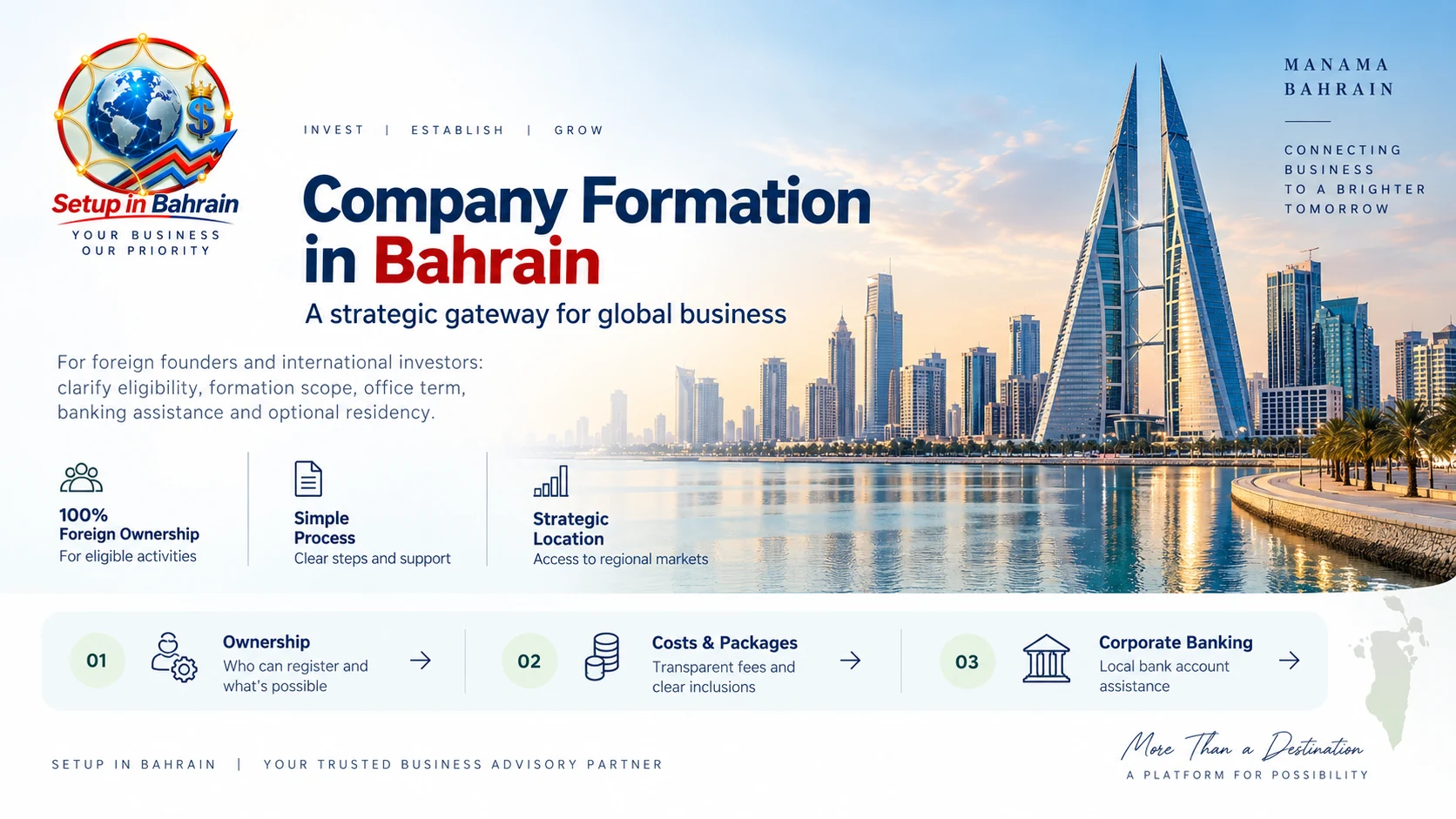
People use different words for the same goal: company formation, company registration, company incorporation, opening a company, or starting a company in Bahrain. In practice, the process has one legal outcome: your Bahrain Commercial Registration (CR), supported by the right company structure, approved business activities, address, bank-ready documents, and post-formation compliance.
If you want to register a company in Bahrain, the usual route is:
- Confirm activity eligibility, ownership and company type.
- Prepare shareholder documents and complete required clearance.
- Reserve the company name and register the address.
- Sign the approved incorporation documents.
- Receive the Commercial Registration and complete licensing requirements.
- Proceed with banking assistance if included in the written scope.
- Apply for investor residency only if purchased separately.
Most foreign-owned service and consultancy businesses can be structured with 100% foreign ownership. Some regulated or restricted activities need extra approval or a Bahraini partner.
For full cost details, see company formation cost in Bahrain. For CR mechanics, see Commercial Registration in Bahrain. For banking, see business bank account in Bahrain. For country-specific guides, see company formation in Bahrain by country. For the step-by-step guide, see setting up a business in Bahrain.
Register your company in Bahrain in 15–20 business days. Most sectors pay no corporate income tax. Eligible activities allow 100% foreign ownership with no local sponsor. We have served 2,800+ clients from 44+ countries since 2018.
View details
| Government authority | MOIC / Sijilat portal |
| Scope (incl. virtual office, Year 1) | Package scope varies: office address is included for 3, 6 or 12 months; banking assistance and other inclusions follow the written quotation. |
| Timeline | Confirmed for the selected activity and shareholder structure in the written case plan. |
| Corporate tax | ✓ 0% SMEs: 0%. MNEs €750M+: 15% (OECD, in force). A 10% tax on larger local companies is a draft law aimed at 2027. (0% personal income tax, 0% capital gains tax) |
| Foreign ownership | ✓ 100% across 350+ activity codes. No local sponsor needed. |
| Physical visit required | Confirmed for your case before payment: formation signing, bank attendance and residency attendance are assessed separately. |
| Most popular entity type | WLL (Limited Liability Company), with one or more shareholders |
| Annual renewal | Managed fully online via Sijilat |
Many foreign investors can own up to 100% of an eligible Bahrain company. Formation timing depends on the activity, shareholder documents and external approvals. Banking and investor residency are separate stages, and the required attendance plan is confirmed for the specific case before payment.
We have served 2,800+ clients from 44+ countries and maintain records to substantiate that total where needed. We have 113 Google reviews; reviews represent only some clients and are not the same as the total clients served.
What company formation provides, and what is separate
Company formation provides the legal company and Commercial Registration. Banking assistance can be included in the agreed service scope, but the bank decides whether to open the account. Investor residency is optional and separately priced; no formation package includes a visa.
→ Business bank account opening in Bahrain
The CR is the document everything else hangs on. With a valid CR you can get:
- A corporate bank account. The bank opens the account during formation to receive the capital, and it needs the final CR to complete it.
- An investor visa. The LMRA issues residency to the company owner against a valid CR, and you can sponsor your family on it.
- Work permits. You can hire employees once the company is registered with the LMRA.
- A commercial lease. Landlords require a CR for business tenancy.
- VAT registration. The NBR registers your company for VAT against the CR.
- International invoicing. UK, US and EU clients accept a Bahrain CR as proof of a legal entity.
Your liability stops at your share in the capital (Article 261 of the Commercial Companies Law). One exception matters: whoever manages the company can be personally liable for losses caused by negligence, gross error or a breach of the law (Article 18 bis).
That is the destination. The rest of this guide is the route: who qualifies, the five steps, the documents, what your life looks like afterwards, and the full price.
Who Can Register a Company? Foreign Investors, Bahrainis, and GCC Citizens
Bahraini nationals, GCC nationals, and foreign individuals or companies can all register a company in Bahrain. What decides your setup is your nationality, your business activity, and your company type. Most service, manufacturing, and export activities allow full foreign ownership with no local partner.
100% Foreign Ownership: No Local Sponsor Needed
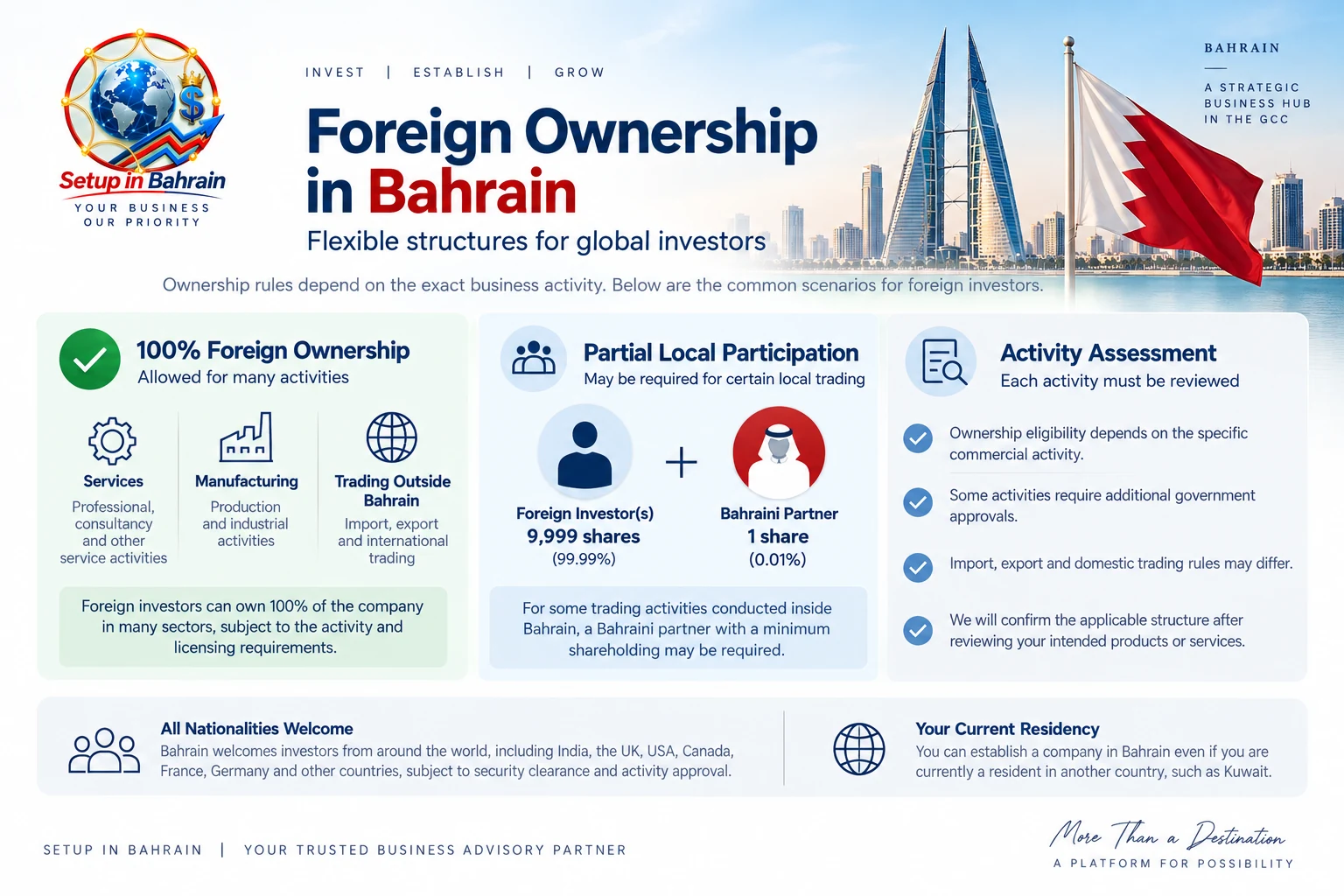
Over 350 activity codes let foreign investors hold 100% equity. No sponsor, no profit-sharing, no local partner for most sectors. Profits, dividends, and capital leave Bahrain with zero restrictions and zero withholding tax.
Which Activities Allow Full Foreign Ownership?
Consulting, tech services, manufacturing, trading (export), logistics, education, and professional services all qualify. Export-based service providers qualify regardless of activity code. The government's activity list changes from time to time, so check your exact activity before you apply. Check your activity code →
Restricted Sectors: When You Need a Local Partner
Construction needs 51% Bahraini ownership. Trading inside Bahrain uses a 9999+1 share structure with one Bahraini share. Financial services need Central Bank of Bahrain approval, healthcare needs NHRA licensing, and education needs Ministry of Education approval. A few activities are reserved for Bahraini nationals: document clearance, pilgrimage services and small traditional shops.
What Fails Security Clearance
Every shareholder passes an NPRA background check before anything else happens. The screening looks for financial crimes, deportations, and security flags. Separately, your bank statements are checked for source of funds: large unexplained cash deposits, complex ownership chains, heavy crypto or gold trading, and previously closed companies all trigger review. If any of this applies to you, raise it before you apply. A surprise at this stage stops the whole process.
How Different Nationalities Register: UK, US, Canada, France, Germany, and India
British citizens get full ownership across most sectors; many UK consultants in the UAE form a Bahrain entity to bill European clients from a 0% base instead of the UAE's 9%. American citizens get extra market access and IP protections through the US–Bahrain Free Trade Agreement, in force since 2006. Bahrain and Oman are the only GCC states that have one. US citizens may also own 100% of activities that otherwise need a Bahraini partner, such as general trading and construction. Canadians trade a 26.5% combined corporate rate for 0%. French and German owners work two hours ahead of Paris and Berlin. Indian nationals, especially those already in the GCC, use the Bahrain–India DTAA and 0% personal income tax on dividends, with Saudi Arabia a causeway drive away.
Limited Liability Under Article 261
Creditors can claim against the company only. If the company fails, you lose what you invested. The limit has one exception: a manager, or anyone who actually runs the company, can be personally liable for losses caused by negligence, gross error or a breach of the law (Article 18 bis).
What Is the Company Formation Process in Bahrain?
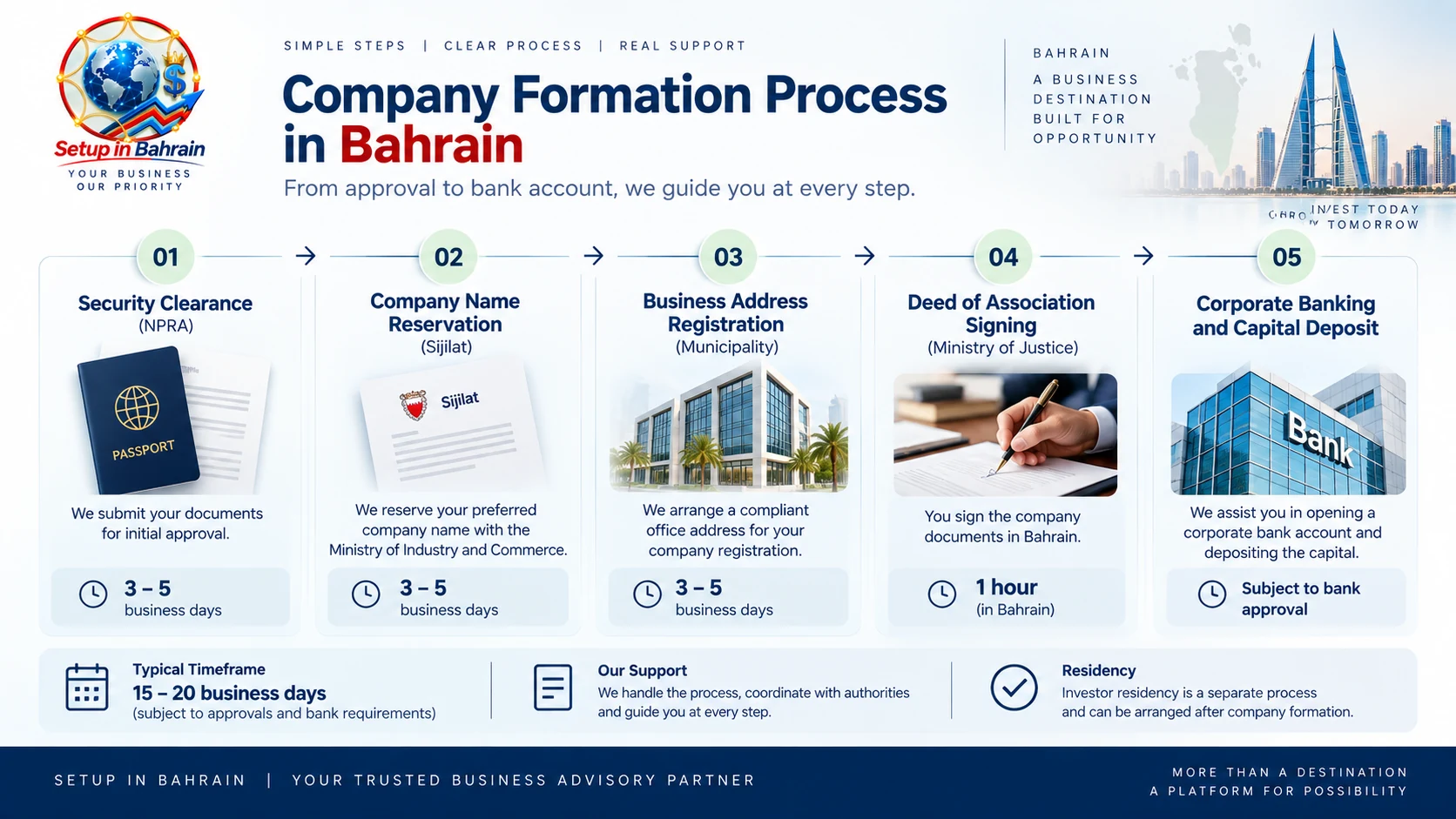
The formation journey is activity and ownership review, security clearance, name reservation, address registration, incorporation-document signing and Commercial Registration. Banking follows as a separate bank-controlled stage, and residency follows only if purchased.
Step 1: Security Clearance (NPRA, 3–5 business days)
Passport copies of all shareholders and directors go to the NPRA for a background check. You supply documents; we file and track. What goes wrong here: a missing passport page or an expired passport (under 6 months validity) adds 3–5 days per fix, and a failed clearance stops everything. Read the list above before you start.
Step 2: Company Name Reservation (Sijilat, 3–5 business days)
Three proposed names, ranked by preference, checked against the MOIC registry in English and Arabic. Reserved names hold for sixty days. What goes wrong here: name conflicts. Submit three different names. Three spellings of one idea count as one.
Step 3: Business Address Registration (3–5 business days)
Every company needs a municipality-approved address: a physical office, a co-working desk or a licensed virtual office. Virtual offices work for consulting, tech, and holding companies. What goes wrong here: nothing at setup. Later, an expired lease suspends your CR immediately, and that freezes your bank account and visa. Keep the lease current.
Step 4: Deed of Association Signing (1 hour)
The Articles and Memorandum of Association set out shareholder rights, capital and activities. They are notarised before the Ministry of Justice. Standard deeds sign online through Sijilat. What goes wrong here: nothing, if you can attend or grant a power of attorney for remote signing.
Step 5: Corporate Banking and Capital Deposit
We prepare the bank-ready company documents and coordinate the selected bank application. The authorised signatory completes any required KYC or signing, deposits the agreed share capital where required, and the bank makes the final decision.
The authorities involved, in one line each: MOIC licenses and registers (via Sijilat), NPRA clears people, the municipality verifies addresses, the Ministry of Justice notarises, the LMRA handles work permits after registration, and the NBR handles VAT.
How Long Does Company Registration Take?
The timeline depends on the activity, shareholder documents, clearance and any external approvals. Your written case plan should identify the expected formation stages and any banking or residency attendance separately.
→ Commercial Registration (CR) in Bahrain: step-by-step guide
| Step | Duration |
|---|---|
| NPRA security clearance | 3–5 business days |
| Company name reservation (Sijilat) | 3–5 business days |
| Address registration | 3–5 business days |
| Deed of Association signing | 1 hour |
| Bank account & capital deposit | Banking: approximately 1 hour in 99% of our reported cases; our last 100 applications handled in 2026 were approved; subsidiaries or CIS shareholders: 3 days to 2 weeks. Subject to the bank’s final review. |
| Total (complete documents) | 15–20 business days |
What Documents Do You Need for Company Formation?
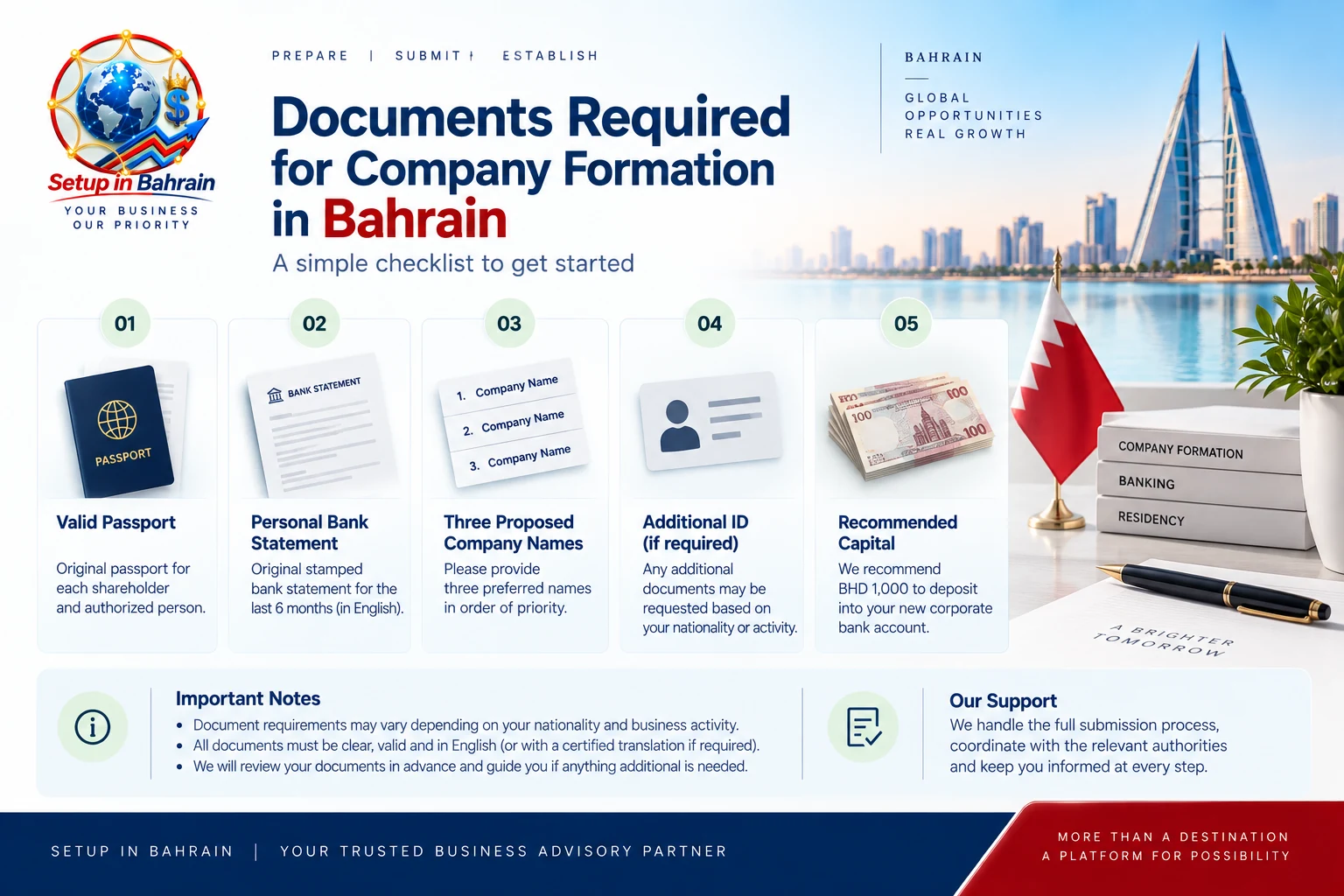
You need five things: passport copies, three proposed company names, stamped bank statements, extra ID if requested, and a capital deposit. Everything submits online through Sijilat.
- Passport copies for all partners, minimum 6 months validity. GCC residents add CPR/Emirates ID/Iqama. US citizens add Social Security information for FATCA. Corporate shareholders add a certificate of incorporation and board resolution.
- Three company names ranked by preference, unique in English and Arabic.
- Six-month bank statements, stamped by your bank. Any major licensed bank in your country will do. Statements must show consistent, explainable income; odd deposits cause delays.
- Additional ID if the bank or government asks: driving licence, national ID, or proof of address.
- Capital deposit at Step 5. The bank certificate activates your CR the same day.
A business plan is not required for registration, but banks want one for account opening and the LMRA reads it for investor visa approval. Have a short one ready.
Company Formation vs Company Registration in Bahrain: What Is the Difference?
Company formation is the whole process: structure, documents, approvals, deed, CR, then bank account and visa. Company registration in Bahrain means the specific step of recording your company with MOIC and receiving your CR number through Sijilat. Company incorporation in Bahrain is the same thing under its international name. Whichever term you searched, you almost certainly mean the whole process, and this page covers all of it.
Business Registration vs Business License
Registration creates the company's legal existence. A license permits specific activities inside it. One registration can hold multiple licenses. The wrong activity code triggers ownership limits or rejection. Get it right the first time, or ask us to check it.
Which Business Activities Need Special Approval?
Three groups: activities needing Bahraini majority ownership (construction, government contracts), activities needing a local partner share (domestic retail), and activities needing special licences (finance, healthcare, education). Everything else, which is the large majority, registers without special approval.
Types of Companies in Bahrain: W.L.L, Branch Office, and More
The main structures are the WLL (the default for foreign founders), the branch office, and a set of special-purpose forms. Your choice sets ownership, liability, and compliance load.
WLL Company (Limited Liability Company)
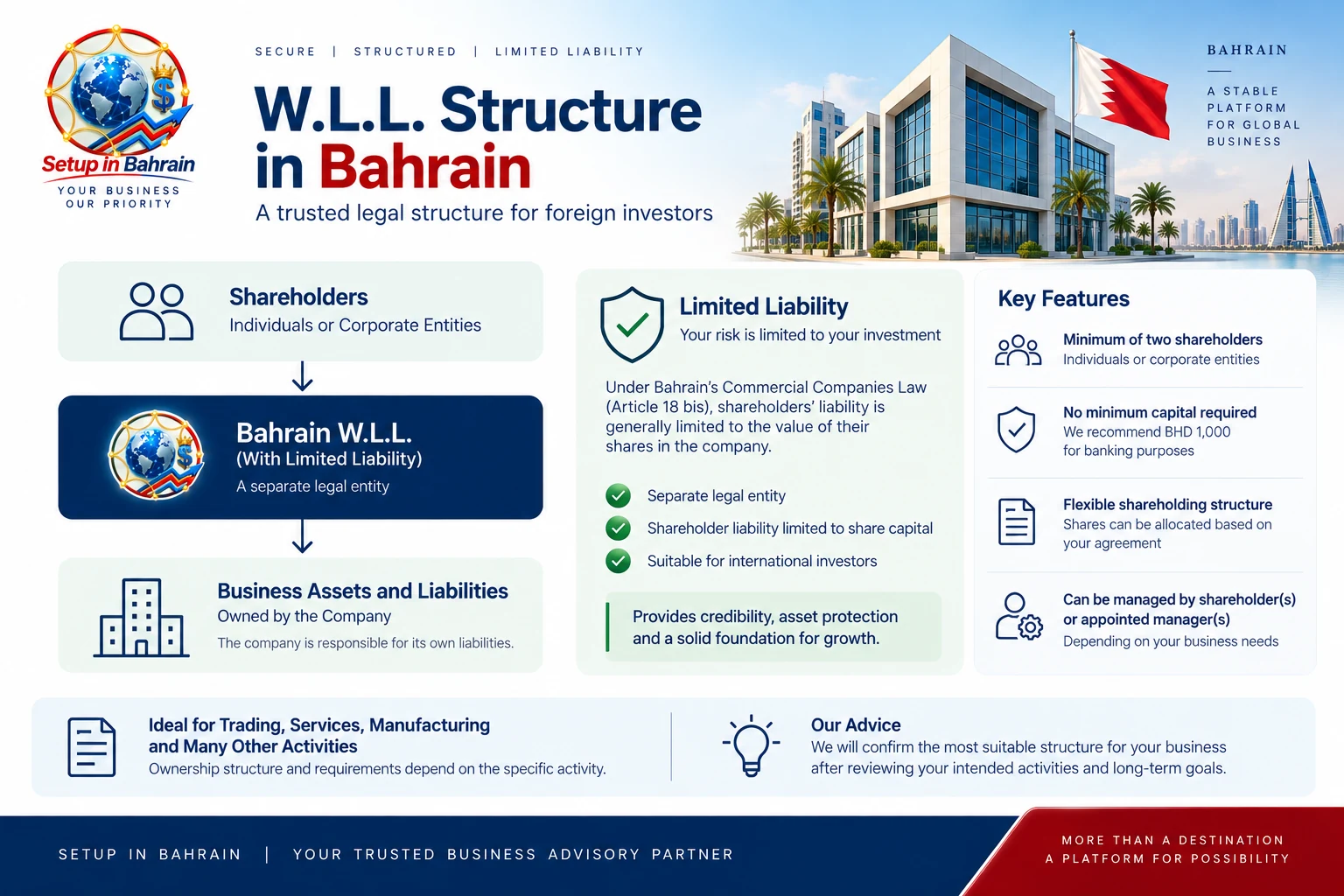
The WLL suits almost everyone: one or more shareholders, flexible capital, up to 100% foreign ownership, liability limited to your investment, multiple activities under one CR.
| Feature | Detail |
|---|---|
| Shareholders | One or more, individuals or companies |
| Minimum share capital | No fixed minimum in the law; BHD 1,000 recommended (AML review flags minimal capital) |
| Foreign ownership | Up to 100% |
| Liability | Limited to capital |
The old Single Person Company (SPC) became part of the WLL under Decree-Law No. 28 of 2020. One person or one company can own a WLL alone and is liable only up to its share in the capital. If you searched “LLC company formation in Bahrain,” the WLL is Bahrain’s LLC.
Branch Office of a Foreign Company
A branch extends your existing company into Bahrain without creating a new entity. The parent stays fully liable. You need parent-company approval, financial statements, a board resolution, and a local manager. No minimum capital. Good for testing Bahrain before committing.
Partnership, Joint Stock, Free Zone and Representative Office
Partnerships share management and unlimited personal liability. Foreign founders rarely choose them. Closed joint stock companies (minimum capital BHD 50,000) suit private equity and family groups; public shareholding companies (minimum issued capital BHD 1,000,000, at least two founders) list on the Bahrain Bourse. Free zone companies add tax and customs advantages in designated zones. A representative office researches the market without trading.
Can I Set Up a Holding Company in Bahrain?
Yes. A Bahrain WLL can hold shares in other GCC companies, receive dividends tax-free, and manage IP or brand licences. Zero withholding on dividends in or out, zero capital gains on selling subsidiary shares, the Bahrain–India DTAA for Indian shareholders, and the Bahrain–UK double tax treaty for British owners. Same 5-step process, same single visit, virtual office sufficient if there’s no active local trade.
Which Structure Fits Your Case?
Most of this page is about the WLL. These comparisons show what the other routes are and how they differ.
Branch or Subsidiary: Which One for a Foreign Company?
A company abroad that wants a presence in Bahrain has two routes.
A branch is the foreign company itself, registered in Bahrain. It is not a company of its own and it has no capital of its own. The head office must guarantee the branch's obligations, so the parent answers for all of them. To register a branch, the parent files its certificate of incorporation, its notarised memorandum or articles, and a resolution that opens the branch, guarantees it and authorises its representative. The application also names the person who will manage the branch. We found no sponsor or agent requirement in the current text of the law, and we confirm this for each case before filing. A branch files audited financial statements every year, within six months of the year end.
A subsidiary is a new Bahraini company, for example a WLL, owned by the foreign company. One company can own a WLL alone, and it is liable only up to its share in the capital.
Take a German GmbH that wants to work from Bahrain. As a branch, the GmbH assumes all the responsibilities of its Bahrain operation. As a WLL, the GmbH is liable only up to its share in the capital, although whoever manages the company can still be personally liable under Article 18 bis. So the choice turns on one question: should the parent answer for the Bahrain business in full, or only up to its share?
| Branch | Subsidiary (WLL) | |
|---|---|---|
| A company of its own | No | Yes |
| Capital | None of its own | Set by the owners; no minimum in the law |
| Who answers for the obligations | The parent, in full | The WLL; the owner up to its share |
| Papers from the parent | Certificate of incorporation, notarised memorandum or articles, resolution with guarantee | Articles of association with amendments, latest audited financial statements, board or general assembly resolution |
| Yearly accounts | Audited, within six months of year end | Audited, within six months of year end |
Source: Commercial Companies Law, Articles 261 and 346 to 350; its implementing regulation, Articles 232 to 242; the Ministry's procedures guide. Verified on 17 November 2026.
WLL or Shareholding Company?
| WLL | Closed shareholding company | Public shareholding company | |
|---|---|---|---|
| Founders | One or more | Two, or one founder under Decree-Law No. 38 of 2025 on the conditions of Resolution No. 11 of 2026 | At least two (the Government may found one alone) |
| Minimum capital | None in the law | BHD 50,000 | BHD 1,000,000 issued |
B.S.C. after a name stands for Bahraini joint stock company. The (c) in B.S.C. (c) marks the closed kind.
The WLL has no minimum capital in the law, and one person can own it. That is why this page treats it as the default. The two shareholding forms start at BHD 50,000 and BHD 1,000,000.
Source: Commercial Companies Law as amended by Decree-Law No. 38 of 2025; Resolution No. 103 of 2023 (capital of the closed company); Resolution No. 11 of 2026 (single founder). Verified on 17 November 2026.
What Are the Rules for a Holding Company?
A holding company is a purpose, and it has no legal form of its own. It must be set up as a WLL or as a shareholding company, and it follows the rules of that form, including its capital. The law adds five rules:
- It must own more than half the capital of each subsidiary.
- A subsidiary may not own shares in it.
- The words "holding company" must appear on its papers.
- It prepares consolidated accounts.
- Its objects are managing its subsidiaries, investing in shares and securities, owning the property it needs, lending to or guaranteeing its subsidiaries, and owning and licensing intellectual property.
Source: Commercial Companies Law, Articles 298 to 304. Verified on 17 November 2026.
Is There an Offshore Company in Bahrain?
We found no offshore or exempt company in the current Commercial Companies Law. Under Article 4, every company founded in Bahrain is domiciled in Bahrain and has Bahraini nationality. A company founded in Bahrain that only holds shares, or sells only to clients abroad, is still a Bahraini company.
Can a Foreigner Register an Individual Establishment?
An individual establishment is not a company. It falls under the Commercial Register Law, which opens it to Bahraini nationals aged 18 or over. The Ministry also admits citizens of the other GCC states and, under the free trade agreement, citizens of the United States. Founders from any other country must use a company. One person can own a WLL alone.
Source: Commercial Register Law (Decree-Law No. 27 of 2015), Article 10; the Ministry's procedures guide. Verified on 17 November 2026.
Which Law Governs Companies in Bahrain?
The Commercial Companies Law, issued by Decree-Law No. 21 of 2001. It has been amended eight times, most recently by Decree-Law No. 38 of 2025, which among other things abolished the joint venture company. Individual establishments fall under the Commercial Register Law, Decree-Law No. 27 of 2015. The official texts are on the website of the Legislation and Legal Opinion Commission, lloc.gov.bh. Only the Arabic text is binding.
Which Kind of Business Gets Which Ownership?
Foreign ownership in Bahrain is decided activity by activity. The rule is Prime Minister's Decision No. 40 of 2021, which sorts activities into five lists. Sijilat shows the result for each activity in its public activity search.
| Your business | Activity in Sijilat | What a foreign owner may hold |
|---|---|---|
| Management consultancy | Management consultancy activities (702) | 100% |
| Software and IT services | Computer programming (6201), computer consultancy (6202), other IT services (6209), software publishing (582) | 100% |
| Online marketplace or web portal that does not own the goods | Operations of eMarketplaces, websites and web portals (6312) | 100% |
| Online shop that sells its own goods | Retail sale via Internet (4791) | A Bahraini shareholder is required. Bahraini, GCC and US citizens may own 100%. |
| General trading, retail and wholesale | General trade (469-1) and the retail and wholesale lines | A Bahraini partner is required, and the partners agree the percentage. Bahraini, GCC and US citizens may own 100%. |
| Construction and contracting | Construction of buildings (41) and the related lines | Up to 49%. GCC and US citizens may own 100%. For construction of buildings, so may citizens of Iceland, Liechtenstein, Norway and Switzerland. |
| Customs clearance, employment agency, fishing, daily newspapers | Schedule 1 of the Decision | Bahraini owners only |
Two notes on the table.
A company can own a trading company in full under Schedule 4 of the same Decision if it meets three conditions: capital of at least BHD 100,000 in the Bahrain company, a parent with total revenues of at least EUR 750 million, and a presence in ten markets.
For a start-up, the activity decides what a foreigner may own. A tech start-up that writes software registers a programming activity and can be 100% foreign-owned. A start-up that sells physical goods online falls under retail and needs a Bahraini shareholder, unless its founders are Bahraini, GCC or US citizens.
Check your own activity before you choose a structure: find your activity or check your ownership eligibility.
Source: Prime Minister's Decision No. 40 of 2021 with its amendments up to Decision No. 36 of 2026; the Sijilat public activity search and FAQ. Verified on 17 November 2026.
What Are the Requirements to Register a Company in Bahrain?
The documents are listed above. Behind them stand seven requirements, in roughly the order of the Ministry's own steps:
- A business activity that your nationality may own, and a legal form that fits it.
- Identity documents for each owner. Foreign owners, other than GCC and US citizens, also pass a security check.
- An approved commercial name.
- A commercial address approved by the municipality.
- A licence or approval for each activity.
- A memorandum and articles of association notarised in Bahrain, where the legal form requires them.
- A bank certificate for the capital, where the legal form requires it.
If the owner is a company, add its articles of association with amendments, its latest audited financial statements, and a board or general assembly resolution to take part. These foreign papers must be certified by the licensing authority in the country of registration, the Ministry of Foreign Affairs, or the Embassy. The Hague Apostille Convention has been in force for Bahrain since 31 December 2013, and the Sijilat FAQ describes both regular authentication and the apostille. Ask us which one the Ministry accepts for your country before you pay for either.
Source: the Ministry's procedures guide for establishments and commercial companies; the Sijilat FAQ; the Hague Conference status table. Verified on 17 November 2026.
Trade Licence, Business Licence, Commercial Licence: What Do They Mean in Bahrain?
People search for all three. Sijilat issues two documents.
The first is the Commercial Registration without licence. It makes the business legally exist. With it you can sign a lease, approach a bank and secure the name. You cannot trade yet.
The second is the Commercial Registration with licence. The Ministry issues it once the activities on your registration have their approvals or licences. Now you can trade.
So the registration itself is not the licence. Activity licences come from the licensing bodies, and Sijilat sends your application to them. Where an activity has no regulator of its own, the Ministry charges an activity fee of BHD 100 for up to three activities. You have one year from the first document to obtain the second. After that the Ministry deletes the registration.
Source: the Sijilat FAQ. Verified on 17 November 2026.
Which Government Bodies Are Involved?
| Body | What it does in a company formation |
|---|---|
| Ministry of Industry and Commerce (MOIC), through Sijilat | Registers the company, issues the Commercial Registration, sends applications to the licensing bodies, and later receives the yearly accounts and beneficial owner details |
| Ministry of Interior | Security check for foreign owners, other than GCC and US citizens |
| Municipality | Approves the commercial address |
| Notary in Bahrain, public or private | Notarises the memorandum and articles of association |
| Your bank | Issues the capital deposit certificate |
| Labour Market Regulatory Authority (LMRA) | Registers the company so it can apply for work permits |
| Social Insurance Organization (SIO) | Registers the company and its employees for social insurance |
| National Bureau for Revenue (NBR) | Registers the company for VAT once its supplies pass BHD 37,500 |
| Sector regulators, such as the Central Bank of Bahrain or the Ministry of Tourism | License the activities they regulate |
The Ministry's current English name is Ministry of Industry and Commerce. Older documents use its former short name, MOICT.
Source: the Sijilat FAQ; the Ministry's procedures guide; the LMRA and SIO websites. Verified on 17 November 2026.
What Does a WLL Have to Do Every Year?
Three duties come back every year, and one runs all year.
- Renew the Commercial Registration in Sijilat. You can do it from six months before it expires. A registration that is not renewed is deleted, and it can be revived within three years.
- File audited financial statements in Sijilat within six months of the end of your financial year. The audit report must come from an audit firm licensed by the Ministry. The year of incorporation is exempt.
- Confirm the beneficial owner details in Sijilat. They are valid for one year. A change has to be filed at once, and by an owner of 10% or more within three working days. The penalties for not filing include fines and striking off. Our guide explains who counts as a beneficial owner.
- All year: keep your employees registered with the Social Insurance Organization. The law covers every worker under an employment contract, whatever their nationality.
Our annual compliance guide takes these one by one. If the owners or the shares change during the year, that is a separate filing: see amendments to a Commercial Registration.
Source: the Sijilat FAQ; Ministerial Order No. 83 of 2020 on beneficial owners; the Social Insurance Law. Verified on 17 November 2026.
How Do I Check That a Company Is Registered in Bahrain?
Use the public search on Sijilat. Enter the company's name in English or Arabic, or its registration number. You need no login. The result shows the registration number, the name in both languages, the company type, the registration date, the expiry date and the status.
For proof on paper, the owner of the company can order a certified extract of its entry in the commercial register through Sijilat. It costs BHD 20 and takes one working day. Our guide to the Commercial Registration in Bahrain explains the registration number and the certificate.
Source: the Sijilat public search page; the bahrain.bh service catalogue. Verified on 17 November 2026.
Can a Foreigner Get a Virtual Commercial Registration (Sijili)?
No. Sijili is a registration for an individual establishment that needs no physical commercial address, and the Ministry offers it to Bahraini nationals only. A foreign founder cannot use Sijili. GCC and US citizens can register an ordinary individual establishment. Founders from other countries form a company, and its address can be a licensed virtual office for the activities that allow one, as Step 3 explains.
Source: the Ministry's Sijili guide, January 2026. Verified on 17 November 2026.
Does Bahrain Have Free Zones?
The official pages we read do not use the words "free zone". Bahrain has named zones: the Bahrain Logistics Zone, which the government describes as a customs-bonded area open to 100% foreign ownership, the Bahrain International Investment Park inside Salman Industrial City, and the Bahrain Investment Wharf.
We found no separate company register for these zones, and no official statement that says there is none. What we can show is this: the tenancy form of the Bahrain Logistics Zone asks for the company's existing registration and commercial licences. That points to the normal commercial registration, but we found no official statement that says so.
Our free zone guide covers the zones themselves.
Source: the Bahrain Logistics Zone page of the Ministry of Transportation and Telecommunications; the zone's tenancy form; the Ministry of Industry and Commerce; the Economic Development Board. Verified on 17 November 2026.
Tax, Corporate Tax, and VAT Registration in Bahrain
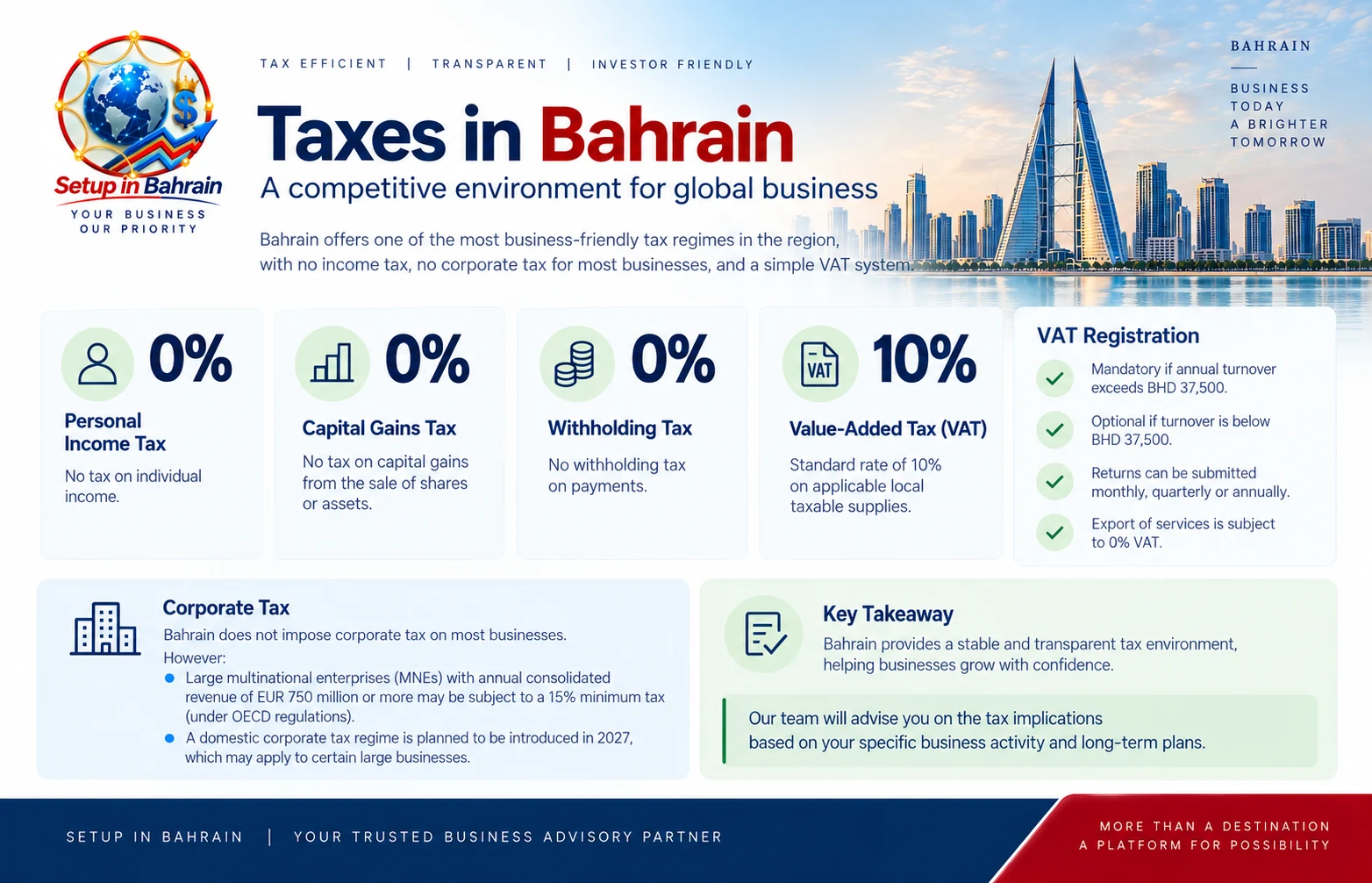
Bahrain charges 0% corporate income tax, 0% personal income tax, 0% capital gains tax, and 0% withholding tax for SMEs and typical foreign-owned companies. VAT is 10% on local sales and 0% on service exports.
| Tax type | Rate |
|---|---|
| Corporate income tax | 0%* |
| Personal income tax | 0% |
| Capital gains tax | 0% |
| Withholding tax | 0% |
| VAT on local sales | 10% |
| VAT on service exports | 0% |
*0% for SMEs and typical foreign-owned companies. Large multinationals (€750M+ global revenue) pay the OECD 15% minimum tax, already in force. A draft law would tax larger local companies at 10% on profit above BHD 200,000, with 2027 as the aim. It would apply to companies with revenue over BHD 1 million or net profit over BHD 200,000. It is not in force. Oil and gas companies pay 46%.
The 0% rate on service exports is the quiet winner: a consultant or SaaS company billing clients outside Bahrain charges no VAT and keeps the margin. VAT registration with the NBR becomes mandatory once local turnover crosses the threshold. Bahrain has double taxation agreements with the UK, France, India and others. For Indian founders, the Bahrain–India DTAA stops the same income being taxed twice.
Planned Corporate Tax for 2027: Who It Would Affect
On 29 December 2025 the Cabinet referred a draft corporate tax law to the legislature. It would tax local companies at 10% on profit above BHD 200,000, if their revenue is over BHD 1 million or their net profit is over BHD 200,000. The aim is to start in 2027. The law is not yet in force, and smaller businesses would stay outside it. Full analysis: Bahrain corporate tax guide →
Can I Register a Company in Bahrain Remotely from the UK, USA, or Canada?
Most preparation and filing can begin remotely. Any physical attendance depends on the signing route, the selected bank and whether residency is purchased. We confirm the required visit plan for the specific shareholder structure before payment.
Sijilat is the Ministry of Industry and Commerce’s digital registration portal: you (or we) submit documents, track each approval in real time, and receive the CR electronically. After formation, the portal handles CR renewals, VAT filings, and ministry correspondence. The system was built for remote company formation. You need a resident manager and a valid address; the owner does not need to live in Bahrain.
Your Life After Company Formation in Bahrain
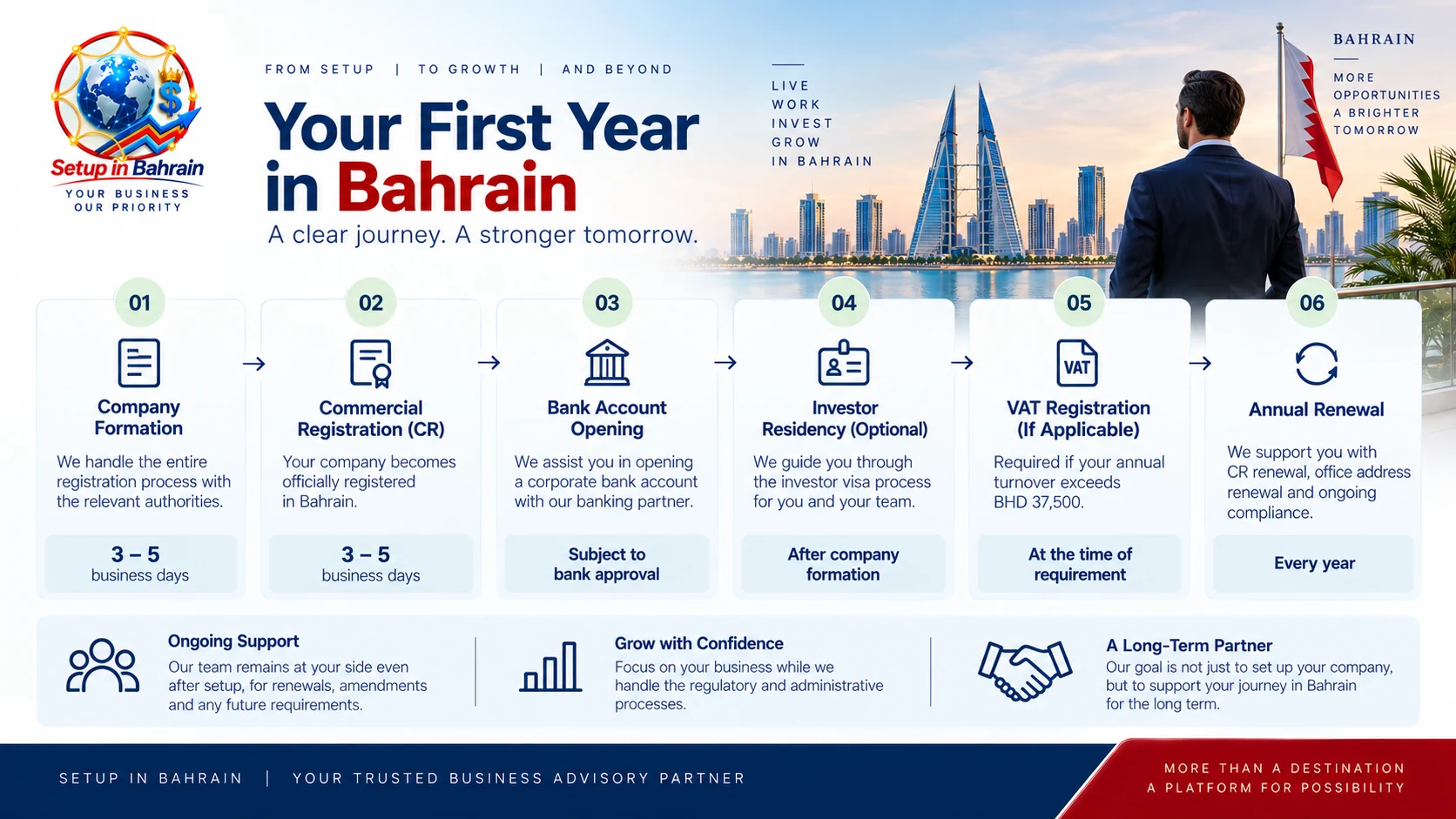
Formation is three weeks. Owning the company is the years after. Here is what changes afterwards.
Residency and Family: What the Investor Visa Gives You
Investor residency is a separate service after company formation. It is not included in Standard, Gold or Premium. The current service price is BHD 755 for one year or BHD 953 for two years; medical, biometric and attendance requirements are confirmed for the applicant before filing.
The Annual Calendar: What Your Company Asks of You Every Year
Renewal and office continuity are ongoing costs. Current renewal packages are BHD 530 with three months of office address, BHD 980 with six months, or BHD 1,520 with twelve months. Visa renewal and other optional services are separate.
What Your Home Country’s Tax Office Will Say
Bahrain will not tax you. Your home country might. UK, US, Canadian, and Indian residents can still owe home-country tax on worldwide income depending on their residency status. The US taxes its citizens wherever they live. Double taxation agreements soften this, and many founders restructure their residency as part of the move, but this page cannot answer your personal case. Take advice from a tax professional in your home country before you form. We say this because clients who plan it properly keep the 0%; clients who don’t get surprised.
If Things Go Wrong: Bank Rejection, CR Suspension, and Exit
Banks reject applications, usually for explainable reasons: gaps in source-of-funds evidence, minimal share capital, or a business plan that doesn’t match the account activity. This is why we prepare each formation bank-ready: the documents are prepared for the bank’s AML and KYC review; approval remains the bank’s decision. CR suspension follows an expired lease or missed renewal and reverses once fixed. And if the business ends, liquidation is a defined legal process, and we handle exits as well as entries. Knowing the way out is part of deciding to come in.
Talk through your situation in a free consultation →
How Much Does Company Formation in Bahrain Cost?
Formation packages are BHD 1,340, BHD 1,700 and BHD 2,150. Each includes a different office-address period; visas are separate. Your formal quotation confirms government fees, share capital, optional services and the cost of maintaining the address after the included period.
Our standard BHD 431 registration-payment and refundable-deposit breakdown is included in the package price, not added again. Confirm activity-specific requirements and any additional charges in your written quotation.
→ Full cost breakdown: company formation in Bahrain
Bahrain vs Dubai/UAE comparison: See the full comparison at Bahrain vs Dubai company formation.
When Bahrain May Not Be the Right Fit
Bahrain is not perfect for every business. Large projects needing public fundraising may find deeper capital markets elsewhere. Pharmaceutical manufacturing and advanced financial products have more mature setups in other countries. And if you only plan to sell inside Bahrain with no regional expansion, the GCC gateway benefits matter less. If that’s you, we’ll tell you in the first call. A bad fit costs both of us more than an honest no.
Frequently Asked Questions: Company Formation & Registration in Bahrain
Can one person own a WLL company in Bahrain?
Can an expat own 100% of a company without a local sponsor?
Does Bahrain charge any income tax?
Can I get Bahrain residency through company formation?
Why do banks reject corporate bank account applications in Bahrain?
What usually causes delays in company formation approval in Bahrain?
What is Sijilat and how do I use it to register a company in Bahrain?
How does share capital work?
Do I need a business plan?
What triggers CR suspension?
Is Bahrain good for e-commerce and small businesses?
How does a Bahrain WLL compare to UAE and Saudi structures?
How much does it cost to register a company in Bahrain from the UK?
Why Bahrain over other GCC countries?
What is a B.S.C. (c) company?
Can I own an online shop in Bahrain as a foreigner?
Do I need a Bahraini sponsor to open a branch of my company?
Can a foreigner register a virtual commercial registration (Sijili)?
Keeping your Bahrain company active
Plan for CR renewal in Bahrain after formation. Review the commercial registration, activity approvals and office-address renewal together, and confirm the itemised renewal scope before the expiry date.
Compare the package price, included office period and the separate costs below. Your quotation confirms government fees and any case-specific requirements before payment.
Choose your Bahrain company-formation package
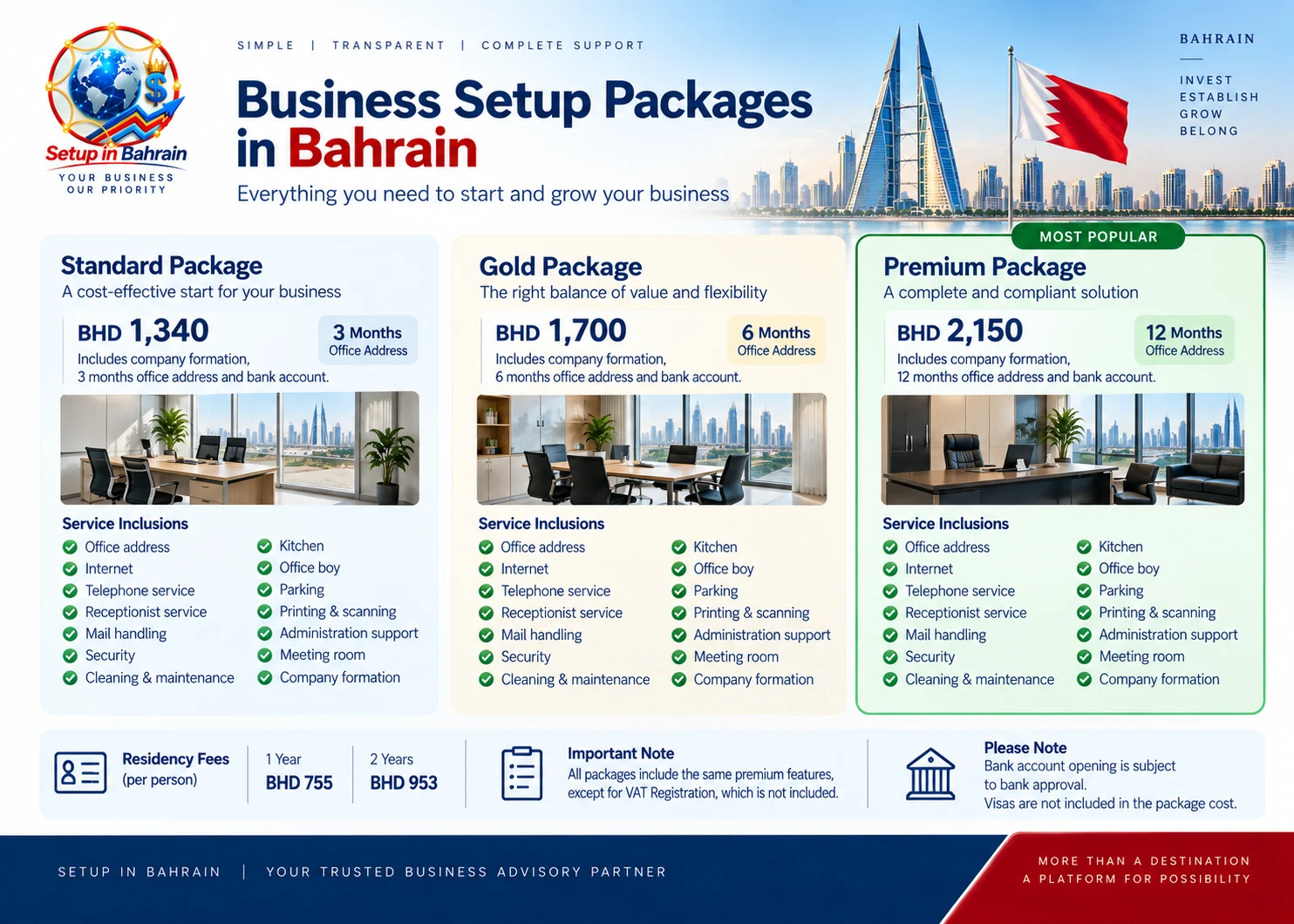
Compare the initial package price and included office period. Visas, share capital and any government fees identified in the formal quotation are separate.
Standard
BHD 1,340
Office address: 3 months
Included office-address component: BHD 440 (not an extra charge)
- Best for
- Founders needing a three-month registered address
- Formation service
- Included to the written scope
- Banking support
- Document preparation and coordination; bank approval is separate
- Residency
- Not included
- Government fees
- Confirmed in the formal quotation
- Share capital
- Not included as a service fee
- What happens next
- Renew or replace the registered address before the included term expires
Company formation
No formation package includes visas, including Premium. Investor residency costs BHD 755 for one year or BHD 953 for two years. Employee visas cost BHD 530 for one year or BHD 755 for two years. These services are priced separately from company formation.
Request an itemized quoteGold
BHD 1,700
Office address: 6 months
Included office-address component: BHD 800 (not an extra charge)
- Best for
- Founders wanting six months of address continuity
- Formation service
- Included to the written scope
- Banking support
- Document preparation and coordination; bank approval is separate
- Residency
- Not included
- Government fees
- Confirmed in the formal quotation
- Share capital
- Not included as a service fee
- What happens next
- Renew or replace the registered address before the included term expires
Company formation
No formation package includes visas, including Premium. Investor residency costs BHD 755 for one year or BHD 953 for two years. Employee visas cost BHD 530 for one year or BHD 755 for two years. These services are priced separately from company formation.
Request an itemized quotePremium
BHD 2,150
Office address: 12 months
Included office-address component: BHD 1,250 (not an extra charge)
- Best for
- Founders wanting a full-year address and the stated cabin furniture
- Formation service
- Included to the written scope
- Banking support
- Document preparation and coordination; bank approval is separate
- Residency
- Not included
- Government fees
- Confirmed in the formal quotation
- Share capital
- Not included as a service fee
- What happens next
- Renew or replace the registered address before the included term expires
Company formation
Premium BHD 2,150 with 12 months and a cabin, officer table and chair, and two guest chairs.
No formation package includes visas, including Premium. Investor residency costs BHD 755 for one year or BHD 953 for two years. Employee visas cost BHD 530 for one year or BHD 755 for two years. These services are priced separately from company formation.
Request an itemized quoteIncluded, separate and bank-controlled
| Item | Status |
|---|---|
| Company formation service | Included according to the selected package scope |
| Office address | Included for 3, 6 or 12 months by package |
| Investor residency | Separate: BHD 755 for one year or BHD 953 for two years |
| Employee visa | Separate: BHD 530 for one year or BHD 755 for two years |
| Government fees | Confirmed in the formal, itemised quotation |
| Share capital | Not a service fee; amount and deposit requirement are confirmed for the case |
| Bank account | Setup assists; the bank controls approval and KYC |
| After the office period | Renew or replace the registered address before it expires |
Optional add-ons
Payment terms: 50% on signing · 40% at MOA · 10% on completion. Standard processing 15–20 business days.
Ready to set up in Bahrain?
Tell us your business idea. We'll work out the right entity, ownership and timeline, then handle the filing while you build.
Official Bahrain government references
- Sijilat, the MOIC commercial registration portalsijilat.bh
- Ministry of Industry and Commercemoic.gov.bh
- Ministry of Justice (notary)moj.gov.bh
- National Bureau for Revenue (VAT)nbr.gov.bh
- Labour Market Regulatory Authoritylmra.gov.bh
- US State Dept: 2025 Bahrain Investment Climate Statementstate.gov