
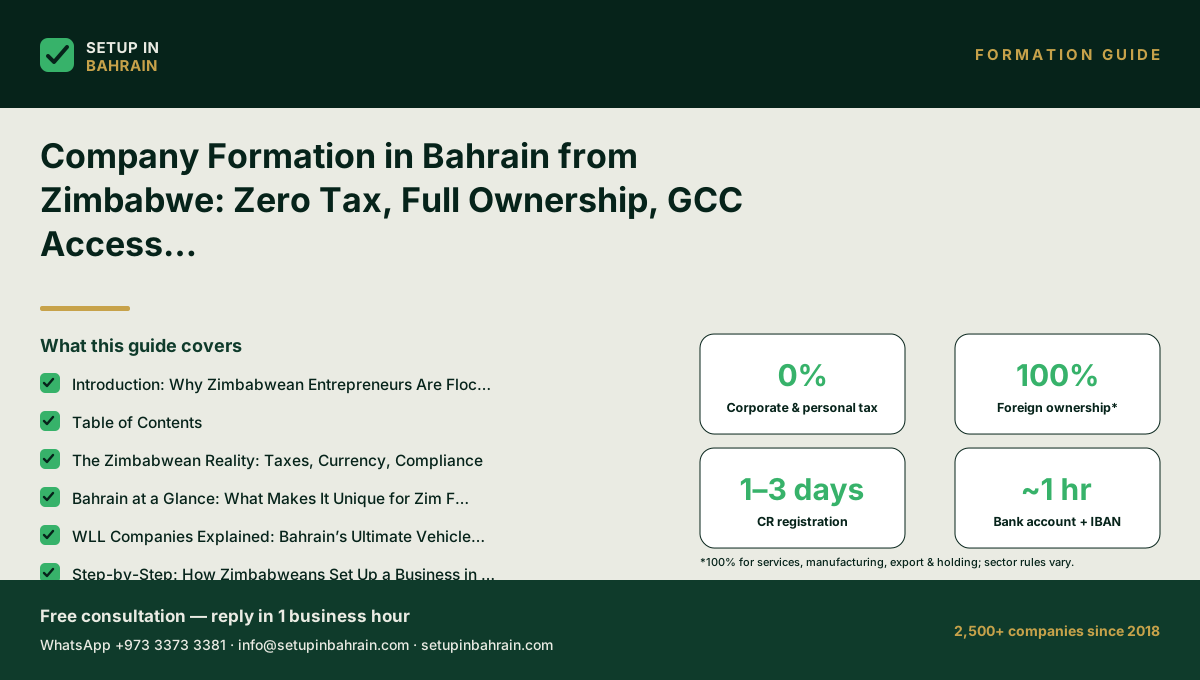
Complete guide for Zimbabwe entrepreneurs: form a company in Bahrain with generally no corporate income tax for most sectors, 100% foreign ownership, and GCC market access. Costs, steps, visas, banking.
→ Complete guide: Company Formation in Bahrain — the full 2026 guide
View details
Ownership & capital
A Bahrain WLL can be owned by a single person — 100% foreign ownership applies to most activities, with no local partner required for services, manufacturing, export trading and holding companies. The minimum share capital is BHD 1; we recommend BHD 1,000, which makes bank account opening and investor visa approval smoother.
Introduction: Why Zimbabwean Entrepreneurs Are Flocking to Bahrain
If you're a Zimbabwean business owner, you know the harsh realities of domestic entrepreneurship. While resourcefulness and adaptability are second nature for most in Harare, Bulawayo, or Mutare, the math simply doesn’t add up any more. Consider this scenario: after a profitable year, you dutifully pay 25% corporate tax to the Zimbabwe Revenue Authority (ZIMRA). On top of that, the Reserve Bank of Zimbabwe (RBZ) compels you to forfeit 25% of your USD export proceeds, converting them into the 2024-launched Zimbabwe Gold (ZiG), a currency that almost nobody trusts after two decades of hyperinflation and devaluation.
As the ZIMRA compliance portal pings you for yet another multi-currency VAT proof or ZIDA sends a confusing “pending” notice, it’s easy to feel your potential slipping through your fingers. And when you compare your profit after Zimbabwean deductions to what’s possible elsewhere, the draw of a stable, zero-tax, investor-friendly jurisdiction becomes almost irresistible.
Enter Bahrain. This small, hyper-connected GCC kingdom has emerged as the go-to regional base for African entrepreneurs who demand real global access — not just survival. With a 0% corporate income tax rate, rock-solid U.S. dollar peg, and full legal right to own your company outright (no local partners, no “hidden” sponsors), Bahrain gives you clarity and control over your future. In this definitive 2026 guide, built exclusively for Zimbabwean founders, we’ll map every step and show exactly why and how to set up in Bahrain.
Table of Contents
- [The Zimbabwean Reality: Taxes, Currency, Compliance](#the-zimbabwean-reality-taxes-currency-compliance)
- [Bahrain at a Glance: What Makes It Unique for Zim Founders](#bahrain-at-a-glance-what-makes-it-unique-for-zim-founders)
- [WLL Companies Explained: Bahrain’s Ultimate Vehicle for Zimbabwean Entrepreneurs](#wll-companies-explained-bahrains-ultimate-vehicle-for-zimbabwean-entrepreneurs)
- [Step-by-Step: How Zimbabweans Set Up a Business in Bahrain](#step-by-step-how-zimbabweans-set-up-a-business-in-bahrain)
- [Comparing Bahrain with Mauritius, UAE, and South Africa](#comparing-bahrain-with-mauritius-uae-and-south-africa)
- [Banking, Forex, and Repatriation: The Bahraini Advantage](#banking-forex-and-repatriation-the-bahraini-advantage)
- Key Regulations and Ongoing Compliance(#key-regulations-and-ongoing-compliance)
- [Costs, Timelines, and Practical Capital Requirements](#costs-timelines-and-practical-capital-requirements)
- Common Questions Zimbabweans Ask(#common-questions-zimbabweans-ask)
- [Expert Tips: Avoiding Pitfalls and Maximizing Bahrain](#expert-tips-avoiding-pitfalls-and-maximizing-bahrain)
- Conclusion & Next Steps(#conclusion--next-steps)
The Zimbabwean Reality: Taxes, Currency, Compliance
The True Cost of "Success" in Zimbabwe
Let’s look at the numbers. Start with a company that earns $700,000 from agricultural exports in 2026.
- Corporate Income Tax (ZIMRA): 25%. Instant deduction: $175,000 disappears.
- Mandatory RBZ Surrender: 25% of export proceeds at the official (not market) rate. On $700,000 in USD export receipts, $175,000 worth gets forcibly converted to ZiG at a rate few in the private sector trust — which after currency slippage typically knocks another $35,000–$40,000 off real value by year-end.
- Vat, Withholding, and Statutory Fees: ZIMRA’s new e-filing expects multi-currency proofs; many legitimate dollar payments trigger compliance reviews, further draining resources.
- Banking: Local banks struggle to process cross-border wires reliably. U.S. dollar shortages and new RBZ rules make outgoing SWIFT always a gamble.
Result: Effective “tax and loss” rates of 40–50%
A Zimbabwean SME, after taxes and currency controls, keeps as little as $350,000 from every $700,000 earned — and that’s before regular requests for “temporary” but nonrefundable RBZ or ZIMRA deposits.The ZiG Dilemma: Trust and Value
After the April 2024 launch, ZiG replaced the troubled ZWL. But trust has not returned:
- Public faith: A May 2026 SIVIO Institute survey found less than 17% of Zimbabwean entrepreneurs hold more than a month of working capital in ZiG, while 72% said they actively avoid “unnecessary conversion.”
- Currency loss: In the first 24 months of ZiG, the street-to-official rate spread widened over 22%.
Regulatory Drag: ZIMRA and RBZ
Paying tax in multiple currencies, reconciling pre-shipment approvals with the RBZ, and handling ZIDA for any cross-border investment keeps compliance teams constantly behind. Most Zimbabwean business owners consider regulatory friction their number one constraint, after currency risk (see World Bank Zimbabwe 2025 Investment Climate Report).
Bahrain at a Glance: What Makes It Unique for Zim Founders
0% Corporate and Personal Income Tax — By Law
Unlike almost every jurisdiction in Africa, Bahrain does not levy corporate income tax for non-oil businesses (Commercial Registration, or CR, entities) — and has no plans to introduce one for at least the next five-year fiscal cycle (source: Bahrain Economic Development Board 2026 policy forecast). Personal income is never taxed.
100% Foreign Ownership — No Local Partner Required
A Zimbabwean entrepreneur can own their Bahrain WLL company outright. You need zero local shareholders or “silent” partners. This is enshrined in Bahrain’s Commercial Companies Law (Legislative Decree No. (21) of 2001, last amended 2022).
Unlimited Repatriation and Stable Currency
The Central Bank of Bahrain (CBB) guarantees convertibility. The Bahraini dinar (BHD) is fully pegged at 0.376 BHD = 1 USD. Outbound payments can be made in any hard currency, banked locally or globally.
Strategic Location: Gateway to GCC and MENA
- Market size: $1.6 trillion across the Gulf Cooperation Council (GCC).
- Access: No import duties for trade with Saudi Arabia, UAE, Qatar, Kuwait, and Oman for Bahrain-made goods.
- Connectivity: Bahrain’s free trade agreement with the United States, and bilateral ties with the UK, India, and Africa.
Table: Bahrain Snapshot for Zimbabwean Investors
| Feature | Zimbabwe | Bahrain |
| Corporate Income Tax | 25% | 0% |
| Currency | ZiG (untrusted), USD | BHD (pegged to USD) |
| Export Proceeds Surrender | 25% (RBZ) | 0% |
| Company Ownership | Some sectors restricted | 100% foreigner allowed |
| Bank Account Restrictions | Many | Few, open to non-residents |
| Capital Controls | Yes | None |
WLL Companies Explained: Bahrain’s Ultimate Vehicle for Zimbabwean Entrepreneurs
What Is a WLL?
A "With Limited Liability" (WLL) company is Bahrain’s flexible equivalent to a private limited company. It is suitable for nearly all lines of business (import/export, holding, consulting, trade, technology, etc.) and can be founded by just one owner — a critical edge missing in most other GCC states.
Key Facts
- 100% foreign ownership allowed.
- No minimum local partners. Own your Bahrain business entirely.
- No minimum share capital required by law, but practical minimum is BHD 1,000 (about $2,650 in June 2026) for smooth bank account opening and investor visa issuance.
- Regulated by: Ministry of Industry & Commerce (MOIC), Bahrain Investors' Center (BIPA).
LSI Keywords
- Bahrain WLL company setup
- Bahrain LLC vs WLL
- Foreign ownership Bahrain
- Bahrain investor visa
Misconception Bust: No single-shareholder WLL — WLL is the Answer
Zimbabweans may see references to "WLL" online. Ignore them: Bahrain no longer allows new Single Person Companies (WLL) as of the 2022 Companies Law reform. Instead, the WLL fulfills all needs for full individual ownership.
Why WLL for Zim Founders?
- Direct branch or subsidiary of a Zimbabwe entity or fully new offshore holding
- Use as a master vehicle for GCC contract bids, Amazon/Shopify merchanting, or MENA investments
- Pathway to Bahrain residence and investor visas
Step-by-Step: How Zimbabweans Set Up a Business in Bahrain
1. Define Your Business Model
- Will your WLL be a trading company, holding, consultant, fintech, logistics? This affects the CR code.
- Decide if you need a physical office, or if a virtual “Flexi Desk” will suffice. Bahrain allows virtual offices for many business types.
2. Pre-Incorporation Consultation
- Engage an experienced formation consultant (licensed by MOIC/BIPA).
- Confirm your exact ownership structure — direct or via a Zimbabwe entity, or as an individual.
3. Name Reservation & Initial Documentation
- Submit trade name choices to MOIC/BIPA.
- Prepare copies of Zimbabwean passport, proof of address, business plan/summary, and CV of each shareholder.
4. Apply for Commercial Registration (CR)
- File company constitution (Memorandum & Articles of Association) via BIPA portal.
- Pay government CR fees (BHD 50–75 average).
5. Deposit Share Capital
- Open a “capital deposit” account with any Bahrain commercial bank (sub-accounts possible for overseas founders if visiting in person).
- Deposit minimum capital (BHD 1,000 is standard for banking, though legally BHD 1 is permitted).
- Issue a banker’s certificate as proof.
6. Lease Registered Address
- Lease a physical or virtual office (required for company registration).
- “Flexi Desk” packages (as little as BHD 300/year) suit many SMEs and consultants.
7. Final Registration & CR Issuance
- Standard timeline: 5–10 working days (if all documents correct).
- Receive official CR, company number, and MOIC registration.
8. Open Operational Bank Account
- Submit CR, board resolution, and KYC/AML forms to a commercial bank (e.g., Bank ABC, Gulf International Bank, NBB).
- Most banks require founder’s in-person visit for compliance.
- Bank approvals: typically 2–4 weeks; some international banks require extra KYC for African residents.
9. (Optional) Apply for Investor Visa / Residence
- Submit visa application through the Nationality, Passports and Residence Affairs (NPRA) directorate.
- Provide company documents and proof of capital.
- Medical screening and police certificate may be required.
Total Timeline: 4–8 weeks in most cases
Table: Typical Incorporation Checkpoints for Zimbabwean Founders
| Step | Typical Processing Time |
| Name reservation | 1–2 working days |
| CR application | 3–5 working days |
| Capital deposit & address | 1–2 weeks (banking) |
| Finalization & banking | Banking: approximately 1 hour in 99% of our reported cases; our last 100 applications handled in 2026 were approved; subsidiaries or CIS shareholders: 3 days to 2 weeks. Subject to the bank’s final review. |
| Investor visa | 2–3 weeks |
Comparing Bahrain with Mauritius, UAE, and South Africa
Zimbabwean founders often ask: “Why Bahrain instead of Mauritius, Dubai, or Johannesburg?”
Here’s a direct, apples-to-apples comparison based on 2026 fact patterns and regulatory realities.
Table: Bahrain vs Mauritius, UAE (Dubai), and South Africa for Zimbabwean Owners
| Feature | Bahrain | Mauritius | UAE (Dubai) | South Africa |
| Corporate Tax Rate | 0% (non-oil) | 15% (Global Min.) | 9% (mainland)* | 27% |
| Ownership | 100% foreigner | 100% (GBC1) | 100% in Free Zones | 100% |
| Residency | Simple visa | Strict requirements | Expensive, complex | Challenging |
| Banking KYC | Medium strict | Very strict for Africa | Strict, slow | Less KYC, but rand instability |
| Cross-Border Payments | Fully open | Often scrutinized | Restrictions on Africa | Exchange control |
| Market Access | GCC, US, UK | Africa/India focus | GCC, Asia, Africa | SADC |
| Setup Time | 4–8 weeks | 8–10 weeks | 10–20 weeks | 10–20 weeks |
| Currency | BHD, pegged to USD | Mauritius Rupee | AED | ZAR |
Bahrain wins for ultra-low tax, true currency stability, and smoothest pathway for Zimbabwean beneficial owners not already resident in the GCC, as confirmed by source reviews from CBB, MOIC, the World Bank, and independent AML auditors.
Banking, Forex, and Repatriation: The Bahraini Advantage
USD-Pegged Currency: Global Certainty
- BHD (Bahraini Dinar) fixed at 0.376 to the U.S. dollar—no float, no hidden fees.
- No forced currency conversion, ever.
- Pay out in any currency — dollars, euros, rand, or pounds — from corporate accounts.
Banking Access
- Choose from over 15 international and local banks, including Bank ABC, NBB, Al Salam, Citibank, and Bank of Bahrain & Kuwait.
- Accounts available to non-resident founders; in-person visit typically required.
Outbound Payments Simplified
Unlike Zimbabwe (RBZ limits), Bahrain has no restrictions on inbound or outbound cross-border transfers for legitimate business purposes. The CBB’s open economy policy guarantees this (see CBB Rulebook, Volume 5, updated 2026).
Advanced Digital Banking
- E-banking and remote payment approval
- Integration with Stripe, PayPal, Wise, and crypto-exchanges (subject to CBB/VFSA sector rules)
- No delays for "African" wires unless flagged by international correspondent banks (much easier than UAE or Mauritius for Zimbabwe-beneficial owned vehicles)
Key Regulations and Ongoing Compliance
Annual Reporting
- Simple annual financial statement submission to MOIC/BIPA.
- No annual tax return for non-petroleum businesses (0% income tax still the rule).
- Standard audit if turnover exceeds BHD 100,000.
Economic Substance & UBO Registration
Bahrain follows global FATF/AML protocols. Ultimate beneficial owner (UBO) declaration required at formation and upon changes. Economic substance rules apply if your WLL company mainly trades offshore — but are lighter than in Mauritius or UAE free zones (EBD 2026 guidelines).
VAT
- 10% VAT on Bahraini sales of goods and services — but zero-rated or exempt if you only export, or operate as a holding/consultancy company with no Bahrain customers.
- Zimbabwean companies focused on global trade rarely need to register for VAT unless they sell in Bahrain.
Flexi Office Rules
Bahrain allows you to use cost-effective “Flexi Desk” or co-working space addresses for many categories of WLL.
Costs, Timelines, and Practical Capital Requirements
Setup Cost Breakdown (2026 Typical WLL, 100% Zimbabwean Owner)
| Item | Amount (BHD) | USD Equivalent (Approx.) |
| MOIC/BIPA Govt Fees | 50–75 | $135–$205 |
| Company Name Reservation | 30 | $80 |
| Flexi Desk Rental (Yr 1) | 350–800 | $950–$2,100 |
| Capital Deposit ("realistic") | 1,000 | $2,650 |
| Bank Account Opening | 0–100 | $0–$265 |
| Investor Visa (optional) | 300–1,000 | $800–$2,650 |
| Legal/Consultancy | 350–950 | $930–$2,520 |
| Total Setup (range) | 2,080–3,955 | $5,500–$10,200 |
Practical Timeline
- Incorporation: 2–4 weeks
- Bank account: add 2–4 weeks (due to global AML checks)
- Visa: 2–3 weeks (if required)
- Can operate remotely after CR is issued and banking is active
Ongoing Costs
- Annual renewal: BHD 100–300
- Flexi Desk: as above
- Light bookkeeping/accounting: BHD 250–600/year
- Optional audit: BHD 1,000+ (only needed above 100K BHD revenue)
Capital: Why BHD 1,000 Beats BHD 1
Only BHD 1 share capital is legally required for a WLL, but in reality, BHD 1,000 (about $2,650) is the minimum most banks and the investor visa process will accept. Anything lower risks account rejection.
Common Questions Zimbabweans Ask
Can I keep 100% ownership? Even if I'm not a GCC citizen?
Yes. Bahrain WLLs allow 100% foreign ownership, regardless of nationality. No local Bahraini partner or sponsor is ever required (per the Commercial Companies Law, updated 2022).
Do I need to visit Bahrain in person?
For company formation: not strictly required if you appoint a licensed agent, but bank account opening almost always requires a personal visit for KYC/AML checks.
Are my funds locked — or can I repatriate anywhere?
Bahrain has no capital or FX controls. Send profits, dividends, or principal back to Zimbabwe (or any other country) at any time, in any currency. There are simply annual company renewals and routine banking oversight (as in any OECD-compliant jurisdiction).
How stable is the Bahraini dinar?
Exceptionally stable. The BHD has been pegged to the U.S. dollar at BHD 0.376 = $1 USD since 1980, with no historical devaluations (CBB, IMF, 2026).
Will the Zimbabwe tax authorities (ZIMRA) accept a Bahrain-registered company for offshore structuring?
You can operate a Bahrain entity as a fully offshore company, but consult a tax advisor in both Bahrain and Zimbabwe. Zimbabwe may seek to tax global income if “management and control” remains in Zimbabwe, or if you repatriate large profits.
What sectors are best for a Bahrain WLL from Zimbabwe?
- Commodity trading (metals, agri, food)
- Logistics and supply chain
- eCommerce export
- Diaspora investment vehicles
- IT outsourcing and software
How does this compare to a UAE Free Zone company?
Bahrain is faster, genuinely 0% tax, simpler UBO/AML, and now cheaper. UAE tax laws are now strictly enforced; Dubai banks typically require much more documentation for African owners.
Expert Tips: Avoiding Pitfalls and Maximizing Bahrain
Clear Communication With Your Bank
Most issues Zimbabwean founders face in Bahrain arise from incomplete KYC, opaque source of funds, or poor communication about business activities. Prepare clean audited accounts and proof of origin for initial banking setup.
Choose the Right Commercial Activity
Be precise in selecting your MOIC business codes — “General Trading” is often too broad. Most Zimbabwean clients achieve fastest approval for “Management Consulting,” “International Trade,” or “Holding Company.”
Plan For Substance, Not Just Structure
Global tax trends mean it pays to show real business substance: a local Flexi Desk, at least two Bahraini clients or partners, and active operations help avoid future “blacklisting” or anti-offshore scrutiny.
Understand UBO Declarations
Bahrain is proud of its compliant, transparent reputation. Register all ultimate beneficial owners accurately — hiding behind proxies is risky.
Maintain Updated Books
Annual reporting is light, but don’t neglect it — failing to file on time can result in fines or even CR suspension. Use a qualified Bahraini accountant.
Bahrain Formation: Your Springboard Out of Zimbabwe’s Trap
Zimbabwe’s export entrepreneurs — from chrome to maize to SaaS — are world-class. But they cannot long survive in a system that taxes at 25%, forcibly converts foreign exchange, and issues new currency faster than business can adapt.
Bahrain, by design, is the global entrepreneur’s antidote. Stable, dollar-pegged, open, tax-free, and accessible — and with a business community that prizes substance and action over bureaucracy. That’s why Harare founders are leading the African wave of registrations in Manama.
If you’re ready to unshackle your enterprise, protect your profits, and build a truly international platform, the Bahraini WLL company is your lever.
Cited Sources & Regulatory Links
- Bahrain Economic Development Board (EDB)(https://www.bahrainedb.com)
- Central Bank of Bahrain (CBB)(https://www.cbb.gov.bh/)
- [Ministry of Industry & Commerce (MOIC), Bahrain](https://www.moic.gov.bh/)
- Bahrain Investors' Center (BIPA)(https://www.bipa.gov.bh/)
- World Bank MENA Investment Report, 2026(https://databankfiles.worldbank.org)
- SIVIO Institute Zimbabwe SME Surveys(https://www.sivioinstitute.org/)
Ready to Launch in Bahrain?
Your Zimbabwean peers are already there — banking in USD, trading across the GCC, and free from the choking grip of local currency and compliance. Take your next step: speak to a Bahrain formation expert with real Africa–GCC experience. By this time next quarter, you could be operating, earning, and growing from the region’s most open platform.
Questions? Feedback? Use the form below — or book a Bahrain strategy session tailored for Zimbabwean entrepreneurs. The global business future is yours to claim.
Bahrain Business Guides for Zimbabwe Citizens
Ready to set up in Bahrain from Zimbabwe?
Tell us your business idea. We map the right entity, ownership and timeline — then handle the filing while you focus on what matters.