Complete guide for Uruguay entrepreneurs: form a company in Bahrain with generally no corporate income tax for most sectors, 100% foreign ownership. GCC market access. Costs, steps, visas, banking.
Key Takeaways
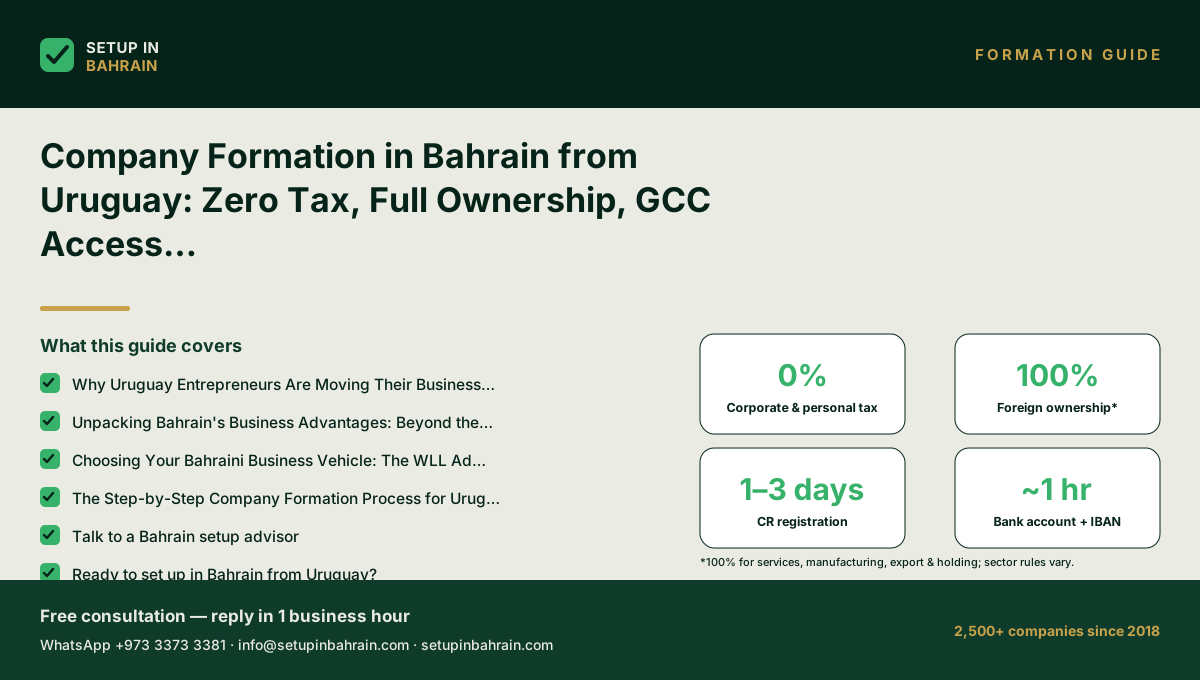
- Why Uruguay Entrepreneurs Are Moving Their Business to Bahrain: A Strategic Imperative
- Unpacking Bahrain's Business Advantages: Beyond the Headlines
- Choosing Your Bahraini Business Vehicle: The WLL Advantage for Uruguayan Entrepreneurs
- The Step-by-Step Company Formation Process for Uruguayan Nationals
→ Complete guide: Company Formation in Bahrain — the full 2026 guide
View details
Ownership & capital
A Bahrain WLL can be owned by a single person — 100% foreign ownership applies to most activities, with no local partner required for services, manufacturing, export trading and holding companies. The minimum share capital is BHD 1 ; we recommend BHD 1,000 . This Makes bank account opening and investor visa approval smoother.
Imagine the scene: Mariana, a Montevideo tech founder, logs into her DGI SIRE portal at 10 pm again — another late night reconciling endless electronic invoices, prepping for another payroll run with mandatory BPS social security rates gnawing 12.625% from every employee salary. Her export startup, despite its innovative edge, constantly battles Uruguay’s 25% corporate tax bracket on its domestic profits. And with the persistent economic turbulence across the River Plate, she sees the UYU currency swing wildly, causing her international clients to raise concerns about payment stability and settlement delays. She dreams of true, unencumbered global expansion, direct access to affluent markets — but domestic compliance and regional economic uncertainty shackle her growth.
Now picture Mateo, who runs a Montevideo-based logistics software firm serving agricultural exporters. He’s managed to leverage Uruguay's IRNR regime for his offshore income, enjoying a 0% tax rate on those specific earnings. Yet, his local operations, his employees. Any profit sourced domestically still face that steep 25% corporate income tax. He’s navigating the DGI’s SIRE electronic invoicing system, which. Digital, requires constant vigilance and updates, adding hidden operational costs. And the employer’s share of BPS social security contributions at 12.625% on top of every salary feels like a perpetual drain, making every new hire a weighty financial decision. When the Argentine crisis sent the UYU swinging 18% in a single quarter, Mateo started calculating what a strategic shift to Bahrain would actually change for his entire business.
He discovered Bahrain levies 0% corporate income tax with no hidden caps, no sunset clauses. No complex caveats for his international activities. The country allows 100% foreign ownership in a With Limited Liability (WLL) company, meaning he, or Mariana, could be the sole proprietor with zero local partners required. He also learned about the stable, USD-pegged Bahraini Dinar, eliminating currency anxiety. And critically, for a regional exporter like Mateo, the entire Gulf Cooperation Council (GCC) market, a $2 trillion economy of over 50 million affluent consumers, sits literally 25 km from Bahrain’s capital, Manama.
This is not just a pipe dream. This is a strategic reality. Hundreds of ambitious companies, from across Latin America and beyond, have quietly and successfully shifted their operational hubs to Bahrain — and for discerning Uruguayan entrepreneurs, this moment marks a profound opportunity. This comprehensive guide, meticulously updated for 2026, is specifically crafted for you: the Uruguayan visionary ready to transcend familiar constraints and unlock unprecedented global growth.
Why Uruguay Entrepreneurs Are Moving Their Business to Bahrain: A Strategic Imperative
Let’s talk honestly: Uruguay is a business-friendly country, lauded for its stability and democratic institutions. It's often referred to as "the Switzerland of South America." But friendly does not mean painless . Stability does not always equate to optimal growth conditions for an internationally-minded entrepreneur. In 2026, Uruguayan entrepreneurs continue to face a labyrinth of regulation, a notoriously high 25% corporate tax rate for onshore operations. The murky, ever-present threat of regional economic spillover risks that can choke access to hard currency and destabilize financial planning.
If you’re running an informática consultancy in Punta Carretas, an e-commerce platform in Ciudad Vieja, or a FinTech startup in Zonamerica, you’ve likely asked yourself these critical questions:
- Why do my tax bills never shrink, no matter how hard I optimize?
- How do I manage BPS contributions that scale up with every single hire — eating directly into my growth capital?
- Is there a way to escape the constant anxiety of UYU currency fluctuations impacting my international sales and profit repatriation?
- Can I access larger, more stable markets directly, without layers of intermediaries and regional complexities?
These are not trivial concerns; they are fundamental obstacles to scaling and global competitiveness.
The Uruguayan Business Landscape: Familiar Challenges for Ambitious Entrepreneurs
To truly appreciate the value proposition of Bahrain, we must first articulate the specific pain points that make many Uruguayan entrepreneurs seek alternatives.
Corporate Income Tax Burden (IRAE): The 25% Hurdle
Uruguay’s Corporate Income Tax (IRAE) stands at a flat 25% for all profits generated from activities within the country. While the IRNR (Non-Resident Income Tax) regime offers a 0% rate on certain offshore income for Uruguayan companies, this benefit often has strict conditions. If your company has a physical presence, employees, or substantial management activities within Uruguay, a significant portion of your profits, or even all of them, can still be classified as Uruguayan-sourced and thus subjected to the 25% IRAE.
The Nuance: The IRNR is excellent for genuinely passive, offshore income. But for an active, growing business with local operations, it quickly becomes complex to ring-fence income. This creates a dual-taxation headache or forces costly corporate structuring that doesn't fully eliminate the 25% local burden. The Impact: This substantial tax rate directly impacts your net profit, reducing capital available for reinvestment, R&D. Expansion. It places Uruguayan companies at a disadvantage compared to peers operating in zero-tax jurisdictions.
Navigating DGI’s SIRE System: The Silent Operational Drain
The Uruguayan Dirección General Impositiva (DGI) mandates the use of the Sistema de Retenciones Electrónicas (SIRE) for electronic invoicing and tax reporting. While intended to streamline processes, for many entrepreneurs, it translates into:
Complex Implementation: Initial setup and ongoing compliance with SIRE can be technically demanding and time-consuming, often requiring specialized accounting software or external consulting. Constant Updates: The DGI frequently issues updates and changes to SIRE requirements, demanding continuous adaptation from businesses. This isn’t a one-time setup; it’s an ongoing compliance burden. Hidden Costs: Beyond the direct cost of software, the time spent by financial teams (or the entrepreneur directly) on reconciliation, error correction. Reporting is a significant, often unquantified, operational expense. It diverts focus from core business activities. Risk of Penalties: Errors or delays in SIRE reporting can lead to fines and penalties, adding another layer of stress.
The Weight of BPS Social Security Contributions: Scaling Liabilities
Uruguay’s social security system, managed by the Banco de Previsión Social (BPS), is robust but imposes significant costs on employers. The employer's share alone for social security contributions sits at a considerable 12.625% on top of every employee’s gross salary. (This is in addition to the employee's contribution, bringing the total payroll cost even higher).
Direct Impact on Hiring: For a growing business, every new hire not only means a salary but an additional 12.625% overhead. This directly affects the ability to scale teams, hire competitively, and manage cash flow. Reduced Competitiveness: When comparing total labor costs, Uruguayan companies face a higher baseline than those in jurisdictions with lower or no employer social security taxes. Complex Administration: Calculating, reporting. Remitting BPS contributions adds administrative complexity, especially for companies with varying employee types or benefits structures.
Currency Volatility: The UYU and Regional Instability
The Uruguayan Peso (UYU) is often influenced by regional economic currents, especially those emanating from its larger neighbors, Argentina and Brazil. While Uruguay’s economy is generally stable, the UYU can experience significant volatility against major international currencies like the USD.
Erosion of International Profits: For export-oriented businesses, a weakening UYU can artificially inflate local costs or reduce the real value of repatriated USD earnings when converted. A strengthening UYU, conversely, can make exports more expensive. Payment Uncertainty: International clients often prefer stable, predictable currencies. UYU volatility can lead to requests for payment in other currencies, increased administrative work, or even lost business due to perceived risk. Investment Hesitation: Foreign investors, when assessing an Uruguayan company, factor in currency risk. This Can impact valuations and funding opportunities.
Limited Domestic Market Size vs. Global Ambition
With a population of about 3.5 million, Uruguay's domestic market. Offering a strong base, is inherently limited for businesses with global aspirations. True scale often necessitates looking beyond national borders. This Then brings the tax and regulatory challenges to the forefront.
Bahrain: A Sanctuary for Growth and Efficiency
In stark contrast to these familiar Uruguayan challenges, Bahrain offers a compelling proposition tailored for international growth.
0% Corporate Income Tax – A True Zero
Bahrain stands out globally for its 0% corporate income tax regime . This isn't a temporary holiday or a conditional incentive; it's a fundamental pillar of its economic strategy. For the vast majority of businesses — especially those in services, technology, trading. Consulting, which comprise a significant portion of Uruguayan exports — this means:
100% Retained Profits: Every dollar your Bahraini company earns is yours to reinvest, distribute, or repatriate. This turbocharges growth and greatly enhances profitability. No Sunset Clauses, No Caps: Unlike some jurisdictions with time-limited tax holidays, Bahrain's 0% tax is a permanent fixture. There's no fear of it expiring or being capped at a certain profit level. Simplicity: The absence of corporate tax drastically simplifies accounting and compliance. No complex deductions, no intricate tax planning needed for corporate income. Key E-E-A-T Signal: This tax policy is enshrined in Bahraini law and consistently promoted by entities like the Economic Development Board (EDB) and the Ministry of Industry and Commerce (MOIC). The only exceptions are specific oil and gas companies (taxed at 46%) and certain branches of foreign banks (taxed at 10%). This Are irrelevant for most Uruguayan entrepreneurs.
100% Foreign Ownership – Unencumbered Control
For many entrepreneurs exploring international expansion, the requirement for a local partner or sponsor is a significant deterrent, often leading to loss of control, profit sharing, and complex legal arrangements. Bahrain eliminates this concern entirely.
Full Autonomy: As a Uruguayan entrepreneur, you can own 100% of your Bahraini company (specifically a With Limited Liability - WLL company), retaining complete control over your business decisions, assets, and profits. No Local Sponsor Required: This means no searching for a trustworthy local partner, no negotiations over equity splits. No ongoing dependence on a third party. Direct Alignment: Your strategic vision is implemented directly, without needing to align with external interests.
Strategic Gateway to a $2 Trillion GCC Market
Bahrain's geographical position is not just a point on a map; it's a profound strategic advantage. It sits at the heart of the GCC, a market boasting over 50 million affluent consumers and a collective GDP exceeding $2 trillion.
- Physical Proximity: A causeway connects Bahrain directly to Saudi Arabia, the largest economy in the GCC. This facilitates logistics and market access.
- Free Trade Agreements: Bahrain benefits from numerous free trade agreements, including with the United States and Singapore, further enhancing its appeal as an export hub.
- High Purchasing Power: The GCC region is characterized by high disposable incomes, creating a lucrative market for a wide range of goods and services, especially in tech, e-commerce, and specialized consulting – sectors where Uruguay excels.
USD-Pegged Dinar: Stability in a Volatile World
The Bahraini Dinar (BHD) has been pegged to the US Dollar at a fixed rate of 1 BHD = 2.659 USD since 1986. This long-standing peg provides unparalleled currency stability.
- Eliminating Exchange Rate Risk: For businesses dealing in international trade or receiving payments in USD, this peg eliminates the anxiety and financial losses associated with currency fluctuations, a stark contrast to the UYU.
- Predictable Financial Planning: Budgets, cash flow forecasts, and profit repatriation become greatly more predictable and stable.
- Investor Confidence: The USD peg enhances Bahrain’s attractiveness for international investors who value currency stability.
Ease of Doing Business: A Global Leader
Bahrain consistently ranks highly in global indices for ease of doing business. The government, through entities like the EDB and MOIC, has actively streamlined processes, digitized services. Reduced bureaucratic hurdles.
- Streamlined Registration: The online Sijilat portal allows for efficient company registration and licensing, often with approvals granted in days, not weeks or months.
- Supportive Ecosystem: Government bodies are accessible and genuinely focused on facilitating foreign investment. The regulatory framework is transparent and predictable.
- E-E-A-T Signal: The World Bank's "Doing Business" report (before its discontinuation) consistently highlighted Bahrain's reforms and efficiency. The EDB actively works to maintain this competitive edge.
Unpacking Bahrain's Business Advantages: Beyond the Headlines
While zero tax and 100% ownership are undeniably powerful draws, Bahrain’s appeal for Uruguayan entrepreneurs extends much deeper, creating a holistic environment for sustainable global expansion.
Economic Stability and Vision 2030
Bahrain’s economy is one of the most diversified in the GCC, with a strategic focus on non-oil sectors such as financial services, manufacturing, logistics, and tourism. The nation’s Vision 2030 outlines a clear roadmap for economic growth, aiming to create a sustainable, competitive. Fair economy.
- Long-Term Planning: This vision provides a stable and predictable economic environment for businesses, indicating a commitment to continued growth and diversification.
- Financial Hub Status: The Central Bank of Bahrain (CBB) is a respected regulator, fostering a robust and innovative financial services sector, including a thriving FinTech ecosystem. This means access to sophisticated banking, payment solutions, and even venture capital opportunities.
- Resilience: The diversification strategy has given Bahrain significant economic resilience, weathering regional and global economic shocks better than many hydrocarbon-dependent economies.
A Pro-Business Regulatory Environment
The Bahraini government actively cultivates a regulatory environment designed to attract and support foreign investment.
Transparent Laws: The Commercial Companies Law (Decree No. 21 of 2001, as amended) provides a clear and comprehensive legal framework for business operations. Digital Transformation: Government services, especially those related to company registration and licensing through the Sijilat portal, are more and more digitized, reducing paperwork and processing times. Investor Protection: The legal system offers robust protection for investors, including intellectual property rights. Fair commercial dispute resolution mechanisms. The Bahrain Investors Centre (BIPA) acts as a single-window interface for investors, further simplifying processes. Free Zones: While mainland incorporation is very flexible, specialized free zones like the Bahrain International Investment Park (BIIP) offer additional incentives, especially for manufacturing and logistics businesses.
Talented Workforce and Cost-Effectiveness
Bahrain boasts a diverse and skilled workforce, comprising both highly educated Bahraini nationals and a large expatriate community.
- Skilled Talent Pool: Investments in education and training, coupled with an open immigration policy, ensure access to a broad range of professional and technical skills.
- Competitive Operating Costs: Compared to major financial hubs in the GCC (like Dubai or Doha), Bahrain offers greatly more competitive operating costs, including office rentals, utility costs, and even living expenses for expatriate staff. This allows your capital to stretch further.
- Multilingual Environment: English is widely spoken in business and daily life, facilitating communication and integration for foreign entrepreneurs and their teams.
World-Class Infrastructure
Bahrain’s compact size belies its sophisticated infrastructure, which is a major asset for international businesses.
Connectivity: Bahrain International Airport (BIA) is a modern, efficient hub. Its deep-water port, Khalifa Bin Salman Port, is a key regional logistics gateway. Digital Backbone: The country boasts advanced digital infrastructure, including widespread 5G coverage, secure data centers. A strong fiber optic network, crucial for tech and digitally native businesses. Logistics Efficiency: Its position at the crossroads of East and West, combined with excellent transport links, makes it an ideal logistics and distribution hub for the wider Middle East and North Africa (MENA) region.
Quality of Life and Expat Appeal
For entrepreneurs considering relocation, quality of life is paramount. Bahrain consistently ranks highly as an attractive destination for expatriates.
Multicultural Society: Home to over 160 nationalities, Bahrain is a welcoming and tolerant society. This eases the transition for individuals and families from Uruguay. Safety and Security: Bahrain is known for its low crime rates and stable social environment, offering peace of mind. Affordable Living: Compared to other major expat hubs, the cost of living in Bahrain is relatively affordable, offering excellent value for money in housing, education, and leisure. Excellent Facilities: World-class healthcare, international schools, diverse dining. Leisure options contribute to a high standard of living. This can be a significant factor when attracting and retaining talent.
Choosing Your Bahraini Business Vehicle: The WLL Advantage for Uruguayan Entrepreneurs
When forming a company in Bahrain, you’ll encounter several legal structures. For the vast majority of Uruguayan entrepreneurs seeking 100% foreign ownership, limited liability. Operational flexibility, the With Limited Liability Company (WLL) is overwhelmingly the most suitable and recommended option.
What is a WLL (With Limited Liability)?
A WLL company is Bahrain’s most common corporate structure for foreign investors. It is analogous to a LLC (Limited Liability Company) in many other jurisdictions.
- Limited Liability: This is its defining feature. The liability of the shareholders is limited to the amount of their capital contribution to the company. This protects your personal assets from business debts and obligations, a crucial safeguard for any entrepreneur.
- Legal Personality: A WLL is a separate legal entity from its owners. It can enter into contracts, own assets, and incur debts in its own name.
- Flexibility: It offers significant flexibility in terms of management structure and business activities.
- Suitability: Ideal for trading, services, consulting, technology, manufacturing, and most commercial ventures.
Dispelling Misconceptions: No WLL, 100% Foreign Ownership is Reality
It's critical to clarify common misunderstandings that often arise from researching company formation in different countries:
- NO WLL (Single Person Company) in Bahrain: Unlike some other GCC nations that have introduced WLLs, Bahrain does not have a distinct legal entity known as a Single Person Company. This is a common point of confusion.
- WLL allows 100% ownership by a single person: This is the key. While a single-shareholder WLL entity doesn't exist, a WLL company in Bahrain can be 100% owned by a single individual (or a single corporate entity). You do not need multiple shareholders, nor do you need a local partner or sponsor. This empowers you, the Uruguayan entrepreneur, with complete control and autonomy. This is a cornerstone of Bahrain’s pro-investor stance.
Share Capital Requirements: Navigating the Practicalities (BHD 1 vs. BHD 1,000)
This is another area where legal minimums often differ from practical realities. Understanding this distinction is crucial for a smooth setup.
Legal Minimum: The Commercial Companies Law in Bahrain states that the minimum share capital for a WLL company is a mere BHD 1 (one Bahraini Dinar) . Legally, you can* register a company with this amount. Practical Recommendation: BHD 1,000: While legally possible, registering with BHD 1 is highly impractical, especially when it comes to opening a corporate bank account and securing an investor visa. Bank Account Approval: Bahraini banks, regulated by the CBB, have robust Anti-Money Laundering (AML) and Know Your Customer (KYC) policies. They view a BHD 1 capital as insufficient to show genuine business intent and financial viability. Most banks will decline to open a corporate account for a company with such minimal capital. A capital of at least BHD 1,000 (one thousand Bahraini Dinars) is generally considered the practical minimum* that will satisfy banks for account opening. This shows a reasonable initial investment and commitment. * Investor Visa: Similarly, when applying for an investor visa as a company owner, the immigration authorities look for a demonstrable investment in the Bahraini economy. A BHD 1 capital is unlikely to be viewed favorably for this purpose. A BHD 1,000 capital, while still modest, greatly strengthens your visa application.
So, as your consultant, I strongly recommend budgeting for and registering with a share capital of BHD 1,000 for your WLL. This small increase in initial capital expenditure will save you significant headaches and delays in the crucial post-registration phase.
Other Company Types (Briefly Mentioned for Context)
While a WLL is generally the best fit, other options exist:
Branch of a Foreign Company: Suitable if you want to establish a direct extension of your existing Uruguayan company. It doesn't offer limited liability. Bahrain Shareholding Company (B.S.C.): For larger ventures, public offerings, or more complex corporate structures. Requires higher capital and more stringent regulations. Setup (Sole Proprietorship): Only for Bahraini or GCC nationals, so not applicable to Uruguayan entrepreneurs.
For the vast majority of Uruguayan entrepreneurs exploring Bahrain, the WLL provides the optimal balance of limited liability, 100% foreign ownership. Operational ease.
The Step-by-Step Company Formation Process for Uruguayan Nationals
Establishing your WLL in Bahrain is a surprisingly straightforward process, especially when compared to the labyrinthine procedures many face in other jurisdictions. Here's a breakdown, designed to give you a clear roadmap. The entire process is managed efficiently through the MOIC’s unified electronic platform, Sijilat (www.sijilat.bh).
Phase 1: Planning and Pre-Approval
Before you even submit an application, a little strategic planning goes a long way.
- 1. Business Activity Determination & Classification: This is foundational. You need to clearly define your company's primary and secondary business activities. Bahrain's MOIC has a comprehensive list of commercial activities, each with specific licensing requirements.
- 2. Name Reservation: You’ll need to propose a few company names, in order of preference. The name must be unique and not conflict with existing registered businesses. MOIC's Sijilat portal allows you to check availability online.
- 3. Choosing Your Office Address: All Bahraini companies, including WLLs, must have
Bahrain Business Guides for Uruguay Citizens
Frequently Asked Questions
How long does it take to set up?
It takes 15 to 20 days. We file all forms for you. You do not need to wait long.
What does it cost?
Company formation: Standard BHD 1,340 with 3 months of office address; Gold BHD 1,700 with 6 months; Premium BHD 2,150 with 12 months and a cabin, officer table and chair, and two guest chairs. No formation package includes visas, including Premium. Investor/work visas are priced separately: BHD 755 for one year or BHD 953 for two years, in addition to the formation package. Ask for a written, itemized quotation confirming government fees and all inclusions before payment.
Do I need to visit Bahrain?
No. You can set up your firm from home. We do all the work online. Some banks may ask for one visit.
What tax will I pay?
You pay zero tax on your profits. Bahrain has no corporate income tax. This is a key benefit of the setup.
Can I own 100% of my firm?
Yes. Foreign owners can hold all shares. No local partner is needed. Full ownership is allowed.
What do I need to start?
You need a valid passport. You also need a trade name and a business address. We help you with all of these.
How do I open a bank account?
We guide you step by step. Most banks take 3 to 6 weeks. You will need your CR and firm papers.
Who issues the Commercial Registration (CR)?
The CR is issued by the MOICT. It is your legal right to trade in Bahrain. We file the CR for you.
Can I renew my CR each year?
Company renewal packages: BHD 530 with 3 months of office address; BHD 980 with 6 months; BHD 1,520 with 12 months. These are separate renewal packages, not visa fees.
How do I get started?
Fill in our form on this page. Our team will call you back. We map your best setup plan at no cost.
Steps to Form Your Company
- Pick your trade name. We check if it is free.
- Choose your business type. WLL is the most common.
- Sign the MOA. We draft and file all legal docs.
- Pay the state fees. About BHD 432 in total.
- Get your CR. Takes 15 to 20 days.
- Open your bank account. We guide each step.
- Start trading. You are ready to do business.
Key Facts
- Tax rate: 0%
- Foreign ownership: 100%
- Setup time: 15 to 20 days
- Company formation: Standard BHD 1,340 with 3 months of office address; Gold BHD 1,700 with 6 months; Premium BHD 2,150 with 12 months and a cabin, officer table and chair, and two guest chairs. No formation package includes visas, including Premium. Investor/work visas are priced separately: BHD 755 for one year or BHD 953 for two years, in addition to the formation package. Ask for a written, itemized quotation confirming government fees and all inclusions before payment.
- Company renewal packages: BHD 530 with 3 months of office address; BHD 980 with 6 months; BHD 1,520 with 12 months. These are separate renewal packages, not visa fees.
- Client rating: 4.8 stars
- Clients served: 2,500 and more
Quick Facts
- Tax rate: 0%
- Own all of your firm: Yes, 100%
- Time to set up: 15 to 20 days
- Company formation: Standard BHD 1,340 with 3 months of office address; Gold BHD 1,700 with 6 months; Premium BHD 2,150 with 12 months and a cabin, officer table and chair, and two guest chairs. No formation package includes visas, including Premium. Investor/work visas are priced separately: BHD 755 for one year or BHD 953 for two years, in addition to the formation package. Ask for a written, itemized quotation confirming government fees and all inclusions before payment.
- Company renewal packages: BHD 530 with 3 months of office address; BHD 980 with 6 months; BHD 1,520 with 12 months. These are separate renewal packages, not visa fees.
- Rating: 4.8 stars
- Clients: 2,500 and more
Why Bahrain?
Bahrain has no tax. You keep all your profits. This is rare in the Gulf.
You can own all of your firm. No local partner is needed. The law allows full foreign ownership.
Setup takes 15 to 20 days. We file all forms for you. You can do it all from home.
Bahrain has a free trade deal with the US. Your goods face low or no tariffs. This gives you access to big markets.
We have served 2,800+ clients from 44+ countries and maintain records to substantiate that total where needed. We have 113 Google reviews; reviews represent only some clients and are not the same as the total clients served.
Our Steps
- Tell us your plan. We advise you for free.
- We pick the right firm type for you.
- We file all your forms with MOICT.
- You get your CR in 15 to 20 days.
- We help you open a bank account.
- You are ready to trade. We stay with you.
Next Steps for Uruguay Citizens
You can set up a firm in Bahrain from Uruguay. You do not need to fly there first. We do all the work online.
Tell us your plan. We call you back the same day. We map the best route for you at no cost.
We file all your forms. We deal with MOICT and the state. You get your CR in 15 to 20 days.
After your CR, we help you get a bank account. We also help with your Investor Visa. One firm guides you at each step.
Why Our Clients from Uruguay Choose Us
- We speak your language. We know your needs.
- We have helped clients from Uruguay before.
- Our fee is clear. No surprise costs.
- We have a 4.8 star rating on Google.
- We have helped more than 2,500 clients set up in Bahrain.
Fill in the form on this page. We will be in touch soon. Let us help you start your Bahrain firm today.
Ready to set up in Bahrain from Uruguay?
Tell us your business idea. We map the right entity, ownership and timeline — then handle the filing while you focus on what matters.