
Registering a Bahrain Company from the USA
US founders can use Bahrain as a GCC operating base, but the US tax and reporting side must be planned before incorporation. Bahrain may offer generally no corporate income tax for most sectors for many local business activities, but US citizens, residents, and US-connected businesses may still have US reporting or tax obligations, including FBAR, FATCA, and CFC/GILTI rules for US shareholders of foreign corporations.
For the full Bahrain process, see company formation in Bahrain. For cost, see company formation cost in Bahrain.
Start your Bahrain company from the United States with generally no corporate income tax for most sectors. Fast registration, full foreign ownership, and strategic Gulf market access for US entrepreneurs.
→ Complete guide: Company Formation in Bahrain — the full 2026 guide
View details
Ownership & capital
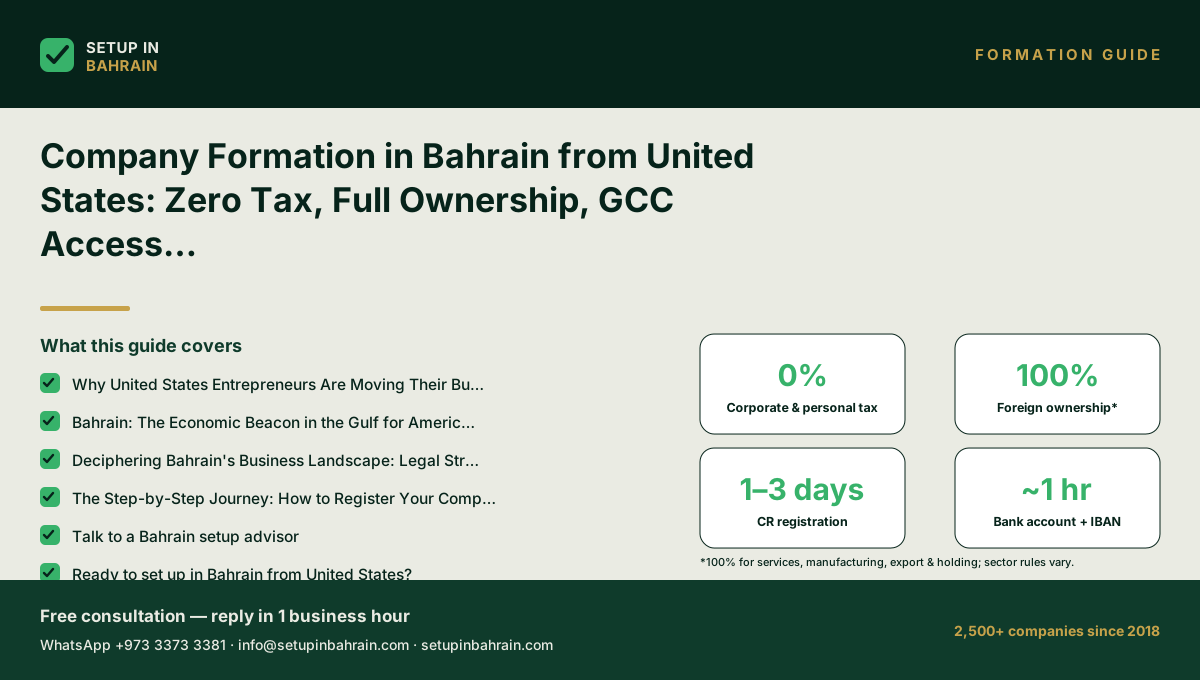
A Bahrain WLL can be owned by a single person — 100% foreign ownership applies to most activities, with no local partner required for services, manufacturing, export trading and holding companies. The minimum share capital is BHD 1; we recommend BHD 1,000, which makes bank account opening and investor visa approval smoother.
Last month, I spoke with Marcus, a SaaS founder from Austin. He’d just closed a banner quarter, pushing his annual revenue past $1.8 million. Instead of celebrating, he was grappling with a common American entrepreneurial dilemma: Stay an LLC and face pass-through taxation plus hefty self-employment taxes on every dollar, or convert to a C-Corp and get hit with a 21% federal corporate tax, plus a pro-rata share of Texas’s gross receipts margin tax. Either path meant another $14,000–$19,000 in annual compliance and registered-agent fees. And when he considered selling his software licenses to clients in Dubai and Riyadh, his US bank flagged the wire transfers, his compliance costs doubled, and his Saudi prospects kept asking for a local Gulf entity.
"I'm literally being taxed to death before I can even compete internationally," Marcus told me. "And the international compliance feels like trying to solve a Rubik's Cube blindfolded."
His story isn't unique. Thousands of American entrepreneurs are discovering that the United States business environment—once the undisputed gold standard for startups—has become a labyrinth of cascading taxes, regulatory complexity, and structural barriers to global expansion. Meanwhile, a small island kingdom, a mere 25 kilometers from Saudi Arabia, offers everything the US system doesn't: Generally no corporate income tax for most sectors, zero personal income tax, zero capital gains tax, full foreign ownership, and a currency pegged directly to the US dollar.
This is Bahrain. And for American business owners eyeing the lucrative, underserved markets of the Middle East, it represents perhaps the most compelling international expansion opportunity available in 2026. This isn't about opaque offshore accounts or convoluted nominee structures; it's about a transparent, legitimate, and strategically positioned economy built for global business.
Why United States Entrepreneurs Are Moving Their Business to Bahrain
Let me paint you a picture that might feel uncomfortably familiar. You're running a profitable online business—maybe SaaS, e-commerce, or consulting—from the United States. You've got clients in the US, maybe a few in Europe. Your revenue hit $500,000 last year. Congratulations. But when you sat down with your CPA in March, the reality hit hard. Your effective tax rate after federal corporate tax (21%), state taxes (let's say 9.5% in California, or even up to 12% in states like New Jersey), self-employment taxes, and compliance costs came to roughly 38-42%. That's nearly $200,000 gone to the government.
The American entrepreneurial dream has developed some serious cracks, especially for those with global ambitions.
The LLC vs. C-Corp: A Never-Ending Dilemma
Take Jennifer, who runs a digital marketing agency from Denver. She incorporated as a C-Corp in 2021 because her startup attorney advised it would make raising venture capital easier. Three years later, she's never raised VC, but she's paying:
- 21% federal corporate income tax. This is the baseline hit on her company's profits before any state taxes.
- 4.63% Colorado state corporate tax. This is on top of the federal rate, eating further into her bottom line. Double taxation on any dividends she pays herself. If her company makes a profit and distributes it to her as an owner, that money is taxed again* at her personal income tax rate, which can be as high as 37% at the federal level, plus state income taxes. This significantly diminishes the actual take-home profit.
- $2,400 annually for registered agent services in Delaware. Even though her operations are in Denver, she incorporated in Delaware for perceived advantages, incurring recurring, non-operational costs.
- $12,000+ annually for accounting and legal compliance. This is the ongoing cost of navigating complex federal and state tax codes, corporate governance, and annual filings.
Contrast this with Tim, a SaaS entrepreneur in Texas. He registers an LLC for flexibility and pass-through taxation initially. But the minute he seeks outside funding, his investors demand a C-Corp for preferred shares and stock options. Now, he's faced with a costly and complex conversion, and then exposed to the 21% federal tax and a pro-rata share of Texas’s gross receipts margin tax (which can range from 0.33% to 0.75% of gross receipts, with complex calculations). Every revenue dollar is hit multiple times: once at the entity level, again as personal income, and yet again if he brings in foreign investors, who also face US tax implications.
This isn't just about paperwork; it's about opportunity cost. Every hour spent on navigating the labyrinthine United States tax code, every dollar funneled into a registered agent just to maintain a presence in a state you don't even operate from, every strategic decision influenced by tax optimization rather than market potential – these are resources diverted from innovation, growth, and profitability. The entrepreneurial spirit, once soaring, often finds itself grounded by the sheer weight of this administrative and financial burden.
United States Pain Points: More Than Just Taxes
The tax burden is significant, but it's only one piece of the puzzle. American entrepreneurs face a unique set of challenges that stifle global ambition:
- FATCA Complexity: The Foreign Account Tax Compliance Act (FATCA) is a global compliance burden. As soon as a US person (individual or entity) considers opening a non-U.S. account or engaging in non-U.S. transactions, the layers of reporting, documentation, and potential withholding (up to 30% of certain US-sourced payments if compliance is missed) become immense. Many foreign banks are simply hesitant to deal with US clients due to this complexity. This often means US entrepreneurs miss out on lucrative international banking relationships or are burdened with exorbitant compliance fees.
- Expensive Registered Agents & State-Level Hurdles: Incorporating in Delaware for its perceived business-friendly laws still means you expect $300+ in annual franchise tax and a $50+ registered agent fee. And that’s before you get to the often higher state-level corporate taxes and regulatory burdens in your operating state. For growth companies, the prospect of SEC/EDGAR reporting looms, adding another layer of cost and scrutiny if you aim for significant funding rounds or a public offering.
- Structural Barriers to International Expansion: As Marcus discovered, US-only structuring can be a major hurdle for international prospects. Many foreign clients, especially in the Gulf Cooperation Council (GCC) region, prefer or even require dealing with a locally registered entity. This isn't just about cultural preference; it's often about local procurement rules, vendor registration processes, and ease of invoicing and payment. A US entity, no matter how reputable, can face significant friction and even outright rejection in certain markets.
- Near-Zero Direct Access to Emerging Markets: While the US market is vast, it's also highly saturated. Many US entrepreneurs eye the rapid growth in emerging markets, particularly the digitally savvy and affluent populations of the Middle East and North Africa (MENA) region. However, a US-only entity offers near-zero direct, friction-free access to these markets. Marketing and sales become more challenging, contracting more complex, and legal disputes more ambiguous without a local foothold.
This is where Bahrain steps in as a game-changer. It’s not just an alternative; it’s a strategic advantage designed to eliminate these specific American pain points and unlock global potential.
Bahrain's Promise: A Direct Counterpoint
Consider what Bahrain offers, directly addressing the pain points Jennifer, Tim, and Marcus face:
- Generally no corporate income tax for most sectors: Yes, it's real. No 21% federal corporate tax, no state corporate tax. This means 100% of your net profit, after operational expenses, stays within your business or can be reinvested without an immediate government haircut.
- Full Foreign Ownership: Unlike some neighboring states with historical local partnership requirements, Bahrain generally allows 100% foreign ownership in most sectors. This means complete control over your business, without the complexities or risks of nominee shareholders.
- GCC Market Access: Strategically located, Bahrain provides direct and unparalleled access to the GCC market of over 55 million consumers, with Saudi Arabia just a 25-kilometer causeway drive away. This proximity is a logistical and strategic goldmine.
- US Dollar Peg: The Bahraini Dinar (BHD) is pegged directly to the US Dollar (1 BHD = 2.659 USD). This eliminates currency exchange risk, a significant concern for US businesses operating internationally, and provides financial stability.
- Streamlined Compliance: While still a regulated environment, Bahrain's compliance framework is designed for efficiency and transparency, without the FATCA-level global burden on the entity itself (though individual US persons still have personal FATCA obligations). The processes are digital and focused on facilitating business, not creating administrative hurdles.
- Affordable Setup & Operations: Compared to the multi-thousand-dollar annual registered agent and state franchise fees in the US, Bahrain offers competitive and transparent setup and operational costs.
Bahrain isn't just another international option; it's a meticulously crafted solution for the modern American entrepreneur who wants to compete globally without being bogged down by domestic complexities.
Bahrain: The Economic Beacon in the Gulf for American Businesses
Bahrain might be a small island nation, but its economic influence, especially as a regional financial and logistical hub, far exceeds its geographical footprint. For American entrepreneurs, it offers a stable, progressive, and highly connected environment.
Macroeconomic Stability and Financial Acumen
The Central Bank of Bahrain (CBB) is a pillar of the nation's financial stability, maintaining a robust and transparent regulatory framework. This is critical for any international investor. The decision to peg the Bahraini Dinar (BHD) directly to the US Dollar at a fixed rate of BHD 0.376 per USD since 1986 is a testament to its commitment to economic predictability and investor confidence. This peg mitigates currency risk, making financial planning and international transactions significantly easier for US businesses.
Bahrain was one of the first GCC countries to diversify its economy away from oil, focusing heavily on financial services, logistics, and, more recently, technology and innovation. This foresight has resulted in a resilient economy recognized by international bodies.
Strategic Location: Your Gateway to the GCC
Perhaps Bahrain's most compelling geographic advantage is its immediate proximity to Saudi Arabia, the largest economy in the Middle East. The King Fahd Causeway, a 25-kilometer marvel of engineering, connects Bahrain directly to Saudi Arabia's Eastern Province. This isn't just a road; it's a vital trade artery. For US businesses establishing a base in Bahrain, this means:
- Direct Access to Saudi Market: Daily movement of goods and people makes it incredibly easy to serve Saudi clients, attend meetings in Riyadh or Dhahran, and tap into a market of over 36 million consumers without needing a separate Saudi entity initially.
- GCC Market of 55 Million+ Consumers: Beyond Saudi Arabia, Bahrain is strategically positioned within the GCC, offering access to the combined markets of UAE, Qatar, Kuwait, and Oman. This eliminates the need to set up individual entities in each country, providing a centralized operational base for regional expansion.
- Global Connectivity: Bahrain International Airport (BIA) is a modern, efficient hub with direct flights to major global cities, while its ports offer excellent maritime links. This logistical advantage is crucial for businesses involved in trade or requiring frequent international travel.
Progressive Regulatory Environment and Ease of Doing Business
The Bahrain Economic Development Board (EDB) is the primary government agency responsible for attracting foreign investment and driving economic growth. Their proactive approach, combined with the Ministry of Industry and Commerce (MOIC), has fostered a highly business-friendly ecosystem.
- Pro-Business Reforms: Bahrain has consistently implemented reforms to streamline business setup and operations. This commitment is reflected in its strong performance in global indices.
- World Bank's Ease of Doing Business: Bahrain has consistently ranked among the top economies in the MENA region and globally for its ease of doing business. While the World Bank has paused this report, Bahrain's historical performance (e.g., often ranking high for 'Starting a Business' and 'Enforcing Contracts') underscores its commitment to a predictable and efficient regulatory environment. These rankings are not just numbers; they translate into less bureaucracy, faster approvals, and a more transparent process for entrepreneurs.
- Full Foreign Ownership: Unlike some GCC countries that historically required local partners or sponsors (sometimes up to 51% ownership), Bahrain has liberalized its laws to allow 100% foreign ownership in most sectors, offering unparalleled control to international investors. This is a game-changer for American entrepreneurs seeking autonomy.
- Regulatory Sandboxes and Innovation Focus: The CBB has been at the forefront of financial technology (FinTech) innovation in the region, establishing regulatory sandboxes to allow startups to test new technologies in a controlled environment. This forward-thinking approach makes Bahrain particularly attractive for tech-driven US businesses.
Modern Infrastructure and a Skilled Talent Pool
Bahrain boasts world-class infrastructure, including reliable utilities, advanced telecommunications networks, and modern office spaces. This makes it easy for businesses to set up operations and maintain global connectivity.
Furthermore, Bahrain has invested heavily in education and training, resulting in a highly skilled, English-speaking local workforce. The government actively supports the development of Bahraini talent, while also facilitating the recruitment of international expertise where needed. This balance ensures businesses have access to the human capital required for growth.
Deciphering Bahrain's Business Landscape: Legal Structures for US Investors
When contemplating company formation in Bahrain, understanding the available legal structures is paramount. It’s a different legal system from the US, but the core principles of limited liability and corporate governance are familiar. Let's compare some US archetypes with their Bahraini counterparts and delve into the specifics.
US LLC/C-Corp vs. Bahraini Equivalents
| Feature | US LLC (Multi-member) | US C-Corp | Bahrain W.L.L. (With Limited Liability) | Bahrain S.P.C. (Single Person Company W.L.L.) |
| :------------------ | :------------------------------------------------------ | :---------------------------------------------------- | :------------------------------------------------------ | :------------------------------------------------------ |
| Ownership | Multiple members (individuals or entities) | Multiple shareholders | Minimum 2, Maximum 50 shareholders/partners | Single shareholder/owner (individual or entity) |
| Liability | Limited to investment | Limited to investment | Limited to investment | Limited to investment |
| Taxation (US) | Pass-through (members pay individual income tax) | Corporate income tax (21% federal + state), double taxation on dividends | N/A (Bahrain has generally no corporate income tax for most sectors) | N/A (Bahrain has generally no corporate income tax for most sectors) |
| Taxation (Bah.) | N/A | N/A | generally no corporate income tax for most sectors | generally no corporate income tax for most sectors |
| Capital Gains | Taxed at individual rates | Taxed at corporate level then again as dividends | 0% Capital Gains Tax | 0% Capital Gains Tax |
| Foreign Ownership | 100% possible (but FATCA implications) | 100% possible (but FATCA implications) | 100% Foreign Ownership (most sectors) | 100% Foreign Ownership (most sectors) |
| Minimum Capital | Varies by state, often low or none | Varies by state, often low or none | BHD 20 (approx. USD 53) – for most activities | BHD 20 (approx. USD 53) – for most activities |
| Management | Managed by members or designated manager | Board of Directors | Board of Managers or single Manager | Owner/Manager |
| Compliance | Complex federal & state filings, FATCA for int'l aspects | SEC/EDGAR for growth, complex tax, FATCA for int'l aspects | Streamlined MOIC/CBB reporting, no FATCA for entity | Streamlined MOIC/CBB reporting, no FATCA for entity |
| Global Reach | Limited by US legal structure, FATCA burden | Limited by US legal structure, FATCA burden | Excellent for GCC/MENA, minimal trade barriers, USD peg | Excellent for GCC/MENA, minimal trade barriers, USD peg |
Key Bahraini Entity Types for US Investors
The primary legal forms for foreign investors in Bahrain fall under the umbrella of limited liability companies, offering robust legal protection with minimal bureaucratic hurdles.
- With Limited Liability Company (W.L.L.): This is the most common and versatile entity type for foreign investors.
- single-shareholder WLL W.L.L.: This is a variant of the W.L.L. designed for solo entrepreneurs.
- Foreign Branch Office: For larger US corporations looking to establish a direct presence without creating a new separate legal entity, a branch office is an option.
- Establishment (Sole Proprietorship): While possible, this is generally not recommended for US investors due to unlimited personal liability and certain restrictions on foreign ownership (requiring a Bahraini owner for some activities). It's more suited for small local businesses.
Free Zones vs. Mainland: Where to Set Up?
Bahrain offers both "mainland" registration (under the Ministry of Industry and Commerce) and designated "free zones." The choice depends on your business model and strategic objectives.
- Mainland Registration (MOIC):
- Free Zones: While not as numerous or strictly delineated as in some other GCC countries, Bahrain has specialized industrial and logistics zones that offer additional benefits, particularly for specific sectors.
For the vast majority of US entrepreneurs, particularly those in SaaS, consulting, e-commerce, or digital services, a single-shareholder WLL W.L.L. or a W.L.L. registered on the mainland through the Ministry of Industry and Commerce (MOIC) will be the most appropriate and beneficial structure. It provides limited liability, full foreign ownership, Generally no corporate income tax for most sectors, and unrestricted access to the Bahraini and wider GCC markets.
The Step-by-Step Journey: How to Register Your Company in Bahrain
The process of registering a company in Bahrain has been significantly streamlined by the government, largely thanks to initiatives led by the EDB and the MOIC's "Sijilat" portal. While relatively efficient, having a clear roadmap and understanding the nuances for US citizens is essential. The Bahrain Investors Center (BIPA) is often your first point of contact, offering a one-stop shop for business registration.
1. Initial Planning & Business Activity Codes
Before anything else, you need a crystal-clear understanding of your business activities.
- Business Plan: Outline your venture's purpose, services/products, target market, financial projections, and operational strategy.
- Activity Codes: Bahrain uses a standardized classification system for business activities (e.g., 62090 for "Other information technology and computer service activities"). You must select the specific codes that match your business. These codes determine licensing requirements, minimum capital (though generally low), and eligibility for certain incentives. The Sijilat portal allows you to search and select these codes. Some activities (e.g., financial services, healthcare) are regulated and require approval from specific government bodies (e.g., CBB, Ministry of Health).
2. Reserving Your Company Name
This is often the first formal step.
- Availability Check: Use the Sijilat portal to check if your desired company name is available and complies with Bahraini naming conventions (e.g., no offensive language, no misleading terms like "Bank" unless licensed).
- Reservation: Once approved, you can reserve the name, typically for a short period (e.g., 30 days), giving you time to prepare other documents.
3. Drafting Memorandum and Articles of Association (MOA/AOA)
These are the foundational legal documents of your company.
- Contents: The MOA outlines the company's objectives, capital structure, and liability. The AOA details the internal management rules, such as shareholder rights, meeting procedures, and director appointments.
- MOIC Templates: The MOIC provides standard templates for WLLs and WLLs, which simplify the process significantly. You'll need to customize these with your specific details (shareholders, capital, managers, etc.).
- Legal Review: While templates exist, it’s advisable for US entrepreneurs to have these reviewed by a local Bahraini lawyer to ensure all specific clauses align with your intentions and US tax reporting considerations.
4. Applying for Commercial Registration (CR)
This is the core registration process conducted through the Sijilat portal.
- Online Application: Submit your MOA/AOA, shareholder details (passport copies, residential addresses), manager details, and select your activity codes.
- Required Documents:
- Review and Approval: The MOIC will review your application. This phase is largely digital and efficient. You might receive queries for clarification or additional documents.
- CR Issuance: Once approved, your Commercial Registration (CR) certificate will be issued, signifying your company's legal existence. This typically takes 2-3 working days if all documents are in order and no external approvals are needed.
5. Opening a Corporate Bank Account
This is a critical step, and for US citizens, it requires careful navigation due to international compliance.
- CBB Oversight: The Central Bank of Bahrain (CBB) supervises a robust and well-regulated banking sector.
- Required Documents: You'll typically need your company's CR, MOA/AOA, passport copies for signatories, and sometimes a board resolution authorizing account opening.
- FATCA Considerations for US Owners/Signatories: As a US citizen, expect enhanced due diligence from Bahraini banks due to FATCA. You will need to provide your US Taxpayer Identification Number (TIN) and fill out W-9 forms. Banks are legally obliged to report accounts held by US persons to the IRS (via the CBB). While this is a standard global process, it means that opening an account might take slightly longer and involve more paperwork than for non-US nationals. Be transparent and cooperative.
- Choosing a Bank: Bahrain has a mix of local and international banks (e.g., Ahli United Bank, National Bank of Bahrain, HSBC, Standard Chartered). Research their specific requirements for foreign-owned businesses and their experience with US citizen clients.
- Timeline: This step can sometimes be the longest, ranging from 1 to 4 weeks depending on the bank and your specific circumstances.
6. Obtaining Necessary Licenses
Beyond the CR, some activities require specific licenses from sector-specific ministries or regulators.
- Example: If you're establishing a FinTech company, you'll need licensing from the CBB. A health-tech startup would need approvals from the Ministry of Health.
- Integrated Process: The Sijilat portal aims to integrate these approvals, but some might still require direct engagement with the relevant authority.
7. Visa and Residency Considerations
As a US entrepreneur, you'll likely want to live and work in Bahrain.
- Investor Visa: Once your company is registered and capital
Bahrain Business Guides for United States Citizens
Ready to set up in Bahrain from United States?
Tell us your business idea. We map the right entity, ownership and timeline — then handle the filing while you focus on what matters.