
Start your Bahrain company from the United Arab Emirates with generally no corporate income tax for most sectors benefits. Fast registration, full foreign ownership & strategic Gulf location.
→ Complete guide: Company Formation in Bahrain — the full 2026 guide
View details
Ownership & capital
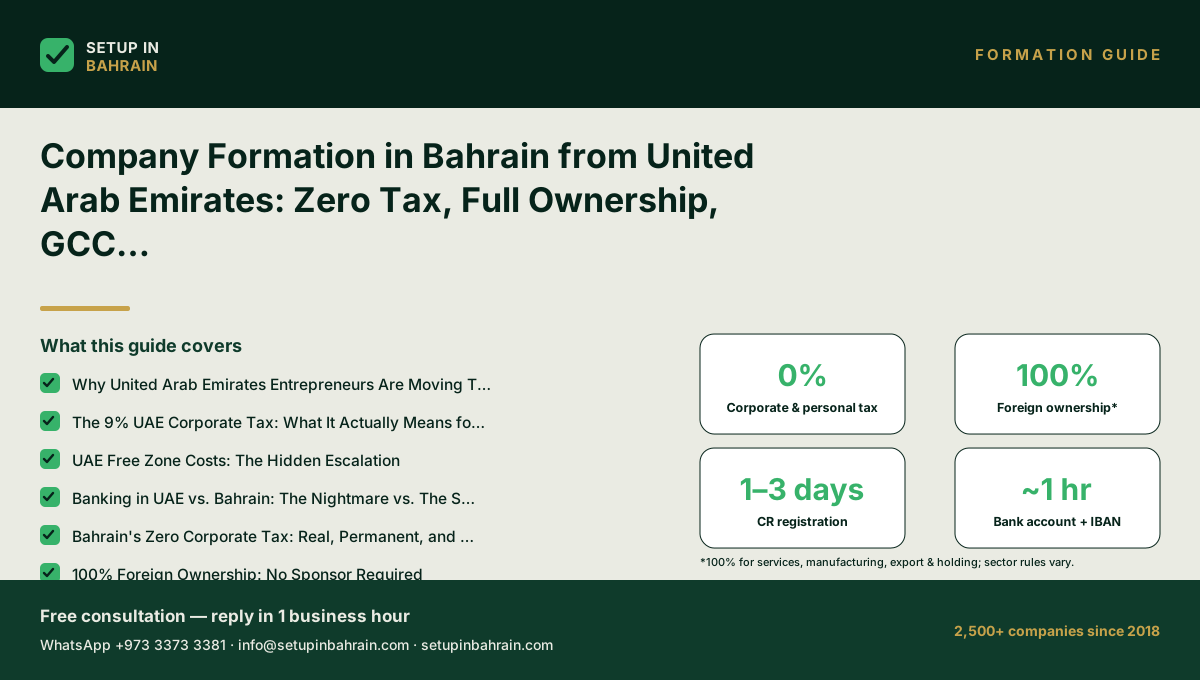
A Bahrain WLL can be owned by a single person — 100% foreign ownership applies to most activities, with no local partner required for services, manufacturing, export trading and holding companies. The minimum share capital is BHD 1; we recommend BHD 1,000, which makes bank account opening and investor visa approval smoother.
Last month, I sat across from Ahmed, a Dubai-based software consultancy owner who had just received his first UAE corporate tax assessment. His company earned AED 2.1 million in profit during 2024. The tax bill? AED 170,100 — money that, twelve months earlier, would have stayed entirely in his business.
"I built this company for eight years paying Generally no corporate income tax for most sectors," he told me. "Now I'm writing cheques to the Federal Tax Authority while my Bahraini competitor across the Gulf pays nothing."
Ahmed's story isn't unique. Since June 2023, when the UAE introduced its 9% corporate tax, thousands of Emirates-based entrepreneurs have been doing the same math. And increasingly, that calculation points them toward a small island kingdom just 350 kilometers across the Gulf: Bahrain.
This guide is specifically written for UAE business owners like Ahmed — people who understand the Emirates market intimately, who've navigated JAFZA renewals and DMCC compliance, who've waited five months for Emirates NBD to approve a business account, and who now face a fundamentally different cost structure than the one they signed up for.
Bahrain isn't just another offshore jurisdiction. It's a fully-fledged GCC member state, 25 kilometers from Saudi Arabia's Eastern Province, with genuine Generally no corporate income tax for most sectors, 100% foreign ownership, and a banking system that actually wants your business.
Let me show you exactly how this works.
Why United Arab Emirates Entrepreneurs Are Moving Their Business to Bahrain
The UAE's corporate tax introduction wasn't just a policy change — it was a psychological shift. For decades, Emirates-based entrepreneurs operated under an implicit promise: build here, keep everything you earn. That promise expired on June 1, 2023.
The 9% rate sounds modest compared to European or American standards. But context matters enormously. A UAE entrepreneur who structured their business around zero-tax assumptions — aggressive reinvestment, lean margins, founder salaries optimized for zero withholding — now faces a complex compliance burden. Transfer pricing documentation. Quarterly estimated payments. Thin capitalization rules.
Here's what that means in real numbers for a typical Dubai free zone company:
Annual UAE Costs (Post-Tax Introduction)
| Cost Category | Pre-June 2023 | Post-June 2023 | Increase |
| Free zone license (DMCC/JAFZA) | AED 22,500–35,000 | AED 25,000–55,000 | 15–57% |
| Corporate tax (AED 2M profit) | AED 0 | AED 180,000 | ∞ |
| Commercial rent (JLT/Barsha) | AED 120,000–280,000 | AED 150,000–330,000 | 18–25% |
| Compliance/accounting fees | AED 12,000–18,000 | AED 25,000–45,000 | 108–150% |
| Bank account setup wait time | 4–8 weeks | 12–20 weeks | 150%+ |
| Total annual outlay | AED 154,500–333,000 | AED 380,000–610,000 | 83–146% |
Now contrast that with Bahrain:
Annual Bahrain Costs (Equivalent Company)
| Cost Category | Bahrain WLL (Service Co.) | Bahrain WLL (Trading Co.) |
| Commercial registration (CR) | BHD 150–200 | BHD 200–300 |
| Company setup (one-time) | BHD 1,500–2,500 | BHD 2,500–4,000 |
| Corporate tax | BHD 0 (0%) | BHD 0 (0%) |
| Office rent (Manama/Busaiteen) | BHD 3,600–8,400/year | BHD 4,800–12,000/year |
| Compliance/accounting fees | BHD 1,800–3,000 | BHD 2,400–4,200 |
| Bank account setup time | 2–4 weeks | Banking: approximately 1 hour in 99% of our reported cases; our last 100 applications handled in 2026 were approved; subsidiaries or CIS shareholders: 3 days to 2 weeks. Subject to the bank’s final review. |
| Total annual outlay | BHD 5,550–11,600 (AED 54,000–112,500) | BHD 7,400–17,500 (AED 72,000–170,000) |
The numbers don't lie. A UAE entrepreneur earning AED 2 million in profit could save AED 280,000–450,000 annually by relocating their operating company to Bahrain — and that's before factoring in banking headaches, licensing complexity, and market access barriers.
The 9% UAE Corporate Tax: What It Actually Means for Your Business
Let's be precise about the UAE's corporate tax regime, because many entrepreneurs still misunderstand it.
The 9% rate applies to taxable profits exceeding AED 375,000. Profits below that threshold are taxed at 0%. But here's what most free zone company owners discover too late:
Free Zone Qualifying Income (FZQI) doesn't automatically cover everything. To maintain your 0% rate on qualifying income, you must:
- Maintain adequate substance in the free zone
- Derive income from specific qualifying activities
- Not deal with "excluded activities" (banking, insurance, certain financial services)
- Comply with transfer pricing documentation requirements
The compliance burden is real. Every free zone company must now file a corporate tax return annually. Many need audited financial statements — an expense many SMEs never budgeted for. Transfer pricing documentation for related-party transactions kicks in at AED 500,000 revenue, which catches most trading and service companies.
Mainland companies face even more complexity. If you operate through a mainland UAE company with a local sponsor, the tax applies to all profits. Your sponsor's share? Also subject to tax. And the historical "sponsor arrangement" where a local partner holds 51% while you bear all cost? That structure now has tax implications the old regime never contemplated.
For a UAE entrepreneur running a consultancy earning AED 1.5 million in profit, the math works out:
- Taxable profit above AED 375,000: AED 1,125,000
- Tax at 9%: AED 101,250
- Plus compliance costs: AED 15,000–25,000
- Total new burden: AED 116,250–126,250 per year
That's a AED 10,000 monthly expense that didn't exist 24 months ago.
UAE Free Zone Costs: The Hidden Escalation
Free zone packages used to be simple. You paid AED 15,000–30,000 for a basic license, optional flexi-desk for AED 5,000–10,000, and you were operational. Today, the picture is dramatically different.
DMCC (Dubai Multi Commodities Centre): Basic trading license now starts at AED 42,000. Add shareholder visas, office space (physical desk minimum at AED 18,000/year), and compliance costs, and you're looking at AED 85,000–120,000 year one.
JAFZA (Jebel Ali Free Zone): Trading license packages begin at AED 25,000 but require actual warehousing or office space for many activities. Renewal packages now often include mandatory audit requirements pushing total cost above AED 60,000.
IFZA (International Free Zone Authority): One of the more affordable options at AED 14,900 basic license, but restrictions on activities and bank account approvals make it limiting for serious trading operations.
ADGM (Abu Dhabi Global Market): The most sophisticated free zone from a legal perspective, but setup costs start at AED 50,000 and quickly escalate to AED 150,000+ for regulated activities.
The hidden escalation isn't just license fees. It's:
- Mandatory health insurance for employees (AED 5,000–15,000/year per employee)
- Immigration costs (visa processing, Emirates ID, medical) rising 20–30% since 2022
- Compliance software for tax filing (AED 5,000–15,000 annually)
- Legal fees for restructuring to optimize FZQI treatment (AED 20,000–50,000 one-time)
When a UAE entrepreneur adds all this up, the annual cost of maintaining a free zone company has effectively doubled since 2022 — before paying a single dirham in corporate tax.
Banking in UAE vs. Bahrain: The Nightmare vs. The Solution
If I had to identify the single biggest operational pain point for UAE-based entrepreneurs, it's banking. Not tax. Not licensing. Banking.
The UAE Banking Reality:
Opening a business bank account in the UAE has become comically difficult — unless you're a large corporation or have AED 5 million+ to deposit.
- Document requirements: Banks routinely request 15–25 documents including board resolutions, source of funds declarations, detailed business plans, supplier contracts, and personal bank statements for all shareholders
- Processing times: 8–16 weeks is standard. Four months is not unusual. Six months has been reported for complex structures
- Minimum balance requirements: AED 100,000–500,000 for business accounts at major banks (Emirates NBD, ADCB, FAB)
- Compliance rejections: Banks increasingly reject applications from free zone companies, especially trading firms, without clear explanation
- Ongoing friction: Transaction limits, daily withdrawal caps, repetitive KYC refreshes — every banking interaction carries friction
I personally know a UAE entrepreneur who waited 18 weeks for a Mashreq business account approval, only to receive a letter stating "the bank has decided not to proceed" with no reason given. His business had been operating profitably for 12 years.
The Bahrain Banking Reality:
Bahrain's banking sector is different. Not because Bahraini banks are less diligent — they're regulated by the Central Bank of Bahrain (CBB), which maintains robust AML/KYC standards. But because the sector is fundamentally designed to support business.
- Document requirements: Typically 8–12 documents. A clear, logical list with no surprises
- Processing times: 2–4 weeks for straightforward structures (WLL with clear ownership and business plan)
- Minimum balance requirements: BHD 500–3,000 (AED 4,850–29,100) — dramatically lower than UAE
- Account types: Current accounts, savings accounts, fixed deposits, multi-currency accounts all available to SMEs
- Banking relationships: Banks actively court SME clients. Relationship managers are accessible and knowledgeable
Bahrain's status as a mature financial center with a 50-year history as the GCC's banking hub means banks understand business needs. They've seen every structure, every industry, every ownership model. Your Bahraini banker isn't suspicious of your business — they want to support it.
Bahrain's Generally no corporate income tax for most sectors: Real, Permanent, and Legally Protected
Let me address the question every UAE entrepreneur asks: "Is Bahrain's zero tax actually permanent, or will they pull a UAE and introduce tax later?"
The answer requires understanding Bahrain's constitutional and economic framework.
Bahrain's Tax-Free Status: The Legal Foundation
Bahrain imposes Generally no corporate income tax for most sectors under Legislative Decree No. 28 of 2017, which abolished the previous 46% tax rate (which applied only to oil and gas companies). This wasn't a temporary exemption — it was a deliberate strategic choice.
Key legal protections:
- Article 1 of the decree: No tax shall be imposed on the profits of any entity registered in Bahrain
- Constitutional protection: Changes to tax law require full parliamentary approval and consultation with the Shura Council
- Economic diversification commitment: Bahrain's Economic Vision 2030 explicitly anchors low-tax policy as a driver of non-oil GDP growth
Comparative Stability Factor:
Bahrain has had Generally no corporate income tax for most sectors since 2017 — but importantly, its 46% rate only ever applied to hydrocarbon companies. Non-oil businesses always operated in a low-tax environment (previously 0% on manufacturing, 0% on most services under specific regimes). The principle of "no tax on business profits" has strong precedent.
Compare this to the UAE, which went from "zero tax forever" to 9% in less than 18 months. Bahrain's trajectory is the opposite — from limited high-tax to comprehensive zero-tax.
What Could Change?
Realistically, the risk isn't a sudden 9% tax. More likely scenarios include:
- VAT expansion (currently 10%, could increase)
- Introduction of withholding tax on specific payments (dividends, interest, royalties)
- Social contribution increases for expatriate workers
None of these would fundamentally alter the zero-corporate-tax proposition. And any such changes would require the same multi-year legislative process that protects the current regime.
100% Foreign Ownership: No Sponsor Required
For UAE entrepreneurs accustomed to the mainland "51% local sponsor" requirement (abolished only in 2021 for most sectors, and still requiring trust arrangements), Bahrain's approach is refreshingly simple.
Bahrain's Foreign Ownership Rules:
Under Bahrain's Commercial Companies Law (Legislative Decree No. 28 of 1975, as amended):
- 100% foreign ownership is permitted for virtually all business activities
- No local sponsor required — no hidden partner, no nominee arrangement, no trust deed
- Full managerial control rests with the foreign owner(s)
- Capital requirements are minimal (BHD 1,000–20,000 depending on legal form and activity)
The Only Exceptions:
A handful of sectors require majority Bahraini ownership:
- Media and publishing (51% Bahraini)
- Fishing and marine resources (51% Bahraini)
- Selected professional services (engineering consultancy, architecture — case-by-case review)
For 95%+ of businesses — trading, services, technology, logistics, manufacturing, construction — 100% foreign ownership is straightforward.
Key Legal Forms for UAE Entrepreneurs:
| Legal Form | Minimum Capital | Liability | Best For |
| WLL (With Limited Liability) | BHD 1,000 (AED 9,700) | Limited to capital | Trading, services, technology |
| Sole Establishment | BHD 1,000 (AED 9,700) | Unlimited | Single-owner services |
| SPV (Single Person Company) | BHD 20,000 (AED 194,000) | Limited | Holding companies |
| Branch of Foreign Company | None | Parent company liability | Extending UAE company to Bahrain |
GCC Market Access: Bahrain's Strategic Advantage
This is where Bahrain changes the game for UAE entrepreneurs — especially those serving Saudi Arabia's massive market.
The King Fahd Causeway Advantage:
Bahrain sits 25 kilometers from Saudi Arabia's Eastern Province — home to 5 million people, the industrial hub of Dammam, Khobar, and Dhahran, and the gateway to Riyadh (400 km inland).
The King Fahd Causeway connects Bahrain directly to Saudi Arabia. Driving time from Manama to Khobar: 45 minutes. From Manama to Dammam airport: 1 hour. From Manama to Riyadh: 4 hours.
What This Means for Your Business:
- Direct market access: Bahrain-incorporated companies can sell goods and services into Saudi Arabia without the burden of maintaining a Saudi-licensed entity (for most products/services)
- Simplified logistics: Clear customs at the causeway as a GCC-originating business, not a foreign entity
- Lower operational costs: Bahrain office rents are 50–70% lower than Riyadh or Jeddah. Talent costs 30–40% less
- No Saudi localization requirements: Saudi's Saudization (Nitaqat) and foreign investment restrictions don't apply to your Bahrain team serving the market
Real Example:
A Dubai-based logistics company I work with moved its GCC operations hub to Bahrain. Their Saudi client base (70% of revenue) now pays directly to a Bahraini bank account, goods move duty-free across the causeway, and they maintain a full operational team in Manama at 40% of the cost of a Riyadh office.
Previously, servicing Saudi clients from the UAE required complex documentation, dual-licensing considerations, and occasional Saudi tax filings. Now it's straightforward.
Step-by-Step Company Formation Process in Bahrain
If you're ready to proceed, here's the exact process my clients follow:
Phase 1: Preparation (1–2 Weeks)
- Activity code selection: Determine your precise business activities using Bahrain's standard classification (similar to UAE's 4-digit codes). Choose wisely — changing later requires MOIC approval.
- Company name reservation: Submit 3 name options to MOIC. Include "WLL" in the name. Avoid religious, political, or sensitive terms.
- Legal structure confirmation: WLL is appropriate for 90%+ of UAE entrepreneurs. Confirm capital requirement (BHD 1,000 minimum for service companies).
- Shareholder documentation: Prepare passport copies, proof of address (utility bill or bank statement), CV/resume for each shareholder, and bank reference letter.
Phase 2: Registration (3–5 Working Days)
- MOIC online submission: File through the MOIC's Sijilat portal. Required documents include:
- Commercial Registration (CR) issuance: Upon approval, your CR is issued electronically. This is your primary business license.
- Chamber of Commerce registration: Mandatory for all businesses. Annual fee approximately BHD 50–150 depending on activity.
Phase 3: Operational Setup (2–3 Weeks)
- Tax registration: Register for VAT with the National Bureau for Revenue (NBR) if turnover exceeds BHD 500,000 (AED 4.85 million) annually. Below that, registration is voluntary but recommended for B2B invoicing.
- Social insurance registration: Register with the Social Insurance Organization (SIO) for Bahraini employees. Expatriate insurance is handled separately.
- Bank account opening: Submit to 2–3 banks simultaneously. Expected timeline: 2–4 weeks.
- Office setup: Finalize physical or virtual office arrangement. Most service companies operate from co-working spaces (BHD 150–400/month) or serviced offices (BHD 400–1,000/month).
Total Timeline: 4–6 Weeks from Preparation to Bank Account Active
Total Cost Range: BHD 2,500–6,000 (AED 24,250–58,200) for a straightforward WLL setup
Banking in Bahrain: How to Open an Account as a UAE Entrepreneur
Since banking is the single biggest pain point in the UAE, let me detail exactly how to open a Bahraini business account.
Documents Required:
- Commercial Registration (CR) certificate
- Memorandum and Articles of Association (MOA/AOA)
- Board resolution authorizing account opening (with signatory list)
- Valid passport copies of all signatories
- Proof of address for each signatory (utility bill or bank statement from country of residence)
- Business plan (1–2 pages describing activities, target markets, projected turnover)
- CV of owner/manager
- Personal bank reference letter from current bank (some banks require)
Recommended Banks for UAE Entrepreneurs:
| Bank | Strengths | Minimum Deposit | Account Opening Time |
| Ahli United Bank (AUB) | Strong SME focus, Arabic/English, good online banking | BHD 1,000 | Banking: approximately 1 hour in 99% of our reported cases; our last 100 applications handled in 2026 were approved; subsidiaries or CIS shareholders: 3 days to 2 weeks. Subject to the bank’s final review. |
| Bank of Bahrain and Kuwait (BBK) | Excellent multi-currency accounts, experienced with foreign clients | BHD 500 | Banking: approximately 1 hour in 99% of our reported cases; our last 100 applications handled in 2026 were approved; subsidiaries or CIS shareholders: 3 days to 2 weeks. Subject to the bank’s final review. |
| National Bank of Bahrain (NBB) | Fastest processing, good for trading companies | BHD 2,000 | Banking: approximately 1 hour in 99% of our reported cases; our last 100 applications handled in 2026 were approved; subsidiaries or CIS shareholders: 3 days to 2 weeks. Subject to the bank’s final review. |
| HSBC Bahrain | Ideal for existing HSBC customers, global connectivity | BHD 3,000 | 3–4 weeks |
| Standard Chartered Bahrain | Strong cross-border capability, good for GCC trade | BHD 2,500 | 3–4 weeks |
- Apply to 2 banks simultaneously — processing times vary
- A well-prepared business plan significantly improves approval odds
- Personal visit to the branch during application is often required (unlike UAE where everything is remote, Bahrain prefers face-to-face for initial KYC)
- Once established, maintain BHD 3,000–5,000 average balance to avoid monthly fees
Bahrain Residency and Visa Options for UAE Entrepreneurs
One of the most attractive aspects of company formation in Bahrain is the straightforward residency pathway.
Investment Visa (Business Owner):
- Eligibility: Owner of a Bahrain company with valid CR
- Visa duration: 2 years, renewable
- Requirements: Valid passport, company CR, BHD 2,000 minimum investment (effectively your company capital)
- Processing time: 2–4 weeks from CR issuance
- Family sponsorship: Yes — spouse, children, parents (with conditions)
- Cost: BHD 300–500 per person including medical, ID, visa stamping
Golden Residence Permit (10-Year):
- Eligibility: Business owner with BHD 500,000+ (AED 4.85M+) investment OR
- Processing time: 4–8 weeks
- Benefits: 10-year renewable residency, work without permit, family sponsorship
- Note: This is less commonly used than the standard investment visa for most UAE entrepreneurs
Flexibility Considerations:
- You can maintain your UAE residence visa (golden visa or employment) while holding Bahrain residency — dual GCC residency is permitted
- Bahrain offers a "Flexi-Residency" program (BHD 2,000 one-time fee, 5-year renewable) for those who don't want full residency but need regular access
- No minimum stay requirements for residence visa maintenance (unlike some jurisdictions)
Living in Bahrain vs. Dubai: Cost of Living Comparison
For UAE entrepreneurs considering relocation, here's what you need to know about day-to-day living costs:
| Expense Category | Dubai (Monthly) | Manama (Monthly) | Savings |
| 1-bedroom apartment (city center) | AED 7,000–12,000 | AED 3,500–6,000 | 40–50% |
| 2-bedroom apartment (good area) | AED 11,000–18,000 | AED 5,000–9,000 | 45–55% |
| Utilities (electricity, water, cooling) | AED 900–1,800 | AED 300–600 | 60–70% |
| High-speed internet | AED 350–500 | AED 150–250 | 50–60% |
| International school (per child/year) | AED 45,000–80,000 | AED 25,000–45,000 | 40–45% |
| Groceries (monthly, family of 4) | AED 3,000–5,000 | AED 2,000–3,500 | 30–40% |
| Dining out (mid-range, 2 people) | AED 250–500 | AED 120–250 | 50–60% |
| Gym membership | AED 400–800 | AED 150–350 | 50–60% |
| Total monthly living (single) | AED 12,000–20,000 | AED 6,000–11,000 | 40–50% |
- Healthcare: Bahrain's public healthcare system is excellent and low-cost. Private insurance is mandatory but affordable (AED 3,000–6,000/year comprehensive)
- Education: International schools (British, American, Indian curricula) at 40–50% less than Dubai. British School of Bahrain and Bahrain Bayan School are high-quality options
- Lifestyle: Manama offers excellent restaurants, shopping malls, golf courses, and water sports. Less glitzy than Dubai but more accessible and less crowded
- Community: Expatriate community is smaller but tighter-knit. Strong British, American, Indian, and Filipino communities
- Climate: Similar to UAE — hot summers (May-October), pleasant winters (November-April). Less humidity than Dubai in summer
Industry-Specific Opportunities in Bahrain
While Bahrain welcomes all business types, certain sectors offer particular advantages for UAE entrepreneurs:
Financial Services and Fintech:
- Bahrain's Central Bank (CBB) is the GCC's most progressive regulator for fintech
- Regulatory sandbox available for innovative financial products
- Access to the broader GCC banking market through Bahrain's mature financial infrastructure
- Category 1 and 2 licenses available for insurance, asset management, payment services
Technology and IT Services:
- No licensing restrictions on IT services (unlike some UAE free zones)
- Strong pool of Arabic/English bilingual tech talent at 30–50% lower salaries than Dubai
- Government incentives for tech startups including subsidized office space through Bahrain Development Bank (BDB)
- Cloud-first policy from the Bahrain government (no data localization requirements for most activities)
Manufacturing and Logistics:
- Land costs 70% lower than Dubai industrial areas
- Bahrain Logistics Zone (BLZ) offers customs-free warehousing and distribution
- Direct shipping connections to Saudi Arabia, Kuwait, and Qatar
- BHD 150–250/sqm annual rent for industrial space vs. AED 800–1,500/sqm in JAFZA
E-commerce:
- No import duties on goods entering Bahrain for re-export
- Bahrain-incorporated e-commerce companies can sell across GCC without establishing entities in each country (for most product categories)
- Local fulfillment centers available at competitive rates
Legal and Tax Considerations for UAE Entrepreneurs
Before making the move, understand these important legal and tax implications:
UAE Tax Considerations When Moving:
- Cessation filing: If you close your UAE company, you must file a final corporate tax return and potentially a capital gains analysis on asset disposal
- Continuing UAE operations: If you maintain your UAE company for existing contracts, ensure transfer pricing documentation is in place between your UAE and Bahrain entities
- Personal tax residency: UAE does not tax personal income regardless of residence. Moving to Bahrain doesn't create a UAE personal tax liability
- VAT implications: Company relocation may trigger VAT implications on asset transfers. Consult a UAE VAT specialist before moving
Bahrain Tax Considerations:
- Generally no corporate income tax for most sectors: Confirmed and legally protected. No surprise taxes on the horizon
- VAT: 10% on goods and services, with standard exemptions (healthcare, education, financial services). Threshold: BHD 500,000 annual turnover
- Withholding tax: Zero on dividends, interest, royalties, and management fees paid to non-residents
- Capital gains tax: Zero
- Estate tax: Zero
- Property tax: Zero (except for land registration fees)
Double Taxation Agreements:
Bahrain has DTTs with 40+ countries including:
- UAE (preventing double taxation on cross-border business income)
- India, China, Singapore (key trade partners)
- Most European countries
Common Myths About Bahrain Company Formation for UAE Entrepreneurs
Myth 1: "Bahrain is too small for serious business." Reality: Bahrain's GDP per capita ($28,000+) is comparable to many European economies. Its strategic position as a GCC hub gives it economic footprint far beyond its 1.7 million population. Saudi Arabia's Eastern Province (5 million people, $200+ billion GDP) is effectively Bahrain's backyard.
Myth 2: "Setting up in Bahrain is complicated." Reality: Total working days from application to CR issuance: 3–5. Compare to DMCC (7–14 days), DED (10–20 days), or Saudi's Ministry of Investment (4–8 weeks minimum). Bahrain's Sijilat portal is genuinely efficient.
Myth 3: "I can't bank in Bahrain if I'm a UAE resident." Reality: Banks are accustomed to non-resident shareholders. Your UAE residence is an asset, not a liability — it signals financial stability and regional commitment.
Myth 4: "Bahrain doesn't have the talent pool I need." Reality: Bahrain has one of the region's most educated workforces (95%+ literacy rate), excellent English proficiency, and a 15,000-student-strong university system producing graduates in engineering, IT, finance, and business.
Myth 5: "I'll lose my UAE visa if I move to Bahrain." Reality: Dual residency is permitted. You can hold both a UAE golden visa (maintained through property investment or existing business) and a Bahrain investment visa simultaneously.
FAQs: UAE Entrepreneurs on Bahrain Company Formation
Q: Can I transfer my existing UAE company registration to Bahrain? A: There's no direct "transfer" mechanism. You incorporate a new Bahrain company and either close your UAE entity or maintain both for separate purposes. Consult a professional for asset/contract migration.
Q: Do I need to be physically present in Bahrain to register a company? A: Initial registration can be done through a PRO (Public Relations Officer) with power of attorney. However, bank account opening typically requires at least one signatory to visit Bahrain. Most find one 3-day trip sufficient.
Q: What activities require special licensing in Bahrain? A: Financial services (CBB license), healthcare (NHRA), education (MOE), construction (Tender Board), and petroleum (Noga) require sector-specific approvals. Standard trading and services go through MOIC.
Q: How does Bahrain's VAT compare to UAE? A: Bahrain's VAT is 10% (vs. UAE's 5%). However, services exported to non-Bahraini customers are zero-rated, and B2B services within GCC often qualify for reverse charge mechanisms.
Q: Can my existing UAE employees work for the Bahrain company? A: Yes, but they need Bahrain work permits. The process is straightforward: transfer their UAE labor card status and apply for Bahrain work visa. Processing time: 2–3 weeks.
Q: What's the real timeline from decision to operation? A: Realistic: 6–8 weeks for full setup including bank account. Aggressive: 4 weeks with express processing and pre-prepared documentation.
Q: Is there a minimum investment requirement? A: For a standard WLL, minimum capital is BHD 1,000 (AED 9,700). No additional investment threshold exists for company formation. The "investment visa" requires BHD 2,000 capital in practice.
Taking Action: Your 30-Day Bahrain Company Formation Plan
If you're serious about this, here's your action plan:
Week 1: Research & Preparation
- Review your UAE company financials — confirm savings from Bahrain zero-tax structure
- Identify your target business activities — match to Bahrain's activity code list
- Prepare shareholder documentation (passports, addresses, CVs)
- Contact 2–3 Bahrain-based PROs or business setup consultants for quotes
- Open a personal conversation with a Bahrain bank relationship manager
Week 2: Legal & Registration
- Submit name reservation to MOIC (Sijilat portal)
- Prepare Memorandum and Articles of Association (standard template)
- Finalize lease agreement (virtual office is sufficient for most activities)
- Submit full registration application
- Receive Commercial Registration (CR)
Week 3: Banking & Operational Setup
- Submit bank account applications (2 banks minimum)
- Register for VAT (if applicable) through NBR online portal
- Register with Social Insurance Organization (SIO)
- Apply for investment visa(s) for owner and family
- Source office space (visit if possible, virtual arrangement if not)
Week 4: Launch
- Bank account active — arrange initial deposit (BHD 2,000–5,000)
- Receive visas (stamp passport, medical, ID processing)
- Set up accounting software, invoices, payment processing
- Notify clients of new billing structure
- Begin operations from Bahrain
Professional Partners I Recommend:
- PRO services: Bahrain Clear (digital-first), Almoayyed International Group (full service)
- Legal: Hassan Radhi & Associates, Trowers & Hamlins (Bahrain office)
- Accounting: PwC Bahrain (for complex structures), KPMG Bahrain (for SME packages)
- Bank introduction: Most banks accept direct applications, but introducers can speed the process
Conclusion: Why UAE Entrepreneurs Should Act Now
The window for early movers is still open. As more UAE entrepreneurs discover Bahrain's advantages, the competitive benefits of being first will narrow.
Here's what I tell every UAE founder considering this:
The UAE's corporate tax introduction was not a mistake or a temporary measure. It's a permanent feature of the Emirates business landscape. The era of zero-tax UAE company formation is over — and it's not coming back.
Bahrain offers the same zero-tax, full-ownership, GCC-access model that made the UAE famous. With better banking, lower costs, and the same international connectivity.
For a UAE entrepreneur earning AED 1.5–5 million in profit annually, the savings — AED 150,000–450,000 per year — aren't just hypothetical. They're real money you can reinvest in growth, hire more team members, or take home as income.
The question isn't whether Bahrain makes sense. It's whether you can afford not to explore it.
Your Next Step:
Schedule a 30-minute call with a Bahrain-based consultant. They're available through the Bahrain EDB (Economic Development Board) or through private firms. Most initial consultations are free. Ask for a specific cost comparison between your current UAE structure and a Bahrain WLL.
If the numbers don't work, you lose nothing but an hour of time. If they do — and for most UAE entrepreneurs, they will — you've found a path to zero tax, full ownership, and stress-free banking, just 45 minutes across the Gulf.
The calculator is waiting. The opportunity is real. The choice is yours.
Bahrain Business Guides for United Arab Emirates Citizens
Ready to set up in Bahrain from United Arab Emirates?
Tell us your business idea. We map the right entity, ownership and timeline — then handle the filing while you focus on what matters.