Complete guide for Trinidad and Tobago entrepreneurs: form a company in Bahrain with generally no corporate income tax for most sectors, 100% foreign ownership, and GCC market access. Costs, steps, visas, banking.
→ Complete guide: Company Formation in Bahrain — the full 2026 guide
View details
Ownership & capital
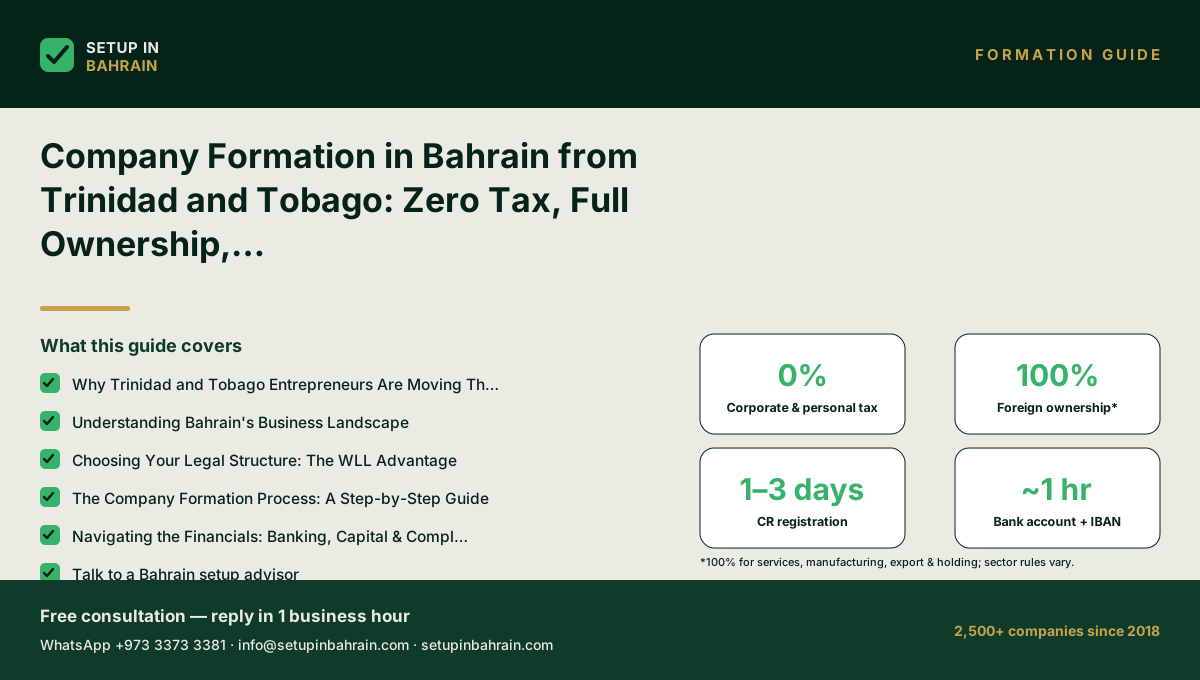
A Bahrain WLL can be owned by a single person — 100% foreign ownership applies to most activities, with no local partner required for services, manufacturing, export trading and holding companies. The minimum share capital is BHD 1; we recommend BHD 1,000, which makes bank account opening and investor visa approval smoother.
If you’re reading this, chances are you’re a Trinidad and Tobago entrepreneur, a visionary accustomed to navigating dynamic markets, who’s currently feeling the weight of the twin-island republic's demanding business landscape. You’ve built something substantial, or you’re on the cusp of it, but you're constantly evaluating how to truly scale, protect your hard-earned profits, and access bigger opportunities.
Picture this: a Port of Spain-based importer of industrial equipment has just cleared another quarter with the Board of Inland Revenue (BIR). The company posted TTD 2.8 million in profit, but after the 30% corporate income tax hit and the mandatory quarterly advance payments, the owner is left reconciling a TTD 210,000 tax bill while still waiting on Central Bank of Trinidad and Tobago (CBTT) approval for USD to pay overseas suppliers. The same week, a competitor in Manama, Bahrain, clears the identical margin with Generally no corporate income tax for most sectors, receives payment in USD the same day, and moves the full amount out the following morning without any central-bank queue or exchange control hurdles.
This stark contrast isn't hypothetical. It illustrates a fundamental divergence in operating environments that’s increasingly prompting savvy Trinidad and Tobago business owners to look beyond their traditional horizons. Entrepreneurs like Anil, a Port of Spain-based software developer with a thriving regional client base, embody this very challenge. For years, he’s reinvested significantly in his team and technology, but every quarter, the 30% corporate income tax on his profits feels like a heavy anchor. When he factors in the complex dance with the BIR for quarterly advance payments, the mandatory 8.4% employer share for NIS contributions, and the constant stress of the CBTT's forex rationing – which makes acquiring USD for his cloud services and international software licenses a perpetual headache – he knows there must be a better way.
Anil’s story isn't unique. It mirrors the silent frustration of countless Trinidad and Tobago business owners wrestling with a hydrocarbon-dependent economy where oil and gas still account for around 35% of GDP, creating an inherent vulnerability to global commodity price swings. For these entrepreneurs, the idea of a stable, tax-efficient, and globally connected jurisdiction isn't a pipe dream; it's an urgent business imperative.
That's where Bahrain enters the conversation. A vibrant island nation in the heart of the Arabian Gulf, Bahrain isn't just another 'offshore' option; it's a strategic gateway offering a dramatically different operating environment. One where corporate income tax is a distant memory, foreign ownership is 100% unrestricted, and your business is literally a 25-kilometer bridge away from Saudi Arabia – the largest economy in the Middle East.
This comprehensive guide is designed specifically for you, the Trinidad and Tobago entrepreneur. We'll cut through the noise, providing you with a clear, humanized, and expert-driven roadmap to establishing your business in Bahrain. We’ll delve into the specifics, from the types of companies you can form and the capital required, to navigating banking, visas, and leveraging Bahrain's strategic advantages. By the end, you'll have a crystal-clear understanding of why Bahrain isn't just an alternative, but a truly transformative step for your business's future.
Why Trinidad and Tobago Entrepreneurs Are Moving Their Business to Bahrain
The decision to expand or relocate a business jurisdiction is never taken lightly. It involves significant research, strategic planning, and a clear understanding of both the current pain points and the potential gains. For Trinidad and Tobago entrepreneurs, the motivation to consider Bahrain often stems from a combination of economic realities back home and the compelling advantages offered by the Kingdom.
Addressing the Trinidad and Tobago Pain Points with Bahraini Solutions
Let’s dissect the specific challenges faced by businesses in Trinidad and Tobago and see how Bahrain offers a direct, often superior, alternative:
- Corporate Income Tax Burden (30% vs. 0%) * T&T Reality: Companies in Trinidad and Tobago face a substantial 30% corporate income tax rate on their profits. For petroleum companies, this rate jumps to a staggering 50%. This directly impacts reinvestment potential, shareholder returns, and overall competitiveness. The Board of Inland Revenue (BIR) also requires complex quarterly advance payments, adding administrative burden and cash flow management challenges. * Bahrain Solution: Bahrain operates a zero corporate income tax regime. This is not a temporary incentive; it’s a foundational principle of their economic policy. The only exception is for companies operating in the oil and gas sector, which are subject to a specific tax rate (currently 46% for crude oil sales). For the vast majority of businesses – from IT services to manufacturing, logistics to consulting – your corporate profits are yours to keep, reinvest, or distribute. Imagine the immediate impact on your bottom line: every TTD 100,000 profit translates into TTD 30,000 more available for growth in Bahrain compared to Trinidad and Tobago. This singular factor is often the most significant driver for relocation.
- Foreign Exchange Controls & Currency Restrictions
- Mandatory Social Contributions (NIS)
- Market Size & Access
- Economic Diversification & Stability
These compelling contrasts highlight why Bahrain is not just an attractive option, but a strategically sound move for Trinidad and Tobago entrepreneurs aiming for growth, efficiency, and global reach.
Understanding Bahrain's Business Landscape
Before diving into the mechanics of company formation, it's crucial to grasp the overarching business environment of Bahrain. This context will help you appreciate the Kingdom's unique advantages and regulatory approach.
Economic Overview and Diversification Strategy
Bahrain, often called the "Pearl of the Gulf," was the first nation in the GCC to discover oil in 1932. However, recognizing the finite nature of oil resources, successive governments have proactively championed economic diversification. This foresight has transformed Bahrain into a dynamic, non-oil driven economy.
Today, the financial services sector is Bahrain's largest contributor to GDP, accounting for approximately 17% in 2023, surpassing oil. The Kingdom is home to a robust banking sector, an advanced Islamic finance industry, and a rapidly growing FinTech ecosystem. Key initiatives by the Economic Development Board (EDB) have positioned Bahrain as a regional hub for technology and innovation, attracting global players and fostering a vibrant startup scene. Logistics, manufacturing, and tourism are also significant and growing sectors, buoyed by strategic investments in infrastructure like the Bahrain International Airport expansion and the Khalifa Bin Salman Port.
This diversified economy means that your business will operate within a resilient ecosystem, less susceptible to the boom-and-bust cycles associated with hydrocarbon dependency. The government’s long-term vision, often outlined in plans like Economic Vision 2030, prioritizes sustainable growth, private sector development, and a digital-first approach.
Regulatory Framework: Pillars of Stability and Transparency
Bahrain prides itself on a transparent and well-regulated business environment, which instills confidence in investors. The key regulatory bodies include:
- Ministry of Industry and Commerce (MOIC): The primary authority for company registration, commercial registrations (CRs), and business licensing. It's the first stop for any new business. MOIC has spearheaded significant digitization efforts, making many registration processes accessible online through the Sijilat portal.
- Central Bank of Bahrain (CBB): The independent regulator for the financial sector, ensuring stability, consumer protection, and adherence to international standards. The CBB's progressive regulatory sandbox for FinTech and its clear guidelines for digital assets demonstrate its forward-thinking approach.
- Economic Development Board (EDB): Not a regulator in the traditional sense, but a powerful facilitator. The EDB is a public agency responsible for attracting foreign direct investment (FDI) into Bahrain. They act as a one-stop-shop for investors, providing guidance, connecting businesses with relevant government entities, and offering insights into market opportunities. Think of them as your strategic partner in Bahrain.
- Labour Market Regulatory Authority (LMRA): Manages work permits, visa processes for expatriate employees, and monitors compliance with labour laws.
This framework is built on principles of ease of doing business, transparency, and investor protection. According to the World Bank's Ease of Doing Business Report (prior to its discontinuation), Bahrain consistently ranked among the top countries globally, particularly for its efficiency in starting a business and protecting minority investors. While the World Bank no longer publishes this specific report, Bahrain continues to refine its processes. For instance, in 2023, the MOIC announced further streamlining of several commercial registration activities, reinforcing its commitment to a seamless investor experience.
Key Sectors for Trinidad and Tobago Businesses
Given the current economic landscape and Bahrain's strategic development goals, several sectors present particularly strong opportunities for Trinidad and Tobago entrepreneurs:
- Financial Services & FinTech: If you're in financial technology, digital payments, blockchain solutions, or traditional financial advisory, Bahrain's established financial hub, progressive CBB regulations (including a regulatory sandbox), and supportive ecosystem make it an ideal launchpad. Many T&T businesses struggle with digital payment integration due to banking restrictions; Bahrain offers a global solution.
- Information & Communication Technology (ICT): Software development, cloud computing, cybersecurity, AI, and IT consulting firms from T&T can leverage Bahrain's digital infrastructure, skilled workforce, and connectivity. The Kingdom is investing heavily in data centres and fibre optic networks.
- Logistics & Supply Chain: For T&T importers or exporters, Bahrain’s strategic location, advanced port facilities (Khalifa Bin Salman Port), and direct bridge access to Saudi Arabia offer unparalleled logistical advantages. This is especially relevant for businesses dealing in industrial equipment, as mentioned in our opening scenario.
- Manufacturing: Bahrain has dedicated industrial zones and offers competitive energy costs. T&T manufacturers looking to produce for the GCC market or export globally can benefit from Bahrain's free trade agreements and investor-friendly policies.
- E-commerce & Digital Services: With a young, tech-savvy population and high internet penetration across the GCC, T&T businesses offering online retail, digital marketing, or app development can find a vast customer base.
- Education & Training: As Bahrain focuses on human capital development, businesses offering specialized training, vocational education, or e-learning solutions, particularly in areas of digital skills and management, will find a receptive market.
By understanding this landscape, you can better align your business model with Bahrain's strengths and maximize your chances of success.
Choosing Your Legal Structure: The WLL Advantage
One of the most critical decisions when forming a company in Bahrain is selecting the appropriate legal structure. For the vast majority of Trinidad and Tobago entrepreneurs, especially those looking for full ownership, liability protection, and operational flexibility, the With Limited Liability (W.L.L.) company is the optimal choice.
Understanding the With Limited Liability (W.L.L.) Company
The W.L.L. is Bahrain's most popular company type for foreign investors due to its blend of flexibility and protection. Here’s why it’s likely the best fit for you:
- 100% Foreign Ownership: This is a key differentiator. Unlike some jurisdictions that require local partners or sponsors, a W.L.L. in Bahrain can be 100% owned by a single foreign individual or corporate entity. This means you, as a Trinidad and Tobago entrepreneur, maintain complete control over your business, its assets, and its strategic direction. No need to dilute equity or navigate complex partnership agreements unless you choose to.
- Single Shareholder Permitted: A W.L.L. can be formed by a single person. This is absolutely crucial to understand. There is NO WLL (Single Person Company) legal structure in Bahrain. If you hear this term elsewhere, it's incorrect. What exists, and what provides the same benefit, is a W.L.L. that can have just one shareholder. This simplifies the setup process immensely and ensures you don't need to find a nominal partner.
- Limited Liability Protection: As the name suggests, the liability of the shareholder(s) is limited to the amount of their capital contribution to the company. Your personal assets are protected from business debts and obligations, providing a vital layer of security.
- Flexibility in Management: A W.L.L. can be managed by one or more managers (directors), who can be shareholders or third parties. There is no requirement for Bahraini residency for managers at the time of incorporation, though a resident manager might be needed for operational purposes later.
- Broad Scope of Activities: A W.L.L. can engage in a wide range of commercial activities, subject to specific licensing requirements for regulated sectors (e.g., financial services, healthcare).
Share Capital: Legal Minimum vs. Practical Recommendation
This is a point of frequent confusion, and it's essential to get it right:
- Legal Minimum: The Bahraini Commercial Companies Law stipulates a legal minimum share capital of BHD 1 for a W.L.L. Yes, that’s one Bahraini Dinar. This makes Bahrain incredibly accessible from a purely legal capital requirement perspective.
- Practical Recommendation (BHD 1,000): While BHD 1 is legally permissible, it is strongly recommended that your W.L.L. has a minimum paid-up share capital of BHD 1,000. Why?
Therefore, when planning your budget, factor in the BHD 1,000 as your practical starting capital, even though the legal minimum is BHD 1. This BHD 1,000 does not need to be locked away; it will be deposited into your company's bank account once opened and can be used for operational expenses.
Other Company Structures (Briefly)
While the W.L.L. is generally best, here are a few other types you might encounter:
- Bahrain Shareholding Company (B.S.C.): For larger enterprises, public offerings, or specific regulated activities. Requires multiple shareholders and higher capital.
- Partnership Company: For two or more partners, with varying liability structures (general, limited). Less common for foreign investors seeking 100% control.
- Foreign Company Branch/Representative Office: For established foreign companies wishing to have a presence without forming a new legal entity. Offers limited scope of activities.
For your objectives as a T&T entrepreneur, focus almost exclusively on the W.L.L. structure. It offers the perfect balance of control, protection, and operational freedom.
The Company Formation Process: A Step-by-Step Guide
The process of forming a company in Bahrain is notably streamlined, thanks to the MOIC's digital initiatives like the Sijilat portal (www.sijilat.bh). This online platform allows you to manage most aspects of your company registration remotely.
Phase 1: Pre-Registration & Planning
Before you even touch the Sijilat portal, some crucial groundwork is necessary:
- Define Your Business Activities: Be specific about what your company will do. The MOIC categorizes business activities, and your Commercial Registration (CR) will list these. Some activities require special approvals from relevant ministries (e.g., financial services from CBB, healthcare from Ministry of Health).
- Choose a Company Name: Select three preferred names, in order of preference. The name must be unique, not offensive, and reflect the company's nature. MOIC has an online name availability checker.
- Identify Your Director(s) & Shareholder(s): Determine who will be the manager(s) and shareholder(s). Remember, a W.L.L. can have a single shareholder who can also be the manager.
- Registered Office Address: You will need a physical registered office address in Bahrain. This can be a serviced office, a co-working space, or a traditional office. Many business setup consultants can provide temporary registered addresses during the initial phase.
- Gather Required Documents (Personal & Corporate): Prepare these in advance to avoid delays.
Phase 2: Online Registration via Sijilat (MOIC)
The Sijilat portal is your central hub for company registration. The steps typically involve:
- Create an Account: Register as a new user on the Sijilat portal.
- Apply for Commercial Registration (CR):
- Obtain Initial Approvals: The MOIC will review your application. If specialized activities are involved, the application will be automatically routed to relevant ministries (e.g., CBB, Ministry of Health, Ministry of Education) for their initial approvals. This cross-ministry routing via Sijilat is a major efficiency gain.
- Pay Fees: Once all initial approvals are granted, you will receive a notification to pay the government registration fees. These typically include the CR registration fee, activity fees, and possibly a trade name fee.
- CR Issuance: Upon payment, your Commercial Registration (CR) certificate will be issued electronically. This is your company's legal birth certificate in Bahrain.
Key Documents Required for W.L.L. (Single Shareholder, Trinidad & Tobago Individual):
- Shareholder/Manager Identity:
- Company Documents:
Note: All foreign documents (e.g., T&T passport, proof of address) may need to be notarized and apostilled/legalized in Trinidad and Tobago, and then translated into Arabic by a sworn translator in Bahrain. Always verify current requirements, as these can be updated.
Phase 3: Post-Incorporation Essentials
Once your CR is issued, your company is legally formed, but you're not quite ready for business.
- Open a Corporate Bank Account: This is critical.
- Obtain Investor/Work Visas:
- Labour Market Regulatory Authority (LMRA) Registration: Your company must register with LMRA to be able to issue work permits and manage employee visas.
- Social Insurance Organization (SIO) Registration: If you plan to hire Bahraini employees, your company must register with SIO for social insurance contributions.
- VAT Registration (if applicable): If your taxable supplies and imports exceed BHD 37,500 annually, you must register for VAT with the National Bureau for Revenue (NBR). Bahrain's standard VAT rate is 5%.
- Find Office Space: While you might start with a virtual office for registration, establishing a physical presence becomes necessary as you scale or hire local staff.
Timeframes: The MOIC CR issuance, assuming all documents are in order and no complex external approvals are needed, can be completed in 5-10 business days. However, the entire process, including bank account opening and visa processing, can realistically take 4-8 weeks. Patience and thorough preparation are key.
Navigating the Financials: Banking, Capital & Compliance
Understanding the financial ecosystem is paramount for a smooth operational experience in Bahrain. This goes beyond just forming the company; it encompasses how you manage your money, capital, and regulatory obligations.
Opening a Corporate Bank Account: Your Business Lifeline
As discussed, opening a corporate bank account is the most critical post-incorporation step. It’s also often the most challenging, particularly for foreign single-shareholder companies.
Why BHD 1,000 Share Capital is Crucial: Let's reiterate: while BHD 1 is the legal minimum, for all practical purposes, especially for securing a corporate bank account, aim for a minimum of BHD 1,000 in paid-up capital. Banks are highly sensitive to financial stability and serious intent. A nominal capital of BHD 1 simply doesn't cut it for their risk assessment. They look for indicators that you are a legitimate, well-funded business, not a shell company.
Best Practices for Bank Account Approval:
- Choose the Right Bank: Research banks that are known for being friendly to new international businesses. Some popular choices include:
- Prepare a Comprehensive Business Plan: Be ready to present a clear, concise, and credible business plan outlining your activities, target market, financial projections, and operational model. Banks need to understand your revenue streams and how you intend to operate.
- Personal Presence is Highly Recommended: While some initial paperwork can be done remotely, attending an in-person meeting with your chosen bank's relationship manager in Bahrain significantly increases your chances of approval and speeds up the process. It allows the bank to conduct their due diligence and verify your identity more easily.
- Be Transparent and Patient: The KYC/AML processes are thorough. Be prepared to provide extensive documentation about yourself, your source of funds, and your business activities. Transparency is key. Delays are possible, so factor this into your timeline.
- Utilize a Business Setup Consultant: An experienced local consultant often has relationships with various banks and can guide you through their specific requirements, pre-vet your documents, and even facilitate introductions, significantly smoothing the process.
Fund Transfers from Trinidad and Tobago to Bahrain
This is where the direct contrast in financial freedom becomes most apparent.
- T&T Outward Transfer Controls: When transferring your initial capital or ongoing funds from your T&T bank account to your new Bahraini corporate account, you will face the CBTT's stringent
Bahrain Business Guides for Trinidad and Tobago Citizens
Ready to set up in Bahrain from Trinidad and Tobago?
Tell us your business idea. We map the right entity, ownership and timeline — then handle the filing while you focus on what matters.