Complete guide for Togo entrepreneurs: form a company in Bahrain with generally no corporate income tax for most sectors, 100% foreign ownership. GCC market access. Costs, steps, visas, banking.
Key Takeaways
- Why Togo Entrepreneurs Are Moving Their Business to Bahrain
- The Pillars of Bahrain's Appeal: What Makes it Ideal for Togo Entrepreneurs
- Understanding Business Structures in Bahrain: Choosing the Right Vehicle
- The Company Formation Process: A Step-by-Step Guide for Togo Entrepreneurs
- Navigating Banking and Financial Transfers from Togo to Bahrain
→ Complete guide: Company Formation in Bahrain — the full 2026 guide
View details
Ownership & capital
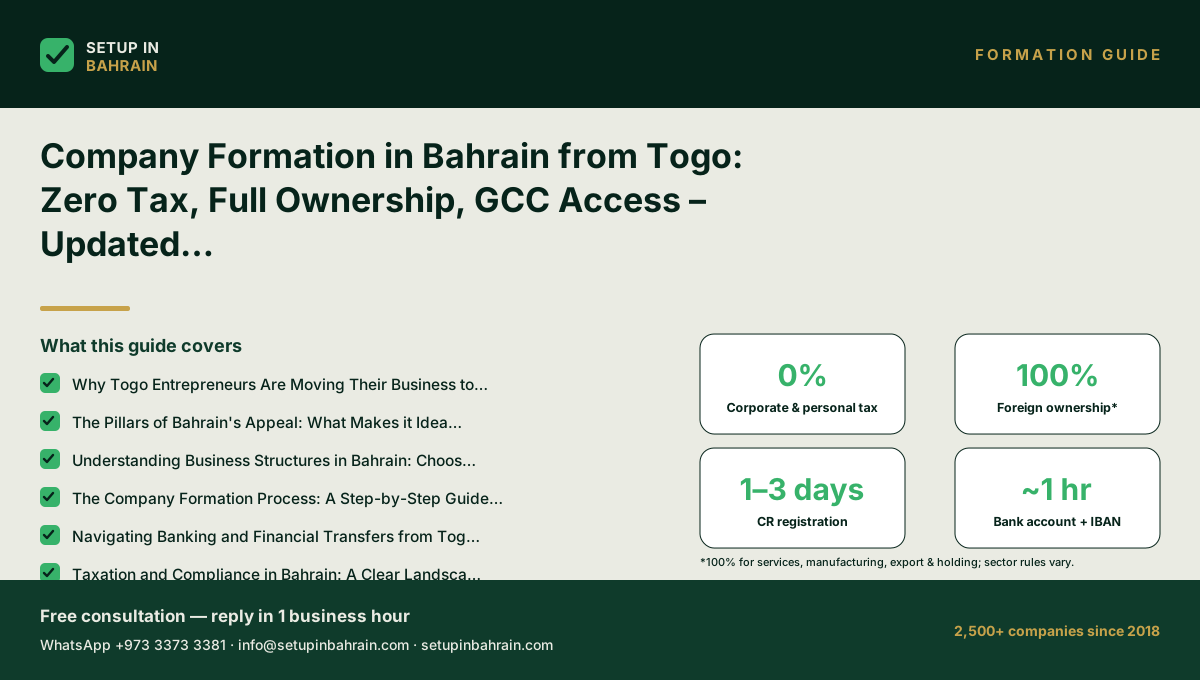
A Bahrain WLL can be owned by a single person — 100% foreign ownership applies to most activities, with no local partner required for services, manufacturing, export trading and holding companies. The minimum share capital is BHD 1 ; we recommend BHD 1,000 . This Makes bank account opening and investor visa approval smoother.
Picture this: you’re a driven entrepreneur in Lomé. Every quarter, you calculate your sales, only to set aside more than a quarter of your profits—a full 27%—just for the corporate taxman. Your accountant explains the intricacies of OTR’s monthly filings, grapples with currency volatility as your West African CFA (XOF) struggles against the US dollar, and warns of surprise BCEAO policy changes that can ripple through your supply chain.
Meanwhile, you see competitors in more strategically located hubs like Dubai or Manama reporting profit margins that seem impossibly high, growing their regional footprint with ease. There’s a fundamental reason for this disparity: the strategic advantage offered by places like Bahrain.
Entrepreneurship in Togo is undeniably a journey of resilience and relentless effort. You've built your business from the ground up, navigating the complexities of the Togolese market, from local regulations to region-wide economic policies. But what if there was a strategic move that could fundamentally transform your profit margins, expand your market reach. Dramatically simplify your financial operations?
This guide is designed exclusively for you, the enterprising Togolese founder, looking beyond current horizons and seeking a more efficient, scalable. Secure company base.
Imagine a world where your hard-earned profits aren't immediately carved up by a hefty 27% corporate income tax. Picture a business environment where you have absolute control over your entity, with no mandates for a local partnership. Envision a financial landscape where your currency isn't constantly battling unfavorable conversion rates and regional monetary policies that offer little national flexibility. This isn't a distant dream; it's the tangible reality Bahrain offers.
Bahrain delivers Generally no corporate income tax for most sectors, complete foreign ownership—with no local partner required—direct GCC connectivity. Instant stability through a currency securely pegged to the US dollar. If you’re an ambitious Togolese founder searching for a powerful springboard for your business, this guide will illuminate the path.
Why Togo Entrepreneurs Are Moving Their Business to Bahrain
“Every year I lose clients in Nigeria and Cote d’Ivoire who specifically want contracts denominated in dollars or Saudi riyals,” laments Kossi, a Lomé-based IT service founder specializing in enterprise software solutions. “Meanwhile, my profit is relentlessly eaten up by the 27% corporate income tax and the opaque nature of OTR’s complex filings. Then there are the mandatory CNSS social contributions on all my salaries. This Add another 17% on top of employee costs.
My company feels stuck, unable to genuinely scale beyond West Africa.”
Kossi’s experience is not unique. For Togolese business owners, especially those in export, digital services, or trading, Togo’s corporate tax burden (a significant 27%), mandatory CNSS social contributions that add substantial overhead to payroll, and the intricate and often opaque filing processes with the OTR tax authority—not to mention the considerable time cost of securing permits through a system ranked 97th globally by the World Bank for ease of doing business—all combine to stifle scaling ambitions.
Add in the West African CFA franc's (XOF) lack of independent currency flexibility, dictated by BCEAO regional policy and region-wide economic shocks, and you’re doubly exposed: high taxes and persistent currency headaches.
Consider the example of a Togolese exporter based in Lomé who ships cotton and shea butter into Gulf markets. Last year, his company cleared XOF 420 million in revenue. After the 27% corporate income tax collected by the OTR, mandatory CNSS contributions on the full payroll, and repeated XOF-to-EUR-to-USD conversion losses before any final USD settlement could be made with his suppliers or received from buyers, his net profit landed at roughly XOF 198 million.
The following quarter, he discovered a Saudi buyer willing to pay 18% more for a larger order, yet the BCEAO’s regional monetary rules and the absence of any direct clearing route with Bahraini or other GCC banks forced him through three correspondent banking layers for the transaction. By the time funds arrived, another 4-5% had been shaved off in fees and less favorable exchange rates, diminishing the initial profit margin greatly.
While the Port of Lomé is undeniably growing as a regional hub, the underlying banking infrastructure for international trade remains comparatively limited, further compounding these challenges.
Now contrast this with the strategic advantages and clarity offered by Bahrain:
0% corporate, personal, and capital gains tax (as of 2026, confirmed by the Ministry of Industry & Commerce – MOIC). Full foreign (100%) company ownership , with no local sponsor or partner required for most business activities. This means absolute control over your operations and profits. USD-pegged Bahraini Dinar (BHD): A stable currency where 1 BHD consistently equals $2.65 US dollars.
This eliminates the currency conversion roulette and provides unparalleled financial predictability, a stark contrast to the XOF which requires multiple conversions for GCC trade. Direct Access to the GCC Market: Bahrain is a natural gateway to a USD 1.6 trillion GCC economy, offering seamless trade and logistics advantages. Streamlined Regulatory Environment: The Bahrain Economic Development Board (EDB) actively promotes foreign investment, working to simplify processes and reduce bureaucratic hurdles.
World-Class Banking Infrastructure: The Central Bank of Bahrain (CBB) regulates a sophisticated and robust financial sector, providing reliable mechanisms for international transactions, unlike the limitations faced when trying to conduct direct business with GCC entities from Togo.
For the Togolese entrepreneur ready to scale, to access new capital, or simply to retain a larger share of their hard-earned profits, Bahrain presents not just an alternative, but a superior strategic base. It’s about more than just tax; it’s about control, stability, and unfettered access to global opportunities.
The Pillars of Bahrain's Appeal: What Makes it Ideal for Togo Entrepreneurs
Bahrain’s allure for foreign investors, especially those from emerging markets like Togo, stems from several interconnected advantages that directly address core pain points experienced in less developed or more restrictive business environments.
1. Zero Corporate, Personal, and Capital Gains Tax
This is often the primary draw. While your business in Togo contends with a 27% corporate income tax, your profits in Bahrain remain entirely untaxed at the corporate level. This isn't a temporary incentive; it's a foundational aspect of Bahrain’s economic policy.
No Corporate Income Tax: For most business activities, companies operating in Bahrain pay generally no corporate income tax for most sectors. This directly translates to greatly higher retained earnings. This Can be reinvested into growth, product development, or market expansion. No Personal Income Tax: As a business owner or employee residing in Bahrain, your personal income from your salary or other earnings is also not taxed. This enhances personal wealth accumulation and makes attracting international talent easier.
No Capital Gains Tax: If you sell assets, shares, or property held by your Bahraini company, there is generally no capital gains tax levied. This is especially attractive for holding companies, investment firms, or entrepreneurs planning future exits or portfolio restructuring.
This tax regime is a game-changer, fundamentally improving your net profit margins compared to operating under Togo’s 27% corporate tax and mandatory CNSS social contributions. It's an immediate, quantifiable benefit that impacts every financial projection.
2. 100% Foreign Ownership and Absolute Control
One of the most significant challenges for foreign investors in many countries is the requirement for local sponsorship or majority local ownership. This often leads to diluted control, profit-sharing obligations, and potential strategic disagreements. Bahrain decisively eliminates this hurdle.
Full Ownership for Most Sectors: In Bahrain, you can establish a company and retain 100% foreign ownership in the vast majority of sectors, including manufacturing, services, logistics, tourism, technology, and more. This means you own every share, make every decision, and keep every profit. No Local Partner Mandate: Unlike jurisdictions where a "silent partner" or nominee shareholder might be required, Bahrain's laws are clear: a foreign entrepreneur from Togo can be the sole owner and director of their company.
Strategic Autonomy: This level of control ensures your business strategy, operational decisions. Profit distribution remain entirely within your purview. There are no external stakeholders to satisfy or navigate, simplifying governance and accelerating decision-making.
This is a stark contrast to many African markets where securing a local partner is mandatory, often adding layers of complexity and risk. For a Togolese entrepreneur, it means taking your innovation and vision and executing it without compromise.
3. A Strategic Gateway to the GCC and Beyond
Bahrain's geographical location and advanced infrastructure make it an unparalleled hub for accessing lucrative regional and international markets.
Heart of the GCC: Situated centrally within the Gulf Cooperation Council (GCC), Bahrain offers direct land, sea. Air access to a USD 1.6 trillion market encompassing Saudi Arabia, UAE, Qatar, Kuwait, and Oman. The King Fahd Causeway, a 25-kilometer bridge, directly connects Bahrain to Saudi Arabia, facilitating swift logistics and trade. Logistics Excellence: Bahrain boasts world-class logistics infrastructure, including Khalifa Bin Salman Port, Bahrain International Airport. Dedicated logistics zones (e.g., Bahrain Logistics Zone – BLZ).
This facilitates efficient import, export. Re-export activities, greatly reducing transit times and costs compared to multi-leg shipping from West Africa. Free Trade Agreements (FTAs): Bahrain has established FTAs with key global economies, notably the United States, making it the only GCC country with such an agreement. This opens doors to duty-free access for a wide range of products and services into the vast US market, a significant advantage for manufacturing or trading companies.
Diversified Economy: While historically reliant on oil, Bahrain has successfully diversified into financial services, manufacturing, tourism. Technology, creating a dynamic and resilient economic environment that fosters new businesses. This diversification also reduces over-reliance on a single industry, offering more stability than economies tied to volatile commodity markets.
For Togolese businesses aiming for pan-African reach or even global expansion, leveraging Bahrain as a regional headquarters or distribution hub drastically cuts down on logistical complexities and opens up entirely new customer bases that are difficult to serve directly from Lomé.
4. Unwavering Currency Stability: The USD-Peg
The stability of your operating currency cannot be overstated, especially when dealing with international trade and investment. Togo’s XOF, tied to the Euro and influenced by BCEAO policies and regional shocks, can present significant conversion losses and unpredictable financial planning.
Bahraini Dinar (BHD) Pegged to USD: The BHD has been rigidly pegged to the US dollar at a fixed exchange rate of 1 BHD = $2.65 US dollars since 1986. This steadfast peg provides unparalleled currency stability and predictability. Elimination of Conversion Losses: For businesses dealing in international trade, especially with the US dollar, this peg eliminates the multiple conversion layers (XOF to EUR, then EUR to USD) and the associated fees and risks of fluctuating exchange rates.
Your financial planning becomes far more predictable. Investor Confidence: The CBB's unwavering commitment to this peg signals financial stability. This Is crucial for attracting and retaining international investors and for managing global transactions. It makes Bahrain an attractive place to hold and manage significant capital without worrying about sudden devaluations or inflationary pressures.
This financial certainty is a powerful antidote to the currency volatility often faced by entrepreneurs operating with the XOF, allowing for more precise budgeting, pricing strategies, and profit forecasting.
5. Robust and Modern Banking & Financial Infrastructure
Compared to the limitations often experienced with banking infrastructure in regions like West Africa, Bahrain boasts a sophisticated and globally connected financial sector.
CBB-Regulated Excellence: The Central Bank of Bahrain (CBB) is a highly respected and proactive regulator, fostering an environment of trust and innovation. Bahrain is home to over 380 financial institutions, including conventional and Islamic banks, investment firms, and insurance companies.
Ease of International Transactions: Opening a corporate bank account with an international bank in Bahrain (such as HSBC, Citibank, or Standard Chartered, alongside reputable local banks like NBB or BBK) allows for seamless international wire transfers, multi-currency accounts, and efficient trade finance solutions. This is a significant upgrade from banking in Togo. This Can often involve slower processes and limited direct clearing routes for GCC trade.
Fintech Hub: The CBB has actively promoted Bahrain as a fintech hub, establishing a regulatory sandbox for innovative financial technologies. This creates a forward-thinking environment that benefits businesses seeking modern payment solutions and digital banking services. Access to Capital: As a well-established financial center, Bahrain offers access to a broader range of financing options, including venture capital, private equity, and structured finance, which can be crucial for scaling businesses that might find capital limited in Togo.
The sophistication of Bahrain's financial sector directly addresses the challenges faced by Togolese entrepreneurs in terms of efficient cross-border payments, currency management, and access to robust financial services.
Understanding Business Structures in Bahrain: Choosing the Right Vehicle
Selecting the appropriate legal structure for your company is a critical early decision. In Bahrain, several options exist, but for most Togolese entrepreneurs seeking full ownership and limited liability, the With Limited Liability (WLL) company is overwhelmingly the most suitable and popular choice.
1. With Limited Liability Company (WLL) – The Entrepreneur's Choice
The WLL is the most common and versatile business structure in Bahrain for foreign investors. It offers the perfect balance of flexibility, protection, and straightforward compliance.
100% Foreign Ownership: Crucially for Togolese entrepreneurs, a WLL can be 100% owned by a single foreign individual or corporate entity. There is no requirement for a local Bahraini partner or shareholder. You can be the sole owner and director. This is a fundamental difference from many other jurisdictions and ensures absolute control. Limited Liability: As the name suggests, the liability of the shareholders is limited to the amount of their capital contribution.
This means your personal assets are protected from the company’s debts or obligations. Minimum Shareholders: A WLL can be formed with a minimum of one shareholder and a maximum of fifty. This means a solo Togolese founder can establish their company without needing to bring in partners purely for compliance reasons. Minimum Share Capital: The legal minimum share capital for a WLL in Bahrain is symbolically low, at BHD 1 (one Bahraini Dinar) .
But, it is strongly recommended to set a practical starting capital of at least BHD 1,000*. This higher capital shows financial substance to banks, greatly easing the corporate bank account opening process and is often a prerequisite for obtaining an investor visa for the owner. Banks are hesitant to open accounts for companies with only BHD 1 capital, as it signals insufficient operational funds.
Business Activities: WLLs can engage in a wide range of commercial activities, from trading and manufacturing to services and consulting, provided they comply with MOIC regulations. No single-shareholder WLL: It's vital to note that while a WLL can be owned by a single person, Bahrain does not recognize a specific "single-shareholder WLL" legal structure. The WLL is the vehicle for single-owner entities. Avoid any advice that mentions a single-shareholder WLL in Bahrain; it simply doesn't exist.
2. Foreign Company Branch
A foreign company branch allows an existing company incorporated outside Bahrain (e.g., your current company in Togo) to establish a presence.
Extension of Parent Company: It is not a separate legal entity but an extension of the parent company. This means the parent company remains fully liable for the branch's obligations. Activities: Typically used for specific projects, regional representation, or where the parent company wants to maintain direct operational control without creating a separate entity.
Taxation: Although profits are technically taxable in the parent company's home country, the branch itself operates under Bahrain's generally no corporate income tax for most sectors regime on profits generated in Bahrain. Administrative Burden: Can sometimes involve more complex regulatory filings due to its connection to an overseas parent entity.
For most new ventures or entrepreneurs looking for maximum flexibility and minimal ongoing connection to their Togolese entity, the WLL is generally the more straightforward and advantageous choice.
3. Public Shareholding Company (BSC) or Exempt Company (B.S.C. Closed)
These structures are typically for larger enterprises, publicly listed companies, or those seeking to raise capital from a broad investor base. They involve more complex regulatory requirements, higher capital thresholds, and multiple shareholders. For the vast majority of Togolese entrepreneurs reading this guide, these options are not immediately relevant.
Key Takeaway for Togolese Entrepreneurs: Focus on the With Limited Liability (WLL) company. It offers the best combination of 100% foreign ownership, limited personal liability. Ease of setup, especially when you ensure a practical minimum share capital of BHD 1,000.
The Company Formation Process: A Step-by-Step Guide for Togo Entrepreneurs
Establishing a company in Bahrain is a relatively streamlined process, especially when guided by local experts. The Bahrain Economic Development Board (EDB) and the Ministry of Industry and Commerce (MOIC) have worked hard to simplify procedures. Here’s a detailed breakdown:
Step 1: Strategic Planning and Business Activity Definition
Before applying, clearly define your business activities. This influences your licensing requirements and potential sector-specific regulations.
Market Research: Leverage EDB resources and insights to understand market demand for your services or products in Bahrain and the wider GCC. Activity Classification: Bahrain uses the International Standard Industrial Classification (ISIC) codes. You must select the appropriate codes for your intended operations. This defines the commercial licenses you will need. Consultation: Engage with a local business setup consultant in Bahrain. They can help you navigate the specific requirements for your chosen activities, ensuring compliance from the outset.
This is an investment that saves time and prevents costly errors.
Step 2: Company Name Reservation
Your company name must be unique and comply with MOIC guidelines.
- Availability Check: Submit a proposed company name (and ideally a few alternatives) to the MOIC for availability checks. The name should not be identical or confusingly similar to an existing registered company.
- Approval: Once approved, the name is reserved for a limited period, giving you time to proceed with the next steps. This can often be done online through the MOIC's Sijilat portal.
Step 3: MOIC Application and Documents Submission
This is the core of the registration process, requiring a set of documents from the individual shareholder(s) and the proposed company.
Key Documents Required (for Individual Shareholder - Togolese National): * Passport Copy: Clear, valid passport copy (all relevant pages). * National ID Card Copy: (If applicable, though passport is usually sufficient for non-residents). * Proof of Residential Address: Recent utility bill (electricity, water, phone) or bank statement, less than three months old, showing your address in Togo. * CV/Resume: A professional CV outlining your experience and qualifications.
* Bank Reference Letter: A letter from your bank in Togo confirming you are a customer in good standing. * Business Plan (Brief): A concise outline of your company's purpose, activities, target market. Projected operations in Bahrain. Key Company Documents (to be prepared for MOIC): * Memorandum of Association (MOA) and Articles of Association (AOA): These legal documents define the company's structure, objectives, share capital, and internal governance. A local consultant will draft these for you.
* MOIC Application Forms: Duly completed application forms. Notarization and Attestation: Some documents (especially if originating from Togo) may require notarization and apostille/legalization in Togo. Subsequent attestation by the Bahraini Embassy in Cairo (which covers Togo) or the Ministry of Foreign Affairs in Bahrain. Your consultant will advise on exact requirements. Submission: All documents are submitted to the MOIC. The Sijilat portal allows for much of this process to be initiated online.
Step 4: Share Capital Deposit
Once the initial MOIC approval is received, you’ll need to deposit the share capital.
Temporary Bank Account: Open a temporary corporate bank account in Bahrain (your consultant can assist with initial introductions). Deposit: Transfer the agreed-upon share capital (the recommended BHD 1,000, not just the legal BHD 1) into this temporary account. Bank Confirmation Letter: The bank will issue a letter confirming the deposit. This Is then submitted to the MOIC.
Step 5: Commercial Registration (CR) Issuance
Upon satisfactory review of all documents and capital deposit, the MOIC will issue your company's Commercial Registration (CR).
- CR Certificate: This is your official license to operate in Bahrain. It includes your company's CR number, legal name, registered activities, and other key details.
- Operating Licenses: Depending on your business activities, you might need additional operating licenses from sector-specific ministries (e.g., Ministry of Health for medical facilities, Central Bank of Bahrain for financial services, Ministry of Transportation for logistics). Your consultant will guide you on these.
Step 6: Corporate Bank Account Opening (Permanent)
This is a crucial step often underestimated, especially for foreign entrepreneurs. While a temporary account might be set up for capital deposit, a permanent, fully operational bank account requires more scrutiny.
KYC (Know Your Customer) & AML (Anti-Money Laundering): Bahraini banks, regulated by the CBB, have stringent KYC and AML requirements. They will request detailed information about the company, its owners, source of funds, and nature of business. Practical Capital Requirement (BHD 1,000): This is where the recommended BHD 1,000 minimum share capital proves invaluable. Banks are highly reluctant to open accounts for companies with only BHD 1, as it raises red flags about financial viability and operational seriousness.
Having BHD 1,000 shows a commitment and provides initial working capital. Documents: Expect to provide all company registration documents (CR, MOA/AOA), shareholder passports, proof of address, CVs. A detailed business plan. Some banks might require a face-to-face meeting or a video call with the signatory. Timeframe: This step can take anywhere from 2 weeks to 2 months, depending on the bank and the completeness of your documents. Patience and thorough preparation are key.
Step 7: Visa and Residency (Investor Visa)
As the company owner, you will need to get an investor visa to reside and manage your business in Bahrain.
Application: After the company is registered, you can apply for an investor visa through the Labour Market Regulatory Authority (LMRA). Requirements: This typically involves a health check, fingerprinting. Submission of company documents, passport copies, and sometimes proof of sufficient funds. The recommended BHD 1,000 share capital helps in this regard, demonstrating a tangible investment.
Family Visas: Once your investor visa is approved, you can sponsor your spouse and dependent children for their residency visas, allowing your family to join you in Bahrain. Processing Time: Visa processing can take several weeks.
Step 8: Office Space (Virtual vs. Physical)
You need a registered address for your company.
- Virtual Office: For many service-based or consulting businesses, a virtual office package is a cost-effective solution initially. These services provide a physical address for registration, mail handling, and sometimes access to meeting rooms.
- Physical Office: If your operations require a physical presence (e.g., manufacturing, retail, significant team), you will need to lease commercial office space. Bahrain offers a range of options, from co-working spaces to dedicated offices in business districts.
Timeline: The entire company formation process, from initial submission to receiving your CR, can typically take 2-4 weeks if all documents are in order and no complex sector-specific licenses are required. The bank account opening and visa process will then follow.
Navigating Banking and Financial Transfers from Togo to Bahrain
For Togolese entrepreneurs, a critical advantage of Bahrain is its superior financial infrastructure. But, moving funds from an XOF-denominated account in Togo to a BHD or USD account in Bahrain requires understanding the process and potential challenges.
The XOF-to-BHD/USD Challenge
The West African CFA franc (XOF) is not directly convertible to BHD or USD in most banking systems. It’s typically pegged to the Euro (€1 = XOF 655.957). This means any transfer to Bahrain will likely involve:
XOF to EUR Conversion: Your Togolese bank will convert your XOF funds into Euros. This involves an exchange rate and potential conversion fees. EUR to USD Conversion (Optional but common): If your Bahraini corporate account is primarily USD-denominated (which is common, given the BHD-USD peg), the Euros may then be converted to US Dollars. Again, this involves another exchange rate and fees.
USD to BHD (if needed): Once funds arrive in Bahrain as USD, they can be easily converted to BHD at the fixed peg (1 BHD = $2.65), usually with minimal or no additional fees from the Bahraini bank for the BHD conversion itself.
This multi-step conversion process can lead to significant leakage in terms of exchange rate spreads and correspondent bank fees, a pain point familiar to Togolese entrepreneurs engaged in international trade.
Solutions and Best Practices:
Use International Banks: If you have an account with an international bank in Togo that also has a presence in the GCC (e.g., Standard Chartered, Citibank), this might* simplify the transfer. But, even these banks will follow the XOF-EUR conversion path. Correspondent Banking Network: Bahraini banks have extensive correspondent banking relationships globally. Funds sent from Togo will travel through this network.
Fintech & Digital Remittance Platforms: Explore reputable fintech platforms that offer competitive exchange rates and lower fees for international transfers. Some platforms specialize in connecting African currencies to global markets, potentially offering more favorable rates than traditional banks for the XOF-EUR leg. But, ensure such platforms are regulated and legitimate for corporate transfers. Multi-Currency Accounts in Bahrain: When opening your corporate bank account in Bahrain, inquire about multi-currency accounts.
This allows you to receive funds in various currencies (EUR, USD) and hold them, converting to BHD only when needed, thus giving you more control over the timing of conversions. Transparent Fee Structures: Before initiating a transfer, always clarify the exact exchange rates and all associated fees (sending bank, correspondent banks, receiving bank) to avoid surprises. Bulk Transfers: If possible, consolidate smaller payments into larger, less frequent transfers to minimize per-transaction fees.
Source of Funds Documents: Be prepared to provide comprehensive documents to both your Togolese bank and your Bahraini bank about the source of funds for all significant transfers. This is part of international AML/KYC compliance.
The CBB's push for fintech innovation means that Bahrain is at the forefront of exploring new payment corridors. While direct XOF-BHD clearing might be a future development, leveraging Bahrain's established banking ecosystem greatly reduces the friction compared to the more limited options available directly from Togo for GCC-bound transactions.
Taxation and Compliance in Bahrain: A Clear Landscape
One of Bahrain's most compelling advantages is its straightforward and business-friendly tax regime. But, "zero tax" doesn't mean "zero compliance."
1. Corporate Income Tax: 0%
- General Rule: As stated, Bahrain imposes 0% corporate income tax on the vast majority of businesses and activities. This is a primary driver for entrepreneurs seeking to maximize profitability.
- Exceptions (Rare): The
Bahrain Business Guides for Togo Citizens
Frequently Asked Questions
How long does it take to set up?
It takes 15 to 20 days. We file all forms for you. You do not need to wait long.
What does it cost?
Company formation: Standard BHD 1,340 with 3 months of office address; Gold BHD 1,700 with 6 months; Premium BHD 2,150 with 12 months and a cabin, officer table and chair, and two guest chairs. No formation package includes visas, including Premium. Investor/work visas are priced separately: BHD 755 for one year or BHD 953 for two years, in addition to the formation package. Ask for a written, itemized quotation confirming government fees and all inclusions before payment.
Do I need to visit Bahrain?
No. You can set up your firm from home. We do all the work online. Some banks may ask for one visit.
What tax will I pay?
You pay zero tax on your profits. Bahrain has no corporate income tax. This is a key benefit of the setup.
Can I own 100% of my firm?
Yes. Foreign owners can hold all shares. No local partner is needed. Full ownership is allowed.
What do I need to start?
You need a valid passport. You also need a trade name and a business address. We help you with all of these.
How do I open a bank account?
We guide you step by step. Most banks take 3 to 6 weeks. You will need your CR and firm papers.
Who issues the Commercial Registration (CR)?
The CR is issued by the MOICT. It is your legal right to trade in Bahrain. We file the CR for you.
Can I renew my CR each year?
Company renewal packages: BHD 530 with 3 months of office address; BHD 980 with 6 months; BHD 1,520 with 12 months. These are separate renewal packages, not visa fees.
How do I get started?
Fill in our form on this page. Our team will call you back. We map your best setup plan at no cost.
Steps to Form Your Company
- Pick your trade name. We check if it is free.
- Choose your business type. WLL is the most common.
- Sign the MOA. We draft and file all legal docs.
- Pay the state fees. About BHD 432 in total.
- Get your CR. Takes 15 to 20 days.
- Open your bank account. We guide each step.
- Start trading. You are ready to do business.
Key Facts
- Tax rate: 0%
- Foreign ownership: 100%
- Setup time: 15 to 20 days
- Company formation: Standard BHD 1,340 with 3 months of office address; Gold BHD 1,700 with 6 months; Premium BHD 2,150 with 12 months and a cabin, officer table and chair, and two guest chairs. No formation package includes visas, including Premium. Investor/work visas are priced separately: BHD 755 for one year or BHD 953 for two years, in addition to the formation package. Ask for a written, itemized quotation confirming government fees and all inclusions before payment.
- Company renewal packages: BHD 530 with 3 months of office address; BHD 980 with 6 months; BHD 1,520 with 12 months. These are separate renewal packages, not visa fees.
- Client rating: 4.8 stars
- Clients served: 2,500 and more
Quick Facts
- Tax rate: 0%
- Own all of your firm: Yes, 100%
- Time to set up: 15 to 20 days
- Company formation: Standard BHD 1,340 with 3 months of office address; Gold BHD 1,700 with 6 months; Premium BHD 2,150 with 12 months and a cabin, officer table and chair, and two guest chairs. No formation package includes visas, including Premium. Investor/work visas are priced separately: BHD 755 for one year or BHD 953 for two years, in addition to the formation package. Ask for a written, itemized quotation confirming government fees and all inclusions before payment.
- Company renewal packages: BHD 530 with 3 months of office address; BHD 980 with 6 months; BHD 1,520 with 12 months. These are separate renewal packages, not visa fees.
- Rating: 4.8 stars
- Clients: 2,500 and more
Why Bahrain?
Bahrain has no tax. You keep all your profits. This is rare in the Gulf.
You can own all of your firm. No local partner is needed. The law allows full foreign ownership.
Setup takes 15 to 20 days. We file all forms for you. You can do it all from home.
Bahrain has a free trade deal with the US. Your goods face low or no tariffs. This gives you access to big markets.
We have served 2,800+ clients from 44+ countries and maintain records to substantiate that total where needed. We have 113 Google reviews; reviews represent only some clients and are not the same as the total clients served.
Our Steps
- Tell us your plan. We advise you for free.
- We pick the right firm type for you.
- We file all your forms with MOICT.
- You get your CR in 15 to 20 days.
- We help you open a bank account.
- You are ready to trade. We stay with you.
Next Steps for Togo Citizens
You can set up a firm in Bahrain from Togo. You do not need to fly there first. We do all the work online.
Tell us your plan. We call you back the same day. We map the best route for you at no cost.
We file all your forms. We deal with MOICT and the state. You get your CR in 15 to 20 days.
After your CR, we help you get a bank account. We also help with your Investor Visa. One firm guides you at each step.
Why Our Clients from Togo Choose Us
- We speak your language. We know your needs.
- We have helped clients from Togo before.
- Our fee is clear. No surprise costs.
- We have a 4.8 star rating on Google.
- We have helped more than 2,500 clients set up in Bahrain.
Fill in the form on this page. We will be in touch soon. Let us help you start your Bahrain firm today.
Ready to set up in Bahrain from Togo?
Tell us your business idea. We map the right entity, ownership and timeline — then handle the filing while you focus on what matters.