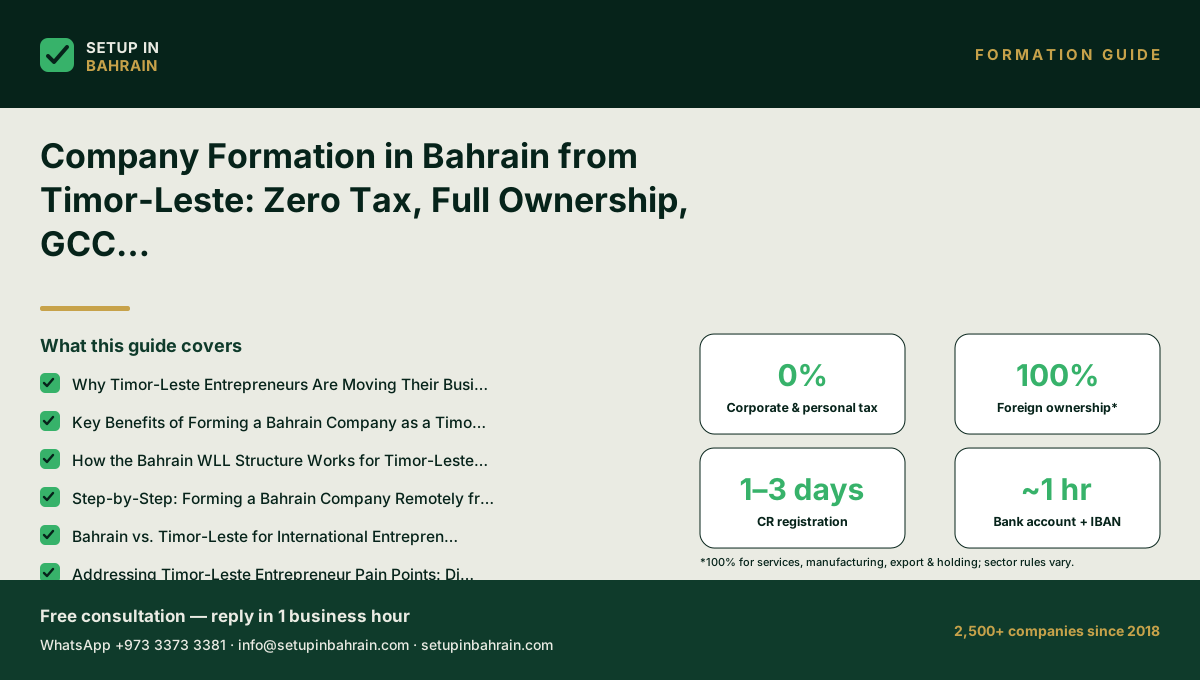
Complete guide for Timor-Leste entrepreneurs: form a company in Bahrain with generally no corporate income tax for most sectors, 100% foreign ownership, and GCC market access. Costs, steps, visas, banking.
→ Complete guide: Company Formation in Bahrain — the full 2026 guide
View details
Ownership & capital
A Bahrain WLL can be owned by a single person — 100% foreign ownership applies to most activities, with no local partner required for services, manufacturing, export trading and holding companies. The minimum share capital is BHD 1; we recommend BHD 1,000, which makes bank account opening and investor visa approval smoother.
Why Timor-Leste Entrepreneurs Are Moving Their Business to Bahrain
Imagine Maria, a determined Timor-Leste entrepreneur exporting coffee and textiles from Dili. Like many small and mid-sized business owners in Timor-Leste, she juggles relentless challenges: a flat 10% corporate income tax, cumbersome paper-based filings at DNTPET (Direcção Nacional de Tributação e Preços de Exportação e Importação), and only a handful of banks at home—all with limited international reach. Every year, she loses thousands of dollars to the tax office and bureaucracy, waiting weeks for approvals that would be finished in days elsewhere.
The local banking sector, led by just four commercial banks (Banco Nacional de Comércio de Timor-Leste, Banco Internacional de Timor-Leste, Banco do Brasil, and ANZ Timor), operates mostly in isolation, with sparse correspondent relationships. That makes international trade, foreign currency transfers, and scaling up outside Timor-Leste exceedingly difficult. And with a national economy reliant on a shrinking Petroleum Fund, the threat of a fiscal cliff is never far away.
Now picture the same business incorporated in Bahrain—a stable, business-friendly Gulf hub. No corporate income tax. 100% foreign ownership in a WLL company (Bahrain's most practical LLC alternative). Direct access to the deep, $2 trillion GCC market. A stable currency permanently pegged (BHD 1 = USD 2.65), so your USD revenues stay rock-solid. No currency conversion worries. Your Bahrain company is recognized across the Gulf and global banking networks, and registration can be completed in as little as one week, without flying to Manama or relying on a local nominee.
This isn’t theory—it’s a strategy chosen by a growing number of Timor-Leste founders and investors in 2026. In this definitive guide, we’ll unpack step-by-step how you can leverage Bahrain’s world-class corporate structure to expand internationally, optimize your taxes, and bypass the physical and financial bottlenecks limiting growth in Timor-Leste.
Key Benefits of Forming a Bahrain Company as a Timor-Leste Entrepreneur
1. Zero Corporate Income Tax — Immediate Cash Flow Boost
Timor-Leste levies a uniform 1generally no corporate income tax for most sectors, as mandated by DNTPET. For a business owner, this means every $100,000 in pre-tax profit costs $10,000 a year—regardless of sector or reinvestment plans. In Bahrain, most business activities are completely exempt from corporate income tax (with the exception of oil, gas, and a very few financial activities). That difference alone represents a 10% net profit improvement—funds that can be reinvested, distributed, or held for growth.
Stat Snapshot:
- Corporate tax in Timor-Leste: 10% (World Bank, 2025)
- Corporate tax in Bahrain: 0% (non-oil sector); confirmed by the Central Bank of Bahrain (CBB) and Economic Development Board (EDB)
2. 100% Foreign Ownership — No Local Partners Needed
Timor-Leste technically allows 100% foreign ownership, but the practicalities of business, investment, and regulatory approval often require local “advisors” or intermediaries, especially for expedited processing at ANIP and DNT. In Bahrain, a WLL (With Limited Liability) company requires no local partner or shareholder, even for a single owner. You can register as the sole and full owner—unlike the structure in many ASEAN or Gulf countries. The share capital can be held in your own name, and is recognized across GCC and international jurisdictions.
Critical Bahrain Fact: A WLL can be owned 100% by a single person, with zero partner requirement (MOIC and BIPA, 2026).
3. Ultra-Fast, Digital Company Formation
The Timor-Leste company registration process is still manual: paperwork at DNTPET, in-person visits to Baucau or Dili, and investment approvals that can average three to six months with ANIP. Bahrain leads the Gulf region with its fully digital company registry (via Sijilat, run by the Ministry of Industry & Commerce - MOIC - and BIPA). For most businesses, company formation takes 5-10 working days end-to-end. Directors and shareholders can be entirely non-resident, and all documentation can be handled remotely if desired.
4. Stable, USD-Pegged Currency
Bahrain’s Dinar is pegged at 1 BHD = 2.65 USD. This removes all currency risk for Timor-Leste entrepreneurs with USD-based trade (e.g., coffee, vanilla, seafood, imports), compared with the regional volatility of the Indonesian Rupiah or the Timor-Leste dollarized system. You can invoice and hold balances with certainty.
5. Access to GCC and International Banking
Bahrain’s banks are regional and global players, regulated by the Central Bank of Bahrain (CBB) under some of the strictest compliance in the Gulf. Unlike Timor-Leste’s four local commercial banks (BPA sector), Bahraini banks maintain deep dollar- and euro-linked correspondent lines. For the first time, you gain frictionless access to SWIFT transfers, multicurrency accounts, and trade finance. Practical share capital of BHD 1,000 (about USD 2,650) is typically enough to open a Bahrain commercial bank account—compare this to the opaque requirements and limited services in Dili.
Note: The legal minimum share capital for Bahrain WLL is BHD 1, but most banks and immigration authorities require at least BHD 1,000 for due diligence and opening new accounts (CBP, EDB, 2026).
How the Bahrain WLL Structure Works for Timor-Leste Founders
What is a Bahrain WLL (With Limited Liability)?
A WLL is Bahrain’s equivalent to a private limited company (LLC). It’s the most popular vehicle for international entrepreneurs and SMEs operating across the GCC. Unlike competitor jurisdictions, there is NO single-shareholder WLL in Bahrain—but the WLL can be owned 100% by one person, with no partner or nominee needed. You retain total ownership and control.
WLL Key Features at a Glance
| Aspect | Bahrain WLL | Timor-Leste Company |
| Legal Owner Structure | 1 or more (100% foreign, single owner allowed) | 1+ foreigner allowed, but often delayed for investors |
| Minimum Capital | BHD 1 (practical: BHD 1,000) | No explicit minimum; but ANIP process is vague |
| Tax Rate | 0% (except oil/gas) | 10% universal |
| Company Registration | Fully digital (5-10 days, Sijilat platform) | Paper-based, 30-90+ days at DNTPET, ANIP |
| Visa Eligibility | Yes (Investor/Partner Visa, renewable) | Long processing; investments scrutinized |
| Need for Local Partner | No | Unwritten “local advice” often needed |
Key Documents Needed
- Valid passport copy of founder(s)
- Proof of address
- Business plan/activities list (Sijilat selection)
- Bank reference letter/source of funds (for investors)
- BHD 1,000 (minimum practical share capital for bank opening)
- Bahrain office address (often via local virtual office provider)
Step-by-Step: Forming a Bahrain Company Remotely from Timor-Leste
1. Choose Business Activities
The Sijilat registry offers an extensive list of pre-approved business activities—from import/export and consulting to technology, logistics, and trade. Select those that map most closely to your current Timor-Leste operations and intended Gulf reach.
2. Reserve Company Name and Apply Online
- Use the MOIC Sijilat portal for instant name checks and reservations.
- Submit founder/partner information and activity selection.
- Upload ID, address proof, and incorporation details digitally.
3. Prepare Capital and Address Requirements
- Deposit BHD 1,000 (approx. USD 2,650) as recommended to meet banking and visa smooth onboarding.
- Engage a Bahrain-based address provider (virtual office is allowed for many sectors—verify with MOIC).
4. Submit Application and Pay Fees
- Government fees (typically BHD 150-350 total) are paid via Sijilat.
- Most applications are pre-screened and expedited online—no embassy visit required.
5. Receive Commercial Registration Certificate
Within 5 to 10 working days, you receive the Commercial Registration (CR) and Certificate of Incorporation—the documents you need for banking, visas, and all trade operations.
6. Open a Bahrain Commercial Bank Account
- Present company documents, share capital certificate, and KYC.
- Leading banks: Bank ABC, National Bank of Bahrain, GFH Bank, and Ithmaar Bank (each offering global correspondent lines).
- Online onboarding is increasingly available for foreign-owned WLLs.
7. Apply for Investor/Partner Visa (Optional)
Once the WLL is registered, you can apply for a renewable Bahrain Investor or Partner Visa, which allows you residency, access to GCC travel, and physical presence in the Kingdom.
Bahrain vs. Timor-Leste for International Entrepreneurs: Quantitative Comparison (2026 Data)
| Metric | Timor-Leste (2026) | Bahrain (2026) |
| Corporate Income Tax | 10% (flat, all companies) | 0% (except oil, gas, insurance) |
| Bank Sector | 4 commercial banks, no international branches | 114 licensed banks, 50+ with global ties |
| Company Registration Time | 30-90 days (often longer) | 5-10 working days |
| Digital Registration? | No (paper & in-person) | Yes, 100% digital (Sijilat platform) |
| Minimum Share Capital | Not specified (ambiguous) | BHD 1 legal, BHD 1,000 practical |
| Foreign Ownership | Yes (often slow, manual) | Yes (100%, single person possible) |
| Investor Visa Availability | Slow, case-by-case | Streamlined, renewable (1-3 years) |
| Economy USD Exposure | High FX risk, dollarized but dependent | BHD pegged to USD, no FX risk |
| Major Regulatory Bodies | DNTPET, BPA, ANIP | MOIC, CBB, EDB, BIPA |
| Access to GCC Market | No | Yes (direct: Saudi, UAE, Qatar, Oman, Kuwait, Bahrain) |
Frequently Asked Questions (FAQs) from Timor-Leste Entrepreneurs
Is there a single owner company structure in Bahrain?
No. Bahrain abolished the WLL (Single Person Company) recently. Instead, use the WLL—which allows one owner with zero requirement for additional partners. This is fully compliant, confirmed by MOIC, BIPA, and CBB guidance as of 2026.
What is the minimum share capital I need?
The legal minimum for a Bahrain WLL is BHD 1. In practice, you should budget BHD 1,000 (about USD 2,650) to satisfy commercial bank and investor visa requirements. This ensures straightforward account opening and signals legitimate business intent to regulators and banks.
How easy is the Bahrain company formation process for non-GCC residents?
Very straightforward. All key stages—from name reservation to document submission and capital deposit—are digital and can be completed remotely. No trips to Manama are needed. You may engage a Bahrain-based consultant for document handling if you prefer, but non-resident entrepreneurs (including Timorense citizens) routinely register companies directly.
Can I use my Bahrain company to invoice international customers (USA, Dubai, Singapore)?
Yes. Your Bahrain WLL is a recognized legal entity in the GCC and globally, with no restrictions on cross-border invoicing in USD, EUR, AED, or other convertible currencies. Major banks in Bahrain offer SWIFT and SEPA transfers as standard.
Will Bahraini banks accept my Timor-Leste documents and credentials?
Bahraini banks are experienced with APAC and ASEAN founders. You will be asked for notarized/certified translations of personal documents (passport, proof of address, sometimes business references). An established business activity and initial capital are the main requirements. Supporting information from any Timor-Leste bank showing origin of funds can also help.
What are the office requirements?
Many professional and trading activities allow a virtual office address. Manufacturing or regulated sectors require a physical Bahrain office. The Sijilat registry and MOIC can confirm permitted options for your chosen activities.
Is Bahrain the best GCC gateway for ASEAN entrepreneurs?
For businesses needing USD stability, fast company formation, and frictionless access to Saudi and UAE markets, Bahrain outranks Dubai (where 51% local shareholding is often required for onshore companies) and Qatar (where closed sectors remain extensive).
Addressing Timor-Leste Entrepreneur Pain Points: Direct Solutions Bahrain Offers
FX and Capital Mobility Problems
- Timor-Leste pain: Outbound USD payments and USD wire receipts are often blocked or delayed by the four commercial banks due to limited correspondent lines and “manual” compliance reviews.
- Bahrain solution: Access to over 50+ global correspondent banking relationships, clearing in USD, EUR, GBP through Tier 1 institutions.
Market Access Constraints
- Timor-Leste pain: National market of just 1.3 million; little to no direct trade routes to Middle East; slow government investment approvals (~3-6 months at ANIP).
- Bahrain solution: Full commercial rights across the $2 trillion GCC market covering Saudi Arabia, UAE, Qatar, Kuwait, Oman, Bahrain; streamlined, digital approval.
Unpredictable Fiscal and Policy Outlook
- Timor-Leste pain: Economy still tied to Petroleum Fund, with government budgets at risk if oil prices fall or reserves diminish.
- Bahrain solution: Diversified, non-oil based economy (financial services, logistics, ICT large contributors); stable business and fiscal environment.
Time-Consuming, Paper-Based Regulation
- Timor-Leste pain: Filing with DNTPET and other authorities is on paper, with personal follow-ups and signature chasing; little online support.
- Bahrain solution: Fully digital incorporation, documentation, and tax filings via Sijilat and iGA (Information & eGovernment Authority) platforms.
Strategic Sectors: What Types of Timor-Leste Businesses Thrive by Expanding to Bahrain?
1. Commodity Traders (Coffee, Vanilla, Spices, Seafood)
Direct access to Middle Eastern buyers; ability to invoice in USD or AED; removes FX and payment bottlenecks.2. Consulting & Professional Services
Bahrain’s regional status and robust legal framework mean legal, business, and export consulting services can be marketed GCC-wide.3. Technology & E-commerce Ventures
Bahrain is a recognized regional fintech and tech innovation center (World Bank 2026 rankings)—digital companies can register and operate fully online, with no requirement for local predecessor operations.4. Logistics & Trade Intermediaries
Full customs and trade facilities, with easy tie-ins to free zones and logistics infrastructure serving Saudi Arabia, UAE, and Oman.Compliance, Reporting, and Regulatory Practices: Comparing Bahrain and Timor-Leste
Tax Compliance & Filing
- Timor-Leste: DNTPET requires annual manual filings (paper forms and local presence), with tax payments at local bank branches.
- Bahrain: No corporate or income tax for most businesses. VAT registration may be required if turnover exceeds BHD 37,500/year (~USD 99,750)—returns are filed quarterly online.
Statutory Reporting
- Timor-Leste: Local auditors limited; filings on paper; financial reporting standards evolving.
- Bahrain: IFRS-aligned accounting and reporting, with a deep pool of international auditors and specialists. Annual returns and filings are digital.
Banking Compliance and KYC
- Bahrain: CBB enforces robust anti-money laundering (AML) and counter-terrorism finance (CTF) standards, in line with FATF and EU standards—ensuring international acceptability but requiring strong KYC documentation.
Case Study: Maria’s Export Business — Before and After Bahrain Incorporation
Situation: Maria exports USD 400,000 coffee yearly to UAE and Saudi clients. Her Timor-Leste company is taxed at 10% ($40,000/year), struggles to repatriate USD profits, and faces 2-3 week transfer delays. When seeking to scale, ANIP makes her wait months for approval to expand product lines.After Bahrain Expansion: Maria registers a Bahrain WLL (fully digital, finished in 8 days), opens a Bahrain bank account, and invoices clients in USD (no FX loss). Corporate tax falls from $40,000/year to zero, freeing cash for expansion. Investor visa application is handled in two weeks, and Maria gains legal GCC residency and travel flexibility. Her business, marketed as a GCC-based supplier, wins new contracts from regional buyers seeking local presence.
Required Local Partnerships, Visa, and Substance Rules
- WLL partner requirements: None—single founder allowed. (Confirmed by MOIC, EDB, and BIPA 2026 guidelines.)
- Visa rules: Investor/Partner Visas available to WLL owners and family; renewable in 1-3 year tranches. No forced “agent” sponsorship or nominee requirement.
- Substance rules: Virtual offices allowed for many consultancies and professional services. Heavier-regulated sectors (financial, medical, food) may require a dedicated physical space and minimum staff—check with MOIC and CBB.
Bahrain vs. Competing Jurisdictions—Why Not Singapore, Mauritius, or Dubai?
| Feature | Bahrain | Singapore | Mauritius | Dubai |
| 100% Foreign Ownership | Yes (WLL) | Yes | Yes | Only in Free Zone |
| Corporate Tax Rate | 0% | 17% | 15% | 0% (free zone) |
| USD Pegged Currency | Yes | No | No | No |
| GCC Market Access | Yes | No | No | Yes (but costlier) |
| Practical Cost (setup & 1st year) | $3,500 – $6,000 | $6,000+ | $4,000+ | $8,000+ |
| Digital Onboarding for Foreigners | Yes | Limited | Yes | Mixed |
| Time to Register | 5-10 days | 2-3 weeks | 7-14 days | 7-21 days |
| Physical Office Required | Often virtual OK | Yes | Often virtual OK | Yes/No (varies) |
| Visa/Residency Path | Yes | Yes | Yes | Yes |
Risks, Pitfalls, and Compliance Considerations for Timor-Leste Entrepreneurs in Bahrain
- KYC diligence: Bahraini banks are strict (due to CBB/FATF standards). Be prepared to show detailed proof of funds/source and translated official documents.
- Sector restrictions: Certain activities (finance, healthcare, regulated trade) require sectoral approval—check Sijilat and consult with BIPA or the EDB.
- VAT registration: GCC-wide VAT applies to most onshore activity. Register if you expect over BHD 37,500 revenue.
- Local presence for some businesses: While many services can start with a virtual office, regulated businesses may be audited for substance (local manager, real address, local phone).
Sourcing Professional Support
For Timor-Leste entrepreneurs who want peace of mind, dozens of reputable Bahrain-based corporate service providers offer company formation packages tailored to SMEs and microenterprises (often for USD 2,500–5,000 including first year compliance support).
Tip: Always verify any adviser’s authorized status with the Bahrain Investors’ Center (BIPA) or cross-reference with the EDB’s approved vendor list. Avoid “nominee” offers from overseas agents.
What Leading Institutions Say:
- Central Bank of Bahrain (CBB):
- EDB (Economic Development Board):
- MOIC (Ministry of Industry and Commerce):
- World Bank:
Conclusion: Why 2026 Is the Year for Timor-Leste Entrepreneurs to Go Gulf
Bahrain is not a wild experiment—it’s a calculated leap forward. For business owners in Timor-Leste worn down by red tape, restricted capital flows, and the 10% tax drag, a Bahrain WLL delivers a proven platform to grow, diversify, and seize global opportunities. Formation is remote, affordable, and 100% foreigner-friendly. Tax, compliance, and FX barriers disappear. The Gulf’s booming services and trade economy, bolstered by Bahrain’s open banking, make it the smartest international expansion for Timorense founders.
If you’re ready to transcend Timor-Leste’s constraints, research the steps above, verify every partner with BIPA or the EDB, and take your business from Dili to Manama and beyond. Your global future starts with a Bahraini company—and in 2026, there’s never been a more pragmatic time to make the move.
Sources: Central Bank of Bahrain (CBB), Bahrain Economic Development Board (EDB), Ministry of Industry & Commerce (MOIC), Bahrain Investors’ Center (BIPA), World Bank, DNTPET (Timor-Leste), BPA, World Bank Doing Business Reports 2026.
Bahrain Business Guides for Timor-Leste Citizens
Ready to set up in Bahrain from Timor Leste?
Tell us your business idea. We map the right entity, ownership and timeline — then handle the filing while you focus on what matters.