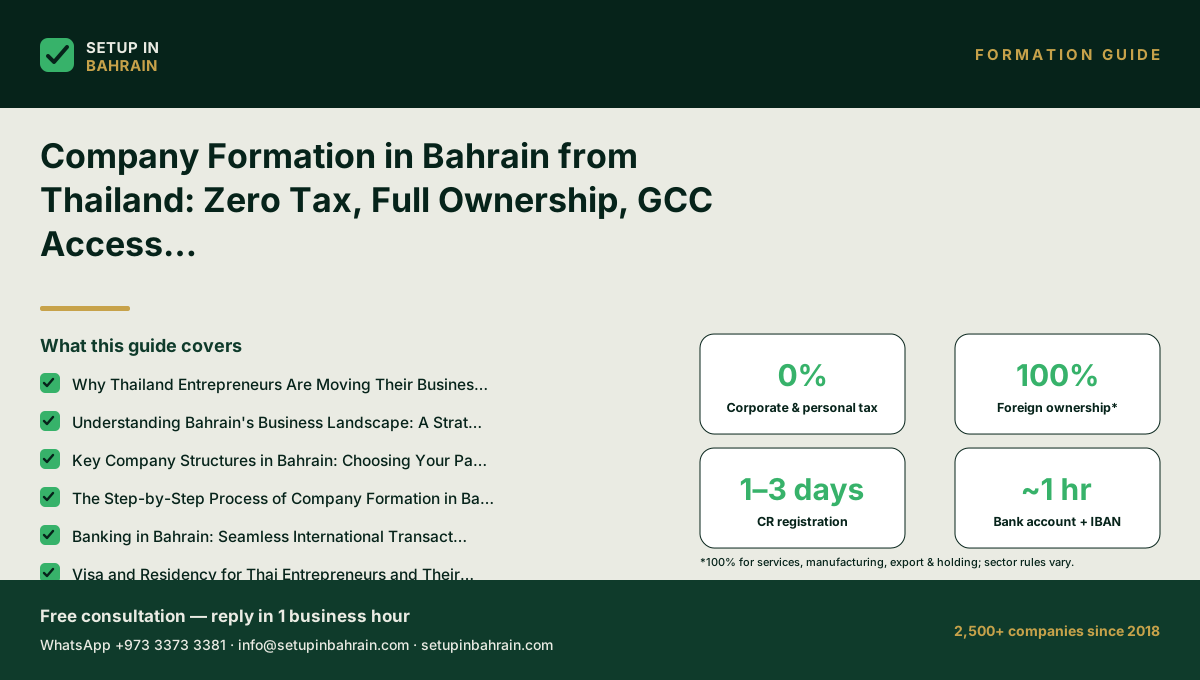
Register your Bahrain company from Thailand with generally no corporate income tax for most sectors. Expert guidance for Thai entrepreneurs seeking tax-efficient Middle East business expansion.
Key Takeaways
- Why Thailand Entrepreneurs Are Moving Their Business to Bahrain
- Understanding Bahrain's Business Landscape: A Strategic Advantage
- Key Company Structures in Bahrain: Choosing Your Path
- The Step-by-Step Process of Company Formation in Bahrain
- Banking in Bahrain: Seamless International Transactions
→ Complete guide: Company Formation in Bahrain — the full 2026 guide
View details
Ownership & capital
A Bahrain WLL can be owned by a single person — 100% foreign ownership applies to most activities, with no local partner required for services, manufacturing, export trading and holding companies. The minimum share capital is BHD 1 ; we recommend BHD 1,000 . This Makes bank account opening and investor visa approval smoother.
For many entrepreneurs in Thailand, the aspiration for business growth often collides with a stark reality: a 20% corporate income tax rate, stringent foreign ownership restrictions under the Alien Business Act, and the constant dance with currency volatility. Imagine a business landscape where these critical hurdles simply vanish. A place where your profits remain entirely yours, your ownership is 100% unfettered. Your operations are supported by a globally stable currency. This isn't a pipe dream; it's the tangible reality of company formation in Bahrain, meticulously designed for ambitious entrepreneurs like you in Thailand.
This comprehensive 2026 guide is crafted specifically for you, the Thai business owner navigating complex local regulations and seeking a clear path to international expansion and financial efficiency. We'll cut through the noise, address your unique pain points. Lay out a precise, step-by-step roadmap to establish your presence in Bahrain – a dynamic gateway to the $1.6 trillion GCC market and beyond.
Why Thailand Entrepreneurs Are Moving Their Business to Bahrain
Let's be candid. You're a founder in Thailand, you’ve built something valuable. You’re looking at your balance sheet, your tax liabilities, and the hoops you jump through every month. Perhaps you’re an e-commerce entrepreneur selling internationally, watching a significant chunk of your hard-earned revenue evaporate into corporate income tax, currently sitting at 20%. Or maybe you run a successful consulting firm, and the complexities of monthly VAT filings and e-withholding tax processes from the Revenue Department consume precious time that could be spent on innovation and client acquisition.
You're not alone in feeling this friction. Many astute Thai business owners are questioning whether their current operational structure truly supports their global ambitions.
Consider the journey of Somchai, a Bangkok-based software exporter. Last year, Somchai watched his company pay 20% corporate income tax on THB 8.4 million in profits. After that, came the Revenue Department’s monthly VAT filings, the mandatory Board of Investment (BOI) renewal paperwork for his promoted activities. The constant threat of the Alien Business Act (ABA) restrictions. The ABA, with its 43 categories, often blocked him from expanding into certain lucrative service sectors without a Thai majority partner – a partnership he wasn’t always keen on for strategic control reasons. The final straw arrived when Bank of Thailand rules on foreign-currency accounts forced him to convert hard-earned USD receivables at unfavorable rates during a sudden THB spike, eroding his international earnings.
Somchai’s story isn't unique. These are the very pain points that compel Thai entrepreneurs to seek greener pastures. He decided to close his Thai entity and, after careful consideration, opened a Bahrain Limited Liability Company (WLL) instead. Within six weeks, the new company was banking in USD-pegged Bahraini Dinars (BHD), operating with 100% foreign ownership. Enjoying a zero-tax environment. He now accesses the entire Gulf Cooperation Council (GCC) market with ease, benefiting from free trade agreements and a business-friendly ecosystem.
Here’s a deeper dive into the specific frustrations driving this migration and how Bahrain offers a compelling alternative:
The Weight of Corporate Income Tax: Thailand’s 20% corporate income tax (for profits over THB 300,000) greatly reduces your net profits. For businesses with international revenue streams, this can feel like a direct penalty on your global success. Bahrain offers a 0% corporate income tax environment, allowing you to reinvest 100% of your profits back into your business or enjoy the full fruits of your labor. This alone can translate into millions of baht in annual savings for successful ventures. The Alien Business Act (ABA) and Ownership Limitations: The ABA is a formidable barrier for foreign entrepreneurs in Thailand. With 43 restricted business categories, securing 100% foreign ownership is often impossible, requiring a Thai majority partner. This often means ceding control, sharing profits, and navigating complex partnership dynamics. In Bahrain, the default for most business activities, especially for a Limited Liability Company (WLL), is 100% foreign ownership. You maintain complete control over your vision and your venture. Bureaucratic Hurdles and Compliance Fatigue: Thai entrepreneurs are intimately familiar with the demands of the Revenue Department – the complexity of e-withholding tax, the detailed monthly VAT filings, and the often-lengthy process of securing and renewing BOI promotional privileges. While essential, these administrative burdens detract from core business activities. Bahrain, while having its own compliance requirements, is widely recognized by the World Bank for its streamlined processes and high ease of doing business, especially for company registration and tax compliance. Currency Volatility and Exchange Rate Risk: The Thai Baht. Generally stable, is subject to global economic shifts and local policies. For businesses with significant international transactions, managing exchange rate fluctuations and adhering to Bank of Thailand’s foreign currency regulations can be a source of constant anxiety and unpredictable costs. Bahrain’s currency, the Bahraini Dinar (BHD), is pegged directly to the US Dollar (USD) at a fixed rate of 1 BHD = 2.659 USD. This offers unparalleled stability, predictability for international trade, and simplified financial planning. Limited Market Access vs. GCC Gateway: While Thailand is a strong market in Southeast Asia, its immediate regional free trade agreements might not compare to the comprehensive access Bahrain offers to the $1.6 trillion GCC market. As a member of the GCC, Bahrain provides a strategic launchpad to Saudi Arabia, UAE, Qatar, Kuwait. Oman, with preferential trade terms and harmonized regulations. This represents a massive consumer base and significant B2B opportunities for expansion.
By choosing Bahrain, you’re not just relocating; you’re strategically positioning your business for exponential growth, financial efficiency. Unparalleled operational freedom.
Understanding Bahrain's Business Landscape: A Strategic Advantage
Bahrain, an archipelago nation in the Arabian Gulf, has meticulously cultivated an environment that fosters business growth, innovation. International trade. It’s not just about tax advantages; it’s a holistic ecosystem designed to attract and support foreign direct investment.
Economic Stability and Strategic Location
Bahrain boasts one of the most diversified economies in the GCC, with a strong focus on financial services, manufacturing, logistics. Technology. Unlike some of its neighbors, Bahrain initiated its economic diversification away from oil decades ago, building robust non-oil sectors that now contribute greatly to its GDP.
Financial Hub: The Central Bank of Bahrain (CBB) supervises a sophisticated and well-regulated financial sector, making Bahrain a regional hub for banking, Islamic finance, insurance, and fintech. For Thai entrepreneurs, this means access to world-class financial infrastructure, secure banking services. A wide array of funding options. Gateway to the GCC: Bahrain's geographic proximity to Saudi Arabia, linked by the 25-kilometer King Fahd Causeway, makes it an ideal logistics and distribution hub for the entire GCC market. Imagine manufacturing in Bahrain and trucking your goods directly to Riyadh, Dammam, or Jeddah within hours, bypassing complex customs procedures often associated with other entry points. The Bahrain Logistics Zone and Khalifa Bin Salman Port offer state-of-the-art facilities for efficient global trade. Open Economy: The World Bank consistently ranks Bahrain highly for its ease of doing business. The Bahrain Economic Development Board (EDB) is actively engaged in attracting foreign investment, offering tailored support and guidance to new entrants. This proactive approach ensures that establishing and operating a business in Bahrain is a streamlined and supportive experience. Stable Currency: As mentioned, the BHD’s peg to the USD provides rock-solid stability, eliminating currency conversion anxieties and simplifying international financial planning for your Thai business.
Taxation: The Zero-Sum Game for Your Profits
This is often the primary draw for many Thai entrepreneurs, and for good reason.
0% Corporate Income Tax: For most business activities, Bahrain imposes no corporate income tax. This means your profits, after operational expenses, remain entirely yours. This is a monumental difference from Thailand’s 20% rate. 0% Personal Income Tax: Not only does your company enjoy a tax-free status. As an individual residing and working in Bahrain, you will also pay 0% personal income tax on your earnings. This greatly increases your personal net income and standard of living. VAT (Value Added Tax): Bahrain introduced VAT in 2019 at a standard rate of 10%. This is an indirect consumption tax, similar to Thailand’s 7% VAT. Is levied on goods and services. Businesses exceeding BHD 37,500 in annual turnover are required to register for VAT and file quarterly returns. While this requires compliance, it's a standard tax globally and doesn't impact your corporate profits directly. No Withholding Tax on Dividends, Interest, or Royalties: Unlike Thailand, where certain payments to foreign entities can be subject to withholding tax, Bahrain generally imposes none on dividends, interest, or royalties paid to non-residents. This makes profit repatriation and intellectual property licensing incredibly efficient.
The financial advantages of Bahrain are not merely marginal; they represent a fundamental shift in how profitable your business can become.
Regulatory Environment: Transparency and Ease of Doing Business
Bahrain's regulatory framework is modern, transparent, and designed to inspire confidence among international investors.
Ministry of Industry and Commerce (MOIC): The MOIC is the primary authority for company registration and commercial licensing. They have digitized many of their services, making the application process faster and more accessible through their "Sijilat" portal. Central Bank of Bahrain (CBB): For regulated financial activities, the CBB provides robust oversight, ensuring integrity and stability. Even if your business isn't directly regulated by the CBB, their overall influence on the financial sector creates a secure environment for banking and transactions. Bahrain Investors Protection Agency (BIPA): BIPA works to protect investor rights and ensure a fair business environment. Company Law (Decree No. 21 of 2001): This law forms the bedrock of company formation in Bahrain, offering clear guidelines for various legal structures, corporate governance. Investor protections. Understanding its provisions is key to ensuring compliance. Data Protection Law (Law No. 30 of 2018): Bahrain has a comprehensive data protection law, aligned with international best practices, giving businesses confidence in handling sensitive information.
The commitment of the Bahraini government to maintaining a business-friendly, transparent, and digitally-enabled regulatory environment is a significant factor in its appeal to entrepreneurs worldwide, including those from Thailand seeking a less convoluted path.
Key Company Structures in Bahrain: Choosing Your Path
Selecting the right legal entity is a foundational decision for your business in Bahrain. The choice depends on your business activities, ownership structure, and future expansion plans. For most Thai entrepreneurs, especially SMEs and startups looking for flexibility and 100% foreign ownership, the Limited Liability Company (WLL) is the overwhelmingly preferred option.
The Limited Liability Company (WLL) – Your Go-To Option
The WLL is the most common and versatile legal structure in Bahrain, perfectly suited for a wide range of commercial activities.
100% Foreign Ownership: This is the paramount advantage for Thai entrepreneurs. A Bahraini WLL can be 100% foreign-owned, with zero local partners required. This contrasts sharply with Thailand's Alien Business Act (ABA). This Often mandates a Thai majority stake (51% or more) in many sectors. You retain complete control of your company, its profits, and its strategic direction. Single Shareholder Permitted: A WLL can be owned by a single individual. You do not* need multiple partners. This flexibility is crucial for sole proprietors or entrepreneurs who prefer to maintain full control without the complexities of co-ownership agreements. There is no such thing as a single-shareholder WLL (Single Person Company) in Bahrain; the WLL structure perfectly accommodates single ownership. Limited Liability: As the name suggests, your personal liability as a shareholder is limited to the amount of your capital contribution. This protects your personal assets from business debts and obligations, offering a crucial layer of security, much like a Thai Company Limited. Minimum Share Capital: Legally, the minimum share capital for a WLL is BHD 1 (Bahraini Dinar One). But, this legal minimum is rarely practical. For entrepreneurs from Thailand, we strongly recommend a practical starting capital of BHD 1,000 . Why BHD 1,000? * Bank Account Approval: Most reputable commercial banks in Bahrain will require a higher initial deposit (typically BHD 500-1,000) to open a corporate bank account. A BHD 1 capital makes it very difficult to secure banking. * Investor Visa: If you plan to apply for an investor or entrepreneur visa to live and work in Bahrain, demonstrating a substantial capital contribution (BHD 1,000 or more) greatly strengthens your application. It signals a serious commitment to the Bahraini economy. * Credibility: A higher capital sum projects greater credibility to suppliers, customers, and potential investors. Permitted Activities: A WLL can engage in most commercial activities, from general trading, consulting, e-commerce. Technology services to manufacturing, real estate, and more. Certain highly regulated sectors (e.g., banking, insurance) might require specific licensing from the CBB and potentially a different company structure. Governance: WLLs are managed by one or more directors. These directors can be of any nationality and do not need to be Bahraini residents initially, though for day-to-day operations and visa sponsorship, a resident director is often practical. Ease of Setup: The registration process for a WLL is relatively straightforward, especially with expert guidance. Can often be completed within a few weeks through the MOIC's Sijilat portal.
For the vast majority of Thai entrepreneurs, the WLL offers the perfect balance of flexibility, full ownership, limited liability. Ease of setup, making it the unequivocally recommended choice.
Branch of a Foreign Company
A branch allows a foreign company to establish a presence in Bahrain without creating a separate legal entity. It operates as an extension of the parent company, which bears full liability for its Bahraini operations.
- Foreign Parent Liability: The foreign parent company is fully liable for all actions and debts of its Bahraini branch. This is a significant difference from a WLL, where liability is limited to the capital.
- No Separate Legal Personality: The branch is not considered a separate legal entity; it's merely a physical presence of the foreign parent.
- Activities: Branches are often suitable for foreign companies undertaking specific projects or wanting a direct representative office in Bahrain.
- Ownership: 100% foreign ownership is allowed.
- Complexity: Establishing a branch can sometimes involve more intricate documents from the parent company, requiring certified and translated corporate documents.
This structure is less common for new entrepreneurs but might be suitable for established Thai corporations looking to expand their existing operations into Bahrain.
Closed Shareholding Company (BSC-C)
A BSC-C is a private joint-stock company with shares not offered to the public.
- Higher Capital Requirement: Typically, a BSC-C requires a much higher minimum share capital (e.g., BHD 25,000 or more), making it less suitable for most startups or SMEs.
- Multiple Shareholders: Requires a single shareholder (one person can own 100%).
- More Complex Governance: Involves a board of directors, general meetings, and stricter compliance requirements.
- Suitability: Best for larger ventures, family businesses with multiple owners, or companies planning future significant capital raises from private investors.
While other structures like partnerships and sole proprietorships exist, the WLL remains the undisputed champion for Thai entrepreneurs seeking the optimal blend of control, flexibility, and limited liability in Bahrain.
The Step-by-Step Process of Company Formation in Bahrain
Establishing your company in Bahrain is a logical and well-defined process. While individual circumstances may vary, here’s a general roadmap to guide you from Thailand to the shores of Bahrain. Remember, partnering with a local expert or a reputable business setup service is highly recommended to navigate the nuances efficiently.
Phase 1: Planning and Preparation
This initial phase is critical for laying a solid foundation for your Bahraini venture.
Define Your Business Activity: Clearly identify the exact nature of your business operations. This will determine the appropriate Commercial Registration (CR) category and any specific licensing requirements. Bahrain has a comprehensive list of activities, and ensuring yours is accurately matched is crucial. For instance, an e-commerce platform selling goods online will have a different CR activity code than a digital marketing agency providing services. Choose Your Company Name: Select three unique company names in order of preference. The name must not be identical or confusingly similar to an existing registered company in Bahrain. This check is done through the MOIC's Sijilat portal. Determine Your Share Capital: While the legal minimum for a WLL is BHD 1, as discussed, BHD 1,000 is the recommended practical minimum for bank account opening and investor visa eligibility. Be prepared to deposit this amount into your company's bank account once it’s established. Identify Shareholders and Directors: Decide who will be the shareholders (owners) and directors (managers) of your WLL. For a WLL, you can have a single shareholder and a single director, who can be the same person and of any nationality. Secure a Registered Office Address: Every company in Bahrain requires a physical registered office address. This can be a leased office space, a co-working space, or a virtual office provided by a business center. Ensure you have a valid tenancy contract or a "No Objection Certificate" (NOC) from the landlord. Gather Required Documents (from Thailand): * Passport Copies: Clear, color copies of all shareholders' and directors' passports. * National ID Card (Thai Citizen ID): Copy of your Thai ID card. * Curriculum Vitae (CV) / Resume: For all shareholders and directors, detailing professional experience. * Bank Reference Letter: From your personal or corporate bank in Thailand, confirming your good standing (sometimes requested. Not always mandatory for WLLs). * Proof of Residential Address: Utility bill or bank statement from Thailand (dated within 3 months). * Power of Attorney (PoA): If you are appointing a local agent or legal representative to act on your behalf during the registration process. This PoA must be notarized in Thailand and then attested by the Ministry of Foreign Affairs in Thailand, followed by attestation at the Embassy of Bahrain in Bangkok. This step is critical if you cannot be physically present.
Phase 2: Registration and Licensing
This is where your company officially takes shape.
Initial Approval and Name Reservation (MOIC): * Submit your chosen company names and proposed business activities to the MOIC via the Sijilat portal. * The MOIC will review your application and reserve an approved name for you. This usually takes 1-2 working days. Drafting of Company Memorandum of Association (MoA) and Articles of Association (AoA): * These are the foundational legal documents outlining your company's purpose, share capital, ownership structure, governance, and operational rules. * An expert legal consultant will draft these in Arabic and English, ensuring compliance with Bahraini Company Law. Submission to MOIC: * All required documents, including the draft MoA/AoA, passport copies, CVs. Proof of office address, are submitted to the MOIC. * If you are not physically present, your appointed PoA holder will complete this. Get Necessary Pre-Approvals (if applicable): Depending on your business activity (e.g., certain financial services, education, healthcare, tourism), you may need pre-approvals from other government ministries or regulatory bodies before* the MOIC grants final approval. For example, a restaurant would need Ministry of Health approval. * Your business setup consultant will advise on these. Notarization of MoA/AoA: * Once MOIC conditionally approves the MoA/AoA, these documents must be signed by all shareholders (or their legal representatives) in the presence of a Public Notary at the Ministry of Justice. Final Commercial Registration (CR) Issuance: * After notarization and any required pre-approvals, the MOIC will issue your official Commercial Registration (CR) certificate. This is your company's official birth certificate. This step usually takes 2-5 working days after notarization. Get General License (MOIC): * With your CR in hand, you will then apply for the general commercial license for your approved activities. This is also processed through Sijilat. VAT Registration (National Bureau for Revenue - NBR): * If your projected annual turnover exceeds BHD 37,500, you must register for VAT with the National Bureau for Revenue (NBR) within 30 days of obtaining your CR.
Phase 3: Post-Registration Compliance
Once your company is officially registered, there are several crucial steps to ensure full operational readiness and ongoing compliance.
Open a Corporate Bank Account: This is a vital step. With your CR and company documents, approach a commercial bank in Bahrain (e.g., NBB, BBK, Al Baraka, HSBC, Standard Chartered). * Deposit Share Capital: You will need to deposit your company's share capital (the recommended BHD 1,000 for a WLL) into this account. The bank will typically require original documents and physical presence of a signatory or a duly appointed representative. * Bank Approval: Banks conduct rigorous due diligence. This Can take 1-4 weeks depending on the bank and the complexity of your business. Having a clear business plan and all personal/corporate documents readily available will expedite this. Get Investor Visa/Residency Permit: * As a Thai entrepreneur, you will likely want to reside in Bahrain to manage your business. You can apply for an investor visa or self-sponsorship visa. * This requires sponsorship by your new Bahraini company. The process involves submitting passport copies, visa application forms, medical checks. Often demonstrating sufficient funds (e.g., through your company's share capital or personal bank statements) and a clean criminal record. * The Bahrain Labour Market Regulatory Authority (LMRA) processes work permits and residency visas. The EDB also offers a "Golden Visa" for long-term residents and investors meeting certain criteria, offering more stability. Labour Market Regulatory Authority (LMRA) Registration: * Your company must register with the LMRA. This is essential for hiring employees, including yourself as a working director or employee. Social Insurance Organization (SIO) Registration: * All companies employing Bahraini citizens must register with the SIO to contribute to their social insurance. Foreign employees are typically covered by their own private insurance or international schemes, though local health insurance is mandatory for all residents. Get CR Copy (Smart Card): * The MOIC issues a smart card version of your CR. This Is convenient for official transactions. Ongoing Compliance: * Annual Renewals: Your CR and business licenses must be renewed annually with the MOIC. * VAT Filings: If VAT registered, you must file quarterly VAT returns with the NBR. * Financial Audits: WLLs typically require annual financial audits if their capital exceeds a certain threshold (currently BHD 20,000). For smaller WLLs, simpler financial statements might suffice. It’s best practice to maintain accurate records and consult with a local accountant.
The entire process, from initial planning to full operational readiness (including bank account and visa), can typically range from 6 to 10 weeks for a straightforward WLL, assuming all documents are in order and no unforeseen complications arise. Patience and proactive engagement are key.
Banking in Bahrain: Seamless International Transactions
One of Bahrain's most significant advantages for Thai entrepreneurs is its sophisticated and globally connected banking sector. The Central Bank of Bahrain (CBB) is renowned for its progressive and robust regulatory framework, ensuring stability and innovation. This directly addresses the pain points Thai businesses face with foreign currency management and bank regulations.
USD-Pegged Currency: As established, the Bahraini Dinar (BHD) is firmly pegged to the US Dollar. This means when your Bahraini company receives payments in USD (common for international e-commerce or services), there’s no conversion risk or loss due to exchange rate fluctuations between the BHD and USD. This contrasts sharply with managing USD receivables in Thailand, where conversion to THB is often mandated and subject to volatility. International Bank Network: Bahrain hosts a vast array of international and local banks, including HSBC, Standard Chartered, Citi. Major GCC banks like National Bank of Bahrain (NBB) and Bank of Bahrain and Kuwait (BBK). This gives you a wide choice, ensuring competitive services, access to multi-currency accounts, trade finance. Online banking platforms that support international transactions with ease. Ease of Fund Repatriation: There are generally no restrictions on the repatriation of capital, profits, or dividends from Bahrain. This freedom to move your money, without the bureaucratic hurdles sometimes encountered in other jurisdictions, is a major draw for Thai investors. Corporate Banking Services: Bahraini banks offer comprehensive corporate banking services tailored for SMEs and larger enterprises: * Multi-currency Accounts: Hold funds in BHD, USD, EUR, GBP, and other major currencies. * Online Banking: Robust and secure platforms for managing accounts, making payments, and tracking transactions globally. * Trade Finance: Letters of credit, guarantees, and other instruments to help international trade. * Forex Services: Though less critical for BHD-USD, full forex services are available for other currency needs. Opening a Corporate Account: The process involves presenting your company's Commercial Registration (CR), Memorandum of Association (MoA), shareholder/director passports. A clear business plan. Due diligence (KYC/AML) is thorough but efficient in Bahrain. As mentioned, a higher initial capital deposit (recommended BHD 1,000) will greatly aid in the bank account approval process compared to the legal minimum of BHD 1. Fintech Innovation: Bahrain is a leader in fintech adoption in the region, with the CBB actively promoting innovation. This means access to modern digital payment solutions, open banking APIs. Emerging financial technologies that can streamline your business operations.
For Thai entrepreneurs dealing with international clients or suppliers, Bahrain's banking system offers a stable, efficient. Transparent environment that greatly reduces financial risk and administrative burden.
Visa and Residency for Thai Entrepreneurs and Their Families
Relocating your business often means relocating yourself and potentially your family. Bahrain offers attractive visa and residency options for entrepreneurs.
Company formation: Standard BHD 1,340 with 3 months of office address; Gold BHD 1,700 with 6 months; Premium BHD 2,150 with 12 months and a cabin, officer table and chair, and two guest chairs. No formation package includes visas, including Premium. Investor/work visas are priced separately: BHD 755 for one year or BHD 953 for two years, in addition to the formation package. Ask for a written, itemized quotation confirming government fees and all inclusions before payment.
Bahrain Business Guides for Thailand Citizens
Frequently Asked Questions
How long does it take to set up?
It takes 15 to 20 days. We file all forms for you. You do not need to wait long.
What does it cost?
Company formation: Standard BHD 1,340 with 3 months of office address; Gold BHD 1,700 with 6 months; Premium BHD 2,150 with 12 months and a cabin, officer table and chair, and two guest chairs. No formation package includes visas, including Premium. Investor/work visas are priced separately: BHD 755 for one year or BHD 953 for two years, in addition to the formation package. Ask for a written, itemized quotation confirming government fees and all inclusions before payment.
Do I need to visit Bahrain?
No. You can set up your firm from home. We do all the work online. Some banks may ask for one visit.
What tax will I pay?
You pay zero tax on your profits. Bahrain has no corporate income tax. This is a key benefit of the setup.
Can I own 100% of my firm?
Yes. Foreign owners can hold all shares. No local partner is needed. Full ownership is allowed.
What do I need to start?
You need a valid passport. You also need a trade name and a business address. We help you with all of these.
How do I open a bank account?
We guide you step by step. Most banks take 3 to 6 weeks. You will need your CR and firm papers.
Who issues the Commercial Registration (CR)?
The CR is issued by the MOICT. It is your legal right to trade in Bahrain. We file the CR for you.
Can I renew my CR each year?
Company renewal packages: BHD 530 with 3 months of office address; BHD 980 with 6 months; BHD 1,520 with 12 months. These are separate renewal packages, not visa fees.
How do I get started?
Fill in our form on this page. Our team will call you back. We map your best setup plan at no cost.
Steps to Form Your Company
- Pick your trade name. We check if it is free.
- Choose your business type. WLL is the most common.
- Sign the MOA. We draft and file all legal docs.
- Pay the state fees. About BHD 432 in total.
- Get your CR. Takes 15 to 20 days.
- Open your bank account. We guide each step.
- Start trading. You are ready to do business.
Key Facts
- Tax rate: 0%
- Foreign ownership: 100%
- Setup time: 15 to 20 days
- Company formation: Standard BHD 1,340 with 3 months of office address; Gold BHD 1,700 with 6 months; Premium BHD 2,150 with 12 months and a cabin, officer table and chair, and two guest chairs. No formation package includes visas, including Premium. Investor/work visas are priced separately: BHD 755 for one year or BHD 953 for two years, in addition to the formation package. Ask for a written, itemized quotation confirming government fees and all inclusions before payment.
- Company renewal packages: BHD 530 with 3 months of office address; BHD 980 with 6 months; BHD 1,520 with 12 months. These are separate renewal packages, not visa fees.
- Client rating: 4.8 stars
- Clients served: 2,500 and more
Quick Facts
- Tax rate: 0%
- Own all of your firm: Yes, 100%
- Time to set up: 15 to 20 days
- Company formation: Standard BHD 1,340 with 3 months of office address; Gold BHD 1,700 with 6 months; Premium BHD 2,150 with 12 months and a cabin, officer table and chair, and two guest chairs. No formation package includes visas, including Premium. Investor/work visas are priced separately: BHD 755 for one year or BHD 953 for two years, in addition to the formation package. Ask for a written, itemized quotation confirming government fees and all inclusions before payment.
- Company renewal packages: BHD 530 with 3 months of office address; BHD 980 with 6 months; BHD 1,520 with 12 months. These are separate renewal packages, not visa fees.
- Rating: 4.8 stars
- Clients: 2,500 and more
Why Bahrain?
Bahrain has no tax. You keep all your profits. This is rare in the Gulf.
You can own all of your firm. No local partner is needed. The law allows full foreign ownership.
Setup takes 15 to 20 days. We file all forms for you. You can do it all from home.
Bahrain has a free trade deal with the US. Your goods face low or no tariffs. This gives you access to big markets.
We have served 2,800+ clients from 44+ countries and maintain records to substantiate that total where needed. We have 113 Google reviews; reviews represent only some clients and are not the same as the total clients served.
Our Steps
- Tell us your plan. We advise you for free.
- We pick the right firm type for you.
- We file all your forms with MOICT.
- You get your CR in 15 to 20 days.
- We help you open a bank account.
- You are ready to trade. We stay with you.
Next Steps for Thailand Citizens
You can set up a firm in Bahrain from Thailand. You do not need to fly there first. We do all the work online.
Tell us your plan. We call you back the same day. We map the best route for you at no cost.
We file all your forms. We deal with MOICT and the state. You get your CR in 15 to 20 days.
After your CR, we help you get a bank account. We also help with your Investor Visa. One firm guides you at each step.
Why Our Clients from Thailand Choose Us
- We speak your language. We know your needs.
- We have helped clients from Thailand before.
- Our fee is clear. No surprise costs.
- We have a 4.8 star rating on Google.
- We have helped more than 2,500 clients set up in Bahrain.
Fill in the form on this page. We will be in touch soon. Let us help you start your Bahrain firm today.
Ready to set up in Bahrain from Thailand?
Tell us your business idea. We map the right entity, ownership and timeline — then handle the filing while you focus on what matters.