
Register your Bahrain company from Tajikistan with generally no corporate income tax for most sectors. Fast setup, full foreign ownership, and easy banking for Tajik entrepreneurs.
Key Takeaways
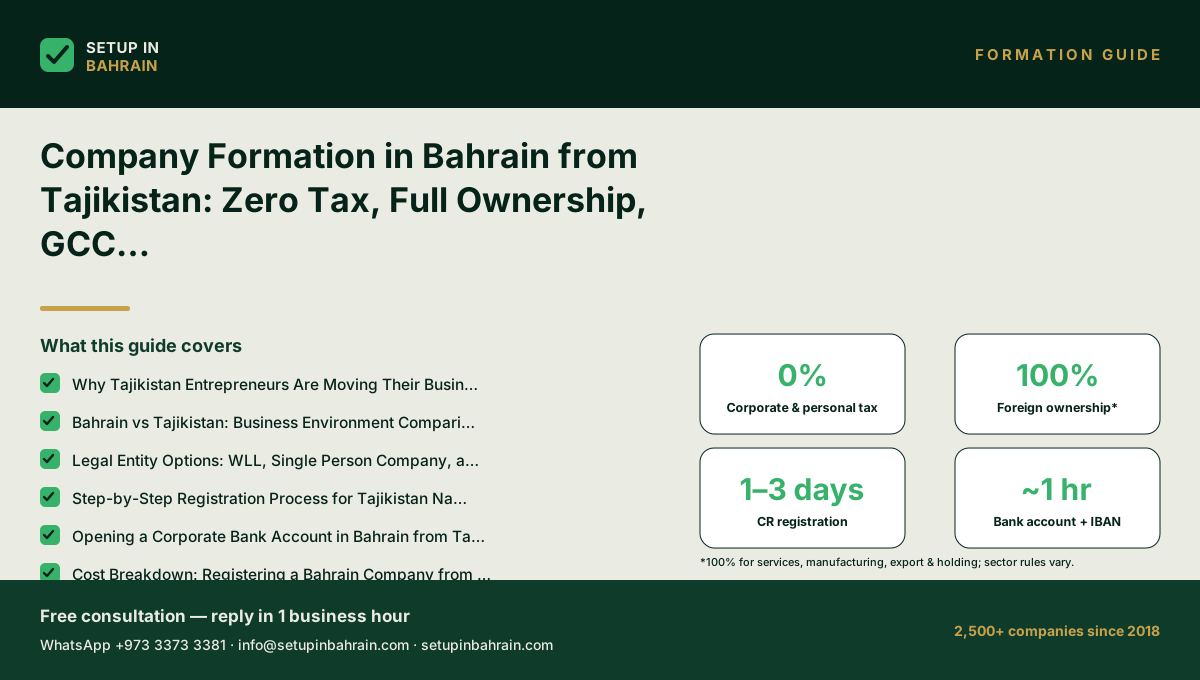
- Why Tajikistan Entrepreneurs Are Moving Their Business to Bahrain
- Bahrain vs Tajikistan: Business Environment Comparison (2026)
- Legal Entity Options: WLL, Single Person Company, and Branch Registration
- Step-by-Step Registration Process for Tajikistan Nationals
- Opening a Corporate Bank Account in Bahrain from Tajikistan
→ Complete guide: Company Formation in Bahrain — the full 2026 guide
View details
Ownership & capital
A Bahrain WLL can be owned by a single person — 100% foreign ownership applies to most activities, with no local partner required for services, manufacturing, export trading and holding companies. The minimum share capital is BHD 1 ; we recommend BHD 1,000 . This Makes bank account opening and investor visa approval smoother.
Rustam runs an IT services company from Dushanbe. In 2024, his operation hit $480,000 in annual revenue — a milestone that should have felt like victory. Instead, it felt like punishment.
After calculating his effective tax burden — the 23% corporate income tax, social security contributions at 25% on payroll. Various local levies — his combined rate reached 34.7%. But the real damage came from currency regulations. The National Bank of Tajikistan forced him to convert 85% of his foreign earnings into somoni at the official rate. This Was running 18% below what he could have received on the parallel market. That single regulation cost him $38,000 in forex value in one year.
Then came January's electricity crisis. Rolling blackouts of six to eight hours daily shut down his development team for eleven consecutive days. He lost a $45,000 contract with a Dubai-based client who couldn't wait for Tajikistan's grid to stabilize.
By March, Rustam wasn't asking whether he should relocate his business. He was asking where.
This guide exists because Rustam's story isn't unique. Every week, we speak with Tajikistan entrepreneurs who've hit the same wall — exceptional effort meeting systemic barriers that no amount of hard work can overcome. They're textile exporters from Khujand watching profits evaporate through forced currency conversion. They're construction materials traders from Dushanbe losing contracts during power cuts. They're logistics operators who've realized that Central Asia's highest corporate tax rate is only the beginning of their challenges.
What they're discovering in Bahrain changes everything they thought they knew about running a business in 2026.
Over the next thirty minutes, this guide will walk you through exactly how Tajikistan entrepreneurs are establishing operations in a jurisdiction with Generally no corporate income tax for most sectors, full foreign ownership rights, and direct access to the $2.2 trillion GCC market. Not theory. Not speculation. The specific steps, real costs, documented timelines, and practical solutions to every obstacle you'll face — from opening your first bank account to managing operations across an 8,500-kilometer distance.
Why Tajikistan Entrepreneurs Are Moving Their Business to Bahrain
The conversation always starts the same way. A founder from Khujand or Dushanbe describes their business — typically trading, logistics, IT services, or remittance-adjacent operations — and asks one question: "Is it actually legal to pay Generally no corporate income tax for most sectors somewhere?"
The answer is yes. Bahrain has maintained a generally no corporate income tax for most sectors for most business activities since its modern commercial code was established. There's no sunset clause, no phase-out period, no hidden catches that appear after year three. The policy is structural, not promotional.
But tax savings alone don't explain the acceleration we've witnessed since 2024. Tajikistan entrepreneurs are relocating to Bahrain because of a specific combination of problems at home that the Gulf state uniquely solves.
The 23% Problem Is Actually a 35% Problem
Tajikistan's headline corporate tax rate — 23% — is already Central Asia's highest. Kazakhstan charges 20%. Uzbekistan recently dropped to 15% for most sectors. Kyrgyzstan sits at 10%.
But the headline rate understates the actual burden. When you add mandatory social fund contributions (25% on payroll), various local taxes. The compliance costs of operating within Tajikistan's regulatory environment, effective rates regularly exceed 35% for profitable operations.
Consider a textile exporter in Khujand generating 1.2 million TJS annually. After corporate tax, social contributions. Typical compliance expenses, the owner retains perhaps 520,000 TJS — under 45% of gross revenue. And that calculation assumes no extraordinary complications, no disputed assessments, no delays in tax refund processing that can stretch eighteen months or longer.
In Bahrain, that same business generally pays no corporate income tax in most sectors. The savings aren't marginal. They're transformational.
The Currency Stranglehold Is Destroying Value
Under NBT Circular 465, businesses receiving foreign currency must convert 85% of those receipts into Tajik somoni at the official exchange rate. This regulation alone costs Tajikistan's export-oriented businesses millions annually.
The mechanism is straightforward but devastating. The official NBT rate consistently trails parallel market rates by 15-20%. When Rustam converts $100,000 in client payments at the official rate, he receives 15-18% less somoni than that money is actually worth. Over a year of substantial foreign earnings, the loss compounds into tens of thousands of dollars — pure wealth destruction mandated by regulation.
The somoni itself compounds the problem. According to IMF data, TJS depreciated an average of 4.2% annually against the dollar between 2019 and 2023. Your retained earnings lose purchasing power simply by existing in the local currency.
Bahrain operates differently. The Bahraini dinar (BHD) has maintained a fixed peg to the US dollar at 0.376 BHD per USD since 1980 — over four decades of currency stability. Your earnings retain their value. Your invoices maintain their purchasing power. Your business planning operates on predictable numbers rather than constant depreciation adjustments.
Infrastructure Failures Cost More Than Taxes
Davlat runs a textile operation in Khujand. His looms require consistent power. During winter 2023-2024, electricity cuts averaged 40-60 hours monthly, sometimes hitting six to eight hours daily during peak shortage periods. Each stoppage doesn't just pause production — it damages equipment, disrupts delivery schedules, and breaks client trust.
Davlat calculated that infrastructure failures cost him roughly 12% of annual revenue in 2024. That's on top of his tax burden, his currency losses, and his compliance expenses.
Bahrain's grid delivers 99.9% reliability. The kingdom invested $3.2 billion in power infrastructure between 2020 and 2024. Rolling blackouts don't exist. Your operations run continuously, your equipment operates within specifications, and your delivery commitments remain achievable.
For Tajikistan entrepreneurs accustomed to treating power cuts as inevitable, Bahrain's infrastructure reliability alone justifies relocation consideration.
МВД-Linked Delays Strangle Growth
Business registration in Tajikistan involves the Ministry of Internal Affairs (МВД) for various verifications and clearances. These processes add weeks or months to company formation, changes in directorship, and ownership transfers. Entrepreneurs report registration delays extending three to six months for procedures that should take days.
The unpredictability is often worse than the duration. You cannot reliably schedule a product launch, a funding round, or a major contract around registration timelines that shift based on factors entirely outside your control.
Bahrain's Sijilat portal — operated by the Ministry of Industry and Commerce (MOIC) — processes standard company registrations in five to seven business days. Not five to seven weeks. Days. The system is digital, the requirements are documented, and the timelines are consistent. When we tell clients their company will be registered by next Thursday, it happens next Thursday.
The GCC Gateway Effect
Perhaps most critically, Tajikistan's geographic position limits market access. Your natural trading partners — Russia, China, neighboring Central Asian states — involve their own currency complications, regulatory unpredictability. Infrastructure challenges.
Bahrain sits at the center of the Gulf Cooperation Council — a $2.2 trillion combined economy comprising Saudi Arabia, UAE, Kuwait, Qatar, Oman. Bahrain itself. A Bahrain-registered company can invoice Saudi clients in dollars, serve UAE markets without additional licensing. Access GCC government contracts reserved for locally-established businesses.
The King Fahd Causeway connects Bahrain directly to Saudi Arabia — the GCC's largest economy at $1.1 trillion GDP. In thirty minutes, you can drive from your Bahrain office to meetings in Saudi's Eastern Province. No flights, no visa complications, no overnight stays.
For Tajikistan entrepreneurs whose growth has been constrained by regional limitations, Bahrain offers market access that transforms business models entirely.
Bahrain vs Tajikistan: Business Environment Comparison (2026)
Understanding exactly how these two environments differ requires specific comparison across every factor that affects your business operations. The following analysis draws on data from the World Bank, Central Bank of Bahrain (CBB), Bahrain Economic Development Board (EDB). IMF country reports.
Corporate Taxation
Tajikistan: 23% corporate income tax — Central Asia's highest rate. Additional local taxes apply depending on region and sector. Social fund contributions add 25% on payroll costs. Effective rates regularly exceed 35% for profitable operations.
Bahrain: generally no corporate income tax for most sectors for most business activities. No capital gains tax. No withholding tax on dividends. The only exception is a 46% rate for oil and gas extraction companies — irrelevant for virtually all foreign entrepreneurs.
Your Savings: On $500,000 annual profit, you retain about $115,000 more in Bahrain than operating the same business in Tajikistan. Over five years, that differential exceeds half a million dollars before considering any compounding from reinvestment.
Currency Stability and Convertibility
Tajikistan: TJS has severely limited international convertibility. Mandatory 85% conversion of foreign receipts under NBT regulations. Annual depreciation averaging 4.2% against USD (2019-2023). Significant spread between official and parallel market rates.
Bahrain: BHD maintains a fixed peg to USD at 0.376 since 1980. Full convertibility. No restrictions on repatriation of profits or capital. No mandatory conversion requirements.
Practical Impact: A $100,000 invoice collected in Tajikistan and converted under NBT rules might yield 15-18% less purchasing power than the same invoice collected in Bahrain. Over years of operation, this differential alone can exceed total setup costs multiple times over.
Company Formation Timeline
Tajikistan: Registration through МВД-linked processes typically requires three to six months for full completion. Document requirements can shift during processing. Extensions are common and difficult to predict.
Bahrain: Standard WLL registration through MOIC's Sijilat portal completes in five to seven business days. Premium processing available for three-day completion. Timeline is consistent and predictable.
Business Impact: In Bahrain, you can incorporate a company, open a bank account. Begin invoicing clients within three weeks. In Tajikistan, the registration process alone might exceed that timeline by months.
Foreign Ownership Rules
Tajikistan: Full foreign ownership is technically permitted in most sectors, but practical implementation involves layers of approval, МВД verification. Relationship dependencies that complicate straightforward setup.
Bahrain: 100% foreign ownership permitted across most sectors since the 2018 Commercial Companies Law reform. No local partner required. No minimum Bahraini shareholding. The law is clear, established, and consistently applied.
Banking Access
Tajikistan: International banking relationships are limited. SWIFT transactions face delays and scrutiny. Dollar account maintenance involves ongoing compliance complications. Major international banks have minimal presence.
Bahrain: Major international banks including HSBC, Standard Chartered, Citibank. Regional leaders like Ahli United Bank operate full-service branches. Multi-currency accounts are standard. SWIFT transactions process same-day for most destinations. Bahrain serves as the GCC's established banking hub with over 400 licensed financial institutions.
Legal System and Dispute Resolution
Tajikistan: Commercial disputes proceed through the Economic Court with proceedings conducted in Russian — not always comfortable for younger Tajik entrepreneurs. Enforcement of judgments can be challenging. International arbitration recognition is limited.
Bahrain: English-language commercial courts operate alongside Arabic-language proceedings. The Bahrain Chamber for Dispute Resolution (BCDR-AAA) provides world-class international arbitration. Foreign judgments are recognized and enforceable. The legal framework follows common law principles familiar to international business.
Infrastructure Reliability
Tajikistan: Electricity supply averages 40-60 hours of outages monthly during winter peak periods. Internet connectivity, while improving, remains inconsistent in industrial areas. Transportation infrastructure limits efficient logistics.
Bahrain: 99.9% electricity reliability. Fiber internet penetration exceeds 95% with average speeds above 100 Mbps. Modern port facilities at Khalifa bin Salman Port. International airport with direct connections to major global destinations.
Comparison Summary Table
| Factor | Tajikistan | Bahrain | Advantage |
| Corporate Tax Rate | 23% | 0% | Bahrain |
| Effective Tax Burden | 35%+ | 0% | Bahrain |
| Currency Stability | 4.2% annual depreciation | Fixed USD peg since 1980 | Bahrain |
| Foreign Currency Rules | 85% mandatory conversion | Full convertibility | Bahrain |
| Company Formation | 3-6 months | 5-7 days | Bahrain |
| Foreign Ownership | Complex approval process | 100% permitted | Bahrain |
| Banking Access | Limited international | Global bank presence | Bahrain |
| Power Reliability | 40-60 hours monthly outages | 99.9% uptime | Bahrain |
| Market Access | Central Asia focused | $2.2T GCC market | Bahrain |
| Legal Proceedings | Russian language | English available | Bahrain |
Legal Entity Options: WLL, Single Person Company, and Branch Registration
Bahrain offers multiple corporate structures suitable for different business models, ownership configurations, and operational requirements. Understanding which entity type matches your specific situation prevents costly restructuring later.
With Limited Liability Company (WLL)
The WLL remains the most popular choice for Tajikistan entrepreneurs establishing Bahrain operations. This structure provides:
Ownership Flexibility: One to fifty shareholders permitted. Since 2018 Commercial Companies Law reforms, 100% foreign ownership is standard for most activities. No Bahraini partner required.
Limited Liability Protection: Shareholders' liability is limited to their capital contribution. Personal assets remain protected from business obligations — a critical consideration for entrepreneurs accustomed to operating in jurisdictions where personal and business liability can blur.
Capital Requirements: Minimum share capital varies by activity but typically starts at BHD 50 (about $133) for service companies. Trading activities may require BHD 20,000 ($53,000) minimum capital, though this is held as company capital, not a government fee.
Management Structure: WLLs require at least one manager who may be a shareholder or external appointment. The manager handles day-to-day operations and legal representation. Foreign nationals can serve as managers without restriction.
Suitable For: Trading operations, consultancy services, IT companies, professional services, manufacturing with Bahrain-based facilities, any business planning to hire employees or maintain physical operations.
single-shareholder WLL
Introduced to accommodate solo entrepreneurs, the WLL structure offers simplified administration while maintaining liability protection.
Sole Ownership: One individual or corporate shareholder owns 100% of the company. No partner negotiations, no shareholder agreements, no board compositions to manage.
Simplified Governance: No requirement for shareholder meetings or board resolutions for routine decisions. The owner maintains complete control over all business decisions.
Capital Requirements: Generally lower than WLL requirements for equivalent activities. Service-based WLLs can launch with minimal capital commitments.
Conversion Path: WLLs can convert to WLLs if you later want to add investors or partners. The structure doesn't lock you into permanent solo ownership.
Suitable For: Solo consultants, freelancers establishing formal invoicing structures, entrepreneurs testing Bahrain operations before scaling, businesses where simple ownership structure provides strategic advantage.
Branch Office
Foreign companies can establish Bahrain branches without creating a separate legal entity. The branch operates as an extension of the parent company.
Legal Status: Not a separate legal entity. The parent company bears full liability for branch operations. This can be advantageous or problematic depending on your existing corporate structure.
Registration Requirements: Requires parent company documents including certificate of incorporation, memorandum of association, board resolution authorizing branch setup. Audited financial statements. More documents-intensive than WLL formation.
Operational Scope: Branch activities must fall within the parent company's authorized activities. You cannot use a branch to enter business lines the parent doesn't already pursue.
Tax Treatment: Branch profits are generally treated the same as WLL profits for Bahrain tax purposes — meaning zero tax for most activities. But, the parent company's home jurisdiction may tax branch income differently than subsidiary dividends.
Suitable For: Established Tajikistan companies wanting to maintain single-entity structure across jurisdictions, businesses where branch treatment provides tax advantages in the home country, operations requiring close integration with parent company systems and processes.
Entity Selection for Common Tajikistan Business Models
Trading Companies: WLL typically optimal. The structure supports multiple shareholders (useful if bringing in partners or investors), provides clear liability separation. Accommodates the documents requirements of import/export operations.
IT Services: WLL depending on scale. Solo developers often start with WLL for simplicity, then convert to WLL when hiring employees or adding co-founders.
Construction Materials: WLL recommended. The capital requirements and contractual obligations in construction typically benefit from the formal governance structure WLLs provide.
Remittance/Financial Services: Special licensing required regardless of entity type. Consult with CBB early in planning process, as financial services fall under additional regulatory frameworks.
Consultancy: WLL for individual consultants, WLL for firms with multiple partners or employees. The choice often depends on planned growth trajectory.
Critical Decision: Operating Company vs. Holding Structure
Some Tajikistan entrepreneurs establish a Bahrain holding company that owns operating subsidiaries in various markets. This structure can provide:
- Centralized treasury management in a stable, convertible currency
- Clean separation between operating risks and accumulated capital
- Efficient structure for future investor entry or exit events
- Simplified dividend flow from multiple operating jurisdictions
But, holding structures add complexity and cost. For most first-time Bahrain incorporations, a straightforward operating WLL provides the right balance of protection and simplicity. Holding structures become relevant when your operation reaches scale that justifies the additional administrative overhead.
Step-by-Step Registration Process for Tajikistan Nationals
The registration process for Tajikistan entrepreneurs follows Bahrain's standard company formation pathway, with specific documents requirements reflecting your home jurisdiction. This section provides the exact steps, expected timelines, and practical guidance for each phase.
Phase 1: Pre-Registration Preparation (1-2 Weeks)
Reserve Your Company Name
Bahrain's MOIC Sijilat portal allows online name reservation. Your proposed name must:
- Be unique (not identical or confusingly similar to existing registrations)
- Not contain restricted terms (bank, insurance, royal, government references)
- Include appropriate suffix (WLL, WLL, etc.)
- Be available in both Arabic and English versions
Name reservation costs BHD 10 (about $27) and holds the name for 30 days while you complete remaining registration steps.
Pro Tip for Tajikistan Entrepreneurs: Choose names that work phonetically in Arabic, English, and Russian. Your company name will appear on contracts, invoices, and communications across multiple language contexts. Names that are difficult to transliterate create ongoing friction.
Gather Personal Documents
Each shareholder and manager must provide:
- Passport copy (valid for minimum 6 months)
- Passport-sized photograph (white background)
- Proof of address (utility bill, bank statement, or official correspondence dated within 3 months)
For Tajikistan nationals, additional verification may be requested given that Tajikistan isn't on standard document verification lists. Apostilled documents from Tajikistan's Ministry of Foreign Affairs accelerate verification.
Prepare Corporate Documents (If Applicable)
If a Tajikistan company will be a shareholder in the Bahrain entity, you'll need:
- Certificate of incorporation (apostilled)
- Memorandum and articles of association (apostilled)
- Board resolution authorizing the Bahrain investment
- Certificate of good standing or equivalent
- Shareholder register
Apostille services in Tajikistan typically require 5-10 business days. Factor this timeline into your planning.
Phase 2: Application Submission (1-3 Days)
Complete Sijilat Application
Bahrain's Sijilat e-portal handles the entire application process online. You'll need to:
- Create an account on the MOIC Sijilat platform
- Select company type (WLL, WLL, Branch)
- Enter proposed company name and alternatives
- Define share capital and ownership percentages
- Specify business activities using Bahrain's standardized activity codes
- Upload required documents
- Pay application fees
Select Business Activities Carefully
Bahrain uses a standardized list of commercial activity codes. Your registration must specify which activities your company will pursue. Some activities require additional approvals:
- General Trading: Straightforward approval
- IT Services: Straightforward approval
- Construction: May require contractor classification
- Financial Services: Requires CBB licensing (separate process)
- Food Services: Requires Ministry of Health approval
- Import/Export: Customs registration required post-incorporation
Select activities broad enough to cover planned operations but specific enough to avoid unnecessary regulatory scrutiny. Our standard recommendation: register for your primary activities initially, then add activities as needed post-incorporation.
Application Fees
Standard MOIC registration fees for a WLL:
- Company registration: BHD 100 ($265)
- Commercial registration: BHD 30 ($80)
- Activity fees: Vary by activity type, typically BHD 10-50 per activity
Total government fees typically range BHD 200-400 ($530-1,060) depending on activities selected.
Phase 3: Processing and Approval (5-7 Business Days)
Once submitted, your application enters MOIC's processing queue. Standard processing:
- Days 1-2: Document verification and completeness check
- Days 3-4: Activity approval and cross-ministry coordination (if required)
- Days 5-7: Final approval and certificate generation
MOIC contacts applicants if additional documents is required. Response delays extend processing time proportionally.
Expedited Processing
For urgent incorporations, Bahrain offers premium processing at additional cost. Three-day completion is achievable for straightforward applications with complete documents.
Phase 4: Post-Incorporation Setup (1-2 Weeks)
Collect Registration Documents
Upon approval, MOIC issues:
- Commercial Registration Certificate (CR)
- Certificate of Incorporation
- Memorandum of Association (stamped and registered)
These documents are essential for all subsequent steps including banking, visa applications, and contract execution.
Register for Municipal and Labor Authorities
Depending on your activities:
- Municipality registration (required for physical premises)
- Labour Market Regulatory Authority (LMRA) registration (required before hiring employees)
- General Organisation for Social Insurance (GOSI) registration (required for employee social contributions)
These registrations typically complete within 3-5 business days each.
Get Physical Registered Address
Every Bahrain company requires a registered address. Options include:
- Leased office space (traditional approach)
- Serviced office arrangements (flexible commitment)
- Virtual office with registered agent (minimum physical presence)
For Tajikistan entrepreneurs testing Bahrain operations, virtual office arrangements starting at BHD 100-200 monthly provide compliant addresses without long-term lease commitments.
Phase 5: Corporate Bank Account Opening (2-4 Weeks)
Banking deserves its own detailed section below, but the timeline typically adds 2-4 weeks to overall setup. Some Tajikistan entrepreneurs begin banking discussions during Phase 3 to run processes in parallel.
Total Timeline Summary
| Phase | Duration | Cumulative |
| Pre-Registration Preparation | 1-2 weeks | 1-2 weeks |
| Application Submission | 1-3 days | 2-3 weeks |
| MOIC Processing | 5-7 business days | 3-4 weeks |
| Post-Incorporation Setup | 1-2 weeks | 4-6 weeks |
| Bank Account Opening | 2-4 weeks | Banking: approximately 1 hour in 99% of our reported cases; our last 100 applications handled in 2026 were approved; subsidiaries or CIS shareholders: 3 days to 2 weeks. Subject to the bank’s final review. |
Opening a Corporate Bank Account in Bahrain from Tajikistan
Banking represents the single most challenging step for Tajikistan nationals establishing Bahrain companies. Not because Bahrain's banking system is restrictive — it's actually one of the most developed in the region — but because Tajikistan's limited international banking integration creates verification challenges that require specific navigation strategies.
Why Banks Require Extra Verification for Tajikistan Applicants
International banks operate under Know Your Customer (KYC) and Anti-Money Laundering (AML) frameworks that assess country-level risk. Tajikistan. Not on any sanctions list, sits in a geographic region that triggers enhanced due diligence at most global banks.
Also, Tajikistan's banking sector has limited correspondent relationships with major international banks. When a Bahrain bank cannot easily verify your existing banking relationships through standard channels, they request additional documents.
This isn't discrimination — it's risk management. The solution is preparation, not frustration.
Bank Options for Tajikistan Entrepreneurs
International Banks with Bahrain Presence
HSBC, Standard Chartered, and Citibank maintain full-service corporate banking in Bahrain. These institutions:
- Offer multi-currency accounts (USD, EUR, GBP, BHD)
- Provide robust online banking platforms
- Enable efficient international transfers via SWIFT
- Apply comprehensive but navigable compliance requirements
Enhanced due diligence timelines for Tajikistan applicants: 4-6 weeks typical.
Regional Banks with GCC Networks
Ahli United Bank, National Bank of Bahrain, and Bank of Bahrain and Kuwait offer:
- Deep GCC correspondent networks
- Competitive foreign exchange rates
- Arabic/English bilingual support
- Often faster processing for first-generation businesses
Enhanced due diligence timelines for Tajikistan applicants: 3-4 weeks typical.
Digital-First Banks
Newer entrants like Meem (by Gulf International Bank) provide:
- Streamlined digital onboarding
- Lower minimum balance requirements
- App-based account management
- Limited branch service needs
Due diligence timelines: Variable, sometimes faster than traditional banks for straightforward applications.
Documents Requirements
Standard corporate account opening requires:
- Commercial Registration Certificate
- Certificate of Incorporation
- Memorandum of Association
- Board resolution authorizing account opening
- Passport copies for all signatories
- Proof of address for all signatories
- Expected transaction volumes and sources
Additional Requirements for Tajikistan Applicants:
Banks typically request supplementary documents including:
- Source of funds documents (inheritance records, business sale documents, employment history with income verification)
- Existing bank statements from Tajikistan accounts (6-12 months)
- Tax residency documents
- Business plan or operational description
- Client contracts or letters of intent demonstrating business legitimacy
- References from existing banking relationships (even if limited)
Practical Banking Strategies
Strategy 1: Start with Regional Banks
Regional banks often have more flexibility in due diligence approaches than global institutions bound by centralized compliance policies. NBB or BBK relationship managers can exercise judgment that HSBC's compliance team cannot.
Open your first account with a regional bank, establish transaction history, then approach international banks for secondary accounts once you have Bahrain banking references.
Strategy 2: Prepare Comprehensive Source of Funds Documents
The most common delay for Tajikistan applicants involves source of funds verification. Banks want to understand where your initial capital originated.
Prepare documents proving:
- Business income (tax returns, client contracts, bank statements)
- Employment income (employment letters, salary records)
- Investment proceeds (brokerage statements, sale documents)
- Family wealth (inheritance documents, gift declarations)
The more comprehensive your documents package, the faster compliance teams can complete their reviews.
Strategy 3: Consider Initial Deposit Strategy
Some banks expedite processing for larger initial deposits. While minimum opening deposits might be BHD 1,000-5,000, accounts opened with BHD 20,000+ often receive priority processing and dedicated relationship manager assignment.
If your capital permits, front-loading your account opening can save weeks of processing time.
Strategy 4: Use Professional Introduction
Banks process applications introduced by established corporate service providers faster than walk-in applications. The provider's relationship with the bank's business development team provides implicit vetting.
This isn't about connections replacing compliance — the same documents requirements apply. But professional introduction ensures your application reaches the right desk and receives appropriate attention.
Expected Timeline and Costs
| Bank Type | Typical Timeline | Account Opening Fees | Monthly Maintenance |
| International (HSBC, StanChart) | 4-6 weeks | BHD 100-500 | BHD 25-75 |
| Regional (NBB, AUB) | 3-4 weeks | BHD 50-200 | BHD 15-50 |
| Digital-First | 2-4 weeks | Often waived | BHD 10-25 |
What If You're Rejected?
Bank rejection happens. It's not personal, and it doesn't prevent you from operating in Bahrain.
If one bank declines your application:
- Request specific feedback on rejection reasons
- Address documents gaps identified
- Apply to alternative institutions with improved package
- Consider engaging banking introduction specialists
Most Tajikistan entrepreneurs who face initial rejection successfully open accounts within 2-3 additional attempts with proper preparation adjustments.
Cost Breakdown: Registering a Bahrain Company from Tajikistan
Transparent cost information prevents surprises that derail planning. The following breakdown covers all expenses involved in establishing and maintaining a Bahrain company, with specific considerations for Tajikistan-based entrepreneurs.
One-Time Registration Costs
Government Fees (MOIC)
- Company name reservation: BHD 10 ($27)
- Company registration certificate: BHD 100 ($265)
- Commercial registration: BHD 30 ($80)
- Activity registration (varies): BHD 30-200 ($80-530)
- Memorandum of Association stamping: BHD 50 ($133)
Subtotal Government Fees: BHD 220-390 ($585-1,035)
Professional Service Fees
Most Tajikistan entrepreneurs engage corporate service providers for registration support. Services include:
- Document preparation and review
- Sijilat portal submission
- Coordination with MOIC during processing
- Collection and delivery of registration documents
- Bank introduction and account opening support
Professional service fees range: BHD 1,500-4,000 ($3,980-10,640)
The range reflects service scope. Basic registration-only services cost less; comprehensive packages including banking, visa support, and ongoing compliance cost more.
Document Preparation (Tajikistan-Specific)
- Apostille services for Tajikistan documents: $100-300
- Document translation (Russian/Tajik to English): $200-500
- Notarization fees: $50-150
Subtotal Document Preparation: $350-950
Total One-Time Setup Costs: $4,900-12,600
Annual Operating Costs
Commercial Registration Renewal
- Annual CR renewal: BHD 30 ($80)
- Company renewal packages: BHD 530 with 3 months of office address; BHD 980 with 6 months; BHD 1,520 with 12 months. These are separate renewal packages, not visa fees.
Registered Address
- Virtual office (basic): BHD 1,200-2,400/year ($3,180-6,360)
- Serviced office (flexible desk): BHD 3,600-7,200/year ($9,540-19,080)
- Dedicated office (small): BHD 6,000-12,000/year ($15,900-31,800)
Accounting and Compliance
- Annual accounting services: BHD 1,000-3,000 ($2,650-7,950)
- VAT registration and filing (if applicable): BHD 500-1,500 ($1,325-3,975)
- Corporate secretarial services: BHD 500-1,500 ($1,325-3,975)
Banking Costs
- Monthly account maintenance: BHD 180-900/year ($480-2,385)
- Transaction fees (variable): BHD 200-1,000/year ($530-2,650)
Total Annual Operating Costs: BHD 3,600-20,000 ($9,540-53,000)
The wide range reflects business scale and operational choices. A solo consultant with virtual office and basic banking operates at the lower end. A trading company with physical warehouse, multiple employees, and active transaction volume operates at the upper end.
Cost Comparison: Bahrain vs. Continuing Tajikistan Operations
For a business generating $500,000 in annual profit, consider the five-year financial comparison:
Continuing Tajikistan Operations:
- Corporate tax (23%): $115,000/year × 5 = $575,000
- Currency conversion losses (estimated 15%): $75,000/year × 5 = $375,000
- Infrastructure disruption costs (estimated 8%): $40,000/year × 5 = $200,000
- Five-Year Total Burden: $1,150,000
Bahrain Operations:
- Setup costs (one-time): $12,600
- Annual operating costs (mid-range): $25,000/year × 5 = $125,000
- Corporate tax: $0
- Five-Year Total Cost: $137,600
Even with conservative assumptions, Bahrain relocation generates over
Bahrain Business Guides for Tajikistan Citizens
Frequently Asked Questions
How long does it take to set up?
It takes 15 to 20 days. We file all forms for you. You do not need to wait long.
What does it cost?
Company formation: Standard BHD 1,340 with 3 months of office address; Gold BHD 1,700 with 6 months; Premium BHD 2,150 with 12 months and a cabin, officer table and chair, and two guest chairs. No formation package includes visas, including Premium. Investor/work visas are priced separately: BHD 755 for one year or BHD 953 for two years, in addition to the formation package. Ask for a written, itemized quotation confirming government fees and all inclusions before payment.
Do I need to visit Bahrain?
No. You can set up your firm from home. We do all the work online. Some banks may ask for one visit.
What tax will I pay?
You pay zero tax on your profits. Bahrain has no corporate income tax. This is a key benefit of the setup.
Can I own 100% of my firm?
Yes. Foreign owners can hold all shares. No local partner is needed. Full ownership is allowed.
What do I need to start?
You need a valid passport. You also need a trade name and a business address. We help you with all of these.
How do I open a bank account?
We guide you step by step. Most banks take 3 to 6 weeks. You will need your CR and firm papers.
Who issues the Commercial Registration (CR)?
The CR is issued by the MOICT. It is your legal right to trade in Bahrain. We file the CR for you.
Can I renew my CR each year?
Company renewal packages: BHD 530 with 3 months of office address; BHD 980 with 6 months; BHD 1,520 with 12 months. These are separate renewal packages, not visa fees.
How do I get started?
Fill in our form on this page. Our team will call you back. We map your best setup plan at no cost.
Steps to Form Your Company
- Pick your trade name. We check if it is free.
- Choose your business type. WLL is the most common.
- Sign the MOA. We draft and file all legal docs.
- Pay the state fees. About BHD 432 in total.
- Get your CR. Takes 15 to 20 days.
- Open your bank account. We guide each step.
- Start trading. You are ready to do business.
Key Facts
- Tax rate: 0%
- Foreign ownership: 100%
- Setup time: 15 to 20 days
- Company formation: Standard BHD 1,340 with 3 months of office address; Gold BHD 1,700 with 6 months; Premium BHD 2,150 with 12 months and a cabin, officer table and chair, and two guest chairs. No formation package includes visas, including Premium. Investor/work visas are priced separately: BHD 755 for one year or BHD 953 for two years, in addition to the formation package. Ask for a written, itemized quotation confirming government fees and all inclusions before payment.
- Company renewal packages: BHD 530 with 3 months of office address; BHD 980 with 6 months; BHD 1,520 with 12 months. These are separate renewal packages, not visa fees.
- Client rating: 4.8 stars
- Clients served: 2,500 and more
Quick Facts
- Tax rate: 0%
- Own all of your firm: Yes, 100%
- Time to set up: 15 to 20 days
- Company formation: Standard BHD 1,340 with 3 months of office address; Gold BHD 1,700 with 6 months; Premium BHD 2,150 with 12 months and a cabin, officer table and chair, and two guest chairs. No formation package includes visas, including Premium. Investor/work visas are priced separately: BHD 755 for one year or BHD 953 for two years, in addition to the formation package. Ask for a written, itemized quotation confirming government fees and all inclusions before payment.
- Company renewal packages: BHD 530 with 3 months of office address; BHD 980 with 6 months; BHD 1,520 with 12 months. These are separate renewal packages, not visa fees.
- Rating: 4.8 stars
- Clients: 2,500 and more
Why Bahrain?
Bahrain has no tax. You keep all your profits. This is rare in the Gulf.
You can own all of your firm. No local partner is needed. The law allows full foreign ownership.
Setup takes 15 to 20 days. We file all forms for you. You can do it all from home.
Bahrain has a free trade deal with the US. Your goods face low or no tariffs. This gives you access to big markets.
We have served 2,800+ clients from 44+ countries and maintain records to substantiate that total where needed. We have 113 Google reviews; reviews represent only some clients and are not the same as the total clients served.
Our Steps
- Tell us your plan. We advise you for free.
- We pick the right firm type for you.
- We file all your forms with MOICT.
- You get your CR in 15 to 20 days.
- We help you open a bank account.
- You are ready to trade. We stay with you.
Why Set Up in Bahrain?
Bahrain is a great place to run a firm. It has no tax. You keep all your profits. This is rare in the Gulf.
You can own your firm 100%. No local partner is needed. The law is clear and fair.
It is fast to set up. You can have a CR in 15 to 20 days. We file all forms for you.
Bahrain has a free trade deal with the US. Your goods face low or no tariffs. This gives you access to big markets.
The banks are good. The roads are good. The schools are good. It is a well-run state.
We have served 2,800+ clients from 44+ countries and maintain records to substantiate that total where needed. We have 113 Google reviews; reviews represent only some clients and are not the same as the total clients served.
Our Services
- Company formation: Standard BHD 1,340 with 3 months of office address; Gold BHD 1,700 with 6 months; Premium BHD 2,150 with 12 months and a cabin, officer table and chair, and two guest chairs. No formation package includes visas, including Premium. Investor/work visas are priced separately: BHD 755 for one year or BHD 953 for two years, in addition to the formation package. Ask for a written, itemized quotation confirming government fees and all inclusions before payment.
- Company renewal packages: BHD 530 with 3 months of office address; BHD 980 with 6 months; BHD 1,520 with 12 months. These are separate renewal packages, not visa fees.
- Investor Visa — from BHD 755
- Work Visa — LMRA managed
- Virtual office — from BHD 600 per year
- Bank account opening — 3 to 6 weeks
- Family visa — for spouse and kids
- UBO filing — as required by law
Bahrain at a Glance
- Tax rate: 0%
- Foreign ownership: 100%
- Setup time: 15 to 20 days
- Free trade deal: Yes, with the US
- Language: Arabic and English
- Currency: Bahraini Dinar (BHD)
- Time zone: UTC+3
- GDP growth: Steady and strong
How to Start
- Fill in the form on this page. It takes 3 minutes.
- We call you back the same day.
- We map the best plan for your firm type and goals.
- We file all forms. We deal with MOICT for you.
- You get your CR in 15 to 20 days.
- We help you open a bank account and get your visa.
- You are ready to trade. We stay with you.
Common Questions
Do I need to visit Bahrain to set up?
No. You can do it all from home. We file online. You may need one visit to open a bank account.
Is Bahrain safe for business?
Yes. Bahrain is a stable state. It has a clear legal system. Your firm and funds are safe here.
Can I hire staff from any country?
Yes. You can hire from any country. Each hire needs a work permit from LMRA. We manage this for you.
What type of firm should I set up?
Most clients choose a WLL. This is a limited liability firm. It is flexible and well-known in Bahrain. We advise you on the best type for your case.
How do I get in touch?
Fill in our form. We call you back the same day. You can also email us or use the chat on this page.
Ready to set up in Bahrain from Tajikistan?
Tell us your business idea. We map the right entity, ownership and timeline — then handle the filing while you focus on what matters.